Loading summary
Transcript272 lines
- [00:01]
Nigel Poor
Nigel.
- [00:01]
Unidentified Speaker
Yes.
- [00:02]
Nigel Poor
I see you over there shopping on quints again. I know you really like their clothes, huh?
- [00:06]
Kat
I do, it's true. And I just bought these really nice lightweight scoop neck tank tops that I'm very excited about taking on my summer
- [00:14]
Earlonne Woods
trip to Spain because you know, it is going to be effing hot there.
- [00:18]
Nigel Poor
Okay, you're going because they just won, huh?
- [00:23]
Earlonne Woods
Exciting.
- [00:23]
Kat
And you know what? They were only $16 each.
- [00:26]
Nigel Poor
Well, yeah. Everything at Quince is priced 50 to 80% less than similar brands. They work directly with ethical fact and cut out the middlemen. So you're paying for quality, not brand markup.
- [00:37]
Kat
And Earlonne, it's not just the clothes. I've actually brought this in to show you because I'm really excited about this new purchase.
- [00:42]
Unidentified Speaker
Let's see.
- [00:45]
Look at this.
- [00:45]
Nigel Poor
Okay. You pulling it out, the quince bag?
- [00:47]
Kat
Yes. This beautiful backpack that I got.
- [00:50]
Nigel Poor
That's nice.
- [00:51]
Earlonne Woods
Don't you like the color?
- [00:52]
Nigel Poor
Yeah.
- [00:53]
Kat
When I bought it, I was like, oh, Earlan's gonna like this color.
- [00:55]
Nigel Poor
It looks like scuba diving material.
- [00:57]
Kat
It's made out of this neoprene, so it's this very cool texture and it's not huge. So it's gonna be more my fancy backpack for commuting and maybe even going out at night.
- [01:08]
Nigel Poor
So that's going to be for your snacks.
- [01:09]
Earlonne Woods
Yeah, I love it.
- [01:10]
Kat
You should get the red one. You can match.
- [01:13]
Nigel Poor
Definitely. From high quality clothing and backpacks to hotel quality bedding and premium cookware, Quint's has got it all.
- [01:21]
Kat
Upgrade your everyday. Download the Quint's app for app exclusive offers or go to quince.com earhustle get free shipping on your orders and 365 day returns. Now available in Canada and the UK too.
- [01:37]
Nigel Poor
That's q-u I n c e.com earhustle and earlonne.
- [01:42]
Kat
Also, the backpack has a little wallet in it.
- [01:44]
Unidentified Speaker
What?
- [01:45]
Alison Stewart
Yep.
- [01:47]
Nigel Poor
You just in love over there.
- [01:51]
Kat
This episode is sponsored by Better Help.
- [01:54]
Nigel Poor
You've heard us talk about Better Help quite a few times, but we haven't talked about how much people love this service when they use it.
- [02:01]
Kat
You can check it out for yourself when you go look@betterhelp.com reviews. You are seeing some of the latest
- [02:08]
Earlonne Woods
reviews that have just come in and
- [02:10]
Kat
Earlonne, I often wonder, like, how old are reviews? You know?
- [02:14]
Nigel Poor
Right.
- [02:15]
Kat
So this gives me confidence to know
- [02:16]
Earlonne Woods
that I'm seeing up to the minute feedback.
- [02:19]
Nigel Poor
More than 6 million people have used BetterHelp globally and the average live therapy session was rated with 4.9 out of 5. Stars. That's based on over 1.7 million reviews.
- [02:31]
Kat
And BetterHelp makes it easy to get started. Answer a few questions, get matched with a therapist based on your needs, and switch therapists at any time if it's
- [02:40]
Earlonne Woods
not the right fit.
- [02:41]
Nigel Poor
See the reviews, see what stands out, and see if BetterHelp is right for you. Visit betterhelp.com earhustle that's BetterH E-L-P.com earhustle
- [02:56]
Pat
I'm Amy Goodman, host of Democracy now. And this episode of Ear Hustle contains language that may not be appropriate for all listeners. Discretion is advised.
- [03:18]
Nigel Poor
What's up, Kat?
- [03:19]
Unidentified Speaker
Hey, Kat.
- [03:19]
Kat
Hey, you guys. How's it going?
- [03:21]
Kelly Wolf
Good.
- [03:22]
Nigel Poor
So we have invited you back into the studio to share something you've been working on for a while, Kat.
- [03:28]
Kat
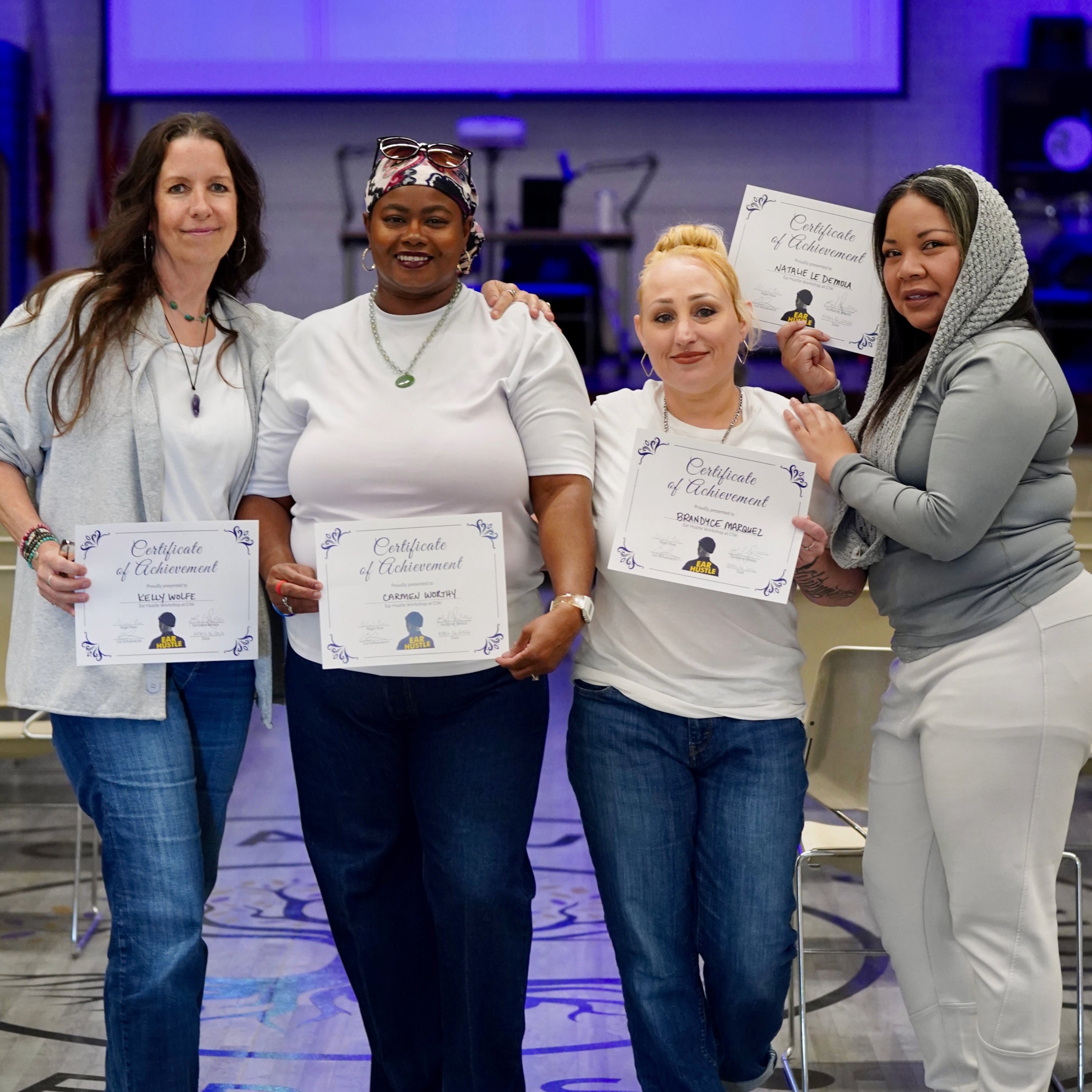
That's right. For the last 10 months, I've been working with a group of women at the California Institution for Women who have been taking part part in an Ear Hustle storytelling workshop. You know, I joined Ear Hustle back in the summer of 2024 to start this program. And this is the first cohort of women who have come through.
- [03:45]
Unidentified Speaker
Right.
- [03:46]
Earlonne Woods
I mean, we've been working earlonne on this idea for how many years?
- [03:49]
Nigel Poor
I don't know. Since I was in jail.
- [03:51]
Earlonne Woods
Oh, my God. So since 2018, we've been like, when are we going to start a program at a women's prison?
- [03:56]
Nigel Poor
Yes.
- [03:57]
Earlonne Woods
Yeah, yeah.
- [03:58]
Nigel Poor
You know, we wanted to do a storytelling project within the women's prison where they learn how to do storytelling, you know, Ear Hustle style.
- [04:06]
Unidentified Speaker
Right.
- [04:06]
Earlonne Woods
All the basics.
- [04:07]
Kat
And to do this, we actually had to build a studio.
- [04:10]
Unidentified Speaker
Right, right.
- [04:11]
Kat
You know, because there was no recording studio there. So we hooked up with another audio training program called Uncuffed, which is a collaboration with the public radio station KALW. And when was it? In the summer of 2024.
- [04:26]
Nigel Poor
2025.
- [04:27]
Kat
2025, exactly. We finally started the program.
- [04:30]
Nigel Poor
Yeah. And Kat, you joined us to kick things off. So she started teach in the program.
- [04:38]
Earlonne Woods
Yeah. Four women.
- [04:39]
Unidentified Speaker
Yep.
- [04:39]
Earlonne Woods
I mean, we are starting small. We're gonna get a little bit bigger, but it's a start.
- [04:43]
Kat
That's right. Yeah, that's right. And we took them through this 10 month long curriculum. We did a ton of stuff. We did interviewing. We did writing for the ear. You know, it's really different than writing for the page. We did story structure, thinking about how to structure a compelling narrative. They wrote scripts and then they actually edited the audio themselves in pro tools. And all of this was leading up to their final Project which was to produce a magazine story like we've done at San Quentin. These are short reported stories about stuff that's going on at the prison.
- [05:13]
Nigel Poor
That's what's up.
- [05:14]
Kat
So today we're gonna hear four stories. The first one is from Natalie Lay d'. Amola, and her story has to do with the new tablets that were recently rolled out at California prisons.
- [05:24]
Yeah, Earlonne.
- [05:24]
Earlonne Woods
I mean, you know this.
- [05:25]
Kat
All the guys inside San Quentin have them too. And the newer ones are pretty slick. They actually look like iPads.
- [05:32]
Nigel Poor
They just like the people on the streets now.
- [05:34]
Kat
Exactly.
- [05:36]
Earlonne Woods
For better or worse, right?
- [05:37]
Kat
That's so true. And there is a pretty big trade off with these new tablets. And that's what Natalie's story is about.
- [05:49]
Natalie Lay Dimola
The sunset is orange. The waves just are crashing and you hear the seagulls. It feels like the seagulls are just roaming around your head. Sunsets going down in front of your eyes. To me, you can't get better than that. And you're in it.
- [06:13]
Narrator/Reporter
This is Cuba. She is describing a video that her friend recorded when she got out of prison of the sun setting over the ocean. Cuba is what we call a long termer. Basically she has a sentence of 10 or more years, but she's not a lifer. And the video that her friend sent her of the sunset is one of the things that's helping her get through her time. She could just hit the play button and free her mind.
- [06:38]
Natalie Lay Dimola
It means more than money, more than a mansion. I usually play it once a week, sometimes a little bit more. If I get down and I sit on the bunk and just close my eyes and envision being at night at the ocean. So it takes you somewhere else emotionally, which is good Sometimes
- [07:05]
Unidentified Speaker
In California prison, everyone gets a free tablet. It's our version of an iPad on the streets where our loved ones could send us videos and pictures like the one that Cuba's friend sent her.
- [07:16]
Narrator/Reporter
But when I talked to Cuba earlier this year, we had just found out that we would be getting new tablets because California was transitioning from an old company to a new company. And the rumor on the yard was that our personal photos and videos might not transition to our new tablets and we might lose them.
- [07:36]
Unidentified Speaker
Memories go away and we're getting older, so my memory's not that good.
- [07:42]
This is Debbie. She has been incarcerated for 21 years.
- [07:46]
Narrator/Reporter
The video that she's afraid of losing
- [07:48]
Unidentified Speaker
is of her 12 year old niece named Mia winning a jiu jitsu tournament.
- [07:56]
She looks excited, hear everybody screaming and laughing and making noises and Everything. She has this look like, I did it, I did it. She walks up to the stage, to the first spot. She looks up to the sky. She lifts up her medals, put her two fingers to her lips, and dedicates this to my daughter, her cousin, because this is the day my daughter passed as well.
- [08:29]
Debbie's daughter Desiree had been killed on the same day nearly 20 years earlier.
- [08:36]
I was in a horrible domestic relationship for five years. I thought that was love. Ultimately, it took my daughter's life. She was five when she died.
- [08:51]
Debbie's niece Mia, never got to meet her cousin Desiree. But Debbie said that Mia started doing
- [08:58]
Narrator/Reporter
jiu jitsu because of her.
- [09:00]
Unidentified Speaker
My brother wanted to make sure that she knew how to protect herself and to make sure that that story never repeated itself and to break that cycle of abuse.
- [09:14]
Narrator/Reporter
And what did it mean for you that you seen in the video her, like, showing a sign, that gesture, that this is for her cousin?
- [09:25]
Unidentified Speaker
They didn't forget about her. When I play this video, I feel joy. I see that my daughter is living through my niece, and it's a moment that I have with her and with my daughter at the same time.
- [09:44]
Narrator/Reporter
If I told you these weren't gonna be transferred and the content was gone forever, how would you feel?
- [09:53]
Unidentified Speaker
Where would I go to help me to overcome a day or just help me pass through that moment? I will not have that. It's gonna be devastating for me.
- [10:08]
Narrator/Reporter
A few months after I talked to Debbie, we still hadn't transitioned to the new tablets. We were just waiting, worrying if we were going to lose our videos and when this actually would happen. Then one day, I remember coming in from work and seeing the new company installing the new equipment. I knew it was real then, that the transition was going to happen and it would be soon.
- [10:30]
Unidentified Speaker
My stomach dropped because I knew that I had my own videos to lose of my father, Dr. Angel Dimola, who died a couple years ago in 2023.
- [10:41]
Narrator/Reporter
When I was growing up, I really didn't talk to my father. And then when I got to prison, he started sending me videos of him saying he loved me. He said all the words that I always wanted to hear.
- [10:53]
Unidentified Speaker
Hello, my daughter, Natalie. I love you. And I am very anxious waiting for the day that we'll be together. Have a happy day and see you later. Bye, sweetie.
- [11:11]
Narrator/Reporter
When my dad passed, being in prison, I couldn't have any of his clothes or any of his memorabilias or items. All I had was these videos of his voice and how he looked. So on the last day before the tablet Switched over. I remember sitting in my room, just playing these videos of my dad over and over again so that I would never forget his voice and that he loved me.
- [11:35]
Unidentified Speaker
Hi, Natalie.
- [11:36]
Nigel Poor
How are you doing?
- [11:36]
Unidentified Speaker
I'm doing pretty well. And I wish you be out of that place pretty soon. Hello, Natalie. I have a dream that for Christmas we're together. Hola, Nathalie. How are you doing, my baby? I'm doing fine. I am just waiting my turn to see the doctor. Happy birthday. I wish you the best and to have many. Happy birthday in the future. Happy birthday, mi amo.
- [12:27]
Narrator/Reporter
The next day, I got my new tablet. When I turned it on, the videos, the pictures, my father's voice, it was all gone. I am so grateful that I recorded the audio for this story. But the image of my father is gone forever. I wasn't the only one that experienced this great loss. Cuba lost a moment of serenity, a moment of peace, a moment just to look back and get out a hard time. Debbie lost a moment that connected her to her daughter and her niece at the same time.
- [13:05]
Unidentified Speaker
And we are just the first prison.
- [13:07]
Narrator/Reporter
Soon the new tablets will be in every prison in the state of California and they will experience the loss that we have.
- [13:15]
Unidentified Speaker
This is Natalie Lay Dimola reporting for the CIW magazine.
- [13:23]
See you later. Bye, sweetie.
- [13:31]
Kat
What do you guys think?
- [13:32]
Nigel Poor
What you think, Nige?
- [13:33]
Earlonne Woods
I loved hearing all the different textures of the interviews and then hearing people's recordings. It took you out of prison, which I thought was really nice. And you could imagine what it did for the people who received those. Yeah, I thought that was really cool.
- [13:48]
Nigel Poor
Yeah. I lost one of my phones the other day, and I was thinking about all the pictures that was on the phone, and I was saying to myself, I didn't back that phone up.
- [13:58]
Earlonne Woods
Well, that's one of the. I love when stories have a connection between inside and outside. So it's something people on the outside can relate to as well. Definitely.
- [14:05]
Nigel Poor
And when I finally found that phone, I uploaded all those pictures onto my computer just in case, so I. I can dig it for, you know, people that's inside, you know, that's losing all these memories because they, you know, probably got a life sentence, been gone a long time, and they get these videos that are very precious to them, you know, And I think the blessing of it all is that you have programs like Ear Hustle. They gave her the opportunity to put her father's voice into the story before that tablet came up missing. So that's dope right there. Yeah, I think overall, I think she did. Cool.
- [14:41]
Kat
Yeah, definitely. I know. I love how newsworthy this story was. I was really impressed by that. And Natalie had a really strong vision for this story from the beginning, and she really, really saw it through. Alrighty. So up next, we have another story. This one is from Kelly Wolf. And Kelly had heard this rumor about a surprising piece of caw's history, and she really wanted to get to the bottom of it. So she brought in some OGs, some ladies who've been incarcerated there since the 70s and 80s, to see what she could find out. Here's Kelly.
- [15:17]
Kelly Wolf
When I first got to the California Institution for Women, I was walking the yard and I saw this cemented outline, and I was curious to what it was. It turned out back in the 1970s, this prison actually had something I never would have dreamed could exist in a prison.
- [15:37]
Nigel Poor
A swimming pool.
- [15:39]
Pat
It was just a place to gather, and the people that were there loved it. My name is Pat. I got to CIW in 1971, and I was a lifeguard at the pool, just as anybody would do at the beach. People, if they were using the pool, were in bathing suits, and they would be in the water or swimming or sunbathing. Everybody was using Bain du Soleil, CN Ski, Coppertone. No one knew there was skin cancer. We were all smoking cigarettes, didn't know there was lung cancer. At that time. There was like roller skates, and they'd bring out a radio and we'd be listening to music, or someone would bring a guitar and sit around. That was a lot of guitar playing at that time. There's a lot of protest songs because we were coming away from the Vietnam War. Everything was on the rise, and the music seemed to sing right with it. A lot of people just sit around with friends, watching the sunset on the water. I love the way the sun always hits the water, the way it sparkles. It's gorgeous.
- [16:47]
Kelly Wolf
In the 80s, the prison decided to drain the pool. What was the mood after it closed?
- [16:54]
Pat
For people that enjoyed swimming, I'm sure they missed it like I did, but most people, it just like everything else, things just started getting shut down. Things just get taken, gone, just like they do now. Nobody does much or nothing. We just adapt.
- [17:13]
Kelly Wolf
When I asked the question, why was the pool closed? I got different answers. One person said, because of aids. Another person said, because of safety and security. And another person said, because there is too much urination in the pool. But even after it was drained, women still hung around the pool as if there was water still in it.
- [17:34]
Linda
Sometimes there'd be so many people in the backyard with our big beach towels that you couldn't see the grass.
- [17:41]
Kelly Wolf
This is Linda. She arrived at CIW in the early 80s.
- [17:45]
Linda
We found other ways to sunbathe and to hose off in the backyard. So there were other ways to. To cool off in, other ways to enjoy ourselves, enjoy one another without the pool actually being filled and used.
- [18:02]
Kelly Wolf
Ruby arrived at CIW around the same time as Linda.
- [18:06]
Ruby
When I came, we did slip and slides in the backyards. We even utilized the clothing bins, and we would all take water from the faucets and we would pour it into these bins, and we would all be in there in the hot spring, laying out in the backyard, laughing, arms and legs everywhere, just like kids, you know.
- [18:25]
Kelly Wolf
Can you describe to me what your bathing suit looked like that you wore?
- [18:29]
Pat
It's just a one piece. And being a lifeguard, that's kind of what you want to. You don't want to worry so much about what you're wearing. If you're jumping in, you don't want to pop out.
- [18:39]
Linda
The bathing suits that I had were what were fashionable at that time. And one of them was a French cut bikini. And when I think back now almost 40 years, like, oh, my goodness, I'm
- [18:50]
Nigel Poor
that, like in here.
- [18:52]
Ruby
I had this great teal green one, and it was a two piece, and it was very small. I was very small then too, because we couldn't always afford stuff to lay out with. We would make our own bikinis with a sewing machine because we were allowed sewing machines back then. We would make full top. It was just like a little triangle with ties around the neck and the back, just like you would have on the streets, just homemade. And people who couldn't afford sunscreen or tanning lotion. We would use butter from the kitchen. And, I mean, we smelled horrific by the end of the day. But, you know, you do what you do.
- [19:30]
Kelly Wolf
So do you remember specifically the last time you got to wear your bikini?
- [19:34]
Ruby
I actually was in Latham. There were probably about maybe 15 of us. We were all out in the backyard, and we had a staff who came out and she told us, take off all those contraband bathing suits and give them to me. And you know, there's no more of this and I want you inside. So it just kind of slowly, you know, melted away like everything else in here.
- [20:03]
Kelly Wolf
Eventually, the prison decided it was time to fill in the pool. They piled a bunch of dirt in there and cemented over it.
- [20:11]
Linda
I remember the day that they came and filled it in. And I do have A recollection of that day feeling very sad, like we were losing something. Even though it was empty, it was still very comforting because it was something very free world.
- [20:27]
Ruby
And I think that's what they took more than anything. They took the normalcy of life. Because in here, there is no normal.
- [20:35]
Pat
This is a place of loss. It hurts, but everything hurts. I mean, I've. You know, I've lost everything here, plus my life, doing time. So it's like it just is just another piece, another brick in the wall
- [20:57]
Kelly Wolf
for the CIW magazine. This is Kelly Wolf.
- [21:04]
Nigel Poor
When I first went to jail, it was in 88. Duke Magin was the governor, right? And as the administrations came in, more shit got took, this got took, that got took. And I'm sure the swimming pool got took. When I was in the youth thought we still had a swimming pool, but I guarantee you that swimming pool gone by now, right? I've never seen them bring shit back, you know what I'm saying? This story definitely reminds me of how over the years, everything gets taken.
- [21:31]
Unidentified Speaker
Right?
- [21:32]
Kat
Kelly really wanted to do a story about the history of ciw, and so I think Kelly did a really good job of, like, narrowing in on this one thing, the pool. We couldn't believe there had been a swimming pool at ciw.
- [21:44]
Unidentified Speaker
I was.
- [21:44]
Kat
I was shocked.
- [21:45]
Unidentified Speaker
I know.
- [21:45]
Earlonne Woods
I remember when Kelly proposed this story, and I was so intrigued that she noticed that architectural detail. And it told me that she's someone who's really observant and looking outside of herself, which I really appreciate. And she did something that we always talk about. She found good mules to carry the story, particularly pat. All of them are super descriptive and bring you right back to the moment of the 70s and 80s. You can see things through their description. Tells me that she's sensitive to how people speak. I also like, and I don't know which speaker it was describing all the different bathing suits. Ruby.
- [22:21]
Kat
Ruby.
- [22:21]
Earlonne Woods
That they're wearing. So you really get a sense of the time. She did a great job.
- [22:25]
Nigel Poor
Indeed. Well, we're going to take a quick break, and then we'll be back with more stories from the California Institution for Women.
- [22:43]
Alison Stewart
On all of it with me, Alison Stewart will talk about art, music, theater, literature, history, food. Well, all of It. Hear in depth, insightful interviews with authors like Zadie Smith, musicians like Steve Earle, actors like Kate Winslet and beyond. You never know who you'll hear next on All of it, but it's always worth listening. That's all of it available wherever you get your podcasts.
- [23:12]
Kat
Listeners do you want even more Ear
- [23:14]
Nigel Poor
Hustle and even fewer ads like zero, zilch, nothing, Nada.
- [23:19]
Kat
If so, subscribe to Ear Hustle Plus.
- [23:22]
Nigel Poor
Ear Hustle plus subscribers get access to ad free episodes and bonus episodes.
- [23:27]
Kat
Our Ear Hustle plus episodes are really fun. Subscribers can find out what's happening with people they've heard on previous episodes, and they can also send in questions for us to answer.
- [23:37]
Nigel Poor
And me and Nigel get to sit here and chop it up with our producer Bruce and just talk about whatever.
- [23:43]
Kat
If you want to hear more of that, subscribe to ear hustle+@earhustlesq.com or directly in Apple Podcasts.
- [23:52]
Nigel Poor
And thanks for supporting the show. We appreciate y'.
- [23:56]
Unidentified Speaker
All.
- [23:57]
Nigel Poor
And send in some provocative questions.
- [23:59]
Kat
Spicy questions.
- [24:14]
All right, well, up next we have a story from China Worthy. And her story is about how it feels when your celly or your bunky in prison rejects you.
- [24:25]
Earlonne Woods
Tough one.
- [24:27]
Unidentified Speaker
Here in prison, one of the things that's guaranteed is shelter somewhere to live, at least on paper. But in reality, that's not always how it works.
- [24:39]
I basically was sitting in the day room for hours trying to figure out where I was gonna go and what I was gonna do. I didn't know the first step to even find a room.
- [24:50]
Take Alison, for example. She's new to prison, what we like to call a first timer. And when she first arrives here, the bunkies she'd been assigned to flat out told her to get lost.
- [25:05]
She came to me, she said, I'm not accepting no bunkies. I'm like, okay, well this is the room they put me in. And she like, well, I'm not accepting no bunkies. She was aggressive. I was aggressive too. Like we both was like a standoff type thing, basically.
- [25:24]
How did you feel in that moment?
- [25:28]
Sad.
- [25:30]
Lonely. Like just a whole lot of mixed emotions.
- [25:37]
In Alison's case, she was able to stay the night after a tense standoff, and they both avoided a write up. Alison's experience is a common one. It happens to a lot of women when they arrive.
- [25:50]
Michelle
I was nervous pulling up sacwfish, like, wow, my heart's beating fast, looking around like, are they gonna accept me?
- [25:59]
Unidentified Speaker
So when Michelle arrived at the Central California Women's Facility in 2021, she knew she would have a hard time blending in. For one, Michelle is really tall and she's got a tough exterior too, but it doesn't match her personality.
- [26:15]
Michelle
If a person get to know me, they'll know I'm just that. You're no giant. I'm not a mean hearted person. At all.
- [26:26]
Unidentified Speaker
So when Michelle got off the bus at ccwf, she, like, gave herself a pep talk.
- [26:31]
Michelle
Hey, just be yourself. Be yourself. Everything will be fine.
- [26:37]
Unidentified Speaker
But as she walked into the unit, she was greeted with these words, the man is here.
- [26:42]
Michelle
And that just, like, took me back for a minute. Like, no, the woman is here.
- [26:48]
Unidentified Speaker
Michelle is one of the first trans women in California to be transferred from a men's prison to a women's prison. In fact, Michelle says she helped write the Senate bill, SB132, that made transfers like hers possible.
- [27:03]
Michelle
SB132 was intended for safe housing of trans women where they can program, not have to worry about looking over their shoulder.
- [27:12]
Unidentified Speaker
That's why Michelle wanted to come to ccwf, to find safe housing. But for a while, she couldn't find anywhere to live. No one would take her in.
- [27:22]
Michelle
I went to maybe four different rooms before I was accepted into a room. Just bouncing from room to room, room to room.
- [27:31]
Unidentified Speaker
So the first four rooms that you landed in off the bat ejected you?
- [27:37]
Michelle
I didn't even land in them.
- [27:38]
Pat
Hmm.
- [27:39]
Michelle
Just refusals.
- [27:41]
Unidentified Speaker
Michelle could understand why some women might fear living with her. It's the same fear she had when she was in the men's prison.
- [27:51]
Michelle
So a lot of women's fears is being raped, but the women don't know that my fears is they fears.
- [28:04]
Unidentified Speaker
In 2022, Michelle transferred here to California's smaller women's prison, the California Institution for women. She says on her first day in her new housing unit, she met some women playing cards. They said, hey, you want to play?
- [28:21]
Michelle
Like, I was part of the family. And I sit there that first night playing spades and people getting to know me, and it was fun. It was absolutely fun.
- [28:33]
Unidentified Speaker
Even though she feels more at home here, Michelle still hasn't had to find a roommate. For now, she lives alone. For the CIW magazine. This is Chyna worthy.
- [28:48]
Nigel Poor
Okay. So, Nigel, how did you think about Chyna's story?
- [28:53]
Earlonne Woods
Well, I really like her voice. She has a very pleasing voice to listen to. And I like how she opened it, that everyone's guaranteed shelter and somewhere to live. And so it just. It opens in an intriguing way when all of a sudden, you hear that. What? That isn't even guaranteed in prison.
- [29:09]
Unidentified Speaker
Mm.
- [29:09]
Nigel Poor
I was put in that situation when I was in San Quentin. I was in one cell. I got moved out of that cell for some reason, and they moved me to this other dude's cell on the first tier, and dude was like, I ain't supposed to have no celly, you know, and da, da, da, da. And. And then I kept telling him, hey, your problem with them, not me. I'm coming where they say go. So if you got a problem, take that problem up with them. I'm finna move my shit in here. You go take that shit up with them. You know what I'm saying? But it. Do people get this? This is mine. You know what I'm saying? They get that shit.
- [29:46]
Unidentified Speaker
Yeah.
- [29:47]
Earlonne Woods
I would say she took on a huge subject. It's ambitious for how, I don't know, like a three minute story or four minute story. So that would be my question about this one. I think it's really well done, but there's a lot that doesn't get explored. So I would like to know, what does the administration do in this situation. Was there anyone coming to Michelle's help or she had to figure this out on her own. Were there any other, like, women who were helping her? So that's. I'd be curious. I would say this is a super ambitious story and that's great that she took on such a tough topic.
- [30:17]
Nigel Poor
She did cool.
- [30:18]
Natalie Lay Dimola
She did cool.
- [30:19]
Nigel Poor
She got a cool little topic.
- [30:23]
Kat
And finally, to close things out, we have a story from Bea Marquez. And I know we did an Ear Hustle episode last season about letters that listeners wrote into the show. Well, this one is also about letters that Bea and some of her friends really look forward to writing and to receiving.
- [30:44]
Bea Marquez
How does it make you feel when you get a love letter?
- [30:50]
Unidentified Speaker
It makes me feel great. It makes me feel good. It makes me feel loved. It makes me feel missed.
- [30:56]
Bea Marquez
Hi, my name's Bea. And recently I asked some women I know here at ciw, China, Jackpot and Amber just how they feel about love letters.
- [31:05]
Unidentified Speaker
You can say on a letter, which you can't say out loud sometimes because
- [31:10]
I can say it without being scared of being judged. I don't know, it's just like how I can communicate best is through writing.
- [31:16]
They can add spice to a relationship. If you're in a relationship, you know, you're able to be free and goofy and quirky and if you're into that kind of stuff, it can lead to role playing perhaps.
- [31:30]
Bea Marquez
Tell me about your honey.
- [31:31]
Unidentified Speaker
It's unlike any relationship I've ever been in. And it's comfort. Like I don't feel insecure in it. It's just like nothing else.
- [31:38]
Bea Marquez
Say you got a love letter from your honey today. How would it make you feel?
- [31:43]
Unidentified Speaker
It would just be so exciting to open it, to read it. The thought that's put into it there's something about a letter, opening it, getting it, seeing these words, the smell that's on the letter, like. Like if you have a grandma that smokes, right? That that smell reminds you of her, right? But, like, when you get the letter, because she could have been smoking that cigarette and you get a visual, like, she was probably smoking the cigarette or it was somewhere in the living room where she smokes. And that smell gives you nostalgia.
- [32:11]
I smelled the letter. I hugged the letter. I kissed the letter. Before I even opened the letter, I
- [32:15]
was like, oh, my God.
- [32:16]
You wrote me.
- [32:16]
I love it.
- [32:17]
Bea Marquez
I thought it was gonna smell like love. What does love smell like?
- [32:22]
Unidentified Speaker
I don't know, but I can taste it damn near.
- [32:24]
Bea Marquez
What does it taste? I would like you to pretend you're writing him a letter right now. Basically say it out loud. Like, I don't know if you would start as Dear Nick.
- [32:39]
Unidentified Speaker
No, I write love bug. I actually start every one of my letters with love bug. I would put I love you, daddy. You're the best. Plus, I might say something nasty. I don't know.
- [32:48]
Shit.
- [32:48]
This is the best it's gonna get for right now.
- [32:51]
Okay, So I have this thing where I do Alphabet, and whatever the letter of the Alphabet is, is what I want to do that day.
- [33:01]
Bea Marquez
What's your favorite letter of the Alphabet?
- [33:03]
Pat
F. What does F stand for?
- [33:06]
Unidentified Speaker
Can't say it on air.
- [33:11]
Bea Marquez
Thinking about your honey right now. If you were to write like, dear honey, blah, blah, blah, blah, blah, what would it say?
- [33:20]
Unidentified Speaker
I guess it would say that I think I'm gonna struggle with you leaving, but I need her to have faith in me. I'm gonna cry.
- [33:31]
Bea Marquez
How would you end it?
- [33:32]
Unidentified Speaker
P S. Just hold on. I'm coming home. I'll be home.
- [33:39]
Bea Marquez
My name's BEA, I'm at CIW and I have a 25 year sentence. I have the last love letter that I wrote to my man. I didn't get to send it to him because he passed away on September 6th. And I was going through my things and I recently found even has my lips on it. So I kissed the corner of the paper with my brown lipstick. And it's written in English, Spanish and Nahua, front to back. Luciano. Hola, mi amorencito. In English, I said, hi, my love, my handsome papi chulo, my soulmate. I love you very much. I can't wait to make you dance with me. You're going to dance with me. I don't care what you say. I can't wait to burn sage with you, to sweat with you to climb the pyramids together. I can't wait. I will meet you tonight in our dreams, like we do every night. Good night, mi amor. I love you, papi. My forever love. Siempre tuya porvida tu novia. You know, in my culture, when someone dies, we cut our hair and we sacrifice it to the fire to help them go on their way. And we put a glass of water and a snack for them next to our window seal so they can come. And while they're figuring out and not being lost, they have something there. Well, I kept that glass of water on my window sill for a month. And you're not supposed to do that, but I wanted. I was being selfish, but I finally like, let him. Let him, let him go, you know? But he still comes. I still feel him. I have a journal that I write to. I write to him like once a month, basically. And it's kind of like helps me grieve, rest in peace and power. Luciano Chano Rivera. Mi hermoso, amorencito. This is Bea for the CIW magazine.
- [36:02]
Earlonne Woods
I liked how poppy it was. Very snappy, very lighthearted.
- [36:07]
Kat
I was curious that the.
- [36:08]
Earlonne Woods
I know at the top they say the names, but then you don't know who's speaking. So they all kind of blend together, which I think is fine. But I was wondering if that was a conscious decision to not really identify people and let them all just sort of be like women getting letters.
- [36:20]
Unidentified Speaker
Yeah.
- [36:21]
Kat
I think that was the idea to create sort of a tapestry. Yeah.
- [36:24]
Nigel Poor
You know, letters probably prior to the tablets.
- [36:30]
Kat
Yeah.
- [36:30]
Nigel Poor
Was the thing. Yeah. You know what I'm saying? Like. Like letters was sometimes your only communication. You know, you have a whole process that you get your mind into when you get. Receive a letter. You know, whether it's sitting down, if you used to smoke cigarettes, rolling a cigarette to smoke, making a shot of coffee to drink. It's just a whole like little stuff ceremony you might have. Being home. I couldn't write a letter probably if my life depended on it. I think maybe it's like a prison thing for me, you know, which is sad, you know?
- [37:00]
Kelly Wolf
No, I think.
- [37:01]
Earlonne Woods
But I think most people outside are too lazy to write letters now because everyone wants a text.
- [37:05]
Unidentified Speaker
Yeah.
- [37:06]
Earlonne Woods
Or a voice memo.
- [37:07]
Nigel Poor
Yeah. So it's good to hear about letters. Bea did good. That was a nice story from old Bea Cat, you know. Definitely. Thanks for working with these women. Get they skills set up to par. We gonna miss you. I know they gonna miss you. So we definitely appreciate your contribution to the program in ciw.
- [37:28]
Kat
Thank you. Thank you. That means so much to me. It was truly, truly my pleasure. And I want to give a big shout out to Natalie, Kelly, China, and Bea for all the hard work they put into these stories. And if you guys are listening, which I hope you are, you should all be really, really proud.
- [37:43]
Michelle
Yeah.
- [37:44]
Earlonne Woods
And we are actually getting ready to
- [37:45]
Kat
launch the next workshop at ciw, which is incredible.
- [37:49]
Unidentified Speaker
Yeah.
- [37:49]
Kat
We're handing the program over to the wonderful Ashley Ann Krigbaum. And pretty soon she and Earlonne are gonna start interviewing women for our next cohort.
- [37:57]
Nigel Poor
Yeah, you know, that's on my calendar to go down there and start our interview process. And I'm hoping that this last class kicked up enough dust to where it's gonna be a lot of women to want to apply. Yeah. Yeah.
- [38:09]
Unidentified Speaker
It'd be great.
- [38:10]
Nigel Poor
Yeah.
- [38:10]
Earlonne Woods
Thanks, Kat.
- [38:11]
Kat
That was great.
- [38:11]
Earlonne Woods
Real fun to do together.
- [38:12]
Kat
Thanks, you guys.
- [38:15]
Nigel Poor
Music for this episode is by David Josse, Antwan Williams, Darrell Siddiq Davis, and me. Thanks to Acton Warden Padilla, Associate Warden Lewis, and Pio Avena at the California Institution for Women for supporting our work at ciw.
- [38:31]
Earlonne Woods
Hi, my name is Lieutenant Avena. I'm the public Information officer at the California Institution for Women and I approve this episode. And if you want to learn more about our storytelling workshop at California Institution for Women, you can read all about it on our website.
- [38:45]
Kat
It's earhustlesq.com workshop CIW, a/dinner-fancy, fancy.
- [38:56]
Earlonne Woods
And also we've got a bunch of plans in the works to expand our education educational efforts.
- [39:01]
Kat
And the place to follow that is
- [39:02]
Earlonne Woods
in our newsletter, the Lowdown, which is
- [39:04]
Kat
where we talk about all the cool
- [39:06]
Earlonne Woods
stuff that Ear Hustle is up to.
- [39:08]
Nigel Poor
Yeah. So if you haven't subscribed to our newsletter, the Lowdown, please do. Because not only do you know, we talk about our episodes, we talk about all the cool stuff that Ear Hustle do outside of making an episode.
- [39:19]
Earlonne Woods
Exactly.
- [39:20]
Kat
Ear Hustle is a proud member of Radiotopia from prx, a network of independent,
- [39:25]
Earlonne Woods
creator owned, listener supported podcasts.
- [39:28]
Nigel Poor
Discover audio with vision at Radiotopia fm.
- [39:31]
Kat
I'm Nigel Poor.
- [39:33]
Nigel Poor
I'm Earlonne Woods. Thanks for listening. Radiotopia
- [39:48]
Earlonne Woods
from prx.