Loading summary
Transcript440 lines
- [00:01]
A
Well, Nige, we finished our big tour. We were on the road performing in 10 cities and three prisons across the south and the Midwest. And I know you were wearing your Quince clothes for a lot of that trip. How did they hold up?
- [00:13]
B
You know what? I'm actually wearing a pair now. Yep, I love my quints. I was wearing those cargo taper pants throughout most of the tour and obviously they held up because I'm still wearing them.
- [00:23]
A
Yeah, it was hot.
- [00:26]
B
Oh, it was hot. And that rainy weather, it was challenging. But you know what? I always look good because I was in my quints.
- [00:32]
A
Indeed.
- [00:32]
B
And now that we're back in the Bay Area where things are a lot cooler, I'm starting to think about the fall. Quince has lots of essential clothing for the fall, like 100% Mongolian cashmere from $50 washable silk tops and skirts and perfectly tailored denim all at prices that feel too good to be true.
- [00:50]
A
Yeah, I mean, I'm checking out their wood coats. Oh, yes, and they look designer level, but like at a fraction of the price. And the quality looks good.
- [00:57]
B
By partnering directly with ethical top tier factories and cutting out the middlemen, Quint's delivers lux quality pieces at half the price of similar brands.
- [01:07]
A
Keep it classic and cozy this fall with long lasting staples from quints. Go to quints.comearhustle for free shipping on your order and 365 day returns. That's Q-U-I-N-C-E.com earhustle to get free shipping and 365 day returns.
- [01:24]
B
Quince.com earhustle.
- [01:31]
A
Ear hustle is brought to you by Progressive Insurance.
- [01:34]
B
Do you ever find yourself playing the budgeting game? Well, with the name your price tool from Progressive, you can find options that fit your budget and potentially lower your bills.
- [01:45]
A
Try it@progressive.com Progressive Casualty Insurance Company and affiliates pricing coverage match limited by state law. Not available in all states. Nigel.
- [01:58]
B
Mm.
- [01:59]
A
It is so good to be sleeping back in my own bed due to back problems.
- [02:07]
B
Well, I was happy to get home, but honestly, Earlonne, and I hope Rick doesn't hear this. I could be on the road forever. I loved it.
- [02:14]
A
Why wouldn't Rick hear this? To any listener that don't know, we just got back from a three week tour across the south and the Midwest and 10 cities and three prisons. It was, what would I say? Epic.
- [02:27]
B
Amazing.
- [02:28]
A
Pretty epic. And I'm gonna say a big success.
- [02:31]
B
It really was Earlonne. It was a blast. And there is so much to celebrate about what we all did together.
- [02:36]
A
Yes. We got to kick it with listeners.
- [02:38]
B
Yes. I love that.
- [02:39]
A
We got to hang out and the best get advice and tell jokes and.
- [02:43]
B
See so many cities and the countryside and places that are so different in California.
- [02:47]
A
And a lot of corn.
- [02:49]
B
You are obsessed with that damn corn. Oh, my God.
- [02:54]
A
Yes, I'm obsessed. But it was such a success that I'm gonna spill the beans on something.
- [03:01]
B
Oh, yes, please do.
- [03:02]
A
We're going to be taking this new show back on the road early next year.
- [03:07]
B
Yes. A mini tour of cities and prisons on the West Coast.
- [03:11]
A
And at each stop, we're gonna do one of each, right?
- [03:13]
B
Mm.
- [03:14]
A
One show for incarcerated people in local prisons and. And one show for the public.
- [03:19]
B
Exactly. And we're still nailing down the details, so stay tuned. We'll have those on our website soon.
- [03:25]
A
But in the meantime, we're going to share something with y' all that we've never shared before.
- [03:29]
B
Yes. This is a recording of the first live tour we did back in 2023.
- [03:34]
A
Right. And what we're sharing with y' all today is a recording from our performance at the Lodge Room in Los Angeles. And guess what? Nyjah.
- [03:41]
B
What's that? My favorite.
- [03:42]
A
That was my favorite. Why? Because my mama was there, my friends was there, and my mom did the listener alert shout out.
- [03:48]
B
Ma. I love revisiting this night. It was amazing. And it almost makes me feel like we're back on the road again.
- [03:55]
A
Yes. Yes. I'm Earlonne Woods.
- [03:58]
B
I'm Nigel Poor. And this is ear hustle from PRX's Radiotopia.
- [04:10]
A
My granny, y'. All okay, Ms. Grood. My name is Alice woods.
- [04:18]
B
And I'm Earlonne's mother.
- [04:28]
A
This episode of Ear Hustle contains language and content that may not be suitable for all listeners. Discretion is advised. When I was young, I was good at using words that I didn't know the meaning of. Like, one day, I told my neighbor I'd wash his car for charity. And when I finished washing his car, I waited for him to come out and pay me. Here's another word I didn't know back then. Good Samaritan. I want you to picture a nine year old child when I tell you this story. So one day, I went swimming at Roosevelt park in my neighborhood on the east side of Los Angeles. I wasn't a great swimmer, but I had fun doing cannonballs, because for some reason, that was the only move I knew. And I had a fear of diving in the pool head first. Walking home from the pool, I passed a train crossing, but there was a Problem. The gates were down and the cars were lining up, unable to cross. I could see a mile in both directions, but there was no train. Obviously, the gates were broken, so I decided to help out. I lifted the gates myself. Cars were starting to pass by when I noticed one of them pulled over. It was a black and white police car. The officer said, put your hands on the car. I was nine, but I understood that command clearly. I put both of my hands on the car and they searched me. All I had on my clothes were some vans, some swimming trunks, and a T shirt. They placed me in handcuffs and put me in the back of the patrol car. I thought for sure they were playing. I was a kid. I'd never been arrested. So when they got in the car and they went to take off, I was like, nah, they not playing. I was in the backseat in handcuffs, in tears. I probably was thinking more, you know, about the ass whooping I was gonna get. When I got to the station, they put me in a holding room with nothing but a bench. After about 30 minutes, I started knocking on the door because I had to use the bathroom, but no one came out for me. I didn't want to pee on the ground in the corner, so I took off one of my van shoes and I peed in it. I pretty much filled it up. I let it sit there for a second, and then I put it back on my foot. I don't know why I did that. I was just scared. Eventually, someone came and told me that I could make a phone call. The only number I knew by heart was my Auntie Donzel's number. So that's where they took me. The next morning, my father came and got me, and I knew it was finna be all bad. The first thing he said to me when I got in his Cadillac was, you know I'm a beat your ass, right? Not what happened, or, tell me your side, Jess. I'm a beat your ass. I started crying immediately. Was this going to be the infamous whooping of your life that the black community talks so much about? Or would that be the whooping I'd get two years later when I crashed this very Cadillac in court? A few months later, the cops claimed that I had been charging cars a dollar to cross. I was like, I ain't even have no money on me. What you mean? They could have just said, hey, kid, what you're doing is dangerous, and I would have never done it again. But instead, they put a narrative on it, and by doing that, they put me in the system. That was my first introduction to the police, and that's what I learned early on about being a Good Samaritan.
- [09:15]
B
I make a lot of phone calls from the San Quentin parking lot. Not a place I ever expected to spend much time. But these days I spend a lot of time not just in the parking lot, but in the prison itself. Sometimes in the morning, I sit in my car and I look at the specular light on the water and ponder the passengers moving by on the commuter ferry. I've heard they can at times make out the voices of the guys on the yard. Unidentifiable voices drifting over the water. Hard to believe it's possible, but I guess voices do carry over the bay. The parking lot is the way station between the inside and the out. Correctional officers park there, and so do prison administrators, staff, volunteers, and people going in to visit their fathers, sons, boyfriends, and family inside. It's a place where all those who go inside merge and sometimes leave behind evidence of their time in prison. I have a personal habit of collecting things people leave behind, and the San Quentin parking lot has become my hunting ground. A place full of intriguing, left behind bits and pieces that have helped me learn more about life inside. A crushed tube of red lipstick. Used tea bags. Flattened spool of string. Underwire from a bra. Saran wrap braided into a chain. Folded piece of paper covered with mathematical notations. Underwires from a bra. One green glove. TB test ruler. An exploded ballpoint pen. A tiny spiral bound notebook wadded up and soaked by water. Underwires from a bra. CO2 cartridge. Child's plastic spoon. A list of musicians and songs. Underwires from a bra. When I found the first underwire, I thought it was a curious anomaly. The second one was like, okay, that's weird. And by the third one, I realized there was something I wasn't getting. It took me some time to put it together, but I learned the underwires are pulled out of the bras of women who visit their family members or friends inside. They can't have metal on, so when they get there to the parking lot, if they've worn the wrong kind of bra, they have to pull the wire out before going in. Every time I pick one up, I think about this person out in the parking lot struggling to cut into her bra and fish out a wire. In my mind, they're flung to the ground in frustration. Every crushed, crumpled, and discarded object I find out in the parking lot has an origin story. It's likely most of the stories I tell myself about the Objects I find are wrong. But the underwire one, I think that one's true. You can find a worthy story anywhere. It just requires being interested in what is around you, listening and being attentive. It's so freaking hard to make it cry in here.
- [13:17]
A
It's prison.
- [13:18]
B
We gotta turn that fan off. Hey, do you think it's quiet enough?
- [13:20]
A
It's gonna get hot. Nope, never is.
- [13:23]
B
It's never freaking quiet enough in here, man.
- [13:25]
A
Never quiet. It's prison place. All right, everybody, we gonna need some quiet. Hey, Jazzy.
- [13:30]
B
All right, we're recording.
- [13:31]
A
Hey, hey, hey. Can we get about 10 minutes so we can get this line out? No problem, man. Hey, good looking out. Over.
- [13:37]
B
Hear that? Thank you.
- [13:38]
A
Hear what?
- [13:38]
B
It's finally quiet in here.
- [13:40]
A
Okay, let's do it. Hey, E. What's up, Nigel?
- [13:54]
B
Should we introduce ourselves?
- [13:56]
A
Can't hurt. I'm Earlonne Woods.
- [14:04]
B
I'm Nigel Poor, and this is Earha from PRX's Radiotopia, the live show.
- [14:24]
A
That face indeed. Who car is that? What's up, Los Angeles? My hometown.
- [14:38]
B
It is very exciting to be here, Earlonne. We're still warming up. This is just our second stop on our live tour.
- [14:45]
A
That it is. We are celebrating our 100th episode.
- [14:49]
B
Oh, yeah. Yeah. Which is coming up next week. And we have a hell of a lot of work to do.
- [14:58]
A
Definitely.
- [14:59]
B
Yeah.
- [15:00]
A
But tonight we're going to do what we always do, which is take people inside prison. Yes.
- [15:06]
B
We're going to hear some of our favorite moments from the last 100 episodes. Moments that really pushed us to think in different ways about what your hustle could be.
- [15:15]
A
We got some music. We got some special performances, and we.
- [15:19]
B
Want to celebrate with you, the listeners, because you are a big part of making what we do happen. And we're so thrilled to be here. I got a tiny glimpse of the audience because the lights were up a little bit. I can't see now, but I can't believe how many people are here. It's so nice.
- [15:36]
A
Thank you.
- [15:38]
B
And wait a minute. And there's people that are standing. I'm so sorry.
- [15:45]
A
So, Nige.
- [15:45]
B
Yes.
- [15:46]
A
Where are we at?
- [15:47]
B
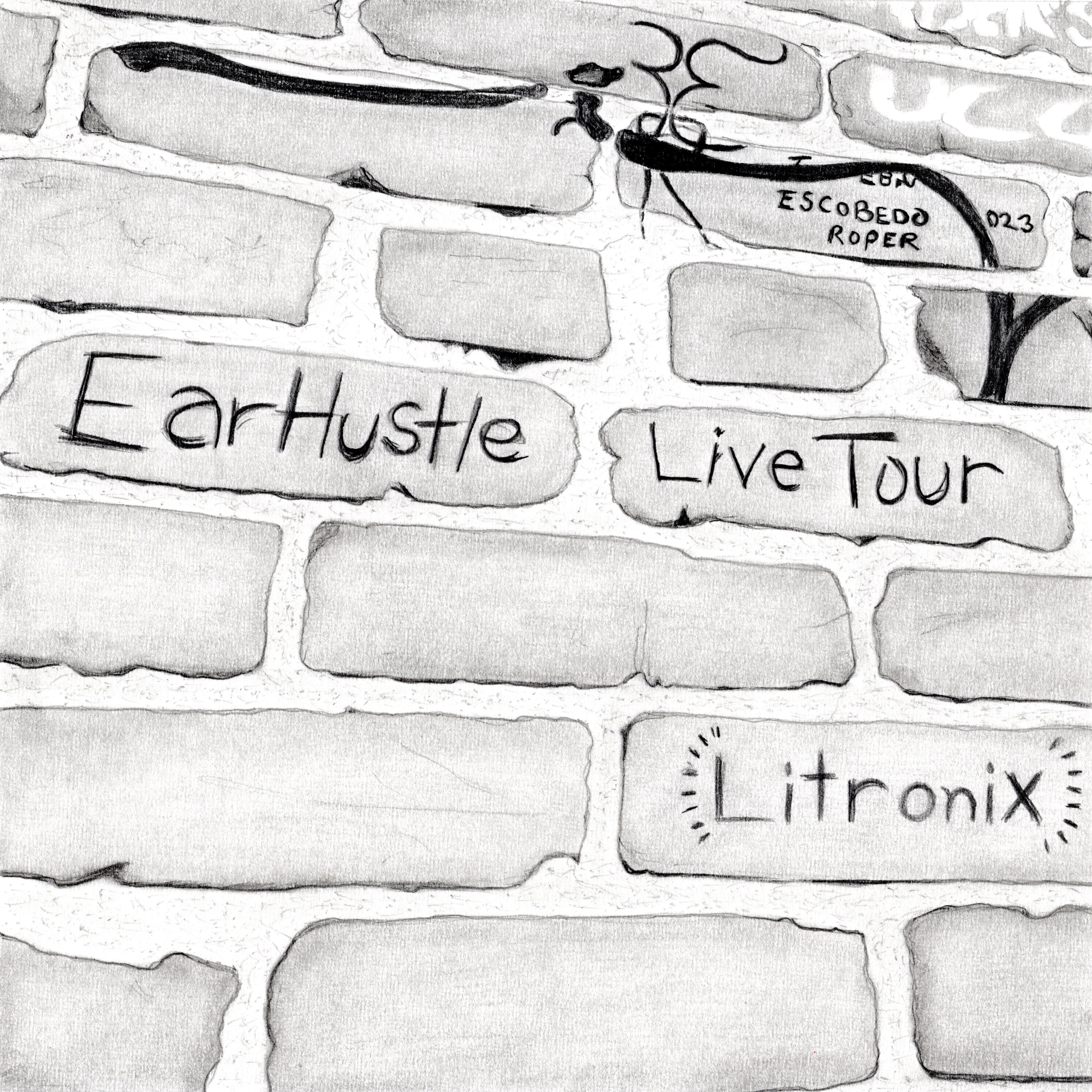
Okay, so we wanted to attempt to reproduce what it looks like inside San Quentin, where we record. And this is what our wall looks like. And we call it a media lab, which I have to say is a little bit generous, maybe.
- [16:03]
A
Well, I mean, you know, it's not much, but it is more than a lot of prisons in California have.
- [16:09]
B
It's true. And I remember when we started working on the podcast People would say to us, how are you going to do an ongoing podcast series Inside Prison? You are going to run out of stories really quickly and really strange. And as you're laughing, it surprised me too. Because even the simplest question Inside Prison, you can get some of the most surprising, sometimes very difficult, and sometimes absolutely delightful answers.
- [16:39]
A
True. All you gotta do is go out to the yard, ask a question, and I guarantee you gonna get some good shit. We did go to the yard and asked some guys, what type of animals would they be? If I could be any animal, I'd be a penguin. They're super cute. And tuxedos and they're like the coolest animals ever.
- [17:03]
C
And they slap box like crazy, too.
- [17:04]
D
I wouldn't want to be a panther. And the reason why is I like the sleekness of the animal.
- [17:10]
A
Dog because I know that someone would adopt me.
- [17:13]
E
The Galapagos turtle, because they live to be over 150 years old.
- [17:18]
A
Lion, because it's king. Marmot, because they're misunderstood. Everybody thinks they're weasels and they're not. They're marmots. I want to be a water bottle.
- [17:27]
E
Because it's diligent and because it says very little.
- [17:31]
A
It would be an eagle because they can fly. So that means I would always be free.
- [17:37]
C
I would always be safe.
- [17:39]
E
Tiger.
- [17:39]
B
Cause tigers love their independence.
- [17:42]
A
A jellyfish, because it has no natural enemies.
- [17:50]
B
So I remember when I asked you what kind of animal you'd want to be, you said a beluga whale. It was so random and charming and delightful and that's earlonne to a T.
- [18:06]
A
I mean, it just sounded cool, that's all.
- [18:09]
B
I knew that's exactly what you said.
- [18:11]
A
Speaking of animals, we want to start this next clip off with one of our earliest episodes. It's a story about a guy we know as San Quentin named Roach.
- [18:27]
B
And just in case you don't know, that's R A U C H. You're closing your eyes. I know. I'm a horrible speller. R O A C H. Are you impressed? I'm getting my spelling out.
- [18:38]
A
You did that. You closed your eyes, though.
- [18:40]
B
I gotta see it in my mind's eye.
- [18:42]
A
So every prison. You probably seen it in the movies. Every prison has like a birdman, somebody that takes in pigeons. They walk on the shoulders. They shit on they shoulders. You know what I'm saying? Roach is like that, but he's like that with critters, you know, he takes care of any critter he can find on the yard.
- [19:01]
C
Since I've been in prison, I've had black widows, tarantulas, a lot of grasshoppers, beetles.
- [19:08]
A
At San Quentin, inmates aren't allowed to have pets. But some guys get creative, like Roach here.
- [19:15]
C
Gophers, rabbits. I had four swallows. I toad, praying mantis, 21, snails, frog, red breasted finch. His arm broke.
- [19:23]
A
Pigeons.
- [19:24]
C
I had a desert mole that was partially paralyzed. Tapir hamster. Just really lazy with an attitude. The centipede. And it was a wolf. It was a bad little monster. I had two fish that had babies. Twice I had a tarantula. Broke out one time, my celly said, yo, Spider got out.
- [19:46]
B
I've heard that clip so many times, and it surprises me every time I hear it. I love the way he describes the different animals. And I keep wondering what a teddy bear hamster looks like. It sounds so damn cute, but it has a little attitude. So whenever I walk into San Quentin, or often when I walk into San Quentin, I'll see Roach sitting at the top of the yard, cross legged, no shoes on, using his toes to hold his pencils and pens. And then the oddest thing is that he's often eating an onion as if it were an apple.
- [20:21]
A
I mean, it was obvious that we needed to bring Roach down there to interview him. So this next clips come from the same episode. Looking out from season one.
- [20:31]
B
So how would you describe him?
- [20:33]
A
To me, I think Roach looked like the original Jesus Christ. You know, I bet he got the dreadlocks. He look like he's from the earth. And if he could, he'd probably just be wearing a leaf. And he got this one little thing that he do, he'll just start sniffing on his dreadlocks.
- [20:52]
B
I know, I've seen him do that. He grabs his hair and he pulls it in front of his nose and just sniffs.
- [20:57]
A
Why you whisper?
- [20:59]
B
Because I feel like I'm talking about him behind his back. He knows he does it, right? Yeah, it's not like he's gonna hear this and go, oh my God, I sniffed my hair.
- [21:08]
A
Hey, he'll catch himself. You just be looking at him. He like, huh.
- [21:13]
C
FYI, I do smell my dreads. I put different oil on each one of them. They smell good. They smell like I just came out the dirt hanging out with roots and stuff.
- [21:24]
A
But you know what though? When people from the outside look at Roach, they be like, oh, dude, weird, man. I ain't talking to dude. But Roach is a cool dude.
- [21:35]
C
My name is Renell Draper, but I go by Roach. My relationship with people is pretty strained. I don't trust them from early on they have been a source of pain for me.
- [21:47]
B
So roach is about 40 years old, and he's a pretty shy guy until, you know him.
- [21:55]
C
When I was a child, before I was removed from the care of my mom's custody, she tried to drown me a couple times in the tub. And then she stopped and she left the bathroom, and she was crying. I knew she was unhappy or sad at some. I did. I wanted to actually comfort her, but I didn't know how to do it. I don't remember her face, and I haven't seen her since.
- [22:27]
B
A lot of things come to mind when I think about that clip, but I always note how it really established our roles on the show. So you as the inside host, me as the outside host, and that allowed each of us to bring our own perspectives, experiences, and, to me, most importantly, our curiosities to the work that we do together.
- [22:46]
A
Right. I think after we edited this episode, we knew exactly what we wanted the show to sound like.
- [22:53]
B
Yeah. I mean, one thing we wanted to make sure was that we always had mixed emotions. So you would be laughing and then sort of shocked and sometimes really emotionally defeated by what you hear, and then just surprises, always surprises coming at you.
- [23:10]
A
And we knew what we didn't want the show to sound like. Like, you know, in every prison documentary, they got the camera to go in and out on the barbed wire. Shit like that.
- [23:20]
B
Yes, exactly. And so we wanted to think, like, what's the podcast equivalent? And we decided that it's the sound of, like, a gate slamming or keys jingling. And we also knew that we didn't want to do stories about crime or violence or stories that were just about how the criminal justice system functioned. But on the other end of the spectrum, we didn't want to do redemption stories where people come in bad and all of a sudden they're good because they've seen the light. Because real people are weirder than that and way more interesting, both in prison and out. So we're not trying to turn people into villains or heroes. We want complex stories and complex people.
- [24:02]
A
You are a sucker for that. Nice.
- [24:03]
B
Yes, I am.
- [24:08]
A
A good example of this type of character is a guy named Artwork. My San Quentin partners down there and Artwork used to to be at San Quentin. And I remember he used to carry around these two little puppets that he made, and they both had different voices. He used to talk with them, and they had their own voices. They had their own personalities.
- [24:34]
B
Yes. And if he was in a good mood, those puppets were fun to be around. And when he wasn't in a good mood.
- [24:43]
A
Yeah, that's artwork.
- [24:47]
E
I got, like, a Hate corner and a Love corner, you know? Well, the love corner is the picture of the people that write you. And I would put my affirmations up on the wall, you know, I would have places in the world that I wanted to visit. You know, I'd have real healthy stuff going on. You know, in the Hate corner, I had a list of names, the people I wanted to take revenge on. I had different ideas on how to get back at him. I had pictures of things that I would use to get back at him. I used to get real specific. I used to be like, man, I hope her son come home late today and lie and be telling her he did his homework and shit. He gonna disappoint the fuck out of her ass. I hope somebody steal her mail, too, and she don't get her insurance stuff, man, and fuck around. And the fire hit, you know, Nobody hates you like a dude in jail. Then the list got too long. I had to knock motherfuckers off the list, you know, like, you lucky, I'm gonna be busy. Be busy whooping his ass, you know what I'm saying? So. And see, you know, when I came to realize in the Hate Corner that everybody don't deserve to be hurt, you know, some people, you just scratch the car up or something. You ain't got to penalize everybody with a rock upside to hit, you know what I mean? The Love corner was like an escape, and the Hate corner was motivation.
- [26:21]
B
Yeah. Wow. And so, Earlonne, do you agree that no one hates you like a dude in prison?
- [26:32]
A
Well, you know, when you're in prison, you got time to harbor resentments, you know what I'm saying? You know, people being there like, you ain't send me no money for 20 years. You ain't send me a letter. You ain't do none of that. You ain't send me a package. So, yeah, a lot of guys in prison hold grudges.
- [26:48]
B
Well, I think about that, but I also think about when I see artwork's clip and him using that hate wall in Love Wall. It's sort of a creative, I don't know, expression of dealing with difficult emotional and physical situations.
- [27:03]
A
Right. I mean, there's a lot of that in prison. Guys make art to deal with what's going on with them, you know? And we're about to meet one of these guys tonight.
- [27:13]
B
Yes, sir.
- [27:20]
A
No lie.
- [27:23]
B
So this. This guy used to come down to the media lab in San Quentin with his guitar and that was interesting to me. But he also always had these notebooks with. And these composition books that were so. They were like bursting with ideas. I swear he would write this way on the paper and that way on the paper. And when I peeked inside of them one day, it was like I couldn't even read them. They were in some kind of secret artist language, like Da Vinci or something. Mad scrawl. They were really beautiful.
- [27:54]
A
And not only is Maserati's music and message, though, you've been hearing him for years on our episodes because it's part of our soundtrack.
- [28:03]
B
Yes, absolutely. So, listeners, here's Maserati. E.
- [28:15]
D
L A.
- [28:15]
A
What's up? What's up? What's going on?
- [28:19]
D
Y' all ready to break the mold? One more time? Let's make some noise from Ear Hustle.
- [28:24]
B
One more time.
- [28:25]
A
We breaking a mold.
- [28:26]
D
100 episodes is lit. Let's get it. I'm so far from perfect yeah, yeah no lie yeah I know I am so far from perfect But I know I can speak for more than one person When I say I am so tired of hurting we could change the world forever if we come together we can break the mo oh yeah we can break them all no lie, yeah we can break the mold we can break the mold we could change the world forever if we come together we can break the mold Mentally constipated shit on my mind but can't come out Surrounded by cats and real Some fake observing way to make them out who's who really ain't got a clue man thinking dude cool man kicking it like Liu Kang Til you see a few things you see on two lanes like J go to 2 Chainz, NAS time 2 Chainz 2 part of your crewmate or do the big crew thing that's the Method man no Wu Tang dudes too loose like shoes and no shoestrings Try to lace but they burn like butane when you introduce flames to the equation Try not to give up on my people and be patient but the reality of the situation Large part of the population can't save them hopefully they see the truth the reason that I care so much Cause I've been through so much Trying to spare the young from the things I done and thinking dumb and the scene of guns and drugs in the slums to where you from to where I'm from it's all the same thing just in different ways it's all the same pain Just a different place same conclusion Just a different pace so I'm trying to break the mold I'm trying to take control of the mind of the masses Won't stop till the death get here Be loud and clearly and the blind see it happen and that's deeper than rapping I speak out of passion no lie Please fear me we are victims of that Willie lynch letter but if we come together so much better we will be I know I am so far from perfect But I know I could speak for more than one person when I say I am so tired of hurting we could change the world forever if we come together we can break them oh yeah we can break the mold no lie yeah we can break the mold we can break the mold we could change the world forever if we come together we can break the mold Product in my environment at least that's what we was told and you don't plan for retirement when you program the blowgrounds to sell dope to the day that you gone Brass west so cold when you gotta call home A place where you grow Thinking hope was a joke and everybody broke Thinking that's how it go for somebody like me Just another young brother in the streets where you gotta see the beauty and the beast Cause the weed can't eat but we can't leave but how can we stay free when they lock us in prison when we been in prison the blacks when no equal opportunity Go for jobs with protection will come from a Glock when will it stop? Some will say never but you never know till you make that endeavor no lie ties to the lies must be 7 so wide try to get a world of perception so fly that you fly away To a higher place when you was told you couldn't reach it Open your eyes today if you alive today we can break the mold into peace all around the globe we could break the mold it's in our control you gotta let go it's frivolous whoa do better to show do you something better Instead of rapping them of they innocence and that's deeper than rapping I speak out of passion no lie Please fear me we are victims of that Willie lynch letter but if we come together so much better we will be I know I am so far from perfect But I know I can speak for more than one person When I say I am so tired of hurting we could change the world forever if we come together we can break the mo yeah we can break the mold no lie yeah we can break the mold we can break the mold we could change the world forever if we come together we can break the mold.
- [33:10]
A
Thanks Maserati. E And also thanks to the Jets Trust for supporting the show and these live performances. Thank you.
- [33:24]
B
That was amazing.
- [33:25]
A
He's always.
- [33:26]
B
Yeah. Okay, so to set up the next story, one of the things we did when we started the podcast was we got a post office box because we wanted a way to be able to interact with listeners. And it had to be a post office box because we wanted listeners to have the same experience of guys at Inside, which meant that you'd have to get a stamp, you'd have to write a letter, put it in a mailbox, slow down communication, have no idea if anyone was ever going to write back, and we had no idea how much mail we were going to get.
- [34:01]
A
That's a prisoner's dream right there.
- [34:07]
B
So just to clarify, this is the photo after I started archiving all of the mail into binders and earlonne. You know, I love to organize. Yes. So this was a real joy for me. There's about 20. Yeah, there's about 25 of these binders. It's really incredible. But before I started organizing them, they were all just in this big mail bin. I mean, hundreds and hundreds, hundreds of letters and postcards just all piled in there.
- [34:34]
A
So this next clip that we're about to hear actually came out of one of these letters.
- [34:38]
B
Yes, that's right. So in 2018, we were getting ready for our second.
- [34:43]
A
Right. And the episode that we were working on was about being a parent from prison.
- [34:47]
B
And one night, after being at San Quentin all day, I came home and I was so tired, but for some reason, I reached into that mail bin just randomly, and I pulled out this specific letter, and I was stunned. Stunned.
- [35:04]
A
So the next day, you brought this letter into San Quentin and asked one of the guys that we were interviewing, a guy named John Newman who had kids of his own outside. We asked him to read it.
- [35:14]
B
Yes. And we didn't let him read it before. We just turned on the mic, asked him to take it out and read.
- [35:22]
F
Okay, this is a letter, it looks like from a youngster named Jalen. It says, my name is Jaylen. My dad is in prison. I'm nine and a half years old. I really like listening to your podcast. My dad does not write me a lot. Now can I get him to write me more? Please, please write back. Thanks, Jaylen. Psych. Can you share this or one of your podcasts, please?
- [36:10]
A
So reading that, like, what do you get? Like, what is your advice to him?
- [36:14]
F
Oh, man, I've got tears in my eyes and something in my throat right now. Jalen, if you're listening in now. My heart goes out to you, little one. I don't know what is in your dad's heart. Wherever he is in this system, there are a lot of pressures on him. Please don't stop. Please. Your letter says that he does not write to you a lot. So that's telling me that he does write you some. So the caring is there. Dig deep into that little heart and soul of yours and try to find the best words you can to let your dad know how important staying in contact with him is to you, how much you love the letters that you do get, how much you get out of them. And when you write him back, tell him about yourself. The fact that he doesn't.
- [37:22]
G
Right.
- [37:22]
F
You may mean a little bit that he's not quite confident about what he can put into words, but don't let that stop you from what you try to put into words. If words are all. If letters are all that you have, write the best letters that you can as often as you can. And I betcha. I really, really betcha that they'll have an effect. And that even if your dad doesn't think that he's a great letter writer, even if he doesn't think that he has something important to say, I bet you your letters are going to make him think again, make him understand how important whatever he has to say is in your life. What a great letter, Jalen. Keep it up, please.
- [38:12]
A
Please. There go Maserati sound in the episode right there.
- [38:28]
B
Yeah. I remember when this episode came out. It was episode 15, thick glass in season two. Yeah.
- [38:35]
A
And it was crazy. I mean, you know, I never imagined that we'd have this reach, which is everyone out here, and that we'll be hearing from a kid.
- [38:47]
B
Yeah. I mean, it really showed me the desperation of a kid when their parents get pulled into the system and it becomes such a mystery, and they are looking for any thread of hope that they would write to strangers. It's heartbreaking and. And I guess reassuring at the same time.
- [39:07]
A
Definitely a kid's way of thinking. You know, it was almost like he was writing to us like we were Santa Claus, you know? And I think that he thought that being that we were in prison, we were in there with his father.
- [39:20]
B
Yeah. So getting that letter was a significant moment for us for sure. But that brings us to another really big moment. Earlonne.
- [39:31]
A
Really?
- [39:32]
B
Mm. Don't you wonder what it is? So he's pulling up. The guard is gonna do one last look. They're talking to the guy at the gate. I'M pretty sure they're telling him there's someone here to meet him. Ah, I can see his profile. Hey.
- [39:56]
A
That'S what's up. That's what's up. Evening. How are you doing? Y' all well? Made it it out. This is. This is it. Y' all got some nice shirts. Oh, she take my bs.
- [40:08]
B
Thank you.
- [40:09]
A
Those some nice shirts y' all got. That was November 30, 2018, which was almost five years ago.
- [40:22]
B
Yeah. Okay, so I want to know what you remember from that day.
- [40:32]
A
Got in the car, drove away.
- [40:35]
B
That happened. I do remember you said before you got out, once you get in that car, you are not going to turn around and look.
- [40:41]
A
And I didn't.
- [40:42]
B
Yeah, that's true. Okay. And then we went over the bridge. We went out for breakfast, and I.
- [40:48]
A
Got some steak and eggs, and then we went to Tar Jay.
- [40:55]
B
Okay, I want to back up a little bit, because I want to know what you remember. Bring up some memories from that breakfast we had together.
- [41:01]
A
It was the first time I legally held a sharp knife in a while. And, you know, in prison, you eat with plastic spoons and forks, so that metal on the teeth wasn't cool with them spoons and forks.
- [41:19]
B
I have a lot of memories from it, but one of the things I remember was when you go in and volunteer in prison, you can't share food with anybody. And so when Earlonne was finally out and we were able to eat together like two colleagues, like two friends, we looked at each other's plate, and I was like, oh, that looks good. And you could just put your fork over there and grab a piece of fruit or take a little bit of my egg. And it was so normal and really wonderful. And then, of course, I wanted to bring him to my favorite coffee shop after Pete's. No.
- [41:52]
A
Feels.
- [41:53]
B
Thank you, Phil's. And do you remember what happened?
- [41:58]
A
No.
- [41:58]
B
How can you not remember this?
- [42:00]
A
What?
- [42:00]
B
His stomach got upset? Because I think it was too strong.
- [42:07]
A
Too much cocoa.
- [42:07]
B
Too much cocoa?
- [42:08]
A
Oh, yeah.
- [42:08]
B
You had to get a kid drink with mocha in it. I felt so bad. But. But also, I was so excited to be out there with you. And I was also thinking about. You said before you got out of prison that once you got out, you weren't gonna ever go back in prison and you weren't gonna hang out with anyone who had been to prison.
- [42:32]
A
Yep. But then you realize that for those people, you've known them for so long, there's a familiarity there. And then. Plus, you vetted them. You know where they at. You've seen how they act, so you.
- [42:45]
B
Like, you can trust them somewhat. So when you got out, I worried a little bit about the show. You know, we had done it together inside the prison. We'd work sometimes 40, 50, 60 hours a week in there. And it's not an exaggeration. And when you create a project like this with somebody and things change, you know, they could change for the better, but you just don't know what's going to happen. And, of course, I was so happy that you were getting out of prison, but I didn't know what was going to happen to the show. And I have to be honest, I was a little bit worried.
- [43:24]
A
Right. I knew you were worried. And I also knew that the show could withstand whatever life threw at it. And, yeah, I was getting out after 21 years. There was a lot of things changing. It was huge. You know what I'm saying? It just wasn't to show. I mean, everything in my life was changing.
- [43:41]
B
Yeah, absolutely.
- [43:43]
A
And when you've been in prison for 21 years and get out, you're starting all over. I mean, it's just not eating with a fork. You know, you're connecting with family, and maybe you've lost touch with some of your family members over the years. Maybe you're trying to figure out how to date again.
- [44:02]
B
Yes.
- [44:03]
A
And that pretty much set this next clip up. It's from our episode we did in season nine called, what is this?
- [44:14]
E
Most men, they come home, they can't do it. And I didn't talk to several men, and they be like, man, you the.
- [44:20]
A
First person ever said that.
- [44:21]
H
Talk to me about it.
- [44:22]
E
They ain't never, you know, they be quiet about it.
- [44:24]
A
So when I say it, everybody be shocked, but they know it happened to them. This is tiptoe, who spent 27 years in the penitentiary.
- [44:34]
E
When you do come home and you be with a woman, it's not. It's not like, you know, you're not intimate, like you don't like her or you can't do it to her or nothing. It just be. It's not what your penises used to have over the years.
- [44:47]
B
Right, Right. So is it.
- [44:48]
A
So it's like a newborn baby.
- [44:49]
E
It's new. It's a different feeling because you're used to your hand. You're not used to a vagina. So if it's not your hand, it's not gonna feel like nothing to you.
- [45:03]
B
Hmm. You mean it's not gonna feel good?
- [45:05]
E
Well, your penis ain't seen it in so long. It's like, what is this?
- [45:11]
A
What is this?
- [45:20]
B
Yeah, exactly.
- [45:23]
D
What is this?
- [45:26]
B
Oh, I could say something really bad. What should I? I think there's men who have never been in prison that say the same thing.
- [45:40]
A
Nice one, Nige.
- [45:41]
B
Thank you. You know what I love about being in the live crowd?
- [45:44]
A
Tell me.
- [45:44]
B
You get such great reactions from people and it lets us banter. We never know exactly what's gonna happen. Yeah, it's super fun.
- [45:53]
A
We're gonna take a quick break and.
- [45:54]
B
When we get back, we're gonna shift gears a little bit, do a little audience participation.
- [45:59]
A
We'll be right back.
- [46:06]
B
There's a lot going on right now. Mounting economic inequality, threats to democracy, environmental.
- [46:12]
I
Disaster, the sour stench of chaos in the air.
- [46:16]
B
I'm Brooke Gladstone, host of WNYC's on the Media. Want to understand the reasons and the meanings of the narratives that led us here and maybe how to head them off at the pass that's on the Media specialty. Take a listen wherever you get your podcasts.
- [46:36]
A
You've probably heard us talk about hello Fresh before. They send chef crafted recipes and fresh ingredients to your home.
- [46:43]
B
And this summer they've made the biggest menu upgrade yet. There are now a hundred options to choose from each week. I ordered the moo shu pork bowl and one pan sweet and spicy chicken lettuce wraps with sesame slaw and scallions and Rick is making one of them tonight. I can't wait to see which one he picks.
- [46:59]
A
Well, I'll be making my own hello Fresh dinner tonight as well.
- [47:03]
B
Oh yeah.
- [47:03]
A
So I'll let you know how it goes.
- [47:05]
B
Excellent.
- [47:05]
A
I can't name what it is because it was fancy, you know, but I know it's steak and broccoli, I can tell you that. And I also got another one with some couscous.
- [47:14]
B
Hey, I like how this is expanding your eating horizon.
- [47:17]
A
It's expanding my vocabulary. They've got healthy stuff on there, high protein, lots of veggies which I need.
- [47:23]
B
And this is for you. E. You can get steak and seafood recipes delivered every week for no extra cost.
- [47:29]
A
The best way to cook just got better. Go to hellofresh.com earhustle10fm now to get 10 free meals plus a free item for life.
- [47:40]
B
One per box with active subscription free meals applied as discount on first box. New subscribers only. Varies by plan.
- [47:48]
A
That's hellofresh.com earhustle10fm to get 10 free meals plus a free item for life.
- [48:01]
B
Earlonne where are we right now?
- [48:03]
A
We are driving to Austin, Texas. Our final stop on the Ear Hustle Live Tour and we've had some long drives. And you know what?
- [48:11]
B
What?
- [48:12]
A
It's been a great time to catch up on some cool new podcasts.
- [48:15]
B
Exactly. Like Life Kit from npr.
- [48:18]
A
If you're looking to be more intentional or just need guidance on how to live better, Life Kit helps you make meaningful, sustainable change. For instance, we checked out an episode about quitting. And I know sometimes people think quitting is bad, it's weak or whatever, but our time is valuable and sometimes you just gotta move on.
- [48:36]
B
Totally. And we also live listened to another episode called Is yous Phone Becoming a Time Suck? And it was a really thoughtful conversation about we know why phones do that to people. I particularly liked it because earlonne, I'm a little bit judgy about how much people are on their phone and I learned some new and interesting ways to think about why that happens. And yes, I'm looking at you.
- [48:59]
A
Why are you looking at me?
- [49:01]
B
I know you got fall in love.
- [49:02]
A
With Life Kit, Nigel. There's no judgment, just real advice from experts.
- [49:07]
B
Life Kit isn't just another podcast about self improvement. It's about understanding how to live a little better. Starting now.
- [49:14]
A
Listen now to the Life Kit podcast from NPR.
- [49:18]
B
Are we there yet?
- [49:19]
A
Nope. Sid's got another 22 minutes. Shall we give the audience a chance to play a little game with us?
- [49:40]
B
I think we should. Okay, so this is a warm up game that we always fall back on with the team, usually at the beginning or the end of a season. And we do it with the inside team and the outside team. And I know people might be rolling their eyes because when I heard about this, I was like, oh, this is not for me. But I'm telling you, it's really fun. And this is a game called this or that. And it's pretty simple.
- [50:05]
A
Basically, we're going to give you two choices and you choose one.
- [50:08]
B
Yeah, that's pretty much the whole game. And we've got someone special to come out here tonight.
- [50:15]
A
Yes, we do.
- [50:15]
B
To do this game with us.
- [50:16]
A
This is our pal Rishi Herway from the Radiotopia podcast, Sung Exploding.
- [50:22]
G
Hi, everybody.
- [50:28]
A
What up, man?
- [50:29]
G
What up? It's so nice to see you here in la. Thanks for coming to visit us.
- [50:33]
A
Yes, yes.
- [50:35]
G
I love these two. I love their show, as do all of you. It's such a thrill to have them here with us. I'm so proud to be on Radiotopia with them. And so they've been doing this game, they're doing this game on tour. This is the LA version They actually don't know what I'm going to ask. But yeah, it's a pretty simple idea. I'm going to give them two choices. I'm going to give you the same two choices. If you like the one that I say, cheer for that one. If you want to wait for the other one, well, you'll hear what they pick first and then you get a chance to answer yourself. So just as an example. Right. I'll do this. So bagel or donut, Nigel?
- [51:19]
B
Bagel.
- [51:20]
A
Donut.
- [51:22]
G
And now I'll ask you if you want a bagel or donut. That's how you know you're in la. We don't have good bagels, but we have great donuts.
- [51:41]
B
Yes, that's true.
- [51:44]
G
Okay, so I know you love organizing. Nigel, I'm curious about your note taking. I'm curious for each of you. This is a simple one on the surface, but I think has layers. Pencil or pen?
- [51:59]
B
Oh, pencil Erlot.
- [52:01]
A
Ian.
- [52:04]
G
Wow. This is just. It's actually quite tense.
- [52:10]
B
There's a lot of pressure with this game because you feel like you're going to be judged. Could I just say answer honestly because that's what makes it better, right?
- [52:16]
G
Yes, absolutely. And you are going to be judged. I'm judging you all for your answers. So pencil or pen?
- [52:32]
B
Wow, okay, I'm seeing a theme or what?
- [52:34]
A
I'm knocking him out the box.
- [52:38]
G
Either a lot more people use pens or they're just louder. Okay, so this is where we're gonna get a little LA centric. Would you rather go on a hike or go to the beach? Okay, you'll get your chance. You'll get your chance. Earlonne. Hiker.
- [53:02]
B
Beach.
- [53:04]
A
So this is not just a this or that question. Can I give us something with this? Yeah. So when you get out of prison. Beach, straight up. But after being out for a while, I go hiking now. So hiking.
- [53:25]
G
Good.
- [53:26]
A
I had to put the beach part in it.
- [53:28]
B
Hiking.
- [53:29]
A
All right.
- [53:30]
G
Okay.
- [53:30]
B
Now let's see who goes for what.
- [53:32]
G
Yeah, natives. Hike, city or beach? I also feel like there's a sense of, like, if you're answering for the second one, you've already heard the response for the first one and so you have to top it.
- [53:53]
B
This is clearly not something scientific.
- [53:58]
G
Okay, this one is a dangerous one, but Clippers or Lakers? I'm not trying to start fights. Well, I'm a little bit there. There are no writers in candidates in this game.
- [54:25]
A
Lakers, of course.
- [54:30]
B
Sorry, I don't have an opinion about this, so I'm going to go with the word I like better, which I prefer to say clipper. Sorry. It's more fun to say.
- [54:40]
A
Okay. In the Bay Area, you have clipper cards. Maybe that's why it is. All right.
- [54:44]
B
No Clippers.
- [54:45]
G
Lakers or Clippers. Oh, my heart goes out to both of you. Okay. This feels la to me. You gotta ask about movies while you're here. George Clooney or Matt Damon?
- [55:15]
A
Wait, wait, wait, wait. Oh, you said. You said George Clinton.
- [55:19]
E
George.
- [55:26]
G
I would love to see George Clooney in a movie about parliament. But no, I said George Clooney. George Clooney. Matt Damon.
- [55:35]
E
George Clooney.
- [55:36]
A
Matt Damon. Matt Damon.
- [55:42]
B
I can see this as the unpopular int. Answer, but I'm going to say Matt Damon because the only reason, because he's from New England, where I'm from.
- [55:49]
G
Sorry, it could have been worse. You could have said Celtics during the Clippers. Okay, la. George Clooney or Matt Damon. How do you like them apples to the pop?
- [56:09]
A
Going to the pop.
- [56:10]
G
Okay. This one is very painful for me personally to have to make this choice. I don't know why I did this to myself or anybody here. Taco or cookie? Earlonne. Taco or cookie?
- [56:36]
A
Don't they go together? They go together, don't they? No. Well, Nigel.
- [56:42]
B
Yeah?
- [56:44]
A
What did I order for lunch?
- [56:45]
B
Yeah, I know the answer here begins with a T. Taco. Taco. I'm going to be taco, too.
- [56:53]
G
All right. Taco. I don't know if there's anybody left. Cookie. Okay. All right. This is going to be my last one. It's also going to be a little bit of a plug for the merch table outside. Book or audiobook?
- [57:18]
B
Audiobook.
- [57:21]
G
This is a podcast, audience. You have a book for sale. Choose carefully.
- [57:30]
A
So there's a long one here. We wrote this book during COVID We didn't get to do a book tour, none of that stuff. So I'm gonna say book.
- [57:41]
B
Yeah. I'm going with my heart. Book. Yeah.
- [57:46]
G
All right, audience, book or audiobook?
- [57:54]
B
Book.
- [57:57]
G
Okay. Those are my. Those. Those are my choices for this or that. Please buy the Ear Hustle book. Thank you so much for having me. Thanks, everybody.
- [58:13]
A
Appreciate you, bro. Thanks, Richie.
- [58:17]
B
Yeah, thank you.
- [58:18]
A
Definitely listen to song exploder on Radiotopia.
- [58:21]
B
Yes, definitely. Okay. Did we learn anything? We probably could have donut or what?
- [58:28]
A
Bagel.
- [58:29]
B
Yeah.
- [58:30]
A
Wasn't it donut?
- [58:32]
B
The one that threw me was the taco or cookie? Because when you have a taco first and then a cookie after. Anyway. Okay.
- [58:38]
A
Or vice versa.
- [58:42]
B
Okay. All right. So.
- [58:46]
A
You ready?
- [58:47]
B
This hard turn Here. Yeah. Okay. So that's what we do. That is right. That is true. Okay, so after you got out of prison, there were lots of things that we wanted to do.
- [59:00]
A
Definitely bring some ladies onto the show.
- [59:03]
B
Yes, yes.
- [59:05]
A
You know, it was about time.
- [59:06]
B
It was about time. We had done, like, six seasons, and we basically had no women voices or stories. Very few.
- [59:14]
A
Only because it started in a man's prison.
- [59:16]
B
Yes, that is true. And it's also like, you can't just show up at a woman's prison, or really any prison with a microphone and just say, I want to start telling stories. So you have to get permission. And things move really slowly. And honest to God, it took us about two years of phone calls and scheduling and conversations.
- [59:38]
A
It took us a long time, but we finally got permission to go in and interview at the California Institution for Women. Yes, yes. Which is a women's prison not far from here.
- [59:51]
B
Exactly, exactly. And on our very first trip, we met a woman who we're about to hear from named Karen.
- [59:58]
A
We've been working on this episode about being pregnant in prison, and we heard that Karen, when she first got to jail, her Celia went into labor.
- [60:08]
B
Yes. Unexpectedly went into labor. And they couldn't even get the guard's attention to get help.
- [60:17]
A
So Karen ended up delivering her celly's baby in the jail cell all alone.
- [60:23]
B
Nothing sanitary, just whatever blankets or sheets they could find in the room. And I remember thinking, man, this woman is a hero. And I said to her, you mean you must have just wanted to get on the phone and call your family and say, can you believe what I just did?
- [60:39]
A
But her answer was kind of flat. It was like she was removed from it. And it seemed like there was something else going on in her mind that she wasn't telling us.
- [60:50]
B
So this next clip is from the episode called Karen, which came out in 2022, was the final episode of season 10. And there's no visuals for this one. It's a little bit of a long clip. It's just over three minutes. And so if you feel comfortable, I invite you to just close your eyes and listen.
- [61:12]
J
When I was able to kind of deal with my. What I had going on, too, and me obtaining a life sentence and having to leave my children and. And all of that, it kind of gave me a different perspective on things because I caused the death of someone, and to be able to bring life back into the world, it kind of put things into perspective for me in a much different way. You know, I see my situation a lot differently. A lot Differently.
- [61:51]
B
So this was kind of an odd moment in the interview because I know we could both sense there was some kind of backstory, something she wasn't quite telling us or that she was hinting at. And I just didn't know if it was time to push her a little bit, you know, especially because we've made it very clear that we don't ask people about their crimes unless it's related to the story.
- [62:11]
A
Right, right.
- [62:11]
B
And at this point, I really wasn't sure.
- [62:13]
A
Yeah, I mean, when she brought up the fact that she had been given a life sentence, of course, my mind started trying to figure out, like, why. So I think when she said that, it was like an opening just to inquire. Just curious. How do you grapple, or is that the word? How do you grapple with a life sentence?
- [62:33]
J
Oh, that's a. That's a. Oh, that's a much different story. I'm kind of different in the reasoning behind I'm here for gross vehicular manslaughter. And it was, excuse me, it was my 9 year old daughter that was killed. And at the time, all I wanted to do was die. For me, being sentenced to life was kind of some weird poetic justice. That's how I felt about it. I wanted nothing more than for my daughter to be okay and to live. And here I am sentenced to life. I thought with my addiction that it would kill me and that would be the worst thing that could possibly happen. And it's so far from the worst thing that could possibly happen. And I. I didn't know that.
- [63:31]
B
I don't know how do we want to get into this or not? I mean, I know it's off topic.
- [63:34]
J
Yeah.
- [63:37]
B
I don't think this comes across on the tape, but when she said that, I was so unprepared, I was trying to stall for time. I actually turned to our editor and was like, mouthing, what do we do?
- [63:49]
A
Yeah, those be hard moments. Like, what is the next question? Because you wasn't really. It just throws you, oh, my God.
- [63:54]
B
And earlonne. It happened so fast. You know, that's what. It's kind of interesting what happens when you go into an interview and you think one thing's gonna happen and then you're told something that is so painful and raw and gut wrenching. But you still have to be there and do the interview.
- [64:14]
A
Right.
- [64:15]
B
I was so glad I wasn't there alone.
- [64:17]
A
Definitely.
- [64:25]
H
I wash my hands in dirty water I guess this is what I get it's raining from a clear blue sky Has Given you yeah and yesterday.
- [64:58]
A
Is.
- [64:58]
H
A memory like my dreams is dead and gone I'm looking through these prison bars, child Time to carry on and if I could I surely would go back and change the past but wish it doesn't do any good when time rose by so fast I traded my.
- [65:47]
A
Youth.
- [65:51]
H
For these prison blues I guess it was my first mistake Spit the love of my family concept so much heartache and yesterday just fades like a rose when summer's gone I'm looking to these prison bars Trying to keep.
- [66:38]
B
And.
- [66:39]
H
If I could I surely would go back and change the past but wish it doesn't do any good when time rose by so fast and yesterday just fades like a rose when summer's gone I'm looking to these prison bars Trying to carry out oh. I'm looking through these prison bars Trying to kill you.
- [67:49]
B
Thank you. Thank you.
- [68:04]
A
Richie Morris.
- [68:05]
B
Wow.
- [68:07]
A
So that song is called Trying to Carry On. And we met Richie when he was incarcerated at San Quentin. He was a good friend of mine, and he played with his group, which was Quentin Blue.
- [68:18]
H
Still is Quentin Blue.
- [68:20]
A
Yes, yes.
- [68:22]
B
White, Brisbane.
- [68:22]
A
The white right here.
- [68:25]
B
And someone else might be there, too. I can't see.
- [68:30]
H
Thank you, brother.
- [68:32]
B
I can remember walking into the prison yard and hearing them practice out there. It was always amazing to hear them. And I've known this guy for over 10 years now, and I've seen him get misty eyed twice.
- [68:46]
A
Really?
- [68:46]
B
Yes. And when Richie would play the this song, he would get so emotional. He'd be like this and this. Yeah. You want us to yesterday do that again, please. Come on. Anyway, it was beautiful. Richie, you're amazing.
- [69:03]
H
Thank you so much.
- [69:05]
E
Thank you all.
- [69:14]
A
Richie. Richie Morris.
- [69:15]
B
Yep. Richie, I can't believe this, but we are almost out of time. I can't believe this has gone so fast. Can we stay for, like, another hour?
- [69:27]
A
I would say ask the people standing.
- [69:29]
B
Yeah, no, they want to go. Okay. But before we end, there is one last piece of tape that we want to play that's really dear to me. It's a woman named Pat who we met earlier this year at the California Institution for Women.
- [69:44]
A
And the women at ciw, there's a different vibe compared to the men's prison, you know what I'm saying? It's less posturing, and I think it's like they ain't got too much to prove.
- [69:55]
B
Yeah. I mean, we talk about this a lot, and it's still hard to figure out what the difference is between the voices at the men's prison and at the women's prison.
- [70:04]
A
So, Pat, this woman we're about to hear, she's been in for a long time, more than 50 years, a triple OG. She in her 70s?
- [70:14]
B
Yeah. And actually, I think this is a really good example of the differences. When you're in your 70s and 80s in prison, you have to face the possibility that you could die there. Right. And when you ask men about this, the answer I always hear is no way.
- [70:31]
A
Definitely. I mean, you know, men be like, hell, no, I ain't dying in prison. You know, even if a guy never getting out got life, triple life, thousand lives sentences, thousand years to prison, I'm not dying in jail.
- [70:44]
B
Yeah, I hear that. Without exception. But the women we talked to, it was a really different conversation. It was really more about finding meaning at the end of life, no matter where you are, and not devaluing the experience of death, even though it's possibly going to happen in a place you absolutely do not want to be.
- [71:09]
I
One thing that I just hope for myself is that I die with all my memories. All the good, all the bad, all the hurt, the pain I have given, all the things I've learned about myself, all the friends, family, every little tiny memory. I want that to come with me to the very bitter end, because that's who I am.
- [71:34]
B
What do you hope your last memory is? What's the memory you want to go out on?
- [71:40]
I
It'd just be having my friends with me again. A lot of them I've lost. I would love to see the faces of those that I've loved. If I think about getting up, I think about contacting the friends that I have and seeing them again and, you know, just seeing the world going for a swim is my number one. I go right out of here into the ocean as quick as I possibly could. I don't care fully dressed. I don't care if it's winter, summer or whatever, I'd be in the water.
- [72:13]
A
It's a trip. Because I think that's on the top list of everybody. Ocean beach, the first place people that get out want to go.
- [72:21]
I
That would be the most best thing for like a brand new start. Because the ocean really is our womb. And the sound, the whole, it's like a heartbeat.
- [72:32]
B
I was just thinking about it, that it also is very womb like it is.
- [72:36]
I
It is the womb.
- [72:37]
B
It's ours.
- [72:37]
I
We're made out of water. We're water babies. Almost all the people that I've loved that are dead are there. Their ashes have been thrown. I don't care if it's a Pinch. Just put me and give me a pinch. Because I had an awful lot of friends in there.
- [72:56]
A
Do it matter what ocean?
- [72:58]
I
No, in the Pacific and Atlantic, I have friends.
- [73:03]
B
I do.
- [73:04]
I
And family. My dad's down at Malibu. My. My best friend is in Cape Hatteras, so. Hey, either one will do me.
- [73:16]
A
Yeah, because you're definitely gonna do some traveling.
- [73:18]
B
Yeah, true.
- [73:21]
I
Once you're in the ocean, you're going everywhere.
- [73:51]
B
Nice.
- [73:52]
A
It was fun listening back to that. Our first tour.
- [73:55]
B
Totally. And it was really neat comparing that one to the show we've been performing these last couple weeks. Because this recent show, Earlonne, was entirely different from what listeners just heard. I mean, different stories, different music, different cities, different outfits.
- [74:09]
A
Yeah, definitely different outfits.
- [74:11]
B
Yes.
- [74:12]
A
And maybe one of these days we'll release a recording of the recent show too. But first, I think we've got a few more cities to hit, Nige.
- [74:20]
B
Absolutely. And not just cities. On a recent tour, we were able to perform inside three women's prisons in Ohio and Oklahoma. And it was amazing. I am super excited to do more of that. Honestly, Earlonne, I can't wait to get back on the road again. I love it so much, man.
- [74:38]
A
I can't wait either. It was fun just hanging out with listeners, hearing what they. It's one thing that listeners say that always amazed me.
- [74:45]
B
What's that?
- [74:46]
A
Your show changed my life.
- [74:49]
B
It's really special, isn't it?
- [74:50]
A
Yeah. That's the deepest. When you hear it and you just look at the person, you just like, damn. Something that we did is. What is it? The reality is bigger than the dream.
- [74:58]
B
We're so lucky we get to do this.
- [75:00]
A
Yeah.
- [75:01]
B
Okay, so let's do it again soon. Yes. In the meantime, big thanks to the Lodge Room in Los Angeles for hosting us for this amazing live show you just heard.
- [75:10]
A
And we gotta mention Al Schatz.
- [75:12]
B
Yes.
- [75:12]
A
Our unflappable tour manager. He was the shit. He kept us going.
- [75:16]
B
He really is amazing.
- [75:18]
A
Hey, look. Handled every lighting, every challenge at every show. That was deep.
- [75:23]
B
And he never loses his cool.
- [75:25]
A
That we see.
- [75:28]
B
Also, big thanks to the Just Trust for sponsoring the tour and making it possible for us to bring some of our favorite musicians along for the ride.
- [75:36]
A
Yeah. And those musicians, of course, were the amazing Maserati E. Who, what can we say? Raw talent. Raw talent. And Richie Morris from Quintin Blue playing one of my favorite Boo Hoo songs.
- [75:51]
B
Totally. Earlonne. You get so emotional every time you hear that song.
- [75:55]
A
It's just what he talking about, what he says.
- [75:57]
C
I know.
- [75:58]
A
Also, you can't see it in the podcast, but this live performance featured a couple of very cool animations by our friend Pedro Gomez. We'll get those on the socials one of these days.
- [76:08]
B
You know, Earlonne, there are actually a lot of visuals in the show that we can't share because it's a podcast. And, you know, when I told my story, I actually showed photographs of all those objects. And those will be getting out on Social too.
- [76:20]
A
That's what's up.
- [76:21]
B
Anyway, welcome to our new season. It is great to be back. And this is kind of a different season for us.
- [76:27]
A
It definitely is. The next episode is a Catch a Kite featuring voices from those women's prisons that you were just talking about. So, listeners, I'mma say this. Get ready to hear some incarcerated women from Ohio and Oklahoma whose voices don't get out much. And we're excited, I mean, excited to share them with you.
- [76:46]
B
Yes, we are. And then after that, we'll be spending the rest of the season in New York City with a series about kids who are impacted in one way or another by the criminal justice system.
- [76:55]
A
Damn. We've been working on those stories forever.
- [76:58]
B
Truly, Earlonne.
- [76:59]
A
It's gonna be good to finally get em out there into the world.
- [77:02]
B
Yes. So stay tuned.
- [77:04]
A
And one more thing.
- [77:05]
B
Yeah. If you like the stories we tell. You know what, Earlonne? I think we should suggest this other project that I think our listeners are really gonna like.
- [77:11]
A
Of course. It's called Songs from the Hole. And it's a documentary that a guy wrote when he was locked up, JJ88, and produced by Richard Reseda. And it's on Netflix. It's called Songs from the Hole. It's literally a visual album.
- [77:25]
B
Yes. Check it out on Netflix. I'm Nigel Poore.
- [77:29]
A
I'm Earlonne Woods. Thanks for listening. Radiotopia.
- [77:44]
B
From prx.