← Ear Hustle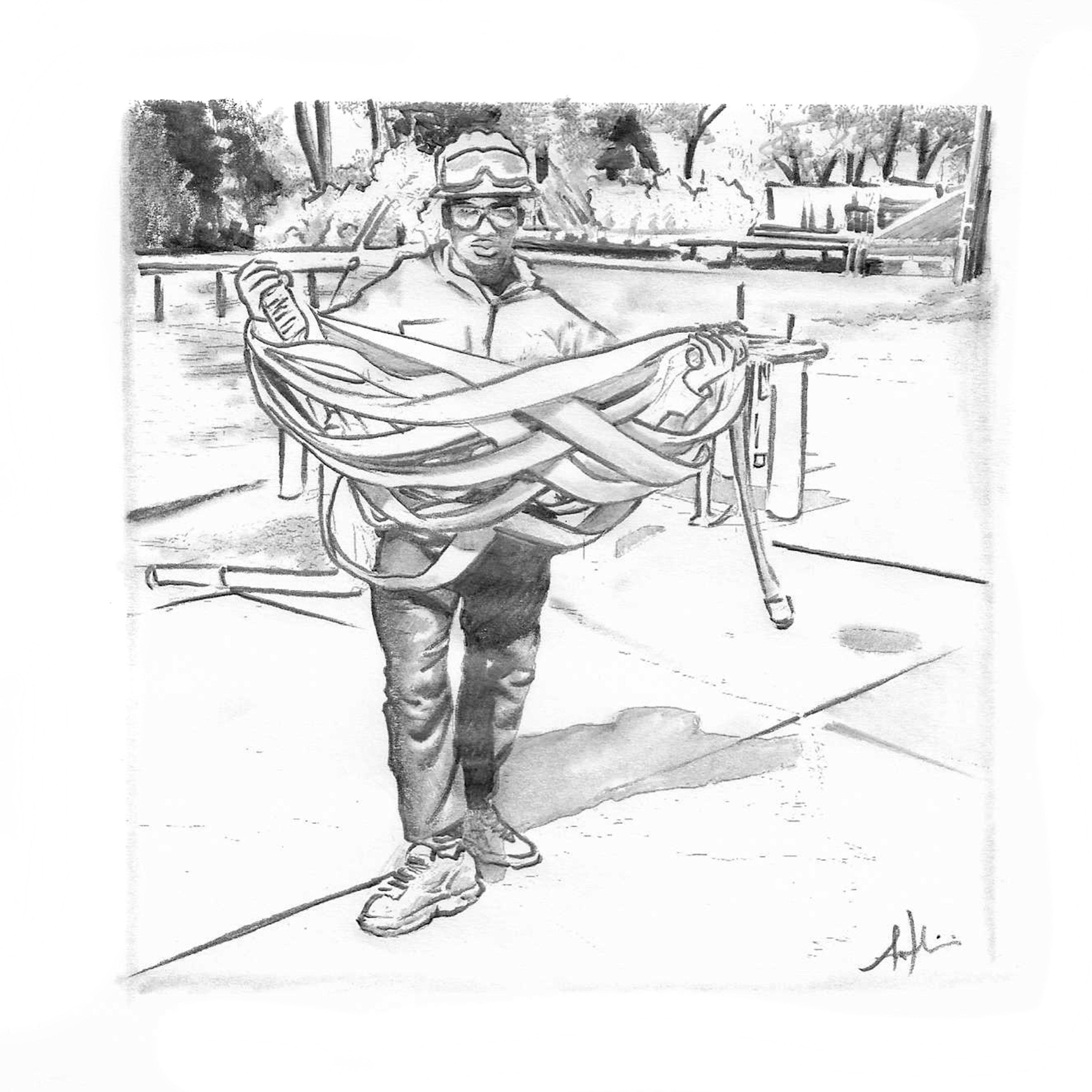
Ear Hustle
From the Vault: Crew No. 7
00:44:48
The terrible fires in SoCal have us thinking about incarcerated firefighters and dusting off this episode from the archives.
Loading summary
Transcript369 lines
- [00:01]
Nigel Poor
This episode of Ear Hustle is brought to you by Progressive Insurance.
- [00:05]
Earlonne Woods
You chose to hit play on this podcast today. Smart choice. Make another smart choice with Auto Quote Explorer to compare rates from multiple car insurance companies all at once. Try it@progressive.com Progressive Casualty Insurance Company and affiliates. Not available in all states or situations. Prices vary based on how you buy.
- [00:28]
Nigel Poor
Hey, everyone, it's Nigel and Earlonne here.
- [00:30]
Earlonne Woods
Since the fires broke out in Southern California last week, we've been hearing from a lot of our listeners wondering about the role of incarcerated people who work as firefighters.
- [00:40]
Nigel Poor
Yeah, and actually, we were there on Tuesday, the day the fires broke out. Right, right. I mean, we had no idea how bad it was gonna get. Remember, from the airplane, as we.
- [00:50]
Earlonne Woods
As my plane turned to go, like in the lax, I'm looking, I'm like, I can literally see the flames.
- [00:54]
Nigel Poor
Yes.
- [00:55]
Earlonne Woods
And I was like, ooh, that looked big. But I thought it was vegetation. I didn't know it was actual structures.
- [00:59]
Nigel Poor
Exactly. So we were there just on Tuesday, and then we left to go inland to Chino. So we were actually very far away from it. But while we were at the California Institution for Women, we actually ran into one of the women who's a firefighter.
- [01:12]
Earlonne Woods
Inside, and she was wearing her orange hookup, which basically signifies that you are part of the fire camp. And, you know, she was waiting to see was some of her unit gonna get called up, because they are kind of far from it, you know.
- [01:24]
Nigel Poor
Exactly. Exactly. So thinking about her and thinking about the fires in LA got us thinking about a trip we made back in 2020 to this fire camp in Ventura, and we made an episode about that trip, definitely.
- [01:39]
Earlonne Woods
And this is a program for people who had just been released from prison, and they opted to spend, I think it was 18 months while they're on parole to train to be a firefighter for Cal fires.
- [01:51]
Nigel Poor
Exactly. And this is a really tough choice for some of these guys because actually, they could go straight home because they're on parole, but instead they were opting to get this additional firefighting training because they'd all been firefighters inside. And I believe after this program, they were actually eligible to apply to become firefighters.
- [02:09]
Earlonne Woods
Yeah, because for years. I mean, years, you had these firefighters that's in prison, but once they get out, they don't qualify because of their past. So this was like a new program to help, like, you know, I guess filter a lot of them into the actual firefighting so they can continue doing the work that they were doing inside of prison.
- [02:24]
Nigel Poor
Exactly. And it was an amazing program. We were there for the training and Earlonne. What do you remember about it?
- [02:29]
Earlonne Woods
I remember, you know, how difficult it was. It was so hard how, you know, they had to wrap the little. The holes up and lay it out and go up these. It was a lot.
- [02:40]
Nigel Poor
We joined them on their, like, march up a hill. Oh, my gosh.
- [02:43]
Earlonne Woods
I forgot how far it was, but they had to march up a hill carrying like 60 pound.
- [02:49]
Nigel Poor
They were carrying. We weren't carrying anything.
- [02:51]
Earlonne Woods
We weren't caring.
- [02:51]
Nigel Poor
But microphones.
- [02:52]
Earlonne Woods
And I was like, oh, yeah, this hill ain't nothing.
- [02:55]
Nigel Poor
I think I got about.
- [02:56]
Earlonne Woods
I got about, like 30 steps into this hill and I was like, how.
- [02:59]
Nigel Poor
Many you actually tapped out before I did. I think I made it almost halfway up and then I jumped into a car.
- [03:04]
Earlonne Woods
Yeah.
- [03:05]
Nigel Poor
I also remember we met that one guy, Eric, and he had been homeless before he went to prison. And now that he was out and doing this training, he was really excited that this was gonna give him a new career and that was gonna help him avoid all the pitfalls of things that had come his way before he went to prison.
- [03:20]
Earlonne Woods
Seemed like a great program cause. And part of the training, remember, we met the actual former incarcerated cats that were actually Cal Fire workers. So they gave a. Got up and gave a good speech. So, you know, it inspired a lot of them dudes.
- [03:33]
Nigel Poor
And remember they talked about whenever they go into a coffee shop, people want to buy them coffee.
- [03:36]
Earlonne Woods
Oh, yeah, yeah. They were celebrities. They were celebrities up in there. So what we wanted to do was we wanted to re share this episode.
- [03:43]
Nigel Poor
It's called Crew Number seven.
- [03:45]
Earlonne Woods
So in the meantime, LA Ear Hustlers, we're thinking of you and we're sending good vibes your way.
- [03:51]
Nigel Poor
I hope you enjoy listening. And if you're down in Southern California, we hope that you're safe out there. Oh, and one more thing. Check out Fire Escape. It's a new series from Snap Judgment about one formerly incarcerated woman's experience fighting fires while she was in prison. It's a great, great series.
- [04:11]
Earlonne Woods
And you know what?
- [04:12]
Nigel Poor
What?
- [04:12]
Earlonne Woods
You might even hear me in the series.
- [04:14]
Nigel Poor
Oh, yeah. Okay.
- [04:17]
Levi Rozier
Hi, this is Tom Van Mayen, Ear Hustle listener from Santa Barbara, California. The following episode of Ear Hustle contains language that may not be appropriate for all listeners. Discretion is advised.
- [04:37]
Nigel Poor
So welcome to the program. I'll have more for you later.
- [04:41]
Eric Kesselmark
You know, in regards to it, when the camera's not.
- [04:44]
Nigel Poor
A little while back, E and I went to class.
- [04:47]
Earlonne Woods
We did, and it was very classy.
- [04:52]
Nigel Poor
I could tell by your face what you mean. It Was a little dry. And I can guarantee you they're very high in regards to it.
- [05:01]
Earlonne Woods
It was the first day of class for a group of formerly incarcerated men who are training to become California firefighters at a spot about an hour north of la.
- [05:09]
Nigel Poor
It's the Cal Fire Ventura Training Center. It's this cluster of buildings not far from the coast.
- [05:16]
Earlonne Woods
We're in this one big classroom with 17 guys sitting at tables. They've each got a little name tag in front of them.
- [05:23]
Nigel Poor
Mm. Very first day of school. Feel. And the guys had all just gotten out of prison. Some of them had been out for a few weeks and others for a few months. And the mood in the room was a mix of nerves, anticipation, and E. I have to say, as a teacher, I definitely recognized a little bit of boredom.
- [05:40]
Earlonne Woods
Ooh.
- [05:42]
Nigel Poor
But then these two guys got up to speak and it's not going to be easy, guys.
- [05:46]
Andrew Morales
We're going to tell you right now, it's not easy.
- [05:48]
Nigel Poor
No.
- [05:48]
Eric Kesselmark
Okay.
- [05:49]
Nigel Poor
You are here given an opportunity, and it ain't going to be easy. It's not going to be easy if you did the. These were two formerly incarcerated men who are now professional firefighters. And as soon as they started talking, the energy in the room just changed.
- [06:03]
Earlonne Woods
And these guys were looking sharp.
- [06:06]
Nigel Poor
Oh, yeah.
- [06:07]
Earlonne Woods
They were dressed in these crisp navy blue uniforms. Cal Fire logos on their arm, shiny silver badges on their shirts.
- [06:15]
Nigel Poor
And one of them, a guy named bae, starts telling the group a story about a time when he was in prison in his cell in Folsom. And E, do you remember those Scared Straight groups?
- [06:25]
Earlonne Woods
Yeah. You talking about the group of, like, high schoolers, they're taken into the prison, and individuals inside show them what could happen to them if they didn't clean up their bad grades or their act.
- [06:37]
Nigel Poor
Exactly. And it was pretty aggressive. California prisons don't do that anymore. But back in the 90s, Bay was in his prison cell, and one of those Scared Straight type groups came through.
- [06:49]
Earlonne Woods
And Bey realizes he was the thing that was supposed to scare these kids.
- [06:53]
Nigel Poor
I am an example of how not to be. Don't grow up to be like this. This is what society puts away.
- [07:02]
Eric Kesselmark
This is that ugliness of the world.
- [07:05]
Nigel Poor
And to Bay, like a lot of the guys here, had a long history of drug addiction. He spent years cycling in and out of the prison on drug charges. But that moment with the Scared Straight kids, that changed things for him.
- [07:16]
Earlonne Woods
So while he was in prison, he got clean and he got involved in fire camp. Those are minimum security facilities where incarcerated people fight fires.
- [07:26]
Nigel Poor
This is something We've talked about on the show. There's a long tradition in California of incarcerated people going out to fight fires.
- [07:32]
Earlonne Woods
And this state really relies on them, Nige. They get paid a dollar an hour to risk their lives fighting fires.
- [07:38]
Nigel Poor
But once you get out of prison, if you keep it up, there's a possibility that you can make good money doing it. That's what Bey did. He got released, he worked towards his certification, and eventually he got a job with Cal Fire. Now he has that badge, that crisp navy blue uniform, and everywhere he goes, people treat him like a hero. We can't go anywhere, any restaurant where.
- [08:01]
Andrew Morales
Somebody will, oh, thank you for your service. Thank you so much for your service.
- [08:07]
Nigel Poor
For what you do.
- [08:09]
Andrew Morales
I'm so grateful and humbled, Humbled by.
- [08:13]
Earlonne Woods
The fact that I was once an.
- [08:16]
Nigel Poor
Example of how not to be.
- [08:18]
Andrew Morales
And today I'm here to tell you that that is not me today.
- [08:22]
Nigel Poor
That was amazing. I mean, you could just tell from the expressions on those guys faces that was really landing with them.
- [08:29]
Earlonne Woods
Yeah. It was like, you can be one of these guys. Like, this is a path that can be done, and it was really powerful.
- [08:49]
Nigel Poor
Earlonne, we've talked to guys on the show before who had a really hard time getting out of prison. You and staying out.
- [08:56]
Earlonne Woods
I mean, getting out of prison is overwhelming. It's really stressful, particularly for guys who had a drug problem before they went in. This is where they get tripped up at.
- [09:06]
Nigel Poor
Oh, yeah. But one major thing that can help is if you have a job to come out to. And that's what fire camp is all about.
- [09:13]
Earlonne Woods
This program is specifically for guys, and, yes, just guys who were on fire teams while they were inside but need to do the training to get certified as firefighters.
- [09:24]
Nigel Poor
Now that they're out in this program, they get paid, and their room and board is fully covered. And if they can stick with the program for the full 18 months, you graduate on the path to a career with a good salary, pension, all of that stuff.
- [09:37]
Earlonne Woods
But, Nige, 18 months, that's a long time for a guy like, you know, you just spent the last five years of your life in prison. You want to be out here in the world. You don't want to be busting your ass out in the sticks. You want to be by the bing bada bang busting your ass.
- [09:54]
Nigel Poor
Okay. Exactly. Right. Okay, I get it. So this fire camp, it might be more than some of these guys are willing to put up with.
- [10:02]
Earlonne Woods
I'm Earlonne Woods.
- [10:03]
Nigel Poor
And I'm Nigel Poor. This is ear hustle from PRX's. Radiotopia. There we go. Crew 3. Moving, moving, moving, moving.
- [10:23]
Earlonne Woods
So the first class we met, those guys were just starting out. It was day one for Hell Week for them.
- [10:29]
Nigel Poor
But not far away, we met another group of guys, another class, actually, who had been there, I think, for about three months, right?
- [10:35]
Earlonne Woods
And these guys were practicing winding up hoses, you know, getting all the water out of them.
- [10:40]
Nigel Poor
There were these two firefighters, and each of them had something like 100ft of hose.
- [10:45]
Earlonne Woods
And they make this windmill motion to wrap those hoses around their shoulders.
- [10:49]
Nigel Poor
It was so cool to watch it. It's like this kind of synchronized ducking and weaving. I mean, honestly, it could be a dance. This team is tight. I mean, they are firing on all cylinders.
- [11:03]
Earlonne Woods
Yeah, those guys are own it for sure.
- [11:06]
Nigel Poor
Meanwhile, the class that started today, those guys were still kind of finding their bearings.
- [11:13]
Earlonne Woods
We met Levi Rozier around on the other side of the building. He has long blonde hair.
- [11:18]
Nigel Poor
Oh, Erlon. I noticed it in the classroom. It's actually longer than mine.
- [11:22]
Earlonne Woods
And he has this real Southern California surfer vibe.
- [11:25]
Nigel Poor
Honestly, I was surprised he had shoes on.
- [11:28]
Levi Rozier
Leave this on or take this off.
- [11:30]
Earlonne Woods
Levi had only been out of prison for two months when we met him. He'd been in and out of the system since he was 12.
- [11:36]
Levi Rozier
I was in the foster care system, and then I got transferred to the delinquency system. Then it was just in and out of juvenile hall because I didn't have anywhere to live, and I would run away from the group homes. And then it's just been in and out of jails and prisons since then. So that was my sixth term. And all of them are about three years, two years, you know, four years.
- [12:02]
Earlonne Woods
So if anybody in this program is hungry, it's you, then.
- [12:07]
Levi Rozier
Yeah. Yeah, I really want it.
- [12:11]
Barrett Brown
My name's Andrew Morales, and I'm here at the Ventura Training Center.
- [12:17]
Earlonne Woods
Andrew Morales is also a part of the new class. We sat down with him at a picnic table in this grassy area next to the dormitories where these guys is going to be shacked up for the next 18 months.
- [12:28]
Nigel Poor
I swear those sprinklers were going all the time down there all the time. What was the conversation last night like in the dorm with people?
- [12:39]
Barrett Brown
It's still just hitting everybody. Everyone is just, man, this is crazy. This is crazy. And people are just. They can't believe, like, this is where we're at right now. This is what came out of all the trouble that we put ourselves in.
- [12:57]
Earlonne Woods
I could see that everything's new, you know, and this Whole new chapter in your life is just happening so fast.
- [13:04]
Nigel Poor
And Andrew knew from being a firefighter inside that the work is grueling and exhausting, but he stuck with it because he knew it could lead to something better.
- [13:13]
Barrett Brown
The way I see it was that when I got out, I had this waiting for me. I was like, I'm just gonna keep. Keep pushing it because it's gonna benefit not just me, but my family. And that's what just kept me going. My little ones, they're six and 10. They're telling everybody my daddy's a firefighter. They're proud. I still talk to them every day. It's good.
- [13:41]
Earlonne Woods
Then. These here or dumbbells, I'm gonna go for the 30s based on. Right past the picnic table where we were talking to Andrew, there was a weight pile with a gang of different weights and exercise machines.
- [13:57]
Nigel Poor
These guys are gonna be carrying 60 pound packs of mountains, so they have to be in really good shape.
- [14:03]
Earlonne Woods
I'll be out here going. I got on the weights, and I hit a few sets, and I was like, man, if I had these, I'd get that bedroom physique back in no time. And, Nige, I seen you over there on them ropes, too.
- [14:19]
Nigel Poor
Oh, yeah. Battle ropes. I love those. Okay.
- [14:29]
Earlonne Woods
Over by those weights, we met Barrett Brown.
- [14:31]
Nigel Poor
And you could tell by looking at him that he spent a lot of time on those weights.
- [14:35]
Earlonne Woods
Yeah, he had that swole ness.
- [14:38]
Nigel Poor
He'd been in the program for a while, so we wanted to pick his brain. And right then, the new class walked by. Here's the new cohort right now.
- [14:45]
Levi Rozier
Yeah, I see them.
- [14:46]
Nigel Poor
Do you think they. Hey, good morning. How do you think they slept last night?
- [14:51]
Andrew Morales
On edge. It's just new. I mean, anytime you go to a new environment, it's not comfortable. You're trying to figure things out. It's hard.
- [14:59]
Earlonne Woods
Barrett applied for this program while he was still locked up.
- [15:03]
Nigel Poor
It's pretty competitive. Not everybody who applies gets admitted, and Barrett did. But still, he wasn't totally sold on it.
- [15:10]
Andrew Morales
So on one of my collect phone calls to my family, I just mentioned it, and my sister basically said that I would be stupid if I didn't do it. I ran it by a friend of mine who, you know, who was more into the street life out there, and she said I would be stupid if I didn't do it. So I had opinions from both worlds, and I put it in my head, and I just started shooting for it, and that was my only goal in sight.
- [15:37]
Nigel Poor
After he got here, though, he wondered if he'd made a big mistake.
- [15:40]
Earlonne Woods
A lot of the other guys in the class were asking themselves the same question.
- [15:44]
Andrew Morales
It was hell for us. We felt like we were no longer free again. We went through all kinds of changes emotionally. Some of us, including myself, contemplated leaving. I was on the edge for a while.
- [15:58]
Earlonne Woods
He said arriving at fire camp brought back memories of the first time he was locked up in a tiny cell.
- [16:03]
Andrew Morales
But if you can imagine getting put in your. In your restroom for, let's say, the first two and a half years, fighting your case or something, if you can imagine what that mentally does to you, it damages us. So when we get out, our thinking isn't as clear as it should be. We don't want to feel like we're locked up. And then you get here, somebody's putting you back in that box, and that's how you feel. You feel like you're being put back in that box.
- [16:35]
Nigel Poor
So today was your first day here, right?
- [16:37]
Levi Rozier
Yeah.
- [16:38]
Nigel Poor
What is honestly going through your mind?
- [16:41]
Levi Rozier
A lot of things changed from what I thought I was signing up for. So I'm kind of a little irritated and questioning it because a lot of stuff changed.
- [16:56]
Nigel Poor
Levi, the guy who'd been in the system since he was 12, says he wanted to be a firefighter since he was young. He loves the idea of helping people and saving lives.
- [17:05]
Earlonne Woods
But on his first day, he was already having misgivings.
- [17:09]
Nigel Poor
He told us he thought he was going to be able to go home to San Diego every weekend, but now it looks like that's not the case. Also, the program is 18 months, but he came in thinking he might get a job with Cal Fire in, like, six.
- [17:23]
Earlonne Woods
Then there was short gate.
- [17:25]
Levi Rozier
I just brought shorts because I figured, okay, we're getting uniforms. Well, I guess they took my dress and my demeanor as not being serious about the program. And then they were like, well, it's regulated that you're not allowed to wear shorts here. So. I'm from San Diego. I don't even have pants. So she was like, well, I need you to go buy pants today. And then today I went in there, they gave me a verbal warning for basically a dress code violation.
- [17:59]
Earlonne Woods
But when he thinks about throwing in the towel, there's a big thing holding him back.
- [18:04]
Levi Rozier
If I do say, screw it, I'm gonna have to go back to my family. And with my track record, all they're gonna see is, oh, dude, you freaking got our hopes up again. You lied to us. Like, you're back. What are you doing?
- [18:20]
Nigel Poor
But, E, you are really rooting for Levi.
- [18:22]
Earlonne Woods
I am. He's like the underdog to me. It's like in the movies. He's the scruffy guy over there that's gonna end up being the hero. Watch.
- [18:31]
Nigel Poor
All right.
- [18:32]
Earlonne Woods
I say stick it out, man. I mean, shit, if this what you want, I mean, it's on you.
- [18:37]
Levi Rozier
Yeah. I think it's a good opportunity, and it's work history if nothing else.
- [18:44]
Nigel Poor
So you going to. You going to stay the night, or are you going to take off? Are you done with it?
- [18:49]
Levi Rozier
No, I'm probably going to stick it out because it seems like it's still worth it.
- [18:57]
Nigel Poor
I don't know, E. I was a little bit like, come on, guys. I mean, this seems like a really good deal, you know? Like, the food is good. Everything's paid for. And they're actually being paid to train for a totally solid career.
- [19:11]
Earlonne Woods
Yeah, but I think if you haven't spent time in prison, it's hard to understand what it does to you, you know? Like, it's really hard to be released and then feel like you're getting your freedom limited all over again.
- [19:23]
Nigel Poor
Yeah. I mean, that is exactly what I heard from Barrett Brown, that guy who'd been with the program for a while. But. So how can someone like me be sympathetic? Because I did start to feel judgy. Like, come on, you guys. This is an amazing opportunity. So give me advice on how to. To not be judgy.
- [19:40]
Andrew Morales
Just try to be more. Try to be understanding of what we come from. It's something that's ingrained in us in prison, and anytime we get a little feel of that, we just feel like caged animals, and we don't have a word. We don't have a say. We don't have anything. We have no freedoms. So that's why we run so hard when we get out.
- [20:09]
Nigel Poor
Can you just give us a list of all the injuries you've had since you've been here?
- [20:12]
Eric Kesselmark
No, that poison oak was really bad. That was the worst thing. Blisters, cuts, bruises, shoulder injuries, back, neck, tendonitis in the elbows. You know, I mean, and you're only 28. Yeah.
- [20:27]
Nigel Poor
Eric Kesselmark started at the fire camp a few months ago, and this course is pretty much his first shot at having some kind of stability in his life.
- [20:36]
Eric Kesselmark
I was homeless off and on since I was 13 years old. @ that age, I thought it was an adventure. I didn't know what the struggle was.
- [20:43]
Nigel Poor
Were you on your own, or were you with your family?
- [20:45]
Eric Kesselmark
I was in a van with my mom.
- [20:47]
Nigel Poor
Okay.
- [20:47]
Earlonne Woods
Like, living in A van? What is that? Like, are you in the same spot or are you in different spots?
- [20:51]
Eric Kesselmark
I'd go to sleep at a truck stop. Right. We'd get chased out. I'd go to sleep at a truck stop. I'll wake up at a park, and then I'll go take a bird bath in. In the restroom while my mom's standing guard at the door. And then I'll go right to school.
- [21:09]
Nigel Poor
But, I mean, it was normal, I guess, for you, right?
- [21:12]
Eric Kesselmark
Yeah. Oh, yeah. It was a. It was an adventure. I didn't see nothing wrong with it, you know, but once I came to grasp that, oh, man, this is what we've been doing this whole time. And this is what my mom been going through this whole time. You know, struggling, you know, trying to find a next meal. Should punt off her rings so we can get something to eat and then somehow try to get them back.
- [21:34]
Nigel Poor
What is the worst thing you've seen.
- [21:36]
Eric Kesselmark
In your life, truthfully? Mom getting beat. Yeah. Seeing her getting carried out in an ambulance by. Because guy tried to snap her neck. Yeah. That's the number one reason why we were homeless. Cause she couldn't work anymore. Yeah. So it was kind of crazy.
- [21:59]
Nigel Poor
How old were you?
- [21:59]
Eric Kesselmark
I was seven. Seven.
- [22:08]
Earlonne Woods
Eric was put in foster care and spent some time living with an older brother. By the time he was 18, he was on meth. When he was 20, he got arrested and sentenced to 10 years.
- [22:18]
Nigel Poor
When he got out, he had nowhere to go, and he realized he was homeless again.
- [22:24]
Eric Kesselmark
I broke down. I broke down, cried. I did. I was like, nah, not again. Here we go. And then I was out on the streets for two days. Two nights.
- [22:37]
Nigel Poor
So during those two days, what did you think was going to happen to you?
- [22:40]
Eric Kesselmark
I didn't know. I was. All I was doing, I was praying, praying. I was praying, lord, please, not again. I've been sitting. I'm walking down the streets and I'm seeing these guys filthy. I'm seeing this guy defecated all over himself. Honestly, I'm like, I broke down. I. I was. I was broken right there. I was like, no, I don't want to be like this. I do not want to be like this again. I mean, I kept clean when I was homeless. I always took bird baths, took a shower wherever I can. But when I saw those guys barefooted, seeing the guys on a cardboard and just sitting there wasting their lives away, I'm like. I was like, yeah.
- [23:22]
Nigel Poor
Eric was gonna do everything he could not to end up like those guys.
- [23:26]
Earlonne Woods
One of the first things he had to do was meet up with his parole officer. But her office was 10 miles from where he'd been dropped off after getting out. He had no money, so he had to walk there.
- [23:36]
Eric Kesselmark
And I had a 70 pound duffel bag full of my property. I was hanging it out like this. I was like, oh, my goodness, this sucks. And so I ended up giving this guy a watch. I was like, man, I'll give you this watch if I can have that stroller you got so I can push my stuff, you know, because this thing is getting heavy. My ankles were swollen.
- [23:56]
Nigel Poor
And he went for it.
- [23:57]
Eric Kesselmark
Oh, yeah. He was like, all right, cool. But what sucked was I was going, you know, Wheel fell off after a while, some odd reason, I guess from the friction, it got hot and melted off. I'm like, you gotta be kidding me.
- [24:12]
Nigel Poor
He did finally get to the parole office. He actually ended up sleeping outside of it.
- [24:18]
Eric Kesselmark
They said I have to be over there by a certain time. So I was like, man, I'm not gonna violate my parole.
- [24:22]
Earlonne Woods
You slept close to the parole office?
- [24:24]
Eric Kesselmark
Oh, right there on the front porch, right behind a bush.
- [24:28]
Earlonne Woods
When he finally did meet with his parole officer, she got him set up with a room at the Salvation Army.
- [24:33]
Nigel Poor
He says if she hadn't been there to help him, things could have gone pretty differently.
- [24:39]
Eric Kesselmark
I don't know what that path would have been, to tell you the truth. That's a pretty scary thought.
- [24:47]
Nigel Poor
Eric had been on the waiting list at the Ventura Training Center a few days before Christmas. They called him to let him know a spot had opened up.
- [24:55]
Earlonne Woods
He started a week later and says his dream is that when he finishes, he'll be able to rejoin his mom. Where is she at now?
- [25:03]
Eric Kesselmark
She's in Georgia. She's in. I don't know why she's in Georgia, but.
- [25:07]
Earlonne Woods
How's she doing?
- [25:10]
Eric Kesselmark
She's doing okay. I mean, I can see in her eyes that she's losing it, you know, and, yeah, I hope that's not the case, but I pray for her.
- [25:26]
Nigel Poor
What do you mean, losing it?
- [25:29]
Eric Kesselmark
Like reality. So. But.
- [25:35]
Earlonne Woods
So in about another 10 months, you'd be ready, hopefully.
- [25:40]
Eric Kesselmark
I love to take care of her.
- [25:41]
Nigel Poor
Yeah.
- [25:41]
Earlonne Woods
That's what I'm saying. You'll be ready.
- [25:43]
Eric Kesselmark
She deserves it. She deserves one of her sons to take care of her. And that's what's up. I think that's me. That's the reason why I stay here. That's what gives me the drive. Yeah, I told her, I said, mom, I need you stay with me because you. You're gonna get that wrench. You gonna get your horses? You gonna get your horses?
- [26:06]
Nigel Poor
What's that about?
- [26:07]
Eric Kesselmark
She was a horse trainer.
- [26:09]
Nigel Poor
She was a horse trainer. She's a horse trainer?
- [26:10]
Eric Kesselmark
Yeah, she was a horse trainer for 15 years before we were homeless. We had a nice house, you know, it was a two story building. It was in San Jacinto, and it was on Tiger Lane, right across the street from the high school that my brother went to. Nice neighborhood, you know, nice people. And she would come home smelling like horse, you know, the horse, horse crap. What's crazy, though, is that when I smell it, it brings back that memory. When she comes back home, we all run to mom, you know, and mom, you know, and she used to take us to the ranch. We'll go ride the horses.
- [27:00]
Nigel Poor
So once you do this and if you end up going to take care of your mom, what will it be like?
- [27:06]
Eric Kesselmark
What would it be like? I'd give her a purpose, you know, I'd give her a purpose of the day because that's the main thing. I'd love to give her something to do. Take care of the horses, take care of the garden. Just give her something to do instead of being in her mind, you know, take her out of her mind. Just give her, give her some tools to come back.
- [27:39]
Nigel Poor
When we get back, we put on our packs and head up the mountain. Listeners, do you want even more Ear.
- [27:57]
Earlonne Woods
Hustle and even fewer ads? Like zero, zilch, nothing, nada.
- [28:02]
Nigel Poor
If so, subscribe to Ear Hustle Plus.
- [28:05]
Earlonne Woods
Ear Hustle plus subscribers get access to ad free episodes and bonus episodes.
- [28:11]
Nigel Poor
Our Ear Hustle plus episodes are really fun. Subscribers can find out what's happening with people they've heard on previous episodes. And they can also send in questions for us to answer.
- [28:20]
Earlonne Woods
And me and Nigel get to sit here and chop it up with our producer Bruce and just talk about whatever.
- [28:26]
Nigel Poor
If you want to hear more of that, subscribe to ear hustle+@earhustlesq.com or directly in Apple Podcasts.
- [28:35]
Earlonne Woods
And thanks for supporting the show. We appreciate y'all. And send in some provocative questions.
- [28:42]
Nigel Poor
Spicy questions.
- [28:52]
Earlonne Woods
Let's go.
- [28:53]
Nigel Poor
Big, deep, baby.
- [28:54]
Eric Kesselmark
I see it in the face.
- [28:57]
Earlonne Woods
It's Wednesday morning, the third day of class, and it's sown.
- [29:04]
Nigel Poor
When we get to the training center, the guys are already into their first big test, a physical exam. If anyone cannot finish each part of the exam, earlonne, they're out of the program.
- [29:18]
Earlonne Woods
So far, they already passed the pull ups, the push ups, and the sit up test. And now they have to run two miles under 18 minutes. Hey, all right, Levi?
- [29:32]
Nigel Poor
Yeah, he was doing it, man. Everyone was cheering each other on. And they all finished the run, no problem.
- [29:41]
Earlonne Woods
Soon as they was done running, they all started filling up their water bottles. It was time for the hike.
- [29:46]
Nigel Poor
Right? The hike and Earlonne. I was a little bit nervous. It's three miles straight uphill, which may or may not sound like a lot, but it's kind of a desert out there and there's no shade, and the day was already heating up.
- [29:58]
Earlonne Woods
Plus, when we talked to him earlier, Barrett had made the hike sound kind of rough.
- [30:03]
Nigel Poor
Yeah. What are these hikes? We've been told about these hikes. Describe them, please.
- [30:07]
Andrew Morales
Pretty much hell on earth for me.
- [30:10]
Nigel Poor
Shit.
- [30:11]
Andrew Morales
Why? Because they're pretty intense, you know? Yesterday we gained almost a thousand feet elevation an hour. My mind was telling me so many crazy things, so many crazy things uphill, in sand, within the heat. And I was like. I couldn't breathe, I couldn't walk. I was wobbling. I was just going and going and going one step, one step, one step, one step. And it was. I can't. Coming back down that mountain. I couldn't. I couldn't even fathom how I made it up. Okay, good morning. This is going to be your qualification hike.
- [30:49]
Nigel Poor
We took a 45 minute drive to the trailhead. All of the students gathered around the captain, who was going to be timing them.
- [30:55]
Andrew Morales
This is a timed 3 mile hike. It will finish in 60 minutes. This is one of the tougher parts. There will be a truck behind you. If you are sick, you're not looking good, you'll be told to step out and you'll get in the truck and.
- [31:12]
Earlonne Woods
We won't debate it.
- [31:13]
Eric Kesselmark
All right, let's. So this is the starting point, that orange line right here.
- [31:18]
Nigel Poor
Captain Easley, are you ready for time?
- [31:21]
Eric Kesselmark
Okay, on the count of three. One, two, three.
- [31:25]
Nigel Poor
Begin. Earlonne. They are cruising.
- [31:29]
Earlonne Woods
And I was back there just like taking selfies and. And wasn't even tripping. And next thing I know, they was like, way up there.
- [31:38]
Nigel Poor
Oh, I know. And I'm gonna say I'm in fairly good shape, but I could not keep up.
- [31:43]
Earlonne Woods
We were immediately way in the back. Our producer Bruce, was carrying the recorder, trying to keep up. Soon, the only guy we could see was my boy Levi, the underdog in the back of the pack.
- [31:59]
Nigel Poor
Yep. And one of the captains gave him a gentle prod.
- [32:02]
Eric Kesselmark
We're about a half mile in. We're at 10 minutes.
- [32:07]
Nigel Poor
Copy?
- [32:08]
Earlonne Woods
Yep.
- [32:08]
Eric Kesselmark
Yes, sir.
- [32:09]
Nigel Poor
Right. Oh, man, I was worried about Levi.
- [32:15]
Earlonne Woods
But remember what happened as we were getting close to the halfway mark?
- [32:19]
Nigel Poor
Oh, yeah. Levi dug in. He found something within himself and he just started passing people. Pew, pew, pew, pew. That's Levi just running by the other four guys.
- [32:33]
Earlonne Woods
You're at 23 minutes, 24 seconds. This is the halfway mark. You don't have to go any faster. If I were you, I wouldn't go any slower, but you don't have to go any faster. Speaking of the halfway mark, that's where we met back up with a guy who was timing a hike. And. And how about that, Nige? He was in a jeep, thank God.
- [32:56]
Eric Kesselmark
Would you like to go up with me?
- [32:58]
Earlonne Woods
Of course. Just climb on in there and Nige, we were right there at the finish line when the first guy crossed. Who's in front? Morales.
- [33:07]
Eric Kesselmark
Morales.
- [33:08]
Nigel Poor
Andrew Morales, the guy we met back on the first day and he won the race. He was the first one up there.
- [33:15]
Earlonne Woods
And right behind him was Joseph.
- [33:18]
Barrett Brown
Man, you kept me going.
- [33:21]
Eric Kesselmark
Still got it.
- [33:22]
Earlonne Woods
All right, you in the front of the line.
- [33:24]
Eric Kesselmark
Oh, yeah.
- [33:25]
Nigel Poor
So you did it, right? That's it.
- [33:26]
Barrett Brown
That's it for now. What are you, 23? He's got 10 years on me, though.
- [33:30]
Eric Kesselmark
So I couldn't let him pass me.
- [33:31]
Levi Rozier
Yeah.
- [33:33]
Nigel Poor
A few more guys crossed the line and then with time to spare.
- [33:37]
Earlonne Woods
Let's go, Levi. Let's go, Levi. Levi jumped in front. Levi, my boy.
- [33:44]
Levi Rozier
Rozier. Rozier.
- [33:46]
Andrew Morales
52, 52, 54.
- [33:49]
Eric Kesselmark
200, kid.
- [33:52]
Andrew Morales
Everybody pass.
- [33:52]
Earlonne Woods
Good stuff, guys. Good stuff.
- [33:54]
Eric Kesselmark
Badass.
- [33:54]
Andrew Morales
Gentlemen.
- [33:55]
Earlonne Woods
Captain.
- [33:56]
Eric Kesselmark
So I have an announcement to make. So this is class seven. You guys are Battalion seven, okay? You guys are the first class out of all seven where there is not a single retake on the physical fitness portion. Okay.
- [34:08]
Nigel Poor
I expect you guys to be breaking.
- [34:10]
Levi Rozier
Records this whole time.
- [34:10]
Eric Kesselmark
Okay.
- [34:12]
Earlonne Woods
Before we left the top of the hill, the group gathered to take a picture together.
- [34:20]
Nigel Poor
But I noticed that Levi was kind of standing off to the side a bit, kind of apart from the group.
- [34:25]
Earlonne Woods
Right, right.
- [34:26]
Nigel Poor
So later I asked him how he was getting along with the other guys. Are you reaching out to anybody and.
- [34:31]
Levi Rozier
Trying to make connections with time? We're all going to get to know each other. Other, you know, so sometimes it's better to take that type of thing slow and really kind of see or fill out who people are.
- [34:49]
Nigel Poor
What do you think you're going to be feeling in a couple weeks? Where do you think you're going to be emotionally and physically?
- [34:54]
Levi Rozier
I don't know. The classroom part. I'm kind of a little nervous about that. So I'm not sure.
- [35:08]
Earlonne Woods
Hello?
- [35:09]
Levi Rozier
Yeah, can I get three chicken flautas, a large Jamaica?
- [35:18]
Earlonne Woods
Hello? Are you there? Hey, this Earlonne, Nigel and Bruce. A couple of weeks after we came home from fire camp, we gave Levi a call.
- [35:26]
Levi Rozier
Who are you trying to call? Yeah, this is Levi.
- [35:31]
Earlonne Woods
All right. Do you remember us, Nigel and Erlon, that interviews you when you was.
- [35:35]
Levi Rozier
Oh, yeah. How are you guys doing? I'm doing good.
- [35:42]
Nigel Poor
We wanted to catch up with you.
- [35:44]
Levi Rozier
Yeah, I'm just eating right now. It's no big deal.
- [35:51]
Earlonne Woods
So while you wait on your food, do you mind if we have a couple of questions and record it?
- [35:55]
Levi Rozier
Go ahead.
- [35:56]
Nigel Poor
Can you give us an update on what's going on in your life?
- [36:02]
Levi Rozier
Well, the clutch on my car is going out, so I'm buying a new clutch. I'm working my old job doing rebar. I got a raise. $20 an hour.
- [36:16]
Earlonne Woods
Yeah. Turns out Levi left fire camp the day after we did.
- [36:21]
Nigel Poor
He told us the final straw was when the captain told him he needed to take some more classes so he could get his high school diploma, which.
- [36:28]
Earlonne Woods
Pissed Levi off because he had his GED already.
- [36:32]
Levi Rozier
I told him there's no way I'm going to be able to do the fire curriculum, all the physical stuff and the high school classes.
- [36:42]
Nigel Poor
But let me ask you this. After that conversation, you just packed up your stuff and left?
- [36:46]
Levi Rozier
Yeah.
- [36:48]
Nigel Poor
How'd that feel?
- [36:50]
Levi Rozier
Well, what sucks is that I had to come back and ask. You know, of course my family is probably thinking I just gave up.
- [37:01]
Nigel Poor
Well, how did you. How did you describe it to your family and how did they take it? Because I remember when we talked to you, you said you were worried they would say, oh, another thing I didn't complete.
- [37:11]
Levi Rozier
Well. Yeah, I don't know what they really feel. I would imagine me, I would think, yeah, this guy, you know, they had their hopes up really high, but they just kind of knew how. How much I wanted to do the firefighting thing. So they like, man, that sucks. But keep your head up and keep. Keep pushing for it.
- [37:39]
Earlonne Woods
Hey, you know. You know, in that program, man, you. You was the underdog for me. I knew you was gonna, you know, be the man in that program, you know what I'm saying? So, yeah, but I just found out today you were no longer in the program. That's crazy.
- [37:55]
Levi Rozier
Yeah, but you can't be a sucker, or you'll always be in a sucker's position, you know?
- [38:04]
Earlonne Woods
You know, I wish Levi.
- [38:06]
Nigel Poor
Well, yeah, I do too.
- [38:08]
Earlonne Woods
We also caught up with Andrew Morales, the guy who finished the hike first. And he was, not surprisingly, still all in.
- [38:16]
Nigel Poor
So how is the new crew bonding?
- [38:20]
Barrett Brown
Well, today was really cool. We laid out 1100ft of hose together as a crew and went up against Crew 1 that's been here for 12 months, and we beat them. Yeah. So that was cool. That was exciting. We've been doing all kinds of things together, man. And everybody's finding their spot and everybody's clicking, and everything's changing for the good. It's crazy. I never thought I'd have. This would be my life. It's insane, man. It's crazy.
- [38:56]
Nigel Poor
That's great.
- [38:57]
Levi Rozier
All right.
- [38:57]
Nigel Poor
I mean, I know you can't see us, but when you're talking, you're smiling so much. So that tells me that things are really good.
- [39:04]
Barrett Brown
Yeah.
- [39:05]
Nigel Poor
Feeling good about yourself?
- [39:07]
Barrett Brown
I am everything, like I said, everything's going smooth, and everybody's happy here, and everybody that here wants to be here. You know, that brotherhood, that bond. We're like road dogs.
- [39:19]
Nigel Poor
Would you be shocked at this point if somebody else dropped out?
- [39:22]
Barrett Brown
There ain't nobody going to leave.
- [39:24]
Nigel Poor
Okay.
- [39:24]
Barrett Brown
Nobody's. Nobody's going to leave. There's. I'm not. That's not even a thought.
- [39:30]
Nigel Poor
All the little rituals of being a firefighter were becoming routine, like polishing your boots every night.
- [39:36]
Barrett Brown
So we're right here sitting next to each other, and we're trying to get it the best we can and see who can get the shiniest boots after you get back from whatever you doing, straight to the boots. Shine, shine, shine. I never had to do that in my life. And it's a pain in the ass, but we're all getting the hang of it.
- [39:53]
Nigel Poor
But at the same time, I think the reality is setting in that this is a really hard life they've chosen.
- [39:59]
Earlonne Woods
And a dangerous one, too.
- [40:01]
Barrett Brown
Yeah, I actually woke up. It was. I think it was Monday. And I stood up and I'm looking around and I just ask myself, like, what the fuck am I doing here?
- [40:16]
Earlonne Woods
A few days before, Andrew had gotten some news about another formerly incarcerated firefighter who had been through the same program.
- [40:23]
Barrett Brown
He got hired with the Orange County Fire Department, and he was on that Blue Ridge fire in Orange county, and he got 50% of his body burned. And he's not doing. Not doing good at all. Yeah, he's so. I think it was like a doctor's induced him into a coma because of all the pain. I guess that helps him. But he had all of his crew. There's like 45 men that went to go visit him. His mom and dad were There. And so the chief went over there and got him to understand, like, look, we're all here because we're. We're a family. We're here to support you, and we're here to support each other. And when one goes down, we all go down.
- [41:14]
Nigel Poor
Wow. But that's intense. No wonder you were, like, woke up feeling weird.
- [41:20]
Barrett Brown
Yeah, I really did. For like, two days. I was. I was just like a zombie, I guess. I was just. Okay, I'm here. I'm just gonna go line up and we still don't really know what happened.
- [41:33]
Nigel Poor
I imagine when that happens, doesn't everyone think, shit that could happen to me, like, that could be me?
- [41:40]
Barrett Brown
Of course I called. I called my girl, my girlfriend, because I needed to talk to somebody about it. I called my daughters, and, you know, I just wanted to talk to them. I wanted to see them. And it's just like, wow. Like, I told my girlfriend, I don't want you to think, like, this can't happen to me because any day, and I needed her to know, like, that's how quick things change.
- [42:07]
Earlonne Woods
Did she ever say, mijo come home?
- [42:10]
Barrett Brown
All the time.
- [42:16]
Levi Rozier
All the time.
- [42:17]
Barrett Brown
But it's been hard. It's been a lot of tears.
- [42:22]
Nigel Poor
What are the tears about?
- [42:24]
Barrett Brown
Me being gone and then missing me. They want to make plans, but I don't know. Up until the last minute, we don't know when we're gonna get the day off or we're gonna get a couple hours off or the whole weekend off.
- [42:37]
Nigel Poor
Right. And that's not gonna change. Right. It's always gonna be like that for.
- [42:41]
Barrett Brown
The rest of this career.
- [42:46]
Nigel Poor
Fighting fire has always been a hard job. It's dangerous, and you're away from home, but it's actually becoming even harder.
- [42:54]
Earlonne Woods
Yeah. I mean, with global warming, California's fire season is getting rougher every year. The fires are getting bigger, and it's causing way more destruction.
- [43:02]
Nigel Poor
Oh, yeah. And you know those guys we heard talk to the class at the top of the show?
- [43:06]
Earlonne Woods
Who? Ariel and Bay.
- [43:07]
Nigel Poor
Exactly. They have been out going from fire to fire, away from home for, like, four months now.
- [43:14]
Earlonne Woods
That's crazy.
- [43:15]
Nigel Poor
Oh, it is crazy. Okay. But we do have some good news. The guy Andrew told us about who was burned really badly. Well, a few weeks ago, he came out of his coma, and he still has a long recovery ahead of him, but he is truly getting better every day.
- [43:31]
Earlonne Woods
Definitely wishing him a speedy recovery.
- [43:33]
Nigel Poor
Yeah, absolutely.
- [43:43]
Barrett Brown
Thanks to Michelle Garcia, Jeremy Brant, and Michael Sellis at the Ventura Training Center.
- [43:49]
Andrew Morales
Ear Hustle is produced by Nigel Poor. Earlonne Woods, Rahsaan, New York. Thomas John, Yahya Johnson and Bruce Wallace.
- [43:57]
Barrett Brown
This episode was engineered by Antwan Williams with music by Antwan and David Jasse.
- [44:03]
Andrew Morales
Amy Stanin edits the show and Julie Shapiro is the executive producer for Radiotopia. Ear Hustle would like to thank Acting Warden Ron Broomfield. And as you know, every episode of Ear Hustle has to be approved by this guy here.
- [44:18]
Earlonne Woods
All right, so how you what's your thoughts on this episode, man?
- [44:23]
Barrett Brown
Man, you know, I was thinking about.
- [44:26]
Nigel Poor
All you brothers who have been on.
- [44:28]
Earlonne Woods
That ride, you know what I mean.
- [44:29]
Barrett Brown
Who'Ve been incarcerated and did extraordinary things.
- [44:32]
Levi Rozier
Inside and got the opportunity for another chance at life, man.
- [44:36]
Earlonne Woods
And I was just kind of just.
- [44:38]
Levi Rozier
Going through the mental Rolodex of you.
- [44:40]
Earlonne Woods
Guys are and how you guys are.
- [44:42]
Barrett Brown
Back in the community and are doing good things, man. And it definitely gave me something on.
- [44:47]
Levi Rozier
That tip to be thankful about. And with that, you know, I say.
- [44:51]
Earlonne Woods
I, I approve this episode.
- [44:56]
Barrett Brown
This podcast was made possible with the support from the Chan Zuckerberg Initiative working.
- [45:02]
Andrew Morales
To redesign the justice system by building power and opportunity for communities impacted by incarceration.
- [45:09]
Nigel Poor
For more information about this episode, check out our show notes on Ear Hustle's website, earhustlesq.com you can find us on.
- [45:16]
Earlonne Woods
Social media, Instagram, Facebook and YouTubeArhustlesq and on our website where guess what? We've got new merch.
- [45:26]
Nigel Poor
I'm so excited. There is really cool stuff there so please check it out and if you're.
- [45:31]
Earlonne Woods
Not already, follow and review Ear Hustle on any of your favorite podcast apps like Apple podcasts, Spotify and iHeartRadio. We love them.
- [45:42]
Nigel Poor
Comments Ear Hustle is a proud member of Radiotopia from prx, a network of independent, creator owned, listener supported podcasts.
- [45:51]
Earlonne Woods
Discover audio with vision at Radiotopia fm.
- [45:55]
Nigel Poor
I'm Nigel Poor.
- [45:56]
Earlonne Woods
I'm Earlonne Woods. Thanks for listening.
- [46:08]
Eric Kesselmark
Radiotopia from prx.