Loading summary
Transcript527 lines
- [00:01]
Earlonne Woods
Thank you to everyone who has already donated to our spring fundraiser so far. We are so grateful.
- [00:08]
Nigel Poor
We are especially grateful because, Earlonne, I've gotta be real here. This is a shit time to ask anyone for money. The economy sucks, the news is terrible, people are overwhelmed, and then we are coming at people we care about, our listeners and asking them to give more. And I don't really like doing it, but we kind of have to. So, donors. Yeah. I'm sorry to do this, but we are asking for donations. We do this every year. We're hoping to get 1,000 donors. I don't know if we're going to reach it, but you know what? We're grateful for anyone who gives.
- [00:42]
Earlonne Woods
If you've been thinking about donating but haven't gotten around to it yet, now's the time. It only takes a minute.
- [00:48]
Nigel Poor
Every single gift, no matter the amount, helps us push forward and continue to try new things.
- [00:54]
Earlonne Woods
Definitely. Everyone who donates will be invited to our virtual party on June 11th where we just kick back, talk about the season and answer some of your questions live.
- [01:04]
Nigel Poor
Monthly gifts of $10 or more get you access to AD free episodes and Ear Hustle, plus bonus content.
- [01:10]
Earlonne Woods
Yep. Which is, you know, we talk about a lot of shit on there.
- [01:13]
Nigel Poor
Yeah, it's fun.
- [01:13]
Earlonne Woods
Please support us today@earhustlesq.com donate or by following the link in the episode notes.
- [01:20]
Nigel Poor
And I wanna acknowledge, again, this is a really hard time to ask people to donate. If you can give anything, we really appreciate it. If you can't, we still love knowing that you're out there listening. So thank you so much.
- [01:31]
Earlonne Woods
Definitely. Because, you know, we love doing what we do, but it do cost. This episode of Ear Hustle is brought to you by Progressive Insurance.
- [01:41]
Nigel Poor
Do you ever think about switching insurance companies to see if you could save some cash?
- [01:45]
Earlonne Woods
Progressive makes it easy to see if you could save when you bundle your home and auto policies. Try it@progressive.com Progressive Casualty Insurance Company and affiliates. Potential savings will vary. Not available in all states. Well, Nige, I'm headed out for another weekend trip to Los Angeles.
- [02:04]
Nigel Poor
Well, travel safe, my friend.
- [02:05]
Earlonne Woods
Thank you very much. But you know what?
- [02:07]
Nigel Poor
What?
- [02:08]
Earlonne Woods
It's time to upgrade my travel look. Yeah, I've got too many bags and backpacks.
- [02:14]
Nigel Poor
You do. I have to say, you really do.
- [02:17]
Earlonne Woods
So right now I'm on Quint's website checking out a suitcase. And tell me what you think of this one. Is it a good looking travel bag?
- [02:24]
Nigel Poor
Earlonne. I'm on the website too, and they have really great things. Check out this one, the one that's made out of Italian leather. It's less than half price of what you would normally pay for a bag that looks this good.
- [02:37]
Earlonne Woods
I need a cool weekend bag like this.
- [02:39]
Nigel Poor
Oh, I know you do. But you know what else we need bags for? We're going on tour this summer.
- [02:43]
Earlonne Woods
Oh yeah.
- [02:44]
Nigel Poor
And we're packing a lot of stuff. So I noticed they had this other very cool travel item, these Quince eco friendly packing cubes. And each cube compresses your clothes by up to 60% so you can fit in all of your outfits and we can pack for the show and look splendid.
- [03:02]
Earlonne Woods
Everything with Quint is priced 50 to 80% less than what you'll find with similar brands. Quint gives you luxury without the markup.
- [03:09]
Nigel Poor
And Quint only works with factories that use safe, ethical and responsible manufacturing practices and premium fabrics and finishes.
- [03:17]
Earlonne Woods
Treat your closet to a little summer glow up with quints. Go to quints.comearhustle for free shipping on your order and 365 day returns. That's Q-U I N C E.com earhustle to get free shipping and 365 day returns.
- [03:38]
Nigel Poor
Quince.com earhustle.
- [03:45]
Earlonne Woods
It'S almost June and you know what that means, Nige.
- [03:48]
Nigel Poor
What?
- [03:48]
Earlonne Woods
Our live tour is only two months away.
- [03:51]
Nigel Poor
You are so right, Earlonne. And I, I am super excited. I know I should be concentrating on the show itself, but I can't stop thinking about our wardrobes.
- [03:58]
Earlonne Woods
That's crazy.
- [03:59]
Nigel Poor
I know.
- [04:01]
Earlonne Woods
We're gonna be hitting the road, performing a brand new live show in 11 cities.
- [04:06]
Nigel Poor
And one of the things we really enjoyed from our last tour was coming out to the lobby after and meeting everyone who comes to the show, sign.
- [04:13]
Earlonne Woods
Books, take selfies and just chop it up with everybody. And you know the one thing that always surprises me?
- [04:19]
Nigel Poor
What's that?
- [04:19]
Earlonne Woods
When someone tells us how Ear Hustle changed their life.
- [04:23]
Nigel Poor
I love hearing about that. Deep. You can find out about all of our tour stops@earhustlesq.com tour and if you're.
- [04:31]
Earlonne Woods
In or near one of those places, we hope you can come see us.
- [04:35]
Nigel Poor
You know what, Earlonne? I just heard from somebody who lives in Boston and they are driving all the way to Pittsburgh. It's like 400 miles.
- [04:42]
Earlonne Woods
That's what's up. That's dedication right there. It is dedication.
- [04:45]
Nigel Poor
Get your tickets @earhustlesq.com tour.
- [04:49]
Earlonne Woods
We'd love to meet you.
- [04:51]
Nigel Poor
My name is Fruce Brandt. I'm a letter midwife. After 40 plus years working with photography and photographers, I've turned my attention to helping people write their essential letters. The following episode of Ear Hustle contains language and content that may not be appropriate for all listeners. Discretion is advised. So what's the date today? It's.
- [05:22]
Becky Bach
Today is 35 25.
- [05:24]
Nigel Poor
3 5, 2 5. And it's about 10 20. So I'm looking at the table and there is a garbage bag that's quite full. It's heavy. It's hard to lift up. So there's a lot of photographs. And then there's a. There's a box that's actually equally heavy, a van's box that's full of pictures. And then there's a 5 by 8 inch envelope, something like that that's quite small, that is full of pictures. So there's three very different ways of archiving photographs and collecting photographs. Papa bear, Mama bear, Baby bear. Photographs. Can you guess what the subject of my episode is?
- [06:11]
Earlonne Woods
Well, I'm hoping that it's not a remake of the trash episode.
- [06:16]
Nigel Poor
I knew you were gonna think of that.
- [06:17]
Earlonne Woods
I'm hoping that it's not Christmas box.
- [06:21]
Nigel Poor
Yeah, there's two. Yeah, it alludes to two different old episodes.
- [06:24]
Earlonne Woods
Okay. Okay.
- [06:26]
Nigel Poor
Okay. So before I give you sort of more clues about it, let's just remind listeners what these mystery episodes are all about.
- [06:35]
Earlonne Woods
Okay. Usually these mystery episodes are secrets that me and Nigel keep from one another. We don't tell each other what we're doing. That's how it usually go. But this season, we did something new, and we had listeners pick the topics that we talk about.
- [06:54]
Nigel Poor
Exactly. So you and I, all season, were working on our episodes.
- [06:57]
Earlonne Woods
Right.
- [06:58]
Nigel Poor
We didn't know about what the other one was doing.
- [07:00]
Earlonne Woods
And then, I don't know, I was picking up some breadcrumbs. I was listening.
- [07:07]
Nigel Poor
Okay. So, Earlonne, today, all secrets will be revealed.
- [07:11]
Earlonne Woods
Okay.
- [07:12]
Nigel Poor
Starting with one secret that's waiting out in the hallway right now.
- [07:16]
Earlonne Woods
Really?
- [07:16]
Nigel Poor
Mm. Hello.
- [07:20]
Earlonne Woods
Hello. How you doing?
- [07:22]
Nigel Poor
Good. Okay, so it's very exciting. We have the actual listener who suggested this idea for the episode in the studio with us right now.
- [07:31]
Tom Nguyen
This is Becky.
- [07:32]
Earlonne Woods
What's up, Becky?
- [07:33]
Nigel Poor
Hello.
- [07:33]
Tom Nguyen
Hi.
- [07:34]
Nigel Poor
So I've met Becky before, and I can tell you that her voice is a little bit different today.
- [07:40]
Earlonne Woods
This is not your regular voice? No. Okay. Was you at a concert last night?
- [07:44]
Siddiq Davis
No.
- [07:45]
Tom Nguyen
I have been asked that a few times today. I. I'm getting over a cold and I lost my voice.
- [07:50]
Earlonne Woods
It's okay. It'll be back. It'll be back.
- [07:54]
Nigel Poor
So what we're going to do is we're going to listen to the episode, and you all jump in anytime you have something to say.
- [08:00]
Earlonne Woods
Okay.
- [08:00]
Nigel Poor
But before we actually get started listening, Becky, I'm going to ask you to read the email that you sent us with your actual suggestion for the episode.
- [08:09]
Tom Nguyen
Definitely. I thought immediately about some photos in prison. No, you can't have a lot of different things there. But I was thinking about telling the story of photos that are particularly important to people who are incarcerated, perhaps revisiting the location or people to get additional perspectives and how to accept that time is passing while still celebrating special moments captured.
- [08:34]
Nigel Poor
So, Earlonne, what do you think?
- [08:36]
Earlonne Woods
Well, when I first heard. What was it? The big bag.
- [08:40]
Nigel Poor
Yeah.
- [08:41]
Earlonne Woods
I'm like, okay, this is Nigel archiving.
- [08:43]
Nigel Poor
You know me so well.
- [08:45]
Earlonne Woods
Hey, my museum partner.
- [08:47]
Nigel Poor
Exactly. Today on the show, it's an episode all about photos in prison.
- [08:55]
Earlonne Woods
Okay.
- [08:56]
Nigel Poor
With all that in mind, I'm Nigel Poor.
- [08:58]
Earlonne Woods
I'm Earlonne Woods.
- [09:00]
Tom Nguyen
I'm Becky Bach.
- [09:01]
Earlonne Woods
And this is ear hustle from PRX's Radiotopia.
- [09:10]
Nigel Poor
Earlonne and Becky, that bit of tape you heard at the top. Mama Bear, Papa Bear, and Baby Bear. That was, of course, our inside team. Tony, Siddiq, and Tom and I had asked each of them to bring all of their photos down to the studio. And the thing I love about this project is that it really corresponds with the work I've been doing in my studio for, like, the last 30 years, you know, which is investigating photography and the objects that we keep around us as a way to think about who we are and how we see ourselves in the world. And so I was so excited to dig into their collections and see what was there and to think about how photography collections can be kind of like an autobiographical expression. So the first person you're gonna hear from is Sadiq, and he had, like, a thousand plus photos all in this big garbage bag. So maybe just open it and pull out. Is it gonna mess up your order?
- [10:04]
Becky Bach
If you pull out something, it's already messed up.
- [10:06]
Nigel Poor
So let's see. Oh, my God. Okay, so there are stacks of photographs, and they are organized, but right now, they are living in a garbage bag. Was that just to transport them, or is that how they live in your.
- [10:19]
Becky Bach
No, that's how they live. I have bags full of pictures.
- [10:22]
Nigel Poor
Next up was Tony. He had all of his photos neatly stacked and tightly packed into this van's shoebox.
- [10:30]
Siddiq Davis
All right, let me get my little shoebox.
- [10:36]
Tony Tafoya
That looks like a lot.
- [10:37]
Becky Bach
That's a lot of pictures.
- [10:38]
Nigel Poor
How many do you have?
- [10:40]
Siddiq Davis
Probably about a Thousand. They're just in a box to keep them from going everywhere.
- [10:48]
Nigel Poor
Mm. Tony and Sadiq may have had around the same amount of photographs, but Tony's were so dense and held together, like, it's like he almost didn't want you to see any of them. And then finally, there was Tom. He had his photos in this small, like, sort of cheap plastic album. Like the kind you get at a souvenir shop.
- [11:07]
Earlonne Woods
Yep. Those are the ones that they sell at the prison canteen.
- [11:11]
Tony Tafoya
Maybe there's, like, 20, 20 some odd pictures in here.
- [11:14]
Nigel Poor
That's it.
- [11:16]
Earlonne Woods
That's all I have.
- [11:16]
Nigel Poor
Okay, so this is the. Where we could quickly count how many he has. 1, 2, 4, 6, 9, 10, 11. It's not even all full.
- [11:30]
Tony Tafoya
No.
- [11:30]
Nigel Poor
12, 21, 22, 23, 24, 25. You have, like, 26 photographs. That's it. Are you guys shocked?
- [11:45]
Becky Bach
No, I'm a little shocked because he's been incarcerated a long time to have 26 pictures. It's like a picture a year, basically.
- [11:57]
Nigel Poor
Why aren't you surprised?
- [11:58]
Siddiq Davis
It's very on brand for thumb.
- [12:01]
Tony Tafoya
What do you mean?
- [12:02]
Siddiq Davis
It's your brand.
- [12:04]
Tony Tafoya
What's my brand?
- [12:05]
Siddiq Davis
As little as possible.
- [12:06]
Tony Tafoya
Okay.
- [12:07]
Siddiq Davis
As simple as possible.
- [12:12]
Nigel Poor
I wanted to hear from each of the guys, and not just about their pictures, but also about their collection, how they were organized and what that might mean to them.
- [12:20]
Earlonne Woods
Right.
- [12:21]
Nigel Poor
So we're going to start with Siddiq. And I know it sounds like he had this unorganized garbage bag just, like, filled with pictures, but once I started looking closely, I noticed that on the back of each of them was, like, this code that he had written. I mean, earlonne. It was tiny and precise. At first I thought it was printed, but then I realized it was written with a pencil. But I cannot express to you enough how exacting it was. And it turned out this was a system he had developed for organizing them.
- [12:52]
Earlonne Woods
His archiving system.
- [12:54]
Nigel Poor
Exactly.
- [12:55]
Becky Bach
A all the way to 99. Then I get to B all the way to 99. And then I got to double letters.
- [13:00]
Nigel Poor
How did you come up with that system?
- [13:02]
Becky Bach
I don't know. I did it in the county.
- [13:04]
Nigel Poor
Cause you know what it reminds me of?
- [13:05]
Becky Bach
What's that?
- [13:06]
Nigel Poor
CDCR numbers.
- [13:07]
Becky Bach
Oh, wow.
- [13:09]
Nigel Poor
Cause they start with A and then they go to doubles.
- [13:12]
Becky Bach
Institutionalized.
- [13:13]
Nigel Poor
Do you see any connection there? Siddiq's photographs documented his whole life. Like, pictures of him growing up, pictures of his family, pictures of friends, pictures when he was in elementary school, high school, all of that stuff. But when I looked at them closely, this was the weird Thing. Almost all of them were reprints and had been printed in 2010. Where were you in 2010?
- [13:36]
Becky Bach
I was in county jail.
- [13:37]
Nigel Poor
Okay. Yeah. So someone was sending you a lot.
- [13:40]
Siddiq Davis
Of pictures of my mom.
- [13:40]
Nigel Poor
Okay.
- [13:41]
Becky Bach
Cause I wanted to get a lot of pictures. It took the stress off my mind because I didn't want to think about court. I didn't want to think about everything that I was going through at the time.
- [13:52]
Nigel Poor
When he was getting all these, he was in county jail, you know, waiting to get sentenced. And he was young, you know, he was, like, 18 years old. And he's kind of like this lonely kid in county jail not knowing what's going to happen to him. And so he's surrounding himself with all these photographs from his life that his mom is sending him, obsessively labeling all of them and, like, archiving his life. And, Becky, I see the expression on your face. It's really. It's really touching as hell. That's how he spent his time in county jail, meticulously making this archive. And then he got sentenced.
- [14:29]
Earlonne Woods
Hmm.
- [14:31]
Becky Bach
Once I kind of, like, figured out I was going to prison, my mind just switched. Like, I didn't really, you know, care about pictures anymore. I don't know. I don't want to just sit here and just be looking at pictures, reminiscing.
- [14:48]
Nigel Poor
So next we took out that cheap plastic photo album that belonged to Tom. You know, it was very small, very tidy, well organized. And it was interesting because most of the photographs in, you know, they were of his family, but they were old, Some of them taken before he was even born.
- [15:04]
Earlonne Woods
You know, I got some of those type of pictures. Nice.
- [15:06]
Nigel Poor
Did you have them in prison, too?
- [15:07]
Earlonne Woods
Yeah, I used to ask for certain pictures that I remembered that we had of, like, my great grandmother and my grandmother and stuff like that. To have your family tree, you know, and where you come from.
- [15:19]
Nigel Poor
Yeah. Nice. Who's that?
- [15:22]
Tony Tafoya
Oh, that's my grandma. Those first pictures you saw from the.
- [15:25]
Nigel Poor
War, I was wondering, because the first ones are black and white.
- [15:28]
Tony Tafoya
That's their ID pictures. My grandfather was in the Vietnam War.
- [15:31]
Nigel Poor
Okay.
- [15:32]
Tony Tafoya
So when we met my grandmother and he came back. So those are their ID Pictures from their passports.
- [15:38]
Nigel Poor
Wow. And then on the back, there's some writing. This is from 1978. This one's from 1974. And they kind of look like passport photographs, one, because they're black and white, but in four of them, the people are very serious.
- [15:53]
Tony Tafoya
Yeah. Like, that was after the war.
- [15:56]
Nigel Poor
There were also some more recent ones, not just these old black and White ones. And one of them showed Tom soon after he got to prison. And so I asked Siddiq and Tony to describe what they saw in this picture of Tom. So if you saw this picture and you didn't know him, what would you think? How would you describe this guy from the photograph?
- [16:15]
Becky Bach
He looked like somebody I ain't gonna mess with. Yeah, he looked real different, for sure. He looks different. He looked like a gang member right there.
- [16:22]
Nigel Poor
Sort of intimidating to me.
- [16:25]
Becky Bach
He is right there.
- [16:26]
Nigel Poor
Yeah, you look very different to me. Thoughts?
- [16:31]
Siddiq Davis
I just think he looks like a character from a Fast and the Furious movie, honestly, like movies one through four.
- [16:39]
Tony Tafoya
I'm looking forward to also now seeing Tony's. For some reason I see a bunch of people that look like, I don't know, from Queer Eye straight guy or something. Like all those model esque clothing guys.
- [16:52]
Nigel Poor
Team Tony.
- [16:55]
Tony Tafoya
Tony, you look a lot different in there.
- [16:57]
Siddiq Davis
Mm.
- [16:58]
Nigel Poor
So at this point we shifted over to Tony's collection.
- [17:01]
Tony Tafoya
You look like Italian for some reason.
- [17:03]
Siddiq Davis
I am.
- [17:05]
Tony Tafoya
No, but one of those like goodfella type guys, you know, lasagna, a meatball. That's what you look like to me.
- [17:13]
Nigel Poor
Yeah.
- [17:15]
Siddiq Davis
So most of the photos that are here are taken. Almost all the photos actually were taken post incarceration.
- [17:24]
Nigel Poor
Just one observation I have is you have a lot more photographs of places and things. They're not all people. What do you make of that?
- [17:33]
Siddiq Davis
Yeah, I actually like seeing stuff because I am really melancholy when it comes to people.
- [17:40]
Nigel Poor
A lot of them seem like they're pictures people took when they were traveling. How does that feel when you see them?
- [17:46]
Siddiq Davis
I love it. Yeah. I love seeing photos of places. I normally don't really care about people that much. That's just to be honest.
- [17:54]
Nigel Poor
I don't know if this comes across in the tape, but Tony was really down and. Can you hear it? You can hear it, Becky? Yeah. I mean, he was uncharacteristically negative that day. But I'm glad you can hear it. There's something, something happening there.
- [18:10]
Tony Tafoya
You're like so pessimistic.
- [18:11]
Nigel Poor
I know. Tony, what is going on? I'm not used to you being like this.
- [18:16]
Siddiq Davis
I know.
- [18:18]
Nigel Poor
Is this a drag for you to go through these?
- [18:21]
Siddiq Davis
No, no, it's fine. Actually, I always ask for photos though. No matter where they're at. I ask for photos constantly.
- [18:29]
Nigel Poor
When you ask for photos, what are you hoping to get?
- [18:31]
Siddiq Davis
Scenery. This is in Cambridge in England. This college has been there for 800 years. It's not going to change. It didn't change when we lived There. It's not changing now unless it is destroyed. It's like I wasn't there. So I don't have a negative emotion attached to him or a negative memory attached. I just wasn't there.
- [18:58]
Nigel Poor
So while we were looking at this collection, I randomly picked up one photo and actually had people in it. And it was a picture of his family, sort of like walking in a line. And then he was at the end of that line facing the camera.
- [19:14]
Siddiq Davis
I don't want to remember that day.
- [19:16]
Nigel Poor
Why?
- [19:19]
Siddiq Davis
Three days before, I had found out that I was HIV positive and my mother was like, let's go to Disneyland. And I'm like, yeah, I really don't feel like going at all or doing anything. And so I had to put on a smile.
- [19:32]
Nigel Poor
Did your parents know?
- [19:33]
Siddiq Davis
Not at all.
- [19:34]
Nigel Poor
How old were you?
- [19:35]
Siddiq Davis
I was 19.
- [19:38]
Nigel Poor
And so how did you get through that time?
- [19:41]
Siddiq Davis
It was like one of the only times I've actually cried in my life and felt sorry for myself. But it's like you don't even really know what to do.
- [19:51]
Nigel Poor
And did your parents inquire what was going on?
- [19:53]
Siddiq Davis
No, they didn't even really know. I really was good at faking things. I've been very good at keeping secrets my whole life. Yeah. That was January 2, 2010, I believe. I just miss how thin I was then. I'd probably keep it to remind myself that I used to be 140 pounds.
- [20:19]
Tony Tafoya
How much do you weigh now?
- [20:21]
Siddiq Davis
I weigh 225, 230 now.
- [20:26]
Becky Bach
How do you feel about memories?
- [20:29]
Siddiq Davis
There's still a tinge of sadness to him. On every single memory I think of even of happy moments of, like, oh, that'll never happen again, or, oh, well, sorry to bring everyone down.
- [20:49]
Nigel Poor
So then I asked each of the guys to come up with just one word to describe the collections of the other two. And Tony went first.
- [20:58]
Siddiq Davis
Thumbs would be curated and sadiqs for me, would be collected.
- [21:02]
Becky Bach
Thumbs would be. Can I use personal? And Tony's would be, I would say, mysterious.
- [21:10]
Tony Tafoya
When I think of your pictures, I think of, like, family or togetherness. Tony's. I don't even know this is a descriptive word, but like, buildings or places.
- [21:21]
Nigel Poor
Yeah, I mean, it's hard to describe the photographs without thinking about the way each of you presented them. Give you mine. And it could change if you showed them in a different way. So, Tom, when I think of your collection, it seems austere to me. Thoughtful, but also difficult because there's so few. Very controlled. It feels like a room that doesn't have a lot in it, but what is in it matters. Siddiq is very bountiful. There's a lot going on. There's a lot of people. Joyful chaos, maybe, is what comes across in the pictures. Tony, yours is going to be very colored by the way you are presenting today. They feel very mournful. They feel very quiet, and maybe a little glimpse into what really is happening inside of you versus what you present. A lot when I see you.
- [22:21]
Becky Bach
Yeah, no, definitely. That's why I chose Mysterious, because it does seem like that. Like something's missing, something is hidden behind those pictures.
- [22:31]
Siddiq Davis
I'm all sad because you guys, like, have them ready and you want to keep them, and I use mine to prop up my celly's tv.
- [22:39]
Becky Bach
What? Are you serious?
- [22:41]
Siddiq Davis
Yeah.
- [22:43]
Tony Tafoya
Why do you sound so sad about it?
- [22:45]
Siddiq Davis
Because I wish I just cared about something so much that I actually loved it. But I don't know if I have anything in my life besides my parents that I actually care about. I'm just mostly frustrated because I don't seem to have the same connection.
- [23:01]
Nigel Poor
At this point. Becky had a question that I hadn't thought to ask them yet.
- [23:05]
Tom Nguyen
Do they have them hung up at all?
- [23:07]
Nigel Poor
That's an interesting question. So my understanding is a lot of people in prison don't want other folks looking at their photographs, and so they tend to keep them more private. That is what I've heard from people. But then I've walked past cells where people have a ton of pictures up now, if I remember correctly, and it's been a long time. I don't remember that you had many pictures up in your cell.
- [23:28]
Earlonne Woods
So I, you know, I was connected to pictures for a while, and when I found myself about to stab a correctional officer over a photo album, I had to take my. I don't know, I had to take something out of that and not make it as important to me.
- [23:53]
Nigel Poor
Was he trying to take it away from you?
- [23:54]
Earlonne Woods
No, he. He took. He took one of my photo albums because he said that there was a. And this is. This is him being petty. He said, you know, this is when they had just stopped frontal nudity and I had a photo album that was very provocative. He was like, yeah, I'm confiscating the photo album because of this picture right here. I came out and was ready to. I was really about to deal with this dude over some pictures. It was the moment when I took the value out of photos. It changed something in me, you know what I'm saying? Knowing that I was going to that extreme.
- [24:33]
Nigel Poor
So how many years ago was that?
- [24:34]
Earlonne Woods
This was in probably 2005 or 2006.
- [24:40]
Nigel Poor
Earlonne. That story really speaks to the power of photographs. You know, I mean, they had such a hold on you that you actually had to let them go because they'd become too important. I mean, that's amazing. And so that's why I wanted to talk to the guys about specific photographs that were meaningful to them. And to do that, I wanted to give them an assignment that would help them kind of dig into their feelings. So I gave them an example from my own life. Okay, this is a picture of me and my mom when I'm 25 and my mom is 50. And there's only one time in your life where you are the half age of your mom, and that's how old she was when you were born. And so on that year, my mom and I went to a photo booth and took a picture of us. And on the back it says, June 1989, Bath, England. I'm 25, my mom is 50. And so after we took it, we ripped it in half. And my mom has two, and I have two. And I always carry this picture with me in my wallet. And now I'm much older than my mom was in this picture. I never thought of myself as, you know, I would ever be older than that. And so at once, this is very emotional for me, but it also makes me sad in some ways because I think about aging, and I think my mom's going towards the end of her life. So it's a really important photograph that I think I will die with. I would never throw it out. And so what I was going to ask you all to do is to go through your collection and find that one photograph that you would never get rid of that really speaks to you and that you can tell a story about and bring it back. But as I was listening to you all talk, I thought, there's more topics I want you to think about. And so I'd love you to go through your collection and bring a photograph of your youth, a photograph that brings back a really good memory, one that brings back a bad memory, and then one that you, like, this, that you would always keep with you. So it's one tooth. So that's four. Youth, good memory, bad memory, and one you'd always keep with you. So, clearly, this is a huge project, and I did go through all of these topics with each of the guys. So the good memory, the bad memory, the one from your childhood in the photograph you could never get rid of. And it was great because it brought up so many conversations and we learned so much about each other. But there's no way that I'm going to tell you all of them because we'd be here till midnight. So we just picked one or two for each guy to talk about. We're going to start with Tom, and the photograph that he brought that we're going to talk about first is from a period in his life when he was a kid, and it's when he and his siblings were living with his grandparents.
- [27:49]
Tony Tafoya
That's my grandmother. I believe that's during a time when I lived with them, and she's cutting up a bunch of fish. My grandparents taught me how to fish. And I remember just being really happy during the time, you know, my grandfather just drinking a beer. I remember when I would hug him, his whiskers rubbing against my face. I could feel it. And he always smelled like Old Spice. I can still remember the smell to this day. Right?
- [28:15]
Nigel Poor
Yeah.
- [28:17]
Tony Tafoya
My grandmother, I always remember, like, whenever she saw me, she had food specifically for me. She'd have a little Tupperware container with the food she made, like chicken curry or deep fried catfish, and she'd have it, and she goes, this is yours. Nobody else can have it. So when I see it, that's what I think of. I struggle with trying to hold back tears, you know, sometimes when I see them.
- [28:38]
Nigel Poor
Yeah. So then the next photograph that Tom showed us was his good memory. And this one was taken inside of a prison visiting room.
- [28:47]
Siddiq Davis
Y.
- [28:48]
Nigel Poor
You know those very well.
- [28:52]
Tony Tafoya
Good memory. Easy one. Me and my girl. This is one of my first times I got to hug her without having to worry.
- [29:02]
Nigel Poor
Earlonne, I think you know this, but Becky, you don't. So Tom has had this serious girlfriend for a long time. But remember, he came to prison when he was really young, and he's 44 now. So this girlfriend of his is someone he met while he was in prison. And that means that they've never actually spent time together outside of prison. So anytime there's a hug or a little bit of affection being shown, somebody's watching. What do you remember from the hug?
- [29:29]
Tony Tafoya
I smelled shampoo. Hugging her. She always feels like, for me, soft. I felt like a warmth, a connection to, like, another human being, especially somebody I love.
- [29:40]
Nigel Poor
What else do you remember about this day?
- [29:43]
Tony Tafoya
I got to hold her hand. Like, I think I expressed to you, I'm not an overly affectionate person. I think it's a product of my life. But when I'm really close with my friends, I put My hand on their shoulder. I might even, like, half hug him to Tony the other day. And I know it felt weird. And guys say that to me. They go, hey, man, you feel really awkward. But it's because I think I'm just so used to not being close to people.
- [30:10]
Nigel Poor
This is what I think I'm learning about you over the last month, is that I think inside of you is a very demonstrative person, somebody who really wants to show affection through touch, and I mean in a friendly way and through language, and. And I see that coming out more and more in you, and maybe that's struggling with this person who's felt very let down and left behind, but I suspect that that's going to become a bigger and bigger part of you.
- [30:35]
Tony Tafoya
Yeah, I hope so. I think you're right.
- [30:42]
Becky Bach
So where do you want me to start?
- [30:44]
Nigel Poor
Maybe just pull out a couple that you want to tell us about.
- [30:46]
Becky Bach
Okay, I'll tell you about this one.
- [30:48]
Nigel Poor
Okay. So this is Siddiq, and this is a picture from his youth. And it's probably actually the first photograph that was ever taken of him.
- [30:56]
Becky Bach
Real light, light skin, baby. Wow, that's me. I think I was sleeping. It's, like, right when I got out the hospital.
- [31:07]
Nigel Poor
So this photograph is at least 37 years old. He's a chubby little baby. Would you ever think this was Sadiq?
- [31:16]
Tony Tafoya
No. Because you look part Asian.
- [31:19]
Nigel Poor
Look at. He's blushing. I love when Satik blushes. He's getting red. What surprised me about this, It's a baby picture, right? Like, I think he's actually still in the hospital and it was taken. He actually keeps a copy of this photograph on his wall in his cell, and he loves to show it to people.
- [31:38]
Earlonne Woods
Mm.
- [31:38]
Nigel Poor
Yeah.
- [31:42]
Becky Bach
It's just something about that picture that I like. I don't know what it is. It's just me. I like that picture because I didn't know anything at the time, and I was just full of life, like. And I want to get back to that same state, and I look at it from time to time, and just knowing that. That. I don't know, it's kind of hard to. I don't know.
- [32:15]
Nigel Poor
What are the feelings that come up for you?
- [32:23]
Becky Bach
Sad sometimes because I'm so far away from that little derail right there, and sometimes I feel like I failed that derail. So disappointment. A lot of times, too, like, you bring out so much out of a picture when you just start just thinking and dwelling on it.
- [32:46]
Nigel Poor
You know, I actually don't think he felt those sad Feelings about that photograph until we started talking about it. Cause he was really clear that he loved showing it to people. He wanted people, I think, to see him in that naive state or something. Yeah. So, okay, so the next one he showed us was of a bad memory. And this was actually a stack of photographs. They were like those class pictures you get in elementary school where there's like what we would call a thumbnail now of every kid. So each one was like a grid.
- [33:16]
Becky Bach
Of 30 kids I have, like from grade one to grade five.
- [33:23]
Nigel Poor
So tell me about this little kid.
- [33:26]
Becky Bach
So little Darrell used to get rolled on a bike to school from his mom because his dad wasn't there. And I used to always get laughed at.
- [33:36]
Nigel Poor
For what?
- [33:36]
Becky Bach
Just getting rolled on a bike. They made fun of that. They made fun of my clothes. They made fun of my shoes. Just a lot of little stuff. Like I was just an outsider. Like a few of these students in these pictures was actually bullying, teasing me.
- [33:54]
Nigel Poor
Who were some of the instigators?
- [33:56]
Becky Bach
So Emeril for sure. She was just like, always on me. Bullying me, teasing me. Trinette was always teasing me. Joseph, who I end up like, we end up becoming close eventually. He used to always tease me a lot.
- [34:11]
Nigel Poor
Was it like physical or name calling?
- [34:14]
Becky Bach
So it was name calling. Pushing, bumping. If I was getting some water. Pushing my head down in the water.
- [34:20]
Nigel Poor
Jeez.
- [34:21]
Becky Bach
Yeah, it was like real aggressive.
- [34:23]
Nigel Poor
Did you tell anyone about it?
- [34:27]
Becky Bach
No, I actually didn't. I didn't know who to tell. Like, I didn't want to go home and tell my mom. She was already struggling and I didn't want to put nothing else on her plate.
- [34:39]
Nigel Poor
What do you think the lasting effects of being bullied are?
- [34:44]
Becky Bach
Low self esteem, feeling like you're not loved and cared. I always wanted to please people. Like, for my stepdad. When my stepdad came into my life, I wanted to always please him. I wanted to always make sure that I had the right answer. I wanted to always make sure my ears was clean when he come by or my teeth was brushed. Like just small little things. Because I just wanted to show that I was a good kid and I wanted to be loved. I didn't want to feel neglected.
- [35:13]
Nigel Poor
Yeah. Were you ever a bully?
- [35:17]
Becky Bach
I became a bully, yes. Like my teenage years, I realized that I started bullying my own friends. Like we seen it as. As we was playing. But no, I was bullying them.
- [35:28]
Nigel Poor
What does that look like?
- [35:29]
Becky Bach
Trying to toughen them up, push them around. I didn't see that until I came to prison. Like, I was A bully. I turned into the bully.
- [35:41]
Nigel Poor
Okay, so the last person is Tony. And he wanted to show us a photograph that was a good memory for him.
- [35:49]
Siddiq Davis
Two people sitting at a restaurant with some food and some tea. It was Mother's Day 2011 or 2010, so my sister had just moved back up to the Bay Area and we went to a Mother's Day tea. It's one of those good memories.
- [36:11]
Nigel Poor
Yeah. So at this point, where did you think your life was going? What were you imagining up? Which would meant what for you?
- [36:20]
Siddiq Davis
I was a sophomore in college. I had just interviewed with Pixar and it would have been like a summer internship type thing. I was like, really hopeful and I just. I thought that I was going to do something fun.
- [36:37]
Nigel Poor
So in the photo, they're sitting at this table and he's with his sister. She's wearing this very like, cool leopard print blouse and she has her hair pulled back with a big black band. And she kind of looks like Audrey Hepburn, you know, and they've got like tea around them and little sandwiches. It's all like, very proper.
- [36:56]
Siddiq Davis
Everything has changed since that day. Like, she has gotten married, she's had two kids. You know, like she's started her career. Like, that was right after she had graduated college. Yeah, that was just like a time of opportunity and innocence and possibility.
- [37:15]
Nigel Poor
Okay. Then after that, we moved on to his next photo.
- [37:20]
Siddiq Davis
So bad memory. And so there's a little bit of sweetness to it, but it's still a bad memory. And there it's. It is in a prison visiting room. There is one of those typical prison visiting room backgrounds that make it look like you're living in a fantasy world, but you're really not. Anywhere it is of me and my parents when I had barely turned 26 years old. It was on a level four yard and it was the first time I had physically touched my parents since 2012.
- [37:52]
Nigel Poor
And what year was it?
- [37:53]
Siddiq Davis
2015.
- [37:54]
Nigel Poor
And what was that like?
- [37:56]
Siddiq Davis
It was really weird because that was the first time you really had any physical connection. Coming from county jail and then going through reception and then going to my mainline and being able to have them come to a visit that wasn't behind glass was.
- [38:15]
Nigel Poor
You.
- [38:15]
Siddiq Davis
You forget how much your family should mean to you. You forget how much, like, these people supported you and cared for you the whole time. Right. Because you're so focused on yourself and you're so selfish. During your, your trial, you're like, what's gonna happen to me? What's happening now? What's going on? Why is this happening. What did I do? I didn't do that. You know, you're trying to make excuses for everything you did. You're trying to mitigate whatever it is that the courts are throwing at you. You forget that they had lives, and not just for, like, you know, a few months. Like, this was years that they were dragged along with me.
- [38:55]
Nigel Poor
So you're all smiling in this picture. Yeah. What do you see in those different smiles?
- [39:00]
Siddiq Davis
I see my dad really happy to see me, my mother very excited that we're able to be in person finally. And I see myself deeply confused and not knowing what's going on.
- [39:20]
Nigel Poor
So when you first saw them after three years, what were the emotions that you were having?
- [39:26]
Siddiq Davis
I was really excited to hug her, and I forgot how small they were. So I'm five nine, and my parents are. They're tiny little things. My mother's like, five four. My dad's like, five' five or five' six. And they were just so much softer than I thought. Right. Like, they had gotten fatter and, you know, older, and they're just soft.
- [39:56]
Nigel Poor
Did you hug, like, as a trio, or was it, like, first your mom and then your dad?
- [40:00]
Siddiq Davis
It was first my mom and then my dad. I think I held onto my dad a little longer, too, because he. He's been there since, like, the minute I was arrested. Like, he just so happened to be home the day that I was arrested.
- [40:12]
Nigel Poor
Oh.
- [40:13]
Siddiq Davis
Like, he actually answered the door for the cops.
- [40:17]
Nigel Poor
Oh. Did you know it was gonna happen?
- [40:25]
Siddiq Davis
Get arrested?
- [40:26]
Nigel Poor
Yeah.
- [40:26]
Siddiq Davis
No.
- [40:28]
Nigel Poor
You were just, like, having a normal day.
- [40:29]
Siddiq Davis
Yeah, I just was a normal college student.
- [40:34]
Nigel Poor
What's your last memory of leaving the house that day?
- [40:38]
Siddiq Davis
So the police woke me up, and I asked if I could brush my teeth, and they allowed me to brush my teeth. My dad was like, should I give you your wallet? Do you need money? Like, we were so confused. Nothing like this had ever happened to anyone we knew. And I just kept thinking, what is going on? Like, what am I supposed to do?
- [41:03]
Nigel Poor
Did you ever come home again?
- [41:05]
Siddiq Davis
No.
- [41:08]
Nigel Poor
So it's quite emotional for me to see these pictures and hear you talk about them. I guess I feel like this is our first real conversation, even though I've known you for a long time.
- [41:17]
Siddiq Davis
Yeah.
- [41:28]
Nigel Poor
So I've got a couple more photographic surprises coming.
- [41:31]
Earlonne Woods
I'm looking forward to seeing what you got up your sleeve.
- [41:34]
Nigel Poor
Yes.
- [41:35]
Earlonne Woods
Let's take a little break. We'll be right back.
- [41:41]
Nigel Poor
Calling out your hustlers.
- [41:44]
Earlonne Woods
We've got an announcement.
- [41:45]
Nigel Poor
We are hitting the road again.
- [41:48]
Earlonne Woods
That's right. Back in 2023 we had our first live tour on the east and west coast and we had so much fun. We're like we gotta do this again.
- [41:57]
Nigel Poor
So that's what's happening. Only this time it's really like an old fashioned roadshow. Kind of like a 70s style rock band. We are renting vans and we are packing so many outfits.
- [42:09]
Earlonne Woods
Earlonne and Hitting the road. We'll start out in Nashville on August 4th and we will drive across the south and Midwest hitting a bunch of cities, hopefully yours.
- [42:19]
Nigel Poor
Grand final in a city I have always wanted to visit, Austin, Texas.
- [42:24]
Earlonne Woods
And this time out we've got an entirely new show. Stories from inside and outside Prison, reimagined by a cool animator and music from some of our favorite artists you've met on the show.
- [42:36]
Nigel Poor
And Earlonne, you know I am already picking out my outfits.
- [42:39]
Earlonne Woods
Yep.
- [42:39]
Nigel Poor
And between you and me, we are going to need our own van. Earlonne. We are going to travel Liverachi style and you know I am dying to see what our listeners are going to be wearing.
- [42:51]
Earlonne Woods
I'm wearing prison blues.
- [42:53]
Nigel Poor
What you talking? You are not. You are not.
- [42:56]
Earlonne Woods
So dress to impress.
- [42:57]
Nigel Poor
For ticket info and all the details go to earhustlesq.com see you on the road. Earlonne there's nothing like getting a fresh perspective from experts who've seen it all and have the wisdom to prove it. If you or someone you love are looking to grow, you should try Masterclass.
- [43:21]
Earlonne Woods
That's what's up. Masterclass is the only streaming platform where you can learn with over 200 of the world's best.
- [43:28]
Nigel Poor
For example, you can take a class on cooking with chef Jose Andres, who I really admire for his work with the World Central Kitchen. Or you can fight disinformation and learn media literacy with renowned scholar Noam Chomsky. Or learn how to think in Korea. Communicate like a scientist with Neil Degrasse Tyson.
- [43:46]
Earlonne Woods
The classes really make a difference. 88% of members say that Masterclass has made a positive impact on their lives.
- [43:53]
Nigel Poor
For just $10 a month, a membership with Masterclass gets you unlimited access to every single instructor. It's an amazing deal. Plus every new membership comes with a 30 day money back guarantee and you.
- [44:05]
Earlonne Woods
Can access Masterclass on your phone, computer, smart TV or even in audio mode. Don't wait another moment to start your learning journey with Masterclass.
- [44:14]
Nigel Poor
Our listeners always get great discounts on Masterclass of at least 15% off any annual membership@masterclass.com Earhustle See Masterclass latest deal.
- [44:26]
Earlonne Woods
At least 15% off@masterclass.com EarhUSTLE masterclass.com EarhUSTLE.
- [44:36]
Nigel Poor
This show is sponsored by BetterHelp.
- [44:39]
Earlonne Woods
Nigel. It's Mental Health Awareness Month. Did you know that 26% of Americans who participated in a recent survey said they avoided seeking mental health support because they were afraid of being judged for it?
- [44:52]
Nigel Poor
Yeah. We still have to get away from that stigma. When people hesitate to get help, it doesn't just affect them. It affects their families, their workplace, their entire community.
- [45:02]
Earlonne Woods
The world is a better place when people are happy and healthy.
- [45:06]
Nigel Poor
True. And therapy can really help you make those adjustments. You need, you know, to have better boundaries, to be a better colleague, to think about how you function in your family. And everyone benefits from that.
- [45:17]
Earlonne Woods
And honestly, when I needed to talk to somebody, a therapist was the best person to talk to. I didn't know them. They didn't know me, but.
- [45:24]
Nigel Poor
But they could help, right?
- [45:25]
Earlonne Woods
Exactly.
- [45:26]
Nigel Poor
Betterhelp has over 10 years of experience matching people with the right therapist from their network of more than 30, 30,000 licensed therapists.
- [45:34]
Earlonne Woods
And BetterHelp is fully online, making therapy affordable and convenient for over 5 million people worldwide.
- [45:41]
Nigel Poor
We're all better with help. Visit betterhelp.comearhustle to get 10% off your first month.
- [45:49]
Earlonne Woods
That's BetterHelp. H-E-L-P.com earhustle.
- [46:04]
Becky Bach
So I thought long and hard about this, and it's a place that we always used to go to. It's the marina in San Leandro.
- [46:13]
Nigel Poor
So, Becky, you had this very cool idea where we would perhaps visit a location. I think you said, add a different perspective. Yeah, I took that idea and I put a twist on it. I asked them to describe a photograph that they wanted me to create for them. This is a photograph that didn't exist, and I was gonna create it based on their descript. Could be a place where they had experienced something before prison. It could be a fantasy place. It became a kind of collaboration. And so we started with Sadiq, and he wanted me to go make a photo at this spot by the water. It's this little park by a marina, and it's the kind of place you can totally imagine teenagers hanging out at night, you know, because it's a little secluded, easy to get to, perfect spot.
- [47:01]
Becky Bach
We used to always just go hang out. We'd park our cars and just stand there and just listen to the ocean.
- [47:07]
Nigel Poor
And what would you be seeing as you looked out?
- [47:12]
Becky Bach
Really, just a lot of darkness and just the water. We like to just open the doors and you could feel a breeze.
- [47:17]
Nigel Poor
What Time of day is it when you imagine going there?
- [47:21]
Becky Bach
It was at night. It was always at night. Sometimes. Sometimes we'd just hang out the car. Sometimes we just have the door open. Sometimes we'd sit in the car and sometimes we get out. But it was always closer to the end of the night. Will you take a picture?
- [47:35]
Nigel Poor
That's what my. That's my goal.
- [47:37]
Becky Bach
Okay.
- [47:37]
Nigel Poor
Is to try to go there.
- [47:38]
Becky Bach
I haven't been there in so long, so.
- [47:40]
Nigel Poor
Yeah.
- [47:43]
Siddiq Davis
I would like the photo to be of somebody standing. I'm not sure if it's still there. In front of the Carl's Jr.
- [47:50]
Nigel Poor
Okay.
- [47:50]
Siddiq Davis
I don't even know if. No, that's actually further down. It's basically where you get to San Francisco City hall, but where the open drug market is also known as the farmer's market. That goes on once a week.
- [48:03]
Nigel Poor
Down near where the library is.
- [48:05]
Siddiq Davis
Down by the library, yes.
- [48:08]
Nigel Poor
Okay, guys. Tony wanted me to recreate a memory that he had, and he was really specific about all the details. And this one took place in downtown San Francisco. What year was the last time you saw this place?
- [48:21]
Siddiq Davis
2012.
- [48:25]
Nigel Poor
And why this place?
- [48:27]
Siddiq Davis
It's just one of those vivid memories that I remember after I made my doctor tell me that I was HIV positive.
- [48:36]
Nigel Poor
That's where you got the news?
- [48:37]
Siddiq Davis
Yeah.
- [48:39]
Nigel Poor
So remember, the way this was going to work was that I was going to recreate the scene from Tony's memory, but I was going to be playing Tony.
- [48:48]
Earlonne Woods
Weird.
- [48:48]
Nigel Poor
Yes. And I had to try to recreate as many of the details as I could.
- [48:52]
Siddiq Davis
It would be a photo of just a person standing there on their phone with everything going on around them.
- [48:58]
Nigel Poor
Around them. What were you wearing?
- [49:00]
Siddiq Davis
It is a giant wool knit cardigan that goes down to about here, and it's all blue with, like a white stripe on it. It's very oversized.
- [49:11]
Nigel Poor
Okay.
- [49:12]
Siddiq Davis
And of course, a beanie.
- [49:13]
Nigel Poor
Oh, beanie.
- [49:13]
Siddiq Davis
Yeah.
- [49:14]
Nigel Poor
Okay.
- [49:14]
Siddiq Davis
Jeans beanie.
- [49:17]
Nigel Poor
Okay. Like I said, Tony was very exact about all of this, including this one specific bag that he wanted me to be carrying.
- [49:26]
Siddiq Davis
A chrome bag? Yeah, it's the brand chrome. The bicycle. It's the cross shoulder. Yeah.
- [49:32]
Earlonne Woods
He was really scripting this out for you.
- [49:35]
Nigel Poor
So true. I love that. Very scripted. Finally, I need to get Tom's assignment. And this one was going to be a little bit hard to pull off because it was based on a dream that his girlfriend had.
- [49:48]
Tony Tafoya
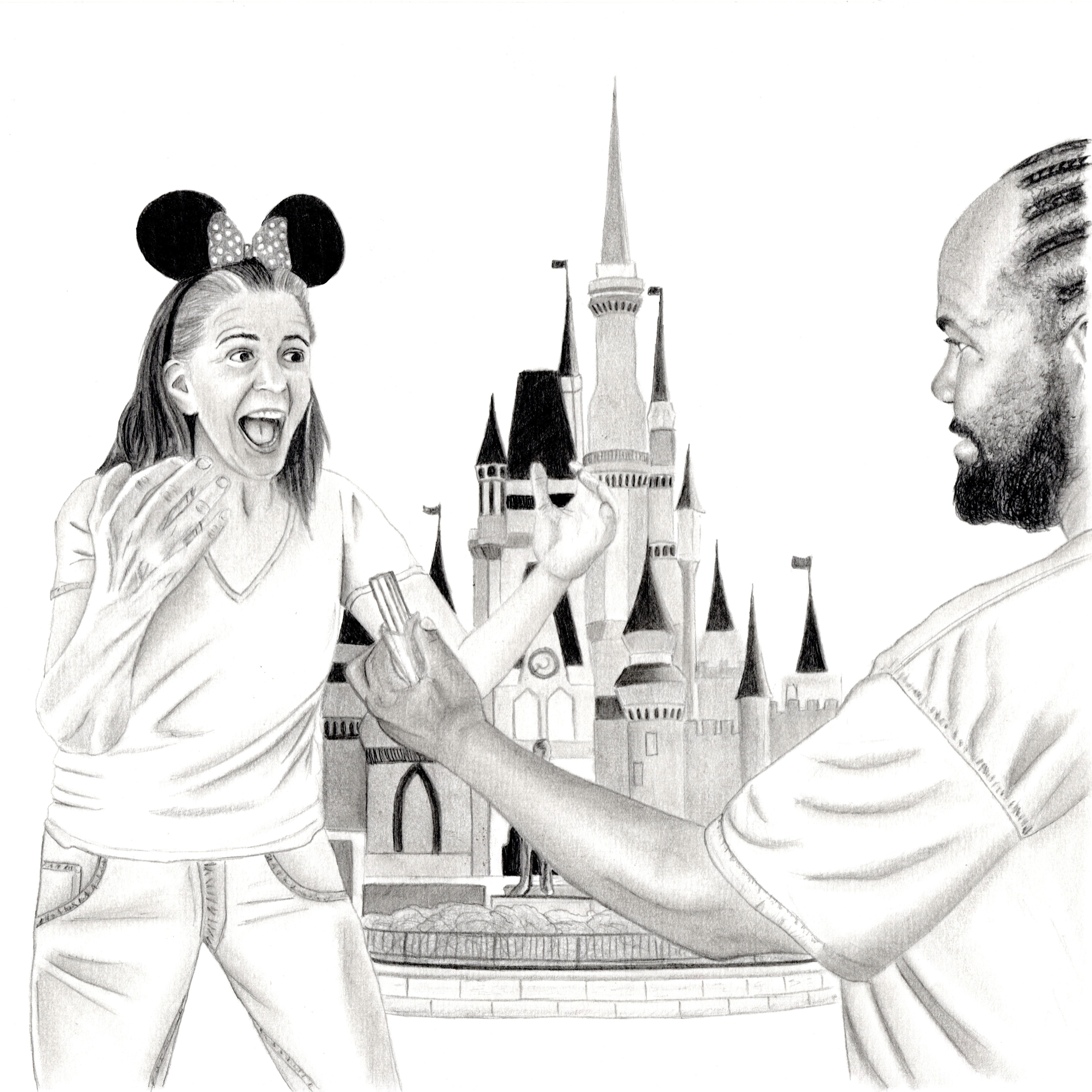
She said, I had a dream that I was at Disneyland with you and you were putting the ears on me. And so after that, that image was in my head. I go we're gonna do it. I go because I always talk about Disneyland. I didn't get. Yeah, yeah, I really wanted to go to Disneyland. It just seems like the fun is place in the world. The one I wish you could take from me is just a picture, like, of a front view of the castle at Disneyland on a bright sunny day. And of course, I would love if my girl was standing, like, in front of the bridge somewhere with her little Minnie mouse ears. I imagine her wearing, like, a white T shirt and some jeans, but, like, such a big smile. All you see is teeth and so happy. Like, you even see maybe like, watery eyes. Just being so happy because I'm there. Oh, I'm holding my churro. And then behind her, out of focus, but you can tell what it is, is the most magical place in the world. The castle.
- [50:49]
Nigel Poor
Okay. And is she holding anything in her hands?
- [50:51]
Tony Tafoya
I imagine her just smiling her hands up or getting ready to hug me.
- [50:57]
Nigel Poor
These were three very different assignments that required different approaches, you know, and it took me a coup weeks to get them done. But I eventually did, and I went back into San Quentin with the photos in hand, and I showed Siddiq his first. Does that look.
- [51:13]
Becky Bach
This look familiar right here? For sure. This is exactly where we used to be at.
- [51:22]
Nigel Poor
Would you be drinking or smoking or.
- [51:24]
Becky Bach
Of course we were drinking. We were drinking, eating, whatever it was we were doing. Of course, it was like our lounge, basically, our outside lounge. You can hear music, like, from other cars. You can see all the stars out because it's dark. But it's not that darkness to where you, like, afraid. It's a darkness where it's, like, calm and soothing and relaxing.
- [51:49]
Nigel Poor
Are you laughing a lot, having conversations.
- [51:52]
Becky Bach
Just listening, dancing a lot. And we'll have deep conversations. Like, sometimes these conversations turn into, like, political conversations. It'll start off, like, just, like, playing around. And it's just like, what are we talking about here? Like, how do we go from just partying, having fun to just, like, now we're on this deep topic every time. It always ended like that, but it was always fun because we'd do it again the next weekend.
- [52:18]
Nigel Poor
How old are you?
- [52:20]
Becky Bach
18.
- [52:22]
Nigel Poor
And at that point, where did you think your future was going to be? What did you imagine for yourself?
- [52:28]
Becky Bach
The next semester, I was supposed to play basketball at Chabot College, so I thought I had it figured out. A lot of my teachers used to tell me, oh, yeah, you have potential. You're going to be out of here. You're going to do this and that. So I always Looked at it like, yeah, I got to figure it out. I just want to go back there for sure. I want to go there again. That was a long time ago.
- [52:55]
Nigel Poor
Do I see the picture?
- [52:56]
Siddiq Davis
Mm.
- [52:57]
Nigel Poor
Oh, wow.
- [52:58]
Siddiq Davis
Oh, wow. Yeah, that's it.
- [53:02]
Nigel Poor
Tony's picture, honestly, was like a piece of theater. To make it, we actually contacted his parents, and they still had the sweater in the messenger bag that Tony described in the photograph from, like, 12 or 15 years ago. And so Bruce, our executive producer, went and picked up the bag with the sweater in it. And Earlonne, I don't know if you noticed, that bag was sitting by my desk for, like, a week. Of course. Why would you notice it? And it was.
- [53:33]
Earlonne Woods
You have bags, Nigel?
- [53:35]
Nigel Poor
I do have some new bags. So it was this really weird feeling having this bag here. It was like a sad presence, but it was also like Tony was really here, but at the same time absent because he wasn't. You know, it was something that he had had 15 years ago. I'm wearing your clothes.
- [53:55]
Siddiq Davis
Yeah. How did they smell?
- [53:57]
Nigel Poor
That's his clothes? Yeah. Oh, that's his sweater.
- [54:01]
Siddiq Davis
Did they smell old?
- [54:03]
Nigel Poor
They smelled. There wasn't. There was some sort of cologne, lingering cologne smell on them. I swear to God. They didn't smell bad. No, it didn't smell bad. There was hair, like animal hair on her jacket. Yeah. There was white hair, little short hair. The sweater felt like it had been worn a lot. It had a lot of, like, nubs on. Was pretty big. Like, it felt like it was something you wore to hide under.
- [54:33]
Siddiq Davis
Yes. Yeah. It was wonderful.
- [54:36]
Nigel Poor
Yeah. The photo. The view is of the back of me.
- [54:40]
Earlonne Woods
Right?
- [54:41]
Nigel Poor
Right. And I'm facing this nondescript kind of urban city space. I look kind of anonymous. Right. It'd be hard. You'd be hard pressed to tell it's me. And I'm holding the phone up to my ear, and I'm wearing that big, bulky, long Tony sweater. And of course, I've got that messenger bag on me.
- [54:59]
Earlonne Woods
He really directed this.
- [55:00]
Nigel Poor
Yes. Oh, yeah. How do you feel about seeing me in your clothes?
- [55:05]
Siddiq Davis
I'm oddly happy. I thought I'd be, like, upset.
- [55:09]
Nigel Poor
I thought you would be too.
- [55:10]
Siddiq Davis
I thought I'd be like, oh, God, here we go. Because that was when we were talking to Sadiq. I was kind of nervous, and then, like, seeing it, it just. It brought me joy that you did that for us.
- [55:19]
Nigel Poor
You're smiling. I'm surprised. I expected it to not be a good experience for you to see it.
- [55:25]
Siddiq Davis
I think it's because I've processed It. You know, like, I've gone through a lot, and I've gone to therapy for it. So looking at it, I thought I'd be really, like, taken back to it and, you know, really shocked by it, but I'm not. I'm like, I just feel pity for that person. But at the same time, seeing you do it, it just makes it funny. I don't know. It's like. It's hilarious. It's. I'm so grateful that you did this. Like, it's. It means more than. Than I think, you know?
- [56:02]
Nigel Poor
Well, it was. It was a very personal thing to do, and I just carried everything down there. I didn't put it on until I got to this place. So then I put the sweater on, and it was very comfortable. And the funny thing was, I parked pretty far away, and I thought I would take it off as soon as I. But when I got back to the car, I realized I still had it on. So I walked all the way back to the car wearing your sweater and carrying your bag, and I felt oddly like me and not like me at all, because it's not what I would wear. And I kept thinking, are people looking at me knowing, like, this isn't really me. I'm somebody else right now? But, of course, nobody cared. But I felt like two people myself. And I felt like you walking back to the car, it was kind of an odd and interesting experience.
- [56:45]
Siddiq Davis
That's so strange.
- [56:47]
Nigel Poor
Yeah.
- [56:48]
Siddiq Davis
I love that, though.
- [56:54]
Nigel Poor
I thought I was going to be sadder doing it, too, because of the story of the phone call. But it oddly didn't feel sad. It felt like I was on this adventure.
- [57:04]
Siddiq Davis
Yeah.
- [57:04]
Nigel Poor
Which was. Which was neat.
- [57:08]
Siddiq Davis
Looking at this photo is, like, healing from that day. It's not necessarily. It's not bringing up any, like, sad memories.
- [57:14]
Nigel Poor
Why. Why do you think it feels that way?
- [57:19]
Siddiq Davis
Because I'm seeing it almost, like 15 years later. Right. I don't know. It just seems healing. Like, I just feel comfortable. I feel safe. Thank you for doing that. I really. I feel safe.
- [57:42]
Nigel Poor
And the last was Tom. And remember, he wanted a picture that didn't exist of him and his girlfriend at Disney. And so there were clearly some challenges. One is that, you know, we're in the Bay Area. We are, like, nowhere near Disneyland. We couldn't get to Disney.
- [57:59]
Tony Tafoya
I get you.
- [58:00]
Nigel Poor
So we had to create the picture.
- [58:02]
Tony Tafoya
That's hilarious.
- [58:04]
Nigel Poor
Earlonne, what do you remember about this day?
- [58:08]
Earlonne Woods
I remember holding some type of object that you got from New York.
- [58:15]
Nigel Poor
Yes. It was supposed to be a churro. We didn't have a churro. So we had to create something to look like a churro.
- [58:21]
Earlonne Woods
Tell people it was a sex toy, Nigel.
- [58:22]
Nigel Poor
It was a sex toy that someone had made for us from a women's prison in New York. And it was the only thing at my desk that was kind of the right. So I wrapped it with paper and gave it to him so he could pretend he was carrying it, holding a churro up.
- [58:37]
Earlonne Woods
I wasn't even trying to figure out what we was doing. I was just standing there to have a perspective.
- [58:43]
Nigel Poor
Yes, exactly. And I had Mickey Mouse or Minnie Mouse ears.
- [58:47]
Earlonne Woods
Minnie Mouse ears.
- [58:48]
Nigel Poor
But we were just. There was just a white wall behind us. So he really had no idea.
- [58:50]
Earlonne Woods
Did you put Disneyland behind you?
- [58:52]
Nigel Poor
Yes. So it got very complicated.
- [58:53]
Earlonne Woods
Okay.
- [58:55]
Nigel Poor
And to make it all work, right, we have this illustrator, Damien Linnane. But he has to work from photogr. And so we had to create like a composite almost to put all the different components together to give to him. So then I showed the illustration to Tom, the completed illustration.
- [59:13]
Becky Bach
Okay.
- [59:23]
Tony Tafoya
Hey, look at Earlonne. Hey, this is cool. You look like you're screaming in horror, though, at the tiniest churro ever. Like, okay, I see the castle. It's in the, like the way it looks. It's like the pillars and then it's like a little. The little triangle roofs, right? And then I see you on the left hand side wearing the little Minnie Mouse ears with the bow tie or the polka dots. Bow tie. And your hands up like you're gonna hug Earlonne or the churro. But your. Your face, you have an open mouth. Your eyes look like really big. Kind of looks like you're smiling, but at the same time it looks like you're horrified. You're like, ah. And then there's Earlonne to off to the right. And you see like the profile of his face, right? And his left arm with a churro. But the churro is like hella tiny and it looks like he's trying to feed it to you, and that's why you look like you're freaked out. Is that what you guys were trying to do?
- [60:24]
Nigel Poor
No. So I was trying to, when they were taking the picture, mimic being in love. That was me trying to be excited. Does this look like she's in love? No.
- [60:35]
Becky Bach
She does.
- [60:36]
Tony Tafoya
What does this look like to you?
- [60:37]
Becky Bach
She was supposed to be happy, right? And it's something just. She was like, ah. Yeah. Okay.
- [60:43]
Tony Tafoya
This is funny, though. I really appreciate it. I'm also like, it's just making me laugh. The look of Terror on your face.
- [60:49]
Nigel Poor
Well, just think of it. Supposed to be love. So how does it feel seeing this?
- [60:54]
Tony Tafoya
It cheered me up. Right When I saw it. Made me laugh. Like, I mean, I didn't know what to expect. I knew that it would be hard for you guys to do it. I. I thought maybe you guys would just, like, Photoshop it in the background, but that's hilarious. I like this even better.
- [61:07]
Nigel Poor
So does this make you want to have this scene happen all the more? Yes.
- [61:11]
Tony Tafoya
I'm gonna go do that pose right. If I can get out here, I'm gonna tell my girl, look terrified when I'm standing there. Like, I'm gonna hug you. Just look scared as hell. And I'm gonna send you guys the picture.
- [61:27]
Nigel Poor
No pressure, but what did you learn about each other through the photographs?
- [61:34]
Siddiq Davis
That Thumb actually has emotions that are happy. That Siddiq cares more about other people than he acts like he does, and that I actually was able to heal from my past.
- [61:58]
Nigel Poor
Believe it or not, there's one last bit to this story.
- [62:01]
Earlonne Woods
So you just don't want this to be in, huh?
- [62:03]
Nigel Poor
Earlonne, you know me well. At the beginning of this project, I had told the guys if any of them wanted to down to the studio to destroy because they wanted it out of their lives, they could. I don't think it really connected with anybody. And so I thought we were all done, but Siddiq took me up on it.
- [62:20]
Becky Bach
So do everybody want to see the picture first before I start tearing it up?
- [62:24]
Tony Tafoya
That's Doug Siddiq.
- [62:26]
Becky Bach
That's the thug Siddiq.
- [62:27]
Tony Tafoya
Young thug Siddiq.
- [62:29]
Nigel Poor
Okay, so it's a picture. It's taken at night. It's out in front of a building.
- [62:33]
Becky Bach
We saw them. Movie theater.
- [62:34]
Nigel Poor
Oh, you're inside a movie theater, and Siddiq is wearing a black sweatshirt. I think you have a black cap on.
- [62:41]
Becky Bach
Some kind of beanie cap.
- [62:42]
Nigel Poor
Beanie cap. And there's a young woman in front of you that's wearing a sundress and a big necklace. She's smiling big. She's actually holding your hands. Your hands are around her. You have a pretty serious look on your face. Not a look that I recognize. I guess what I notice most are the hands. The way your hands are kind of passively there. But it doesn't feel very affectionate.
- [63:11]
Becky Bach
I didn't look at it like that. Yeah, I think I was 19. I was drinking that night too. I remember. And the reason why I want to. The reason why I want to. To demolish this picture is because this is Who I used to be. And I really don't want to have any memory of this person, so.
- [63:36]
Nigel Poor
And who was that?
- [63:40]
Becky Bach
A person that was lawless. A person that really didn't care about affection. As you see, I was at that I don't give a fuck stage. This is where I really felt like I. I thought I was somebody. I was 19. I was young, I was wild. Can nobody tell me nothing? And I don't want to be like that no more. I don't want to be that person that's not affectionate or act like I don't care. Yeah. So I think this was long overdue. And I'm sorry I have to chop her up too. But I have pictures of her, so that doesn't really, you know. So I'm going to go for the. This part first. I'm just going to. Oh, get ripped.
- [64:24]
Nigel Poor
That one's easy. Okay. Ripped it in half, pretty much. 50. 50.
- [64:30]
Becky Bach
Ripped it in half.
- [64:30]
Siddiq Davis
Yeah.
- [64:32]
Becky Bach
Get rid of my face first. Think I get rid of this.
- [64:45]
Nigel Poor
Is that enough?
- [64:47]
Becky Bach
I do want to go smaller.
- [64:48]
Nigel Poor
Yeah.
- [64:52]
Becky Bach
Just only a picture. But for some reason, it feels like I'm being relieved of something, like I'm letting something go.
- [64:57]
Nigel Poor
You've gotten rid of it now. They're getting into really small pieces. And mostly what's left now is black negative space. Isn't that funny? Now when you see the picture like this, you realize what percentage of it was empty, dark space.
- [65:15]
Becky Bach
I know.
- [65:16]
Nigel Poor
Huh?
- [65:16]
Becky Bach
It's a lot.
- [65:17]
Nigel Poor
Yep. And only.
- [65:18]
Becky Bach
It's only a little bit of color.
- [65:19]
Nigel Poor
Yep.
- [65:24]
Becky Bach
Some dark days.
- [65:26]
Nigel Poor
Yeah. So you can throw it out and move on.
- [65:30]
Becky Bach
Oh, yeah, definitely.
- [65:41]
Nigel Poor
Becky, I am so excited to hear your voice.
- [65:44]
Tom Nguyen
Hi, everyone. I've got a voice now and can talk, which is amazing.
- [65:50]
Nigel Poor
I know it was a little rough when we were last together, so thanks for making time to come back and talk to us again.
- [65:56]
Tom Nguyen
I'm so glad to be here. What are the odds that you lose your voice the day you're invited to the podcast?
- [66:03]
Nigel Poor
So I'm really curious what you thought about the episode and sort of your thoughts on what you imagined it would be and what it actually ended up being.
- [66:13]
Tom Nguyen
I think. I think there were so many possibilities. And, you know, I would have loved to hear more about almost all of the photos. I did think it was interesting how the individuals all focused mostly on them themselves and it was less kind of external influenced. In my mind, I was thinking, oh, there's going to be photos of, you know, niece at 2 years old and then family photo at a birthday party. Or something. Events that maybe are being missed. It was super interesting to hear the importance of, like, a baby photo.
- [66:47]
Nigel Poor
That really stuck with me.
- [66:48]
Tom Nguyen
Yeah. And showing it to your buddies.
- [66:51]
Nigel Poor
Okay, I'm gonna ask you a question. I know Earlonne can hear me, but if I whisper, maybe he won't. Will you ask Earlonne what surprised him about the episode?
- [66:59]
Tom Nguyen
Earlonne, did anything surprise you about the episode?
- [67:04]
Earlonne Woods
Uh, Tom, his lack of having pictures surprised me.
- [67:08]
Nigel Poor
Yes.
- [67:09]
Tony Tafoya
What?
- [67:09]
Earlonne Woods
He had 26 pictures, one for each 28.
- [67:11]
Nigel Poor
Yeah. I mean, it was crazy. I thought. I was shocked he had so few pictures.
- [67:15]
Earlonne Woods
Yeah. That's like. He's really about feng shui lifestyle, you know?
- [67:20]
Nigel Poor
Okay, here's a hard question for both of you. What is, like, the one part of the episode that stayed with you? It could be very. A very small thing.
- [67:27]
Tom Nguyen
At first, I was puzzled by the Farmer's Market HIV diagnosis request. It wasn't clear to me why that was something like a moment you would want to have quickly accessible.
- [67:42]
Nigel Poor
You know, Becky, that's so curious to me too, because when he asked me to make that picture, I never thought to ask him why.
- [67:49]
Earlonne Woods
To me, it was memorable because it was the moment he found out he was infected.
- [67:53]
Nigel Poor
Yeah, but would you want a picture of that? Like, it's not a great memory.
- [67:57]
Earlonne Woods
It changed his life, maybe.
- [67:59]
Nigel Poor
Yeah. Yeah. Well, it was. I really loved your suggestion. It was so fun to work with that. Cause it was a topic I always wanted to figure out how to work into the podcast. So thank you so much for the suggestion.
- [68:11]
Tom Nguyen
No, it was real fun to go along on the journey, and I learned a lot, and I love where you took it.
- [68:17]
Nigel Poor
Oh, good. Thank you. Thanks, Becky.
- [68:24]
Tom Nguyen
Hi, this is Becky Bach. Ear Hustle is produced by Nigel Poore, Earlonne Woods, Amy Standen, Bruce Wallace, Rahsaad New York Thomas, and Kat Shore Sigman is the managing producer. The producing team, Inside San Quentin includes Darrell Siddiq Davis and Tom Nguyen. The inside managing producer is Tony Tafoya. Thanks also to Adesteo San Pablo. Thanks to Warden Andes at San Quentin Rehabilitation Center, Warden De la Cruz and Lt. Williams at the Central California Women's Facility, and and Acting Warden Parker and Lt. Newborg at the California Institution for Women for their support of the show. Thanks also to this woman here.
- [69:12]
Nigel Poor
I am Lieutenant Giamari Berry, the Public Information Officer here at San Quentin Rehabilitation center, and I approve this episode.
- [69:22]
Earlonne Woods
This episode was made possible by the Just Trust Building, a smaller, more humane engine of justice and safety across the country.
- [69:30]
Nigel Poor
Earlonne woods sound designs and engineers the show with help from Fernando Arruda, Harry Culhane, Darrell Siddiq Davis and Bruce Wallace.
- [69:38]
Earlonne Woods
Music for this episode comes from Antwan Williams, David Jasse, Darrell Siddiq Davis, Fernando Arruda, Lee Jaspar and me.
- [69:46]
Nigel Poor
If you wanna learn more about this episode and all of our episodes, sign up for our monthly email newsletter the Lowdown.
- [69:53]
Earlonne Woods
You can see photos, go behind the scenes to find out what the Ear Hustle team is up to and more. Sign up@earhustlesq.com newsletter.
- [70:02]
Nigel Poor
You know what, I gotta say something. There's gonna be some extra funny photographs from this episode.
- [70:08]
Earlonne Woods
Really?
- [70:08]
Nigel Poor
One that is a little shocking and you know what I'm talking about.
- [70:12]
Earlonne Woods
Think he's gonna get us banned?
- [70:14]
Nigel Poor
We're gonna find out. Ear Hustle is a proud member of Radiotopia from prx, a network of independent.
- [70:22]
Earlonne Woods
Creator owned, listener supported podcast, Discover Audio and visionadiotopia fm.
- [70:28]
Nigel Poor
I'm Nigel Poor.
- [70:29]
Earlonne Woods
I'm Earlonne Woods. Thanks for listening.
- [70:39]
Nigel Poor
And then about a year and a half ago, my purse got stolen and for some reason that day I had taken it out of my wallet. And of all the things that got stolen that day, I had lost that photograph. That would have been the worst because I could not replace it.
- [70:57]
Earlonne Woods
Support Ear Hustle by donating today as part of our annual fundraiser.
- [71:01]
Nigel Poor
Everyone who donates will be invited to our virtual party. If you've never been, it's a really fun time where we all talk about the season and answer questions from you all live.
- [71:12]
Earlonne Woods
Every gift will help us reach our goal of 1,000 donors. Head over to earhustlesq.com to learn more and please contribute.
- [71:21]
Nigel Poor
Thank you Radiotopia from prx.