Loading summary
Transcript260 lines
- [00:01]
Anita Rao
I'm Anita Rao, host of Embodied, your source of intimate conversations about sex, relationships and health. Join me to meet people who will.
- [00:09]
Nigel Poor
Change the way you think about everything.
- [00:11]
Anita Rao
From disability to sex work, and who will take you into their own lived experiences of how things like climate anxiety.
- [00:18]
Nigel Poor
Shape their identity and relationships. Subscribe to Embodied wherever you get your podcasts and we'll take on the taboo together.
- [00:34]
Shubnum
Hey, Shubnum.
- [00:35]
Nigel Poor
Hey, Bruce.
- [00:36]
Shubnum
Why are listeners hearing road noise in the background?
- [00:41]
Anita Rao
Well, we're on the road as part of our Ear Hustle live roadshow and today we're driving from Oklahoma City to Dallas for what is it, the ninth out of our 10 performances, which has.
- [00:54]
Shubnum
Been so much fun and people will certainly be hearing more about that in the future. Also, just to say, we were in Oklahoma City because we brought the show into two women's prisons in Oklahoma, and the second of them was yesterday and was near Oklahoma City. It was beautiful, really rewarding, really special, and one of the hottest experiences I've ever had.
- [01:19]
Anita Rao
I drank a lot of water. It was 100 degrees yesterday, and the place where we performed the live show at the prison was not air conditioned. But it was great though. I think everyone really appreciated it.
- [01:31]
Shubnum
Yep. All right, and before we get into what we're here to talk about, just remind listeners what your role on Ear Hustle is.
- [01:37]
Anita Rao
I'm the managing producer, so I handle a lot of what goes on outside of the audio production. So communications, social media, newsletter, handling a lot of our events and logistics, and a lot of the fun and different collaborations we get to do with outside groups. Just a really fun and diverse list of activities, also including cat herding.
- [02:02]
Shubnum
So many cats on this trip. All right, so what we're here to do today is do these things called Sleeper Hits, which is every person on the air. Hustle staff picks an episode from our archives that they really liked but feel like maybe didn't get the attention that it deserved when you first dropped it. So we're revisiting it. We'll talk about it a bit now and then we'll listen to it and then we'll come back at the end and say some more about it. So what episode have you chosen for us?
- [02:28]
Anita Rao
So the episode I chose is called Future on Ice, and I remember when I first hear it before I worked for Ear Hustle and I was just a fan and I thought with so much more money being dedicated to Ice and all of the changes and events happening in this country, I thought it'd be interesting to listen and see how relevant it still is the episode which.
- [02:52]
Shubnum
If memory serves, and the fun thing about this is that we don't go back and listen to the episodes before we have this conversation. So where today we're going to listen into it in the car. And this is the first time you or I have heard this in quite some time. In fact, I don't think I've listened to it it since I was an Ear Hustle fan and I've been at Ear Hustle a year or two longer than you. So I think it was, you know what it was the last time I listened to it was in Guatemala when I was interviewing for the job. So it was in 2019, beginning of 2019. And future on Ice is about immigration and incarceration. Okay. So without further ado, here is Future on Ice, which originally dropped September 26, 2018.
- [03:45]
David Josse
This episode of Ear Hustle contain language.
- [03:48]
Shubnum
That may not be appropriate for all listeners. Discretion is advised.
- [04:05]
Martin Gomez
My boy Martin told me he was 15 years old when he first tried to cross the border from Mexico into the United States. His group was told two things. Run as fast as you can and if you get caught, don't tell them who the coyote is. So they take off running and the Border Patrol comes out of nowhere on motorcycles and horseback. Like a movie, like Braveheart or something. Can you believe that shit? So they all get caught except this one guy who just keeps running. For some reason, everybody's yelling, stop, stop. And it isn't just the Border Patrol. Even though Coyote is telling them they got us, man. Stop, stop. This fool just keeps running and he's jumping over bushes and the damn Border Patrol on horseback is gaining on him bush by bush. Eventually, the horse catches up with him and bites down on his hair hard enough to knock him down. It was like some Looney Tunes shit. And that was it. He wasn't running anywhere.
- [05:42]
Nigel Poor
That was Martin Gomez with Miguel C. Fuentes telling his story in English. We don't know what happened to the guy who got his head bitten by the horse, but we do know that the next day Martine made it across the border.
- [05:53]
Earlonne Woods
He later got in trouble with the law, and now he's here in San Quentin. You're now tuned in to San Quentin's ear hustle from PRX's Radiotopia. I'm Earlonne Woods. I've been incarcerated for 21 years and I'm currently housed here at San Quentin State Prison in California.
- [06:12]
Nigel Poor
I'm Nigel Poor, a visual artist and now podcaster. I've been working with the guys here at San Quentin for about seven years.
- [06:19]
Earlonne Woods
And together we're going to take you inside.
- [06:40]
Wayne Boatwright
I'm against illegal immigration. I don't consider that a racist stance. I believe strongly in citizenship. I have American citizenship. I was lucky enough to get it by birth. There's over 30 million people who have earned that right by becoming here legally and becoming citizens.
- [06:59]
Nigel Poor
That's Wayne Boatwright. He's been on the podcast before talking about race in prison.
- [07:05]
Earlonne Woods
When it comes to the issue of immigration, he thinks American citizenship is sacred.
- [07:10]
Wayne Boatwright
I think as an American, I find it sacred because I've been able to go to other countries and really appreciate what America gives us in the sense of liberty and rights and, and protection of the law. Which may sound kind of ironic given the fact that we're doing this inside a prison.
- [07:29]
Earlonne Woods
Ironic indeed.
- [07:35]
Nigel Poor
Earlonne. Immigration and crime is a hot button issue. And when an undocumented immigrant commits a serious crime, it might even end up on Trump's Twitter feed.
- [07:45]
Earlonne Woods
Ah, so I've heard.
- [07:47]
Nigel Poor
It's outrageous.
- [07:48]
Earlonne Woods
Yeah. But that ignores the fact that immigrants, documented or undocumented, commit crimes at a lower rate than native born Americans.
- [07:56]
Nigel Poor
There's a fair number of guys here from other countries and I've seen tension between races, but I've never got the feeling that there's any hostility towards immigrants. I just haven't seen it come up.
- [08:08]
Earlonne Woods
Well, it does happen in prison, you know, I mean, all factions beef, you know, but not as much. Like, probably like how they do it on the street.
- [08:18]
Nigel Poor
Yeah, I mean, it's in the news every day about it.
- [08:21]
Earlonne Woods
So I think at the end of the day, we all have to follow the same rules in prison. It don't matter if you were born in another country, if you in prison garb, you in prison garb, you know.
- [08:33]
Nigel Poor
So it makes me wonder, though, what is it like to be in an American prison if you're from another country? It has got to be weird.
- [08:41]
Earlonne Woods
I used to always think, like, when I see like a Mexican prison on TV or on the news, I used to be like, damn, what would it be like if I was in there?
- [08:49]
Nigel Poor
I know what if you. Do you speak Spanish?
- [08:51]
Earlonne Woods
I'm just probably. No, I don't speak Spanish. I'm just gonna be a black dude in prison in a Mexican prison.
- [08:55]
Nigel Poor
Like, yeah, maybe not so good. I don't know.
- [08:58]
Earlonne Woods
They'd probably be trying to fuck me over.
- [09:00]
Nigel Poor
You wouldn't know.
- [09:01]
Earlonne Woods
I wouldn't know what's going on.
- [09:03]
Nigel Poor
Oh, man.
- [09:04]
Earlonne Woods
Well, that'd be one way to learn about another country.
- [09:09]
Nigel Poor
I could definitely think of better ways to do it.
- [09:12]
Earlonne Woods
So for this episode, we talked to a couple of prisoners who were born outside the United States, and we really wanted to know, what's that like?
- [09:21]
David Josse
I came to America. I'm a songwriter and a music producer. And I came. A friend of mine was working on the Britney Spears record and he asked me if I wanted to help him. So I came to work with him for a few weeks and just write for different artists.
- [09:36]
Earlonne Woods
But yet you've been here.
- [09:38]
David Josse
Now I'm on my 10th year in prison for second degree murder.
- [09:44]
Earlonne Woods
That's our very own David Josse. He's been contributing monster beats to Ear Hustle since season one.
- [09:50]
Nigel Poor
Yep, this one.
- [09:59]
Pun (also called Sane)
Here.
- [10:00]
David Josse
I came to America to fulfill my dream, and now I'm sitting in an interview on a murder charge. It's overwhelming. It's just too shocking. You know, being in that situation would never be anything that anybody could imagine. But when you add that you're in a different country, it adds to the fear factor. And the only thing I knew about American prisons was from movies.
- [10:26]
Earlonne Woods
The crime that Jazzy's in for took place in LA while he was out here working on music.
- [10:30]
Nigel Poor
He was convicted of second degree murder for an altercation at a crosswalk that turned deadly.
- [10:35]
Earlonne Woods
It was his first encounter with the American legal system.
- [10:39]
David Josse
When I first came to jail, I thought that, man, how am I gonna survive in LA county jail alone? There ain't no nobody from Sweden, ain't nobody from Europe, period. I don't run with nobody. You have all these different gang members, and that was a whole different world.
- [11:00]
Nigel Poor
One day, while waiting to be transported to court, Jassy was put into a holding tank that was full of gang members.
- [11:07]
David Josse
And it's tense. Everybody's serious. You got some big dudes standing there ready, like, you know, they ready to fight. And I remember this day particularly a young guy comes in all tatted up and looking too hard for the yard. And he walks up to guys that are way bigger than him too, and was like, where you from? Where you from? And everybody was like, I'm from so and so. I'm from Da da da. And everybody answered very aggressively back. And just like the whole body movement was like, what? What you want? You want it? So he goes around the whole room and he walks up to me and he's like, where you from? And I looked at him straight in the eye. I said, europe. And his eyes goes left, right, all over the globe trying to figure out. And he go, oh, you messed me.
- [11:59]
Martin Gomez
Up with that one.
- [12:00]
David Josse
And the Whole tank starts cracking up, and we just all started laughing, and it just broke the ice. And it was just funny because everybody. Everybody knew that he was really going through, like, where is that? You know, he was geographically trying to locate Europe and see if he had beef with beef with Europe.
- [12:24]
Earlonne Woods
Now that Jazzy was in the system, he had to make a choice that we all have to make. Who are you gonna run with?
- [12:32]
David Josse
So when you first get to the jail, in my case, L.A. county jail, they put you on a long bench, where everybody's sitting on a line on a long bench, and you walk up to this window, and I had no idea what he was going to ask me. And the first question, I guess, what are you housed as? Black, white, other Asian? And it's like really rapid questions. And I had never heard that before in my life.
- [13:02]
Nigel Poor
So we've talked about this before, but we should go over it again. Earlonne, explain what he's talking about.
- [13:07]
Earlonne Woods
When you first go to prison or you first go to jail, you're axed, what are you?
- [13:14]
Nigel Poor
But what do they mean? What are you?
- [13:15]
Earlonne Woods
Like, what are you? You're black, you're white, you're Mexican.
- [13:19]
Nigel Poor
Everybody has to answer that question.
- [13:21]
Earlonne Woods
Everybody has to answer that question.
- [13:22]
Nigel Poor
And then you're housed by that.
- [13:23]
Earlonne Woods
Yeah, because they document it. It's just like, probably on your driver license, it says what you are.
- [13:28]
Nigel Poor
I have to look. I don't know if it does what. I just know it has my height and weight.
- [13:33]
Earlonne Woods
It's gonna say white female.
- [13:35]
Nigel Poor
Oh, my God. I gotta double check that.
- [13:37]
Earlonne Woods
I think it's only been 21 years since I've seen.
- [13:43]
David Josse
In Sweden, they don't put you. What race do you belong to? I've never had that question in my whole life. So first I'm like. I was confused by the question. My mom is white, my dad is African, and he was kind of speeding me, like, come on, make up your mind. I'm just thinking fast. I'm just going black. With not knowing what that actually meant within the prison system.
- [14:06]
Nigel Poor
So from the get go, he was administratively categorized as black.
- [14:09]
Earlonne Woods
I say, welcome to America. But guys knew he was from a different place, sort of.
- [14:18]
David Josse
Even though I was housed as black, all the blacks knew me from being from Europe. They hear me in a visiting room talking Swedish. They hear me on the phone talking Swedish.
- [14:29]
Earlonne Woods
What is talking Swedish?
- [14:39]
David Josse
And a lot of times I'd be on the phone talking like that, and, man, you really spit that shit, huh? Yeah. You know, they couldn't really make that connection that I learned that Language? No, it's my first language that you.
- [14:50]
Earlonne Woods
Had that you were speaking differently. Look the same, but you speaking differently.
- [14:53]
David Josse
And the first question I always get, I didn't know they had. Do they really have black people in Sweden? You know, I had a lot of funny questions like that. I remember one guy in LA county jail, he was like, you guys have hip hop in Sweden? I said, yeah. You guys got Lil Wayne? I said, yeah. He said, so every time Lil Wayne goes there, he rap in Swedish.
- [15:19]
Nigel Poor
It was funny then, but later he wasn't laughing about the choice he made. And we're gonna hear more about that in a minute.
- [15:25]
Earlonne Woods
But first we're gonna bring in another guy with a very different American story.
- [15:30]
Pun (also called Sane)
What's happening?
- [15:31]
Nigel Poor
Hey, so can you start by just telling us your name?
- [15:33]
Pun (also called Sane)
Yes, my name is Pu and Yu.
- [15:35]
Nigel Poor
But I know you by a different name.
- [15:37]
Pun (also called Sane)
Yeah, most people call me sane, but I'm trying to transition back to my first name.
- [15:42]
Earlonne Woods
There's nothing wrong with sane. Cause that means that you're sane.
- [15:44]
Nigel Poor
Well, that's what I was gonna ask him. Where does that name come from? Sane.
- [15:47]
Pun (also called Sane)
Same is short for insane. And then I was trying to cut that out, trying to be a better person. So I came to sane. And now I'm trying to come all the way back to my birth name, which is Pun.
- [15:59]
Nigel Poor
Pun was born in Cambodia. He left when he was 5. But he still has a few memories of life there before his family had to flee.
- [16:07]
Earlonne Woods
He remembers his critters like this beetle.
- [16:11]
Pun (also called Sane)
I would tie a string to it and allow it to fly in the air, you know what I mean? And I walk with it like it was a kite or something. But I remember me and my brothers do that quite often.
- [16:21]
Nigel Poor
Pun's last memory of Cambodia was fleeing the Khmer Rouge. They were killing everybody who was educated. It became known as the Killing Fields.
- [16:31]
Pun (also called Sane)
We had to leave. I don't remember packing up and leaving, but I remember traveling, like, on foot with me being on my dad's back. And I didn't know until later on that we walked, like, for three days and three nights. And I see a bunch of other, like, refugees too, trying to get to safety in another country. We ended up in Thailand.
- [17:02]
Earlonne Woods
Hoon and his family spent about two years in a refugee camp in Thailand before being admitted to the United States. They were sponsored by a Mormon family and settled in.
- [17:14]
Pun (also called Sane)
The people I lived with was white. The food was strange. Going to church was strange. It was a culture shock.
- [17:23]
Nigel Poor
After four or five years in Utah, there was another culture shock. His family moved To Long beach in Southern California.
- [17:30]
Pun (also called Sane)
Now I gotta adjust to another life. Now it's city life, now it's gang life. Now it's fast paced place. And the people was different.
- [17:41]
Earlonne Woods
There were blacks, there were Mexicans, and there was also a Cambodian community in Long Beach. That's why his family moved there.
- [17:48]
Nigel Poor
Poon had a lot of brothers and sisters, and even though his parents were strict, they couldn't keep him away from the Cambodian gang.
- [17:55]
Earlonne Woods
This is around the time when he picked up that nickname, Insane.
- [17:59]
Pun (also called Sane)
We were new arrivals to Long Beach. Blacks and Mexicans were already there and I don't think they liked us invading their territory. So from school we started fighting with them. Coming home, we started fighting with them also. Oftentimes we will often lose because we were outnumbered. So that's when for me, the gang started. We started building our own, like core nucleus of guys so that way we can start defending ourselves.
- [18:35]
Earlonne Woods
We hear this a lot in prison. A guy looks for acceptance, joins a gang. Then there's trouble. In Poon's case, he got into a conflict with a Mexican gang and he killed somebody. He was 21 years old.
- [18:48]
Nigel Poor
He'd never been arrested before. And he went from the streets to a maximum security level four prison. More culture shock.
- [18:58]
Pun (also called Sane)
Going to the four yard was really scary for me. Yeah, I look around and I see like men, huge men, different races, tattoos all over their faces, their bodies. And I feel like I was a little boy amongst men.
- [19:24]
Nigel Poor
Poon faced the same choice Jassy had to make. Which category would he belong to?
- [19:29]
Earlonne Woods
The choice is simple. Asian Pacific Islanders. That group includes anybody from Pakistan to Polynesia, Asia to the Pacific. And within that category, Pun found other Cambodians to run with.
- [19:41]
Nigel Poor
For Jassy, it wasn't so easy. Remember, Jassy is Swedish, but he identified as black.
- [19:50]
David Josse
So now I'm at Solano State Prison and it's pretty far away from Los Angeles. And my girlfriend was flying in from Sweden and I was really happy. You know, I hadn't seen her in a long time. I was really excited. And just before she came here, there was a black guy that had had a fist fight with a white guy. So all the blacks and all the whites were on lockdown. And just because I was housed as black, I was not allowed to go out. Now I'm on lockdown and it hits me. I realize I'm like, wow, she really took that trip in vain. She's on a plane now not knowing what's going on. There is no way for me to contact her. And it's just. It's. Yeah, it's. It's devastating.
- [20:45]
Nigel Poor
Josse had to figure something out. He had a young son back in Sweden, and he didn't want to be on lockdown when he came to visit.
- [20:53]
David Josse
Over and over, black kept going on lockdown. Not that blacks were more violent. It's just that the blacks make up a way bigger percentage in the prison population. So the chances of us going on lockdown, all the risk, I would say, are much bigger.
- [21:12]
Nigel Poor
This was a few years ago. Now, in California state prisons, lockdowns cannot be done by race.
- [21:18]
Earlonne Woods
Ooh, that shit used to suck.
- [21:24]
Nigel Poor
I'm surprised they could do it, actually.
- [21:26]
Earlonne Woods
Yeah, I think it was illegal. It might have been. But I'll tell you, it sucked. Cause you'll be sitting there like, fuck. See everybody else walking by. But at the time, Jazzy was in Solano State Prison, race lockdowns were still in play, and Jazzy was regretting his choice.
- [21:44]
Nigel Poor
He decided he didn't want to be classified as black anymore.
- [21:48]
David Josse
I remember going to my counselor, I said, man, there's been a misunderstanding, man. And he was like, man, I wouldn't make that transition if I was you. You know, the blacks gonna start tripping, and da, da, da, da, da. And I was like, I don't care.
- [22:06]
Nigel Poor
He wanted to be reclassified as Other.
- [22:09]
Earlonne Woods
Yep. There's a racial category in prison called other. For everyone who doesn't fit in the usual categories.
- [22:17]
David Josse
Everybody else that's black from a different country ran other. I seen all the Africans, the Jamaicans, everybody from Belize, they all ran others. I'm like, why am I not doing that? Why am I making it hard for myself?
- [22:31]
Nigel Poor
Jassy got in touch with the Swedish Consulate, and they gave him the paperwork he needed to change his classification.
- [22:36]
Earlonne Woods
And three days later, he officially became an Other. So we asked him what he thought about his new label.
- [22:46]
David Josse
I felt like I was put in a situation where I had to choose something. That was their rule that they had implemented. I know who I am. I know my African roots. I know my. My European roots. I'm all of that. I never felt like, oh, man.
- [23:00]
Earlonne Woods
Oh, you.
- [23:01]
David Josse
You're not. You know, you're giving up on your own race. No, it was never that for me. Cause I'm not confused at all of who I am. It was just a matter of I need to do this prison time in a way that works for me.
- [23:15]
Earlonne Woods
So what do people reference you as when you make a dope ass beat? Are you a Other? Are you a black?
- [23:20]
David Josse
Are you just a dope Ass. They calling me the Swedish Phen.
- [23:31]
Pun (also called Sane)
So I got this tattoo approximately 20 years ago.
- [23:38]
Nigel Poor
Poon's tattoo is really noticeable. It covers half his neck, and it says in cursive, the killing fields.
- [23:45]
Pun (also called Sane)
And the killing fields represents two things. One is the history of my people and what they've been through. And he also served as an identity piece for prison, where the Asian Pacific Islander community, when they see it, they're going to acknowledge that, okay, I know who he is, where he's from. Cambodia. And having this is almost. Having this tattoo that says a killing field almost served me as a protection piece from other races. Whites, blacks, Mexicans. When they see this, they're not going to understand that this is not my. This is my culture. This is my history. They're not going to understand that, but they're going to see it as potentially a threat, somebody that they don't want to mess with.
- [24:39]
Nigel Poor
When you see that, what do you think on his neck? What would you think it meant?
- [24:43]
Earlonne Woods
Oh, shit. He's probably about the business, you know?
- [24:46]
Pun (also called Sane)
Yeah.
- [24:49]
Nigel Poor
All right. Here's one more thing about Pune we haven't told you yet. He had refugee status, but he never became a citizen. He said he never even thought about it, but now it's starting to weigh on him.
- [25:01]
Pun (also called Sane)
When you come to prison, being a citizen doesn't matter. People don't care. That's the last thing on their mind.
- [25:11]
Nigel Poor
So why is it starting to matter now?
- [25:13]
Pun (also called Sane)
It started to matter because I want to leave prison and return to the community that I harmed and make amends. So when I get out, because I'm not a citizen, there's a strong possibility that I'll get deported.
- [25:40]
Wayne Boatwright
I mean, I would hate to have been in a refugee camp as a young child and have a chance to come to America and then be at risk of being deported after I'd served whatever sentence I had to serve. But I'm not at all bothered by that. It goes back to this concept of the sacredness of citizenship.
- [25:59]
Earlonne Woods
This is Wayne Boatwright again. He's obviously thought a lot about this.
- [26:02]
Nigel Poor
Issue, and we don't agree with him. But just like on the outside, there's a huge range of opinion here.
- [26:09]
Wayne Boatwright
If they had been here since they were one year old, they had every opportunity to become a citizen. Either their parents or they never learned how to do that, so they never finalized their citizenship status. They were just residents. And under our current law, if you're a resident and you commit a felony and not a citizen, we can deport you. And I'm fine. With that, I mean, I'm not saying it's good for them, but it doesn't bother me because I consider citizenship sacred.
- [26:42]
Nigel Poor
So where would you get deported to?
- [26:44]
Pun (also called Sane)
I'll probably go back to Cambodia. Probably battambang. I'm not 100% sure. Yeah, I wonder about that.
- [26:54]
Nigel Poor
So you were four years old when you left Cambodia?
- [26:56]
Pun (also called Sane)
Yeah.
- [26:56]
Nigel Poor
And how old are you now?
- [26:58]
Pun (also called Sane)
I'm 42. Turning 43.
- [27:00]
Nigel Poor
Okay, so let's say you get out when you're 44. Let's just say what would be waiting for you in Cambodia?
- [27:09]
Pun (also called Sane)
A whole lot of nothing. Because family members that I left behind, I don't know them. I don't know why me being a grown man could knock on their door and say, hey, I'm your family. Could you receive me?
- [27:25]
Nigel Poor
Do you speak Cambodian still?
- [27:27]
Pun (also called Sane)
I speak Cambodian, but I can't hold a long conversation. I don't read or write either. So that's going to be tough. Just walking to a strange land again. Brand new. I'm going to need somebody either to walk alongside me or somebody, and I don't have that. That's a scary feeling.
- [27:52]
Nigel Poor
We asked Poon what's going to happen to him. How can he find out?
- [27:57]
Pun (also called Sane)
How do I find out? I have to rely on those that came before me, meaning the guys that's already deported or the guys who made it free and made it to the streets in America. You know.
- [28:21]
PJ Bori
I was raised in a refugee camp until I was like four and a half years old. And then after that we immigrated to the United States around 1985.
- [28:30]
Nigel Poor
And how old were you when you got here?
- [28:31]
PJ Bori
I was four and a half. 25.
- [28:36]
Earlonne Woods
This is Bori I, or PJ as he's known here. PJ's story is like Poon's. His family left Cambodia to escape the killing fields. But unlike Poon, PJ never stepped foot in Cambodia. He was born in Thailand in that.
- [28:51]
Nigel Poor
Refugee camp in the U.S. pJ got involved with gangs. When he was 14, he killed someone during a robbery. When he was 15, he was tried as an adult and sentenced to 25 years to life.
- [29:03]
Earlonne Woods
And like Poon, he wasn't a citizen. His family got citizenship, but he couldn't because he was in prison. PJ served 20 years, and in November 2016, he was found suitable by the parole board.
- [29:16]
Nigel Poor
That's right. He's out of prison. And I had to go to Oakland to meet with him. His story is so similar to Poon's.
- [29:23]
Earlonne Woods
Sure is.
- [29:24]
Nigel Poor
And I wanted to find out what happened to him when he Got out of San Quentin. And maybe that would give us some sense of what Poon might be facing.
- [29:32]
Earlonne Woods
PJ was ready. He had his parole plans all worked out. A job, a place to stay, even a new outfit. A gray shirt with two pockets, blue Levi's and Timberland boots.
- [29:44]
PJ Bori
They're pretty heavy, actually.
- [29:45]
Nigel Poor
They are heavy.
- [29:46]
PJ Bori
They're really heavy, but comfortable.
- [29:48]
Nigel Poor
And then how did it feel when you got. When you put those clothes on?
- [29:52]
PJ Bori
It felt great. It felt odd, right? I felt like knowing, like, this is my last day in prison, knowing that this is different, right? You feel different. But then the clothes, like, substantiate that I'm no longer in blue, right? I'm no longer in, like, a blue shirt, prison outfit.
- [30:11]
Nigel Poor
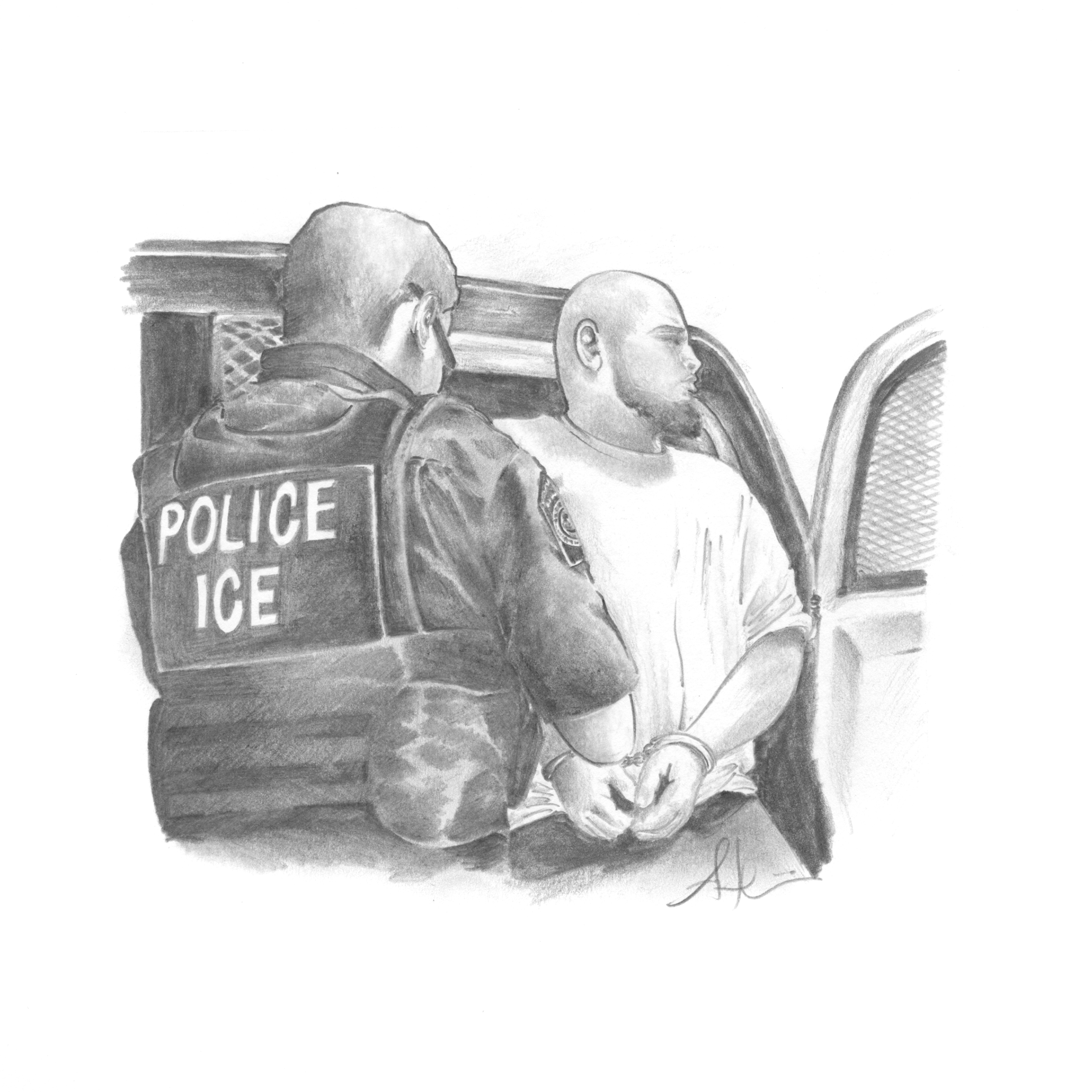
About a month before his date, his counselor told PJ that ICE Immigration and Customs Enforcement might be there waiting for him. But he didn't know for sure, and he put it out of his mind. But the day of his release, when he was sitting in San Quentin's holding tank, he learned that ICE was going to pick him up.
- [30:30]
PJ Bori
As I walk out the tank, there's two ICE officers waiting. I mean, they had handcuffs and everything. They told me, leave my property there. They pick it up. You can't take off my shoes, the Timberland shoes. I take that out because they can't have shoelaces. Took my belt out because you can't have belt either. So I took my belt out, and then they shackled me right from head to toe.
- [30:50]
Earlonne Woods
And then the ICE officers put him in a van.
- [30:52]
PJ Bori
It was like a dog cage van, we call it in that van because it's all metal. Concrete, like, it's metal all the way around is the metal bench. And so they put me in there, and I sat on this metal seat, and it drove me to San Francisco.
- [31:05]
Nigel Poor
In San Francisco, he was processed in an ICE field office, then sent to Sacramento in that same van.
- [31:11]
Earlonne Woods
He was shackled again, so he couldn't get the seat belt on.
- [31:15]
PJ Bori
So I'm sliding. And then I remember, like, when he stopped and I hit my head in the cages, like, and then I cut myself. And that moment I woke up, like, I mean, you know, I'm back in prison again.
- [31:37]
Earlonne Woods
PJ was sent to a county jail in Sacramento that was serving as an ICE detention facility.
- [31:43]
Wayne Boatwright
I think they're just like a camp. I don't think it's like a prison. I think that they have extra rights and privileges in there. They have a good meal. They're taken care of. They're kept safe. They're not allowed to Leave it. They go to school, they go to exercises. They do stuff in these detention centers. They obviously. I've never been to one. I have no idea what it is.
- [32:11]
PJ Bori
I walk into a dorm, it's like shocking. The people are running everywhere, surrounded by people from all different cultures. People who's never been in prison before, people who is off the street, who detoxes from drugs. And I walk in there and it's like, noisy. It's just like 12 o' clock at night and it's like. Like people banging on tables, people yelling and screaming. The TV's all really loud and it's just like. It was. It was. It was overwhelming.
- [32:35]
Nigel Poor
It was a lot.
- [32:36]
PJ Bori
Then I looked around. It's like the bunks are everywhere, right? And it's small space. And then like, they gave me this mattress that's right off the yard. But I remember looking at the mattress, there's, like bugs crawling all over it. It's so nasty. And then they don't give you any type of disinfectant to clean it. Nothing. Just give it to you. Throw three wool blankets here, deal with it. Go in the pod. And that was it. When I was in a county jail, I didn't go anywhere for a year and a half. I was in a pod. I walked 20ft a day, sitting on my bed most of the time. So my muscle was falling asleep, right? And my joint and everything was falling asleep because I wasn't used to walking.
- [33:19]
Nigel Poor
PJ spent a total of 19 months in ICE detention. He was waiting to be deported. And we can't say back to Cambodia because he's never been there.
- [33:28]
Earlonne Woods
But that's what the US government wants to send him. The problem is the Cambodian government hasn't provided the necessary paperwork, so ICE released him from detention.
- [33:39]
PJ Bori
So I'm under ODA supervision right now on the ankle monitor. Anytime Cambodia changed their mind and issue documents, ICE will come and detain me again and then they'll deport me. So I've been out for three months. So I'm living in San Francisco and I'm living in limbo. I'm waiting, see what's going to happen next.
- [33:59]
Nigel Poor
But how can it end? What needs to happen to let you.
- [34:05]
PJ Bori
Stay here right now? If the governor will give me a pardon for my crime, for my past crime, that would take it.
- [34:15]
Nigel Poor
Is that the only thing?
- [34:16]
PJ Bori
That's the only thing.
- [34:18]
Nigel Poor
And how likely is that?
- [34:19]
PJ Bori
It's up to the governor.
- [34:23]
Nigel Poor
If you did get deported, what's waiting for you in Cambodia?
- [34:27]
PJ Bori
Nothing.
- [34:36]
Marco Villa
My release date will be September 25th. In 32 days, I'll be gone.
- [34:43]
Nigel Poor
Marco Villa has been in the United States for 32 years and in a California prison for 10 and a half. He's not a citizen.
- [34:51]
Earlonne Woods
When he's released, he faces another one of those stark choices that prisoners have to make.
- [34:58]
Nigel Poor
And what's gonna happen when you walk out that gate?
- [35:02]
Marco Villa
Well, I'm gonna be asked by the immigration if I want to file my case, file my papers, because I had a Social Security number and a green card, and I had it for 20 years. But what I know, as far as I know, is about 5% possibilities for me to win my case. So they're going to ask me if I want to sign my deportation, and that's most likely what I'm going to do. Because if I file my case, it will take, like, two years or more, and I'm going to have to be in an immigration facility and end up getting deported anyways. I mean, with a 5% chance to stay in here, I think it's not worth it to take that risk.
- [35:57]
Nigel Poor
Marco has heard what it's like in those deportation facilities. And Earlonne, we keep hearing the conditions in them are deliberately harsh so that undocumented immigrants won't stay there and fight their cases.
- [36:08]
Earlonne Woods
If that's so it worked on Marco.
- [36:18]
Nigel Poor
If you knew when you got out you were going to be deported back to Cambodia, would you rather stay in prison, or would you rather get out and go back to Cambodia?
- [36:28]
Pun (also called Sane)
This thought crossed my mind a lot after 20 plus 23 so far. I don't want to sit in Immigration, be detained further. I want to be free. Yeah, I want to be free. So I don't know if I want to challenge the policy or not. At the same time, I do, because this is all I know. I'm not an American on paper, but I still feel like an American.
- [37:12]
Nigel Poor
So Pun's probably going to fight deportation to Cambodia. He really doesn't know what his chances are, and it's going to be tough for him to stay.
- [37:21]
Earlonne Woods
Same for the Swedish phenom. Jassy came over for work, and he doesn't have US Citizenship either.
- [37:29]
Nigel Poor
So when you get out, what are you expecting? What's waiting for you when you get out?
- [37:32]
David Josse
Well, first thing is my son and I always say that the first thing I'm gonna do is I'm gonna fly to Sweden, see my son, and I always tell him that the day after, we're gonna fly to Gambia to see my dad. It bothers me a lot because I have a lot of guilt for getting into this situation and to have him grown up without me.
- [38:28]
Earlonne Woods
On the brighter side, Jossy has a familiar country to go back to. He has family there and he speaks.
- [38:34]
Nigel Poor
The language, so it's probably going to be easier for him to make his parole plans, where to live, where to work and all of that. But if you're facing deportation back to a country where there's nothing waiting for you, how do you plan for that?
- [38:48]
Earlonne Woods
I guess you don't. But this is when it finally matters in prison, if you're a citizen or not. The day you get out.
- [39:11]
Nigel Poor
Thanks to David Josseon, PJ Bori and Marco Villa for talking to us about their hopes and fears.
- [39:18]
Earlonne Woods
And don't forget about Miguel C. Fuentes, who translated Martin Gomez's story at the top of the episode.
- [39:24]
Nigel Poor
And thanks to Wayne Boatwright for sharing.
- [39:26]
Earlonne Woods
His thoughts with us and shout out to Snap Judgment for letting us record PJ in their Oakland studio. When we come back, we'll have a count time for you. That's when we play a little something extra. We want you to hear.
- [39:43]
Shubnum
Dear Son.
- [39:44]
David Josse
I hope this letter reaches you in good health. I spilled some ink up on this paper just to see if you're well. I know you going through the motions cause I'm trapped in a cell but stay strong and get that education under your belt. I know it's hard to crack a smile when you going through hell and no one truly feels the pain but God of yourself but when you stare into the mirror know them tears don't lie. Remember Rick is Grady lady know them tears gonna dry.
- [40:12]
Nigel Poor
There's a lot going on right now. Mounting economic inequality, threats to democracy, environmental disaster, the sour stench of chaos in the air. I'm Brooke Gladstone, host of WNYC's on the Media. Want to understand the reasons and the meanings of the narratives that led us here and maybe how to head them off at the past that's on the Media's specialty. Take a listen wherever you get your podcasts.
- [40:42]
Earlonne Woods
You'Ve probably heard us talk about hello Fresh before they send chef crafted recipes and fresh ingredients to your home.
- [40:49]
Nigel Poor
And this summer they've made the biggest menu upgrade yet. There are now 100 options to choose from each week. I ordered the Moo shu pork bowl and one pan sweet and spicy chicken lettuce wraps with sesame slaw and scallions and Rick is making one of them tonight. I can't wait to see which one he picks.
- [41:05]
Earlonne Woods
Well, I'll be making my own hello Fresh dinner tonight as well. So I'LL let you know how it goes.
- [41:10]
Nigel Poor
Excellent.
- [41:11]
Earlonne Woods
I can't name what it is because it was fancy, you know, but I know it's steak and broccoli, I can tell you that. And I also got another one with some couscous.
- [41:19]
Nigel Poor
Hey, I like how this is expanding your eating horizon.
- [41:22]
Earlonne Woods
It's expanding my vocabulary. They've got healthy stuff on there, high protein, lots of veggies, which I need.
- [41:28]
Nigel Poor
And this is for you, E. You can get steak and and seafood recipes delivered every week for no extra cost.
- [41:34]
Earlonne Woods
The best way to cook just got better. Go to hellofresh.com earhustle10fm now to get 10 free meals plus a free item for life.
- [41:46]
Nigel Poor
One per box with active subscription. Free meals applied as discount on first box. New subscribers only. Varies by plan.
- [41:53]
Earlonne Woods
That's hellofresh.com earhustle10fm to get 10 free meals plus a free item for life.
- [42:26]
Nigel Poor
Sometimes when I walk down into the yard, I hear these guys and I can't see where it's coming from. It just gives me the biggest smile every time.
- [42:34]
Earlonne Woods
Hey. So when I recorded them, I was afraid that I was just bouncing up and down. My head was bouncing up and down. But that's the three guitars. We've been trying to get them recorded forever. And the last time, if you remember, I forgot to push the record button.
- [42:50]
Nigel Poor
Oh, I remember. But this time you redeemed yourself.
- [42:55]
Earlonne Woods
Redeemed myself? I did good. That's Jose Vicente and Jerry, the three guitarists.
- [43:46]
Nigel Poor
Ear Hustle is produced by myself, Nigel.
- [43:48]
Earlonne Woods
Poor and me, Earlonne woods, with help.
- [43:52]
Nigel Poor
From outside producer Pat Mesiti Miller, who also comes in to work with our sound design team. This episode was scored with music by David Josse and Antwan Williams.
- [44:01]
Earlonne Woods
Curtis Fox is our story editor, Aaron Wades, our digital producer, and Julie Shapiro is our executive producer for Radiotopia. We want to thank Ward and Ron Davis. And as you know, every episode has to be approved by this guy here.
- [44:18]
David Josse
This is Lieutenant Sam Robinson at San Quentin State Prison. And I think this story demonstrates that just as divergent of views are outside the walls of the prison, they are inside the prison. And so, as I always do, I approve the story.
- [44:37]
Earlonne Woods
Next time on Ear Hustle, the history of San Quentin, partially based on a book by warden Clinton T. Duffy written in 1950.
- [44:47]
Shubnum
I had known since my boyhood that one of the principal causes of bitterness among imprisoned men is that invisible barrier much more impregnable than a mere concrete wall between them and the outside world.
- [45:04]
Earlonne Woods
Earhas was a proud member of Radiotopia from prx, a collection of the best podcasts around. Hear more at Radiotopia fm.
- [45:14]
David Josse
This is Ali Tambora, who used to be a resident here at San Quentin State Prison. I now work for the Chan Zuckerberg Initiative. This podcast was made possible with support from the Chan Zuckerberg Initiative, working to redesign the justice system by building power and opportunity for communities impacted by incarceration.
- [45:34]
Nigel Poor
I'm Nigel Poor.
- [45:35]
Earlonne Woods
And I'm Earlonne Wood. Thanks for ear hustling.
- [45:44]
Shubnum
Okay, and we're back. We just finished listening to the episode and we are 30 miles away from Frozen Custard and still in Oklahoma. Where should we begin? Chubnum.
- [45:58]
Anita Rao
Really excited for Frozen Custard, but other than that, yeah, it was really interesting to hear this episode. And I kept thinking about, in many ways how things have changed. And I was really interested to know how the folks in the episode are doing now. Do you know?
- [46:16]
Shubnum
Yeah, I do know about three of them. David Jassi, we actually have an update about him at the beginning of a later episode, the episode called Nobody Comes Back. And so he was deported as soon as he got out and did get to go back to Sweden and then visited his father soon after that. And then Poon also was deported to Cambodia. And I think I know Nigel is still in touch with him, and I think we had an update on him in our email newsletter.
- [46:51]
Anita Rao
Yeah, we did. I think it was a couple years ago. We had an update about Pun in the Lowdown, and I think he was just struggling to form a life in Cambodia. Yeah.
- [47:01]
Shubnum
Yeah. And if anybody's interested in hearing more about that kind of story, the main story in Nobody Comes Back is actually also about somebody who came here as a refugee, a child of Cambodian parents, and sort of his interactions with the prison and immigration system in the US and then pj, I am pretty sure he is still in the Bay Area. I think he's still here. Yeah. Last I heard, the other two folks in there I have lost track of. And also Wayne Boatwright, I believe is now out. Any other things that stuck out to you listening through?
- [47:38]
Anita Rao
Yeah, I thought about the importance of possibly having somebody do more reporting now that I'm assuming there's so many more stories to be told coming from ICE detention facilities. And. Yeah, and one thing I always think about is the fact that our country and people who have some opinions similar to Wayne's tend to not think about how we destabilize other countries and the effects of that. And when those people are here, we just. It feels like we tend to Want to throw them away. And so that's just something I thought about during the episode.
- [48:18]
Shubnum
Two things that struck me about the episode one was just it's very old school in its structure in that we, like, start one story and then move to another story. We're kind of bouncing back and forth. It's sort of more like a buffet or something. There's a lot of little elements interwoven between things. Also, count time. I totally forgot. That's such a lovely one. And Earlonne is always talking about bringing back count times, and every time I hear it, I'm like, oh, yeah, we should bring back count time.
- [48:41]
Anita Rao
Yeah, I love the count time. I wonder if that's something the Insight team could do.
- [48:46]
Shubnum
That's a very good idea. Yeah. Yeah. Oh, and we were also, I wondered, just as you yourself are an immigrant, I wonder, just kind of did particular things about this story stand out to you based on your experience?
- [49:00]
Anita Rao
Yeah, I mean, I moved to the US When I was a kid, but, yeah, the experience David Josse had of just the questions people ask. I think I definitely got a lot of similar questions when I moved here as a kid. Like, you know, do people sing the same songs but in a different language in different countries? And I definitely moved to a part of the world where. A part of this country where people don't travel or didn't travel as much. And so it was such a weird feeling to realize that many Americans aren't familiar with the rest of the world in the same way that the rest of the world is familiar with America.
- [49:36]
Shubnum
Yeah, totally. All right, thanks, Shabnam. This was great. I love revisiting these old episodes.
- [49:41]
Anita Rao
Yeah, that was really fun. And thanks to Al for driving quietly while we listened.
- [49:46]
Shubnum
Yeah, Al, our unstoppable tech production manager. I can never. You do so many things, I can never remember what it is. But among many other things, he manages to work Technical wizardry. When we show up in a prison and they don't necessarily have the state of the art sound system that we're used to. Thanks, Al. Thanks. Chubnum.
- [50:15]
David Josse
Radiotopia.
- [50:18]
Nigel Poor
From prx.