← Easy Money: The Charles Ponzi Story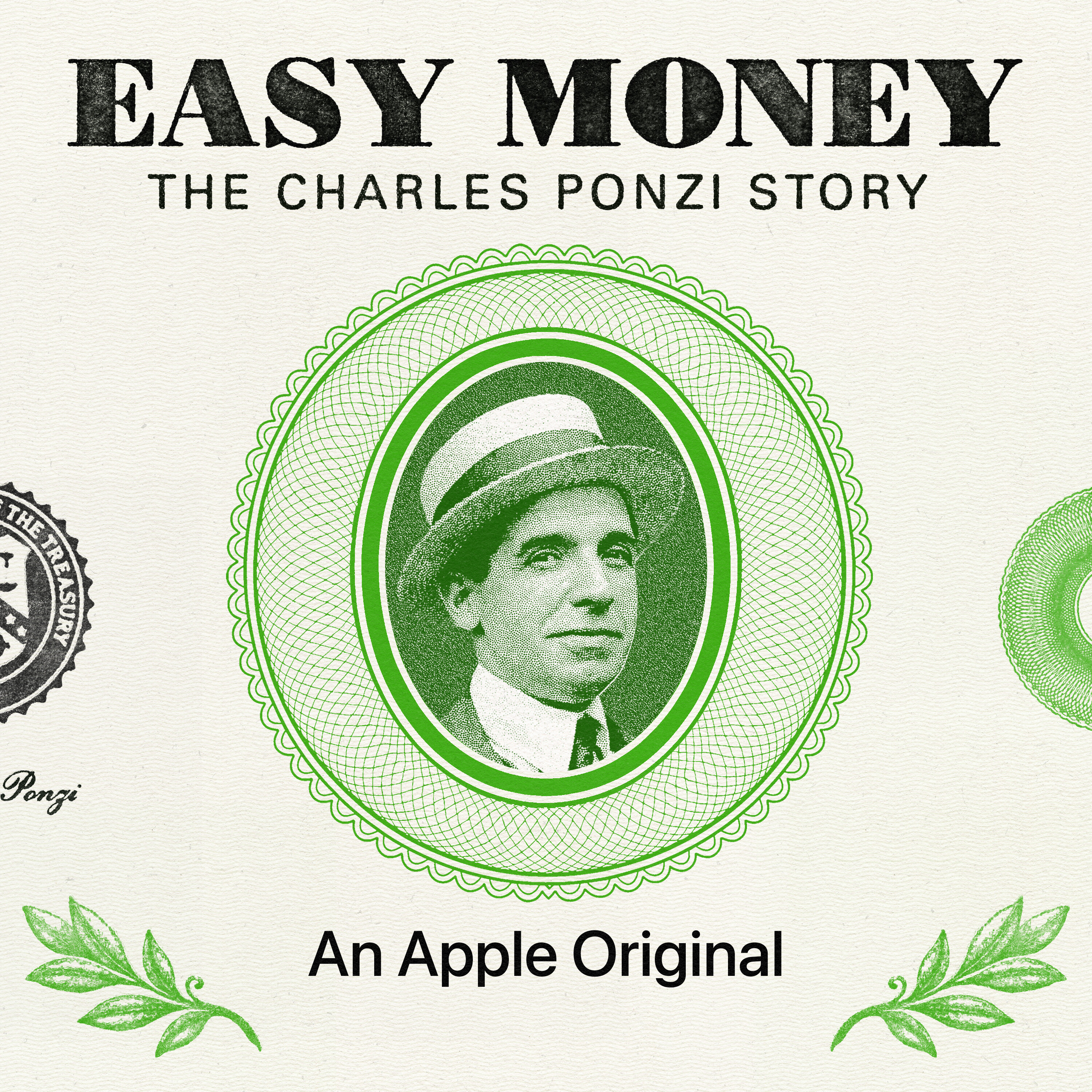
Easy Money: The Charles Ponzi Story
Easy Money: A Live Conversation at the 2025 Tribeca Film Festival | 1
00:58:28
Loading summary
Transcript179 lines
- [00:02]
Maya Lau
And now, please welcome Tribeca's head of.
- [00:05]
Davey Gardner
Podcasts and audio, Davey Gardner.
- [00:09]
Maya Lau
Hey, welcome. Welcome to the world premiere of Easy Money, the Charles Ponzi Story. This show, so good. When I first heard it, the acting, the writing, I love it. It's so happy you're here. I also am very excited because tonight we've got, you know her from maybe the Sopranos. Jamie Lynn Siegler. Give it up. Please enjoy Easy Money, the Charles Ponzi Story. Thank you.
- [00:50]
Jamie Lynn Sigler
Hello, everybody, welcome. My name is Jamie Lynn Sigler, and welcome to an. Oh, thank you. Than welcome to an exclusive preview and chat with the producer and star of the forthcoming Apple TV original podcast series, Easy Money, the Charles Ponzi Story. We'll be hearing clips of the show and get to talk with the executive producer and star, Sebastian Maniscalco. I have a feeling that's why a lot of you are here. But before we bring him out, to help us get things set up and learn how this incredible show came to be, please welcome executive producer and CEO of Ill Media, my old pal, Will Malnati, and the host, Maya Lau. Why did you guys decide to tell this story from over a century ago?
- [01:52]
Davey Gardner
Well, I think it's still very obvious these days that some of the similar kind of themes of this show are relevant, you know, and we're talking about power, we're talking about deceit, we're talking about how you're trying to use the media to spin things and to write about things, write about you a certain way. Charles Ponzi did a lot of that. He was arm in arm with the press until they started to turn on him. Or at least one of these. You know, the Boston Post was the big, big newspaper that started to turn on him. But you just, you still see that all the time, every day. And from just like a business and financial perspective. You know, we've been talking about this a bit. It's just like crypto and AI and all these new things that we have no idea what the actual future potential is of. These things are now starting to really infiltrate into some of these schemes. And like, wow, that's like truly could pour gasoline on an already established issue, which is a Ponzi scheme.
- [02:58]
Jamie Lynn Sigler
Yeah. And learning through this just how common Ponzi schemes are. And I learned the term affinity fraud, which I thought was really interesting. Do you mind explaining to everybody what that is?
- [03:12]
Maya Lau
Yeah. So affinity fraud is when fraud occurs within a social group. So a tight knit group like a church, an alumni network, even your group of friends, anybody that you Trust. Because the thing is, none of us, even people who work in finance, nobody really understands money. We're all mystified about how money actually works and how we can get ahead. And so we have to trust a guy. We have to know someone who says that they have an in. And who are you going to trust more but your cousin, your pastor, whoever it is that you take that shortcut and say, okay, great, I'm going to trust you. You're coming to me with a business opportunity. And that's how these things start. And one of the experts we spoke to said there's no way to absolutely end Ponzi schemes. They still go on. Part of what was interesting to us is they're still alive and well, and it's because people just trust one another and want to make money. And so if you don't want to be part of a Ponzi scheme, one of the recommendations is to never invest with friends or family. Just don't do it, because that's how.
- [04:26]
Davey Gardner
You hear that for everyone paying attention. Just don't invest with friends or family. It's very simple.
- [04:31]
Maya Lau
If your friend has a restaurant that's opening, consider it a gift. Consider it not money that you're going to get back, because that is literally how they start. And so you see that a lot in an immigrant community, which is what Charles Ponzi profited off of, is, I'm an immigrant, just like you. I want to help you. I got ahead. I'm figuring out how America works. And so that is, you know, makes you a sitting duck.
- [04:58]
Jamie Lynn Sigler
And with easy money, you know, everybody wants it. And when you hear that, you don't want to ask questions. You don't want to know how you're getting it right. It's like people would rather be ignorant to it, but when you have the trust factor in, there is when it gets dangerous. So that makes a lot of sense. So to transition to how this story comes magically to life, it's time to bring out Easy Money's star. And again, I'm pretty sure the reason why you're all here. So please welcome to the stage Sebastian Maniscalco. Hi, Sebastian.
- [05:39]
Sebastian Maniscalco
Hello. Thanks for being here, everybody.
- [05:42]
Jamie Lynn Sigler
I've had the pleasure of meeting Sebastian actually, on one of my podcasts, Knock Today, Pal. He was so generous to come to Austin and visit my friend Rob and I. You were awesome. I've been such a fan of you for so long, and you've made a career out of pointing out the absurdities of life. Some of my favorites recently are Bowling shoes. I agree. I don't get it.
- [06:07]
Sebastian Maniscalco
Yeah, I'm not into bowling shoes. Rather bring my own shoes and bowl. So.
- [06:17]
Jamie Lynn Sigler
I support that. So you've been a titan of comedy for so long, you've hosted podcasts, and as of late, you've really begun to make a name for yourself as an actor. You were in the Irishman bookies. That's right. Working with Scorsese, De Niro. Was acting always a goal of yours? Is there a reason that you've sort of been leaning more into the acting side of things?
- [06:47]
Sebastian Maniscalco
Wasn't a big goal of mine. I came out to Los Angeles in 1998 to do stand up comedy, and just on the back of stand up, I started getting roles or started getting an interest in doing roles as an actor. So, yeah, it's not like a burning passion of mine. I'd rather do standup comedy. Comedy. But I like doing acting. I like doing projects that I feel passionate about. That's why I did this one. Because as soon as I read that Ponzi set up shop right next to City Hall, I mean, that's like. That's like a drug dealer setting up right next to the police station. That kind of drew me in. I go, this sounds like a really interesting story to tell. And the way we did it through a podcast is very unfamiliar to me. I thought it was an exciting new venture, and I like challenges. So it's one of the hardest things I've ever had to do. Definitely it was difficult for me.
- [07:49]
Jamie Lynn Sigler
Well, you did a phenomenal job, because I have to say, from moment one, from second one, when the podcast starts and you hear your voice, you're immediately drawn into the story, immediately connected to Ponzi. And as I'm listening to it, all I could feel was like, I want to finish these eight episodes and go to the movie theater or turn on my television and watch you in this film. So I really hope that this leads to that, because there's no one on this planet meant to play Charles Ponzi more than you.
- [08:27]
Sebastian Maniscalco
He's 5 2, by the way. He's a small man, but, yeah, we do look alike.
- [08:34]
Jamie Lynn Sigler
So I just want to start with you telling us, how did you get involved with this project?
- [08:39]
Sebastian Maniscalco
Well, I met Will. He came to one of my shows, and we started talking backstage. He had this project, and he told me all about it, and I was interested in doing it. And you were looking for more things.
- [08:52]
Davey Gardner
To do at the time?
- [08:53]
Sebastian Maniscalco
Yeah, just pile it on. Pile it on.
- [08:55]
Davey Gardner
This guy's touring, like, 340 days a year. And he still made time to do this, which is incredible.
- [09:02]
Sebastian Maniscalco
No, well, listen, it was. Thank you. It was very sweet. It was something that I, again, felt passionate about and really wanted to challenge myself to do. And this was something. If you're unfamiliar with the process of this, which I was. You're in a recording booth with nobody. I could barely act with the people next to me in a movie, let alone people behind glass. So I'm like, how is this gonna work? You know, you're gonna bring in the other actors, they're gonna do their part and they're gonna marry it together. But when you listen to it, it sounds like we're all in the room together. The sound effects, the investigative journalism. To be honest with you, when I was listening to it, I wanted to get to the investigative journalism part more than I. You know, I didn't really like listening to me, I'm like, let's get to, like, this part of it. So that's what I found interesting about it. And another thing I found fascinating, and I don't know if we have any married couples in the audience. Yeah, okay, my wife.
- [10:10]
Davey Gardner
We'll do some crowd work now.
- [10:12]
Sebastian Maniscalco
No, no, my wife is here. She'll vouch for this. Rose Ponzi's wife is in the dark. Doesn't have any idea this is even going on.
- [10:21]
Davey Gardner
Right.
- [10:22]
Sebastian Maniscalco
And she suspects him a little bit. But like, my wife, like, I like to have Chipotle burritos, and they're not really good for you, so, you know, I'll sneak one and I'll come home. And my wife's like, did you ever. Did you have a burrito? I go, I can't sneak anything by my wife. And this guy is stealing $250 million from people. And the wife's walking around going, oh, this is great. Fascinating. Just that alone's a listen.
- [10:55]
Jamie Lynn Sigler
Did you know of Charles Ponzi before? Did you know anything about this story prior to the project?
- [11:02]
Sebastian Maniscalco
No idea that the Ponzi scheme was named after a guy. It's one of those things where you just hear Ponzi and you're like, oh, the president might have made that up somewhere. So I didn't know that the Ponzi was a real life guy. And I was almost subject to a Ponzi scheme. Not almost. I saw it kind of happening in front of me where I used to work, and it was very alluring, the amount of money that was being thrown around. You're like, wow, what are these people doing? But again, I'M Italian and I'm very suspicious of people. All right? So my grandfather didn't even want to put money in, like, the stocks. Cause he thought that was a scam. So I grew up in a family where you just like, tuck your money under your bed and you don't give it to anybody. So. And I didn't even talk to you about this, but if you fall prey to a Ponzi scheme, do you deserve your money back? I mean, to me it's like, all right, you didn't see it. I mean, you didn't see it coming, so you kind of paid the price. I mean, 50% return on your money. Wake up.
- [12:17]
Davey Gardner
All right?
- [12:18]
Sebastian Maniscalco
There's no easy money in life. You gotta work for it. That's kinda how I grew up. And I just find it fascinating that people constantly give their money and thinking that, oh, this is it, this is gonna be the one. It's not.
- [12:33]
Jamie Lynn Sigler
If you've learned anything tonight. So you speak of being in a booth by yourself as opposed to like on a set with other actors. So how was your approach different for this project? What was, how was your preparation? How did you become Charles Ponzi? Because I believed it.
- [12:53]
Sebastian Maniscalco
Oh, thank you. Well, it was difficult for me. It was one of the hardest things I had to do because you have to stand still. And even just sitting here, I feel like I gotta get up, man.
- [13:06]
Davey Gardner
You're allowed to if you want to stand up and do it.
- [13:08]
Sebastian Maniscalco
So I'm always like leaning in. But in this recording booth, there's a microphone there and you gotta stand still and like, project what you're trying to convey through the script. And, you know, if you move to the right, to the left, you know, you're off. You know, they're not getting your voice. So it was difficult for me to, you know, stand still. Also, I'm big on, you know, facial expressions and showing my emotions through either body movement or face. Here I'm doing those things and hopefully on the other side, while you're listening, you feel it. But yeah, I mean, it was, it was. I'm not gonna lie, this was like, this was a tough thing to accomplish for me. And Katie, the director was fantastic and really kind of guiding me through telling me to do it different ways. Will got a little impatient. He was like, okay, come on, let's go. Pick it up. But we had a good time. I mean, it was a good time. It was done over several months. We didn't like, knock this out in a, in a two week time frame because I was Touring, and I was bouncing around the country, so I had to come in when I had time. But, yeah, very, very difficult to do. I'd rather do the visual portion of this, which we will do, by the way. This thing's gonna be a hit, and I would rather do the. It's funny, I'm thinking backstage, would I play it different if it was visual and you could see me? Which I definitely think I would. But, yeah. And thanks for being here, by the way. I know this is. This is. Thanks for coming. I appreciate it.
- [14:45]
Jamie Lynn Sigler
Well, I think it's time now to hear a clip from the show which I think will allow you guys to understand how they feature the dramatic reenactment. So this first clip is from the second episode, and it's a bit of a flashback to Ponzi's life after he first arrived in the United States as a young man from Italy and the struggles that he faced.
- [15:10]
Sebastian Maniscalco
Let's just say I had a lot to learn about things here. Name? Carlo. Carlo Ponzi. Another one. You know, bookkeeping, starting with one very important lesson. That landing in America without money wasn't half as bad as landing without the slightest knowledge of its language.
- [15:32]
Davey Gardner
Yes. No.
- [15:33]
Sebastian Maniscalco
Do you know any English? Uh. God bless Americano. Christ. I couldn't fill out an office job because I didn't understand a word of English. And as a small man of frail physique, I wasn't exactly cut out for manual labor either. Look at this one. He can't be more than 5 foot tall. So job. Still, I had to live, which left me only the most undesirable jobs, from grocery store clerk to sewing machine repairman to insurance salesman. Good morning, madame. Do you want money for your house if it burns? From factory hand to dining room help. I tried it all. Your vino, madame? Sometimes I was fired. More often, I quit before I was fired.
- [16:27]
Davey Gardner
What's going on over here?
- [16:28]
Sebastian Maniscalco
Why the fuck they fought today? You could ask your Italian friends about that one. But however the employment ended or started or whatever it entailed, the point is that those were hard times. Long years with limited options. And even if I wasn't working with my hands, they left calluses. All right.
- [16:56]
Jamie Lynn Sigler
So talk to us about where Ponzi is in his story and why you guys chose to focus on his backstory at this time.
- [17:06]
Maya Lau
Yeah, well, when Charles Ponzi first arrived, I mean, at that time in the early 1900s, Italians weren't considered white in the U.S. they were considered other. They were looked upon with a lot of suspicion, and so I think we're trying to show all of the hurdles that he faced racially and also in terms of language, in terms of finding a job. He felt defeated, he felt resentful that he saw other people succeeding and he felt like, I've been rejected from so many things. I'm going to push my way through. And you get a sense of sympathy for the guy. You know, he was like many other immigrants, just trying to make it through.
- [17:46]
Sebastian Maniscalco
Yeah. And listening to that. Just a side note, this was one of the most difficult things I had to do. Again, you're finding all this out firsthand. They brought in like an Italian interpreter, like, to coach me on how to, like, talk. Like an dialect coach. Like a dialect coach. What did I say? Interpreter. Okay.
- [18:10]
Davey Gardner
We had an interpreter also just to try to figure out what he was saying. But that was separate.
- [18:17]
Sebastian Maniscalco
But, yeah, I mean, those were things that were pining on my head. Am I doing the accent? Like, I just got off the boat. So those were, you know, I would go home at night going, I tell my wife, I don't think I did the accent right. It was a lot of self doubt. But yeah, it was interesting because I have a father who came to the United States when he was 15 years old and he had told me stories about them trying to settle here in America. They ended up in Mississippi. From Mississippi, they went to Chicago. Thank God. No, they told me it was not good, but yeah, so I channeled some of those moments that he used to say about how hard it was to kind of get their feet on the ground here in America. My father opened up a hair salon shortly after coming back from the army. So, yeah, I mean, I could sympathize with the character in that point because, you know, don't know the language. You're coming to a country. I mean, it's really. I mean, when you look at it, I look at my own father and just coming here when he was 15, leaving his friends, leaving his family, all he knew in Sicily, and then coming here three years later, getting drafted to the army and then serving two years and then starting a business, I could see, you know, the pressure that Charles Ponzi had to succeed, especially from his mother. His mother basically sent them and said, go make something out of yourself in America. And I don't think he wanted to disappoint her. So. Yeah.
- [19:48]
Jamie Lynn Sigler
Yeah. And I just, I always love in storytelling, just finding out how people got to where they are, why they made the choices they made. And a lot of the notorious gangsters in our history Felt like the underdogs. They felt disregarded. They felt, you know, disrespected, ripped off, not taken seriously. So, like you said, I mean, there's. There's much that you sympathize for with Ponzi and how hard he tried to make it in America and just how difficult it was, which was, you know, not to condone what he did, but really understand his objective and why he did what he did. I'm wondering, Sebastian, in all of this, like, when you play a character, you have to empathize with them. You're speaking about your father and that type of connection. Is that what really helped you kind of relate to him and get into that character?
- [20:49]
Sebastian Maniscalco
I just grew up around, like, you know, all my cousins, and everybody came, you know, first generation, you know, Americans. So I kind of grew up with an immigrant upbringing and stories of how it was in the old country opposed to how it is here. And so, yeah, I mean, I channeled a lot of those, you know, memories and stories. But listen, to be honest with you, I'm not Dustin Hoffman turning into Rain Man. All this is like a. I'm not saying I became the guy, but, I mean, it's a version of, I guess, myself. And every role, I think you bring your personality or whatnot to the role. I just don't see, like, myself transforming into characters when I play them as actors. It's just, you know, even when I was doing a movie about my father, when De Niro, I had a cry in a scene with De Niro, and I was. Two scenes we did, I wasn't crying, right? And I told him, I go, bro, I need your help here. He goes, well, I didn't want to get involved in your, you know, your process. I go, there's no process. I'm just hoping I cry in this damn thing. So I'm not gonna sit up here and lie to you where I. You know, before I go into the booth, I'm like, okay, I gotta get into Ponzi.
- [22:22]
Jamie Lynn Sigler
Well, you could have fooled me. I bought every ounce of you as possible.
- [22:25]
Davey Gardner
I will say one thing about Ponzi. He is, like, a master salesman. Like, he can sell anything to anyone, clearly, all right? Or he wouldn't have been as successful as he was. Yeah, maybe what he was doing wasn't a good thing, but he. He was really good at it. And so, you know, even over this 15 years where he was struggling, he started to kind of, like, learn what he was good at, and he was able to talk to people and, like, win People over and, like, then he started to learn English and it was over because he could just, like, he could get you to say yes. And when he found out that he was good at it, that's when he started to really take off because he's like, actually, I'm convinced the idea doesn't matter. I'm going to make someone think my idea is a winner. And I think with Sebastian, he's a salesman. I mean, if you've ever seen him, he can turn on that part of him. And I think that's what really allowed him to sink into the character in the way that he did that. Just like, you believe it, you just believe it because he's selling you the.
- [23:34]
Sebastian Maniscalco
There's one scene I think that really depicts this is woman comes back and she wants her money back. And the way Ponzi deals with it is so slick. He's like, yeah, no problem. Give your money back. You know, gives the money back. And she almost feels now like, oh, my God, this guy is legitimate. But he uses that particular moment to bilk other people that were around him during that scene to get their money. So, yeah, like you said, you have to be good. It's a very specific skill set to entice people to give money. And he definitely had it.
- [24:09]
Jamie Lynn Sigler
All right, well, that brings us to our next clip, which is another montage, but this time it shows Ponzi's rise to fame.
- [24:19]
Maya Lau
While Ponzi may have had it working to his advantage that people don't like to ask questions when things look exciting, he still had a lot working against him. I mean, he was nobody, for one, with no name or reputation or decent business contacts. Which only makes it all the more remarkable how quickly things got out of hand.
- [24:38]
Davey Gardner
You heard about this Ponzi character?
- [24:40]
Sebastian Maniscalco
It's the real deal.
- [24:41]
Davey Gardner
My cousin invested with him and says it's all legit.
- [24:45]
Maya Lau
It started, of course, with the Italian community. From there, word started spreading. And once those first investors were happy, it spread even faster. I don't have money just lying around.
- [24:57]
Sebastian Maniscalco
He'll take anything. That's what I'm saying. Folks like us can get rich from practically nothing.
- [25:03]
Maya Lau
In February 1920, just a couple of months after getting started, Ponzi brought in more than $5,000. Roughly $80,000 today.
- [25:12]
Sebastian Maniscalco
I just gave him another 200.
- [25:14]
Jamie Lynn Sigler
Really?
- [25:15]
Davey Gardner
Another 200?
- [25:17]
Maya Lau
Are you talking about Ponzi? The man's a miracle worker.
- [25:21]
Davey Gardner
This dinner is practically free.
- [25:23]
Sebastian Maniscalco
Salute.
- [25:26]
Maya Lau
Soon he expanded beyond the Italians and into other immigrant and working class groups. So much so that in March, he Brought in five times more than he did in February.
- [25:37]
Sebastian Maniscalco
His name's Ponzi. Charles Ponzi.
- [25:40]
Jamie Lynn Sigler
Don't tell me you trust an Italian.
- [25:43]
Sebastian Maniscalco
Could be a scam. Sergei, the guy operates next to City Hall. All of his customers swear by him.
- [25:50]
Maya Lau
Ponzi was on a roll. He opened offices in cities throughout Massachusetts and then in Maine, Vermont, Connecticut, and New Jersey. In April, his monthly takings shot up to $140,000. That's over $2 million today. All in less than five months of operating there.
- [26:11]
Jamie Lynn Sigler
$1,519.
- [26:14]
Sebastian Maniscalco
Wonderful. And what's the name again, sir? Sergey.
- [26:17]
Jamie Lynn Sigler
Thank you.
- [26:18]
Sebastian Maniscalco
No need to thank me, Sergey. Happy to share the wealth. See you in 45. Next.
- [26:25]
Maya Lau
Soon, it was an empire. It was chaos.
- [26:29]
Sebastian Maniscalco
New customers on your left, returning customers on your right.
- [26:33]
Maya Lau
In May alone, He brought in $400,000, which is more than 6 million today. And in June, he made. Okay, I'm sure you get it. Ponzi had a lot of money coming in. To the outside world, he seemed like a bona fide success story. His business was growing, and his office was even right next to City Hall. Just another thing that added to his legitimacy. But keep in mind, for every dollar he was taking in, Ponzi was putting himself 50 cents in debt, which meant that if he didn't figure things out soon, he was going to be in a lot of trouble.
- [27:08]
Sebastian Maniscalco
And I was gonna bring a lot of people down with me, which is why I only had one option. Figure it out fast.
- [27:22]
Jamie Lynn Sigler
So I'm assuming I know why you picked this clip. Because you could feel the urgency in which things were building, how quickly things were going. And, you know, we talked about kind of the state of delusion that he would have to live in. Right. Kind of believing his own bullshit, in a way. But do you really think he didn't realize the trouble he was in? Do you think that he really thought he could catch up to it at some point?
- [27:52]
Maya Lau
I think he probably knew he was in trouble at some point, but I think he just thought he wasn't there yet. You know, it's the fake it till you make it. Like, I just haven't made a profit yet. And that is something you see even today in Silicon Valley, in many different areas. People believe in someone who has vision. They're investing in the person. They're not necessarily investing in something that they've done their due diligence on. And so I think that, you know, he got in. He probably, at least some point, yeah, felt the heat. But as we saw from his love Letters. Years later, he was still pitching new scams, saying that he was going to do some kind of import export scheme with trucks trying to sell swampland in Florida. This is after he served prison time, didn't learn his lesson. So he still thought he had a great idea and it just hadn't panned out yet.
- [28:53]
Davey Gardner
One of our guys, one of our experts in this show, his name is Eugene Soltis, and he's here tonight. Where is he? I think he's. Yeah, there he is, front and center, baby. Eugene Soltis is a professor at Harvard Business School, if you've ever heard of it. He is also one of the foremost experts on Ponzi schemes and Ponzi schemers, and has spent more time interviewing Bernie Madoff than anyone. So I guess I'd like to ask you. And we gave him a mic just in case we wanted to ask him something. I want to ask you, Eugene, when you're talking to someone like Bernie Madoff, same question. Like, do you think that they think what they're doing is legit and what they're doing is ultimately going to pan out or going to work? And thank you for being here, Eugene Soltis.
- [29:48]
Sebastian Maniscalco
Thank you.
- [29:49]
Davey Gardner
And this is awesome that you've made a nuanced, complex financial story, like, accessible in depth. I mean, it's really an awesome achievement. I mean, that question that I wanted to ask Charles Ponzi is the one I did have the chance to ask Madoff.
- [30:04]
Sebastian Maniscalco
I spoke with him every Wednesday night for four years consistently and asked him that question a lot, and he couldn't answer it. He was that optimist that we're talking about. He always thought he would come up with something new that would get him out of it.
- [30:19]
Davey Gardner
The one time he did, actually, Madoff's.
- [30:22]
Sebastian Maniscalco
Case said, you know, the thing I hoped for, and it was actually pretty dark, is he actually reflected back on.
- [30:28]
Davey Gardner
Actually on 9 11, when banks lost.
- [30:31]
Sebastian Maniscalco
Their vaults in the World Trade center, and he said, you know what? Maybe there will be a disaster and it'll wipe my records away. And in doing so, I could get a clean slate. That was his best plan B, otherwise it would just fall into his kids, which he didn't think would happen. So it just shows that delusional optimism that people in this situation have.
- [30:58]
Davey Gardner
Thanks, Eugene.
- [31:03]
Jamie Lynn Sigler
And you also spoke of, like, how quick he was on his feet, how quickly he would pivot in moments from one room to the next, like, getting news that he was being audited and walking out into another and still pitching people. I mean, it takes a very specific type of person. And you guys all together really were able to help the listener really understand that and understand him in a beautiful way.
- [31:33]
Maya Lau
Yeah.
- [31:33]
Jamie Lynn Sigler
I also want to, again, acknowledge the format that they have here, because, like I said, you're given the history and the education from all these fantastic journalists and then the dramatic reenactions, so you really get to absorb and experience the story from every single angle. You're riveted the entire, entire time, truly. So I want to take us on to the next clip. So in this scene, we have Ponzi and someone from his past who shows up unexpectedly at his office one day.
- [32:10]
Davey Gardner
Yeah, I actually. I'll give a little more context to this one if I can, just because, you know, this is hard for you guys. You're not actually watching or, you know, listening to a full episode. So Ponzi spent time in a lot of different places, and one of the places he spent time in was Montreal. So he actually did leave the United States for a little while. And in Montreal, he was working, actually, at a bank, and he got caught up in, like, the closing of this bank, and somehow. And you'll have to listen to all the podcast for the full detail, but somehow he got in trouble for cashing a forged check. And this happened years before he came to Boston, and all this happened. And so he knew that he had something in his life that he never wanted anyone to know about. So he has this secret, because, of course, if anyone knew that he had been in prison, especially for something related to financial fraud, he would not be legitimate, and people would not give him their money. So this person who shows up one day is a real thorn in Charles Ponzi's side for the series because he has the one secret that Charles does not want anyone to get out. So this is him showing up to his office unannounced. So this is the reception I get.
- [33:44]
Sebastian Maniscalco
After all this time. Look, sir, I'm really quite afraid that you've mistaken me for someone else. Ah, yeah, the other five foot two Italian I bunked with for years. Come on. What are you playing at here? Well, maybe if I go out there and start telling people the story of our meeting, it might shake something loose for you. No, no, please. Oh, Lou. Is that Luke? A. Wow. What a pleasant surprise. There he is. Forgive me, Lou. You. You look good. And my brain isn't what it used to be. Huh. Well, by the looks of this place, your brain is working pretty fine these days, Bianchi. Well, it's actually Ponzi. I go by Ponzi.
- [34:24]
Jamie Lynn Sigler
Now.
- [34:24]
Davey Gardner
Yeah, yeah, yeah, yeah, yeah.
- [34:25]
Sebastian Maniscalco
I saw that in the paper. Ponzi. Not as elegant, I have to say, but, hey, everyone's entitled to a clean slate, huh? Probably should have thought of that myself. So, Lou, what brings you here? Well, you, of course.
- [34:41]
Davey Gardner
I saw you were doing well, and.
- [34:42]
Sebastian Maniscalco
I thought, hey, maybe I could be useful to you. Really? You're here to help? Well, I just figured we could work something out.
- [34:49]
Davey Gardner
I mean, I could do a lot of things.
- [34:51]
Sebastian Maniscalco
I could talk, for instance, or I can be quiet. Yes, very versatile. I gotta tell you, this hurts, Bianchi. Excuse me? I mean, Ponzi. There I go again. That could be tough, you know, getting the name right without incentive. I'm guessing. What?
- [35:09]
Davey Gardner
You offered me a job.
- [35:12]
Sebastian Maniscalco
Suppose I could find some use for you. But I expect a certain amount of. I don't know how you say this. Cooperation from my employees, of course. And as long as I'm fairly remunerated for my services, I don't think we'll have a problem cooperating. Oh, but on that subject, could I get an advance on my first week's salary here? But by accepting this money, you're entering into a binding gentleman's agreement. All right. Ah, come on. You know me. I'm nothing if not agreeable. Call tomorrow. My assistant will set everything up. Now go, please. I got work to do.
- [35:55]
Davey Gardner
2, 3, 4, 5, 6, 7, 8.
- [35:57]
Sebastian Maniscalco
Could you at least wait until you're out of sight the counter, huh?
- [35:59]
Davey Gardner
Oh, yeah. Sure thing, Mr. Ponzi.
- [36:03]
Sebastian Maniscalco
Ha ha.
- [36:04]
Davey Gardner
Would you look at that?
- [36:05]
Sebastian Maniscalco
Got it right on the first try. Astonishing. They'll print your name for centuries to come, no doubt.
- [36:11]
Davey Gardner
Great running into you again, pal.
- [36:13]
Sebastian Maniscalco
Feels like fate. Does he? Just gotta say, I mean, it sounds like we're in the room, right? I mean, that guy never met that actor. And the door, the papers rustling. I was, like, amazed when I heard this. I was like, man, it just. It didn't. When I was doing it, I didn't envision that to be the end product. So, yeah, hats off to you. It was really special to hear.
- [36:47]
Davey Gardner
Well, to that, I think. Listen, the goal is for people who, you know, maybe exclusively listen to nonfiction podcasts, for you to have something that is absolutely that, and that is the heartbeat of this show, but to also be able to have certain things feel like they're coming to life in front of you around this reporting. And I think that gave us an advantage in a lot of ways to really make moments stand out and come to life.
- [37:18]
Jamie Lynn Sigler
Yeah. And as. I mean, as somebody that absorbs A lot of entertainment. You know, I'm sure, like many of you, I watch TV with my phone in my hand a lot of the time. And, you know, this kind of takes you back to, like, an old way of storytelling, like when people used to, like, gather around the radio and listen, and you're. You're fully invested, you're riveted. And this, like, you're saying, like, hearing the noises in the room, it just. It stops you in your tracks. It makes you use your imagination. And I think it's going to be a new way of storytelling that people are going to be really interested in. I know I was. But explain to us what was going on in that clip. He was essential. There was some blackmailing going on, essentially. Right?
- [38:01]
Maya Lau
Yeah. I mean, this is a moment, one of those turning points where Ponzi could have come clean. He could realize, look, my past is going to catch up to me. This guy is going to spill the beans and let everybody know that I was in prison before. And I think that's one of the things that we explore, is there's all these turning points where I think all of us in life have moments where we could have made a bad decision or not, and Ponzi just keeps making the bad decision, and that's how he gets to where he is. So, yeah, I mean, he. This was the big secret. This was the big thing that he didn't want his wife to know, he didn't want to anybody to know about his past. And it comes to haunt him especially.
- [38:48]
Davey Gardner
And specifically this photo. This photo and its existence becomes the smoking gun around his past. And this is, you know, this is a mug shot that he took in Montreal that eventually, once the Boston Post really sinks there, their hooks in on this story, and they are determined to take him down. Once they get this photo in their hands, it's the beginning of the end for him. So he knows it exists. Maybe. But once he finds out that someone else knows it exists, it's problematic.
- [39:27]
Sebastian Maniscalco
Again. Again, Rose doesn't know the guy was in prison. It just goes to show you, we're 100 years and the Internet, right away, you could find out what somebody's all about. This guy's walking around with a prison record and nobody knows, which I also found fascinating listening to the podcast.
- [39:49]
Maya Lau
And back in those days, you could just change your name and move to a different city and be a whole new person, and that can't happen anymore.
- [39:58]
Davey Gardner
Yes, he has this as a secret that no one knows. But, you know, one thing that really drew us to this story is this character in Charles who is just so dynamic. And I think one thing that we really looked at was, is he all good or all bad? And I don't think he's either. I think that we found this character so fascinating because you actually are cheering for him and rooting for him in some ways, and you're watching his real, you know, behind the showman life, you know, behind the curtain. And one of the secrets that we also find out about is that way before this Ponzi scheme, he had done something remarkable in Alabama. Actually, I feel like I'm spoiler alerting, but. Or I should be spoiler alerting, but yeah. Anyways, this is an interesting moment in this is that we find out something that he did in Alabama that is incredible because it's such a charitable thing that no regular person would ever do. And he really. I won't spoil all of it. He gave something that he had, maybe the only thing that he had, to someone else in a very selfless act. And it was documented in papers. And so he never tells anyone about this. This selfless act that he did. That again, it just goes above and beyond normal. And I think once we hear about that in the podcast, I think it makes you feel something different for him. It makes you feel a different way about this person that, you know, you're seeing rip people off. And those are the interesting characters. Those are the people we want to see rather than, you know, there's all these podcasts out there that are just about scammers or, you know, documentaries that are just about scammers.
- [42:01]
Jamie Lynn Sigler
Yeah.
- [42:01]
Davey Gardner
This is about more than a scammer. It's about a real person who had real feelings and a real, you know, love life and a real. A real road that we try to follow.
- [42:13]
Jamie Lynn Sigler
The greatest characters in history, fictional or not, I got to live a life with one of them. Tony Soprano. Right. You know, he was like. He was not a good guy, but we all loved him, and we all rooted for him because we saw him in his entirety as a human being. And one of the beautiful parts about Charles Ponzi and one of the reasons why you fall in love with him is his love of. With Rose and their love for each other, which you guys spend a lot of time on because of the love letters that you've been able to discover between the two of them that they sent each other while he was in jail. So could you guys tell us more about their love?
- [43:02]
Davey Gardner
Can we see the love letters? I know we have a photo of the love Letters, too. It just helps you get in the mood.
- [43:11]
Maya Lau
Yeah. So one of the cool things that we were able to do, I flew to Boston from where I live in Mexico City, and went out to sit with some of Rose's descendants. So she didn't have kids, but these were people that were her nephews and their kids. And they kept copies of a big stack of letters, both handwritten and written on a typewriter. And, you know, he would say things like, hey, kid, you know, it's been too long since I got a letter from you, or your last letter was this or that. And they really, as much as their relationship changed, and they actually ended up getting a divorce at one point when he was in exile, they kept writing to each other and they kept having this epistolary affair where they were. There's even one letter where he says, like, I can't believe that photo you sent me. You know, like this nude photo, basically, that we didn't see. But like, he. He referenced it and there were all these references to how he still thinks about her. And he wound up in Brazil at one point toward the end of his life, and he was trying to get her to come down there, and she was even suggesting that I. That she come down there. So we just know that there was that real thread in his life. She had desperately wanted kids, and he wanted them too. But, you know, when do you find time to have kids when you're running a Ponzi scheme? And so it's actually really sad that they never got to do that. And, you know, they. They didn't have the happily ever after that they had envisioned because of his self delusion and of his drive to succeed in the most in a dark way.
- [45:08]
Sebastian Maniscalco
If your mother looked like that, wouldn't you steal? I mean, that's who was telling him to go make it in the Americas. I mean, that's stone cold. Look at that.
- [45:24]
Maya Lau
Yeah. Poor Rose really was in a relationship with both Charles and his mother because she was a big presence.
- [45:32]
Jamie Lynn Sigler
Well, and, you know, like you said, she didn't know about what he was doing for so long, but even when she knew what was going on, she stood by him. She stood by him through the 10 years that he was in prison prior to him being exiled. So there was some real love there. But that brings us to our next clip. This. This clip is from episode five, and it's between Ponzi and Rose on the morning of the first front page story. Doubles money within three months has thousands of investors.
- [46:07]
Sebastian Maniscalco
I know a front page headline of The Post. It's practically an advertisement. A proposition fathered by Charles Ponzi, head.
- [46:16]
Jamie Lynn Sigler
Of the securities Exchange Company, is sweeping Boston. People are falling over themselves. This almost literally, to loan him their money.
- [46:24]
Maya Lau
The piece was largely glowing. It included that headline about doubling money, as well as column after column of Ponzi regaling the journalist with his life story. But there was one interesting detail missing.
- [46:37]
Jamie Lynn Sigler
All this talk about your years slogging about America, and you didn't even mention Alabama. Why not tell the journalists what you you did for that poor woman?
- [46:45]
Sebastian Maniscalco
Because I didn't do that for publicity, Rose.
- [46:48]
Maya Lau
We'll pick up on that later. For now, Ponzi figured there was enough information for the public to make up their minds about him.
- [46:55]
Sebastian Maniscalco
Look at this part. All my life I have said that if I make $1 million, that I could live happily and comfortably. Anything I earn over and above that will be spent on trying to do good in this world.
- [47:10]
Jamie Lynn Sigler
I'm pretty sure we have more than a million dollars already.
- [47:12]
Sebastian Maniscalco
It's a figure of speech. Just keep reading.
- [47:15]
Maya Lau
That quote about stopping when he got to a million dollars was a real line from his interview, one that helped Ponzi come off looking good, a hero for the common man. But there were other parts to the story, parts that were less flattering.
- [47:32]
Jamie Lynn Sigler
What it says here that you're under investigation.
- [47:36]
Maya Lau
It did. Since news of the Daniels lawsuit hit the presses, authorities had started paying more attention to Ponzi.
- [47:44]
Sebastian Maniscalco
It's just a small part of the story.
- [47:45]
Jamie Lynn Sigler
Multiple investigations, the state's attorney general, the district attorney, the banking commissioner, the Postmaster general.
- [47:52]
Sebastian Maniscalco
Look at the part right here. Ponzi himself is an interesting figure.
- [47:57]
Jamie Lynn Sigler
Investigations began several months ago into what.
- [48:00]
Sebastian Maniscalco
Some are calling says quite clearly that these investigations haven't found anything. I mean, come on. Do you think Rockefeller was never subjected to government scrutiny?
- [48:08]
Jamie Lynn Sigler
Oh, so we're Rockefellers now?
- [48:09]
Sebastian Maniscalco
We're better.
- [48:10]
Davey Gardner
We're us.
- [48:13]
Sebastian Maniscalco
I gotta get going.
- [48:16]
Jamie Lynn Sigler
Don't forget my family's coming over to meet your mother tomorrow.
- [48:19]
Sebastian Maniscalco
I'm looking forward to it. And speaking of Mama, make sure she sees the paper, will you?
- [48:23]
Maya Lau
That's not the most important thing.
- [48:25]
Sebastian Maniscalco
It is to her.
- [48:33]
Jamie Lynn Sigler
What is it about Italian men and their mothers. What do you think it is?
- [48:38]
Sebastian Maniscalco
Lana, you want to take that? You know, once you find out what this guy did in Alabama, it's so extraordinary. I mean, not even like a normal person would. Would do this. You're going to completely have a different look at Ponzi because you sit up here and you go, how could you feel sorry for A guy that ripped off $250 million from people. But once you hear about this story that what he did, it's gonna change your perspective of the guy. So when I read that, I was.
- [49:12]
Jamie Lynn Sigler
Like, geez, you talk about in episode five, that being the peak of Ponzi. What does that mean?
- [49:19]
Maya Lau
Yeah. So he had taken in so much money that it was like cash back then. It was just sloshing around his office, and people were still giving him money. And then during this time, though, people had suspicions of him, and the authorities were after him. The Postmaster General, the banking Commission, other bankers were noticing how much money people were taking out of their accounts to give over to Ponzi. And so there was this growing suspicion around him that eventually led to enough attention that he got found out, which we get into from a kind of unlikely source.
- [50:07]
Jamie Lynn Sigler
Yeah. And I thought was very interesting was like, was it the Post? That was the Boston Post. The Boston Post was sort of running the negative stories about him, and he would kind of turn and double down, and then was somehow able to get the other papers to rally behind him and have all these journalists kind of defend him and celebrate him. And that was really impressive that he was able to do that.
- [50:32]
Maya Lau
Yeah. And I mean, like any. You know, I've covered many politicians in my career. The really good ones, they know how to use a scandal. They love attention. And so that is just another opportunity for them to get in front of the cameras and do their spin. And there was even some negative headlines that came out that brought in more money for him because it just brought more publicity to him. But, yeah, it ended up being another newspaper man who had retired from that and had a Post journalism pivot to public relations, a very common thing to do, and became his PR guy. His name was William McMasters, who ended up looking around the office and kind of asking Ponzi questions and not getting very good answers. And that was the guy who. That was where things started to turn, where you really had somebody from the inside who had the power to bring him down.
- [51:31]
Jamie Lynn Sigler
And he was the ultimate whistleblower, right?
- [51:33]
Maya Lau
He was. It was even just a few days into working with Ponzi that William McMasters, this former reporter turned PR guy, did enough digging to find that Ponzi actually didn't have the money that he claimed he had. And McMasters went to the Boston Post and said, I want to write a story. I'm willing to put my name on it. And that is very rare. You know, most Ponzi schemes, there's just nobody we Talked about how the employees don't know, the wife doesn't know. It's rare to have somebody on the inside who's willing to stake their entire reputation on something like this because Ponzi could have gone after McMasters and taken him down. So this headline, hopelessly insolvent was really the beginning of the end for Ponzi.
- [52:30]
Jamie Lynn Sigler
And McMasters wrote his own memoir. Correct. Which did you use a lot for your research in this?
- [52:35]
Maya Lau
Yeah, he wrote a memoir which people didn't know about until about a decade ago. His granddaughter donated many of his effects to a library that somebody on our team was able to go and sit and look at. You can't check it out. You know, it's not like a bound book you can walk out of the library with and went and read it. And we have McMaster's account. So that was really useful to be able to read Ponzi's version of events and weigh that against McMaster's account and really put together that story.
- [53:10]
Jamie Lynn Sigler
So even with eight episodes full of so much, I'm sure there was a lot that you couldn't fit in. Are there any things that you wish you could have explored more that maybe you could share with us tonight about Charles and this story?
- [53:26]
Davey Gardner
Oh, yeah, real quick. I mean, this is like he faked his death at one point. Like we didn't even talk about that. This is a guy, he put together this disguise at one point when he was running. He did some crazy shit. What else? He.
- [53:42]
Jamie Lynn Sigler
Oh yeah, Miniseries.
- [53:43]
Davey Gardner
Oh yeah. He was trying to sell Swampland, which was like a huge scheme type thing back then because, you know, you couldn't actually build on it. What else?
- [53:53]
Maya Lau
Well, his cousin was a pilot for Mussolini, so he's the most Italian thing.
- [54:00]
Davey Gardner
You could ever come up with.
- [54:03]
Maya Lau
We didn't have time to really go into it, but he kept close ties with his Italian family. And his cousin who had been a pilot for Mussolini, ended up fleeing Italy post Mussolini, as many Mussolini aligned Italians did to South America and started an airline. And that is where Ponzi got a job working out of Rio de Janeiro. And so I actually spoke to Ponzi's cousin's great grandson who lives in Chile and knew that he was related to Ponzi, talked to me a bit about it, but didn't know much more than we knew, knew what is available on the Internet and stuff like that. And so, you know, Ponzi really has this very far flung story connected to some really interesting characters in history. And there's lots of other Threads, you could go down of how far this reaches. But he didn't have kids and he doesn't have siblings, so it was hard to.
- [55:05]
Jamie Lynn Sigler
But he has a legacy.
- [55:06]
Maya Lau
But he has a legacy. And those are some of the threads that, if we had more time, we could explore.
- [55:13]
Jamie Lynn Sigler
So, Maya, as a financial reporter, what are some takeaways that you hope people leave this tonight? And after listening to the podcast, considering how common Ponzi schemes are, there's no.
- [55:29]
Maya Lau
Such thing as guaranteed returns, as we talked about, even if it's a guaranteed, you know, 12% return, something that sounds reasonable. No such thing as guaranteed returns. If. If your financial advisor asks you to invest in his fund but asks you to make out the check to his name, that is a red flag. All investments should be registered. You can go to finra F I N R A. You can see the securities and Exchange Commission actually regulates investments like that. Don't invest with friends and family. If it sounds too good to be true, it probably is. Yeah. I mean, there's a lot of things you could do. But interestingly, Ponzi schemes can't really be stopped. People keep doing this. People keep believing it. I even talked to some people just in my personal life, and they mentioned to me, oh, yeah, I would probably invest with a friend over, you know, some person that I don't know, even if they're a registered, you know, investment advisor. So, you know, this is just one of those interesting things that keeps coming up.
- [56:43]
Jamie Lynn Sigler
Well, I just want to close it out by asking you, Sebastian, you spent so much time with Charles as Charles, if he was sitting in this audience in that front row today, what would you like to say to him?
- [57:00]
Sebastian Maniscalco
I guess the one question I would like to ask Charles would be, did you plan on stealing from everybody? I guess because I know the good side of Charles. So I would like to know if he went into this with the intention of ripping everybody off, which I don't think he did. I just think he got in over his head. And maybe I'm naive and thinking that way, but I would just like to know if he started this whole thing by going, I'm gonna steal every dime I could get.
- [57:32]
Jamie Lynn Sigler
I think after finishing listening to this, a lot of other people would have that same question because of how brilliantly you played him, and you guys set the world and helped us understand him and everything.
- [57:44]
Maya Lau
You would be absolutely tickled if this is happening. This is like his fantasy.
- [57:50]
Jamie Lynn Sigler
All right, well, I just want to thank everyone here tonight on this stage and everyone here in this audience. Thank you for coming. Have a wonderful night. Thank you so much.
- [58:01]
Maya Lau
Thank you.
- [58:17]
Sebastian Maniscalco
Sa.