← The Signal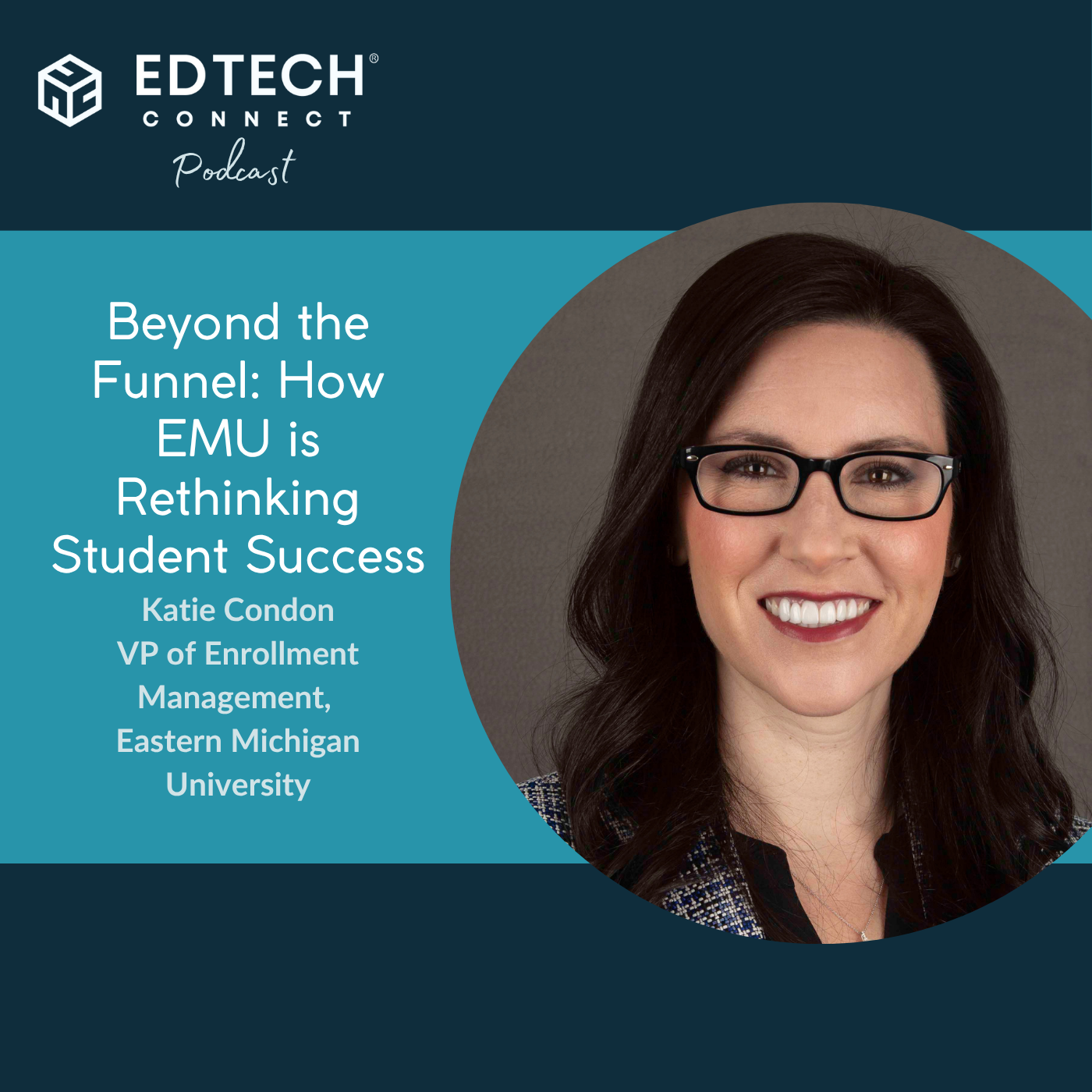
The Signal
Beyond the Funnel: How EMU is Rethinking Student Success
00:30:29
In this episode of EdTech Connect, host Jeff Dillon sits down with Katie Condon, Vice President of Enrollment Management at Eastern Michigan University, to unpack the urgent challenges and innovative strategies shaping higher ed’s future. With over a decade of experience spanning West Virginia University and EMU, Katie offers a candid look at how regional publics can compete amid shrinking demographics, financial aid upheavals, and rising student demands for ROI. From her viral 4,000-handwritten-note campaign (yes, even the rowing team pitched in) to rethinking transfer student pathways, Katie shares how she balances data-driven decisions with human-centric approaches. Discover why “many” and “a lot” are her least favorite words, how AI could revolutionize financial aid transparency, and why teaching freshman communication classes made her a better leader. Tune in for actionable insights on turning enrollment crises into opportunities—without losing your authenticity. Regional vs....
Loading summary
Transcript62 lines
- [00:00]
A
I always try to encourage teams to come to it with curiosity. What I find is that people like to ask for data that's going to prove them right and that's the wrong way to use data. And so I always try to like ask the question and assume positive intent of why they're asking for it or what they really want to know. But I feel like that's an important component of it all, is it's not there to just prove that you're right.
- [00:28]
B
So this is the podcast where we bring so many different types of leaders in technology, from institutions across the board, in academia. I'm always trying to bring a fresh perspective to the podcast. And with the current challenges in higher ed, including private competition, the demographic cliff, political challenges with funding, I'm really excited to bring this next guest. Katie Condon is the Vice President of Enrollment Management at Eastern Michigan University where she leads strategic initiatives to improve access, retention and student success through a data informed lens. With her nearly decade of experience at West Virginia University, spanning roles in recruitment, financial aid, strategy orientation programs, and teaching, Katie brings a comprehensive understanding of the student journey. She's known for her collaborative leadership style and her ability to turn complex enrollment challenges into into actionable plans. From developing a $2.2 million aid strategies to managing large scale ambassador programs and outreach efforts, Katie has built systems that align institutional goals with student needs while never losing sight of the human element in higher education. Today, Katie joins us to share her insights on navigating the evolving Iroma Cliff landscape, why data doesn't replace intuition, and how higher ed leaders can create environments that truly support student success. So welcome to the show, Katie. I'm so excited to have you today.
- [02:03]
A
Thanks so much for inviting me, Jeff. It's a pleasure.
- [02:05]
B
I want to start you have experience at a few, a couple institutions. You have so much experience in enrollment management both at WVU and now Eastern Michigan University. What are the major differences or surprises you've encountered moving between institutions?
- [02:23]
A
Yeah, absolutely. So two pretty different institutions. And I actually started my career, not my career, but my educational career at a really small liberal arts college. So I've kind of seen like a really small liberal arts. I graduated with like 300 students and my bachelor's degree, then did my master's at West Virginia and stuck around there and then now at Eastern. So I've seen like the full gamut of institutional sizes. Yeah. But for me, the largest differences between like an R1 flagship institution and more of like a regional public institution really have to do about resources. Right. So at a Large institution, there's one person and they're really heads down and they're focused on this one aspect of this one project. And the smaller the institution, the more hats they, that you wear. Right. And so you're a little bit of this, a little bit of this, a little bit of this. And overall there's just the resources as well as kind of at larger institutions I think that there's a little bit more opportunity for failure and or they lean into it a little bit more. They're, they're more willing to take risks because they, the risk seems smaller. But at a regional or smaller institution the risks seem bigger. Right. Because there's a lot to lose if something doesn't work out. So I feel like regional publics are a little bit more risk inferred comparable to a large institution. And the last difference is of course just the recruitment and enrollment of students. So the institution at WVU we were 50% non resident. And so that makes it just an entirely different recruitment strategy when you're trying to get students from all over the US versus a regional that 80% of our students at Eastern are coming within 100 miles of us. So a lot of differences, but also a lot of similarities in that you still have to call students, you still have to email them, you still have to send many, many reminders, all of those good things.
- [04:08]
B
I've seen a difference from when I work with smaller schools to the really big R1s and Ivies in decentralization, all the silos, it gets so much exponentially more complicated the bigger the school. Seems pretty obvious. But have you seen those challenges too? Like maybe smaller schools? Yeah, they don't have the resources, but at least they're kind of centralized and it's easier to maybe implement a site wide initiative. Is that.
- [04:35]
A
Yeah, I do think there's opportunities one at a larger school there's a lot of people with a lot of opinions because they're really focused again on that kind of one project, one task, one college, one school, one area of the institution. At a, at a smaller school you have to be nimble and you have to think about, okay, how will this affect every student that you have here, not just the students in this one program. There's a lot more trickle down of students. And so yes, that is, can be very refreshing when it's slightly easier to get something onboarded and get people onboarded just due to the size.
- [05:07]
B
And you're always, I think enrollment management leaders are always looking at data. Right. We have to be data driven. You know, you think you might be the first one on this podcast that's really an enrollment management leader. So I'm excited to talk a little bit about this. You know, everyone wants data driven decisions. How do you define data in this evolving world in the context of enrollment management?
- [05:29]
A
Yeah, it can become a little exhausting sometimes, right, to think about all the data that's available out there. But really, if it's not actionable, then why do we need it? And so that's always the question of, okay, like, why are we collecting this? Is it useful for us? If it's not going to lead to a call campaign or an email or a change in a policy or something like that, then it's probably not data that we need. But for me, I think the important thing about enrollment management and student success is the words many and a lot. My staff know that those are my two least favorite words is when people come to me and they say, well, a lot of students said this, or many of our faculty had this experience, right? And they're like, no, I want a number. Because your definitions of many or a lot could mean drastically different things. And so I remember having a colleague one time who was really, really reactive to negative feedback on responses. And so we were overseeing orientation and we got one negative response out of like 2,000 reviews, one negative response about the food available at the event. And they were just ready to throw up the towel and ready to be like, let's change everything, let's redo the menu. And I'm like, no, no, no. That's 1,999 people that didn't say anything negative about the food. But like they, in their brain, it was a lot of people said negative things about the food. And so therefore we must change the entire menu. And so that's when I think that data is really, really important and that it needs to be contextualized. It can't just be here, we're up, we're down, we're in route. That could mean drastically different things. If you're up in part time enrollment versus full time enrollment, or if you're down in your regional market and up in your non resident, especially if you're charging non resident fees. So every bit of data needs a little bit of context.
- [07:07]
B
Do you find any challenges with providing access to the data? Like you probably have access to, you've been there a long time, you have experience. Like, what about, you know, do you have access to the data you need? And what about the people that need the data too? Is that a challenge?
- [07:24]
A
Yeah, I think any opportunity that there is, if somebody has curiosity. Right. I always try to encourage teams to come to it with curiosity. What I find is that people like to ask for data that's going to prove them right and that's the wrong way to use data. And so I always try to like ask the question and assume positive intent of why they're asking for it or what they really want to know. But I feel like that's an important component of it all, is it's not there to just prove that you're right. It's there and it'll tell you what the answer is without you having to like, oh, if I just. If I only look at students in this or only this, then I can find exactly what I want. And so I think access to the data is really, really important. But an understanding of what the data means and letting that lead the whys and lead the curiosity and not starting with the questions and kind of going to the data to try to find answers.
- [08:12]
B
Well, in your current role at Eastern Michigan, what's one initiative you're most proud of that has made a measurable impact?
- [08:19]
A
So I've been at Eastern now for two years and it both feels like I've been here about two days and 20 years. Right. There's no in between when it comes to kind of measurement of time. But one of the things that I'm really, really proud of is that I think we've been able to accomplish, because we are a slightly smaller school, is just the initiatives that we've been able to do that have campus wide support. And so we've really tried to hone in on our communication plans and what does it mean to be an Eastern student? How do we lead with authenticity in what we do? And one of those things is that we have a tagline, all are welcome here. So in higher ed you have these taglines that live out in the world. But what does that actually mean when it comes to the recruitment and retention of students? If all are welcome here, how do we communicate that in communication plan? How do we talk about it in retention initiatives? How are our policies reflecting that? And so we did over 4,000 handwritten note cards across our campus community to admitted students. And so I look forward to continuing that year after year. It was kind of our first year doing a large scale handwritten note card campaign to our students, but everyone across the institution participated. And so even our rowing team that was on spring break, headed to a spring break tournament there was, they wrote 700 note cards in one week while they were out and about representing Eastern. And so when I think back of, like, the things that I'm most proud of, it's really kind of including the campus community in the recruitment process.
- [09:49]
B
So it was largely students connecting to.
- [09:51]
A
Students is that it was a lot of faculty and staff members, some alumni wrote note cards, some people out in our community. And so we kind of just opened it up to whoever wanted to, and we got literally every type of person that you could imagine.
- [10:04]
B
Yeah, that sounds really awesome.
- [10:06]
A
Yeah.
- [10:08]
B
And now a word from our sponsor.
- [10:13]
A
How can your next campaign soar? With experience helping colleges and universities raise billions of dollars, Mackie Strategies delivers communications, fundraising, and tech expertise that your campaign can take to the bank. Mackie Strategies, build your breakthrough.
- [10:37]
B
Can you talk to me about how financial aid strategies have evolved to meet these shifting student demographics?
- [10:46]
A
Yes, absolutely. So I think the first thing that has changed a lot in just my 12 years in higher education is that that there's been more and more competition. We know of a demographic cliff. Right. That's the thing that is already happening in higher ed. And then we're going to get demographic cliff part two in my career as well. And so there is no future that I see with massive enrollment growth. It's all responding. And so because of that, there's a really large increase in competition. And so in my 12 years in enrollment management, what I've seen is that flagships in particular have done a lot more leveraging of financial aid, so they're offering more scholarships where maybe historically they kind of just lean on their brand and not have to do as much. And there's still schools that don't. But you see more and more schools every year kind of in that battle with competing price. Right. And so that's one thing. But I also think students really, really value transparency. There's some conversations around, are students consumers? Are they students? They're probably a combination of both their parents. What. How do they fit into this? So I really, really feel like the transparency is a really important part for students. You see more and more students asking and calling, saying, can you go through my financial aid package with me? Can you just tell me what my bill will be like on my first day? Like, I want to know exactly what I'm going to be charged. And they're doing this as juniors. Right. They're doing this a year before, and they're like, I want to know what my degree will cost. And I don't fault them at all. Right. There's a lot of loan aversions. Students want to make good financial decisions. But I think that that's something that I've definitely seen a lot of is the increased need for transparency and pricing.
- [12:24]
B
Right, Right. With so many changes in policy and funding, how do you keep your team agile and aligned?
- [12:32]
A
My general counsel on our campus was talking with somebody recently, and she said pretty much every day she wakes up and she reads NPR and Inside Higher Ed and the Chronicle, and she's like. And that's what I work on for the day, like, whatever is the news, groundbreaking thing of the day. That's what is on the agenda. I try to keep our staff focused and not being in panic mode all the time. Right. Because a lot of these things that are happening aren't confirmed changes. They're just what could change. And we need to be prepared for those. But we also, like, we need to be proactive, but it's no use fully leaning into something that's going to change 10 more times in the next three months. And so how do you kind of balance that as a campus community? And it's a lot of just building trust that I'm looking at it. We as enrollment leaders are looking at it. We as executive council members are looking at it. But until we know exactly what's going to happen, we're not going to react. We're not going to lean in too far in one direction. So Pell Grant changes. We have all of our data, and we're prepared to know what that will mean for our campus. But besides for that, it's not data that we're looking at every day. We would know what the impact will be. In what ways can we have conversations with our congresspeople and advocate for higher education. That's really, I think, where more energy can be spent. But it's trying to keep everybody out of the panic mode. I think that that's the most important because it can kind of feel, especially I feel like if you work in higher education and feel free to intervene here, but when you work in higher education, I think you tend to love higher education. You don't work in higher education unless you have a passion for education, unless you had a really positive experience yourself in higher education. And so it can become very personal when things are being attacked, when people distrust the industry that you work in. And so I don't know if you have any thoughts on that one.
- [14:18]
B
You're a public servant and you, like, some of the most passionate people that I've ever met in their careers are in higher ed. It's really kind of amazing. And so it's so hard right now to see so many people struggling. And you, you mentioned the demographic cliff. Like I've talked about this a lot. Not in the last couple of months. I haven't talked too much about it. Is your thought or do you see this affecting for different schools different ways? Like, I love your take on I mean, what I've seen and talked to different people at different schools is these smaller schools that recruit, have a very local pool they're recruiting from, are getting hit the hardest because they just can't afford to compete. When the College Board Student Search Service, the test went digital and we don't have access to those names anymore, do you see it affecting schools differently depending on where they are, their size?
- [15:07]
A
Yeah, absolutely. So we know, for example, if you're in a state that's growing a Florida or Texas, that your enrollment looks dramatically different than a Northeast or Midwest state that's seeing those demographic declines. And so it's not even, it's not like every, it's not the United States is going down at this rate as individual states have a plus or minus swing. And then I think every institution has to figure out who they are and how to message that to students. I feel like there's going to be less exploration, there's going to be less undecided students, there's going to be less exploratory students. There's going to be students who have a path in mind for college. And so how do you meet that path? And certainly there's going to be students that will always want that Big Ten, Big 12 SEC experience on a large college campus. And there's always going to be students that will thrive in smaller classes that need that academic assistance, that want that personal relationship with their professors. And so it's really leaning into what your institution does really, really well, what you can provide the students and making sure that your prospective students know who you are and how you provide that service to them. Because every student comes with a different mindset of why they want to go to college. And so you have to kind of match that mindset with your institution.
- [16:21]
B
Have you talked about or have you implemented any personalization strategies for enrollment? If so, like what have you tried, what's worked, or what are you thinking about?
- [16:30]
A
Yeah, we're really aware of how career minded our students are at Eastern. And it's kind of our whole geographic area is really, really career minded. What I mean by that is they're looking for immediate ROI after graduation. They're not saying, how will my college career pay off when I'm 40, they're saying, how will my college career pay off when I am 25?
- [16:51]
B
What will my salary be when I get out of school?
- [16:53]
A
Yes, I want to know right now whether I can pay off my student loan or whether I can move out of my parents house. And so we've tried to be a lot more transparent. We've implemented certain things on our websites to try to make that information more accessible to our students, which I feel like is important. But also just being mindful of our curriculum, being mindful of our recruitment tactics, that we're making sure that students know that higher education pays off. It pays off in the short term, it pays off in the long term. It pays off. You're pursuing your passion because sometimes there's students that won't go into teaching or social work out of fear of not being able to get the salary that they expect. And so how can we kind of balance all of these things? And, and so there's institutions that are doing that really well in, in some of these spaces. So how do we lean into really being more career minded with our students and saying that your college degree will pay off? We're doing a lot of young alumni stuff on our campus right now to be like just showcasing those student profiles, showcasing the students that are graduated from Eastern two months ago and are on Wall street now. Right. And some of those success stories, stories that you just want to make sure students know that you have a path to success without having to go to a big giant brand name school. You can get a really, really affordable education and still get to where you want to go.
- [18:06]
B
Do you see AI as being a strategy you would consider or have you in personalization for enrollment or any other area that you're working in?
- [18:17]
A
Yeah, absolutely. I think there's so much potential for AI. I want to be mindful of though, of when you use AI, you don't want to lose your personalization, your authenticity of your campus. And so you don't want to send an encourage Application push that looks the same as every other college's AI Encourage Application push. Like you still have to do some human elements of it, but I think it'll be so important as you. One thing that I'm really, really excited about with AI that I think is such a good space for AI is financial aid packages. So if you've done like the Notebook, LM stuff and the podcast, just imagine if you could send a personalized video walkthrough of a financial aid package for a student, especially a school like Eastern that serves so many first generation students. The technology is almost there. We're almost there. We want to make sure there's data security. Right. I'm talking to all my IT people out there. Yes, I know not to upload student level data into AI, but like building those types of platforms, that's really where I see the power of AI going is less than kind of the email and certainly some email spaces and things like that, but some really, really personalized yield communication for students. Thinking about really focusing on maybe specific housing tours that you could do specific matching that you could do with roommates to make sure that you're going to mesh together. Kind of the dating app of college roommates. So I think there's a lot of spaces for AI, but the financial aid package is one that I really hope we lean into in the next couple of years.
- [19:45]
B
Yeah, that's a really great idea. And what Katie's referring to, if my listeners don't, don't know. Google Notebook LLM by Google released this almost a year ago now, where you can upload a document or PDF or give us some data, hit a button and it'll create like this podcast conversation about the document or the data or that you've created.
- [20:06]
A
And it's not as good as this podcast. It's.
- [20:09]
B
Yeah, it is pretty impressive though. Like, and you know, you get to where students, we know they want information differently, so yeah, they can get their whole package. But to have someone pull out the points and talk about the key points of that package, it sounds, makes a lot of sense to me.
- [20:23]
A
Yeah, the information is all available to them. It's just delivered in a way that maybe feels more familiar to them, maybe feels more conversational, less transactional to be like, okay, this is what a subsidized loan means. This is what an unsubsidized loan means. This is what it's going to mean now. This is what it's going to mean five years from now. And like being able to interact with a financial aid package in that way, maybe being able to ask the questions against the chatbot specifically about your financial aid package. So I'm really excited about that space in the next couple of years.
- [20:52]
B
It's really interesting you brought that up because I'm not a big audiobook person, but I know a lot of my colleagues and friends are. And, but I do, I do like podcasts and this report came out months ago from the UN about the future of AI and I would just love reading this stuff. And it's like 100 page PDF so I put it into NotebookLM, turned into a podcast and listen to it while I rode my bike.
- [21:13]
A
Yes.
- [21:14]
B
Like a little geeky, but like I'd rather have that than like have it read to me.
- [21:18]
A
So yeah, 100%. I think that that's going to be the future of all these like big research reports from RNL and EAB and all these other people that are sending really, really in depth reports. But like if they know exactly what Eastern needs. Right. If AI knows what's on Eastern strategic plan going forward and then it will be able to pull out exactly. With the information that's going to be most relevant for me and my campus out of these large scale research reports and then being able to really focus in and use our time wisely. Not that I don't want to spend a lot of time reading an 80 page research report, but who's got the time right?
- [21:51]
B
There's so much to do. You just want to save your time for everything.
- [21:55]
A
Yeah.
- [21:56]
B
So you've worked extensively with students or student ambassadors. You could say, what have you learned from them that's influenced your strategy?
- [22:05]
A
Yeah, absolutely. So student ambassadors are really your pulse check on your campus. Right. What's going well? What's not going well? Are there policies or procedures that just aren't working to benefit students? But I started supervising student ambassadors when I was 25, so I wasn't too much older than a lot of the student ambassadors. And so I felt like I was one of them a little bit. I spoke their language. And now many years later in my career and it's also like an opportunity for me to not be, I don't want to say not be cool, but to try to be cool, to try to understand. And so like our students. I'll show you this one. I don't wear Crocs. I'm not part of the Croc generation of shoes. More power tea if you wear Crocs. But I was unaware of Croc charms as it's hard to see. Cause it's a little blurry. Cause I think the blur is on. Put it in front of my face. But like we made Croc charms as like a little giveaway. And so if it wasn't for my student ambassadors being like, oh yeah, we wear Crocs. And even my president was like, I thought those were like grandma gardening shoes.
- [23:02]
B
Yeah. You would never come up with that idea on your own.
- [23:04]
A
No. And so I think that those are important opportunities to have conversations of really what's happening in their life. I think that's also A good reflection point for student ambassadors. Their education looked different than my education, especially when talking with students who went through the pandemic learning and things like that. So what was that experience like for them in high school? And so I really just feel like they're a pulse on your campus. They are your best people to ask for what can be improved on your campus because they want to provide honest feedback and they want the institution to be better.
- [23:34]
B
You've taught communication courses, Right. How has that shaped your leadership or mentorship approach?
- [23:41]
A
So I got the opportunity very early in my career that it was basically just an adjunct instructor. So I did my master's degree at West Virginia University. The department chair needed kind of a fill in one semester for an instructor, and he was like, hey, do you want to do this? And then I did it for seven years. And for the most of the semesters, I taught an introductory public communication class with around 200 students. And so I love that experience for a couple of different reasons. One, I think anytime this is before I was a senior level leader, right. I was like a program coordinator type leader, assistant director, associate director. And it has drastically shaped the type of leader that I am. Because especially within enrollment management, I started my career really focused on getting students. You get told like butts and seats the first day. That's enrollment management is just get them here and then kind of hand them off to the next group. But what was great is that I got to teach first semester freshmen.
- [24:35]
B
Yeah.
- [24:35]
A
And so being able to see, okay, how can the summer melt campaign really help build the confidence for students in that first semester, what types of questions are they truly asking? And then from the opposite perspective being being a lecturer who has a pretty good grasp on recruitment, how can I actively recruit my students in my class every single day? And so that means in the same way that you would do outreach to students who sent you perfect ACT or SAT score. Right. That's just a recruitment. Everyone does it. They sent you the perfect test score, you're going to reach out to them, or they just sent you a test score. Okay. That means that any student who gets an A on one of my exams, they get a personalized outreach from me congratulating them on getting an A. What if somebody is now admissible? That wasn't before in admissions, you're going to reach out to them, you're going to congratulate them on doing well that semester, that they're now admissible. Same thing goes with being a lecturer. You got a C on your last exam and you got An A on this one. I'm going to email you and tell you how proud I am of you for taking the initiative and doing better on this one. So there was so many opportunities from both sides of it to learn and respect the other side of the job better by being in that seat. And so it's one of the opportunities that I reflect back on my career most fondly that I did it for so long and I was just kind of a pitch hitter. Just whenever they needed somebody to teach that class, I just always. It was just I taught at night on weekdays and it was just such a pleasant experience to get to see all the work that recruitment does and to get to see that through the rest of the semester.
- [26:03]
B
Such a great, great experience for someone in your role right now. So it's great that.
- [26:08]
A
Yeah, I would highly recommend if anyone gets an opportunity to teach first semester freshmen do it. I know that there's a lot of like graduate seminars and things like that that senior leaders will teach. Man, if you can teach a first semester freshman class, you'll just learn the most out of that one class than anywhere else at the institution.
- [26:26]
B
What's one area in enrollment, I guess across academia enrollment or student success that feels broken or outdated to you?
- [26:35]
A
I think what feels most broken in higher education is probably still the transfer experience. We've made so many strides of improving transfer experiences, improving articulations. There's statewide opportunities, but really for the most part, I believe articulation agreements are largely just PDFs for administrators to sign agreements. There's very few transfer students who fit the mold of what people traditionally think of as transfer students. So meaning that they did 60 credit hours at a community college and are now, they got their associates and are now coming to pursue a bachelor's degree. In my experience, transfer students probably did some dual enrollment or AP credit in high school. So they have already completed some. Maybe they went to a four year and were didn't have the greatest time, we're homesick and then went to a community college and now we're trying there. Right. And so there's just transfers. We tend to think of this homogenous group of transfers. And so that's where I think it's really, really broken is that transfer students really need some segmentation within it. Because who is a transfer student means drastically different things than a student who did just one semester and is coming in with 12 credit hours of transfer versus a student who has bounced around six different institutions coming to you with 100 credit hours. And so I think that there's a lot of really good segmentation that needs to happen with that group. And articulation agreements just aren't quite where they need to be to really respond to all the different transfer populations.
- [28:07]
B
I think you're spot on with how it's one example of how traditional higher ed just hasn't quite evolved quick enough.
- [28:14]
A
And we want students to still find their spot in college. Right. But that means that maybe they're jumping around two or three times to find find that spot.
- [28:20]
B
So one final question before we wrap it up.
- [28:23]
A
Yeah.
- [28:23]
B
What advice would you give to someone stepping into their first leadership role in enrollment?
- [28:30]
A
Yeah. So I was lucky enough to pursue this opportunity to be a vice president fairly early in my career in higher education. And one thing that if I could go back and give myself advice for kind of my onboarding is just ask a lot of questions. Be as curious as possible, because if you don't know anything, people are going to assume positive intent asking, like, why do you do it this way? The longer that you're there, people start to assume negative intent of like, okay, you're asking for some other ulterior motive. So my number one piece of advice is just really, really understand the why behind the things on campus, even if it's just, well, we've always done it this way, at least so you know that information going forward. And you can be kind of strategic as you continue to answer those questions because eventually, two years from now, someone's going to ask you, what? Why do you ask that question on the application? And you can find the answer, but it's better to know as many answers up front. So really spend like your first two to three months just meeting with as many people as possible, asking as many questions as possible.
- [29:28]
B
That was really great talking to you, Katie. I'm going to put the links to your LinkedIn and your school in the show notes. And it's really great talking to you. So much great advice. Thanks.
- [29:40]
A
Thanks so much for your time today, Jeff.
- [29:45]
B
We wrap up this episode. Remember, EdTech Connect is your trusted companion on your journey to enhance education through technology. Whether you're looking to spark student engagement, refine edtech implementation strategies, or stay ahead of the curve in emerging technologies, EdTech Connect brings you the insights you need. Be sure to subscribe on your favorite podcast platform so you never miss an inspiring and informative episode. And while you're there, please leave us a review. Your feedback fuels us to keep bringing you valuable content. For even more resources and connections, head over to edtechconnect com your hub for edtech reviews, trends and solutions. Until next time, thanks for tuning in.