← The Signal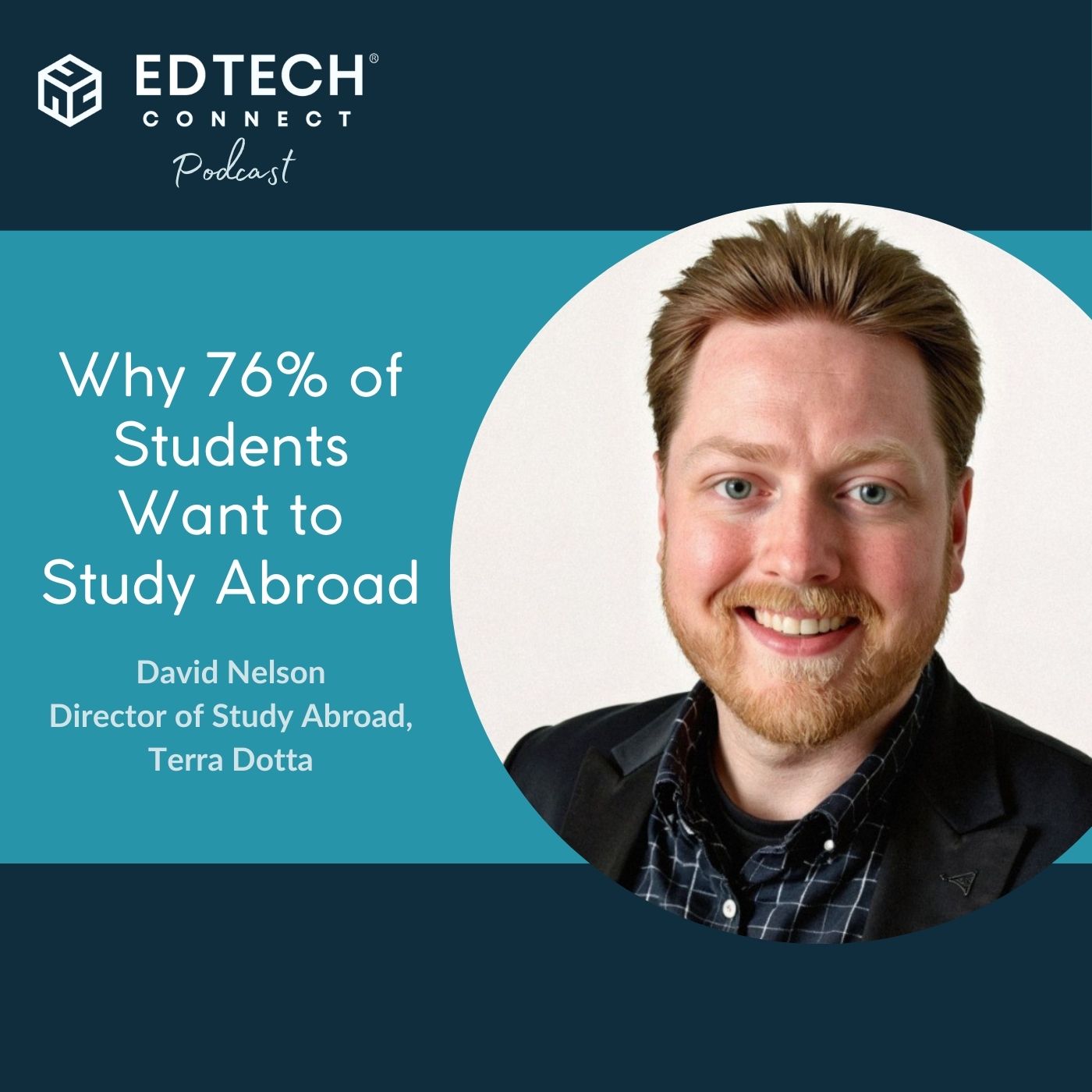
The Signal
David Nelson: Why 76% of Students Want to Study Abroad
00:29:15
Student interest in studying abroad is at an all-time high, but so are the challenges of cost, safety, and accessibility. In this episode of Edtech Connect, host Jeff Dillon sits down with David Nelson, Director of Study Abroad at Terra Dotta and a veteran international education leader. David breaks down the findings from Terra Dotta's latest survey, revealing why 76% of students want to study abroad and how their motivations are shifting from personal growth to resume building. They explore the "clustering effect" of social media, why students are choosing "safe" destinations like the UK, and the critical role parents play in the decision-making process. David also shares how technology—from AI-driven data analysis to automation—is helping understaffed offices meet student expectations and make global experiences more affordable and impactful. For anyone involved in international education, this is a deep dive into the data shaping the future of study abroad. Key Takeaways: Stud...
Loading summary
Transcript67 lines
- [00:00]
David Nelson
You have other tools that you can use to say, okay, we don't have any more staff, we can't be manually reviewing all these forms anymore. And students are sending us emails throughout the night and they're expecting answers by 8 o' clock in the morning when we, when we come in the door. So how do we get ahead of that, how do we get ahead of the students to say, okay, message comes in, we're going to automatically recognize it, we're going to parallelize it and then run it through our AI agents to look at the file, recognize the need in that email.
- [00:34]
Podcast Host
Welcome to another episode of the EdTech Connect podcast. Today's guest brings a true global perspective to higher education. David Nelson is a recognized leader at the intersection of international education and technology. As Director of Study Abroad at Terra.
- [00:51]
Interviewer
Dotta, he he aligns the company's platform.
- [00:54]
Podcast Host
Development with the evolving needs of study abroad offices and helps institutions respond to evolving study abroad trends including high student interest, persistent cost barriers and growing safety concerns. For more than a decade, he managed and directed faculty led study abroad programs and frequently served as program director. Having lived and worked in Japan and Australia, David brings a firsthand global perspective. He is known for a data driven approach and for building automation that expands study abroad access, reduces friction and equips students with the adaptability, problem solving and cross cultural skills essential for success in a global workforce.
- [01:44]
Interviewer
Welcome to the show, David. It's great to have you today.
- [01:46]
David Nelson
Thanks for having me. Excited to be here today.
- [01:49]
Interviewer
So why don't we start off and just could you tell our audience what Teradata does?
- [01:53]
David Nelson
Yeah. So for those who don't know, Teradata is a global mobility solutions provider. So we provide a lot of the software that drives the experience behind both outbound study abroad and inbound study abroad, things like partnership management. So we really provide that sort of beginning to end solution for study abroad offices, for international student offices to manage the process from beginning to end for those students.
- [02:18]
Interviewer
Right. And you recently became the director of Study Abroad at terradata. What excited you most about stepping into this role, especially at this time for international education?
- [02:31]
David Nelson
Yeah, so this is a really exciting opportunity and the end goal sort of remains the same for me having come from higher ed. So the mission is to provide that essential study abroad experience for the student and do that through an easy pathway for them, for the education abroad advisor, where you have the students find the right experience at the right time for them, connecting them with the right people at the right time. And by taking sort of that philosophy from the University level where we were managing a couple of thousand students. Now at the Terra dotta level, we can affect that change for quite literally millions of students a year. So it's a really big chance to make a difference on a larger scale and positively impact the lives of a lot of students who are looking to go abroad in the near future. And that doesn't even count our scholarships and course proposals and everything else. So it's a, it's quite a large opportunity.
- [03:22]
Interviewer
You've lived and worked abroad in places like Japan and Australia. How did those experiences shape your perspective on study abroad?
- [03:33]
David Nelson
Yeah, and that was a really great opportunity post graduation to have that experience and just be able to take that journey Jump. You know, one of the things I hope students get out of their experience, which is what I sort of had in my experience too, besides the academic credit, is just seeing there's other ways out there for people to live and work and they have different perspectives on life and their goals. So having experienced that, it's a really great chance to give students that same chance. And a lot of students, you know, they come from, they can come from isolated communities or isolated social circles. So study abroad becomes that kind of critical inflection point in the growth of a student where they understand how much more they can do with their career and their life. Especially now that we're more of a globally connected world post pandemic.
- [04:19]
Interviewer
Yeah, well, speaking of being globally connected, I'm just wondering, considering the country's current political climate, I would call it in high reserve, tumultuous, unpredictable, how has that affected Terradata? Is this a good time for you or what's the take from Terradata's perspective?
- [04:41]
David Nelson
Yeah, yeah, and it's, it's an interesting time, you know, and there's concerns about safety and instability in various countries. So students are looking for destinations that are probably perceived as more stable. So they're looking for opportunities where they tend to be more English speaking first. I know recently we've seen a big push towards the UK instead of alternative destinations because I think students, they may not be as globally connected as we always think, but they are seeing some of the news articles that are coming out about sort of anti tourism in places like Barcelona in Japan and places like that. When they're looking for those first steps to get their chance to go abroad, I think they're looking at what they perceive are safer destinations for that.
- [05:24]
Interviewer
Do you think the overall interest in study abroad has gone up because maybe students want to experience another culture outside of the U.S. yeah, there's a lot.
- [05:35]
David Nelson
Of reasons students are always interested in study abroad and that interest continues growing and I think a lot of that is sometimes it's the experience, sometimes they're looking for the academic credit. But I think a lot of it these days we're seeing is from things like resume building and they're facing competition from their peers. How do you set yourself apart hard in a globally connected world? You're not just competing against your peers in, you know, the ones coming from the same classroom as you. But when you're looking at jobs now, it's going to be anywhere in the world that you're competing at. So having study abroad experience on your resume really sets you apart.
- [06:13]
Podcast Host
Yeah.
- [06:13]
David Nelson
When they go to have that first big job interview or internship interview.
- [06:17]
Interviewer
That's a great point. You have a new survey out that's shows that 76% of students want to study abroad and also highlights that more than 90% of students see study abroad as an important, important to their personal growth. Did you have a moment abroad that really sparked your own personal growth?
- [06:34]
David Nelson
Yeah, I mean, I had quite a few. And one of the great things about living over when you're in Asia is that it's so easy to travel to other destinations over there as well. So it's a nice base to explore the rest of the world. But for me, some of that personal growth came in the form of a lot of independence because there's nothing like being dropped down in a country and saying, in our day it was probably a paper map. These days students are going to have their phone, but here's a paper map. You don't understand the language, you can't read any of the street signs, you can't communicate. So how do you communicate? How do you build relationships with the people there and just say, okay, I've got to get across the city, how do I do that? So that's a really important piece of personal growth to say, okay, it's me, I'm here, I'm on my own. How do I do this? How do I communicate with people? You know, how do I get across this city if I, if I don't know the language?
- [07:23]
Interviewer
You know, I hadn't really thought about it, but it's one of the defining pillars of academia in a way, because in the last decade we've been under, I would say, extreme competition. There's private competition now, you know, people are questioning the value of a degree. But where else can you do something like this, right, except, yeah, mainly at a traditional know university. So I kind of wish I would have done that. My daughter's interested in that. She hasn't done yet. My wife studied in London for a semester, so I'm a little jealous of those people that had that experience.
- [07:57]
David Nelson
Well, these students get to have some fascinating experiences. I mean, more than some students view it as a, you know, a vacation, which is what we try and get them away from. You know, there's academic accredit attached to it and there's a lot of growth factors. But one of the nice things about study abroad is that we really try and get these students to have practical life experience experiences when they're on these programs. So things like seeing how business works in another country. One of the great experiences I have was taking students through Bloomberg in London. So the students got a chance to go behind the curtain where, you know, they don't let any tourists in there at all. We had to have security pre screening, but they got a chance to actually meet the financial people and the tech people behind the scenes at Bloomberg. And they sat them down at, I think it's called the terminal, the Bloomberg financial feed. And they just said, this is the live feed in the home office. Sit down. We're going to talk about how to use this and how you would use this in business, in international finance. Like those are those kind of irreplaceable experiences that they get to have as part of that.
- [08:57]
Interviewer
You've talked about the UK a little bit and it came out as the top student destination with most students aiming at spring 2026 programs. From your experience coordinating programs, what challenges does this kind of concentrated demand create for universities?
- [09:16]
David Nelson
Yeah, so kind of like mentioned before, students are looking for that safe step, safe choice. So I mean, I think, really from an interesting standpoint, you know, why are students interested in this destination in particular? But those used to be a stepping stone. And I think what's interesting that we're seeing now is that students aren't necessarily taking that next step, steps. So we're seeing a lot of students take this safe choice, but they're not taking that next step to say, well, I did the three weeks or the six weeks in the uk, now it's time for me to go out and look at Japan or Spain or Italy or South Africa and all these other destinations. So students aren't taking that next step as often as they used to.
- [09:54]
Podcast Host
Right, right, right.
- [09:55]
David Nelson
And of course we start seeing clusters of students. When one student goes to one location, they start building momentum towards that. So it's a difficult proposition to shift that Student perception towards, hey, there's other out there, you don't have to do that one.
- [10:09]
Interviewer
Yeah. Do you know if the select set of countries that students travel to has kind of shrunk? Basically because you're saying maybe they want to go to fewer safe places. So that's the challenge is like getting everyone their top choice basically.
- [10:22]
David Nelson
Yeah. And one of the fun parts of being in the study abroad, which work I get from my background, is sort of the data scientist data nerve where you get to track all of this and visualize all this and look at the trends and then feed that back into your sort of data driven decision making. But there was a lot more differentiation pre Covid and post Covid. We're just not seeing quite the same spread of students across destinations and countries. Italy always remains a top contender for those. It'll be interesting when we see the Open Doors report come out here in the next year or so, probably November. I think the next one is due to see how that's changed because students are selecting down into fewer destinations than they have in the past. So it's a challenge on the education abroad office's point, you know, to try and get the message out to the students and sort of that ideation phase that where they can think about seeing themselves in other locations.
- [11:15]
Interviewer
Right. I want to talk a little bit about the tech now and talk about your experience at the University of Kentucky. You've led automation and process improvements at the University of Kentucky. How do you think tech driven efficiencies help institutions handle this surge in study abroad interest?
- [11:32]
David Nelson
Yeah, so budgets are tight. That's one thing that we're seeing a lot of right now. There's a lot of contraction in the space. There's no more staff coming in. You know, the money's not there to bring on new people. So what you have is what you have. So how do you do that better and how do you take advantage of the tools you already have to automate? Like a lot of universities are Microsoft tenant organizations, so you have things like Power Automate at your disposal. You have other tools that you can use to say, okay, we don't have any more staff, we can't be manually reviewing all these forms anymore. And students are sending us emails throughout the night and they're expecting answers by 8 o' clock in the morning when we come in the door. So how do we get ahead of that? How do we get ahead of the students to say, okay, message comes in, we're going to automatically recognize it, we're going to parallelize it and then run it through our AI agents to look at the file and recognize the need in that email and then validate the form and store it in your file structure and then respond to the student alert. A person in an office. And you can do all that automatically now with a lot of tools that universities already have access to. And we really see a shift in the students because the students expect that answer right away. I mean, they're not waiting for that. In our day, we probably had to go get a form signed and it was on paper and then you walked it over to another office and then you dropped it in the financial aids, the basket inside the front door and.
- [12:57]
Interviewer
Yeah, it's not acceptable anymore.
- [12:59]
David Nelson
Yeah, it's sort of like, well, maybe I'll get an answer in two weeks. And you know, these days if a student submits a form at one o' clock in the morning, they want that, that feedback right away to say, yep, this is checked off, this is done, I'm ready to move on. So.
- [13:14]
Sponsor Announcer
And now a word from our sponsor.
- [13:19]
Sponsor Representative
How can your next campaign soar? With experience helping colleges and universities raise billions of dollars, Mackie Strategies delivers communications, fundraising and tech expertise that your campaign can take to the bank. Mackie Strategies, build your breakthrough.
- [13:43]
Interviewer
Your survey that you conducted revealed that 43% of students expect to spend 5 to $10,000 abroad and many want more financial aid guidance. How can Terra dotta or institutions better address the affordability gap?
- [14:00]
David Nelson
Yeah, so we have to guide students to better programs. It's tough to get students to understand that sometimes a more costly program doesn't necessarily mean a better program for that. But I mean other than destination, students and institutions can look at other opportunities because we have more virtual opportunity these days. We've seen some actually really great success with some of our things like virtual internships. So I don't want to name any providers in particular, but if students are looking at an experience and it's $10,000 to do an on site experience versus less than 1,000 to do a virtual internship, you know, we have students who get some really prestigious placements, so they get placed in a virtual internship like marketing and digital promotion in Dublin for Netflix. And we've had students placed at Nike and Airbnb and all these big name companies, which again feeds back into the resume building aspect of this. But you know, they don't have quite the same from an intercultural competency building perspective, may not be quite as impactful as an on site experience, but from a cost perspective, those are so much more Accessible for these students.
- [15:15]
Interviewer
I have a question. I might ramble on this to get it out here, but basically I'm thinking about my day in college and I would have loved to travel abroad. I was a student who's just trying to get through college. I didn't really. I wasn't really focused. I got a marketing communication degree after I declared it a year and a half or two years in. And so I would choose more to like, I want to have an experience somewhere. I don't really care what programs they have. Hopefully I can knock off some of my GE requirements and it won't slow me down too much. But I want to go travel. When I talk to my kids and I've talked to other college, you know, younger, traditional age college kids, they're so focused on their program. Like my program is data science and linguistics. Talked to my son, he's like, I want to travel, but only there's countries that can really support my program I don't want to go to. So I'm not going to travel abroad. It's such a different way to look at it. Do you see different? Like, what kind of student is that, ideal student that's going to travel abroad?
- [16:09]
David Nelson
Well, what you're talking about, there has been an actual very purposeful transition on the part of the university. We've been planting that seed for many years now to, to show to the students it's not, you know, you don't pick based on the country, although they still are going to, you know, in some capacity either way. But it's been very purposeful to say, no, you go abroad based on the opportunity for your degree program.
- [16:32]
Interviewer
Yeah, yeah.
- [16:33]
David Nelson
So that's just. That's been a very purposeful change.
- [16:35]
Interviewer
Yeah, yeah. And my son was exactly in that mindset. I'm like, okay, different than I would have just wanted to travel. You know, I was not as focused on my degree as probably. It's definitely my kids are.
- [16:46]
David Nelson
Yeah, well, they start using it early for the students when we're seeing the academic advising step happening, as early as when they're coming in the door and sometimes before as well, to say, look, you can plan this now you want to take calc4. You can take calc4 in Germany with one of our faculty who are traveling. They build it into their academic plan now and they look forward to that. To say, no, I know already that the summer after my junior year I'm going to Germany and I'm going to take this class and they have that planned out a couple of years ahead. Of time.
- [17:16]
Interviewer
So you've been both a program coordinator and a developer. You've seen the human side and the technical sides. How do you think that combination helps you tackle barriers like high costs and lack of information, which 48% and 17% of students cited?
- [17:34]
David Nelson
Yeah, so this is a fun part where technology can kind of help us tackle it from the university side as well. So using things like AI to consolidate feedback from students. So when we have students go on these programs, we tend to get thousands of bits of feedback that can be in various forms. Some of it's numerical, some of it's written form, some of its verbal form, some of its advising appointments as students are re entry for students. But using things like AI to help us consolidate that data and actually drive decision makings for the university. So we actually, we talk about this as an example in some of our AI talks. I sort of have some partners in crime I guess you'd call. We're sort of some AI in education abroad experts. We work together on these opportunities for institutions. Meek McFarland out of Barcelona, SAE and John Hibbert out of Northeastern. But things like, let's say you've got a portfolio of programs. You can take all of your feedback, you can take the pricing, you can take the flight costs and the flight time and the duration, and you can boil that down to very concrete numbers that you can take to a provider and say, look, here's our normalized distribution curve. Here's providers A, B, C and D. Here's your provider E. You're way off the spectrum over here. So let's talk about cheaper options for the students or changing up how we're providing programs to students so they are more affordable. And they are things like, you know, AI is great for pulling out kind of automated sentiment analysis from written feedback. So perceived value for the dollar that they're getting out of study abroad programs or value for their degree program, you can pull all of that and reduce that down to numbers that you can very easily take to those providers and say, look, you're not cutting it. You're part of this portfolio or you're not. You need to make this better for our students or change up the experiences. So that's part of the fun.
- [19:28]
Interviewer
That sounds like a great use case for AI.
- [19:30]
David Nelson
Yeah, it's the tech side of things where it's like data driven decision making is the key sort of the end of all that loop that we can now do so much easier than.
- [19:40]
Interviewer
Yeah, that makes so much sense for being a use case for AI. Your survey found that 40% of students develop interest in study abroad as early as high school. How should universities rethink recruitment and engagement at this earlier stage?
- [19:57]
David Nelson
Yeah, this is a fun one. So there's always push and pull on this when it comes to students sort of pre matriculation or pre enrollment to the university. And we see it, there's kind of a divide between the students and then the parents. The parents almost become more of a critical factor to this. So the students are interested in study abroad, they hear about it, they know about it, they want to go on it. But the parents hear about it, you know, at orientation or even earlier when they're choosing a university. And you can almost see that terror building behind their eyes. And it's become, I mean, I even remember these are interesting times, tabling for the university, representing the education abroad office, or the experience and being there and seeing the students come up or the prospective students coming up. And then like, hey, you can go abroad, we'll do it in your degree program, we can get you scholarships for it. You can go for less than the cost of staying here on campus. And then the parents come over and immediately go, wait, hold on a second, what are you talking about? No, no, no, no, you're not doing that. And they kind of drag them away. So the university, they're getting better about that. So we see it now earlier in the process, they showcase it as part of the university campus tour. And they stop in front of the international building, they talk about the experience and what they can get out of it. And it becomes a selling tool for the university. But they have to do it really carefully. And I think we're seeing a lot more universities lean on that aspect of faculty led programs for which the students hear, oh, I get to travel with my friends and part of a course. And the parents always hear, oh good, they're going with someone that's going to be looking.
- [21:29]
Interviewer
Yeah, I hadn't thought about the parent influence. You know, my wife works as a student affairs administrator for many years and I always hear the stories of like the helicopter parents that are checking in on their kids, nervous about what their kids are doing, calling, like, my kid's not answering my phone. Can you check on them? Yeah, there must be a real conversation between the student who wants to study abroad and the parent who's just, just terrified of everything.
- [21:57]
David Nelson
Yeah, they are. And they, they see disparate aspects of it because they, you know, they see, oh, my student's going to be out of the pocket of safety or out of the, you know, sphere. It's just we have different terms and you hit one one of them, which is helicopter parent. And recently we kind of joke about different ones like jet fighter parent and some of the other ones.
- [22:15]
Interviewer
It's so social media, especially like Instagram, was the top way students heard about study abroad. How do you see digital communication evolving in the international education space?
- [22:27]
David Nelson
Oh yeah, we've definitely seen an effect and it's both a blessing and a curse on that. We start to see clusters and super clusters of programs and countries. So social media tends to make students interested in it. And we have, there might be like an influencer student in one part of the university and they showcase their experience on study abroad. And now next year every student that walks in the door wants that same experience in that same country with that same study abroad provider. I mean, we're all for getting students interested in going abroad, but we have to find ways to sort of offset some of those clustering effects that social media pushes students towards that, that one destination, so they're being bombarded with that one experience. So how do we diversify the message? How do we, you know, is it email, is it social media, is it, is it on campus events, is it, how do we get things to say, okay, there are more places to go out there than the traditional big five countries in study abroad. Let's have you look at the Philippines or Malaysia or other locations that just might be something different where there hasn't already been sort of a path pre scored for them for that.
- [23:39]
Interviewer
You mentioned peer influence. I guess that would be huge based on your leadership with Terradata super users. How important is peer collaboration when addressing improvements students want like clear financial aid information and better program alignment.
- [23:56]
David Nelson
Yeah, so one of the great things about the study abroad and the education abroad community in particular is that we're kind of all in it together, so we're not competing for the same students. The students are already there at the university. I mean, other than bragging rights, which is always a, a thing between education abroad offices, but we're all in it together for the same end goal for the students. So the great thing with the superusers is that these are tend to be the tech people, the data nerds, the automation specialists, or just people kind of getting their feet into that or dipping their toes into that so it gives them a chance to say, oh, hey, you figured out a way to build this AI process into the communication pathway for the students that helps them. Let's all figure it out and show us what you did and show us what you were doing under the hood to do this or what are you doing for this automated communication pipeline over here? So collaboration tends to be a big part of particularly the international ed community. It's a very small community. We tend to know each other a lot. But the great thing is we're all sharing that. So, you know, by having one institution come up with something great and new and interesting, it really provides that for students at all the other institutions as well. So things like financial aid information, you know, one institution finds a better way to communicate that with the students, we all benefit from it.
- [25:13]
Interviewer
Your survey showed the students place a strong value on career skills like adaptability and cross cultural communication. How do you see technology supporting study abroad offices in highlighting those benefits to students and employers?
- [25:29]
David Nelson
Yes, we're starting to see this more with universities having using technology to have more of a sort of a pre, during and post coaching and even cultural communication and cultural competency testing and advising while they're having their experience. Because we can do this both sort of live and asynchronously. The coaching is really key and the technology has really helped us do that now. So we have a lot of success with universities building these. Call them like sort of Study Abroad 101, Study Abroad Coaching, Study abroad copilot, where they have to take a course from the home institution even while they're abroad. So it keeps the student in connection with the university. And a lot of that is, you know, it's teaching them. How do you articulate your experience? You're there, you're having this experience. Okay, now if you really want to add this to your resume and make an impact in the future, let's get you in front of a couple of employers over there and get you a chance to interview managers of restaurants or behind the scenes at technology companies. So really that live stream back and forth between the students and the university just helps them long term in developing their career skills.
- [26:41]
Interviewer
Well, if you had to sum it up, David, how will these survey insights shape Terradata's long term vision and your own role in helping students access transformative global experiences?
- [26:53]
David Nelson
Yeah, so this report, really the thing I like about this one is it really helps answer a lot of the why factor. So I kind of think of it like a companion report to something like the Open Doors report, which if we have any sort of data, scientists listening, that's kind of nirvana for everyone. There's so much data there to extract from that. But the Open Doors is a lot of sort of where and when and maybe what they were taking something like the voice of the student more tries to dig into the why are they going? Why are they going at all? Or why are they going there? So examining the Y factor really helps us when we're building out development pathways for the software to develop the tools around the student experience. So things like targeted guides and a lot of hand holding through the initial contact phase and tools for connecting the advisor and the student together so that, you know, the student gets the right information from the right person at the right time. And institutions don't usually have the capacity to build these themselves. So that's what's so fun about this is we get to build it once and then so many institutions get to benefit from it. Which is. Which is really fun.
- [28:02]
Interviewer
Yeah, I love it. Love what you're doing. David. If someone wants access to the report, what's the best way to get that to them?
- [28:09]
David Nelson
So the best way to access that is through the ebooks on our website is where that's currently published on the Terradata.com website.
- [28:16]
Interviewer
All right, well, I will put a link to your website and David's LinkedIn profile in the show notes. It was really great having you on all things study abroad.
- [28:25]
David Nelson
Thanks. I appreciate being here.
- [28:29]
Sponsor Announcer
As we wrap up this episode, remember EdTech Connect is your trusted companion on your journey to enhance education through technology. Whether you're looking to spark student engagement, refine edtech implementation strategies, or stay ahead of the curve in emerging technologies, EdTech.
- [28:45]
Interviewer
Connect brings you the insights you need.
- [28:48]
Sponsor Announcer
Be sure to subscribe on your favorite podcast platform so you never miss an inspiring and informative episode. And while you're there, please leave us a review. Your feedback fuels us to keep bringing you valuable content. For even more resources and connections, head over to edtechconnect.com your hub for edtech.
- [29:06]
Podcast Host
Reviews, trends and solutions.
- [29:08]
Sponsor Announcer
Until next time, thanks for tuning in.