← The Signal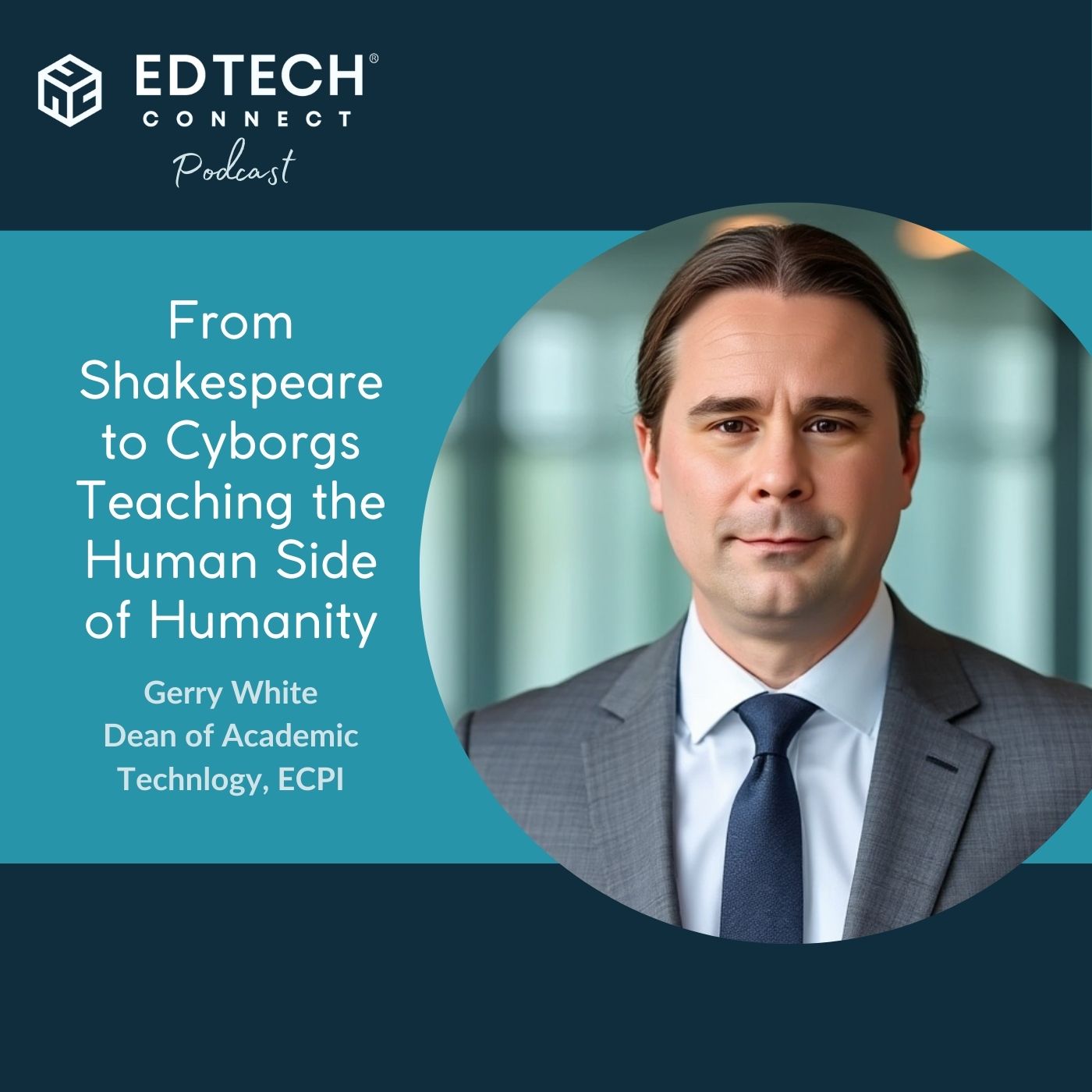
The Signal
Ep. 69 - Gerry White: From Shakespeare to Cyborgs Teaching the Human Side of Humanity
00:24:21
In this episode of EdTech Connect, host Jeff Dillon sits down with Gerry White, an award-winning educator and Dean of Academic Technology at ECPI University whose career defies easy categorization. Gerry’s journey spans from English literature and music to AI development and robotics, and he brings this interdisciplinary passion to every project. They discuss his AI-powered tutoring platform, MyTutorPlus, which creates a personalized "Iron Man"-style knowledge map for learners. Gerry also shares the surprising origins of Project Virgil—a school safety initiative using quadrupedal robots—and his work with local police. The conversation dives deep into why the fusion of code and quill (technology and humanities) is more critical than ever, how to teach students not just to use AI but to ask the right questions, and why maintaining human agency and ethics is non-negotiable in our tech-driven future. For any educator wondering how to keep humanity at the center of innovation, this conv...
Loading summary
Transcript42 lines
- [00:00]
A
And I see that in every sector, even in some of the technology sectors. I know you've seen this. People are so in their silos. They only know their particular, you know, language of tech, not more of a broader picture. So really seeing what's coming, when I start to talk about it in education, which is what I do most of the time, teachers seem to get it, but they're hesitant to play with it because they're afraid of what it might take away. Because of course, teachers, students use it unethically, but I think, you know, if used correctly, it can give a student even more agency and definitely in governance.
- [00:39]
B
Welcome to another episode of the EdTech Connect podcast. Today I have an award winning educator, technologist and creative visionary with over two decades of experience in teaching and innovation. Jerry White is dean of academic technology at ECPI University and founder of multiple ventures including MyTutor plus and Project Virgil. Jerry blends the power of AI with the depth of the humanities to reimagine how we learn, live and lead. His background spans English literature, music, philosophy and AI development, making him a champion of interdisciplinary education. Jerry's work is deeply rooted in cultural empathy, ethical technology and lifelong learning. From personalized AI tutoring systems to robotics for school safety, his projects empower students to shape a better future. Through his journal, Code and Quill Review and Community Initiative amhr, Jerry builds bridges between technology and society, ensuring the innovation uplifts every learner. A writer, musician and technologist, Jerry's mission is to simply inspire the next generation to create with purpose. So welcome to the show, Jerry. It's great to have you today.
- [02:04]
A
Oh, thank you for having me.
- [02:05]
B
You have such a rich blend of passions, from English and philosophy to AI and gaming. If your life were a video game, what would the title be? And what would be your power up?
- [02:17]
A
Wow. We built one not too long ago, which might be it, called Gray Hacker. It was to teach some cybersecurity techniques, but it was also a way to hack life as well. So it kind of combined the humanities and the tech classes into one, and that's kind of where arts and sciences meet. That's where I like to be. So.
- [02:37]
B
Well, you've been teaching for over 20 years. What originally drew you into education and how has that evolved over time?
- [02:47]
A
Well, I always tell this story every semester. I remember the class in sixth grade, we were in an English class reading Rikki Tikki Tavi, which was the old story, and discussing it, and there was something about how everybody was able to see things differently and that that was a good thing. And to explain it. And from that moment on, I really wanted to be an English teacher. So I kind of kept my head down in school. Also picked up music on the way and that's what I went for for undergrad was music and English. So I kind of just plowed through. Did a lot of minors in philosophy, religious studies and some other things. But as soon as I got into grad school, I started teaching and then I taught after and have been teaching ever since. I taught at my alma mater, which was Old Dominion University, typical literature English classes. And then I started teaching a class here at my current university, ECPI University. Then I got to play with some tech that I never really got to play with before. So I get bored really easily. So, you know, waiting for a student who needed help or for something to grade, I dove head first into first web development and then app and game development. So it's just been so much fun.
- [04:00]
B
Well, let's talk about MyTutor Plus. How did the idea come about? How does it uniquely personalized learning for users?
- [04:09]
A
Well, AI as we know has hit the scene pretty hard post Covid I really started to look into it a little bit before maybe 2017, but did just deep dives into it and really saw its potential. It's actually a music idea that brought me to it kind of what is around right now. If you've heard of Suno, some of those apps that can write music, we're trying to build something similar to that just to see it could be done or if it could be done. And once we came back to school, ChatGPT came out with the language model. So I was like, wow, I could really use this and leverage it in class in English. So those two worlds kind of came together. And you know, it started with writing because I'm a writing teacher. So how can students use AI to make them better critical thinkers and not worse critical thinkers, which is also possible. So kind of just built something to help them through all the stages in the process and ask them to kind of question the model just as much as the model questioned them. And that turned into just a full suite of it's kind of a kitchen sink app almost where if you want to learn something, you go in and it will teach you with audio, not video. Yet I think that scratch made on demand video is coming really soon. That which will be part of that. But it follows the learner, it learns their learning style, it gives them things the way they need them. And then something that I've always really thought would be amazing is it connects every single tiny thing they learn to every single other thing they've learned. If you remember Iron man, the movie where he kind of like went boom and he saw all of that. I've always wanted that to be with assignments and papers and theories. So this kind of takes what you learn in your different classes, different things, and it does connect them and kind of your. It's not really an algorithm, but who you are represented in that kind of 3D space.
- [06:09]
B
So almost like an AI personal assistant for students. Well, what role do you see AI playing in closing these educational gaps, especially for underrepresented communities?
- [06:24]
A
Well, something like a general program like that could really help for people who don't have any other access, if we can get them access to the technology in some way. But people all over the world have phones now, so that's definitely possible. But maybe even with some very narrow AI, maybe agent type AI for very specific, specific things like literacy, plain literacy to start with, but digital literacy, which is becoming so much more important in everything in our society, I really think you can kind of meet students where they're at with a teacher that's built just for them. Because it doesn't take much for an AI to learn a person, really now if you ask the right questions and you nudge it in the right way. So hopefully that's going to help a lot. And we need that again, especially with some of the things coming down the pipe that we won't know whether it's real or not.
- [07:20]
B
Yeah, I would think it might even help instructors teach a larger class, a more diverse class. It's gotta be really hard to teach that spectrum of pedagogy in a class where some students are just at a different level. And maybe AI can help meet those students wherever they're at would think, yeah, you said that AI should serve humanity's highest ideals. How do you keep ethics front and center in your projects, like Project Virgil?
- [07:50]
A
Well, that's a very interesting project. That's an idea that me and some students came up with. We were working with the quadrupedal robot, and we all know terrible school shootings that keep happening. And we were thinking about what would be a way that, you know, this could help. And at first it was just kind of a recon approach where this could give police eyes and ears in the actual school. But then as we did some research, there's a lot of non lethal threat deterrence out there. Police departments use them. And that was just something that we did. Now, again, the highest human ideal, you would Never make something that could harm a person autonomous. So kind of how it would work is it would alert somebody at a police department and then they would be the one who would. Actually, in our case, it was just a taser that we're testing. Nothing like what they're using in military applications or things like that right now. But hopefully that AI can really help make a difference quickly if we can get it into some of the schools.
- [08:52]
B
Yeah, Project Virgil was with the students. You said you came up with that. How long ago did you was that?
- [08:58]
A
Ooh, it's not even. Maybe it's been a year. Maybe not even a year so far. We are working with some local police departments really kind of in the brainstorming phases, testing phases for that. We've worked with them on some other projects in the past with some of our students doing their capstone projects with the police department. But we're hoping to get some real world testing with the police department really soon. We have a big criminal justice program here at my school, so we have some great contacts in there. Enforcement.
- [09:28]
B
Cool. Well, you have another project. You do so many things. It's called aim, Hampton Roads. You're bringing together education, business, government. What's the most surprising outcome of that collaboration? Tell us about that one.
- [09:43]
A
I guess it shouldn't surprise me, but it does just what people don't know and are almost afraid to try and find out. You know, people hear AI and all they hear is doom and gloomy. And I see that in every sector, even in some of the technology sectors. I know you've seen this. People are so in their silos. They only know their particular language of tech, not more of a broader picture. So really seeing what's coming. When I start to talk about it in education, which is what I do most of the time, teachers seem to get it, but they're hesitant to play with it because they're afraid of what it might take away. Because of course, students use it unethically. But I think, you know, if used correctly, it can give a student even more agency. And definitely in governance, this is going to be a huge part of probably every layer in the stack of government at some point. We already see, you know, they're going all in on it from the top all the way down to the bottom, you know, pushing it down to kindergarten, even in schools. I'm not sure how we're going to work with that one. But with local government and state government, you know, I know here in my state of Virginia, there's a push to start using it and some of the talks we have in classes with the students, like, and I know a couple of countries have done this, what might a AI administrator look like in government? Like even a judge? So interesting questions. It might sound out in left field right now, but they're not going to be for very long, I don't think.
- [11:14]
B
Wow, that's a great question. Can you imagine how do you feel if you show up for court and you have an AI judge?
- [11:20]
A
Yeah. You'd want to definitely try to get the bias programmed out.
- [11:23]
B
I just don't want to be first. Okay. I don't want to be the first one. So how can educators better prepare students for the realities of an AI driven future workplace?
- [11:36]
A
Well, in every class, I think what we need to start really doing, which we do to some extent, is prepare the students for change. The one skill that will be absolutely more valuable, at least in the next five to 10 years, is somebody's ability to pivot and to do something completely different. Because I think all of us are going to see that in every field that we're in. Whether you're a programmer, a teacher, a police officer or a firefighter, it's coming. And a lot of people don't like change. So I think preparing them to change is important. Now with the AI tools themselves, really what I've seen is the most important thing to teach, not just students, but everyone, is how to ask the right questions. And that's thousands of years old. But I think today we can see very easily that the right question might be way more important than the right answer in some situations because you get what you put in. So how to ask a very specific question, I don't necessarily think we need to call it engineering when we come to a prompt, but even like putting the right search setting, Google to give you exactly what it is you're looking for.
- [12:46]
B
And all the follow up questions too. Right. Like, I think that's a great point. Like you do ask it the right questions. And now a word from our sponsor.
- [12:59]
A
Your audiences know the true power of.
- [13:02]
B
Your institution's story with deep inquiry and expert strategic and creative development. Mackie Strategies applies decades of leadership to help you drive branding, marketing and fundraising that get results. Mackie Strategies moving your mission forward. So you've created Code and Quill Review which blends humanities, computational science. Why is this interdisciplinary lens so important right now?
- [13:36]
A
Well, I mentioned a little while ago how people are siloed. And you know, usually the tech and the arts are really siloed, but they're intermingling now. In ways that I don't think people ever saw possible, not just with AI, but definitely with AI. I mentioned suno, where you have musicians that are able to use tools that they've never seen before. And then maybe people who aren't traditional musicians having access to a musical voice that they might not have known they had before. Now this is, it's an academic journal, so it is academic, peer reviewed. And we do take creative subjects. We have poetry, we have novel chapters that people publish, but we also have academic papers, whether they're on mathematics or how mathematics integrate with AI. And really the bridging of those two sides really of our brain, the creative side and that more analytical side. So that's the idea of code and Quill is where those two meet, which if we look at history every interesting time, is when those two have really come together and that's when all the renaissances seem to happen.
- [14:42]
B
I love that you brought up the musicians talking about how they might be using AI. I'm guessing maybe you can confirm this for me that they musicians probably can create incredible music using these tools relative to maybe someone who doesn't know anything. The reason I kind of am guessing that is because I was trying to use one of these tools to create images. Like when Text to images came up a few years ago and I couldn't believe the results people were getting. And still right now when Midjourney released the prompts of all these great images, these kind of realistic looking images, but they were very sci fi looking. And I just was like, how are they doing this? And I looked at the prompts and guess what they were saying. Well, use a Leica camera with this aperture and this f stop at this angle. And I'm like, I could never have written that prompt. So I think of this quote from so the subject matter experts, you just have a great tool in your hand. Mitch Joel is, I think he has the longest running podcast out there. And he said, AI isn't here to replace us, it's here to make us superhuman. So I hadn't thought, but yeah, that's probably equating to music too, right? It's just another great tool for the assimilate some of these musicians, I think.
- [15:55]
A
So most of them hate it right now. They see it losing work and it not being natural or real. And I mean, I teach music too. I play guitar. That's my main instrument. But you know, you could say, you know, I want to create a song. How many bars, the verse, the chorus, I want to bridge, what key? I want it in the chord. You know, put your lyric so you can dial it in, just like if you were writing the sheet music out. And what's great is you then push the button and you've got it so you don't have to write that, then go get the musicians, then come in and record it. It's like prototyping a huge application via vibe coding, but on the music side of it.
- [16:32]
B
So in an increasing tech focus world, how do you keep the value of humanities alive in your classroom and work?
- [16:41]
A
Well, having discussions about it is the most important thing. Kind of talking about what technology has done to us now, done for us in the past, especially in the past few years with AI. So what do we want AI to be? People seem to have seeded their agency. Like, we don't have any control of it for the time being. Right now, we do have control of it. And what I always say is, you know, if we in this room don't decide what's going to happen, nobody else will. So, you know, nobody is off the hook. If you want to live in a world where humans are valued, each individual human is valued, then we need to create that world and not cede our agency to something else. So it's like everything else, people need to get involved. And AI, like any technology, can make that a lot easier, or it can, you know, make it so easy that people don't do anything, which is, you know, the easy button that people push. So I think discussing it, maybe even programming that into some of the models. I know they're not doing that with some of the big foundation models that we see right now. They're not, you know, pushing any agendas, which I guess is a good thing. But we get to control, you know, these weights, we get to control the balance. And I think, you know, I teach a lot of people who are going into the tech field that are going to be designing and developing some of these technologies. If we want to create that world, we have to do it. So talking still.
- [18:07]
B
Yeah, I love that. Tell us about your work with augmented reality and preserving memories. How does that tie into your educational mission?
- [18:16]
A
Wow. Well, it's kind of cool. I remember before this was called augmented reality and the iPhone came out and everybody saw that, and I just thought, what if I could lay something over the camera view? You know, like, what if I could build an app that could just lay anything over it? So, you know, I started playing with it and there were tools out there that you could grab, like if you wanted, you know, GPS coordinates to go over it you could go to, you know, and hit this server and do that. And I remember the first thing that we built here on campus was just an AR tour. And it actually, it had the floor, so we had latitude, longitude, and altitude. So it led them to different labs. And then when they got to the lab, a trigger would fire and show them video of what was going on in that lab. And once figured that out and, you know, started teaching it to my students, I work with the R and D club, so that's where we do a lot of these. These emerging technical projects. But we built a augmented reality experience for the Virginia Zoo, our local zoo here. And it was much the same. It was a tour where you go around and you, you know, the trigger was fired. And, you know, you could fire that a lot of different ways. Now with the quest, and I'm hoping the meta glasses, as soon as they have that little monitor that comes over that will be able to use that as well. And one of the projects in that vein that I really have been trying to get off the ground and getting a little movement is I want to augment every grave in Arlington Cemetery so that when people go there, they could see the person, look at their record, maybe even the family could put things in there about them, and it could help them find their loved ones as well.
- [19:56]
B
Yeah, I love those stories. I always remember working at Sacramento State when Pokemon Go came out, and we were so close to building a layer that we could part of the game.
- [20:06]
A
I remember that as well.
- [20:08]
B
Not that long ago.
- [20:09]
A
No.
- [20:10]
B
So, Jerry, what advice would you give to school leaders looking to integrate AI and creative technologies into their districts or schools without losing the human element?
- [20:23]
A
Everybody needs to actually try it, from the administrators to the teachers to the students. And the best way to use it is. Is to model it. That's what I do in the class every day. You could do that with your faculty if you're an administrator. When they. They're asking all these questions, I'm like, okay, let's turn it on and show you what we're talking about and actually do live demonstrations of whatever it is you're working on. If it's assignment design, if it's rubric design, or if it's just building your own, like a GPT or a model for a bot inside of a class, actually getting their hands dirty and, you know, on the keyboard or talking to it to do it themselves. So really to try it. Everybody's got their people who like to play with new tech, you know, so give them the resources to actually play with it and then let that spread to everyone else, because it's a great thing, it can be a bad thing. But I see it as net positive if it's done that way, you know, thoughtfully done and not just thrown in like, here's the newest tech toy, but really, really using it and leveraging it the way that it can be, I think.
- [21:27]
B
Yeah, I agree with that take on it. Well, looking ahead 10 years, what's your hope for the role of technology in education? And what legacy do you hope to leave behind?
- [21:37]
A
Well, I hope that we can build technologies that can do what we want the technologies to do in the classroom, if there is a classroom or in education, and leave the human things to the humans. So that person to person connection, or one person to many. I think we need to make sure that we maintain that in any technology that we roll out, whether in school or society. So in 10 years, I'm hoping that we still have some of that. I know I've even seen schools that are going to an all AI model, Some of them successfully, some of them may be going down the wrong rabbit hole. But what was it, the ABC or the Alphabet school in Texas? They're having some promising results with that, but they've maintained that human aspect as well. Now, for me, that's exactly what I'd want to see, you know, leveraging technology, which, you know, at its base, the word means skill in art. So what tools do we make to help humans? The key is humans. Multiple notches, just numbers trying to, you know, everybody's for profit. We all want to make money. But a way to kind of keep humans on at least somewhat of a level playing field and not have this split that a lot of people seeing. We're talking about, you know, underserved communities. We don't want that divide to grow larger. Yeah, maybe this could be something that we can lead back to help with that.
- [23:09]
B
Yeah, I really agree with that. I talk a lot about having a human in the loop. I talk about content discovery solutions and how we can't just give it over to AI, but a human. Humans need to be in the loop. So I'm right there with you, Jerry. Jerry, you are an interesting fellow and doing incredible work. I'm going to close it out and say I'll put links to Jerry's website and his LinkedIn in the show notes, and it was great to have you. Thanks.
- [23:32]
A
Thanks so much, Jeff.
- [23:35]
B
As we wrap up this episode, remember EdTech Connect is your trusted companion on your journey to enhance education through technology. Whether you're looking to spark student engagement, refine edtech implementation strategies, or stay ahead of the curve in emerging technologies, EdTech Connect brings you the insights you need. Be sure to subscribe on your favorite podcast platform so you never miss an inspiring and informative episode. And while you're there, please leave us a review. Your feedback fuels us to keep bringing you valuable content. For even more resources and connect connections, head over to edtechconnect.com your hub for edtech reviews, trends and solutions. Until next time, thanks for tuning in.