← The Signal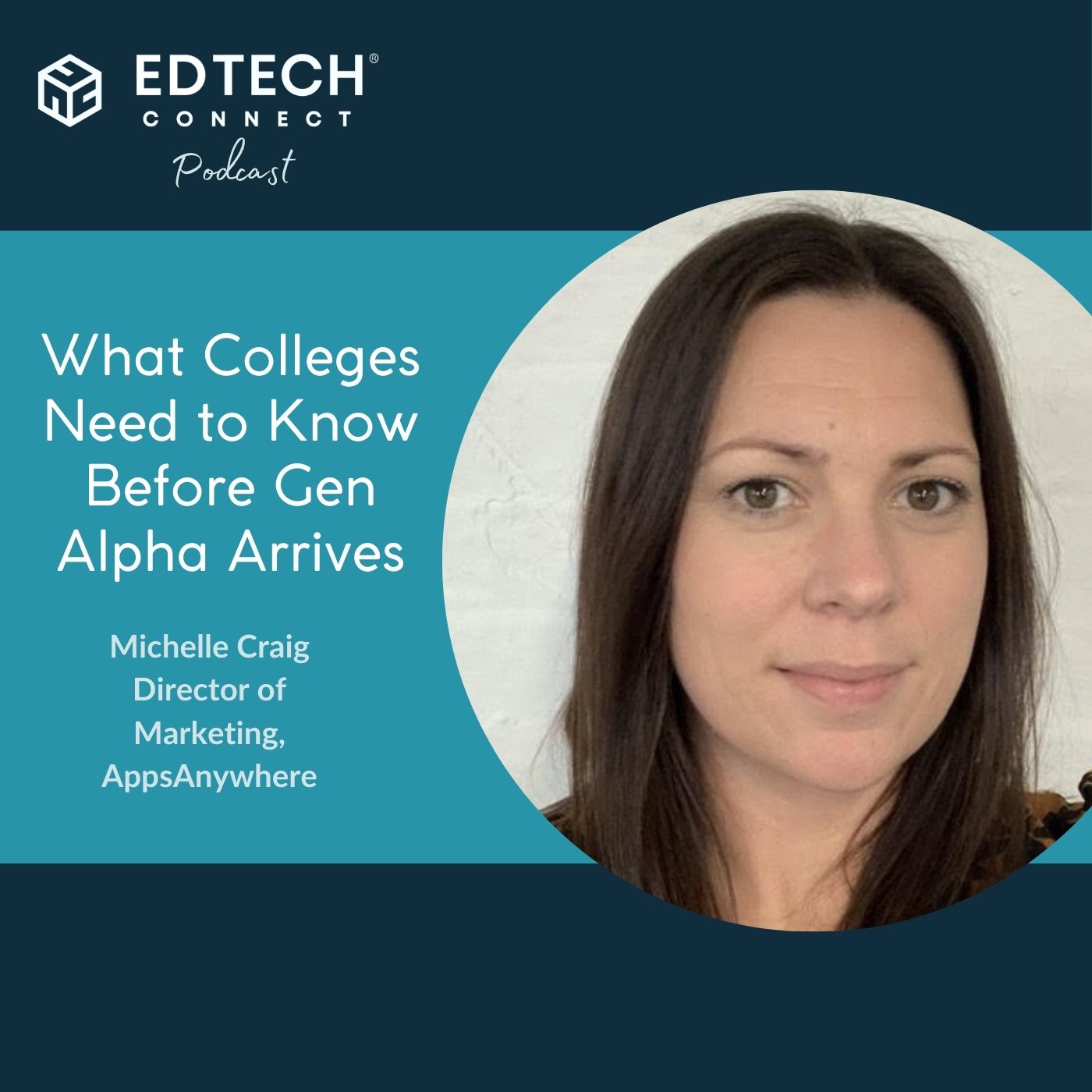
The Signal
Ep. 72 - Michelle Craig: What Colleges Need to Know Before Gen Alpha Arrives
00:31:38
Jeff Dillon sits down with Michelle Craig, Director of Marketing and Commercial Operations at AppsAnywhere, to explore the seismic shifts happening in higher education as Generation Alpha prepares to enter college. With two decades of experience at companies like Blackboard, QS Unisolution, and Job Teaser, Michelle shares insights from her groundbreaking research into Gen Alpha—students born between 2010 and 2025. They discuss how this "Generation AI" is already using tools like ChatGPT, why 56% expect hybrid learning to be the norm, and the critical challenges institutions face around equity, access, and digital transformation. From rethinking IT strategy to marketing in the EdTech space, this conversation is a must-listen for anyone preparing for the future of student success. Key Takeaways Generation Alpha is “Generation AI” – The first Gen Alpha students will enter higher ed in 2028. Born alongside the iPad and Siri, they are early adopters of AI, with 73% already using or pla...
Loading summary
Transcript40 lines
- [00:00]
A
I have my own experience of an 8 year old son who was doing some creative writing recently and the teacher said, right, put your creative writing into ChatGPT, ask it to create an image of what you are describing in your story and let's see if that's what you were imagining. And of course it was completely what he is imagining. Whether that was true or not is to be debated, but these kind of practices are already in practice in the classroom right now. And there's some other trends here too. So like 64% of Gen Alpha say they can code or if they can't, they're going to learn to in the next six months. And 24% of those have taught themselves. So we're seeing some really interesting trends in behavior.
- [00:48]
B
Welcome to another episode of the EdTech Connect podcast. Today I have someone who has been leading some of the most meaningful work at the intersection of student success and digital transformation in higher education. Michelle Craig is the Director of Marketing and Commercial Operations at Apps Anywhere, where she helps universities simplify software access for over 3 million students across 300 institutions worldwide. She brings two decades of EdTech experience from senior roles at Blackboard, QS, UniSolution, Job Teaser and Solution Path. At each stop, she's driven impact through a mix of smart strategy, brand clarity, and meaningful partnerships. She's recently led new research into Generation Alpha's expectations of college, offering a glimpse of the future our institutions need to prepare for. Now, whether she's building a marketing function from scratch, leading a rebrand, or presenting at global conferences, Michelle blends practicality with vision in a way that always moves the conversation forward. Welcome to the pod, Michelle. It's great to have you today.
- [02:00]
A
Thank you so much. Thank you for having me.
- [02:02]
B
Well, to kick this off, I'd love to hear about something you've learned recently that really has surprised you.
- [02:09]
A
Yeah, so I think my recent thing has been looking into Generation Alpha, so it makes sense for me to kind of talk to that. So for those who are not familiar with that, with Generation Alpha, it's Those born between 2010 and 25, and it means that the first fully fledged Gen Alpha will be entering higher education in 2028, which is just less than three years time. I think what surprised me is when you see the reality of that generation. So the first born were at the same time as the launch of the iPad, Instagram and, and closely followed by Siri. So when you put that into perspective, especially as a Gen Y, it doesn't feel very long ago. But my goodness, a lot has happened since then. So we really are talking about generation AI here and I guess in relation to that, in a bit of a contrast, the thing that surprises me is, although this generation, young people are already really, you know, early adopters, I guess, of technology, it's a big part of their life and they're very positive about that. They, they're also really acutely aware of the negative impacts of technology as well. So what we found in our research is that nine in 10 claim that technology is crucial for their Future success, but 72% are really worried about the negative impacts of technology. Things like their safety online, the distractions it might cause, data security, that type of thing. So I think that surprises me. We think that they'll be kind of really eager and, you know, just think technology is just there now and, you know, they're very savvy, but actually they do carry a lot of the worries that other generations have as well.
- [03:48]
B
Yeah, it's kind of a gap. Yeah. It's interesting that you point that out. Well, You've had a 20 year career in ed tech. What originally drew you to this space?
- [03:59]
A
Sure. So for me it's always been about purpose and mission and I think this mainly comes from my own experiences of education and the benefits that I've been able to realize, but also the belief that I have an education as an enabler of opportunity and success for other people, as long as that is supported correctly and in a good way. I believe that everyone has the ability to achieve anything they want to with the right support and the confidence to do it. And I'm really passionate about removing the barriers that get in the way of achieving that. And I think that is really at the centre of a lot of ed tech businesses and companies. And why, for me, it's such a great space to work in because I can bring that passion to my work, basically.
- [04:43]
B
Well, you've led marketing at companies like Blackboard, qs, Unisolution, Job Teaser, now you're at Apps anywhere. What's been consistent across those experiences and what's changed the most?
- [04:58]
A
Yeah, I mean, I've been so lucky to work at several amazing companies and areas of higher education, from international mobility to teaching and learning, communication, student support. But I think what's been consistent in every one of those companies is being that there's always been something that is transforming. So I feel like there's always been, or I've always been part of a wave or a movement of some kind. So whether that's been about higher education going into more of a globalization Kind of period or changing mindsets around the importance of graduate outcomes, free employability and skills, perhaps communication methods. So my first role in edtech was actually convincing universities to stop sending letters to students which were often going to their actual parents houses that they didn't even live at during term time and get them to start using text messaging technology, which now, you know, being so integrated in all of our lives seems so obvious and a bit boring and mundane. But at the time that was a real revolution in how we would communicate with students. So I feel like that's always been a consistent of like being part of a movement or a wave. And obviously at the moment, now with Apps Anywhere, this wave's all about moving towards more flexible and hybrid learning. So, yeah, I'd say that is what's been a consistent.
- [06:14]
B
You remember like trying to change the attitude of sending letters. Our careers may have overlapped in some generation because I remember trying to convince people that our website was going to be a marketing tool way back in the day because I was getting flooded with emails. It was like so obvious. But come on, people. Like, we're in a new world here.
- [06:32]
A
Yeah, absolutely.
- [06:33]
B
At Solution Path, you built out the marketing function from scratch. What's your approach when starting from a blank slate?
- [06:42]
A
So this really connects with why I'm in this space to begin with. It's about connecting with the why and actually working with the founders. At Solution Path, I was very lucky because they were so passionate about that and they wanted to start from there. They had personal connections to why they sort of founded and developed the business and it was all around the student experience and making sure that equity was there for all students so that people could be successful in their higher education. So I think to look from the inside out, starting at purpose mission really helps to understand what you're fighting for, what kind of change you really want to stand up for. And I think when you've got that at the heart of your brand, everything else starts to unfold. So everything starts from there and then it's about how you know you want to communicate that message, who needs to hear it, and then obviously the mediums to do that. So really that's sort of what I think is really important when you're looking at a blank, blank slate.
- [07:38]
B
So let's get into this research. The recent Gen Alpha research from App Anywhere is really eye opening. I'd like to kind of just tell us about that research. What motivated you to commission that, that study?
- [07:50]
A
Sure. So our mission at Apps Anywhere is to help IT teams to Remove the barriers that impact students ability to succeed by giving them the access to the tools they need to be successful by providing easier, more efficient and affordable ways to manage and deliver education software. So that's really where we start from and what we've seen in recent years is many institutions looking to future proof, thinking of ways to be more financially and environmentally sustainable, reimagining their purpose actually in many ways, and all the while trying to ensure a valuable student experience for the students that they've got now. So we felt that we were kind of in a position where we had a responsibility as a partner in the sector to really question whether those decisions, future proofing, the decisions we're making now are actually going to benefit students needs and expectations in the future. So we wanted to ask questions like what will their barriers be? Is Generation Alpha going to be different to Gen Z and if so, in what ways? And will what we're doing now actually align to those in the future? And are we really prepared for that? So are institutions prepared for what's coming up down the line? Are the decisions we're making today actually going to be valuable and scalable and future proof? So that's really what inspired us to commission the study. And just in summary there we worked with a company called Insights Family. We looked at young people aged between 12 and 15 knowing that they're going to be the first to walk through those doors from Generation Alpha into higher education in the next few years. And we looked at their experiences of how they're using technology today and their opinions of technology. And then we've tried to draw some conclusions around how that might shape their expectations of higher education. So we can give higher education those insights to hopefully inform some decision making as they go through that right now.
- [09:45]
B
Yeah, well you mentioned these adolescents. One stat that really stands out is that 73% of 13 to 15 year olds already use or plan to use AI tools. How should higher ed institutions prepare for students arriving with that level of fluency?
- [10:03]
A
Yeah, I mean that's a great question. Yeah. Not surprisingly, Gen Alpha early adopters as particularly so we're seeing like 2 and 5 are already using ChatGPT for their learning. Now I have my own experience of an 8 year old son who was doing some creative writing recently and the teacher said, right, put your creative writing into ChatGPT, ask it to create an image of what you are describing in your story and let's see if that's what you were imagining. And of course it was completely what he is imagining. Whether that was true. Or not is to be debated. But these kind of practices are already in practice in the classroom right now. And there's some other trends here too. So like 64% of Gen Alpha say they can code or if they can't, they're going to learn to in the next six months. And 24% of those have taught themselves. So we're seeing some really interesting trends in behaviour that are going to come through. So I think there's far more things to consider, you know, in this topic that stirs lots of debate around AI, but I think things that we could be more prepared for in terms of that fluency, etc. Is about the importance of understanding students ability as early as maybe pre enrollment to get a better understanding of the level that they're actually entering higher education at and what skills provision might be required as a result of that. Because we can quite easily make sweeping statements like all of Gen Alpha are really technically savvy. Right. Or they're all using AI and they're so native and all of that. But actually that's not quite true. Right. We know there's some disadvantage there and some digital poverty, etc. That are creating barriers. So I think perhaps even doing something as simple as putting some questions in a pre enrollment form will give you a baseline of what you're working with and then what kind of things you need to stack around it to make sure that everybody's on a level playing field. Knowing what tools are already being used in the classroom during K12 education, I think could really give insight into what might be expected in higher education. What do they already see as normal, what's already okay to use and that might not actually align with what you want at the university or the institution. It might not be the same view. So then that kind of leads me to think, well, if that's the case, then we also need to be thinking about what advice and guidance we're giving to students when they come through the door. Right. You know, what's your viewpoint as an organization? Do you have a policy around acceptable and appropriate use? Have you got ways to show students what kind of AI tools are acceptable and do they know the fine lines between things like how AI might assist them or what might actually be considered as plagiarism, for example? And I think those boundaries and guidelines have to be set because students also want to know, in our qualitative findings in this research, there were comments like I'm worried about if I use AI, whether that would be considered as cheating, for example, so they need that guidance they need to know where they stand and what they can use. And then just lastly, Apps Anywhere is a great example of a platform that could be used to put all of kind of the university approved AI tools in one place so that students have that reassurance that if I go in here and I use a software package in here, I know that's already approved by the university as AI that I can use in my course. Right. So I think there are a few different things we can do here, but really interesting area and something we've got to be on the ball about, Right?
- [13:33]
B
Yeah. Over the past few years, colleges have been forced to really, I think, rethink what being on campus even means.
- [13:41]
A
Absolutely.
- [13:42]
B
Students expect to jump, I think, between in person, remote hybrid, evening classes, work schedules, clinical hours without, you know, losing access to tools they need. So if anything breaks in that chain, it reflects on the institution whether it likes it or not. So a lot of schools are realizing, I think the hybrid's no longer a backup plan, it's kind of the default. So my question is, you know, with a baseline expectation now, how does Apps Anywhere support that shift?
- [14:12]
A
Yeah, sure. So firstly, let's, let's look at the hybrid learning kind of landscape because in the Gen Alpha survey they came back to say that 56% think that higher education should be offered as hybrid and only 18% think that that should be fully on campus, that learning should be fully on campus. So that is a big shift that we're seeing. And in the qualitative findings, it pointed to things like their own personal circumstance being the driver for wanting that hybrid environment. So realizing at a young age that they're probably going to have to work alongside study one, stating that this is just the way of the world now. So perhaps they see their parents already remote working, maybe they think that that's actually a normal way to work. And then fundamentally it's allowing them to work at their own pace. Right. So that means that it gives them flexibility. And I think that in those all those different scenarios, that's what students are going to need. Right. They already realize, according to this research, that they're going to need that. Right. So in order to take advantage of that hybrid learning, students are going to need access to the devices and tools that they need to complete that work in that flexible way. And this is another stat that I really wanted to get in there because again, maybe one of those kind of surprising stats when it comes to devices, 96% of Generalpha say they expect the college to provide that device to use or own when they come to study. So I assume from that that what they're really saying is if I'm paying to learn with you, you're going to give me all the tools I need to do that. And if they don't, I'll be at a disadvantage. Right. They already recognize this. So we see evidence of this with current students not having the devices that they need with the performance required for particular software. Perhaps they're trying to access a Windows, sorry, Windows applications from non window devices, for example, or perhaps they're having to use software in a lab based scenario on a computer at a certain time of day and that's a barrier because they can't get there at first on Thursday at 4 o' clock to study, they need to do it at two in the morning after the bar shift. Right. So we're seeing that world change so much and even at 12 to 15, they already recognize that that's the world they're entering and that that's how they'll probably study. Right. So coming back to Apps anywhere and how we help, it's designed around that notion of equity. Right. So we're saying irrelevant of your device or your location or where you are, you can still access the tools you're going to need to complete your coursework. Okay. So you go to the platform, you find the application you need, you'll launch it directly on the device at a time and a place that suits you. And then for the IT team, it provides a central place to manage and control that landscape and ensure that those apps are up to date, they're approved, they're available to the right user, in the right place, et cetera. And that's really what hybrid learning is all about. So really we're absolutely the heart of that movement, for sure.
- [17:10]
B
Wow. Well, you've worked across roles, institutions, you've seen tech trends come and go. Funny thing about higher ed is sometimes the ideas that seem small at first end up rewriting how we work later. So with all that experience behind you, what's one ed tech trend you think we're still underestimating?
- [17:31]
A
Yeah, I think without question, and I have mentioned it several times already, it's the issue of equity. Understanding the baseline skills and equipment students need to have the best chance of succeeding on their course is absolutely vital. And understanding what the long term impact of not having that is, it is a huge disadvantage and we're not setting them up for success. And that can't be right. In a landscape we're expecting people to give up Three or four years of their life and a huge amount of money to do. Right. So equity has to be a big priority for institutions to work on if we want to have lifelong learning.
- [18:17]
B
When you look across the sector right now, I think it feels like every institution is trying to modernize at once. New tools, new expectations from students, pressure on budgets, pressure on staff. So I don't think there's like one playbook. Some campuses are sprinting, others are patching the bike while they're still riding it uphill.
- [18:40]
A
Yeah.
- [18:41]
B
From your vantage point, like you've seen both the bright spots and the friction. What are some of the biggest challenges you see for higher ed institutions and their efforts in digital transformation?
- [18:53]
A
Sure. So, like I say, I've seen lots of waves of transformation. I think what makes it particularly hard for institutions is the scale that we're talking about in terms of an organization. It's a very complex organization structure. You know, there's a lot of people as well as processes to work with when it comes to digital transformation. And I think the way things are moving so quickly, and especially even the last year, I cannot believe how quickly things are moving compared to my last, you know, 15, 20 years I've been in this space, I have never seen the pace so fast right now. And I think this is really challenging for the sector to stay ahead of latest trends, latest technologies, things that are literally coming out, tried, trusted, iterated, moved on before you even got a chance to think about how that fits in a plan and an organization. So, I mean, it's a huge challenge for institutions. But I think looking at the Generation Alpha survey, one of the new challenges that are going to come up, and I keep thinking about this over and over again, is with the hybrid learning environment with technology kind of underpinning everything, I really think the next big challenge will be about how institutions create a consistent experience both on and offline. So you touched on it earlier about a student's experience. What will quantify satisfaction to them? Right. Natively, they're going to come in with high expectations. We've seen this in one of the questions we asked around what makes a good digital experience. Top responses were quick and fast performance, easy navigation, you know, smooth interactions and quality and relevant content. And from a facilities perspective, 70% said high speed WI fi is just it should be a given. But these are all going to shape the perspective on what satisfaction looks like. And by default, institutions will be judged on that. Right. So thinking ahead now about how will students seamlessly transition from the physical to the digital in that hybrid world to make sure that the satisfaction is high. I think this is like a massive priority. Who's going to create these online and offline experiences because they're different? You can't turn up with a PowerPoint anymore. Yeah, we might even be in a position where we're rethinking roles within an institution around content creation and all of those kind of things on the back of it. So I think. I know that's not quite the question you asked me, but when we think about digital transformation, I see this as the next big thing.
- [21:23]
B
You know, one thing that really did stand out in the research was tech equity. Students expect consistent access to tools, software and support, just like you're saying, whether they're on campus online or in lab or on a borrowed device at home. And that expectation isn't going away. If anything, it's rising. But at the same time, institutions are juggling flat budgets, aging systems, teams that are already stretched pretty thin. So how do institutions meet those expectations without overextending their budgets?
- [21:55]
A
Yeah, good question. Because this is definitely a very real problem and challenge issue for many institutions globally. Actually, across our higher education landscape, I think the equity piece is the complexity for IT departments, especially when we think about device use, BYOD people bringing different technology onto campus. For example, you might have some students bringing a Chromebook that they got given at school right through to the high end spec of a Mac that is on the latest innovation in terms of the backbones of that operating system, for example. And this is very hard to standardize and to work with for the institution. So I think centralization as much as possible is key. Having the means to be agnostic as much as possible, because new technologies and innovations are going to come in as well. So you can't be sort of fixed around one type of something, especially around devices. We've just seen Windows ARMS compatibility come in. We've seen the movement from Windows 10 to Windows 11 and the disruption that's caused. There's so many things that are going to come in, so we have to be a bit more agnostic. And I think data and analytics are going to be key here as well to really understand the landscape in real time and be able to respond to that. So I think it's important for IT departments to know what the demands of the course are so that we know, okay, what is it that students are going to have to come equipped with. So in our case, what software applications are required for courses, for example, and then institutions can offer the right advice for BYOD for Example, so that students are well equipped in the first place and if they don't have the means to bring that have the resource in place and the right delivery method for the device and the location, which is agnostic. So that that way it doesn't really matter if they're on a low performing device, you can still get those tools to them. And then the data can not only help understand the IT software hardware estate, but help inform with accuracy what resources are really required and make efficiencies where they can be made. So what we're doing is we're optimizing what we're doing. We're reducing waste. We're only using what we need with the right tools that are set up in the first place. And I think that precision is going to be important in our world when we look at software applications and things. It's very common for an institution to say I don't know what applications are being purchased. I think there's duplications across the institution. We probably buy more licenses than we really need. So I think being able to pinpoint that through data will help with the equity piece as well.
- [24:35]
B
Pivoting here a little bit. Anyone who has tried to market into higher ed learns pretty quickly that it's not like selling project management software to a startup. The buying cycles are slower, the audiences are layered, the stakes are tied to mission, not to profit. And yet a lot of edtech vendors still show up with plans, but borrowed straight from SaaS companies. So you've worked close enough to the space to see what actually resonates and what doesn't. How do you think marketing in edtech differs from other industries?
- [25:12]
A
Yeah, and I think this comes back to that complexity of the higher education organization. These are huge organizations with many, many layers. And you have to understand that the buying process is very different to other organizations. There is much more of a business case required. It can take a long time to get the right buy in, have the right people involved. You know, when, when they buy software, it's not impacting one person for one problem. It's often got multiple stakeholders like you allude to. The end user will always be the student and making sure that ultimately it's going to improve their experience in some way or their outcome and it has to be driven that way. So you really have to understand that and the different Personas that you're speaking to and how this is going to help them because often across those stakeholders, your product is going to help them in different ways. It's not one message for all So I think also making change in these environments is not easy and you have to understand that as well and be patient with that. If they need to make change, it can take them sometimes years to do that. So vendors really need to be very supportive. You've got to work with he more as a long term investment and a partnership rather than thinking there's a quick win here because ultimately I've seen it happen. If you go in like a quick win, if you go in without doing all of that work and that support with them, it often doesn't work Right. And it often is a failed implementation. You know, they don't realize the value from it and that's a real waste of their time and money as much as our own. And nobody wants that. Right. And I think when it comes to product development innovation, we have to remember that this is a shared mission. Collaboration is key. We have to be doing this together, co designing the future of our products around their problematics and you know, the challenges that are going to come up against is the only way to resonate so always with those things in mind. And again, it's almost like if you get those things right, it becomes quite easy to market.
- [27:18]
B
That's insights I really, I do agree with you. Spoken at the digital universities Educause UKUSA events. What's your approach to making sure your message resonates and what are, what are some of the reactions?
- [27:34]
A
Yeah, so obviously it could be quite nervy going and speaking of in front of those audiences because at the end of the day they're the expert way more than me. I could not sit here and say I know more than them. But I do really try to put myself in their shoes. I try to relate to their challenges and what I try to do is go and do some research around those things to be able to provide something that's going to add value to them, something that maybe will offer some provocation perhaps to help them see another perspective. Just challenge the status quo a little bit. Like, okay, if we continue to do this, what would the impact be? So I like to bring a little bit of that in. But I think going away and actually investing in some insight that does help their decision making is always appreciated. And the feedback I tend to get is that they really appreciate that I've done that, for example, and that they can, it's something they can go off and actually genuinely use in their own environments or at least gives them something to go away and discuss. So I think that's what I would always lead with going in front of any of these audiences.
- [28:37]
B
Well, what's next for Apps Anywhere as IT continues to expand across global higher ed markets?
- [28:42]
A
So we're working on some really exciting innovation that's really focused on making the life of IT teams simpler. You alluded to IT earlier about the sort of the challenges that IT departments face at the moment around shrinking resources particularly. So we are coming out with some new innovation in our product to help that, whilst also providing a great experience for the student, of course. So you know, more news to come on that next year. And then if you haven't already heard, we've also recently announced that we'll be merging with another edtech business called Lab Stats, which is widely used across institutions across the US who provide insight on IT software and hardware. And together we think we're going to be really well positioned to reimagine the future of decision making in it, which is really exciting and and of course more to come. Again, we'll come on that next year. Wow.
- [29:31]
B
Exciting news. Yes, I know of Lab Stats. Well, finally, to wrap it up, if you could give your 25 year old self one piece of advice, what would it be? Michelle?
- [29:40]
A
So I've certainly made many mistakes and I've had to learn the hard way many times since I was 25. But I think I would say have confidence, not arrogance. Be open minded, don't judge and keep fighting for what you believe in. Because if you do, you'll never feel like you did a day's work in your life.
- [29:56]
B
I love that. Well, thanks Michelle. It was really fun having you on the show. Thank you. I will put links to Michelle's LinkedIn and also to Apps Anywhere and you can find apps anywhere on Ed TechConnect as well. So thanks again. Great talking to you.
- [30:11]
A
Thank you. It.
- [30:53]
B
As we wrap up this episode, remember EdTech Connect is your trusted companion on your journey to enhance education through technology. Whether you're looking to spark student engagement, refined edtech implementation strategies, or stay ahead of the curve in emerging technologies, EdTech Connect brings you the insights you need. Be sure to subscribe on your favorite podcast platform so you never miss an inspiring and informative episode. And while you're there, please leave us a review. Your feedback fuels us to keep bringing you valuable content. For even more resources and connections, head over to edtechconnect.com your hub for edtech reviews, trends and solutions. Until next time, thanks for tuning in.