← The Signal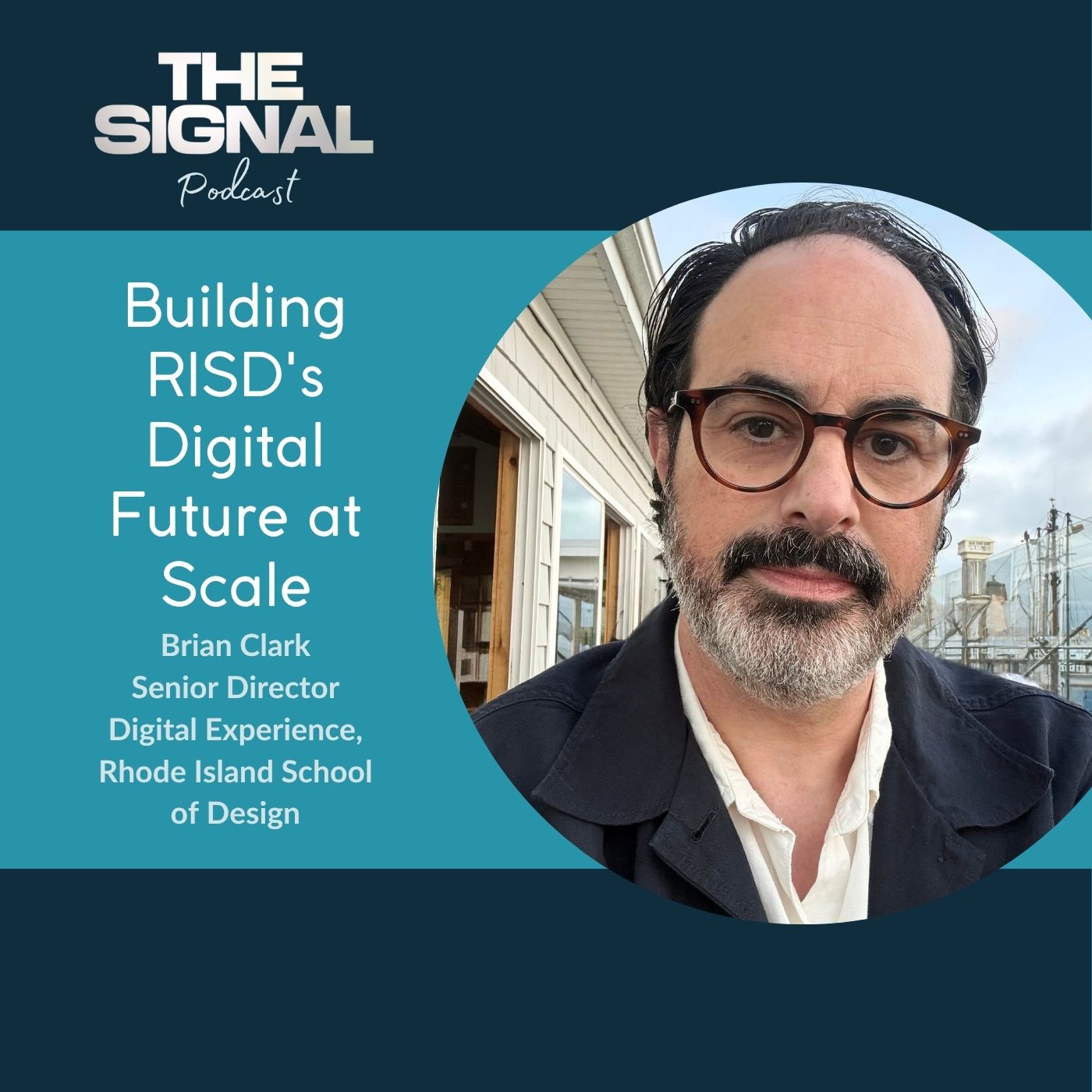
The Signal
Ep. 88 - Brian Clark: Building RISD's Digital Future at Scale
00:30:08
What happens when a prestigious art and design school has over a hundred siloed websites, each with its own content management system, hosting arrangement, and visual identity—many of them orphaned and unmaintained? You get a digital governance nightmare. But you also get a rare opportunity to rebuild from first principles. In this episode, Jeff Dillon welcomes Brian Clark, Senior Director of Digital Experience at the Rhode Island School of Design (RISD). Brian shares the remarkable story of how he led the consolidation of RISD's fragmented digital ecosystem—from 100+ disparate sites to a unified, design-driven, user-centric platform built on Drupal. He explains why this wasn't just a technical project but an organizational and cultural one, requiring years of relationship-building, transparent communication, and strategic alignment with the institution's broader brand refresh. Brian also offers a grounded perspective on AI in higher ed, explaining why RISD chose to implement AI-po...
Loading summary
Transcript50 lines
- [00:00]
A
AI is changing. You know, we already see industry wide that AI is changing how prospects are searching for colleges, right? So you know, each year an increasing number of initial inquiries search about, you know, what schools are good for this, what programs exist at these schools, or how do I compare this school to this school that's happening in an LLM, that's happening in ChatGPT or Cloud or somewhere else.
- [00:31]
B
Welcome to another episode of the Signal. I'm thrilled today to be talking to Brian Clark, Senior Director of Digital Experience at the Rhode Island School of Design, risd. If you're an institutional leader evaluating digital platforms and grappling with how to consolidate your digital ecosystem while maintaining governance and user experience, this conversation is essential. Listening. Brian has spent two decades in digital media marketing and experience design and his current work at RISD gives us a masterclass what it actually takes to unite a fragmented digital campus. He's leading the charge to consolidate 100 plus siloed websites into a unified design driven, user centric digital experience, a problem that hundreds of institutions are wrestling with right now. His team spans marketing, student support and it and he's working with enterprise level platforms and partners to make it happen. Beyond the technical architecture, Brian is thinking strategically about how AI and generative technologies are reshaping search experiences on university websites, how to implement governed content creation at scale, and how to measure success in ways that matter to your institution. In short, Brian understands the intersection of institutional priorities, user needs and technology platforms that every Chief Marketing officer, CIO and digital officer in higher ed needs to understand.
- [02:11]
C
Brian, welcome to the show. I'm so happy to have you today.
- [02:14]
A
Thanks Jeff. Yeah, I'm happy to be here.
- [02:17]
C
Why don't we start with the personal part of this? Walk us through your career path. How'd you end up in digital experience leadership at an institution like risd?
- [02:26]
B
And what were some of the key
- [02:28]
C
moments that shaped how you think about digital strategy in higher ed?
- [02:32]
A
Yeah, I've had a pretty interesting, I guess long. There was a point in time where I think I thought it was too convoluted or maybe not direct enough. But now when I look back I look at it and I think it's all, all the different stops along the way have prepared me in good ways. So I started in out of college. I was an English major. So I started. I wanted to work in the literary world and so I started in book publishing and I was, I think I realized, you know, I was visually oriented. I realized that I probably didn't want to be an editor and I found Myself drawn to what was going on in the art department. And that was my first forays into designing using some of the early desktop publishing software and stuff like that. And so that my internships kind of narrowed around that. And then it led to another internship with a larger book publisher in Boston. Boston. And that turned into a job. So my first job was in the jacket design department of Houghton Mifflin in Boston. And while I was there, I was, you know, the web was exploding and people were learning how to do stuff and I had, you know, I had that kind of youthful enthusiasm to try to figure it out and be the person in the, in the group who knew where the web was going and started doing early kind of web designs and realized I wanted to focus my career there. And so my next job after that was with the design studio working on web based interactive projects. And then, then I made the jump to kind of a more serious like marketing agency, you know, full, full agency. And that was where I really started to learn about digital marketing. And that was, I remember it was a place called Circle. It was in Boston at the time, kind of part of the startup era. And they had this tagline which, you know, seems simple enough, but I had never really thought about it, which was at the end of the line there's a person, or at the end of the wire there's a person. And you know, it was there to kind of stress for us the two way communication of digital marketing. And we were doing some interesting work. We were doing some early work with logins and it was for Campbell Soup Co. So we were doing like a recipe database. So you had to register to save your favorite recipes. And that was the first I'd ever heard of being able to kind of solicit first person customer data and be able to do something with that. And so that was really interesting. It was a group of really talented people who've gone on to do other stuff. And I ended up moving to New York and I worked in some agencies in New York and the last two agencies, I think, where I really sort of honed in on things that have been valuable, particularly at risd, which was strategy and ux, the last company I worked for, last couple of companies, I worked with a really talented strategist. And what he really taught me and what I was really eager to learn was not just, you know, because I was in a project management like producer type of role. So, you know, it was often about budgets and deadlines and things like that. But I found myself increasingly interested in why are we doing this? What is the business purpose of what we're doing? What do we do with this data that we're collecting? Or why do these things matter? And so I learned a ton about just kind of the business strategy that frames good ux and then I learned about the tactics of UX as well, which was how you really think about meeting customer needs and meeting users. And so I took all that to RISD and basically I wanted to, I wanted to slow down, get out of agency world. And I worked near NYU and so I started looking at jobs in higher ed. That's how I ended up at risd. And. Yeah, and so we've been doing that work there ever since.
- [06:10]
C
You made me think of a couple things because I had a similar background to you where I was a web director at a large public, not like RISD on the West Coast. But no one ever really aspired to have these jobs we have. Right. Because they didn't exist now. We just kind of, we kind of fall into it. But I did not plan to ask this, but I have to ask you. You were after the era of secret
- [06:30]
A
mall apartment at risd. Yeah.
- [06:32]
C
So I can tell everybody if you. This obscure reference I just made. There's a new Netflix show out there that's about these guys that found a little space in a mall and they lived in a mall kind of secretly. It was kind of interesting, very fascinating, but just made me think of you, Brian, when I watched it.
- [06:47]
A
There was a really interesting era in RISD's history where there was. Well, in Providence's history too. It was connected to a number of students who were kind of moving out into the lofts and you know, non typical spaces throughout the city from our industrial era and through concerts and parties and did art installations and had studios there. And so it was all connected. It was a pretty, pretty vibrant era.
- [07:10]
C
Yeah. So it's a great foundation. I think it sets you up for what you walked into at RISD because it's, it's a good thing to have a vision, but then it's not to realize a. Right, a reality. Walk into this reality. You got into your current role around 2018, I think about 10 plus years after you got there. You inherited this digital landscape that grown organically to 100 plus websites, siloed teams, fragmented governance. What was the state of things and what was the primary pain point that made your consolidation pretty, pretty urgent?
- [07:43]
A
Sure, yeah. I mean for the first several years that I was at risd, I was involved. I helped build a kind of a new version of RISD edu. But our team was really focused on just that one site. And what was happening, I think because of a number of factors. One was a lack of governance, one was just the spirit of the place. There's so much creative entrepreneurialism and technical know how and just eagerness to make stuff. So sites were kind of popping up all over the place. And what we realized was, you know, it was becoming unsustainable with all these sites on different content management platforms, hosting arrangements, ownership levels, some were entirely orphaned over time. And so in 2018 when I kind of took on my current role and it was clear that I was going to be leading RISD edu, I knew that we were not going to be successful just trying to bring one site along, that we really needed to address the entire landscape. And so in order to get institutional support, we framed it as what it was, right? It was a problem in terms of branding, it was a problem in terms of governance, it was a problem of, in terms problem in terms of ensuring accessibility, maintenance cost. There were so many factors to it. So I went to leadership and was like, you know, we need some resources and some investment to kind of make sure we pull this all back together and align it and get everyone kind of working on a common system and towards common ends. And that's been my work ever since, honestly.
- [09:15]
C
So once you saw how complex and fragmented things were, the next step really is a big strategic call, I think, not just fixing it, but deciding how to rebuild. Choosing the platform, getting entire institution to move with you is a different challenge. Talk us through that decision to build this campus experience on Drupal. What other platforms did you evaluate and what made that stack the right choice for RISD's mission?
- [09:41]
A
We wanted to make sure that we were building not just towards one site, but a system of sites, a very cohesive, coherent, user focused system of sites. And so that was in mind as we looked at different models. We had a number of sites at the time that were in WordPress and people. There were a lot of people comfortable with WordPress. So we looked at WordPress, what we found was that of all the sites that we looked at, we looked at aem, which certainly is built for scale but was I think expensive for our purposes. When we really compared WordPress ultimately to Drupal, what we found that was Drupal was the better platform for building a multi site arrangement and really building towards a coherent ecosystem. And that's largely because of its extensibility, the structure of the way the content is structured. And the content model and just its ability, I think to. There were also players in space like Aquia and Pantheon who are making these multi site environments possible. So all of that I think helped bring us towards Drupal as the CMS layer.
- [10:40]
C
Yeah, yeah. So consolidating 100 plus websites isn't really just a technical project. It's really organizational and cultural. How did you build buy in across academic leadership and the President's office and content creators who are used to autonomy. Really?
- [10:59]
A
Yep. Slowly, deliberately, methodically. We thought a lot about how to talk about it. And you know, I think I spent probably that first year, I mean, a number of things happened. We positioned it as like, this is a real institutional need. And we got lucky in that in the year that we were doing that, it was also a strategic planning, the beginning of a strategic planning year. And so we were able to attach a lot of these ideas to the strategic plan, which helped unlock some funding and some institutional support investment that might not ordinarily be right, but in terms of people, I think we just knew from working with folks that even if a site maybe wasn't the best possible expression of the school or maybe, you know, had kind of dodgy content, a lot of times there were people behind it, there was a team behind it or a stakeholder who cared and was actively working on it. And so we wanted to make sure that our efforts to bring people into a new platform were collaborative and sensitive to how they'd been working. So we spent a lot of time going out and trying to understand not only, I mean, we knew it was out there, but we wanted to understand the purpose and what people thought its value was. And we also did research on the user side and found out how people were viewing all of these things. And we put all that information together and worked with an agency to come up with kind of a holistic plan. And then once we had that plan, I went back out and talked to groups one by one. I went to everyone's team meeting, if they would invite me, all the divisions, departments, groups. And once we had a plan, I then sort of communicated the plan and talked about the sequencing of things and whether I thought their sites would continue to stand alone or be folded into the bigger RISD EDU site or some of the other sites. But it was all communication, it was all people, it was all talking about how it was going to go and being really clear so that when it happened, no one was surprised. I don't think anyone could say, like I didn't know this was coming or we weren't informed, we tried really hard to prioritize that.
- [13:05]
C
I wanted to tell the audience something that like, part of what inspired me to get Brian on the show was we presented together on, on Search out there. And I also interviewed his CIO because I was kind of looking at the different tools you were using. And so I'll put a link to the story I wrote on the the modern tech stack at risd, but I want to talk about the design driven part of your approach at a art and design school, specifically a pretty prestigious art and design school, I'd imagine. Digital experience itself has to reflect institutional values. How did you ensure that the new Digital Campus reflected RISD's ethos in creative culture?
- [13:44]
A
Well, simultaneously as we were starting to think about how to shore up our digital ecosystem and optimize and strengthen it, we were doing the same thing and my colleagues within marcom were doing the same work at a brand level. And what we realized was similar to how there were kind of different websites with different looks and feel for each department. There were also. There had also developed over the years all kinds of different logos and identity marks and a kind of individual branding between areas of the college that got to a point where I think they were in conflict with one another as opposed to in a kind of dialogue with one another. And that was also weakening our ability to present ourselves as a cohesive whole. So the nice thing that happened was the team worked with and I was attached to this project as well. We worked with a branding agency to put together a real overhaul of our visual and verbal approach. And out of that ton of research happened that led to a kind of guiding principle around question to create, create to question, which ideally can be considered at every stage of a design process in terms of thinking about how, you know, that's what RISD considers its core value is being able to create students who question and through their questioning are able to make artworks or works of design or systems or whatever that are going to help challenge and bring about the next waves of culture. So anyway, that was a nice time to have that kind of being all codified. And the good thing too was it resulted in a new brand identity framework which we could then take and build as the kind of inaugural design system for our new digital environment. It all came together and it helped. We made a bespoke typeface, a couple of bespoke typefaces, so that we could really concentrate on a unifying visual presentation for all of the school's expressions.
- [15:51]
C
It made me think of Something Just a comment I want to add here is. I don't know if you remember or if MIT still does this, but years ago, for a long time they would launch a new homepage design every single day. It was just CSS that they would let people submit new designs. The structure, the navigation would be the same. It might move around a little bit, but it was fascinating. I would check it every day, but. But you can get away with that when your brand is innovation. I don't know if they can get away with it anymore, but it was really cool to follow.
- [16:21]
A
Yeah, that's interesting. Yeah, there was a Yale. It still exists. I think Yale School of Art has this kind of wiki that is constantly evolving and changing and I think that's their website. And yeah, I mean that stuff's really fun, but I think we were in a situation where we had to, we really had to think about how do we, how do we kind of get everyone moving in one direction. And I think only now, you know, a few years in are we starting to think about, okay, we really have established a pretty coherent sense of place both digitally and brand wise and how do we open it up a little bit more now and how do we think about, you know, different modalities of that for maybe parts of the school that are less central to the administration and, you know, deserve a bit more experimental opportunities.
- [17:09]
C
Right. I think the kind of experience that you're building doesn't happen by accident. Usually reflects how teams are structured behind the scenes. I've seen the most success that the teams that can move the fastest are often more technical people that are in the marketing team. So marketing IT don't have to completely convene for every decision. It's kind of built in, in the process. So your structure is really marketing and you report into marketing and IT and you collaborate with the student services types of entities out there. What does that governance look like when you're trying to be both coordinated and flexible?
- [17:52]
A
Sure. The reporting structure was deliberate again when it took over in 2018 and kind of we were trying to make sure that our web landscape was as effective as it could be. I knew that I didn't want to operate just out of marcom, that I needed to be in the mix with it because it wasn't just about a content management system. It was really about the overall platform and how that platform measured up in terms of security and performance and accessibility and the third party integrations. We had just completed a transition of our ERP system to workday. We knew that we Wanted the site to have integrations with data from workday. So I knew that it was going to be a lot easier to approach that stuff if we were doing it from a combination of both marketing and it. So I asked to report I had a great relationship with rick, who's our CIO, Rick McCool, and he was open to it. And so we meet frequently as a group and talk through kind of where we're going, both from a marketing strategy and a technology platform place. In terms of the governance in general, what we do is then my team, I have an in house team of content strategists and producers, a great team who partners out with folks across all areas of the college. So we have close relationships with student services, student life, we call it admissions folks in ce. I don't want to leave anybody, but lots of all of the functions. We have a growing network of folks who are learning how to use Drupal and, and as we bring sites from an older platform, older design into the new platform, whether or not those sites continue to stand alone or whether they are absorbed and consolidated into the larger site or our student hub site, we teach them how to maintain their content and how to work and we try to maintain those relationships proactively. Right now we're working on a suite of video tutorials that we can offer so that, you know, in between training sessions or you know, if people forget kind of how to do things. So we have a reference library, so we're trying to nurture those relationships and in those relationships is where conversations about, you know, not just the cms, but brand and voice and, you know, we learn from them about goals or maybe missed opportunities or gaps in content that they're hearing from their constituencies or the users that they're closest to. And that helps us create kind of a feedback loop that inspires all of our next ideas.
- [20:23]
C
Right. And now you're layering something that's really changing the rules again, how people actually find and interact with content. So there's a lot of buzz around AI and generative technologies reshaping how people discover information on websites. RISD is working with AI powered search capabilities. What's driving that move? How are you thinking about the implications for how students and faculty and prospective students interact with your digital ecosystem?
- [20:53]
A
Yeah, I think, you know, when it comes to AI specifically, we surveyed the scene for a while and kind of watched to see how things were starting to shape up. And we don't always necessarily need to be first, but when we come out with something we want to do, it thoughtfully and purposefully. What felt best was that we weren't approaching AI as this thing we kind of needed to like, somehow figure out how to graft onto the platform or shoehorn in. We wanted to really approach it as a practical layer that would help us do what we were, you know, help us accomplish what our predominant goal was already, which was quality. You know, whether you're talking about quality of content or quality of access to that content, visibility for that content, you know, just quality of experience. That was where we thought, well, how can, how can we make sure that AI is a great new tool in helping us achieve those goals? And that's how ultimately we ended up choosing a search platform that not only helped us with just standard search, keyword based search, and gave us a lot of tools for optimizing the basics of search, but then allowed us to provide a layer of AI that would help now facilitate a much more conversational approach to search, one that was semantically based and sensitive to user intent. And the upside of both AI and the platform has been we're about to roll that out this year. The AI, conversational search and the ability to really gain visibility into what students, prospects, parents, whoever's donors are asking of the site is game changing, right? Like that's visibility into how people want to use the site, what types of information is either being met or demands for information that's either being met or not met. So that's gold.
- [22:45]
C
You know, I'm not going to hijack the entire podcast and talk about search. Everyone knows I love talking about search. But I do bring it up with Brian and RISD because they are one of the leaders in that their AI powered search platform has some features already built in and they're working like Brian says on the generative AI testing now. And I've seen the results and it's really exciting to see that they're close to launching the generative AI summaries on
- [23:08]
B
top of their search results.
- [23:09]
A
At a really basic level, it was just valuable to be able to search across multiple subdomains, you know, so no matter where you enter our ecosystem, whatever site you're on, if you're searching for something and maybe it's not, you know, the best information is not necessarily on the exact subdomain you're on, as long as it's going to tell you where else you can find it and take you there across the entirety of the ecosystem, that was a core value from the very beginning.
- [23:34]
C
Yeah, and I got to bring up that one example. It's a very Visual thing that we often, Brian and I talk about together. But I'll try to explain this one, where when you're using a search tool and you get a bunch of no results, people say like, well, why don't you have AI fix those no results, like queries that are coming back with nothing for a user? Can't AI fix that? And yet the answer is yes, but we need to keep a human in the loop. And so what Brian's team discovered was one of them that was coming up was mfa. And I'm like, and I see that, you know, a human could go in and check that and accept it and. Or say, no, I don't want to accept that. And they didn't accept that one. Like, why did you not just say MFA is two fa Multi Factor Authentication, Brian? And he looks at me like, well, that's. What is that, Brian?
- [24:14]
A
Master of Fine Arts.
- [24:15]
C
Master of Fine Arts, yeah.
- [24:17]
A
In our world.
- [24:17]
C
Yeah, yeah. So even AI does not know, like, you gotta have that.
- [24:22]
A
It's very.
- [24:22]
C
Like I said, we spent a whole podcast on this. But AI is great. But yet we're trying to keep a human in the loop is the story we tell. And whenever AI is in the picture, it's not just excitement, there's a healthy dose of skepticism. So when it comes to implementing these generative AI answers on campus, whether it's search or content creation or student support, what are the questions and concerns you're hearing from your stakeholders, and how are you addressing those?
- [24:49]
A
Well, I think at the outset of any conversation about AI, it's become important to sort of establish the ground rules for, like, this conversation is about these things and maybe not these things because it, it can get, you know, conversations can start to go in a lot of different directions. And sometimes you end up discussing maybe the ethics or the business of AI and in ways that aren't necessarily where. Where you were intending to go. And especially at an art school. I mean, obviously there is a. We are a school that pedagogically is embracing AI in certain ways, and there are certain programs that are using AI to ask questions about creative process. And so that's one context. I'm approaching it from a place where we're in the marketing business, we're digital experience professionals. We are. And I talk to my team about that a lot. It's like, yes, we work in higher ed, but we are digital design and technology practitioners who happen to be working in higher ed. And from that, and marketers and all of those things, you wear a lot of hats And I think what we learned was that the position that we take is that AI is changing. We already see industry wide that AI is changing how prospects are searching for colleges. So each year an increasing number of initial inquiries search about what schools are good for this, what programs exist at these schools, or how do I compare this school to this school that's happening in an LLM, that's happening in ChatGPT or Cloud or somewhere else. And that may not even yield traffic to your site. Right. So when I talk about it, I talk about it as this is the place that we're coming from and we are interested in making sure that we're not losing ground or missing opportunities to make sure that our information, our content, our story is best understood by these LLMs or by Google's Gemini search snippets. Or we want to make sure that our content is structured in a way that it's going to respond and be understood and present really well for external searches. And then also when you come to the site, we are using AI to make sure that when you come to the site and you're searching kind of in a different mode at that point you're kind of, you're a more qualified lead. Right? You're definitely, I think, a bit more further along. And we want to make sure that folks who are searching from that mindset are also getting the most relevant and contextually valuable content. So I don't think there's a situation where you can avoid, you know, not trying to understand how to adapt.
- [27:32]
C
Yeah, that's a great point, Brian. Like search traffic might be going down, but it is more qualified traffic now because everyone's more educated from all these LLMs that are just trying to confirm that and, and get what they need. So thanks for saying that again, I say that all the time as we wrap it up. Thinking forward, what's on your roadmap for RISD's digital experience over the next year or two? What are the emerging capabilities or challenges you're preparing for?
- [27:54]
A
We subscribe to the concept of we're never going to redesign because we're always redesigning. And so to that end, we're looking at ways to enhance our design system, our front end design system, but also the component system within the Drupal platform partially to, you know, to just fix some things that could be better in general, but also to create some new forms for different types of telling stories or displaying information or allowing more experimentation into the mix. So that's a big one. AEO is a huge one. Just you know, we've already got good fundamentals in place. You know, our content is pretty well governed. It's, you know, updated pretty frequently. It's structured really well through Drupal. But there are always opportunities to structure even better and add some new schema into the mix. So we'll be focused on that. And then the biggest thing is also creating some new experiences around alumni impact. Yeah, the school next year is going to turn 150 years old. And so to help celebrate, we are going to be really working hard to tell not just the story of the institute or tell the story of the institution through so much of the great work that has been done by our community.
- [29:09]
C
Yeah. Yeah. Well, it was a great conversation. Incredible insights as always, Brian. Thanks for being on the show.
- [29:16]
A
Thank you for having me.
- [29:17]
C
I'll put a link to RISD's website. The article I wrote about the modern tech stack featuring risd and Brian's LinkedIn profile in the show notes. So thanks again, Brian. That was fun.
- [29:27]
A
Pleasure to be here.
- [29:29]
C
That's a wrap of this episode of the Signal.
- [29:32]
B
If today's conversation sparked a new idea
- [29:35]
C
or challenged your thinking, that's exactly the point. This show is about cutting through the noise and helping you see what's actually
- [29:43]
B
shaping higher ed right now. Please subscribe so you never miss an episode. And if you found this valuable, leave us a quick review.
- [29:50]
C
It helps more higher ed leaders find the signature signal for deeper edtech insights,
- [29:55]
B
news and trends delivered monthly.
- [29:57]
C
Subscribe to the Signal monthly newsletter@edtechconnect.com thanks for listening. We'll see you next time.