← The Signal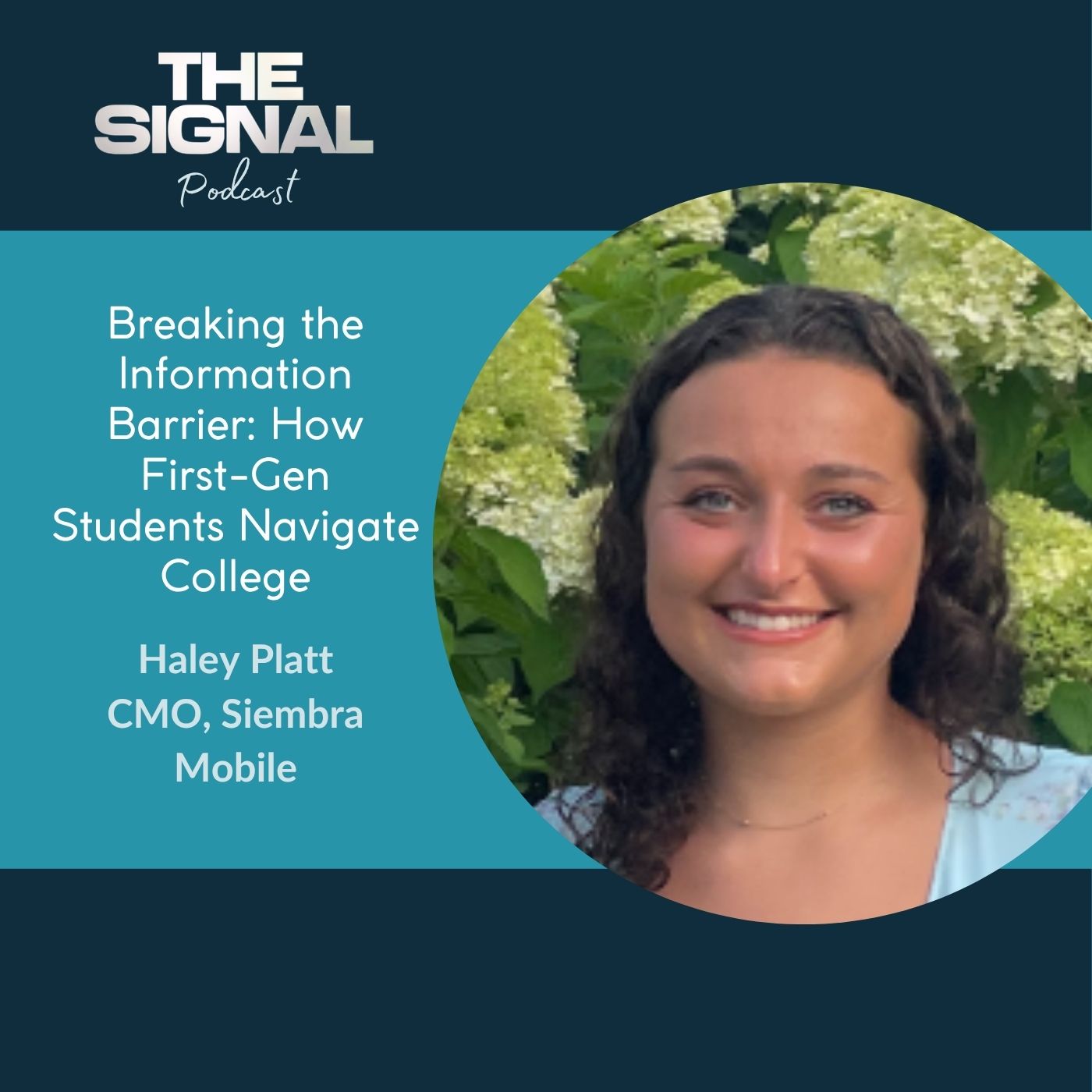
The Signal
Ep. 90 - Haley Platt: Breaking the Information Barrier: How First-Gen Students Navigate College
00:30:36
What happens when a recent college graduate who grew up with smartphones, social media, and the chaos of modern college applications becomes a chief marketing officer? You get a perspective that most higher ed leaders desperately need but rarely hear. In this episode, host Jeff Dillon welcomes Haley Platt, Chief Marketing Officer at Síembra Mobile—a company building technology to connect first-generation students and families with post-secondary pathways. At just 23 years old, Haley made the leap from intern to CMO, bringing a Gen Z lens to marketing, student engagement, and the gap between K-12 and higher ed. Haley pulls no punches about what's broken in traditional college outreach. She describes the "stack of postcards" problem—students receiving thousands of generic mailers that feel disingenuous and overwhelming—and explains why targeted, early, meaningful engagement is the only way forward. She shares how Síembra‘s self-monitoring intervention model helps students track acade...
Loading summary
Transcript32 lines
- [00:00]
A
We're navigating a really unique time in history right now. And to be raised with the technology knowledge that we have, the AI boom right now, all of the politics, all of the economy, this huge wealth disparity, it's really hard for a student, like if they're talking to their parents and parents are like, oh, well, I worked a job all through college and I paid my college through when I was in there. That's not realistic in this day and age for students.
- [00:33]
B
Welcome to another episode of the Signal. Today we're joined by Haley Platt, Chief Marketing Officer at Siembra Mobile and a true innovator in the ed tech space. What's remarkable about Haley is that at just 23 years old, she's already leading marketing strategy, business development and customer relations at a company, making a real difference in how students access post secondary pathways. With a degree from Santa Clara University in finance, along with minors in Spanish and international business, Haley brings both analytical rigor and a passion for social entrepreneurship to her work. She's not just building a career, she's building a movement. Sambra Mobile connects students and families with the information and support they need to explore educational pathways, with a special focus on first generation students who often face the greatest barriers to information. Beyond her CMO role, Hailey has been deeply involved in sharing student stories through her own podcast and leading webinar series with superintendents and higher education leaders. Her combination of Gen Z perspective, practical ed tech experience, and genuine commitment to breaking down barriers between K12 and higher education makes her an essential voice in conversations about enrollment, student support, and institutional innovation. Welcome to the show, Hailey. It is great to have you today.
- [02:01]
A
Thank you. It's nice to be here.
- [02:03]
B
So can you take us back to the moment you decided to transition from being an intern at Siembra to stepping into a Chief Marketing Officer role? What changed for you? What did that leap of faith really look like?
- [02:17]
A
So I actually got involved with Sambra when I was a senior in college. I was kind of confused about what I wanted to do post grad, as many college seniors are, and I thought it would be really cool experience to work for a startup. Such a foreign concept to me. Obviously, being in the Bay Area, everyone is part of a startup culture, but I am originally from Boston and so that kind of energy and work environment is just not something I was used to. So I definitely was interested in the mission of the company and kind of giving that Gen C perspective to them. And upon entering I realized, wow, this truly is a startup situation. There's kind of A big disconnect between this generation and how college applications actually work nowadays. There's even such a big difference between when I applied and when my sister applied three years later. So, yeah, I'm excited to kind of get into what that looks like for students now later on. But yeah, stepping into that role, I had actually originally taken a different job for postgrad and I was really on that track. Supposed to do financial planning. And although kind of similar missions and human connection, I realized it just wasn't the right path for me. So I ended up circling back with my boss, Tim, and I was like, hey, can I get involved? Just keep my feet wet a little bit while I'm kind of figuring out what I want to do. And we actually got funding and I was able to get hired full time. So that's kind of the main. The main thing that I. Dealing with a lot of emotions kind of lost of where I was, but clearly I was feeling this pull back to be with this company.
- [03:55]
B
So the opportunity was there. You had this conviction about the work. And I think that's important because the leap probably feels less risky with someone that has your background. Which actually brings me to something I've noticed in higher ed is that so many admissions office offices are staffed by people with traditional paths. They majored in marketing or communications or business. You come in kind of sideways through finance and Spanish and international business. And that's a different lens entirely. So with this background in international business and language, you know, languages and finance, how has that specific education shaped the way you approach marketing and business development in the edtech space?
- [04:34]
A
Sure. So I would say I've been really lucky. You know, both my parents were in finance, and so I was kind of exposed to a bunch of different tracks from a young age. And I knew that I was pretty entrepreneurial and business savvy from a young age as well. So I knew that it kind of fits my strengths. I'm very extroverted, I'm super creative. And I always kind of fell into writing or history, which is why I pursued Spanish, because I think it allowed me to kind of get the cultural knowledge alongside the history and literature, which actually some of my Spanish classes were my more favorite classes in college. So that was definitely a great experience. I would say I was lucky to go to Santa Clara because of the Jesuit background. It's really educating the whole person. And I didn't necessarily knew what that meant when I was starting out. Right. But I think everyone who I know from there would agree. By the time our senior year was over, that we were going into the world equipped to deal with the challenges that were going to come our way, but in a way that's respectful of our community, economically and politically aware. It truly made sense to me when I was leaving. I'm ready to be in the world.
- [05:51]
B
So you're bringing this cross cultural, financially literate perspective to how students are supported. And here's what I think this is kind of, kind of wild. A lot of college marketers have never actually used the products they're selling. They don't know what students experience on day one. You do. You lived it from inside. Walk us through what a student actually experiences with Siembra's app. What does that self monitoring intervention model really do for a first generation student who might not have access to college counselors?
- [06:20]
A
Yeah, so Siembra is kind of the parent company and we build an entire ecosystem so the students and families are at the core of the ecosystem and they're using the app. College Connect by Sembra and College Connect helps them track academic progress. It helps them connect with colleges earlier. And it works both ways so our higher ed partners are able to engage with students earlier and more meaningfully. And what that looks like is through that intervention approach. Anyone who doesn't work in education, like I didn't know what an intervention was until I started working here. Basically just showing that a student is on track, giving them positive affirmations or maybe intervening when they're not on track or they're struggling. So an intervention is used in various forms, mostly by teachers. And. And so we adapted that self monitoring intervention model to a high schooler in terms of how they can matriculate. A big part of what Sembra does is showing students that there are a lot of pathways that are out there. The traditional four year college pathway doesn't always make the most sense for everyone. And so having different pathways that you can see directly on your app from a younger age can make that process a bit easier for you and allows you to be more realistic about what you want. So they can track community college pathways and requirements as well as like a CSU or a UC standard, which for anyone outside of California, it's basically just basic unit graduation requirements that are required by the UC system for admission. But that's what all students are tracking to in California. But only about 30% of students actually complete those A through G goals, which is huge because we're trying to show like, okay, how do we scoop up those other 70% and work directly with our community college and Higher ed partners to help keep them on track. Because the ultimate goal that all the K12 and all the higher ed partners have is that once they graduate, then they can enter the job market and feel prepared. That's the main goal. So we just work to connect all of the stages of that process.
- [08:28]
B
I think that's powerful because you're not just describing a feature, you're really talking about what matters and you've actually listened to what matters through your own podcast work. I imagine those conversations with first gen and Latinx students told you things that dashboards never would.
- [08:47]
A
Yes, exactly.
- [08:48]
B
So what was the most surprising insight you learned from those conversations that directly influenced your work at Sembra?
- [08:54]
A
You know, I was very lucky to have the education that I did. And so I would go into it with a lot of humility. I have no idea what they're experiencing. And so part of that was engaging with questions that feel relevant to them and feel authentic and just kind of hearing about their stories and keeping the conversation casual. These are 18 to 22 year olds and I'm only 23 and so I felt like I was just having a conversation with my peers. But I think the biggest thing I learned was the barrier to information is very dependent on your population, your family, where you live. Like all these different factors that we know when you work in higher edit or if you work in edtech, that's why there's so many companies out there to help. But I think the biggest difference that I've seen is that there's so much information out there, it is really hard for students to assess what they need to follow. So like the barrier to the information is here's all of this stuff up here about college or about post secondary pathways, but we're down here. And that barrier, whether it's a data silo barrier to information, just like for example, fafsa, so much harder. They changed the process and it was so much harder for students to fill out the fafsa. And I would have to look up what the correct number is. But the amount of need, need based aid that went unmet was through the roof this year or last year. So I think that's why my background in finance, I think influences me as a young woman. I want people to be financially savvy as well. And so that kind of pulls into picking the right path for you, like maybe in state makes way more sense and will help you stay on track. So I kind of bring that knowledge to the table as well when I'm having these conversations.
- [10:49]
B
Yeah, I Love that you're really surfacing these stories that matter. And I think that's exactly what institutions are missing right now because you're hearing these individual narratives. Universities are staring at spreadsheets and they're seeing an enrollment cliff, but not understanding why or who it affects. You know, what's really driving the shift? How are students being affected differently depending on their background?
- [11:12]
A
You know, policy and politics aside, I think it's a really big paradigm shift right now that's happening where the old model for recruitment by colleges is fading out and it's not working anymore. And so what we're trying to do is, especially for our higher ed partners, is help them make more meaningful engagements and increase their top line funnel earlier by connecting entirely with K12 districts. That's where the barrier conversation comes back in, is that the enrollment cliff is like this big looming doom. And so what I try to do, at least on my webinars, is bring in some of our partners from both sides of the conversation and just really understand, like what is realistic for districts. What is working right now, how are admissions departments adjusting their strategy to adapt and meet Gen Z and families where they are. And I think part of that looming doom is that the lack of communication between everyone. I think from the higher ed side, it's like, is your CFO talking to your admissions department? Because enrollment is directly linked to whether a college is going to stay open. We just saw on Friday, Hampshire College in New Hampshire is going to close. We're seeing all these distressed schools and they're like really small schools and they need to raise their recruitment. How are they finding students? Well, I think it's less about they need to find the students, but I think we got to have more communication between these because now there's, now there's students who are pursuing maybe a different pathway who are transfer eligible would be a great fit to make up that student body. That's part of what my team does too, is fostering these conversations and building these relationships. And they're what we call virtual enrollment communities. So kind of like this matrix of of all the constituents in one place.
- [13:05]
B
Yeah, there is a disconnect. Institutions see the numbers dropping, but they're not seeing the people behind the numbers. And I think that gap shows up in how they try to fix it. They send an email campaign, they post on Instagram, they hope. But based on everything you're seeing, what's going wrong, what are they getting wrong?
- [13:24]
A
I think. Well, part of this, and I've experienced this not in my direct team, but Just being young in the workforce is misconception. And I think Gen Z has some qualities that we get labeled for. But I think I want to give all of my younger kids, especially first gen students, a bit more credit. We're navigating a really unique time in history right now. And to be raised with the technology knowledge that we have, the AI boom right now, all of the politics, all of the economy, this huge wealth disparity, it's really hard for a student, like if they're talking to their parents and parents are like, oh, well, I worked a job all through college and I paid my college through when I was in there. That's not realistic in this day and age for students. And so I think what's going wrong, it's easy to focus on what's going wrong. I think there's a lot of things that are going right, but we still have a lot of work to do. I think like the marketing situation. When I, after I took an exam in my junior year, I got a stack in the mail this thick. I probably would have considered three of those. It just was like, so overwhelming and it felt disingenuous. Like, you're just setting me a fire. I'm one of the numbers. And that's where our intervention model and our post secondary partnerships actually negate. That feeling of just being a number is because they're reaching out earlier based on what the student has indicated on their app of areas of interest. Say they're interested in a STEM pathway. Well, a university recruiter can query all STEM achievers from this one district that we have and they can send a targeted message saying, hey, this, this STEM professor is having a lecture next week. We think you'd be interested in it. And to that student to receive a message like, wow, they knew I was interested in STEM versus stacks. One stacks. I think it's like either too much information or not enough and we need to find a middle ground, if that makes sense.
- [15:27]
B
Yeah, yeah, I totally see that. And I think this moment we're in is where the k12 connection really becomes critical. Because if colleges don't understand what students need, K12 schools are really flying even more blind. They're trying to prepare students for institutions that they don't fully understand. Your webinar series, Reimagining Access, brings together K12 leaders and higher ed professionals. What's the biggest gap or disconnect you see between these two worlds?
- [15:59]
A
You know, I think a big gap is that everyone's doing things a little differently. And that's fine. I Love that. But it makes it hard for a student to see visibility into life after high school if their district hasn't implemented the necessary components to make sure that they're not only applying to a college. But I was actually at the ASU GSB conference last week and there was a lot of talk about social, emotional learning and college and career readiness. I think we need to be teaching these life skills and be having like third spaces where students can interact with their community, be parts of something bigger than themselves that doesn't. That don't feel like an obligation, but feel like something that they want to do. Like, I don't know, like an after school or a weekend program or something that teaches the students like volunteer work. One of the panels that I sat through had direct relationships. Certain colleges were pairing up with local businesses or like, I mean, these could be giant manufacturers or tech companies or whatever in their areas and essentially creating majors designed so that when they graduate they are ready to step into that job. That was like a ding, ding, ding bell in my head because at Santa Clara I actually did design thinking, social entrepreneurship as a pathway. And so I try to bring that into everything I do, especially with Siembra, like, okay, well here are a bunch of students who have no idea what's next. How can we give them either like action items or resources so that they can be on the right track? And I think other schools need to replicate this model, whether it's making more internships available. The job market, that's a whole other conversation we could talk about, but there's too many students and not enough internship opportunities. We hear Gency saying the job market is so tough, I have nowhere to apply. Well, it's like it requires one year plus of experience for an entry level job. So anyway, I could go on for
- [18:07]
B
ages about that, but I think a lot of ed tech companies talk about bridging the gap, but they never actually explain how. Can you give us an example of how is building that bridge in ways that traditional college outreach isn't?
- [18:23]
A
Okay, so one of our best examples and partnerships. So we're based all throughout California and expanding. We're partners with Stanford, of course, but also the National College Resources Foundation. So bringing everyone into the community from a younger age. So this is starting in the ninth grade. A ninth grader can be thinking about college pathways, getting that college material. That's where that social psychology comes in. Because we're deployed mostly, I would say our strongest connections are in the Inland Empire right now. Best example is Colton joint unified and La Sierra University La Sierra University Dr. Christian Arthur, the President is actually first gen himself. He's an amazing. Everyone should go check out my series when he was on. But he recognized that they're a small school, they have a lot to offer but they had no idea how to engage with students or get students to hear about them. So as a tech partner with them, we connect them directly to the K12 and they actually have direct admissions programs. And so what they're doing through us is reaching out to those students and pre qualifying them so they don't even have to get to their senior year. They could be in their summer and they can go and look on, you know, from last year and see they've been admitted for direct admissions because La Sierra already has their transcript. Real GPA interests. That is huge. And we're already seeing the trickle down effect with the peer to peer where our current seniors are in school saying, yeah, I got indirect admissions to La Sierra and I'm going to pursue this program or I'm getting scholarship opportunities. That mental block like that can often happen to students, especially if they're first gen. It's like an 85% acceptance rate at a school. Oh well, what if I'm part of that 15%? I don't want to even try. I'm not even going to do it because I don't want to know if I'm going to be part of that 15. So taking that kind of mental block away and fostering these relationships early. I have meetings with Ron Veneguez who's in the admissions department where I work with his marketing team to create flyers. We have partner spotlight pages on our website. We have ways for students to engage with them in the app. And then we also have with you UC Santa Barbara we did a webinar series on understanding the E3G requirements. Their team is absolutely amazing. So just examples of how like the higher ed side is connecting to the K12 through us and then we turn around and work directly. Melody Mon and I, she's the director of our counselor and kind of our lead interventionist. Her and I will turn around and work with the K 12 districts, whether that's the College of Career Counselors, the Avid or Puente kind of specific counselors, the superintendents and kind of the high level people. And we say, what do you want your students to know this month we might send them a message during final exam saying remember to turn in your late work and keep up the study and keep up the great work. That's an intervention. So kind of Working to, like, expand the resources for students and families and making things accessible while also, you know, fostering these communities and actually getting students from high school to college.
- [21:34]
B
Yeah, you're doing something traditional college outreach really never could. You're listening to students before they commit. And I think that's the generational shift that's happening. You're a recent graduate yourself leading this work. What does your generation expect from institutions that most college administrators still haven't figured out?
- [21:55]
A
I think it's making inroads with the local community and, like, companies that are out there and basically not. Not doing it alone. I think each school has their own way of implementing it, but I think something should be even required to be doing. And I think we need to have more course and, like, job visibility outside of, like, for example, the business school at Santa Clara. In our advanced writing course, we covered everything from public speaking to updating our LinkedIn and resumes and networking. I don't know how many other majors were able to do that. And so, you know, I think part of that is making sure that the students and families know from a young, younger age because it's never too early to start, and just making sure that they have the skills that they need to succeed. I don't know, I feel like as a recent graduation, also learning how to take breaks, it can be very mentally draining. And I think those support systems, like, hey, let's all sit together and apply to 25 jobs this week. Like, let's try to do it. Yeah, it's. It's tough. And I feel for anyone who's trying to do it right now, because it's grueling, and I don't think we can beat around the bush about that.
- [23:14]
B
Yeah, well, I mean, there's. There's a worldview gap, I think. I think Gen Z sees education differently, values differently, needs differently. And when you're in those rooms, when you're in those rooms with decision makers, I imagine you're trying to translate that. What's the conversation you're most eager to have when you're in that room?
- [23:34]
A
I think everyone that I am lucky enough to work alongside and across from, they are super passionate about what they do. It's no doubt about it. And teachers and counselors and these superintendents work so hard every day, and they really are the backbone of why we're able to do what we're doing. I'm so lucky to be exposed, not only on my team, to everyone else, also how much experience they all have, too. So I love to be open Ears and just hear anything that they have to offer. But, you know, making sure that we're not putting students in a box, I would say is the biggest thing that I've heard from these supers that we work with. Making sure that, you know, the negative. One of our superintendents heard from his counselor, like, oh, well, you'll basically end up doing this or doing this. And he was like, what? Like, I don't, I'm not interested in either of those. Like, why am I being put into this box? Or being stereotyped to generalize. Like, that can't happen. And so what we're seeing at even some of our bigger districts too, just making sure that all the pathways are explored, not putting students in a box, making sure that they're just turning out like well rounded individuals. Like they're not only smart, but they're socially conscious and they're giving back to their community.
- [24:50]
B
I think institutions have really been built on a particular framework and it really wasn't designed for first generation students and they're playing catch up. Siembra really focuses heavily on first gen students. Why did you choose to concentrate your efforts there? What do you think institutions fundamentally misunderstand about, about this population?
- [25:09]
A
Well, we chose to focus on first gen. Our name, Siembra, actually Spanish for to cultivate and to harvest. And so we, 10 years ago when, when they started the project, long before I was involved, you know, we were down, my boss was down in Los Angeles talking to Latinx mothers where they were saying like, this would be great to have a way to, I want to help my kid get into college. How do I do that? Having those experiences. That's why we created the name Siembra. A lot of our partners, you know, they have immigrants in their family or they have large Spanish speaking populations. So obviously being in California, we have a pull to that and helping as many students as we can. I would say for the first gen students, they are some of the most hardworking people. And young women, especially from the podcast that I've met, they see themselves in a very humble way. And I think that should not be lost on people. I think administrators and admissions directors do see that if they're able to have conversations with them, they know and they can see the drive. I think it's making sure that we support them through every single stage and not assuming like, oh, well, they're a freshman now, so they figured it out. Making sure that they have the support systems in place, peer to peer is huge. I know a lot of schools have first generation Clubs or support groups, but we need to invest more in those. I've had offline chats with people that say, yeah, we have it, but it wasn't the best. I feel like there could be improvements made. So I think having like student representation on your school board, council, whatever that looks like, and just listening to them and hearing what they need, because oftentimes it's, they're not actually heavy lifts. They're just making sure that a student has, has those support systems in place.
- [27:08]
B
Well, Hayley, I want to wrap it up with one final question for you. You know, you didn't follow the path that institutions really usually reward. There was no real pay your dues, no five year climb. You saw something that mattered and you, you moved. I think that's the model a lot of, of young people need to hear, especially in ed tech where the problems are so urgent. So let me ask, what would you tell another fellow gen zer who sees an opportunity in student success but doesn't have the traditional credentials or experience yet?
- [27:36]
A
Well, I would say first off, follow your gut and follow what makes you happy. I know that's so general and that's what we hear growing up all the time, but one of my favorite quotes is your calling will keep on calling. And I think that really speaks to what. It's a really good summary of what I do and why I chose to stay with Sambra because I think I had this pull and this like, higher calling of like you're, you're meant to be helping people and you're meant to be working with, with students. And I come from a long line of educators, so I've always really respected teaching and education space. But how do I do that and make a difference and make sure that I'm pursuing? I'm happy every day to sit down at my desk and be working on things for students and families. For students who might not have a traditional path, I would say that everyone's journey takes time. You're not going to be on the same path as your best friend or your mom or your peers. You have to pick what makes the most sense for you. And there is absolutely no shame in how long that takes you. I think Covid, actually the blessing of COVID was that everyone was able to explore and what works best for them. And no one could question that. And I think that's been the biggest, biggest blessing. We're seeing more gap years, we're seeing non traditional pathways, whether it's dual enrollment CTE and those are becoming more popular. We continue to see adults taking these classes at community college or at a four year institution. And I think also too, you're never too young and you're never too old. If you're 60 and watching this and you're like, oh, this makes me want to get back out there, go for it. Life's too short. In summary, my best advice I could give you is follow what your calling is, but then also find mentors in your space and find people that can look up to you. That's part of the reason why I stayed with Siembra, because I have so many people that I'm learning from on a daily basis who much, much crazier and meaningful, more meaningful experiences than I've been able to have in my two years on Earth.
- [29:42]
B
Well, thank you Haley. What great information and insights. I will have all your links in the show notes. I think you're reimagining Access webinar series your podcast Siembro's website. So thanks again. It was great having you.
- [29:55]
A
Yeah, thank you so much.
- [29:56]
B
Bye Bye. That's a wrap of this episode of the Signal. If today's conversation sparked a new idea or challenged your thinking, that's exactly the point. This show is about cutting through the noise and helping you see what's actually shaping higher ed right now. Please subscribe so you never miss an episode. And if you found this valuable, leave us a quick review. It helps more higher ed leaders find the signal for deeper edtech insights, news and trends delivered monthly. Subscribe to the Signal monthly newsletter@edtechconnect.com thanks for listening. We'll see you next time.