← The Signal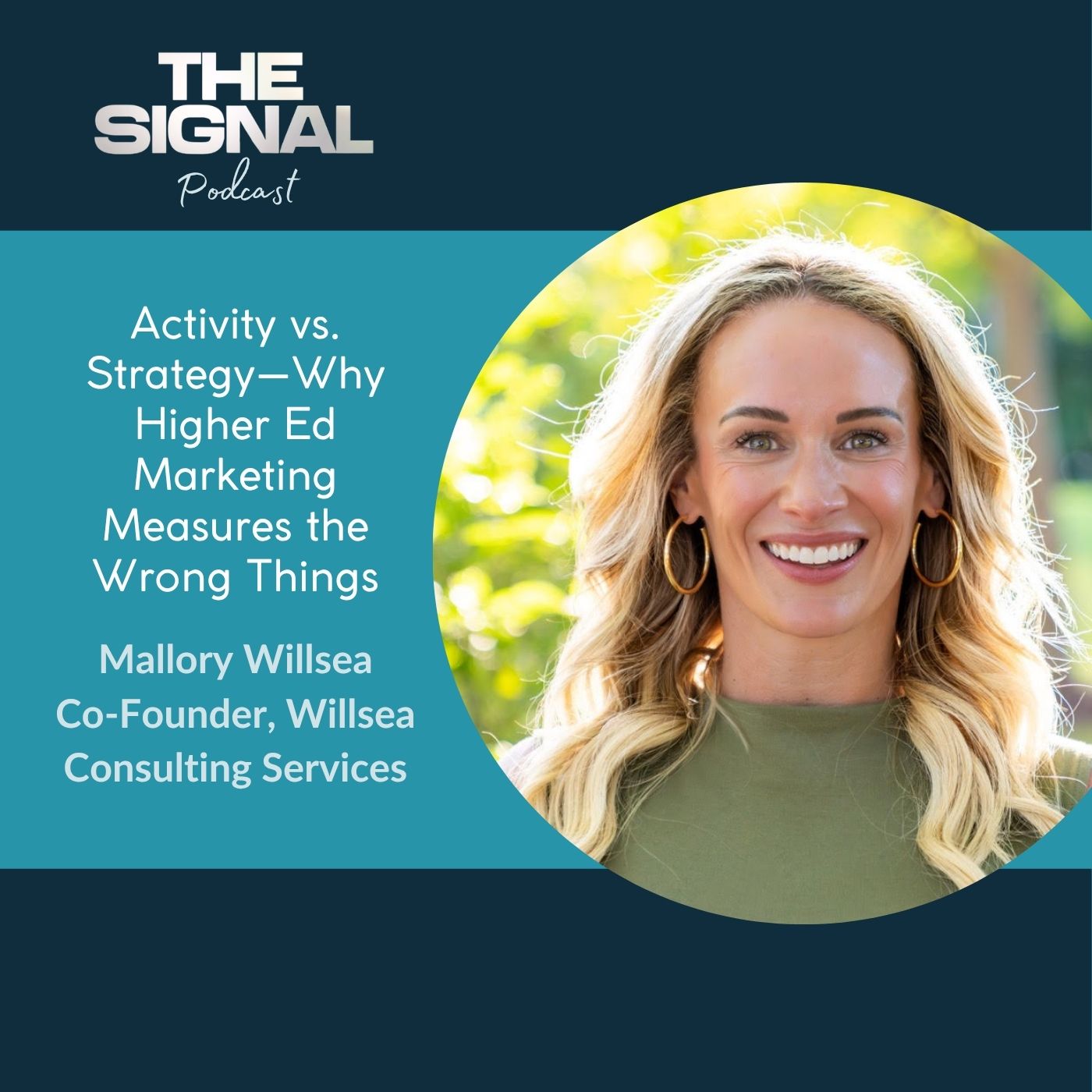
The Signal
Ep. 91 - Mallory Willsea: Activity vs. Strategy—Why Higher Ed Marketing Measures the Wrong Things
00:31:34
After nearly 20 years watching colleges pour millions into sameness—the same viewbooks, the same home page videos, the same taglines—Mallory Willsea has a message for higher ed: stop mistaking activity for strategy. In this episode, Jeff Dillon sits down with Mallory, a strategist and consultant who has been shaping digital marketing in higher ed since the early days of social media. From her early experiments with YouTube recruitment videos at St. Michael's College to co-founding Higher Ed Icons and hosting the Higher Ed Pulse Podcast, Mallory brings a rare longitudinal view of what actually works—and what doesn't. Mallory argues that the real enemy isn't polish; it's sameness. When every institution claims to "develop the whole student" without showing what the chemistry department actually does at 9 a.m. on a Tuesday, trust erodes. The fix? Specificity. Real people. Proof behind the claims. She also tackles the AI shift head-on, warning that SEO strategies from 2019 are no longe...
Loading summary
Transcript56 lines
- [00:00]
A
Brand is what shortens the trust curve and that is how I think about brand awareness and that is how I measure brand awareness. Does it shorten that trust curve? AKA if you're a company, does it change your win rate, the length of your sales cycle and your pricing power? If you are an institution, does it build preference among your prospective student audience as early as possible? And as we talk about it's a long windy road this this new era Funne Foreign
- [00:35]
B
welcome back to another episode of the Signal. Today we're diving into digital strategy, brand authority and the rapid evolution of AI in higher education with somebody who's been shaping how colleges and universities tell their stories for nearly two decades. Mallory Willsie is a strategist and consultant who works at the intersection of higher education, media and AI. With nearly 20 years of experience in enrollment marketing and brand leadership, she helps institutions and companies sharpen their messaging, grow their influence and adapt to an increasingly AI driven digital landscape. Her early work focused on developing digital first student centered engagement strategies at St. Michael's College. She's also known for scaling media brands like Higher Ed Live and a Rollify's podcast network. Mallory now runs Will See Consulting Services and co founded Higher Ed Icons, a platform celebrating the pioneers and trendsetters in higher ed marketing. She's also the award winning host of the Higher Ed Pulse podcast where she explores the ideas and strategies reshaping how institutions connect with their communities. Hey Mallory, it is great to have you on the show today. Thanks for being here.
- [01:51]
A
Hi Jeff, thank you for the invite. I appreciate it.
- [01:54]
B
Well, I would love to start by understanding your journey. How did you go from being an admissions counselor to doing social media experience at St. Michael's College to being someone who's really shaped helped shape the entire landscape of higher ed marketing media. Was there a pivotal moment in this journey?
- [02:15]
A
You give me too much credit. But you know, there were some pivotal moments and I think a little bit of it was luck and a little bit of it was taking advantage of the opportunities that I saw. You know, St. Michael's was like the petri dish. I like you said I was an admission counselor, but I was an admission counselor in 2008, 9, 10 when social media and experimenting with social media as a communications channel was in its very early days very similar to, I think where we are today with artificial intelligence. You know, like truly nobody was paying attention to those channels from an executive level at that time. And I saw some opportunities and had the motivation and willingness to, you know, kind of help create the playbook and Set the pattern. And really from there, you know, I got to, at a very young age, go to conferences and speak about what I was doing and what I knew. And some of those early presentations were on YouTube and how to use video to recruit students and other social media tools. Through that opportunity and those opportunities, I got to meet people who were doing some really interesting stuff. Seth o', Dell, who started a higher ed live network, which was a podcast before podcasts were cool. And I saw how through that network or through some of the blogs that like Callback Eduguru was doing on their website. Right. I was seeing how all these individuals really help shaping a narrative within the industry. And honestly, like, I'm a competitive person and I'm like, I want to do that too. Like, I was seeing other people do it and I was like, why not me?
- [04:05]
B
Yeah. Yeah.
- [04:06]
A
So, yeah.
- [04:07]
B
So you were experimenting, I think when most of hired was still figuring out what social media really was. And I think it probably gave you a real advantage seeing the gap between what institutions thought they should be doing and what actually works. So from that vantage point, what's the biggest gap you see between how colleges think they should be doing digital digital marketing and what actually moves the needle?
- [04:29]
A
Yeah, colleges confuse activity with strategy. And so I think the gap is right. Outputs versus outcomes. And a lot of times we as leaders are measuring our teams on how many things they made that day, how busy were they without stopping and saying, okay, well, is the needle moving on whether or not someone's actually changed their mind as a result of looking at the information that was output a lot of times too? And like some real talk, but like a lot of our institutional digital media is solving for the comfort of our institution and not the decision that our target audience needs to make. And so if we're just telling the institution story to the institution, then what are we really doing? And I think that, you know, one more thing on this, like, knowing which decision the prospect is making and at what stage sounds simple and sounds obvious, but it's not. It requires us to actually know our audience versus the audience of the institution that's recruiting students down the street from us. And if we can show up where they are with the specific thing that's going to help them decide. I mean, that's really all it boils down to.
- [05:52]
B
You're right. Yeah. And you've seen this from both sides. You know, where the disconnect lives. And I'm guessing a lot of that gap has to do with how marketing gets practiced on the ground. And the culture of how colleges approach this, it's that trust in that authenticity piece. And you've mentioned that the higher ed is drowned in polished marketing, but it doesn't really land anymore. What does authentic digital strategy actually look like in practice? And where are the institutions going wrong?
- [06:26]
A
Jav, we've been using the word authenticity for 20 or more years and we still don't really understand what it means. Okay, I am going to reframe the question, though, just slightly, because I don't know that the issue is polish. I might have said that before, but I actually think the issue is sameness. And so every view book and every video and every campaign is hitting the same beats. The polish stops doing work when we're in a sea of sameness. And that's why, gosh, just last year, like the Featherstone University from Colorado Mesa, that's why that makes waves, because it's not the same as everything else. It's not hitting the same beats as everything else. And so authentic in practice. It goes back to what I said to your last question. In a lot of ways, you need to have a real point of view with real people and specificity. You need to have proof to back up the claims you're making. We. We can't. Like, words are cheap and we can all say the same things. So. So it's not like, oh, we develop the whole student. But hey, here's what our chemistry program does at 9am on a Tuesday, right? Like, let's get more specific. And that will directly lead to authenticity.
- [07:45]
B
Yeah, I think it's. It's kind of ironic. It's that all this polish or sameness is actually erasing people who built these institutions and understand how they actually work, which is probably why you started capturing these stories in higher ed icons. That project feels like it's really responding to exactly what you're describing. Tell me more about higher ed icons and what's, what's important to you right now. And what are you hearing from these people you're interviewing about where the field is headed?
- [08:16]
A
Oh, thank you for asking. I am so grateful that my friend and former boss, Voltaire Santos Baron, called me up earlier this year and said, hey, I've got this really cool idea and I think you're the right person to partner with it on. So all the credit for the idea goes to Voltaire. The aim was pretty simple. Like, it is time to celebrate the change makers and thought leaders of this industry, particularly when it comes to marketing and digital, because a lot of the people who built this field are aging out or their institutional memory just isn't being captured anywhere. And so this is, this is our, like, small attempt at a fix for that problem. And beyond the aging out, like, we're going to lose the lessons, right? And every conversation we've had, we. We have a number of episodes public already. We've got a few more that have been recorded. It all comes back to the same thing. It's maybe a little less about the nostalgia and it's more about reminding us of the foundational elements that just, like, sit underneath good marketing. And I think the time for. In this AI world that we're in, like, we need the reminders that we have to go back to the foundations. We have to think about our goals and our strategies before we think about the shiny new tools that are in front of us. Otherwise we just get lost. And like, you know, these pioneers who lasted weren't necessarily the ones with the best ideas, Jeff. They were the ones who, who stayed long enough and had the discipline to implement their ideas.
- [10:01]
B
Yeah, yeah, yeah. You reminded me of a story I have to tell you real quick because you'll appreciate it. I don't think I've told it on this podcast, but in short, my first job in higher ed was a webmaster. I was a webmaster at Northern Arizona University. The first one, they took the job out of the IT team. Some guy on the side was a programmer and he was doing it. They're like, we need this to live in marketing. So I was that guy in marketing that had worked with the disgruntled IT people. So there was an email address on the website, this webmasterau.edu. and that went to me and I would get like, what are your chemistry requirements? Athletics questions. I would get all these things. And so I'd bring up to the marketing team, I'd say, hey, I think we're onto something here. I think this website could do a lot for us. And they're like, yeah, yeah. I couldn't convince anyone how important this would be. And this is aging me here because this was like 26 years ago.
- [10:50]
A
Wow.
- [10:51]
B
So I said, I said, hey, I'm going to. At least I'm going to put a pull down menu. So at least people have to pick, like categorize their question. I'm going to funnel that up to like 20 different people on campus and then I'll take the rest. So solo. That was my first thing and it was just dates me a little bit.
- [11:05]
A
But you're a pioneer, Jeff.
- [11:07]
B
Yeah. I got to put my, my story out there that hey, I saw it actually happen. It was really fun.
- [11:12]
A
You saw it and you were building it in real time.
- [11:15]
B
Right. From your work across enrollment marketing, demand gen and media development. What are the Quick Wins that most mid sized institutions are completely overlooking when it comes to their digital presence?
- [11:30]
A
Quick Wins are often like the unglamorous, not so sexy thing. Right? We can't go to a conference and like get a red stapler at Digi call for the Quick Wins presentation. But you know, I think we, we have to get into a creator mindset and I say this is two people who host a podcast, right? So easy for us to get on board. But I wish everybody could get into a creator mindset because the executive visibility that you can create on LinkedIn, like presidents and cabinet members are still treating this like it is optional and it's not like build authority authority where your peers aren't. That is a real opportunity to elevate the profile of your institution within the sector. Faculty and staff members, give them a stage to hop on. Right. Especially your faculty who are doing really interesting research. Right. You want to get about the specifics behind the words in our tagline. What is the chemistry department doing at 9am on a Tuesday? Let's go stick a video and a microphone in front of their face and record it. Right. Let's think about all these creators that we have. And I think we're trained now to think of our students that way. Right. It's pretty common. You'll see the Instagram takeovers or you know this, the student led TikToks. I know Michigan does some really great work there under Erica Kain, but like go find the people. No one's asking. Give them a stage. There's a whole thread, there's a whole story that can be shared. And when you start creating these digital assets, we know, right? Audio, video, it becomes a flywheel for so much more content. You can really get a lot out of a little effort.
- [13:23]
B
Yeah, yeah, I'm fully on board with that. I love having finding people that maybe wouldn't be looking to be on a podcast, but they have these stories to tell.
- [13:32]
A
Can I tell you a quick story?
- [13:34]
B
Yeah, yeah, yeah.
- [13:35]
A
The example that has stuck with me since I, I think I was in year two of my career. Ravi Jain at the time was at Boston College and he was leading their new media video, whatever we called it in 2009 department and he was creating these 60 second videos at BC, very behind the scenes. And one of the videos he created followed the man who flicked the light switch to light up the tree at Christmas time. And so you got to see both views. You got to see the audience's reaction when the lights came up. Right.
- [14:21]
B
Ooh.
- [14:21]
A
Ah. But you also, but you. You watched the story from the person who flipped the light switches. Perspective and the pride on his face. Like, I clearly, like, we're. We are many years past when I first watched that video, I will never forget it because that told me the story of B.C. in a way that, like, no fancy drone video on the homepage or no, like, view book was ever going to touch. You know, like, the pride on his face. Oh, it just. It gives me chills just thinking about it.
- [14:54]
B
I love running into people who love what they do, whether they've been doing it for one year or 20 years. It just really is exciting when I run into that.
- [15:03]
A
Yeah, the linchpin, right?
- [15:04]
B
Yeah, yeah, the linchpin. I talk a lot about content discovery. Like, that's what I spent the last five years of my career talking about, search and content discovery. And it's becoming more and more relevant now just because of the digital chaos we are having to deal with with all these CMSs we've created content with. And now there's AI search. Now, even in the last few years, Reddit is on my radar. Yes, there's Reddit and AI and search. The entire landscape of how students find information is shifting. How do colleges think about that? What's your thoughts on, like, I don't know, what's the framework or how a college should navigate this shift without losing their voice or over investing in the wrong channels?
- [15:43]
A
Yeah, we're old enough to know when we all used to say the homepage was the. The new front door to the institution. And that was a radical statement. And now it is no longer the front door. Right. Claude is. Or the AI overview that.
- [16:01]
B
The search bar in general.
- [16:03]
A
Yeah, yeah, the search bar in general. Exactly. Like, we as marketers got to get comfortable with giving up some of that control to the robot overlords, because it's happening whether we want it to or not. And it is a real shift. Like, yes, students are still going to Google, but the first thing they're seeing in Google is an AI overview. Right. Or they're starting in ChatGPT, TikTok, Reddit. Claude, the SEO strategy from, like 2019 is just not enough anymore. And so it's going to force us. Right. If you haven't done it already, like, really audit reality. You need to know, like, where your audience is actually finding out information about you. And then, you know, like, show up where AI is pulling from. And you said it. Reddit's a really big one. So is YouTube transcripts, right? Any structured content that's on your own site. Review platforms. If you yourself go to ChatGPT or Claude, ask it for the sources and see, follow those links, see where it's citing you. And then we can't abandon our owned channels, but we do need to stop pretending like they're the whole game now. So. And it's overwhelming, right? When you do an audit like this, you're gonna get so many inputs, take a deep breath and just start knocking them out. Like, go one at a time, stop chasing things and just get.
- [17:32]
B
Make a little progress every week or every day. Right. You can't boil the Ocean. I agree.
- [17:36]
A
One step forward is better than no steps forward. And 10 weeks from now, if you took one step, you're 10 steps farther than you would have been before. It's a discipline game sometimes.
- [17:48]
B
Here's the thing I think is that it's not just a question for marketing teams either anymore. The institutions I think are going to win are the ones where leadership understands why this matters. And I think that's a different conversation entirely. How do you get executives to step into this? I know you advise on top of funnel strategy and executive visibility. How do you help these institutional leaders understand why they need to build a personal platform or a voice, especially when it could feel risky or uncomfortable?
- [18:20]
A
Yeah, Well, I would argue that not showing up is also a choice. And it's a choice with bigger consequences than the risk that comes from showing up. And it's what we just said, start small, right? You don't have to be everywhere all at once. Maybe it's just one post a week that's not corporate. And it's just something specific to what you, as the leader or the leader you're advising is thinking about that day. Consistency is going to beat virality. None of us need a viral post. We just need to be findable and recognizable. And we do that with discipline and consistency. And if, like, look good, if it's not comfortable, good, maybe lean into that. Maybe that's telling you something, right? Like a tenant of storytelling is conflict. We often shy away from that in public spaces like LinkedIn because we don't want to get into an argument or we don't want to like, you know, get the trolls are all coming out or whatever. But, like, it's okay to disagree. In fact, that's what moves us forward faster. And if there isn't conflict if there isn't disagreement. I would argue it's not that interesting.
- [19:32]
B
Yeah, that's a great point. Like, the more out there you are, the more you're going to have people that disagree with you. And that's. That's okay because it's going to build. Even your base is going to become stronger the more you. You let your opinions out too. So great. I think good advice.
- [19:46]
A
It means you have a perspective, right? Like if. If someone's not disagreeing with you at some point, you probably don't have a perspective, so that's probably a sign that you need to go get one.
- [19:57]
B
Yeah. Your career seems to pivot towards areas right before they become critical. You were doing social media strategy before it was really mainstream, building media networks before everyone really realized podcasting mattered. How do you spot what's next?
- [20:13]
A
What.
- [20:13]
B
What should colleges be paying attention to that they're sleeping on, you know, right now?
- [20:17]
A
Jeff, I appreciate that you noticed. I think that that has been a through line of my career as well. And it's. It's because I'm curious, honestly. Like, I just follow my curiosity. I follow it early. I trust that if I'm genuinely interested in something, someone else is probably going to catch up eventually. And if they don't, that's fine because I have scratched the itch of my curiosity and I have learned something along the way. I am always a lifelong learner. But there are patterns and you can spot them. Like, you can train yourself to spot them, go pay attention to where audience behavior is moving. But maybe the old playbook isn't satisfying the answer yet. So, yes, social in 2008, responsive design in 2013. Podcasts, before, they were cool. AI search now, right? I have really great mentors and advisors who help me see these things and help me think about them from the foundations, right? What are the goals? And then we apply the tools to them. So what are schools sleeping on? We've talked a little bit about it. AI search visibility is going to continue to explode. We have to be setting ourselves up for that. You know, the traditional funnel is just a messy shape now. It's certainly not the shape of a funnel. It's a long, winding road that, like, circles back on each other and creator style content, right, From. From not just students, but from faculty and from our executives. And I think all three of those things are happening at the same time. And yet we're still sitting in marcom meetings arguing about whether or not we should, like, have a TikTok account. So, like, we're not always talking about the right things.
- [22:01]
B
In these meetings, you talk about aligning market presence with how buyers actually choose in higher ed. That's, that's really messy. Students are crowdsourcing information on Reddit. They're using AI to filter options or checking reviews or asking their friends, how do you build strategy around this, this chaos?
- [22:24]
A
So my perspectives are very much geared towards the companies like the ed tech companies and the agencies that are serving the institutions, not necessarily the institution to the stud. So just reframing a bit. Right. When I talk about market presence and building the stage, I am thinking about it from the lens of the founder of that edtech company who is looking to get more brand awareness from her buyers, who are maybe CMOs or chief enrollment officers on campuses. If there are other ed tech or agency leaders listening. We know that we operate in an industry with complex, lengthy sales cycles, very robust committees pulling from, you know, expertise throughout an entire organization. And it's relationship driven. And so if a buyer's waking up this morning realizing that they need a solution that you provide, if you are not already known to that buyer, they're not going to Google and searching for you. Right. Like, that's not how it works here. So consistently showing up where they are is important, but we tend to rent those stages from conferences. And my marketing perspective and my entire career has been built on a belief that you should build your stage, own your channel, and that will get you much farther in the relationship building and selling into this industry.
- [24:06]
B
Yeah, yeah. Well, you're getting into what I wanted to get to a little bit here. Is brand itself, you know, the payoff still in building brand authority the traditional way. Or, or is the game now being about being agile and, and real time? Because I know it used to be, you know, you need a brand in your experience. What is that relationship between. And you kind of talked about it already a little bit, but between brand authority and actually converting students, is it still worth it to put that much effort into it or is it now entirely about the agility and real time response?
- [24:40]
A
Yeah. Brand is what shortens the trust curve. And that is how I think about brand awareness. And that is how I measure brand awareness. Does it shorten that trust curve, AKA if you're a company, does it change your win rate, the length of your sales cycle, and your pricing power? If you're an institution, does it build preference among your prospective student audience as early as possible? And as we talk about, it's a long, windy road, this, this new era funnel, it's really Hard to say, hey, this student walking by this screen in my high school resulted in a button seat. Right. Four years later, it is nearly impossible to draw that line from a screen in a school all the way to an enrolled student. But we know we have to put the screens in the schools in order to build that brand awareness and recognition early and start that process. But we're stuck in a world that's obsessed with performance marketing. And we certainly try to measure and justify everything brand awareness related like we do our LinkedIn or Instagram ads. So it comes back to brand isn't separate from conversion. It's what shortens the time for conversion.
- [26:08]
B
Yeah, yeah, that totally makes sense. That's a great way to frame it. You know, I rarely wait this long to talk too much about this in a podcast, but AI, AI is, I would say it's coming, it's here, you know, for some institutions, not quite here. But you're advising on AI strategy in higher ed. What's the biggest mistake? Or even maybe some creative use cases, but what's a smart approach to AI look like? Where schools getting it wrong or getting it right?
- [26:36]
A
Goals before tools, Jeff. Goals before tools. You know, AI is not broken. If you read a lot of headlines, you're gonna, you know, in any given day see some preference towards Claude versus ChatGPT or this new way of using AI agents or this or that. But within higher ed, we are slow moving institutions for many good reasons and the organizational scaffolding around AI just isn't there yet. For a lot of schools there's kind of a few different failure modes. Leaders, I think, misread how fast trust breaks. And a lot of people still do not trust AI with decisions. And that's everything from like what content they should be putting in their email to whether or not their application, if they are a student got processed correctly to if they're on staff. Right. Where is AI in the HR process? Around pay and promotions. So people are going to use AI to speed up tasks, but trusting it to judge them is a very different conversation. Yet we like have the same conversation about AI at the same time. So I think that's one thing we have to remember. AI adoption is more about governance than it is about the tools themselves. And I had a great chat with my pal Gil Rogers, gosh, many months ago at this point, and he made the point in that podcast that organizations give AI less onboarding than they give a junior hire. And you know, a new staff member is getting a whole onboarding handbook and clarity about their role. In training and time to ramp up and AI gets a login, right? And then we're all shocked when it doesn't deliver. So this is a governance challenge and it really needs to be top down in order to be effective. Then I'd say the last thing is like this mirage around roi. If you read a lot of the headlines, like Even those Fortune 100 companies are still struggling to point to productivity gains to the level that maybe it was predicted a couple years ago. So, you know, green lighting some small pilots and kind of measuring and being like rigorous about whether or not they're working is a great place to start. But to implement it and scale it org wide like that requires new workflows, a lot of human team training, clean data, which we know is very hard to do in our siloed institutions. So ROI is going to come, but the mirage of it, like you know, impacting ROI overnight, I think is, is not true.
- [29:24]
B
Yeah, yeah, yeah, agreed. Totally agreed. Well, I want to give you one final wrap up question here. What are you genuinely excited about right now, Mallory? What is the one trend or platform or strategy or idea in the higher ed space you think is going to change the game in the next couple years?
- [29:40]
A
Oh my gosh. I mean, it's hard to predict, especially now. But look, we've talked about it quite a bit. I think it's time for us to all build our own stages. It has never been easier, I'll tell you when. When we took over higher ed live from Seth at m. Stoner In 2011, there was about 14 different tools that were required in order to get a video feed of two talking heads to somebody else's screen. And here we are sitting in Riverside doing this in such a simple way. Right? So the technology has caught up and it is very easy to be a creator. And I do hope and believe that we will all start investing in our own stages and you know, if we can own our own just audio and video distribution, like we can build something that no one can take away from us. And that is true whether you are an executive leader or the responsible steward of the brand for your institution.
- [30:39]
B
Well, thank you, Mallory. It's always incredible insights from you. I love talking to you and thanks again for being on the show.
- [30:47]
A
Yeah, thanks Jeff.
- [30:48]
B
I'll put links to your LinkedIn and to your website in the show notes.
- [30:52]
A
Sounds good.
- [30:53]
B
Thanks everybody. That's a wrap of this episode of the Signal. If today's conversation sparked a new idea or challenged your thinking, that's exactly the point. This show is about cutting through the noise and helping you see what's actually shaping higher ed right now. Please subscribe so you never miss an episode. And if you found this valuable, leave us a quick review. It helps more higher ed leaders find the signal. For deeper edtech insights, news and trends delivered monthly, subscribe to the Signal monthly newsletter@edtechconnect.com thanks for listening. We'll see you next time.