← The Signal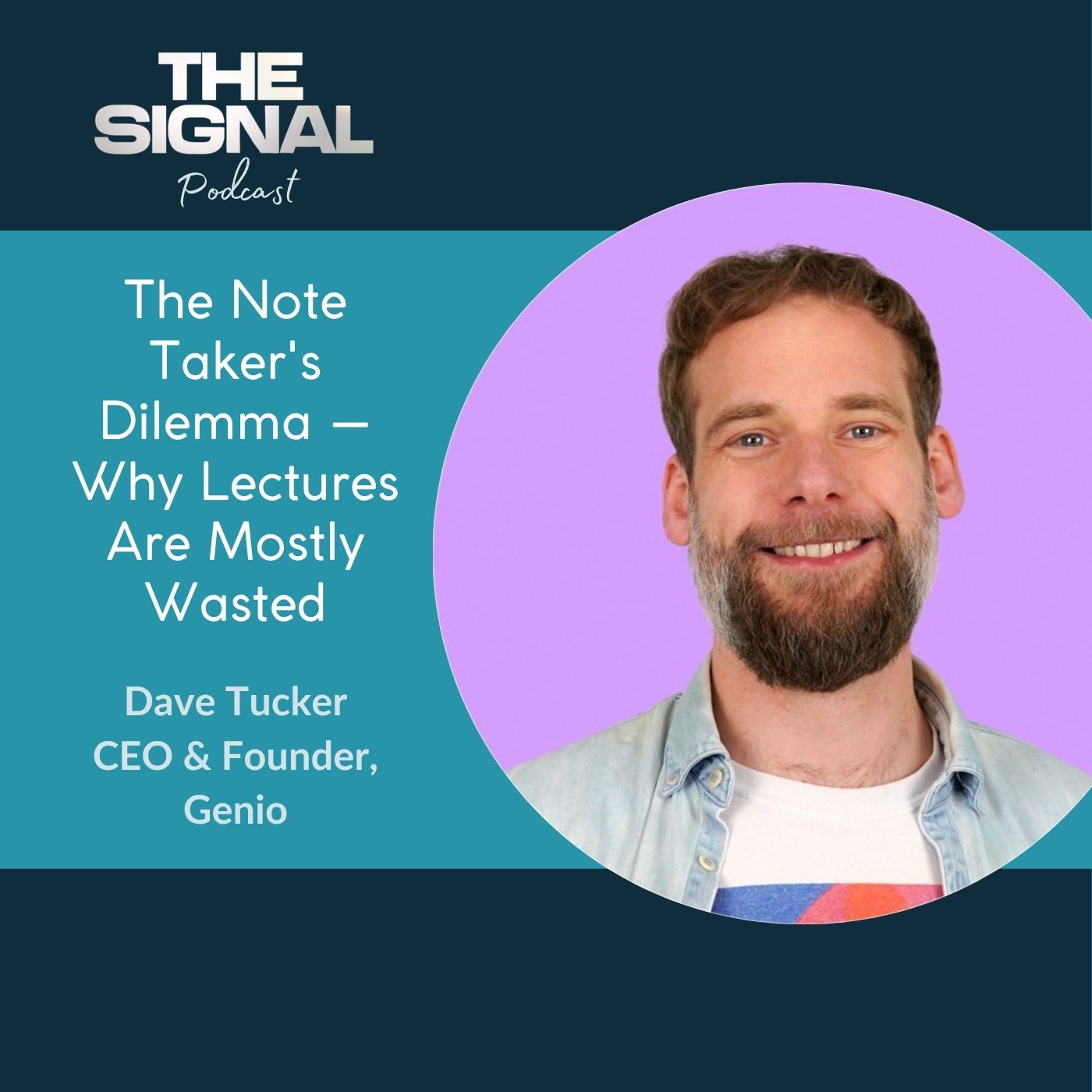
The Signal
Ep. 93 - Dave Tucker: The Note Taker's Dilemma — Why Lectures Are Mostly Wasted
00:33:59
What if the biggest barrier to student success isn't ability—but the belief that effort is even worth it? In this episode, host Jeff Dillon sits down with Dave Tucker, founder and CEO of Genio, a learning technology company that's been quietly transforming how students study, learn, and persist for nearly two decades. What started as an assistive note-taking tool for students with dyslexia has evolved into a platform used by over 900 institutions worldwide, supporting more than 160,000 learners—including first-generation students, working adults, veterans, and neurodivergent learners. Dave shares the company's origin story: creating a visual interface for lecture recordings so students wouldn't have to re-listen to hours of audio. But along the way, he discovered something deeper—the "note taker's dilemma," the cognitive overload of trying to capture information while simultaneously processing it, and the devastating impact of students internalizing failure as a personal flaw. The ...
Loading summary
Transcript30 lines
- [00:00]
A
We heard from students. There's this one student, Monica, from a community college in California. She said, well, I've been living in a D world my whole life and I couldn't get more than a D. And I actually thought I was stupid. But now I'm using this tool. I realized it's not me, it's actually I was missing this thing and now I'm getting A's and B's for the first time in my life. I'm going on four year college, first in my family. And it's this lesson that for some individuals, they experience so much friction in their whole educational experience and it's so easy for them to put the blame on themselves as somehow being part of the problem.
- [00:45]
B
Welcome to the Signal. Today I'm thrilled to speak with Dave Tucker Diaz, founder and CEO of Genio, a learning technology company that's transforming how students across the globe study, learn and succeed in higher education. Only the learner can do the learning. For Dave, that conviction underpins a broader vision for the future of education. One where every person has the tools and the confidence to expand what's possible through learning. Genio is where that vision starts. Dave is the driving force behind edtech tools that equipment learners to overcome common challenges to effective independent learning. A long standing change maker in the industry, he established an entirely new category in disability services a decade ago, Assistive note taking technology, a direct alternative to peer note taking. His approach put control back in the hands of the learner. Today he continues to advocate for the role of technology that's rooted in learning science to be help every student succeed, particularly the new majority, first generation students, neurodivergent learners, veterans, working adults and others who arrive in higher education underprepared and time poor. This learner first approach continues to set Genio apart. Under his leadership, Genio partners with over a thousand higher education institutions worldwide, supporting more than 160,000 learners. An optimist about AI's potential in education, Dave champions the belief that beautifully simple evidence informed tools can be genuinely life changing for some individuals. Welcome to the show, Dave. It's great to have you today.
- [02:33]
A
Great to be here.
- [02:34]
B
Talk about the evolution of Genio. You know it was rebranded a couple years ago and redesigned. You made a significant bet. Walk us through what you learned about note taking and student learning that justified this investment and give us the overview.
- [02:47]
A
The company's gone on quite an interesting nonlinear path over the last 20 years. We actually started as an assistive technology product, solving a very specific challenge back in the mid 2000s a lot of students were recording their lectures on digital voice recorders, and they were actually being given to students with disabilities as an accommodation. The expectation was a student could record their lecture and then listen back to hours and hours and hours again in order to revisit the material. And the real problem there was most students wouldn't do that. It was a lot of effort to re listen to the recordings. And that's really where we got going, creating a piece of software where students could import their recordings. We would visualize them and create a visual interface for interacting with those audio recordings, and then the student could take notes. And we built that for specifically students with dyslexia. So that's where we began. But over the years, we've learned a lot about learning. We've learned a lot about the challenges that students face when it comes to effective study, especially from lecture material. And also I think the world's evolved a lot since then as well. And the technology available to us has changed, but also the needs have changed as well. So one of the biggest moments for us, I would say, is when we decided to completely rewrite our product and start again with a slightly different focus. And this was about eight years into the journey. And at that point I really had conviction about several things that are still true today. So the first one was that most learning opportunities from lectures are wasted because students actually concentrate for a long period of time. They can't understand things at the speed of the lecturer. They can't really capture that material, but they need to to return back to it later. And I call this the note taker's dilemma. And our solution was, well, why don't you record your lecture and then we facilitate you marking what you think is important, what you don't understand. And we combine that with the slides and provide a all in one place to revisit and actually engage with the lecture material in your own time. And that's still the basis of our Junior Notes product today. I also had learned that, or believed that the most underutilized way of improving learning outcomes is to actually ensure that students know how to learn and know how to learn effectively. Abraham Lincoln has a quote attributed to him, although I don't think he said it. Give me six hours to chop a tree and I'll spend the first four sharpening the axe. And it really is this idea that if you're going to do something, prepare first to do that thing well. And I think this is essentially study skills. And I don't think they were taught much when I was A student. I think they're probably taught less now because I do think it's a huge investment for a student to have to develop all of these skills. They're not necessarily intuitive or easy, but what if we could create a technology that could help support that process?
- [06:02]
B
One thing that stands out about Genio, I think, is that you're not positioning this as just another productivity tool. You've invested heavily in understanding whether students actually learn better and persist at higher rates. But having evidence and getting institutions to pay attention to it are two different. Two different things. Your recent research showed that genial notes increased GPAs by 3.6% and reduced dropout by 28%. And in a real competitive ed tech landscape, how do you ensure that claims like these actually get heard and trusted by college leaders evaluating solutions?
- [06:41]
A
I do think it's hard for people making these decisions. The market's noisy, there are incentives for people to make claims. And you can have a study, but it really depends on the detail of that study, who is using the product, when, what's the context? And I think it's one of these things where those studies are important but not sufficient. And we invest a lot into making sure it happens. But I think the core thing is trust. You need to be a company that educators can trust, administration can trust, the learners themselves can trust. I think that trust is built up over a long period of time. I think it comes from consistency, integrity, and ultimately you need to show and not tell. And there's lots of things that you can do to support that. So the independent research is one. But I think the student voice matters. I think research partnerships matter. I think you need to build up a picture of the type of company you are and that informs those types of decisions.
- [07:42]
B
The results are impressive, but I think what's interesting to me is that they seem to stem from a very deliberate learning process rather than a single feature you've built Genio around. I think this idea that effective learning is a skill students can develop, not just something that happens during a lecture. So you talk about this framework, capture, organize, refine and apply the Quora framework. Can you talk about why that process matters and how it changed the way students interact with lectures and in their own learning?
- [08:13]
A
I think the root of this comes down to study skills and scaffolding the learning process for learners. So you have the note taking process, which is about capturing information, and you have the note making process, which is about engaging, synthesizing that information, creating study notes as well. So capture, organize, refine, and apply was a framework we created to first of all explain to students how they should be using our product, but also to explain that study process. You need to capture the information, make sure you have the slides, make sure you have the recording. You need to annotate what you think is important and then come back, refine the information and apply it. And that process itself is built on the study skills of note taking and note making. But I think understanding the learning process and recognizing learning isn't an event. It happens over time. And thinking about, well, how do we take the student on that journey from content or new information all the way to applicable knowledge and what are the challenges in the way of that and how do we design around them?
- [09:19]
B
Core really feels like a framework designed for all learners, even though Genio's roots are in supporting students with disabilities and neurodiverse learners. I think the broader question about is about accessibility and whether it should be treated as a specialized accommodation or simply good product design. So accessibility is clearly, you know, woven into Genia from the start, but, but it sometimes feels like it's in kind of a tension with user experience. How do you make accessibility feel natural and seamless rather than like, like an afterthought?
- [09:57]
A
I have seen that tension in other products and I think it just takes a lot of effort in order to do it well. I think accessibility can be done badly as a box ticking exercise, just meeting the minimum requirements to be deemed accessible. But I think it can be done well and incorporated into the design process. And that comes from caring about it. I think it comes from understanding the learners and their needs as well, as well as having the expertise to do it. A really good example of this, I think, is the iPhone. Actually, I was part of the assistive technology community when that was first released, and to most of the world it was an amazing new technological invention. But to many people in the disabled community, it was actually one of the most incredible assistive technology devices that had ever been made. And that's because the accessibility was built in from the very beginning and it had all these settings that just made the phone usable and accessible to various different users. And I think that's a great example of what it looks like when you do it well.
- [11:03]
B
You know, there's this common thread, I think, running through all this, and it's not really about, you know, note taking or even accessibility. It's really about helping learners who have the ability to succeed, but they might not have the time or the confidence or the support that really a traditional higher education in a traditional environment might Assume they have. You talk about like new majority learners, working adults and parents and first generation students and even students from, you know, underrepresented backgrounds. Why are these learners the focus of your roadmap and what does Genio do differently for them?
- [11:43]
A
There's the obvious answer, which is there's a great need to support those learners. And they do have different needs to traditional learners as they're often time poor, working at the same time as studying, and about 70% of learners fall into that category. They're also generally underprepared. So they could be mature students or first generation or they might be facing individual barriers. So English as a second language or being neurodiverse. So there's a great need and I don't think the education environment has necessarily changed and adapted rapidly enough to meet their needs. But there's another piece to this as well, which is the challenges they face, I think are very similar to the challenges that we've been designing for for a really long time. And that does come down to that learning process. And I think those fundamental challenges can act as a bottleneck for almost all learners if they're not being addressed. So what do I mean by that? Challenges such as attention and concentration, if you can't take the information into your brain because you can't concentrate on it, can learning even begin? And that's a big challenge to design for, I think also working memory capacity and kind of cognitive overload. People learn at different paces, people have different schema people. Their working memory might be taken up processing a second language or trying to decipher print. So I think designing tools that can help support that working memory is really important for that cohort as well. So there's all these design decisions that we've been working on for a really long time that I think are really applicable to that population.
- [13:23]
B
One of the things that really struck me when I was preparing for this conversation is the scale of what you've built. Genio is used by over 900 instit institutions globally. It's one thing to create a tool that works for a handful of institutions, and I think it's something entirely different when you, you're supporting hundreds of campuses across different countries and student populations and there's accessibility requirements and, you know, technology environments. I imagine there are days when the product team wants to move fast and push the next big innovation, while the institutional partners just want reliability and stability and integrations that work exactly as they're expected. So finding that balance can't be easy when you're operating at that scale, with that kind of reach, how do you balance the rapid innovation with the need for stability and integration into complex institutional systems?
- [14:15]
A
I think we've intentionally made life very simple for ourselves, so we tried to minimize those integrations. And we have mostly basic integrations at the moment to minimize the complexity. And it also reduces the cost of implementation. Our focus is really putting the technology in the hands of learners. So a lot of what we do is actually focused on the learner tools themselves. And then the administrative part is actually more basic compared to that. But I think your point still stands, that there is a real need to be considerate of the user experience, given the broad range of different learner types that we are working with. And I think it is about being bold in some ways and cautious in other ways and being opinionated on on that. And it needs to come from your understanding of the learner and your understanding of the learning itself. I think AI is a good example for us. We've been pretty considered, I would say, compared to a lot of companies in how we approach that, partly because we don't really want to get it wrong. And once something goes in the product, it's quite hard to take it away. And there is risk when it comes to AI implementation and whether it's beneficial to learning or not, but also because I think actually designing for the actual challenges the learners are facing, rather than just putting things in because others are doing it, is really important too.
- [15:35]
B
One of the reasons I was really excited for this talking to you is that you're really operating at the intersection of practice and theory. You're building products used by hundreds of institutions, but you're also spending time in conversations with researchers and faculty and future education leaders. And those worlds don't always see technology in the same lens. You know, practitioners are often focused on outcomes and implementation, while academics tended to ask deeper questions about learning and cognition and student development. I'm curious what you've learned from being in both environments. What's the conversation happening in those rooms about the role of technology and learning, and what's being missed or misunderstood about the relationship between tech and student success?
- [16:23]
A
I think you point to a very real dynamic here where faculty have a certain perspective on the world, students will have another one, and then administrators have another one. Yet I think there's a lot of apprehension and fear about technology, some of it very legitimate, some of it less so, I think. And it does come down to the trust of the company doing that. And I think it is about building the relationships and collaborating with different stakeholders to help build that trust and to some extent be active in those communities. I think one of the things that is misunderstood is that learning technology, as in learning tools for learners, is a relatively new category. We've been operating in the space for a really long time, but it's only really since AI tools have started doing this in earnest that this category is starting to grow. And I think that is partly because we generally have quite a teaching centric view of education. Thinking about the best mechanisms for improving learning is through better classroom design or better pedagogy or, or improving and equipping teachers to teach better. And I think the role of technology actually can be even more powerful when taken from a learner centered perspective, where you think about what are the learners challenges and what do they need to accomplish and how do we support those. And the reality is actually probably most learning in higher education happens outside of the classroom. It's through independent study and what happens there. So I think the real question is how do we support learners with being successful in those environments and how do we collaborate and work together to build up a picture of how holistically to make learners as successful as possible?
- [18:16]
B
What's interesting to me is that many of these, I think tenants about accessibility and independent learning and supporting working adults and helping students build confidence are becoming even more important as institutions face enrollment pressure. For years, colleges could largely design around these needs of the traditional 18 to 22 year old student. And that's becoming a smaller share of the market. So you know, institutions are being forced to think differently about who they're serving and how they support them. And they're grappling with the demographic cliff. With fewer traditional students enrolling, how should colleges be rethinking their technology strategy in response to that reality? And how does Genio fit into that conversation?
- [19:07]
A
I think there's not many options. At a very highest level, you can either attract more non traditional students or retain students for longer. And the truth is colleges need to do both and neither have really simple solutions to them. I think one of the key lessons I learned from being in the assistive technology industry for a long time is actually there's two different approaches to changing this. And then just to use some kind of assistive technology language, you've got the medical model and you've got the social model. The medical model says, well, this person needs an accommodation, this person needs some assistance to enable them to succeed in the environments that they're operating in. And it's very individualized. The social model says, well, no we should be changing the environment. The environment should be inclusive to all individuals. And that's true as well. Both of those things, I think, are really valid and important ways of thinking about the challenges and the problem. The issue with only focusing on changing the environment is that one size doesn't fit all and it's impossible to know exactly what every challenge someone is facing. But the advantage of having a more individualized approach is to this is that you can put the right tools in the hands of the learners if you understand their challenges. And having a range of different supports that are actually available to meet the needs of those different types of students. And having that in your toolbox, I think is going to become increasingly powerful. And it's all part of this really learner centered approach. And I think this is how education is moving and will need to move because ultimately the learners are the customers and they will have needs and they will have expectation and that's going to be shaped by the world they live in externally. And we do need to keep up with that.
- [20:53]
B
Yeah. One thing I find fascinating is that some of the best innovations in higher education start by solving a challenge for a specific group of students and then it ends up benefiting everyone. We've seen that with captioning and many of the technologies we now take for granted. Geneo began with a focus on neurodiverse learners and students with disabilities, but. But today it's being used by a much broader population. And to me that suggests that there are some bigger lessons, bigger lessons about learning itself. You started with this, you know, the focus on disabilities. How have your views on accessibility and inclusive design evolved as Genio has grown? And what have you learned about what all students actually need?
- [21:40]
A
My thinking and my own personal philosophy has evolved a lot over the years through conversations with practitioners, through building the solutions myself, and through chats with learners. I think the experiences I've had with the learners themselves have been most formative. But just before I get to that, I mean, what are those philosophies I'm talking about? Well, I personally feel that when we think about accessibility, it shouldn't be access to the material, it should be access to the learning process. And actually learning is not about ingesting information, it's about digesting information. And we should be thinking more about those types of things. I also think accessibility can be put in a box and it can be framed that way as something you kind of need to do for compliance reasons. But I see accessibility on a spectrum of accessibility and learning productivity. On the other side and if the material isn't accessible to a student, no learning can happen. They just can't get through that phase. And then the next challenge is, well, you need access to the learning experience and the learning process. You can keep going on that and make the process less wasteful or more productive by considering how to improve that experience for a learner. But to come back to the biggest philosophy shift or learning experience I've had actually has come from working with learners and their testimonials. And this was back in the early days, you know, we had this simple yet, I guess, kind of clunky tool. But the testimonials coming from learners, it was life changing. You know, we heard from students. There's this one student, Monica, from a community college in California, she said, well, I've been living in a D world my whole life and I couldn't get more than a D. And I actually thought I was stupid. But now I'm using this tool, I realize it's not me, it's actually I was missing this thing. And now I'm getting A's and B's for the first time in my life. I'm going on four year college, first in my family. And it's this lesson that for some individuals, they experience so much friction in their whole educational experience and it's so easy for them to put the blame on themselves as somehow being part of the problem. And then very simple tools or interventions, if they address that core challenge or one of the core challenges, can have this outsized impact on the individual themselves because it changes their belief about themselves, it changes their identity. I often say, you know, you wouldn't run for a bus or, you know, a train if you didn't think you could catch it. You have to believe you'll catch it to put that effort in. And I think that's so true of so many learners. They, they just need to believe that it's worth the effort. And the challenge so many learners face is there's so much about the overall experience that is unnecessarily hard, in my opinion. And if we can help relieve some of that, then confidence and self efficacy is actually the product and more agency as well. And I think agency for learners should be the goal, not just like a component of what we're trying to put into motivation.
- [24:55]
B
This all really leads to, I think, a broader question about the EdTech market itself. Every year there's a new wave of technologies, new buzzwords, new promises about what will transform learning. But one thing that's been consistent throughout Your journey is a focus on learning science and measurable outcomes rather than chasing whatever happens to be getting attention at the moment. And that's increasingly important for institutions that are trying to separate genuine impact from marketing noise. How do you stay grounded in learning science when there's so much pressure to chase trends? And what role should research play in how college leaders evaluate tools?
- [25:37]
A
I think we're in a very fortunate position as a company in that both founder led and founder owned. And the reason I'm here is because I genuinely believe in the opportunity to positively impact learners at scale. And we don't have stakeholders with different incentives making decisions, but to have that positive impact, there's a huge amount of integrity that needs to go into that process. I genuinely care about the value and quality of our products and I personally have a strong understanding of learning science and I am opinionated on what is and isn't good for learning and I am part of that product development process as well. So that's all really beneficial. But I think there is a lot of tension here and a lot of gray areas. There's misinformation about learning. You know, there's going to be lots of marketing messages out there, there's going to be trends, as you say, about what people are saying is good. And I think we've learned so much over the last few decades about how the brain learns, but that theory is not necessarily being put into place practice. I also think another tension that's really difficult, especially for us as a, as a learning technology company, is student demand and student usage of our products. Because of course, to have any impact, the products have to be used by the learner, but also the learner is going to come with their expectations of what a learning tool should do. And I think this is a challenge a lot of educators face about how challenging should the course be, how much do we support and scaffold and how do we get that balance right? And I think the reality is, is good learning is effortful, it's hard, it requires, you know, struggle to some extent. I think the best analogy to think about this is the gym, right? We can get fitter and stronger, unless you go through the pain of lifting heavy weights or going for long runs. But the challenge is if, if you haven't gotten into fitness at all, that first part of the process is really hard and it takes a really long time to pay off. And so if there's a shortcut, if there's an easier way, then you're going to take it. Whether it's not effective or is effective. And you also can't ask a new person to the gym what they need to become really fit and healthy. And they don't have that knowledge or understanding. But you also can't ignore their preferences, you can't ignore their challenges, their lifestyle, like what's going to work for them. So I think research really plays a role in understanding the learners better and understanding where that tension needs to lie between what a learner needs in order to be successful, but also what the product needs to support and scaffold or not do. Essentially say, we're not going to do this part because it's going to lead to the wrong outcomes and we can basically have our best attempt at getting that right. But I think the research needs to play a role in actually validating that. And that's an ongoing process all the time.
- [28:38]
B
You know, it's no longer enough to have a compelling demo or a great user interface. With tighter budgets and increasing scrutiny around student outcomes, leaders are asking tougher questions about the evidence that this actually works. That's where your recent research milestones become really, really interesting. You've achieved Essa Level 3 validation, which is a significant research milestone. What does that mean in practical terms for colleges and why does that level of evidence matter when institutions are making technology decisions?
- [29:16]
A
So ESSA level three of four, there's more levels you can achieve, but it does mean that there's been a well defined and implemented correlational study with selection bias. There's a statistically significant positive effect on relevant outcome. And I think these things, it comes back to trust. Again, I think these certifications, their badges, and there's others that we have and that are important to us. But I think it sends a signal that these things are important to the company, that they've put the time into conducting that study or that they want to shout about it. And it's probably not just one that's going to paint the real picture. I think it's cumulative of what a company actually does over time. So I think, I think it helps inform colleges of the types of companies that they should be working with. And when there's a decision between various different options, I think it does matter. And I think there is a responsibility when it comes to learning technology to work with companies and use tools that do have the best intentions for learning. I don't think it's dissimilar to medical technology in some ways. Okay, the stakes aren't as high as life and death, but you have practitioners making decisions for their patients and there needs to be a level of trust that this will lead to good outcomes and that the company doing it does have that good intention. And I think as a learning technology company ourselves, there's a responsibility to ensure what we say we do is actually what we're doing.
- [31:02]
B
You know, I'd like to close by zooming out and getting your perspective on where higher ed goes from here. What's the single biggest shift you think higher ed needs to make and how it and how it approaches student support? And where does technology fit into that picture?
- [31:19]
A
I think a key theme during this conversation has been the need to be learner centric. And I think that for me is the core message here. The only one who can do the learning is the learner, and that's really important. And what do I mean by that? Well, I think that means starting off with the learner's experience, their wants, their needs, their challenges, and building out from that perspective. And I think we need to answer the question, like, are we setting learners up for success at college? And if not, why not? An analogy for this is like we're leading a group of people up a mountain on a hiking expedition and we've got a big group with lots of different people, different experience levels, different abilities. And are we just giving them a brief intro and setting them off, or are we thinking about, well, what equipment do they need for this climb? Do they understand how to overcome the obstacles they're going to face? Are they surrounded by people that will encourage them to persevere, or will they be left behind if they can't keep up? My vision for the future of education is one where we equip learners with the right tools. We empower them with knowledge of how to be a good lear learner, and we encourage them through communities and support, to believe in themselves that it is worth it. And I think evidence of that progress, evidence that comes from the tools, is such a key component to getting that cycle working because the student needs to believe that it's worth it to invest in their learning. So I think we can and we should make tools for effective study part of what a college uses in their toolkit to set students up as success.
- [32:56]
B
Day one yeah, well, Dave, this has been a fantastic conversation. I really appreciate your perspective and the work you're doing to help students become more confident and independent learners. And thanks for joining us on the signal and for everyone listening, we'll include links to Genio and Dave's profile and some of the research we discussed today in the show. Notes. Thanks for tuning in and we'll see you on the next episode.
- [33:17]
A
Thanks, Dave. Been great. Thanks for the conversation.
- [33:20]
B
That's a wrap of this episode of the Signal. If today's conversation sparked a new idea or challenged your thinking, that's exactly the point. This show is about cutting through the noise and helping you see what's actually shaping higher ed right now. Please subscribe so you never miss an episode. And if you found this valuable, leave us a quick review. It helps more higher ed leaders find the signal for deeper edtech insights, news and trends delivered monthly. Subscribe subscribe to the Signal monthly newsletter@edtechconnect.com thanks for listening. We'll see you next time.