← The Signal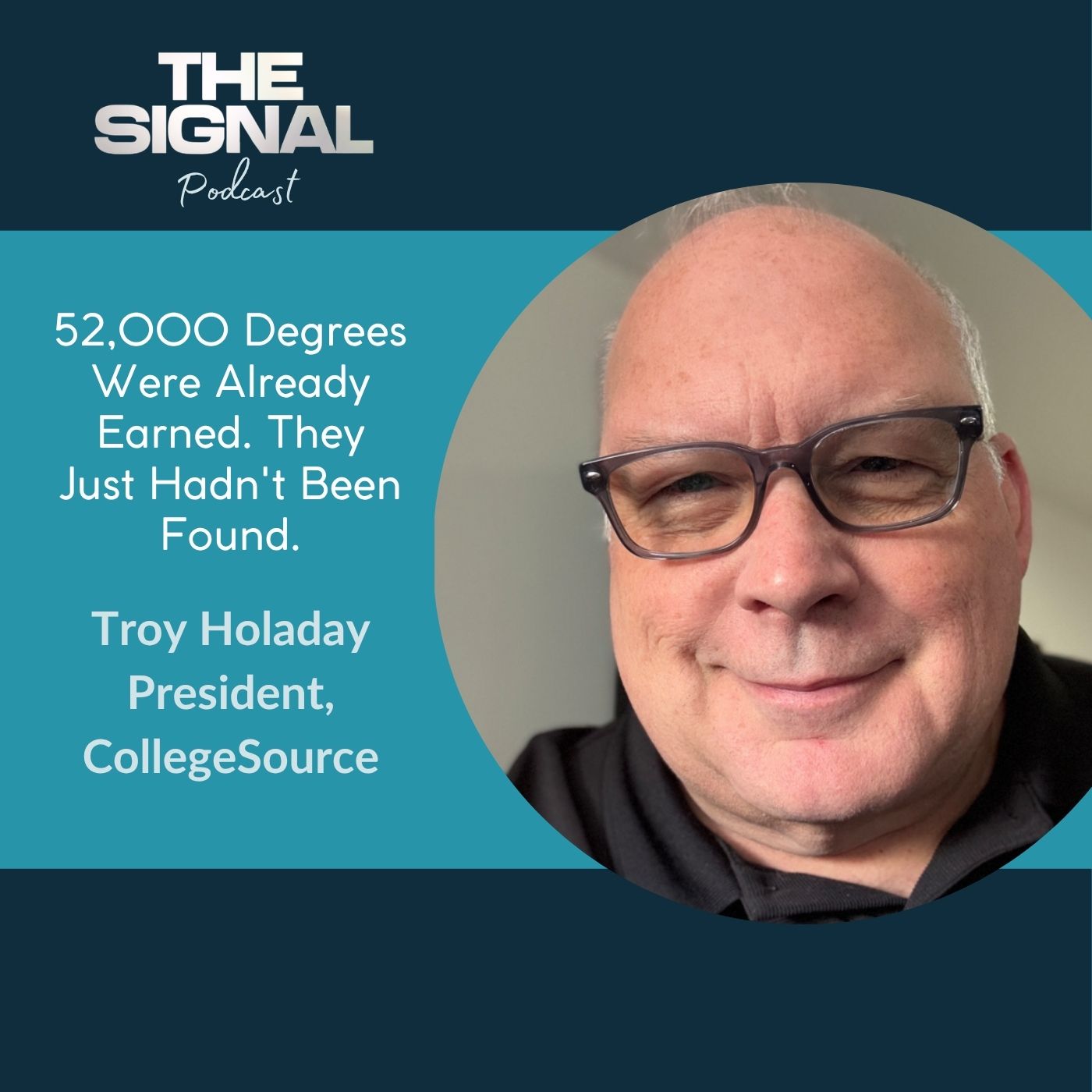
The Signal
Ep. 96 - Troy Holaday: 52,000 Degrees Were Already Earned. They Just Hadn't Been Found.
00:34:09
Transfer credit is one of higher ed's most persistent headaches. Students lose credits, take longer to graduate, and navigate a labyrinth of institutional policies that often feel designed to frustrate rather than help. But according to Troy Holaday, president of CollegeSource, the narrative that "transfer is broken" is outdated—and it's getting in the way of real progress. In this episode, host Jeff Dillon sits down with Troy, a former academic advisor and professor who spent 16 years inside Ball State University before leading one of the most widely used transfer technology platforms in the country. Troy brings a rare perspective: he's been the advisor sitting across from students, the faculty member designing curriculum, and the technologist building systems to make transfer work. Troy challenges the conventional wisdom that transfer is a disaster, pointing to recent data showing that most students now have their credits evaluated automatically and are largely satisfied with the...
Loading summary
Transcript30 lines
- [00:00]
A
I think first of all, we need to stop saying transfer is broken. It's insulting to all the good work that's already been done and is being done. We need to stop relating a few anecdotal horror stories and pretending they stand in for all transfer experiences everywhere. Instead, we should be telling the stories of institutions and companies that are succeeding at transfer and pushing practices forward.
- [00:26]
B
Welcome to another episode of the Signal.
- [00:28]
A
Jeff.
- [00:29]
B
I'm Jeff Dhillon and today's guest is someone who's been quietly reshaping one of the most frustrating problems in higher education, transfer credit. If you've spent any time inside a registrar's office, an advising center, or a state system office trying to figure out how credits move from one institution to another, you already know why this matters. My guest today is Troy Holiday, president of CollegeSource. My role he has held since 2007. Troy didn't come to this work from the corporate side. He spent more than 16 years at Ball State University as an academic advisor, a humanities professor, and eventually assistant director of Academic Systems, where he helped design some of the earliest interactive transfer credit evaluation tools in the country. He also chaired the Nakata Advising Transfer Students Commission and led the team that built Indiana's core transfer library. At College Source, Troy has led the development of TESS, the Transfer Evaluation System, along with Transferology and Uachieve tools now used by more than 2100 institutions serving millions of students. Most recently, the Louisiana Board of Regents expanded tests across every public degree granting institution in the state, creating a unified public facing transfer equivalency portal that will directly benefit more than 25,000 transfer students annually. Troy holds a PhD in English composition and Rhetoric from Ball State. Troy, it is great to have you on the show today. Welcome. Thanks for being here.
- [02:06]
A
Thank you. It's good to be here.
- [02:07]
B
So let's start off with talking about your background a little bit. You've spent 16 years teaching, advising students, and building academic systems inside a university. How did that experience shape how you think about the problems College Source is solving?
- [02:25]
A
Well, the funny thing is I've been kind of obsessed with higher education since I was 11. There was a TV show on at the time called the Paper Chase. I don't know if you're old enough. I don't remember that one was about.
- [02:38]
B
I think I'm old enough, but I
- [02:39]
A
don't remember about a group of law students who were trying to, you know, constantly under pressure, trying to learn case law and deal with their very hardcore professors. And something about that show really caught my imagination, made me Want to be a part of that world. I've taken a pretty odd path to get where I am today. But in hindsight, I think it gave me a much stronger perspective than I would have gained from a straighter path. When I was an undergraduate, even working at working on a Bachelor of Fine Arts, I took a student job in the registrar's office maintaining student records and processing grade changes. During my master's, which was in English Lit, I ran a tutoring facility. And while I was writing my dissertation for my doctorate in rhetoric, I took a full time job in academic advising. So I've always had this odd duality coupling academic studies with work in the administrative side of higher education. I spent time in that registrar's office job as an undergraduate. It gave me a peek behind the curtain of the university. My art degree taught me about how to create under constraints and manage my time and use criticism to improve my work without getting defensive. Running the tutoring facility gave me a real appreciation for students who honestly had to work a lot harder than I did to get the same results. And the study of rhetoric taught me to think a lot about not just the message, but the audience, the medium, the channel, the opportunity for interference and feedback and, and all that plays into software design in a big way. When I was in academic advising, I got the privilege of working with a lot of different student populations. I worked directly with veterans, student athletes, adult students, students with disabilities. And while I was building ways to improve their experiences, I discovered that I had a real passion for designing better processes and programs and technologies for the university. That's when I joined Academic Systems and got to work on a suite of tools for registration, degree planning, course offerings, and most especially transfer. Yeah, it was there in academic systems that I know you know about this, but we launched a software called the Automated Course transfer system, or AXE. It was right around 1988, 1999, and it was the first place on the Internet where a student could enter courses they had taken, choose a major, and then get a complete report on how those courses were accepted, how they applied to a degree. And it was about that time that I started also working with the Indiana Commission for Higher Education and Nakata. So really joining College Source. For me, while it was a huge change, I mean, I moved across the country from Indiana to California. I switched from being inside higher education to leading a corporation under the mentorship of my incredible CEO, Carey Cooper. And I generally turned my life upside down in a lot of ways. But in reality, it was just a way for me to continue doing What I'd always done, which was building tools for higher education on a national scale this time. And I honestly think that what I do here is still just building tools that I wished I'd had when I was in the training.
- [05:42]
B
We're birds of a feather in a way. I came from higher ed too, for 20 plus years. And when my old colleagues say I went to the dark side to work with solution providers. So I kind of like that. But one thing that strikes me about your background like you've, you've really seen this challenge from almost every angle. You've been the, you know, the advisor with students, sitting down with them, trying to map out their path to graduation, worked on the academic systems, and now you're leading this company with thousands of institutions, you know, to navigate this issue at scale. What's interesting is that transfer credit isn't really a new problem. Higher ed's been talking about it for, for decades. But when I talk to enrollment leaders, it comes up as one of the most frustrating, resource intensive processes on campus. Students are still losing credits. Institutions like they're, they're manually evaluating courses and states are still trying to improve their, their transfer pathways. So it makes me wonder from your vantage point, after spending so many years in the space, it's been described as higher ed's most stubborn infrastructure problems. Like why has it been so hard to solve and why does it still matter so much?
- [06:48]
A
Well, I mean, you start with the second part first. Transfer still matters because it's more prevalent than ever and overwhelming. The majority of students earn credit for more than one institution when they're pursuing a degree. High school students now approach college for the first time with a huge amount of credit from ap, clep. Dual enrollment. It's just normal. Transfer is normal. It isn't and shouldn't be treated like an oddity or a disruption to some idealistic patterns. And all providers of education are kind of equal partners in the job of elevating students and delivering education. In fact, when I hear myself say that, I'm thinking about something I heard on one of your earlier podcasts, Bethany Gross, I think from Western Governor University Labs. She said something like, public education is the goal and no one institution or group of institutions owns it. And I think that's absolutely true. The providers of education, and for that matter, the technologies are sort of interchangeable. If I go back to the idea of transfer as a tough nut to crack, I think we often frame our thoughts on transfer incorrectly. It can absolutely be improved, but we don't spend enough time looking at the things that are going right. And we often talk about it in the negative too much. We have the most fluid system of higher education in the world. The most alarming data about credit loss is now something like 20 years old. When I say that, I'm referencing the Department of Education's Beginning Students Longitudinal Study and the Government Accountability Office that released some findings, something like 43% loss of credit. But that study was looking AT transcripts from 2004 to 2009, and everything has changed since then. Some of the more recent studies that are still in the 2010s paint a little better picture, like the Baccalaureate and Beyond study from 2017. It found that nearly all the students who attempted to transfer credit reported having some or all of their credits transferred. An ACRA study found that less than half of the students who transfer were dissatisfied with the experience. An overwhelming majority, like 77% of them, had their credit evaluated automatically and didn't have to ask. And those that were dissatisfied tend to point to bad advising and not the practices of the institution as the problem. So I guess I just want to say that, like, yes, we can improve. Absolutely. I don't want to pretend that we can't. We can. We can do better. There are, for instance, some bad practices still out there about artificial limits that institutions place on how much credit can transfer, or just the general lackluster efforts that a lot of institutions make in dealing with less traditional forms of learning. But we ought to be praising and studying the best practices more and looking to improve on those methods instead of calling transfer broken all the time and trying to reinvent everything from scratch. So, you know, yeah, transfer is normal. Systems are available to deal with it for schools who want to make the effort. And there's really no excuse for denying credit or as I like to say, discrediting students and their previous learning experiences without some understandable and meaningful reason for doing so.
- [09:51]
B
I think it's where a lot of people outside of the enrollment or advising world get lost. They hear transfer credit and assume it's one workflow when it's really this whole ecosystem of decisions and data and processes that have to work together. I've seen something similar in other areas of higher ed tech institutions. They often try to solve a complex problem with one single point solution, only to discover there are several interconnected pieces underneath it. And so that brings us to College Source itself. You've built. There's a suite of products that seem to address different parts of the journey. We have tes, Transferology, and uachieve, Correct me if I get these wrong. But can you walk us through how those fit together and what problem each is primarily solving?
- [10:36]
A
Yeah, sure, I'd love to, Tess. Let's start there. It's the transfer evaluation system. It's a staff facing tool that enables institutions to research credits from virtually every institution in America, some abroad. We have close to 200 million course descriptions from both current and historic catalogs. We go back decades. Users can look up the courses, find matches to their own institution's courses, route them to faculty for decision making as needed, like approvals, manage the resulting equivalencies, organize them into transfer pathways if they want, and publish them all within the same system. Transferology is a more student facing product and it provides students with quick answers to the question, will my courses transfer? We have over 400 institutions in the network, so it shows them how their courses will transfer across those 400 institutions. It currently houses more than 36 million equivalencies. It lets students compare institutions for transfer friendliness while keeping them anonymous so they don't open up a can of worms for like, you know, emails and things like that. They can shop essentially in a safe environment and then, you know, once they see the matches that they like. And I'll say also that our tool also provides applicability for those schools using our degree audit in that system. Once they find a school they like, they can reach out to the school through the application. And we have another side to the transferology applications called the lab, where staff can go and they can see aggregated and anonymized data about student interest in their courses and which ones they need to pay attention to for transfer. And then they can respond to students who've reached out as leads and then you achieve is kind of the third leg of the stool. It's actually funny because when I was an advisor at Ball State, I used to use the you achieve degree audit every day, all day. So now being somebody that gets to shepherd it as a product is really gratifying for me. It provides students with customized term by term plans for a degree based on their anticipated graduation date, on the number of hours they want to complete each term, and the university requirements for the degree of course. I think it's worth noting that our planner is not based on patterns of previous students or on university check sheets because those tend to be outdated, sometimes an error. And they're locked into this myth of a four year full time student that's just not helpful to a student who wants to attend the school in a different way. So our Planner is just much more dynamic, just on the fly and builds off of the student needs. The students can take their plan courses directly into a scheduler and you achieve which generates all kinds of possibilities for them for a schedule and then feeds into the institution's registration system and the audit itself that underpins all of this. The degree audit is what's used by the institution to not only help students understand all the requirements for their degree, but to do some really heavy hitting analysis and perform tasks like NCAA certification, course demand analysis at risk, student monitoring, and of course, graduation clearance. So all of those kind of work together to provide. We just encompass it all as transfer solutions and degree achievement.
- [13:42]
B
Right. I think what's interesting listening to you describe those products is they really mirror the transfer journey itself. You have the student trying to understand their options, student evaluating credits, and then the degree planning audit work that happens after those credits are awarded. I was reading about prepping for this, reading about the announcement in Louisiana and what stood out to me was, wasn't just the tech, it was this coordination required. Anyone who's worked in higher ed knows that getting a single campus line can be challenging. Getting multiple institutions, each with their own processes and cultures and priorities moving the same direction is really a different level of complexity. It's a big deal. The Board of Regents just expanded tests across every public degree granting institution in the state of Louisiana covering 25,000 plus transfer students a year. Did I get that right? And what, what is actually, what did it take to make something like that happen at the statewide level?
- [14:39]
A
Well, it's still a work in progress in a way, but you're right, it is a huge effort and it's really ambitious and it's, and it's pretty great. It is a big deal. This isn't the first statewide initiative that we've supported, but it is one that has pushed our software further than some others have to respond to their needs. We implemented a more robust like peer sharing utility within the tool. The 25,000 students they reference, I think they're talking about direct, like more traditional transfer, because there's 200,000 people in the students, totally in the total enrollment of those institutions. And knowing that most like maybe two thirds or more of students have credit for more than one institution, I think the impact is going to be much larger than 25,000 students. But as you know, they've got 28 schools, 29 if you count the Board of Regents there, all working together in a peer sharing network in our tool. It allows them to compare how they're Transferring courses and align their transfer and to just make it easier for students to visualize how they're going to get from one place to another. It's really ambitious. Dr. Tristan Denley and a lot of other folks there in Louisiana have worked very hard to get this together, piece this together. It is difficult for the state higher education agencies. I really feel for them sometimes because they have to navigate this landscape that involves both like a shifting political environment and the kind of, you know, that, I'll admit it, sometimes territorialism of institutions and their own quirks and, you know, so it can be very challenging. So I really take my hat off when you see that many institutions working together. It's kind of crazy. I also wanted, I'm sorry, not to take the focus off of Louisiana, but if you haven't heard this yet, and I'm not sure when this podcast is going to air, but the Cal State University system just selected our UHG product for all of its institutions. So we already had a number of their institutions as clients and now the entire system is going to be able to leverage it to help them succeed at their, what they call the Student Success Strategic Framework led by the Chancellor's office. And one out of every four degrees in the state of California is awarded by the Cal state system, and one in 20 nationwide is awarded by the Cal State system.
- [16:44]
B
So we're like, I'm familiar. That's my system. That's where I worked for 13 years. We're talking half a million students, Everybody that that 23 campus system supports. So, wow, congrats on that. That's amazing. I think back to conversations I've had with transfer students over the years, handful of them. One of the biggest frustrations is uncertainty. They're trying to decide where to apply, whether to enroll, and sometimes whether they can afford to make a move without a clear understanding of what will happen to the credits they've already earned. And it's pretty high stakes decisions to make with incomplete information. So one thing that stands out with this Louisiana rollout is the expansion of the peer course equivalency visibility, going from six to as many as 35 institutions. What does that change mean for a student trying to figure out whether their credits will transfer?
- [17:37]
A
Well, what I like about this initiative, it really is all about students. Yes, the institutions are going to benefit financially and I think qualitatively from embracing transfer students and serving them better. But I think the way they benefit most is not only providing more transfer pathways for transferring degrees to students, but in helping students perceive the institutions as friendly to transfer. You said it takes a lot for a student to go through this process. It's something that some you people usually only do once in their life. It's kind of like it's a big event and it's hard to do things like that because you don't know how to do them. And by the time you got the experience and know what you're doing, you've already done it and you're probably not going to do it again. It takes a lot of effort for a student to knock on the door of an institution, whether that's virtually or otherwise. And I think when institutions work hard to like, open the door and show that the door is open, it really signals that they're expecting transfer students and they're ready to acknowledge the work that they've done to prepare themselves for college and for a chosen major. And so I think students will feel more empowered to transfer. They will have more forewarning about how their courses will transfer, and maybe they can escape the trap of taking courses that are unlikely to count when they do transfer. So I think that's mainly the impact. I think they'll just see it as more possible, more realistic, and know what to expect when they do transfer.
- [19:00]
B
I think we all, we all kind of know or, you know, agree. The outcomes for transfer students are still uneven. There are countless studies showing students lose credits, take longer to graduate. Sometimes they never complete a degree because the path becomes too complex or expensive. What's always been interesting to me is that when you talk to different people, you get a very different explanations as to why that happens. In my work covering higher ed tech, I've learned that tech rarely solves a broken process by itself. It can, it can make a good process dramatically better. But I'm curious how you think about that balance with transfer student outcomes. Completion rates, credit loss, time to degree. They remain pretty concerning across the sector. How much of that is a data problem versus a policy problem? And where does technology actually move the needle?
- [19:52]
A
I'm glad you said it that way because you're right. People often look to technology as some magic solution that's going to solve all the problems. And I see this a lot where in systems. A lot of times there's money for technology, but not money for people. And that always saddens me quite a bit because as I mentioned before, I think when you get down to some of our data is old, we need some new studies and some more detailed. Persistence among transfer students seems to be good, but clearly the longer one takes to complete, the more opportunity life has to interrupt that. Children changing jobs, six parents, sick parents, economic terms. And I'd like to see that studied more. I'd like to see that understood better in the context of what transfer means. But the gist of it is that earlier planning is critical for transfer, and technology is the answer for that. Academic advisors are often overloaded with the students they're serving that are already enrolled and they don't have institutional support a lot of times for servicing prospective students. Technology, on the other hand, is tireless. So once you set up the environment and the transfer pathways, technology can deliver that over and over again in a quick and digestible way that helps students understand transfer and plan for it, rather than just experience it as it happens. Policies matter too. That's they. I think our policies are easier to change in a way, but they're way more intense politically. We offer a policy central database. It's another piece of software we have that anybody can subscribe to. And it allows policymakers and institutions to kind of look at policies across other institutions, generate boilerplate and kind of write better policies honestly for transfer. So yeah, I think technology plays a huge role in it, but in the end, it really just takes clear vision and good champions of the process in the trenches, the grassroots people that do all this work to use that technology. It's a tool. Technology is a tool. They got to pick it up and use it to good effect to really make a difference.
- [21:50]
B
Yeah. One of the reasons I was really excited to have you on the show is that you've had this front row seat to this evolution, not just as a vendor or industry observer, but as someone who actually was building the solutions before most institutions were even thinking about transfer credit online. You helped build one of the first interactive online transfer credit evaluation systems back in your ball state days. When you look at what TESS is today compared to what you were working on then, what surprises you the most about how far the field has come or hasn't?
- [22:25]
A
Yeah, so I did work on the automated course transfer system along with a bunch of other great people. Mike McCauley, Jason Elwood, Mike Flieger pool of advisors who helped us. Advisors are great software testers, by the way. If you ever want to break a piece of software when it comes to students, go to an advisor because they'll shove every edge case they can imagine at it. They know all of them. But it was a big project and it leaned on the code that is now you achieve. But it was so advanced for its time that most institutions still don't have anything like it, including Ball State, who let it lapse after we all left, which is, I think, indicative of what happens a lot, which is getting a good thing going. It's not just enough to establish it. You have to keep it going. And it takes effort, you know, to keep it going. And so when you lose people, sometimes you lose the process as well. But yeah, it was really advanced. And even though a lot of schools don't have something like that now, a lot has changed and technology has changed a lot of that back then. This is around 2000. You know, two weeks was considered a good turnaround time for transfer. Now a good turnaround time is measured in seconds, right? Students should be able to get answers to transfer in seconds, especially to pathways that are already worked out or equivalencies already worked out. Institutions, I think, better understand transfer patterns. They're more aware of the places where equity and transparency needs to be improved. And I think a lot of people, it's not just college source, there's a lot of people out there working on these problems and doing a lot of good work. I think really it has improved a lot. Now, having said that, there are still some persisting problems. I gave a presentation For Nakata probably 20 years ago now, and the title of the presentation was Transfer shock. Why is a 40 year old term still relevant? So transfer shock is a 60 year old term and it's because transfer, and we've covered this, I think, but transfer is just a bigger thing than credit mobility. When a student moves from one institution to another, they have to figure out where to park. They have to learn who their professors are and get reacquainted with them. They have to find new study groups. All these things that they kind of had at their old institution, they have to rebuild at their new institution. And so that can lead to an overall pattern of success or failure that we need to pay attention to.
- [24:36]
B
You know, when I look at college source, you're serving a remarkably broad cross section of institutions, which. Which makes me curious about how you approach that balancing act. You serve more than 2,000 institutions. It's a huge range of size and capacity and technical sophistication. How do you build a product that serves a small community college and a large research university without losing either of them?
- [25:02]
A
Well, we look at transfer as unilateral. It's always just about one institution responding to credit brought to them by a student from another institution. And other than screening for bad actors in the process, we don't treat any institution of higher education differently than any other. And because of that I think our product scales really well. You'd be surprised probably by which institutions have the most equivalencies established in our systems. It's not always the large school. In fact, small schools with a more outward vision often do a lot more work in transfer than the bigger inward looking monolithic institutions do. And we've had to bring a lot of technology know how to this over the years to scale it. But that's mostly in the area of things like upgrading hardware and software continually to meet demand, designing and adopting self healing environments that survive disruptions, defending our resources from constant cyber attacks and data scraping attempts. Which is all kind of intense. But when it comes down to just the act of evaluating transfer credit, that's where we live and breathe and that's what we really enjoy. And while the work can be intense, we're pretty tight knit group here at College Source. We're not that many people, like 100 employees. We laugh a lot, we have a good time and at the end of the day we know what we do is important. So it feels really good. We're getting ready to have our user conference next week and it's one of the most fun things we do all year and it's just because we get to see the people that we deal with on a daily basis. I, if you, if you don't mind me giving a few numbers. Like TESS alone, it serves over 1500 institutions in higher ed and the total enrollment in those 1546 institutions is 15.6 million students. Wow. Right? So that's an to service. Those students are just. Last year our staff, the staff of higher ed, that use test put in 814,000 hours of work and the approval rate on things that they sent out to faculty for evaluations was almost 95%. So there is a massive amount of work being done at scale, but it's very, how you describe it, fractal. Like it's all just a bunch of small transactions that add up to like a big difference. Right.
- [27:16]
B
Yeah, I save this for the end here, but like we, we I often get to it earlier and we spend the whole podcast on AI. You know, I talk to a lot of campus leaders about AI and what's interesting is that we've moved beyond the initial excitement. The conversation is now becoming more practical. Where does AI actually solve a problem? Where does it save staff time? Where do we need to be careful? Because accuracy and accountability matter more than. And speed transfer credit feels like a particularly interesting use case because there are obvious Opportunities for automation. But there's also high stakes if a student receives the wrong answer. You know, mistaken recommendation isn't just an inconvenience. You know, it can affect enrollment decisions and financial aid and time to degree. Are you seeing AI come into the transfer credit space in meaningful ways yet? And where do you think it could actually help versus where it could create new problems?
- [28:10]
A
Yeah, the AI fatigue is real, isn't it? I mean, I think I get tired of talking about it and sometimes, and I know people get tired of hearing about it, but it is a transformative, disruptive technology. Right. One day we'll look back and probably have a hard time imagining how things were before AI it is. I think a lot of software companies are still kind of missing the boat a little bit with AI. One of the biggest potentials I see for AI has to do with accessibility. You can now just talk to an application to get things done. It dramatically reduces the amount of clicks and keystrokes that it takes. And that has big implications with motor skill challenges and other types of challenges. So I'd like to see it used that way more. Where I see it being used most in transfer is not. Well, I think is in two ways. One has to do with like these big smash and grab data practices where, you know, they're using AI to go out and just like grab a bunch of data. And they often don't take the time to make sure that, you know, there's this bad data in, bad data out. Right. So if you don't take the time to organize and clean your data and make sure that it's like a good set of data and that it's relevant and accurate, you can get very bad results. And so the other side of this is that people are rushing to use AI to replace human decision making in a lot of places. And yeah, AI can parse a large amount of data very quickly and find like, like to like kind of matches when it comes to courses and things. But what I've seen so far, our own testing with it and our own development, we've shown that really it's not any better than like algorithms that use keywords and credit hours and other the formula. And it's definitely not better at it than people are. So keeping a human in the loop is really critical. I don't think a good goal is to, you know, AI is faster and can work better at scale, but a good goal isn't to make errors faster and on a bigger scale. Right. It can both succeed big and fail big. Careful. I was Reading a book just recently. It's by tech writer Joanna Stern. It's called I am Not a Robot. I don't know if you're familiar with it, but she tries to shoehorn AI into every aspect of her life for a year. And one of her examples, use case examples, was in work in breast mammograms. And basically the conclusion is that AI can get really good at it if it's trained by good doctors and trained on good data. It can become exceptionally good at finding cancer early. It finds things that doctors would not, but doctors are finding things that the AI is not. And it's the power of the two together that makes. That makes things better. And I think that's where higher ed should be looking at is the power of two together. AI trained by experts and used by experts to do more at a larger scale better.
- [30:54]
B
I like that example. I talk about human in the Loop a lot and so I am. I'm on board with that philosophy. Troy, as we wrap up, if you could change one thing about how higher ed institutions approach transfer credit today, what would that be?
- [31:06]
A
I would love to change the stories we tell. Honestly. Maybe I've gotten that across already. But like, I think first of all, we need to stop saying transfer is broken. It's insulting to all the good work that's already been done and is being done. We need to stop relating a few anecdotal horror stories and pretending they stand in for all transfer experiences everywhere. Instead, we should be telling the stories of institutions and companies that are succeeding at transfer and pushing practices forward, forward. And we also need to change student stories. You know, sometimes there's an opportunity for correcting things in the past as well as looking forward. And we engaged in this thing at college was called degree discovery. Essentially what we do is we find a community college, gather all the transfers we can for the students from both that school and once they attended elsewhere, shove it all at every degree program offered by that institution with the goal of turning a stop out into a success. To take someone whose story was that they went to school and didn't finish into I earned my associate's degree. And I mean, even if their goal was a bachelor's degree, if they can claim something along the way, it's a big deal. It's transformative. It changes someone's life by changing not only their credentials, but how they see themselves. Last year we ran over 50 million audits for degree discovery and we found 52,000 degrees that could be awarded. We've helped institutions award more than 200,000 degrees since we started just a few years ago. Ivy Tech alone increased their output by 20,000 degrees. They were so successful that the state of Indiana, their funding model is partially based on completion rates and they ended up reformulating their model because Ivy Tech was so successful that they worked together. But it was great. I mean, everybody wins in that scenario. The institution gets to do provide more of what it's intending to do. It's more of its mission, right, to educate students and award degrees. The state gets to spend money on something that it wanted to change and see it change to see good results. And the student, you know, changes their story from a negative to a positive. And so I think that's what I want to say is we want to change the story from negatives to positives. Right? In every way that we can do that. We should be doing that.
- [33:14]
B
Yeah. Thanks Troy. I love your perspective. It has been a great 30 minutes spending this time with you. We'll put links to college sources website in the show notes as well as Troy's LinkedIn. And again, thanks for your time, Troy.
- [33:27]
A
Thank you so much. I appreciate it.
- [33:30]
B
That's a wrap of this episode of the Signal. If today's conversation sparked a new idea or challenged your thinking, that's exactly the point. This show is about cutting through the noise and helping you see what's actually shaping higher ed right now. Please subscribe so you never miss an episode. And if you found this valuable, leave us a quick review. It helps more higher ed leaders find the Signal. For deeper edtech insights, news and trends delivered monthly, subscribe to the Signal monthly newsletter@edtechconnect.com thanks for listening. We'll see you next time.