← The Signal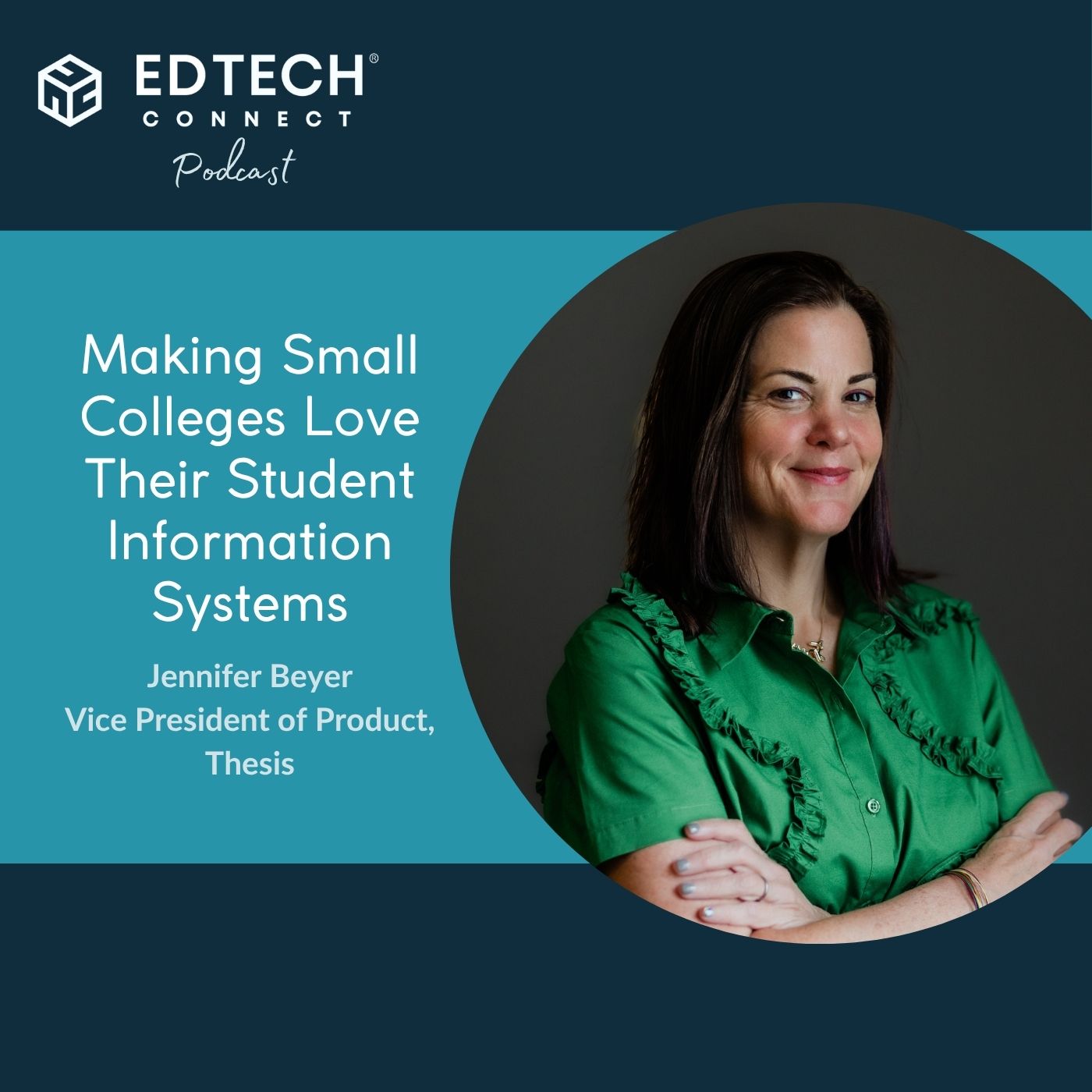
The Signal
Making Small Colleges Love Their Student Information Systems
00:31:42
Host Jeff Dillon sits down with Jennifer Beyer, VP of Product at Thesis, to explore the evolving landscape of student information systems (SIS) and the unique challenges faced by small to mid-sized colleges. With over two decades of experience spanning campus administration and EdTech leadership, Jennifer shares her mission to simplify higher education processes through cloud-based solutions. From her beginnings as a first-generation student and campus tour guide to her current role driving product strategy, Jennifer offers insights into how institutions can reduce friction, leverage technology, and prioritize the student experience. Tune in to learn how Thesis Elements is redefining the SIS space and why smaller schools are leading the charge in innovation. Key Takeaways: Access and Student-Centric Design: Jennifer emphasizes the importance of creating technology that helps students find the right fit and enables staff to focus on meaningful work. Her firsthand experience as a ...
Loading summary
Transcript62 lines
- [00:00]
A
I think back to, you know, my early admissions days where it was live chat is going to change the world and then chatbots were going to help. And then we went through this stage of analytics where analytics were going to change everything. And we kind of sat back and said, all right, maybe sort of AI is really doing that for us. Whether it is enabling us to craft better and targeted messages to help our students, whether it is driving better plans even from a student side helping them to craft better essays. Right? So it's, it's how do we really harness that power?
- [00:44]
B
Welcome to another episode of the EdTech Connect podcast where we explore the tools, trends and talent shaping the future of higher ed. Today's guest knows a few things about the chaos behind the curtain. Student information systems are the digital lifeblood of every college and also the source of more headaches than a registrar during finals week. Fortunately, Dr. Jennifer Byer has made it her mission to simplify that complexity. Jennifer is the Vice President of Product Management Thesis where she leads the strategic vision and development of cloud based student information systems designed for small to mid sized colleges and universities. With over two decades of experience spanning both sides of higher education, from campus administration to edtech innovation, Jennifer brings a unique perspective to solving institutional challenges. Her journey began as a first generation college student who started her career as a campus tour guide, eventually spending 15 years in frontline higher education roles including Director of Enrollment Management at the University of South Florida. Transitioning to Ed Tech, she's held senior product management positions at industry leaders including Hobsons Anthology and Campus Management Corporation. Dr. Beyer holds an EdD in Higher Education and an MBA in Marketing from Nature Nova Southeastern University. Under her leadership thesis, Elements has been recognized as a niche player in the inaugural 2025 Gardner Magic Quadrant for Higher Education SIS software as a service. So welcome to the show Jennifer. I'm really happy to have you today.
- [02:33]
A
Thank you for having me. Really happy to be here.
- [02:36]
B
You started your career as as a campus tour guide walking backwards around campus and now you're leading product strategy for a cutting edge student information system company. What moments in that journey shaped how you think about the student experience?
- [02:53]
A
I love that question and thanks for asking it. I mean I do joke that I started my career backwards, right? And I think for me as I think about that experience and then working on campus and admissions and student success offices and now on the software side, there's a couple of key themes, right? For me, access is really, really important and that is helping students to find the right fit enabling staff so that they can guide students and do the work that they really want to be doing. And then how do we think about that at scale? Right. How do we identify what are some of the macro issues that students and institutions and users are facing? And that's really where my role in Ed Tech comes into play, is that we're able to solve some of those problems for institutions across the country and even around the world.
- [03:46]
B
So you mentioned access. As a first generation student yourself, how does that personal experience influence the products you build and the problems you choose to solve? I mean, you're talking about people who have more challenges getting what they need.
- [04:01]
A
Yeah. I think for me, neither of my parents have a college degree, but they knew that for the goals that I had and for the world that we live in, that college really wasn't an option. Right. Or not an option. Right. They knew that they needed to help me figure out how to do it, and so was really fortunate to be able to visit schools and find that fit. And I think that is something that I think about a lot. Right. It's helping students to find their place. From a technology perspective. We are not the right solution for every institution. And so how can we help to blend those institutional goals with our software? And then ultimately, how do we think about that person on the other side? Whether it is a high school senior going through an admissions process, an adult learner who is coming back to train or retool, an administrator who's trying to figure out what are the right programs and services to offer to really support the students that make up their community. All of that combined was really informed by my own journey of navigating what it meant to be a college student, what it meant to be a grad student, and then what it ultimately meant to work on the other side.
- [05:18]
B
Yeah. You spent 15 years working in campus admissions, enrollment management, student success before moving to Ed Tech. How did that frontline experience inform your approach? And like, how did that pivot happen? How did that transition?
- [05:33]
A
Yeah, so for me, you know, my move to Ed Tech I really thought was going to be temporary. I was really happy on campus. I loved what I did. I loved the energy that comes from being on a college campus with students and faculty, but found myself needing to make a transition and I thought it would be maybe a two or three year detour as a consultant. And that was was 12 years ago. And so for me, when I think about that frontline experience, it really comes back to that user journey. What a admissions counselor needs to do their job is different than what a faculty member needs to do. And it's different from what a college president and different from what the IT team needs. And so as we think about software and the work that we do, it's really, really about that purpose driven design and thinking about usability from the context of sitting in the seat. Now it's been a long time since I've sat on a college campus full time. I still try to get out as much as I can, but that's where really engaging with our user community to understand what are the problems that they're facing, how do they want to interact with software. Sitting in their offices, watching them do that, watching them work with students is really critical to how we move thesis forward.
- [06:57]
B
Well, let me tell you my experience because I was a higher ed Web director for 20 plus years. I managed an SIS, we used PeopleSoft in my school. I talked to schools who were on banner, these big monoliths. They were. And that was back in the day where there are only a handful of systems the CIO had to worry about. And it was quite a beast of resource consumption. And problem with some of these bigger older systems was integrations and they weren't mobile friendly. Let's talk about thesis elements and your mission to make higher education processes frictionless. What does that look like in practice for a small college?
- [07:32]
A
Yeah, I think Jeff, you hit on a couple of really big things for us, right. It is this idea of it used to be a couple of systems on campus, the CIS and lms, maybe a CRM, but the CRM tended to live in one of the A offices. Right? Right. Admissions, advancement, athletics. And that's changed. Right. And so as we think about Frictionless, it really comes back to and starts with that integration approach. Right. Thinking about how do we support the campus ecosystem that are large softwares that are enterprise and scale, but also those really niche solutions that might drive student engagement or housing or meal plans or something that's really purpose driven. So I think that's a piece of it. Right. Really thinking about that integration strategy. Then I think the other piece, Jeff, is that whole idea of shifting away from that monolithic approach as we work with our schools, particularly for our smaller institutions, they are moving faster than some of the larger schools to the cloud and they need to do that for a number of reasons. Partially it is scalability. They need software that they don't have to be managing on their own. They need more modern technology so that they can really not just innovate but in some cases survive in a different way. And they need tools that are more secure, that require fewer resources to manage. And so those are the things that we're thinking about on the thesis side to really drive that frictionless experience. Experience.
- [09:17]
B
It's funny, I think of a decade ago, maybe a little longer, but about a decade or so ago I'm working at university and the whole idea when buying any software was why would we ever put something in the cloud when we need to be secure, we need to keep it on our campus and be secure. Right. And that's a complete 180 now. Right. We all admit that like you said, it's a race to the cloud. So I see security, scalability, you're right on with that. So that's kind of what I do at EdTech Connect is that was one of my founding visions was that how do we compete with all these monoliths out there and all these smaller companies pop up, these best of breed companies that are doing something so well rather than a company that maybe was an SAS and started adding on all these other things and now you're not quite sure what their core competency is. So I love that you're claiming hey, we're good for small mid sized colleges. That's who we're focusing on. You're not, you know, possibly like maybe we're not a good fit for an A big R1. I love that. Tell us about your focus on thesis elements which is designed specifically for smaller institutions. Why small to mid market? So we can understand is there different needs than large universities?
- [10:23]
A
Yeah, I think it's needs and resource. Right. And for us, Jeff, you're spot on. That idea of how can we be purpose built and mission driven if we're trying to serve everybody. And so as we think about our audience, you know, those schools that are tend to have enrollment of under 5,000. There's some common themes that we see. One is they are looking for a solution that can drive, you know, critical automations. Things like how do I automatically assign holds to a student, how do I do mass registrations of cohorts. Right. How do I automate repeatable processes? But at the same time I have constraints. Right. I have fiscal constraints potentially. Right. So being able to not only afford software, but the complexities of implementation of some of the larger solutions is a big piece. Right. That change to the cloud is tricky and can be costly. But also it's the human capacity. Right. So our schools tend to have an IT office of three or four people. There might be two people in the registrar's office. And so the idea of Completely re engineering their processes. There's not a team of people that can be kind of squirreled away to do a new CIS implementation. They're having to run the institution and do this really big tech transformation. And so when we think about this, we are not all things to everybody, but we are really good and have seen great success with our schools who are able to select the new software and be fully live and up and running on a brand new system in about a year. And that's pretty fast in the student information system world.
- [12:20]
B
Yeah, yeah, that's the problem with some of these big, I mean that's I guess why it might be great to be targeting smaller schools. Because projects are actually manageable.
- [12:28]
A
Correct, that's exactly it.
- [12:29]
B
I mean I know so many multi campus schools that are using these bigger systems and they just can't fathom the product.
- [12:35]
A
That's right. That's right.
- [12:37]
B
Not going to happen. And now a word from our sponsor.
- [12:44]
A
How can your next campaign soar? With experience helping colleges and universities raise billions of dollars, Mackie Strategies delivers communications, fundraising and tech expertise that your campaign can take to the bank. Mackie Strategies, build your breakthrough.
- [13:08]
B
I understand you, you launched a new student life module. Walk us through how you identify and prioritize which features to build next. What's your product development philosophy?
- [13:19]
A
Yeah, a little bit of luck, a little bit of science, a little bit of art if I'm telling the truth. Right. But it ultimately starts with our clients. We spend a lot of time with our user community and with our community overall. Right. So really understanding what are some of their biggest pain points, what are some of their challenges and what are some of their needs. And then we go away in solution answers for those. And so a few minutes ago we talked about the complexity of the ecosystem and where does the school need a niche solution and where do they want something that can fold in. And so for us, student life made a lot of sense because again, these are institutions that might have two or three residence halls, but they also needed flexibility because they have some off campus housing. Right. And they needed it to be streamline with billing, with registration, with financial aid, with their analytics. And so as we think about prioritizing where we are investing our resources, it's how do we help the institutions that partner with us to be more efficient? Not just today, but we really take that idea of kind of future proofing the solution and future proofing their investment really seriously. How can we help them prepare for where they're ultimately going to go or want to go?
- [14:42]
B
Right, right. You've worked at major players like Hobson's and Anthology.
- [14:47]
A
Yeah.
- [14:48]
B
Now at Thesis Elements, how is the edtech landscape evolved? Where do you see the biggest opportunities for innovation?
- [14:54]
A
It's been a really interesting journey. Right. You know, and as we look at the space, you had commented a little bit earlier on, there's just so many players that are out there right now. Right. Some of the larger players, like a anthology that can essentially run the institution and then a number of us who are smaller in scale. I think it is that blend of how do we leverage new technology? I don't think I could be a technologist today and not mention AI a couple of times. Right. So here's number one. How do we best leverage AI? But how do we do it in ways that are both secure? Right. For our schools that we deal with, it's how can we make it scalable and accessible so that it's useful? Right. And it's not just a shiny tool that sits on a shelf that everyone's kind of afraid of and doesn't really understand. And then I think the other thing is how do we partner with like minded organizations? We're really good at building student information systems and one of the things that we've done is gone out into the ecosystem like our, our schools do and said, who else is really good at doing what they do? Who shares our vision of making software that is scalable both up and down, that is secure and modern, but that also meets the needs of the institutions that we partner with?
- [16:19]
B
It seems like you're on the track to help reshape that perspective of sass are clunky. That's my goal, you know, almost you need to rebrand the whole category to say like, because you think of an sas, you're like, ugh, gotta work with my sas. Is that an intentional. Is it more like, hey, if we build the best product, it's going to be much easier to use and to hopefully lose. That will hopefully change that perception. Is that a conscious thing that you're.
- [16:44]
A
Yeah. When I came to thesis, I came because I was really excited about the leadership team that was here and the work that we were doing and the market that we serve. Right. I keep coming back to that. I think this is an underserved audience who needs really good solutions to help them deliver on their mission for their students. But I, I had sworn, Jeff, earlier in my career that I was never, ever going to work on ASSIST because they are boring and hard and nobody likes us. Right? Nobody likes their cess. Everybody likes to complain about it. And we really are on a campaign and on a mission at Thesis with Elements to really help our schools be delighted with the solution. And I really want them to be wearing shirts genuinely that say, I love my sis. For us, it comes back to that idea of reducing friction, that feeling that we're listening to them is really important, and that we're building a solution that solves the problems that they're facing. That, you know, reducing the number of clicks that it takes to do tasks. Right. That visualization of data so that they can understand the decisions that need to be made, and that ability to really help them help their students is ultimately what's driving us.
- [18:00]
B
I have to admit, even when I started this podcast, I didn't envision bringing on a CISS product leader that would be like an engaging conversation. But I did get excited when I kind of looked at what you were doing. And it's great to have someone who's kind of trying to change that landscape on the show.
- [18:16]
A
Yeah, thanks. Thanks.
- [18:18]
B
With your experience across the entire student life cycle, from recruitment to advancement, what do you think are the biggest pain points you see institutions struggling with today?
- [18:28]
A
Yeah, I mean, I think it is that idea of transition, Right. And it is still that idea that on the one hand, we talk about that student life cycle, that journey, but as institutions, as technology, we don't practice that. Right. So in the admissions process, we learn a lot about our students. We help them to understand their fit, we help them to understand the offerings that we can deliver for them. And then that student enrolls, and we expect them then to kind of figure it out, right? We drop them in a student portal. We spend two days with them at orientation. Maybe they have a freshman success class. But, you know, we put up signs across campus and then say, well, we know our students, and they know to come to us. You know, I'm the mom of a college sophomore, and I watched them navigate their first year, and I know what I know, right? And they called me and they said, mom, how do I do this? Right? And this is at a small school, 1500 students. And so that idea of we know you so well, and then when you get here, we kind of have forgotten everything about you and make you try to navigate that again. Right? And so I think that's a big disconnect. And then the same thing happens again on the advancement side where we need to kind of get to know them again. And what were their experiences as a student that could drive them to remain connected, to, you know, remain engaged, to Ultimately leave us their, their money. And so as we think about technology, it's how do we help to create a more consistent through line? How do we use what we learn at each stage of that life cycle to inform and ultimately help the student reach the outcomes that they're intending to. To achieve?
- [20:11]
B
Yeah. It sounds like you're working on personalization. Right. And so.
- [20:14]
A
Absolutely. Yeah. Personalization at scale. Right. That's the challenge.
- [20:19]
B
That's the trick. I remember, I mean, it's over 20 years ago that the school I was working at, we were trying personalization.
- [20:25]
A
Yeah.
- [20:26]
B
And it was a manual process, so it didn't work. Right. We had to have all these content owners update their own personalized messages and it was just too hard. But once it's automated, it's. Yeah, it's possible.
- [20:35]
A
Yeah, absolutely, absolutely.
- [20:37]
B
I want to talk about your leadership style and you've built and led product teams globally. What's your approach to creating highly functioning teams in this rapidly changing tech landscape?
- [20:50]
A
It comes down to a couple of things. Right. One is, you know, certainly we can look at someone's resume and see that the, you know, experience that they might bring to the table. But there's a certain number of things that I'm always looking for. One is that natural curiosity. Right. Especially in the tech world and in the higher education world, it's looking for people who want to learn more, who are not afraid to fail. Right. Because they're willing to try new things. And so it's finding those skills, really thinking about how do they fit into a team that's already existing, how do they align with culture and then setting up some guardrails, providing that clear expectation. And then, Jeff, the reality is getting the heck out of their way so that they can deliver and do the really great things that that talent and that background and that passion enables them to do. It's trickier when it's global. Right. We're fortunate. We've got folks around the world at thesis. And so sometimes it's the tactical of college and faculty and course and program. Program don't mean the same thing in every country. Right. And so how do we align on that? But then it's continuing to share the successes, continuing to share the mission and providing that freedom to kind of enable and empower folks to raise their voice and help to offer solutions to the problems we're trying to solve.
- [22:22]
B
How do you balance being data driven with maintaining that human centered approach to product development?
- [22:30]
A
This is, I think, the art, right. Because it is understanding data. But that key is really context, Right. So we use a lot of analytics. We, you know, we track user engagement with software. We are watching the clicks behind the scenes. Right. We're understanding that usability, but it's then really balancing that with conversation, with focus groups, with live session shadowing, and then understanding how do we use that data to tell a story. Whether it is helping a developer understand the impact of a financial aid awarding practice or working with our board to solicit more funding to drive a better student experience. Experience. It's really blending that quantitative data. These are the clicks, these are the users, this is the engagement, these are the metrics with that story behind it. All right. And then continuing to provide those proof points on both sides as we make progress.
- [23:38]
B
Yeah, you really need both. You need great storytelling, you need the data. Yeah, it's almost. Yeah. You can't do it with one, I think. So you hold an MBA and an Eddie. How do you blend the business strategy with educational expertise in your leadership style?
- [23:54]
A
I think for me it comes back to, you know, whether it was in, in my MBA or in my doctoral work, it's really finding value. Right. So in my mba, I focused a lot on what do customers need, what do customers want? How can organizations deliver against that? How can we ensure brand, message and clarity? And when I combine that with my academic background, again. Right. I thought I would live on a college campus forever. I was on a path where I really wanted to be a college president. It was how do we deliver value for students? Right. Whether that's we're introducing new programs, introducing new degree programs, providing them the support that they need, understanding what drives their success. So I think there's a really clear throughput from both of those. Right. And I carry both of those. Now when we think about what do we build in the product, you know, from a business perspective, it's how do we build a product that people will want to use, that people will want to buy, that people want to renew. But at the same time, our clients are the universities, are the staff, are the faculty. How do we enable them to better serve their students? Right. How do we enable them to better support their community? And so I love that I kind of get to hit the best of both of those worlds every day.
- [25:25]
B
Yeah, Maybe you share this with me like I was in higher ed for so long and it was hard to leave. But I love now stepping out and looking into higher ed and touching so many more schools. I can help so many more schools now on the outside rather than just one. And the challenges with them Being in the system are tough, too, within. Within higher ed. So I do. I love that. That part of it.
- [25:46]
A
Yeah. I mean, I got into this to serve students. Right. I started in admissions helping students to understand were we the right fit for them and making those kinds of decisions. I still think that every day. But to your point, Jeff, like, now we get to do it at scale. You know, whether it's a small Christian, you know, Bible school in Mississippi or a community college in Mont, a small private in New York. Right. On paper, they might look very different, but at the end, they're all serving their community.
- [26:17]
B
Right. It's a large niche, basically.
- [26:19]
A
Exactly.
- [26:20]
B
So looking ahead, what emerging technologies or trends do you think will have the biggest impact on higher ed administration?
- [26:27]
A
Yeah. So here comes AI number two. Right. We're foolish to not think about how it enables us to work smarter and use our resources more effectively. I think back to my early admissions days where it was, live chat is going to change the world, and then chatbots were going to help. And then we went through this stage of analytics where analytics were going to change everything. And we kind of sat back and said, all right, maybe sort of AI is really doing that for us, whether it is enabling us to craft better and targeted messages to help our students, whether it is driving better plans, even from a student side, helping them to craft better essays. Right. So it's how do we really harness that power and think about that? And then I think the other piece that we've talked about is the move to the cloud and how moving to cloud software really now changes the way that we work. It is no longer I can customize everything because it lives in a server in a closet on my campus, and I can do whatever I want. It is, how do I best leverage the technology that's available? How do I align that with my processes? How do I support the change that's needed in my community to get there? So I think as I think about where we go from tech, it's really aligning those two things.
- [27:55]
B
Yeah. I love that this race to the cloud has that benefit. Where I talked to web directors who knew they needed to move because they kept being forced to do all these customizations because they knew everyone knew they could. And so they're like, I talked to their vendors, please help me get to the cloud. So I could just say, no, it's not possible. We have to go along with their product roadmap, which aligns with us.
- [28:15]
A
Yeah.
- [28:16]
B
So many people do understand not higher ed is always a little bit behind you Know, and trying to convince people to change even the regulations of like, we still have a compliance issue with moving stuff to the cloud, like.
- [28:26]
A
Yep.
- [28:27]
B
Oh my gosh.
- [28:27]
A
Yes. Agreed, agreed, agreed. Yeah.
- [28:30]
B
To wrap this up, one last question for our listeners who are ed tech professionals or higher ed administrators? What's your advice for driving meaningful change at their institutions?
- [28:39]
A
Yeah. So I think for me it comes back to even the way that we think about change here at Thesis. Right. And that is keeping that laser focus on who are you best optimized to serve, understanding what their needs are and staying true to that mission. It is really easy to get distracted by something shiny or something new or a suggestion that comes out of left field from a leader in the community. But I think that meaningful change isn't an overnight thing. It happens over time. And so it is that combination of if I know who I'm serving, if I know what my mission is, it makes it a heck of a lot easier then to do the hard work. Changing process, changing people, changing technology to help meet that.
- [29:36]
B
That's a great. I want to throw out one example because you made me think of this where the goal is to redo the campus homepage. Campus webpage. The leadership wants it. Someone in the community. Like, we need a new webpage. It's part of my, you know, as a web director, I had to do that. But I'm like, okay, let's have the focus group first. Right. What are the students saying? And guess what I realized in the student focus group is that the website didn't matter a whole lot. What mattered was the search bar. They all went to the search bar. They weren't using the navigation. So sure, we got to do the homepage, but maybe less resources need to go to the homepage and more need to go into the. That driving search across this chaotic digital landscape. So it's a great example of like, it's not very glamorous to reading your search. No one really understands or knows, you know, but.
- [30:15]
A
Right. It's like when I, when we go to user conference and I do the reflection on like the new stuff that we delivered over the last year and I'm really excited to talk about, you know, our new student life module, which is awesome and great, but people are like, oh yeah, you reduced two clicks. And this task that I did every day. And that's what people are excited about and losing their minds over. So, yeah, search bars, reducing clicks, you know, it's those like, know your audience and deliver what they need.
- [30:43]
B
Well, it was great having on the show Jennifer. We will put links to Jennifer's LinkedIn bio and thesis elements in the show notes and great to have a chat with you, Jeff.
- [30:53]
A
Thanks so much.
- [30:53]
B
Bye Bye. As we wrap up this episode, remember EdTech Connect is your trusted companion on your journey to enhance education through technology. Whether you're looking to spark student engagement, refine edtech implementation strategies, or stay ahead of the curve in emerging technologies, EdTech Connect brings you the insights you need. Be sure to subscribe on your favorite podcast platform so you never miss an inspiring and informative episode. And while you're there, please leave us a review. Your feedback fuels us to keep bringing you valuable content. For even more resources and connections, head over to edtechconnect. Com, your hub for edtech reviews, trends and solutions. Until next time, thanks for tuning in.