← The Signal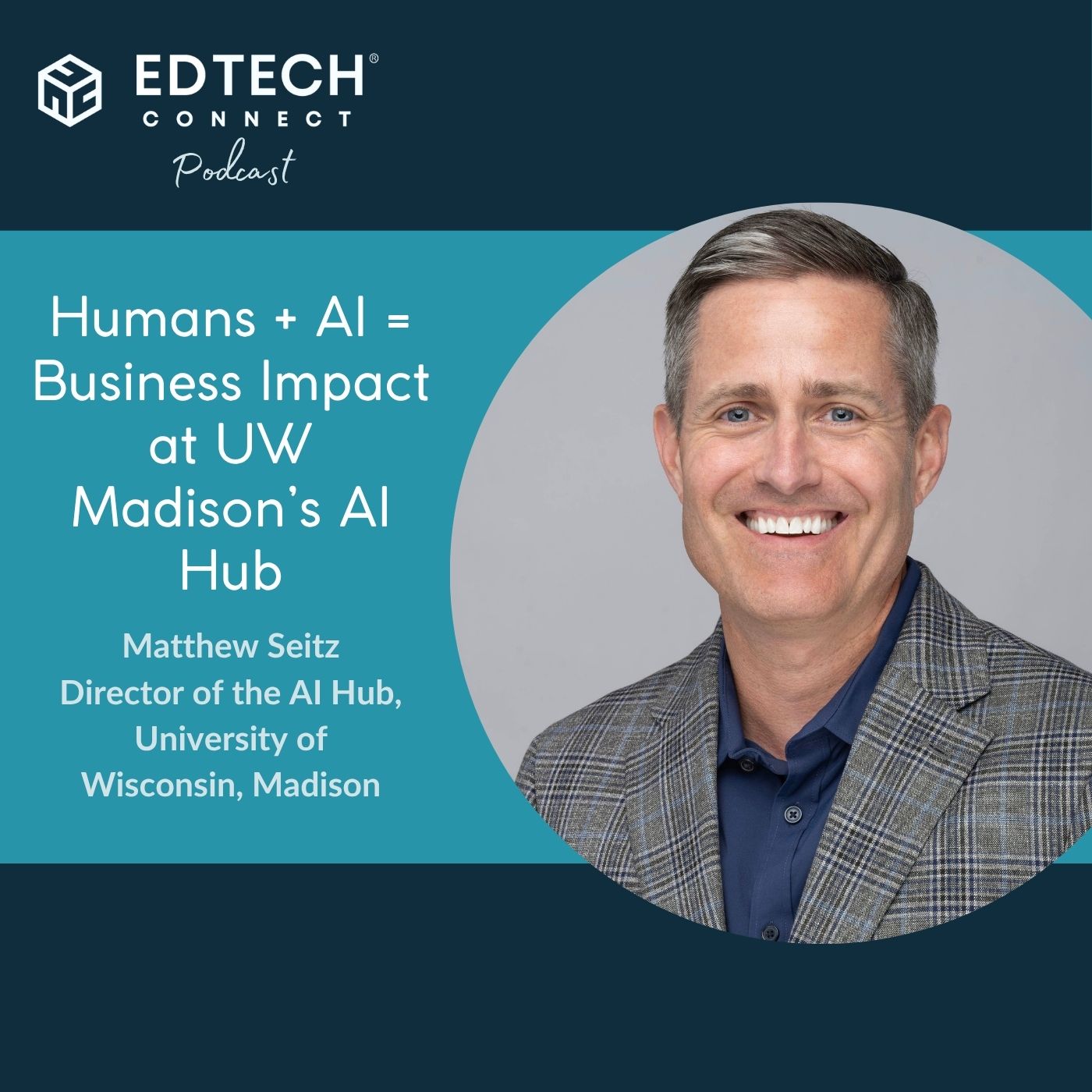
The Signal
Matthew Seitz: Humans + AI = Business Impact at UW Madison’s AI Hub
00:31:20
Date: 13 October Name of podcast: EdTech Connect Podcast Episode number: 59 Episode title: Matthew Seitz: Humans + AI = Business Impact at UW Madison’s AI Hub Publication Date: 31 October What does training for one of the world's hardest Ironman races have in common with leading AI transformation in business education? In this episode of Edtech Connect, host Jeff Dillon sits down with Matt Seitz, Director of the AI Hub for Business at the University of Wisconsin-Madison. A veteran of Google, Abbott, and McDonald's, Matt brings 30 years of tech leadership to his mission of preparing students for an AI-driven world. He draws powerful parallels between overcoming the fear of the triathlon swim and the misconceptions holding businesses back from AI adoption. They tackle the critical questions: How can universities balance genuine learning with the need for AI skills that employers demand? What's the "barbell effect" of prom...
Loading summary
Transcript56 lines
- [00:00]
Matthew Seitz
My the associate dean or assistant dean for research at the business school, she did a study on fashion and AI and fashion. What she found is my favorite study. They found that AI designs, they had AI design clothes versus humans and the AI design clothes outsold the human design clothes. Right. So that's your headline. But what was neat about it is it wasn't just that they actually used a crowdsourcing platform for the data to do the designs off of which was all human created. Right. And so they, they had a way of humans plus AI that delivered the results that was then both valuable for research but also had businesses saying okay, now I can think about how to use AI in design that preserves the humanity but also has a. And so I think finding those marriages is critical.
- [00:55]
Jeff
Welcome to another episode of the EdTech Connect podcast. Today's guest is Matthew Seitz, director of the AI Hub for Business at the University of Wisconsin Madison. With over 30 years of experience driving growth through technology, data and AI, Matt has held executive roles at Google where he led US retail performance and at brands like Abbott and McDonald's. At Google he pioneered AI based retail strategies and and helped C suite leaders navigate digital transformation. Now at UW Madison, Matt is on a mission to empower the next generation of business leaders to thrive in an AI driven world. His work at the AI Hub focuses on advancing research, building industry partnerships and delivering hands on education. A Kellogg MBA AI advisor keynote speaker and four time Ironman athlete that brings unmatched energy and insight to the intersection of technology, business and education. Well, it is great to have you here, Matt. Thanks for being on the pod.
- [02:36]
Matthew Seitz
Yeah, thanks Jeff. Looking forward to this.
- [02:38]
Jeff
Yeah. So let's talk about this Ironman you recently did. You're a multiple Ironman finisher. I've done a couple of Ironmans. I know how hard they are. I know I call it, my wife calls it like the Ironman, you know, almost the Ironman widow. For the training months where you're, it's all about the training. But you're in Wisconsin. You did the Wisconsin Ironman a couple weeks ago and that's a hard one, everybody. These Ironmans, if you don't know, there's 2.4 miles of swimming, 112 miles on the bike, 26.2 mile marathon at the end. And this one's a climby ride too, so I even looked you up too. You had a pretty good race. Tell me, how'd it go?
- [03:15]
Matthew Seitz
Yeah, you set up well, Jeff. So it's hard, right? It's a really hard race. And The Wisconsin, I think by number it's the second hardest in North America and it's because of the bike. So It's. You do 7,000. I think I logged 7,100ft of climbing. But this was, it was a PR and I finished in the daylight, right. Which was a big goal of mine to finish workout dark. And the big thing about it was nutrition. So in every other race, I, by the time I got halfway through the run, or even a quarter, I couldn't eat anymore. And so then you just, you really run out of gas. I burned something like 8,500 calories during those races. And so if you don't keep eating, you're dead meat. And so for this one, I was finally able to keep the calories going throughout and had a decent run at the end.
- [04:03]
Jeff
I learned that too. I have a friend who trained me. He had done many. He was an ex pro and he said it's an eating contest, not even as an eating contest. And you have to train your body to eat like that, even if you're not hungry on these long rides. Train your body, eat on your long rides and get ready. The good thing about me, I can eat Big Macs on, on a bike ride, so I'm good in that way. But congratulations to you on that. That's incredible. Especially on that hard course. But let's try to bridge a gap here because with your ironman training, how does an ironman compare to leading AI transformation in business?
- [04:35]
Matthew Seitz
Yeah, we'll do some work here to make these fit. But broadly, I mean, Jeff, the reason, and you may feel the same, but the reason I do these is on balance, I think I live a really easy life.
- [04:47]
Jeff
Right.
- [04:47]
Matthew Seitz
I mean, the problems that I deal with on a day to day basis pale in comparison to 200 years ago. Or, you know, it's like, am I going to have food this winter? You know, the crop comes in, right. And so I think, I think to do something genuinely hard is really satisfying. And I think for AI, the thing that sticks out to me is I think there's a lot of misconceptions about AI and when people talk to me about Ironman or triathlon, you know, they always say, matt, I could never do the swim. 80% of people say that. And the swim is easily the easiest part of the race.
- [05:22]
Jeff
The easiest part by far.
- [05:23]
Matthew Seitz
Yeah. And it's the shortest, right. So, you know, I was 12:30 or 12:29, 28, and I was 75 minutes in the water. And so it's the smallest piece and I think there's a lot. It's a lot of ways with AI, there's people are afraid or concerned about some really big things that in their minds that aren't the biggest issues really to deal with when you start digging into it. And so I think that's the bridge I'll make on it.
- [05:45]
Jeff
I love that. I love that because you're right. Most people that runners, so many runners and cyclists out there and won't do a triathlon cause they're afraid of the water. But you think about it, how many things don't you start? Because the beginning is hard, right. And the rest of it wouldn't, you know, it's all hard, but not a little intimidating, but not that bad. That's a great lesson. Well, you've had an incredible career at companies like Google, Abbott, now at UW Madison. What drew you into the world of AI in the first place?
- [06:15]
Matthew Seitz
So I'm a big nerd. That's who I am, right? And I love technology. I spent my whole career in tech. And Jeff, in my life, there's been four big technical revolutions, right? So it was the PC, the Internet, the smartphone, and now AI. And I do think AI will be the biggest. It builds on the other three, but I think it'll be the biggest. And I think the way play it out for me is at Google. In my last couple years, I led the search business for US retail and every customer I met with as big as Walmart to as small as, you know, tractor supplier, party city. Three quarters of the conversation was about AI. You know, what does this mean to my team, how do I use it, et cetera. And so when I found out about Wisconsin creating this hub, it was just very natural to say, hey, now I can really focus on AI and go beyond just marketing to help business, students, alumni, all the people we work with really engage on AI. On. I think what I think is the transformational technology of our age.
- [07:16]
Jeff
The role you're in seems pretty unique. I haven't heard of this out there yet. I'm sure there's some other comparable people out there doing this work at schools, but can you talk about the AI hub for business at your school? What does it do? What's the vision for it?
- [07:29]
Matthew Seitz
Yeah, yeah. So broadly, I think, you know, this AI is existential for education and academia. It touches what do we teach? It touches how do we teach? You know, it touches what research we do. How do we do research? And then alumni come to us in industry and say, hey, how are you thinking about AI? And so every piece of our value chain is affected and the hub. We're really two things in one way. We're a shared service. So for any group working on AI at the university, we can help them with resources, with advice, with content, and then we also lead on things. And so we're going to host a summit at the school in the spring, and I write a newsletter once a week on AI and we're going to have a webinar series. So there's things we lead on as well. Now, I should say with my background, I think where I give the most value to the school is connection with industry. Because, you know, on the teaching side, we have people who are deeply expert in how to teach. And so for them, it's how do I now incorporate this new tech? What there's less of at the school is someone who's taught business and results for 30 years within the four walls of business. And so I think that's where we uniquely add value. But the role is really to think about how do we just meet the moment for all of our stakeholders.
- [08:44]
Jeff
Yeah. Tell me what I've seen out there. I talked to many schools on AI strategy and, and comes down to governance often where in the lack of governance. We were poor with digital governance before AI came. Now we have AI on top of the lack of digital governance, which is. It seems to be a pretty pervasive issue out there. And what happens, I see is it trickles down to the faculty member because there's nothing in place. So we have a spectrum of perspectives of how faculty can integrate it. Do you deal with that at all to help guide your school with some guideline and policy at the different levels of a school or how do you look at that part of AI?
- [09:23]
Matthew Seitz
Yeah, I mean, I think we're in the hub, we're more involved, but not. We don't lead that. Right. I think there's, there's people at the school that lead policy. And it's, it's, it's really tricky. Right. I mean, there's, there's so multi. You know, one is data. Think about data security, security. Then there's intellectual property. Right. Then there's how do we make sure that when we give a student a grade that that is accurate and reflective of that. And so there's a whole bunch of dynamics that we have to play out. And then I think the related point that you acknowledge is, you know, out of every hundred faculty, there's 30 who are excited and chomping at the bed to get involved, you know, there's 30 who are really not interested. Right. And then there's a bunch in the middle that are not sure. And so I think part of it is just encouragement, you know, energy. Right. Like really trying to inspire people to lean into this moment in education.
- [10:16]
Jeff
How are you seeing it reshape the skills and roles that students need out there?
- [10:22]
Matthew Seitz
Yeah, I think it's really significant, Jeff. You know, one of the analogies you'll hear is it's a barbell effect, which is, is you need to be good at asking the AI to do something and then verifying it on the back end.
- [10:33]
Jeff
Right.
- [10:33]
Matthew Seitz
So prompting and verification. I think more broadly, when I talk to students, there's three things I really anchor on, which is one, you still need to know your stuff. You know, if you're coming out of school in marketing, you better know marketing cold because the AI might get it wrong. Right. And so you need to still really know it so that you can work effectively with it. The second is you better know AI, you know? Right. So most companies, if not all I talk to, the number one thing or top tier thing they want from a graduate is AI skills. Right. Because they want to plug them in and be AI ready. And then the third is, I would say, adaptability. I listed four tech changes in my lifetime. This way is probably the first for many of our students. And so they need to be ready to do the next one and the one after that and the one after that. And so that ability to adapt to a technology or any change in the businesses, I think a key skill people are going to need.
- [11:26]
Jeff
Yeah, I love those, those three. I lived through the same four transformations. In the most recent, I would say mobile probably affected me the most later in my career. And I'm thinking we're getting to the point now where mobile was like, hey, are you going. You had to be proactive. Are you building your mobile app? Are you making your content mobile friendly? And it's almost. Mobile isn't even a really, really a. It's almost embedded these days, right. It's like, you know, you have to. And I think we're in two years, three years, we've almost got there. I mean, we're not there yet. There's a lot of resistance still, but it's almost the same, you know, it's not stopping, it's coming. And you mentioned something else. Like people ask me, they probably ask you, is this going to replace us? Are we going to lose our jobs? And I heard Mitch Joel. Mitch Joel is. I think he might be the Longest running podcast ever out there. For 19 years he's had a weekly podcast. He's a thought leader, talks a lot about education. But I heard him say in a presentation recently, he said, AI isn't here to replace us, it's here to make you superhuman. And I've said this example once and it applies to academia. I think I'm probably talking about this a lot. But when text to image generation was coming out, I mean it's been out for years now, but I discovered it about a year or two ago. I'm like, this is incredible. How are people creating such great images from text? And I was trying to use Mid Journey and Dolly and I couldn't produce the same results. Everybody else like these great images were being created by other people. And then Mid Journey released their like, what are prompts are being created. And what I saw was guess what, who's creating the best images is their professional photographers. And I could tell by their prompts, right? Use a certain aperture at this angle and this lens and I would never know what to what to do. So yeah, I agree, it's not, it's going to really empower what knowledge you already have.
- [13:16]
Matthew Seitz
Absolutely.
- [13:19]
Jeff
And now a word from our sponsor. Where can you find a consultant who knows your challenges? Really? With decades of campus executive experience, the Mackey Strategies senior team provides interim leadership, presidential and vice presidential council, crisis communications and technology guidance built on real world success. Mackie Strategies expertise when it matters most. You mentioned the power of humans using AI vs AI replacing humans. Can you share examples of that from your experience?
- [13:59]
Matthew Seitz
Yeah, this is where so I'm in the school of business Jeff at Wisconsin. And so we're not building the models, you know, we're not hands on keyboard programming. We're putting them into practice and a function and except for a very small number of cases, impact from a business perspective is a human working with AI to have that impact. And so you know my background in marketing, Google Meta, Pinterest, these companies have incredible algorithms that will find the best place to show your ad, the best search, the best image. But a human has to say, what's my goal for this campaign? What creative do I want? What data am I going to share? How much budget am I going to spend? How am I going to allocate across all these other things? And so the human is critical to work with the AI to find results. And we see that across, you know, same thing of supply chain or hr, legal, any field AI can, what you said it makes you superhuman. And you know the people that do that are going to be more and more effective as well as specifically within the different functional area they work in.
- [15:04]
Jeff
The, within the college of business. What have you seen? What partnerships have you developed? What's exciting relative to that field with AI?
- [15:12]
Matthew Seitz
Yeah. So I'm early, Jeff. So we're eight months in or I'm eight months into building the hub. So we have a few partnerships or a number we're actually already engaging in. I don't know I have any public ones that I can announce yet. But you know, one thing that's neat is we're building an advisory board for the hub. And so we'll have probably 20 executives, director, VP, CEO. And you know, we have companies like Google and Reddit and Medtronic and Hyatt and Accenture. Right. So we have a bunch of really neat companies because we want their advice and input into what do they need and how do we show up. And I think, I think we'll have partnerships come out of it as well where we partner on research or experiential learning, et cetera. We're probably just a quarter or two away from having those sort of publicly available.
- [15:59]
Jeff
Are you to the point where your team at the AI hub can work with students to make sure they're ready for a career, they're job market ready in the fast evolving tech space?
- [16:12]
Matthew Seitz
We are working with them. And it's funny, my first week one of the people who brought me into the school had me visit her class and within a day after that I had 10 students reaching out to me saying hey, I want to be a part of what are we doing with the hub. And so we've launched, or they have now launched a student org this fall and I think there's already 80, 100 members of the organization. They have six speakers set up. So for one is letting them have agency, letting the students say what are we doing and where do they care about? I mean then I think in terms of specifics, it's first finding ways for teachers to bring it into the classroom. Right up. Leveling our curriculum to make sure, you know, if you're talking about AI for marketing, talk about how AI is affecting marketing. And then the things that are moving faster than the curriculum can adjust. You know, augmenting that with speakers or case studies, etc. That wrap around because, you know, well, in education you don't change your curriculum on a dime. That takes a long time. I think you have to augment the longer term durable pieces with fresh sort of current topics. Yeah.
- [17:24]
Jeff
What do you think is a common myth or misconception that leaders have about integrating AI into their. Into their work and their operational day.
- [17:34]
Matthew Seitz
Well, a lot. So, I mean, the funny thing you probably see this, Jeff, but out of, you know, if you talk to, When I talk to, let's say, every 10 business leaders, you know, there's some that are think, AI is this magic bullet, it's going to solve everything. And then you have others that say, oh, no, I saw it hallucinate once, so I'm never going to use it. Right. And it can't be valuable. And the truth is it's, you know, it's in the middle. And I think the one thing that tactically companies are dealing with is the traditional software development life cycle, the SDLC for traditional computing. It launched, what, 50 years ago? 55. And we'll be running that playbook from requirements to design to coding, the testing, we would run in that playbook for 50 years. And AI has some of those elements. You still need to do some of them. But there are other things you now have to do. You have to adapt a model based on what it can and can't do. You have to deal with the jagged frontier of can it handle this use case or not? How do I think about a model that will get better when the next GPT comes out or the next Gemini comes out? And so companies, I think, are wrestling with how to keep what worked for delivering software for 50 years, but now have it also handle the nuances of an AI system that works differently.
- [18:51]
Jeff
Yeah, I like that you brought up software, because I have enough of a development background to be. To be dangerous. Way back in the day, I wrote Cold Fusion, so. All right, I know you'll know what that is because we've been on similar trajectories. And so I knew enough to manage developers. And so AI now, great tool for me because I know enough to prompt an engine and I use Claude for some things. And what I realized is that there's a very public, proud view of AI with code almost saying, like, look what I built with AI. Maybe I know it's not perfect, but look how far I got. It works. And no, it seems a little, like, accepted. Like, yeah, I think a lot of junior software software, software engineers are probably scared and they're in a difficult situation, but the tool is here on the other side. It can really help us with our writing, with our creative endeavors. And that seems to be a little bit more taboo to be to say, hey, I wrote this with AI and we don't do that. Right. I wouldn't say, because although both of these are a spectrum, that side is much more nuanced. And it's almost. I tell a lot of schools, I'm like, hey, first thing you need to do is have your prompt, share your prompt library. You have. Some people are really good. Let's share those. And a lot of people in schools are very reluctant. And it's on the writing side, on the. On that, not really the code. I don't really talk to people, advise them on how to manage their code and with AI, But I don't know why do you think that is? Do you see similar situations at Wisconsin?
- [20:22]
Matthew Seitz
Wow. Well, there's a lot in there, Jeff, and it's really good stuff. So I do think, and there's a talk track around this, which is that the model companies, it's almost like the cobbler's shoes, they're over indexing on coding as the use case because the engineers building them are programmers. Right. And so they get excited about that. And I think that's where we're going to need the next round of companies to say, okay, I'm going to use these models to actually solve a business problem, not just make a better Claude code or a cursor tool. And so I think that's a really interesting nuance in the creative writing. I mean, actually, two different. Two different notions on this, Jeff. I think one is there's been studies that show that if someone says, I used AI to do this, they're regarded less well. You know, they're like, oh, okay, well, maybe you don't have the talent to do it. It's even worse if I think it's women. And like, minority groups or underrepresented groups have a higher bias, and so they'll often use the tools less or be less open about using them. Right. And because that stigma. And so I think that's something, you know, my sense is that that goes away in three years.
- [21:33]
Jeff
Yeah, I think so.
- [21:34]
Matthew Seitz
You know, just like, you know, Google or all the other tools, like using a calculator, you know, like, I think some of that goes away as we adjust because, you know, a CEO doesn't care.
- [21:43]
Jeff
Right.
- [21:43]
Matthew Seitz
CEO says, did you do this faster? And how productive were you? And then the third piece, Jeff, that you touched on is, you know, this idea of genuine learning. Well, let's see, you kind of touched on two things, but, like, genuine creativity. And what is genuine creativity in this world? I'm not really a person. I don't consider myself an artist. Right. Or creative person, but I think I can still appreciate it. And so my bet is we're going to see. We're going to see an increase in the value authenticity. When you can have infinite creative at such a fingertips, you're going to see a premium place back on authenticity. In a way.
- [22:23]
Jeff
Yeah, I think the last thing to really be accepted, it'll be hard like is a poem or true creative writing is like, when we're using writing to write thought leadership. Like, what's. Is there another motive here? Are we trying to do this to promote something else? I think that's happening. We're going to be successful, but it's just everything is so nuanced in such a spectrum in every way that it's just interesting to watch. I'll tell everyone right now, I do use AI. I write a lot of thought leadership. I use it as a starting point, though. I have an idea in my head first. I'm like, I'll write. The blog is really ugly. I don't care about the structure. I'll write the whole thing. Then I have AI organize it for me. Hey, can you find an example of this for me? I think this university has this. I'm not sure, but I'll give it that and I'll see what it comes back with. I'll make some more edits, but I will always have the final say. I won't take the final pass at it. I will not have EM dashes in it. For the most part, I will. And everybody, please use your settings in your accounts, whether it's cloud or OpenAI, and tell it all the things you don't want it to do. If you're using it for writing, like, do that once. Just a little tip, like all the words, don't use the word delve. Okay? No one uses the word delve. I love it.
- [23:32]
Matthew Seitz
Hey, one build on this. Jeff, with your podcast, you may have covered the MIT study already.
- [23:38]
Jeff
I haven't.
- [23:40]
Matthew Seitz
Okay, so there was a study that MIT did, and it was on students writing essays, and it was called your brain on ChatGPT. Is this familiar at all?
- [23:48]
Jeff
I heard it mentioned, but not on my podcast.
- [23:51]
Matthew Seitz
Well, I think it's super important. So they split people into two cohorts. Cohort one, you know, these students had ChatGPT from the start, and cohort two didn't. They had to write them by hand. And I think roughly the essays were of comparable quality. But they found that the students that had the chatbot were more anodyne. The essays were more, you know, less variety. They had less ability to remember what they wrote, and then they felt less ownership about what they'd written. I think a lot of it's pretty intuitive, right? We've all experienced that. I just one shot, and I've got an essay, and it's like, oh, I guess I'll publish that. But what was interesting is then they took the students that didn't have the chatbot, and they gave them the chatbot after they'd written their first essay, and they found that those students actually learned the most because they first tried to do it themselves and really did that hard work, and then they had a new round of ideas come in. So I'm optimistic that that could be. Could be a method we use even for teaching. Right. Where you still have to learn, but also learn how to use the tool.
- [24:54]
Jeff
Yeah, yeah. We're still all competing with each other, especially students. Right. All students are submitting their papers. The faculty member will be judging them relative to each other, whether they try to or not. So I feel like we all have the tool set. You better level up in how you use the tool set, and it's going to naturally kind of shake out. Because I heard Andy Crestadina, I love that study. I got to look that up. Andy Crestadina is a big marketer out there and said he always puts a slide up that says, and AI equals average information. Right. So we do need to up it. And another study you may. Maybe you've heard of, a few months ago, I had Lee Rainey from Elon University who led a study, and they asked faculty. I forget how many, but it was a legitimate study. If you assign a student to write an essay in class and they create a prompt for that, and they. That output is their. Is their assignment that they turn in. Is that cheating or not? Half said it was, half said it wasn't. So I was shocked that even half said it wasn't, because there wasn't really a description of, like, how much I used it. It was like, did I. Did I turn the output in as my own work? So it was 50, 50. So we're right in this. This transition of. Of how do people feel about these tools?
- [26:03]
Matthew Seitz
Hey, Jeff, I think this is so interesting because what a teacher calls cheating is what a company expects a new hire to be able to do. And I think that's actually the paradox education's facing right now, right. Is how do you still preserve learning but also have that person coming out being an AI Superhero. It maybe is the biggest part of the challenge.
- [26:26]
Jeff
Well, I think you're right. It's so interesting. And I do also want to know, how do you balance pushing cutting edge AI research while keeping curriculum practical and career focused?
- [26:39]
Matthew Seitz
Yeah. The tricky part, Jeff, is university culture. It's very asymmetric to industry, you know, so when you think about partnering on a research study, the university has its own timelines and its own data management practices and its own objectives. And then the company says, listen, I need this solved in next month. Right. I don't want to wait for summer, a summer intern. Right. And so I think from the research side, what we do is we look for the Venn diagram overlap. Right. Which is where can we find a set of goals and tools and problem sets that provide value to both. The associate dean or assistant dean for research at the business school, she did a study on fashion and AI and fashion. What she found is my favorite study. They found that AI designs, they had AI design clothes versus humans. And the AI design clothes outsourced, sold the human design clothes. Right. So that's your, that's your headline. But what was neat about it is it wasn't just that they actually used a crowdsourcing platform for the data to do the designs off of which was all human created. Right. And so they, they had a way of humans plus AI that delivered the results that was then both valuable for research, but also had businesses saying, okay, now I can think about how to use AI in design that preserves the humanity but also has a at it. And so I think finding those marriages is critical.
- [28:04]
Jeff
Yeah, that's fascinating. One thing that I'll share from the private sector that's happening at like software companies and private companies outside of higher ed is they're using AI to create synthetic Personas. So they want to sell to these audiences that may be higher ed. So they create a marketing director or a CIO Persona and run the messaging by these Personas to save time and make sure the messaging is going to resonate and it saves a lot of time. And it's, it's great. It's a great use of AI. Well, let's see. I want to ask you one more question. If you could give one piece of advice to students or professionals looking to future proof their careers, what would that be?
- [28:44]
Matthew Seitz
So I'll bring it back to our open Jeff around Ironman and I'll talk about the. So you, I'm sure you know this, but in 2017, Nike released the first of these carbon running shoes. They were called, I think vaporfly. Now they're called alphafly. And you know, they they have this rocker plate and they basically, they make it easier to run. And so we've seen the world records and marathoning get crushed by people wearing these shoes. But we saw also is the Boston Marathon qualifying times are 15 minutes faster than when they release these shoes. And a lot of that's due to the shoes. Right. Because people are just faster running in them. I mean, there's other things, but that's one of the key things. And so what I always tell people is we're kind of like that right now. Because what's interesting is in 20, 20, maybe 1 out of 10 runners was running in them. Now if you line up to go for a bq, everybody's in them. And so it's the same with AI. If you use the tools now, you can actually be ahead because a lot of people aren't. And so you're more effect. Right. You're that superhuman and your peers aren't. Yeah. And then of course, when eventually they get to it, you'll be ahead of them. But I think now is a unique moment to take advantage. Right. And really be a leader.
- [30:02]
Jeff
Yeah, I love that example because I know exactly what you're talking about. My wife's a runner. I. I was a runner. People would call it those shoes, you know, free speed. I'm like, they're not free. They're like $300. But I guess I get what you're.
- [30:14]
Matthew Seitz
Saying, you know, it's a moment right where we are and. And I think, you know, people should take advantage of.
- [30:20]
Jeff
Well, that was really fun talking to you, Matt. I'm going to put a link to Matt's LinkedIn in the show notes and link to his university website at University of Wisconsin in there too.
- [30:30]
Matthew Seitz
So thank you, Jeff.
- [30:31]
Jeff
Great having you.
- [30:32]
Matthew Seitz
Pleasure.
- [30:32]
Jeff
Thanks, Matt. As we wrap up this episode, remember EdTech Connect is your trusted companion on your journey to enhance education through technology. Whether you're looking to spark, share student engagement, refine edtech implementation strategies, or stay ahead of the curve in emerging technologies, EdTech Connect brings you the insights you need. Be sure to subscribe on your favorite podcast platform so you never miss an inspiring and informative episode. And while you're there, please leave us a review. Your feedback fuels us to keep bringing you valuable content. For even more resources and connections, head over to EdTech Connect.com, your hub for edtech reviews, trends and solutions. Until next time, thanks for tuning in.