← The Signal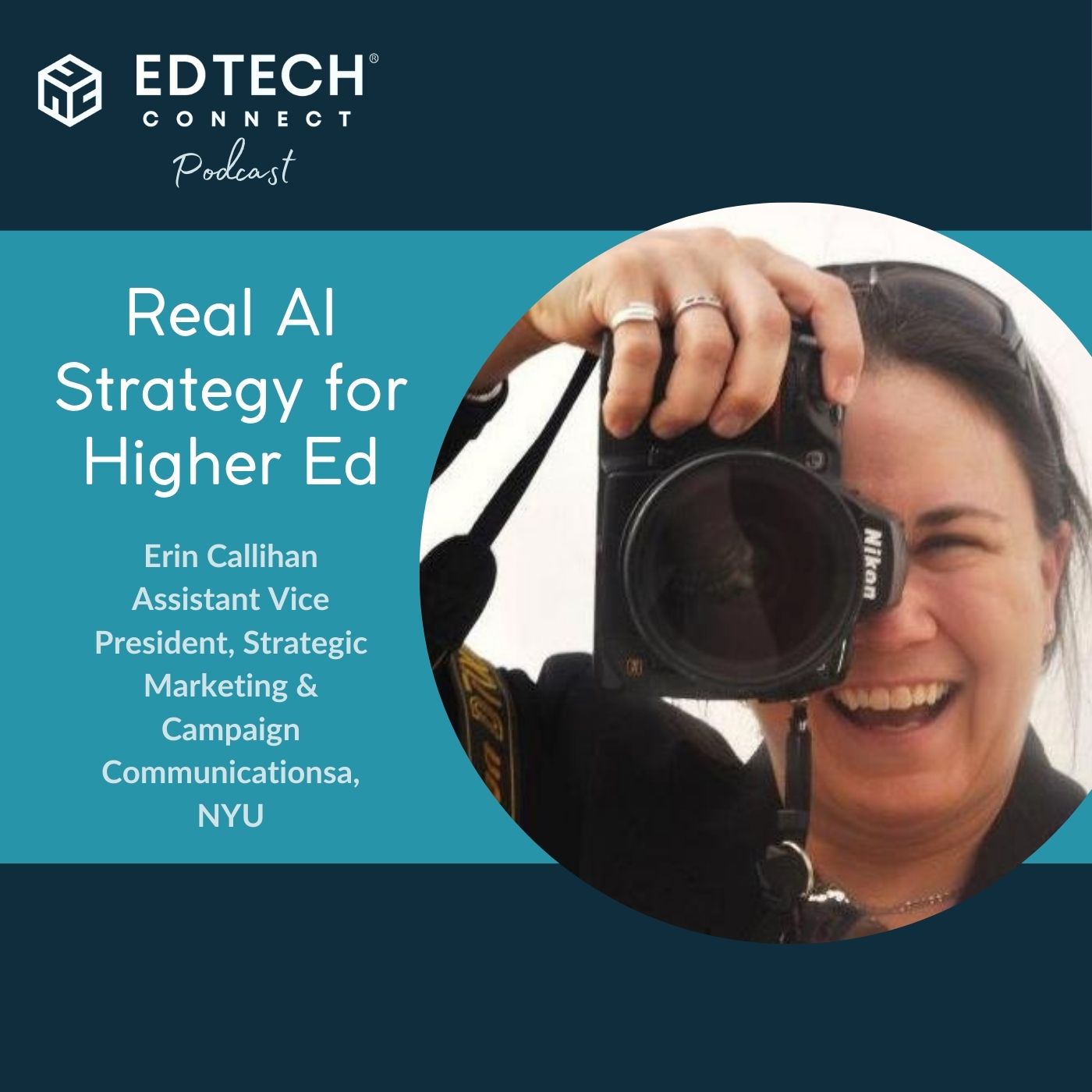
The Signal
NYU's Erin Callihan: Real AI Strategy for Higher Ed
00:31:29
This week on EdTech Connect, host Jeff Dillon sits down with Erin Callihan, AVP of Strategic Marketing at NYU and a powerhouse who blends law, design, and deep tech strategy. They dive into the ever-expanding AI toolbox that's reshaping how higher ed professionals work. Erin shares her latest favorite tools—from Google Gemini's surprising slide design capabilities and Napkin AI for instant data viz to Notebook LM's powerful research features. She gets practical about how AI is saving her team significant time on everything from analyzing survey data to identifying fonts from a screenshot. The conversation tackles the big questions: How do we maintain an authentic, human voice while scaling content with AI? What's the right pace for developing university-wide AI policy? And how can professionals in "high-risk" areas like advancement and fundraising get started safely? Tune in for a masterclass in practical AI adoption from one of higher ed's most creative and strategic minds. Key ...
Loading summary
Transcript44 lines
- [00:00]
A
You're going to be able to go out there soon and not know which one to choose, which is going to be a good problem to have. I also think a lot of these why this excited me with it rolling into one of these major foundation models is that it's just showing how complex and multimodal they're truly becoming. So not another standalone tool, but instead something sort of coming into an ethos that I already use every day.
- [00:26]
B
Welcome to another episode of the EdTech Connect podcast. Today's guest is someone who really has a knack for merging deep strategy with relentless creativity. Aaron callahan is the AVP of strategic marketing and campaign communications at NYU. With over 25 years of experience across global communications, student engagement, alumni relations and advancement, Erin has led award winning campaigns rather than recognized by Case, NASPA and the American Marketing Association. She's been a driving force behind NYU's push into Genai, delivering standout presentations at entities like Digital Collegium and asu, and building a playbook for how higher ed can actually work smarter with AI. Erin also has a law degree. She's a 3D designer and once coded NYU athletics website from scratch. Basically, if MacGyver and a TED speaker had a marketing savvy cousin in higher ed, it might be her. Welcome to the show, Aaron. It is great to have you today.
- [01:36]
A
Thanks, Jeff.
- [01:37]
B
So I want to start and just find out what is the most fun tool you've tried lately and what did you do with it?
- [01:44]
A
It's a loaded question. I feel like I'm having fun all the time. I have to say I'm using a lot of the old tools in new ways. A whole lot of things have sort of changed lately. I think big eye opener for me was about two weeks ago that now in Google Gemini you can go into canvas mode and it actually makes really nice slides. Who would have thought? So you know, that's kind of been a really nice thing. You can also make mind maps and other things within canvas that sometimes I'm kind of blown away. I think it's going to give me text and all of a sudden it starts designing something or hey, here's a mood board and it's kind of neat to see. I still use napkin all the time. It's literally one of those things that is a big surprise. And it's great on data visualization. It's a free tool. If people haven't used it or looked it up, I still feel like it's one of those things that hides.
- [02:32]
B
I love napkin. I've used that one For a few months now. So I saw your talk at Digital Collegium, which is why you're on here, because I'm like, I got to get Aaron on this podcast because it was such a great, practical presentation. It was the top tools AI needs to be using AI tools. And it was a couple months ago, it was great. One of the tools you mentioned, slides, and I want to mention one too that I've been using called Manus and it's really an agentic kind of tool and I think you mentioned it or it was in your list and it does great slides too. So there's Gamma, there's Manus and now Gemini. It's crazy how fast these tools are becoming really good at the slideware stuff.
- [03:08]
A
Well, and we know that the competition will be a good thing, right? I think Gamma has sort of cornered this market and has done some incredible, incredible things and they just been so effective at it for both designers and non designers that they still have an edge. But yeah, everybody's coming up with different, just different methodologies. You know, you're going to be able to go out there soon and not know which one to choose, which is going to be a good problem to have. I also think a lot of these, why this excited me with it rolling into one of these major foundation models is that it's just showing how complex and multimodal they're truly becoming. So not another standalone tool, but instead something sort of coming into an ethos that I already use every day.
- [03:47]
B
One way to look at this too, and that you've been good about, like showing this in your demos, like the Google Sheets AI, there's an AI function to Google Sheets everybody, which is incredible. But using the AI that's built into the tools we're already using, whether it's Google, even Notebook lm, I was using about a year ago when they came out with the podcast. Everyone's talking about the podcast feature. I've kind of not used that as much lately just because there's so many other tools. But when you showed me, I think there's so many other things now you can do with a Notebook lm. It's kind of incredible to just be revisit all the capabilities and some of.
- [04:22]
A
These changes were within the last four days, others were within the last month or two that you now have a video output. So in addition to the great audio output that you can do a summary. And for people who don't use NotebookLM a lot, it's great that it's grounded. It's one of these tools that it can now pull from the Internet, but a lot of times it's just pulling from the sources you give it. So. So it's I think a little bit more trusted in some atmospheres. It really is a powerful tool. Now you can connect your Google Drive, at least on the academic version. You can upload sheets now and it will parse your data and you can interact with your data like just a lot of power. You can now do deep research within NotebookLM. So all of a sudden you now have this one tool that was already powerful but like you, I used it a year ago, got away from it and wasn't really just wasn't something I went to. Now I think it's going to be one of those probably the top three that I can't not use. Yeah, there's a double negative for you.
- [05:18]
B
No, I agree. I'm trying to keep up. You're helping me keep up with the space. You mentioned some other tools like Whisper Flow which I'd heard about, but I've never been a big voice person but I've started testing that and I like that. What are some other sleepers that most people are overlooking out there?
- [05:33]
A
Yeah, there's one that I came across that's actually really interesting for people just I think across actually a lot of industries if I'm thinking about this. Monetyai it's a tool that allows you to go out and type into any URL, any website and it will track a part of that website or the entire page and it will alert you for any changes that happen. So if you're trying to look at competitor pricing, you could actually look at four different sites and they'll come right into your inbox. For me, I'm looking to use it for what news has changed. We have 14 schools at NYU and I need to keep track of all of them. Okay, so great. I want them to come to my inbox. I don't want to go every day and check and look. So yeah, there are other ways to do this, but this has just become sort of my latest. Let's see what happens here. But it is powerful tool and it also can connect to your own pages and make edits as well. So it's an interesting one. Other standalones, I think that's really a big one right now. I told you. Napkin AI and for those who aren't using that, that is just a great data visualization. You can put any text you want in and it will create just beautiful charts, graphics, animations, anything that you need you can just do. And there is zero design skill required and you can export them into PNGs transparent backgrounds. So you can just throw them into anything you need. So to me, that's still one of the ones that just has a lot of power, right?
- [06:57]
B
I remember watching you, you kind of Intro to Perplexities Comment Agentic browser and we were just talking about this before the show. The gap I have between recording this podcast and it going live, I'm like, oh my gosh, what's going to happen? Like, how can we keep up with this? Have you discovered anything with these agentic browsers that might be useful for higher ed people?
- [07:18]
A
I've discovered lots of neat things. I am still trying to figure out where I feel about the security. So nothing that I would really tell folks right now, hey, go do this and connect your work calendar and your work documents. But if you want to play around with a personal like my newsletters, go to my personal drive, right? And I have an email account that's just those. So what I have been able to do is tell Comet like, hey, I want you to go out, I want you to look in my inbox and I want you to look for these five newsletters and I just give it the title. I don't even give it anything else. And I want you to return back to me a chart that only lists the tools that are mentioned in that newsletter. I want you to keep the URL out to them and I want you to give me a brief description of the tool and the date of the newsletter and which newsletter. So five or six columns and it can go out and do that work. And it is astounding. You know, sometimes we're having it breaks, but I've had that work so many times now that I can just see this in the future as being something that's automated that instead of reading these newsletters, sorry for everybody who puts so much time and effort into them. For some of the things like the big news or tools, being able to extract from seven or eight newsletters at once right now, as fast as things are going has been incredibly powerful. Then I can go into those editions of the newsletters and read more.
- [08:37]
B
Yeah, yeah. What are some examples where AI has saved your team significant time or uncovered insights where you otherwise maybe wouldn't have found that.
- [08:51]
A
I can think of so many survey data is a big one, right? Or just anytime that we have qualitative data, it has saved a ton of time. Because, you know, I used to early on I was uploading this into chatgpt or Gemini and just interacting and asking it, what was the percentage of, you know, seniors versus juniors, freshmen, sophomores who took this survey? What however you want to do it. And it was good. Now right within Google Sheets I can go ahead and ask those questions and it's right there on the panel and it's much, much better. I'm lucky that the industry that I work in, we're not dealing with financials, we're not dealing, you know, I. Not within AI. Right. So the things that we're using are a little bit lower risk. I am fully aware of that. But the survey data and being able to analyze sentiments when you can be off plus one or three points this way or the other way, it is just incredibly time saving and it's allowed us to have insights going into meetings that we never would have bothered honestly to look for. The other big win I had this week, which sounds ridiculously, it's just, it still makes me chuckle. Obviously NYU is a very established brand and for the most part when I'm designing something, I'm designing on brand. We are doing some collaborations with other partnerships and I wanted to work their fonts into our designs. And of course typical Aaron Fashion, you know, it's 2:00am on a, on a Tuesday night. Right. I'm not writing them to ask what the font is and picking this up in the morning. And I just screenshot some of their work and put it into ChatGPT and said, hey, what's this font? And it's like, here are the options. And it, it was incredibly accurate, but it just silly things. Anytime I put a flattened, you know, screenshot into anything and it can read and parse that information, I'm still, I'm still just kind of blown away.
- [10:32]
B
Yeah. One thing I've used that I've told some people about is I'm decent with Excel formulas or Google Sheets formulas, but I'm still leaning towards AI tools now to do some of that work. If you're really good at formulas, it's probably not going to help you a whole lot. But for people who struggle with Excel formulas, just ask, put your spreadsheets up and give it a prompt and it will parse your spreadsheets and combine them or whatever.
- [10:55]
A
Absolutely. And I think one of you know, I hate to call them this, but like the gateway drugs of getting people to use AI, one of them is these technical things. Right. So I can never remember how to split text from columns. Right. Okay. I can never remember how to build a drop down button. Just whatever it Is it just will not settle in my head. But yeah, so I started doing that earlier, kind of asking and then going in now you can do it kind of directly within there. But other things like if I have a glitch, I am asking one of these foundation models like how do I change my password on this? Or where can I find my account information that's buried because you know, Netflix, Disney, whoever does not want me to find it, like figuring out how to do those things. It is really funny, but it's really one of the top things that I have found with people who have been sort of anti AI and then getting in and seeing sort of that real world things you wouldn't find on Google without then clicking into 7, 8, 9, 10 links to hope you found that right service thing that somebody put the right thing in there. So that's another way that we've been having fun.
- [11:59]
B
Yeah, love that. And now a word from our sponsor.
- [12:06]
A
How can your next campaign soar?
- [12:10]
B
With experience helping colleges and universities raise.
- [12:13]
A
Billions of dollars, Mackie Strategies delivers communications, fundraising and tech expertise that your campaign can take to the bank. Mackie Strategies build your breakthrough.
- [12:29]
B
Well, let's talk a little bit about advancement. That's a world you live in. What tools have you found or what do you think advancement and fundraising can be using? What's the first step in using AI to help in those areas?
- [12:43]
A
Honestly, the first step is just getting started because it's sort of like banking. So I just said I was using it with low risk scenarios with fundraising. So advancement. We have both the alumni relations side of the house and we have fundraising and two very just different areas and different risks involved. For us, having one tool that we can educate on is going to save us just a ton of time. So we are close to committing with one tool. We're a Gemini school. So that will allow us to actually train folks on the same thing and get going. So to other advancement shops. It's really. It is get going. When I talk to my colleagues, they've heard from their leadership. We can't do that. It's too risky. What if our donors names and fundraising information gets out into these systems and you hear that across higher ed with FERPA and hipaa, all of these regulations that make great sense, but there are ways to use this information and use these tools without jeopardizing that. So I think the second piece of that is looking at your data now and making sure that it's as clean as possible when you export things into, you know, a spreadsheet can you easily replace somebody's name with a unique identifier? If you are going to go ahead and put this information in through an LLM and that way you avoid that risk? Again, we're being told that there shouldn't be risk there in many, many ways, but we don't know that for sure. So I think those are the two things that I would say is first, get started. Pick one tool and start using it. If leadership is, I'm very, very fortunate. Our leadership has been on board, has been really just above and beyond in supporting us in supporting my colleagues and getting used to using these AI tools in our work. But if you have leadership, that's not even getting them to just use the tool in their personal life is a big deal. You know, telling somebody to talk and say, hey, my daughter's having her 16th birthday party. She likes this, this and this. It's going to be Saturday, this date in Brooklyn, New York. What should I do? All of a sudden they'll start to see value. You know, using voice mode and video mode on ChatGPT and holding it up. I had one of those electric doors where you have to type the code in and for the life of me could not get the batteries out of this thing. It ended up being rust. I was not that big of an ID but could not figure it out. But, you know, I'm holding it up and saying like, hey, how do I do this? And it's like, yeah, take the screwdriver. Like it can blow your mind when you first do that. But these real world situations of what should I have for dinner tonight? I'm in this neighborhood, you know, New York, that's a big one. So I think getting people comfortable in their own life, they then can sit down with work and find those lower risk situations and start to build their way up to trust. And hopefully you have folks across around you who are sharing the work they're doing. I think we went through a culture maybe six months ago where the people who were using these tools didn't want anybody else to know because you still had that sort of, am I cheating? Am I not cheating? Well, I'm doing my work a lot faster. How does that reflect or past that? And I think I want my team to be able to save as much time as I do. And I think that's the general consensus with most of the folks who are really passionate about the AI work and what it can do for our lives. So I think just also sharing those positive things with people who do similar.
- [15:57]
B
Work goes a Long way as our efficiency rises. I think the expectations are rising too. You've built campaigns that not only turn heads, but win case awards. So clearly creativity is one of your superpowers. I'm curious, where does AI fit into that? Is it sparking new ideas, streamlining processes, maybe challenging how you think about storytelling in higher ed?
- [16:22]
A
It's really hard to discern where I'm not using it these days. I'm thinking back through a few of those. Creating microsites is a place where I sort of a one person shop in that sense when I'm designing something like that, just because I'm the only one who's using that tool. And I will often take screenshots and spit them back in and say like, hey, is this working? And just kind of testing out the UX and the UI with a partner, you know what I mean? It is not a human, but it is a partner through and through. Even color contrast, being able to take a snapshot and put it in and say, does this hit, you know, WCHA standards for higher ed? And it can spit back immediately, oh, it looks like you're using hex this and hex that. It's like, okay, I used to take that into Photoshop, you know, eyedrop, put that out. Like it's those sort of tools that kind of go through the creative process. As far as the brainstorming, I think we're using it quite a bit up front and I'm even thinking about social media campaigns as well as larger things of we know holidays come around every year, so what is that evergreen content that we know we're going to do next fall? Being able to use AI and have some team members go out and Brainstorm it with ChatGPT or with Gemini right away, come into a meeting with some ideas has saved a lot of time. I think people who may not have seen themselves as creative before really now have a level playing field and the ones who really maybe thought outside of the box really are bringing it and then dialing it back down like of, okay, we need this for social for three different platforms. Okay. You know, put great information in and you're getting things spit back out in record time. And that's really, really helpful when you're trying to do things across different channels.
- [18:03]
B
Yeah, agreed. One thing I think higher ed does really well is speak with heart. Whether it's a recruitment campaign or appealing to donors, I think that authentic voice matters. But now with AI helping scale content across channels, I think the question is how do we keep that voice sounding Real and human and not robotic.
- [18:27]
A
Yeah.
- [18:27]
B
What are you seeing that works?
- [18:29]
A
I mean, and this is particularly true with what we're doing, trying to tell a fundraiser to automate their work. Relationships are everything, right? I mean, that is what we're built on. I do think it's sort of. I've heard it called a lot of different things. I kind of call it the human 20 or bookends that the front end really teaching that model, whatever you're using, who you are, how you speak. So if that's a custom GPT that you're taking your information, you're putting things like your style guide in just so that it understands how to write like you. But then you're writing sort of a manifesto of these are the things I believe in. Here's our mission, vision, values. Here's examples of great things that we've written that we're passionate about. Here are our priorities for the year. All of the things that you would want a new employee to understand so that they could wrap themselves up in context. Giving that to a system is the only way for it to possibly be close to delivering something that sounds and feels like you want it to feel. So I think the front end of really giving it that audience Personas are a big deal. Make them and, you know, just kind of upload them and say, hey, we're talking to seniors this time. So only look at that Persona and it spits it out. But then that 20% on the back end is really where I think it's critical. That's a human, period, full stop. That is a human. It's very, very interesting right now. As these tools become better and better and closer and closer, I think it's easier to become lazier and lazier. And I think it's close enough, it's authentic enough, it's accurate enough. I'm feeling it, I'm seeing it. Right? And it's because people are busy. It's not mal intentioned, but when something's wrong, it's wrong. When something's a B plus, I'll take a B a day. It's been a hell of a day, right? That's the piece where I think we need a human. So right now, if we draft social media content and we have two people who are then looking at that content before it's posted, let's take one of them off of that, let it draft and let's put both of them on the back end, right? So I think it's really at the beginning of that conception and working with the Tool. Then let the tool do its thing and then come in at the end and make sure that you're putting this out. It's on you. It's literally. This is your signature on this. Right. And that's why I say to my folks all the time is, yeah, if you wouldn't put it out as yours, stop. Like just stop. And again, it's powerful. So it's hard not to just give in.
- [20:52]
B
I know. I think it's going to self regulate in a way because the competition's just. The level of work is just rising and, you know, we can churn out so much. We have to focus on the quality and let's say, authentic voice. Agreed. You have this rare combination of a law degree and a design background. Most people pick one lane and stick to it, but you're bridging both. How do those worlds come together in your work with AI and strategy today?
- [21:20]
A
Hey, listen, you only get one life. Have fun with it. My background's journalism. Then I did my master's so many years ago in design that why not get a law degree? The law piece is really interesting because it's taking massive amounts of information and distilling it down to one accurate, truthful sentiment. That's it. And you're doing that by looking at sources that are either authoritative or like the Constitution or federal laws or statutes, state laws, depending where you're at, that are gospel. And then there's persuasive sources. Persuasive sources are the things that are the heartstrings. So maybe this is if we're dealing with drunk driving, maybe this is a report that was written by Mothers Against Drunk Driving and it has stats in it and you want to quote it because of its influence and its heartstrings. Those persuasive sources in that case can be just as important as, you know, the law. I say this because when I'm playing with ChatGPT and things, I always want to know where it's sourced because I still think there's a place for your top level. And then there's. It's now picking up things that I never would have found. And I'm trying to not look at that as a bad thing. But you need to know. You need to know what you're using and when because it very much impacts the accuracy of what you're stating. From the design standpoint, you can't do a design until you ask a ton of questions or you can't do a design. Well. Right. It's always, who's the Audience, when is this event? Who's putting it on? Have we done this before? Has it worked in the past? Why do you want a video? All of those questions you ask from the beginning so that you have all that information. I found that prompting became just very natural for me because I give it all of the things I need to know as a designer and all of the things I tell somebody they're designing for me or I want them to tell me if I'm designing for them. So those are sort of the two big buckets, I think. And honestly, I feel very, very lucky that I have both sides of my brain. My mom was an English teacher and my dad was an engineer. So I feel lucky to have those things and lucky that I had the opportunity to do both. But it's interesting, they both impact sort of how I interact with technology.
- [23:24]
B
Yeah, I think that might be the ticket, is those people who have both sides can ramp up so fast with this because it's like, how can I ask the right question? And I find it pretty easy, too, to get what I want out of. Out of AI. You know, every campus is kind of buzzing about AI right now, but policy is really where things get real. How, how. Have you seen universities move? Sometimes it's strategic, sometimes it's glacial.
- [23:48]
A
Yep.
- [23:48]
B
What's your take on AI policy development across higher ed? Are we moving fast enough or is or is sprinting ahead kind of the rulebook?
- [23:58]
A
If you are thinking about guidelines or drafting guidelines, you are going exactly the right speed. If you are not, there's a problem. But how I feel about this, you know, NYU is the world's largest private institution. Right. We have 60,000 students. We have 14 or 19,000 faculty and administrators. We're not going to get another chance to do this. So you have students who were told. If you look at the ages of our students and when ChatGPT hit the scene in 2022, like just over three years ago, you look at that and you say they were told this was bad right away, this was wrong. It's not something you should use. It's cheating. We have to re correct that you have faculty members. We have 270 majors at NYU. So if you have a law faculty member and you're trying to tell them that this is a good thing, they want to know, what's the privacy, what's the data, what's the ethics? If you have a scientist who's looking at this, is it 100% right all the time or is it not? You can kind of go through this an anthropologist is going to look at this, of how is this changing us? Like, how is this different than the revolutions? All of those folks need to be on board for this to work. So policies is a tough term for me. I think policies are don't share your data. Right. Like those very, very high level. But past that, I really think it's guidance. I think it's showing people good use cases and bad use cases. It's going into specific tools. It's easier when you have one product because again, you know, whether you trust Google or you know, Anthropic or whoever it is with your data, and whether you have those data policies signed, sealed and delivered across the university, then it's easier to encourage people to go in and play. Right. But so I think it isn't a one size fits all. I certainly was frustrated a year ago that people weren't moving on this fast enough, but. But I think if you back up and look at again, the need to get this right the first time, that you're going the right speed if you're already in it and doing it, those who aren't in trouble.
- [25:59]
B
And there's so many places in higher ed we need to think about this. I know, you know, there's the administrative side, there's the classroom. And from the classroom perspective, I think my basic view of this is that if we don't do something, it trickles down to that faculty member. So every faculty member has their own opinion about how they're going to monitor or how they're going to regulate AI in their classroom. And that's not fair to the student, I don't think, to have it different. So at the very least have some guidelines.
- [26:27]
A
It's not fair to the faculty member either. Our team here has done, I think, a phenomenal job. And I remember being in a meeting, it was probably December 1 or December 2, 2022, a work group on basically, where is this heading? What does this mean for higher ed? And our people in the teaching and learning space really have done a tremendous job of listening to faculty, sitting down with them. You can't fix something. You can't basically litigate something unless you've actually heard what the issues are and tried to solve for them. You can't give everybody what they want, but at least if you know what you're dealing with, then you can make an informed decision. And I think our team's done that very, very well over the years and as well as the group education, because once you get a core group of faculty who believe in this, it's a lot easier for a faculty member to influence another faculty member or a dean than it is for somebody from the outside. I couldn't possibly understand what they do in their day to day in the classroom. I know it's incredibly important and we don't have a job without it. But I can't be the one to tell them how to do their job. I can only be the one to listen and hope that they have the tools that are going to let them be even more effective.
- [27:38]
B
Right? Yes, I agree. Totally agree. We have to empower them. So AI is having its moment. And with that comes plenty of myths, fears, call them, I'll call them creative interpretations of what it can really do. From your vantage point, what's one AI myth or misunderstanding you think you wish more people would finally let go of?
- [27:58]
A
I think the general one, and this is as much in my personal life as it is in my professional life, is this is just a fad. You know, I don't have to worry about this. It doesn't mean anything to me. And I'm just. People are now starting to see the reports about the economy. They're starting to see these major companies laying folks off. They're starting to see AI being integrated in everything that's being done. It's not going anywhere. Now, do you need to use these tools every day in your life? You don't need to jump into ChatGPT right now and use them, but you're going to be using AI as you have been with your iPhone, right? For how many years now You've been using AI without maybe recognizing it. But these tools are, they're fast and they're powerful and they're moving quickly. And I think I want everybody in my life to just have the understanding of what they can and can't do. They can then make a decision. But I want them to understand that these are available because I think there's going to be a great divide that's going to cause even more conflict. And these items are also going to become very political with us midterm elections coming up. It's going to impact every single thing. And if you don't even know what the tool is or think, it's just going to go away. You're not going to be informed in all of those other areas of civil society. I also think the second piece is work wise. When somebody says, I can't use that. My job uses secure data, this, that or the other thing you can. And it probably can help you think about the things that are low risk. Right. Like to me everything is divided into the lower risk and the high risk. Yes. Stay away from that stuff. You don't want to lose your job, you don't want to do something stupid. But those lower risk, you can save yourself a lot of time.
- [29:33]
B
Right? Right. Well, to wrap it up, if you could give every higher ed professional one AI superpower, what would it be and why?
- [29:40]
A
I don't know if it's an AI superpower, but it's a pause button. I think since COVID we've come out of here a little bit, maybe under resourced, overwhelmed. Never seems like there's enough time in the day and I'm sure that's true in lots of professions. But acutely, this nine month cycle that we have, really everything is tucked up into those nine months. It would be awesome to have more time today. I remember every single tool that came out. Right. Like every time a tool came out, I used to be able to play with it, like web development. Be like, oh, I'm going to go over here and play for six hours and figure out what I can do with it. Now there's a new tool every six minutes. Right. So, you know, I have to actually think through where do I spend my time. And I wish we could just give everybody more time in the day. The most valuable commodity that we have. Right. So yeah, a pause button. If you find it, let me know.
- [30:25]
B
I don't know how you keep up with it, but that's a great one. I haven't had that one before, but more time, let's work on that one. Well, thanks for being on the show. I will put links to your LinkedIn and your NYU website on in the show notes. And great having you, Aaron. Bye bye.
- [30:40]
A
Always fun, Jeff. Thanks again.
- [30:42]
B
We wrap up this episode. Remember, EdTech Connect is your trusted companion on your journey to enhance education through technology. Whether you're looking to spark student engagement, refine edtech implementation strategies, or stay ahead of the curve in emerging technologies, EdTech Connect brings you the insights you need. Be sure to subscribe on your favorite podcast platform so you never miss an inspiring and informative episode. And while you're there, please leave us a review. Your feedback fuels us to keep bringing you valuable content. For even more resources and connections, head over to edtechconnect.com your hub for edtech reviews, trends and solutions. Until next time, thanks for tuning in.