← The Signal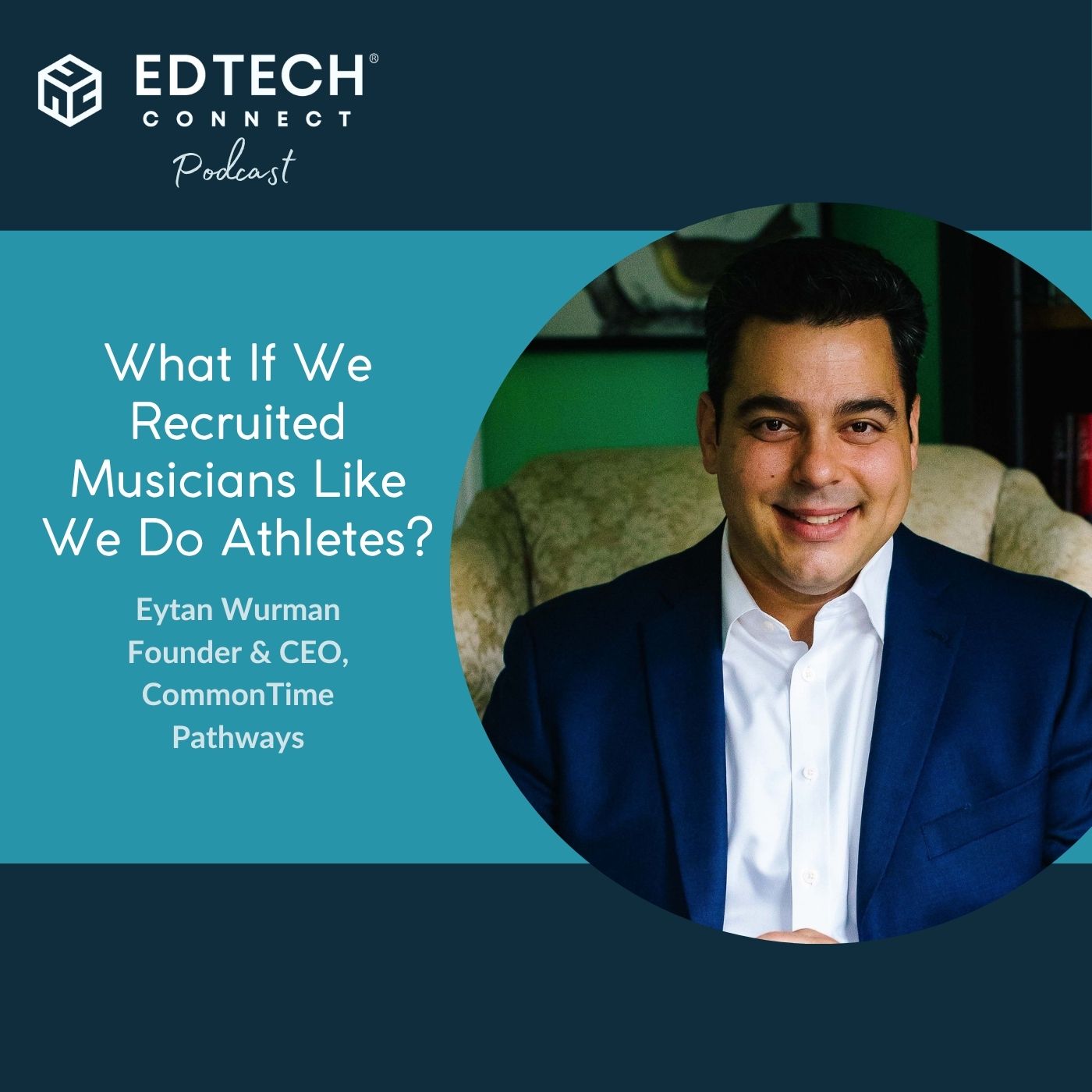
The Signal
What If We Recruited Musicians Like We Do Athletes?
00:33:27
In this episode of EdTech Connect, host Jeff Dillon sits down with Eytan Wurman, founder of Common Time Pathways, to explore the untapped potential of music in college admissions. A former music teacher turned entrepreneur, Eytan reveals how his platform is bridging the gap between student musicians and $5 billion in overlooked scholarships—more than athletic scholarships combined. From debunking myths about music careers (“You don’t have to be Yo-Yo Ma to succeed”) to leveraging AI for music education (without replacing human artistry), Eytan shares how Common Time Pathways is creating athlete-style recruitment pipelines for musicians. Discover why colleges are prioritizing students who retain music as part of their identity, how harmonic resonance connects cultures, and why the future of education needs more creativity—not less—in an AI-dominated world. Music Scholarships Outpace Athletics Over $5B in performing arts scholarships are awarded annually—more than D1/D2 athletic sc...
Loading summary
Transcript80 lines
- [00:00]
A
The real vision and the real mission, the real success point is that there are more musicians than ever retaining music as a part of their identity. Once they leave the house. Once they leave your house. There's so much to be said for being a musician. When you are independently identifying yourself as a young adult. When you're 18, 19, 20, in those extraordinarily formative years, when you're a new, free, emancipated adult, do you make the choice to continue music? That is an enormously valuable moment and I'd rather that instead of 50 or 60,000 students every year choosing that path, that musical journey, and rather it was 5 or 600,000 just in the US.
- [01:01]
B
Welcome to the EdTech Connect podcast, where we cover the entire spectrum of higher education software. Today I have a unique guest and we're talking about a topic I haven't had on the show. Music. Eitan Wurman is a musician, educator and entrepreneur dedicated to transforming how student artists are seen in higher education. With over a decade of experience as a music director in the greater Boston area and leadership roles in the arts community, Eitan founded Common Time Pathways to challenge the traditional admissions model and elevate musicians roles in the recruitment process. A fluent Hebrew speaker and classically trained musician, he holds multiple degrees from Boston University and and Gordon College in music and educational leadership. Through CT Pathways, Eitan is connecting student talent with institutions that recognize the value of creative expression. Whether he's behind a piano or leading strategic change, his mission is the same. Make space for art to thrive where decisions are made. Welcome to the show. Eta. I'm so happy to finally have you.
- [02:15]
A
Thanks, Jeff. It's really great to hang out.
- [02:17]
B
So let's start off and tell me you have this great music background. Like, what inspired you? Tell me the story to launch Common Time Pathways. What gap are you aiming to fill in this college admissions world?
- [02:32]
A
There's a lot. So I was a musician growing up, and I definitely was also an athlete in a few ways, but never quite with the same intensity that I was a music kid. And I found that I wanted to be a music teacher growing up, which is where I ended up. I was a music teacher in the Boston and Cambridge area for probably 12, 13 years before I realized that I needed to figure out how to have a larger impact in a problem no one was talking about, because Everybody's talking about K12 education and what are the problems there. And then everyone talks about a college education and why it's important there. But from a musical lens, it seemed to me like no One was talking to my kids about why it was important to go to college and stay musical. And it's not that the music teachers out there aren't screaming into the void. Everyone's saying, don't stop playing when you go to college. But there's no usually economic reason that is espoused to them that they should do so. And so it became a problem that I had to face when I got called out by a student of mine who said to me, hey, Mr. Wurman, I played the French horn for seven years like you told me. How do I get that scholarship you said I would get when I was back in sixth grade? And I just went, gee, I don't know.
- [03:51]
B
Easier said than done. Tell them just go get a scholarship.
- [03:54]
A
Just, I don't know, like, just you figure it out. And I felt like I was a fraud in that moment. And I figured there's got to be a way to do this. And the athletes have such easy and accessible ways to get help with regards to college recruiting and application and admission, preferential admission, which is really something that doesn't exist very much for musicians. But that's actually what I thought. And it turns out it's a myth. Music scholarships actually exist in higher volume and in higher numbers in athletic scholarships, which is a shocking thing to find out.
- [04:25]
B
I did not know that.
- [04:26]
A
Well, that's the thing is that the NCAA restricts the way in which scholarships and the amounts of scholarships that are allowed to be given to D1 and D2 schools, which still huge. I mean, last year, $3 billion were handed out to D1 and D2 athletes. But performing arts scholarships are estimated to have topped $5 billion. Because they can engage third parties, they can engage foundation giving, they can have access to institutional funds that are completely from different pools of money that's not associated with the athletics department and regulated by the ncaa. And so it's very interesting. I said, hey, this is a problem that we can solve, because it's more mostly a culture issue. It's mostly a way we talk about music as just something nice. And so it's a completely different kind of methodology here, which just really copying all of the things that are happening in the athletics world. But instead of you as a musician now having to find those scholarships by going to an expensive summer camp or getting into a highly competitive all state festival, now you can meet colleges and recruiters in the same way that the athletes do and get access to all of that.
- [05:33]
B
Can you talk a little bit more about the misconceptions about music Students or programs that you're trying to change?
- [05:40]
A
Oh, yeah. I mean, this is a cultural issue.
- [05:42]
B
I love the athletic one. It clicks in my mind.
- [05:44]
A
You know, it clicks in a lot of people's mind. I mean, I have a three and a half year old son, and he signed up for Mini Kickers soccer, Right. And when he did that, I mean, it's adorable. They're practically falling over the soccer ball as much as they're actively kicking it. And we signed up for the app to contact the families and the coach about rain delays and cancellations and field assignments and things like that. And the very first push notification we got on that athletics community group app was, ncsa, want to play sports in college? Click here to sign up now. And I'm thinking to myself, my kid's three and a half. You guys are 17 years in advance. But I took a screenshot and I sent it to my team and I said, guys, we have to start earlier. It's all about communication. And especially in today's absolutely insane input world of you're hearing left and right from things 200 times a day, especially as we scroll through social media, instead of the five or six times that it used to take for someone to recognize what your brand is and what you do and to think about you when they might need you, it's now like 20 times that someone needs to hear about you before. When it's time, they might actually think about you. And so that kind of culture shift, that narrative shift as soon as you're five years old. Most of these athletics programs have already tracked you into you're going to be an Olympian or you're not, and that's horrifying. First of all, I mean, I think there's something to be said for an educational value, which just as a growth in human development kind of energy, which is really important for us as parents and as adults, to try and make sure that our kids can love learning things that they're not going to be professionals at. I think that's hugely valuable as an individual to learn how to be bad at something, but learn how to be a little bit better and be okay with that skill. But now it's about shifting music from being something that's just nice for human development and just something nice that is good for a kid's education and upbringing and turning it into an economic machine which can actually help you pay for college.
- [07:45]
B
Eitan, is it a different story in other cultures, like in Japan or other society, international schools? I'm just guessing.
- [07:55]
A
I'd think yeah, that's a really cool question. I didn't expect that question today, and I like it a lot because I've actually already started talking with the International Society for Music education, which comprises 5, 6 consonants worth of music teachers and their discussions over, what is music? How does it establish itself in the public education sphere? And what many of them have not really started talking about is what does that pipeline look like when they were approaching post secondary education? And now there is a lot of conversation that's starting. And next year, hopefully at the World Conference in Montreal, I'm hoping Common Time Pathways will actually be leading a panel discussion with educators and researchers from across the world who are going to address this idea of how do we define our own pipelines for music education leading into post secondary education? And here's the most interesting thing. At what point does Westernized classical music stop being the only thing that we think about when we think about conservatory study, which is a whole different situation?
- [09:04]
B
Wow. Well, I'm excited to hear how that goes. Like, great to hear.
- [09:07]
A
I got to tell you, there's the dissertation and a half right there that I could go into with you, but, man, it's cool.
- [09:12]
B
Let's jump into what I always end up talking about in this podcast is AI.
- [09:16]
A
Sure.
- [09:17]
B
In this world dominated by AI, why is music the key to more human society?
- [09:24]
A
Oh, man. One of my favorite people in the world said in a podcast not too long ago that in the 80s, the drum machines were going to take over. We still have live drummers at shows. Right. And that's the thing, is that there is only so much that even generative AI can do for music. There's a human element which exists, which is not just. And this is the weird thing, like, if I hear a computer or an AI machine playing Beethoven's Moonlight Sonata, I do not have the same emotional reaction that I do when I hear a human's energy and force of being put into those notes and phrases. There's something that's not just about the pattern of harmonic resonance. Harmonic resonance in and of itself is an enormously wonderful tool to connect human beings. I mean, that's part of my religion, is the belief that musical harmonic structures are the reasons that biochemically we are a human race and that we talk to one another. But that's, again, another dissertation.
- [10:31]
B
When we stop going to concerts, maybe we need to worry. But I'm seeing, like, people still love going to concerts.
- [10:37]
A
Like, absolutely people still love going to concerts. And here's the really beautiful thing is that at a certain Point. The artistry comes from a human being. So when you go to Coachella and you see these absolutely incredible light shows and these absolutely incredible sculpture art shows, these things are intended to wow and impress and amaze you. And a huge amount of it is technologically incorporated and designed very graphically and thoughtfully in that way. But it's intended to elicit a humanly emotional response and open your mind to hearing new music, hearing new things, and experiencing new things to experience. But all of that comes from the brain of a human. It comes from a person who said, I think this is the aesthetic we're looking for here. And this is what's going to open people's minds to this music.
- [11:25]
B
And I think you're timing it just right. With AI, people are craving that connection. So, yeah, I think it'd be more important than ever. And now a word from our sponsor.
- [11:38]
A
Where can you find a consultant who knows your challenges, really? With decades of campus executive experience, the Mackey Strategies senior team provides interim leadership, presidential and vice presidential counsel, crisis communications, and technology guidance built on real world success. Mackie Strategies expertise when it matters most.
- [12:04]
B
What is it about music that makes people. People call it an international language. Is there something deeper?
- [12:09]
A
Oh, boy. Well, so I think that's where we were really kind of diving into the concept of harmonic resonance. It doesn't matter where you grew up or in what economic conditions you were growing up or what language you speak at home. When you hear that piece of music, it makes everyone feel the same way. There are some musics that hyper engage cultural tropes that allow different musics to have a more culturally tribalistic impact on the people who are listening to it. But generally speaking, there's something biochemical that happens in our brains and in our communities when we hear a certain energy put into the universe specifically by a human being that is a piece of music now. And that's why I'm a fan of classical music, because you can say that the music of Taylor Swift is universally understandable, but there's something about even the first movement of, as I mentioned, Beethoven's first. You know, the first movement of Beethoven's Moonlight Sonata, where it doesn't matter if you grew up in a village in aboriginal Australia or New Zealand, or if you grew up as a member of the royal family in Denmark, you have the same emotional connection to that music the first time you hear it. And there's something really extraordinary about that. There's an author that I tell everyone about. His name is Stefan Alexander. I swear to God, he's not paying me to say this. He's phenomenal and he is a theoretical physicist and jazz saxophonist. And his entire postulation is that he can mathematically explain the superstructures that govern the universe in the harmonic resonance frequencies that govern the physics around us. The idea that when you have a plate of sand and you vibrate it at a certain frequency, it actually creates geometric patterns within the, the waves of sound. It's just, that's my religion. And it's really cool just to think that I. It. I don't think it matters what you believe so much as that you can feel.
- [14:12]
B
That's. That might be our sound bite for the show. I love that. Well, let's get to reality here. Like.
- [14:20]
A
Yeah, let's bring it down.
- [14:21]
B
So hard to be a professional musician. Why would anyone want to be a professional musician? Isn't it nearly impossible?
- [14:28]
A
That's also a huge myth, right? And that's the interesting thing is there's 10,000 hours of mastery, right? We've all learned that. We've all heard that as adults. We've heard if you spend 10,000 hours doing anything, you are going to be a master at it. And here's the really beautiful thing. College is a place where you get to cut your teeth. If you're going to be a med student. You spend your 10,000 hours, probably 15 or 20,000 hours over several years, cutting your teeth and becoming a master at something. The same thing happens when you're an economist. The same thing happens when you're a lawyer. The same thing happens when you're a teacher. I mean, I was a public school music teacher. I'll tell you, the first five years I was a teacher, I was not a master at my craft. It took five years for me to understand what it was to be a really good teacher. And at that point, I wish I could have apologized. The first class of students I ever had. If only I had known the things that I'd known after 10,000 hours of teaching. And so that's the really beautiful and valuable part of 10,000 hours of mastery. But going back to the question, is it nearly impossible to have a career in music? Absolutely not. It's just like everything else, difficult. If you're willing to spend 10,000 hours learning to master your craft and then learning how to run your life like a mini business, 10,000 hours will mean you can be a successful musician. And for every Taylor Swift out there, for every Yo Yo Ma or Joshua Bell or Yujia Wang in the classical world, there are thousands of working, performing, teaching, traveling, Musicians who have bigger houses than mine because they have decent income, they have a portfolio of things that they do to sustain their families. And they're doing extremely well doing it. It's all about those 10,000 hours. And so if my kid decides he wants to be an astronaut, great. If my kid decides he wants to play French horn for the San Francisco Symphony, great. 10,000 hours is where you start to be considered a master. The next 10,000 after that is what makes you really good.
- [16:32]
B
So did that 10,000 at the Malcolm.
- [16:33]
A
Gladwell, I think I can't quite remember where.
- [16:37]
B
That's different disciplines. In a personal story, I've seen this. My sister is a professional violinist, and I can't remember when she started, but it was really young. I think it was before high school, but I saw her go through college. She's always focused on being a professional violinist. And now she's doing it. She's done it. She teaches when the concert seasons aren't here, but during the holidays. And she's always doing her gigs, and that's what she does. And she's not even at a university anymore where she has to go in. It's just all private, plus these concerts. It's really cool.
- [17:06]
A
And she's making a good living doing it. She's making a very good living doing it. And that's the great, really beautiful thing. If you want to be an accountant, you can, but you're not a master until you've done it for five, six, seven years. So going and expecting a musician to be professional when they're 18 is like asking somebody to be Tom Brady when they enroll in college. And the idea that you're not good enough as a high school student to go to Juilliard is like saying you shouldn't be a professional athlete because you can't get in at first string to be quarterback in Notre Dame. That's not the way it is.
- [17:40]
B
So why is it that athletic recruiting is the most prevalent form of recruiting for college? And how do we change that? Is it budget?
- [17:47]
A
I don't think we need to change necessarily that. Athletics is a very strong recruiting and preferential admission system. I think it's wonderful. Art and music and athletics are the way that we identify culturally as who we are. Classical music, I believe, has a deeper and wider connection internationally and amongst different cultures. But our music and our culture and our sports, very much part of that culture, are what define us as who we are, as our community, as our tribalistic sense of self. We compare ourselves to other countries through our art. We Compare ourselves to other countries through our sport. Need I prove myself if the Olympics even exists? The idea is that all of this, all of these cultural things, these things that tie us together and give us a sense of self belonging and worth are things that colleges need to be focusing on for recruitment purposes and student cultural life as they go through. Because everyone talks about college burnout, Everyone, everyone talks about increasing dropout rates amongst college students. And everyone thinks that it's a mental health issue and it absolutely is. But instead of trying to support with mental health supports how to not burn out, by the time they need that service, there's already a problem. The students who came back right after Covid were musicians. They were the ones who felt that the community, that they were a part of their ensemble was a way that they identified as who they are themselves. And so when the universities opened back up, the marching bands came back, the orchestras came back and the choirs came back faster and in greater numbers than anyone else because they could identify as themselves again. And they could then associate that identification with a strong specific and positive experience at their university.
- [19:45]
B
Well, that's powerful.
- [19:47]
A
These are just observations. That's the thing. It's powerful to realize how.
- [19:52]
B
But I didn't like you're pointing things out I've never really thought about.
- [19:55]
A
I'm glad you know. And that's, that's the point of these conversations, you know. And my 10,000 hours of talking about this has given me the ability to boil it down.
- [20:04]
B
Well, how are current college and career counseling practices failing to identify our kids strengths?
- [20:12]
A
Well, that's interesting. I don't think necessarily that college counseling services and school counselors and advisors are failing to do good jobs. I think that they're suffering from the same thing everyone else suffers from, which is that 90% or more of anyone in any field will do it professionally the same way that it was done to them when they were younger. So 90% of teachers will teach exactly the same way that they were taught in elementary, middle and high school unless some very traumatic or dramatic event occurs to convince them that there is a much better way. And so with school counselors, many of them were not musical individuals, at least not semi seriously at all. And many of them received athletic scholarships or new people who received athletic scholarships when they were in middle and high school. And so their first inclination, when a high school freshman comes up and says I'm on the basketball team, the school counselor says oh great. Hey, here are these five websites where you might want to put up your stuff so that you might get recruited, and a scout might come find you, and you could get a scholarship to go to college and set yourself up for success. That same freshman comes into the counselor's office and says, I play the cello. And that school counselor says, oh, that's nice. And they have no idea how to help. So it's not as if they're failing to support their students. They're doing a dozen other things that are extraordinarily valuable and important for that child. But the fact that they have no tool and the fact that they have no personal experience in music and art admissions and recruiting means that they are less weaponized to help in that way. They don't have the toolbox on their desk in their pocket ready to go.
- [22:00]
B
Well, let's get into that now.
- [22:02]
A
The tool, sure.
- [22:03]
B
So we've talked about the bigger picture here. I love how we've kind of laid it out. And you're right in the middle of this scenario.
- [22:13]
A
Yeah.
- [22:14]
B
Let's say I'm a French. I play the French horn. I live in the middle of Iowa in this little school. Nobody really knows how great I am. Maybe my music teacher does this. Diamond in the rough. How do you find this person? Tell us how Common Time Pathways works to connect those people, those kids, to college.
- [22:33]
A
And it's not just those kids. It's their parents. Because here's the beautiful thing. You're saying I'm a diamond in the rough. I'm a great French horn player. I kind of know it. My music teacher knows it, but no one else knows it. The most important thing to remember is that in most cases, those families are not entirely musical. So your father, like mine, may have said, you're not going to go study music. Are you crazy? You're going to go be an engineer. And that's an enormously powerful message that they send in the family home. And so I think this platform, Common Time Pathways, was designed for several purposes, but one of them was to create a viable pathway towards preferential admission and scholarships for musicians. A way for music teachers to give a tool. A way for school counselors to give a tool to that kid to. And that kid's family to be able to figure out that there are $5 billion in scholarships available to the right artist in the right circumstances with the right connections. And here's the issue is everyone thinks, oh, if you're good enough, you'll get a scholarship. That's a lie. Everyone's good enough to get a scholarship.
- [23:33]
B
Wow.
- [23:34]
A
The person who gets a scholarship is the one who knows how to network their way into that scholarship. No one applies and prays and actually think something's going to come from it. And if they do, it's a miracle it worked. I was selected.
- [23:48]
B
That's a distinction between athletics, right?
- [23:50]
A
Correct.
- [23:51]
B
That's the distinction that, like, everybody's trying to get those.
- [23:55]
A
Yes, but no one's networking. No one's networking unless you pay $10,000 to go to a music camp or bust your bottom to go to an all state festival that's highly competitive. No way are you going to meet a professor or a college recruiter that's going to say, you're an incredible musician. Come and be in my studio. But now we do. Common Time Pathways creates that avenue, creates the ability for students to start as early as 13 and 14, networking with colleges and networking with recruiters at those colleges and networking with professors directly. So if they say, gee, I'd really like to go to Florida State, the first thing they should do is connect with them and see, hey, when's your next upcoming hangout where I can learn more about fsu? And then our friends over at fsu, Chris Watson, who's the assistant dean of admissions for the music, the College of Music will have a hangout every couple of months on the platform, meet a few dozen kids. The goal is that if you really connect and feel this is a good thing, you can then message directly with him, and you can directly message with any college that fits your bill. And you can match against those colleges with our algorithm, which is also a whole other piece of what's going on here. But the really beautiful thing is that that's the beginning. That's the beginning of deeper connections. Because if you're a trombone player, that person's going to connect you with the trombone professor. If you're a violinist, that person's going to connect you with the orchestra director. And then you have a master class, you have a lesson online. You get to know them, you get to think about that platform, you get to think about that school and that environment and whether it's a good fit for you. You and your family can make a better informed decision. And then when it's time to apply your name already potentially has a scholarship associated with it, how the athletes get it done.
- [25:40]
B
So what does success look like for you as a. As a, the owner of this company, Common Time Pathways? Oh.
- [25:47]
A
Oh, boy. Success looks like musicians thinking of music as an economic viable machine that actually gives them the ability to follow their passions not just musically, but academically in any direction. The idea that a Musician is a higher value student recruit than another because they understand that their passion, their identity, and the way that they perform is going to lead them to success, whether it's in music or in something else entirely. That's the really cool thing, is that you don't have to be a music major to get a scholarship. The football player doesn't study football. Interesting soundbite here for you. The real vision and the real mission, the real success point is that there are more musicians than ever retaining music as a part of their identity. Once they leave the house. Once they leave your house. There's so much to be said for being a musician. When you are independently identifying yourself as a young adult. When you're 18, 19, 20, in those extraordinarily formative years when you're a new, free, emancipated adult, do you make the choice to continue music? That is an enormously valuable moment. And I'd rather that instead of 50 or 60,000 students every year choosing that path, that musical journey, I'd rather it was 5 or 600,000 just in the U.S. yeah.
- [27:27]
B
I mean, that would still pale in comparison to athletics, right?
- [27:31]
A
Not actually true. 200,000 D1 and D2 scholarships were handed out last year.
- [27:36]
B
Oh, wow.
- [27:36]
A
It's only 200,000. But the marketing is extraordinary. You'd think everybody gets a sports scholarship to play at a D1 or D2 school. It's only 200,000 kids a year.
- [27:46]
B
Let's talk about a little bit of your community involvement. You've served on multiple art boards.
- [27:51]
A
Oh, God, yeah.
- [27:52]
B
What trends are you seeing and how these organizations and ed tech are intersecting?
- [27:56]
A
Oh, ed tech intersecting with these. That's cool. So I am not seeing edtech connecting to larger organizations that typically address adult learners, even young learners. Even in the K12 environment, there have been enormous kind of upgrades and improvements over the last couple of decades just in classroom technology that allows music education to function. I think the most valuable pieces of AI driven innovation in the K through 12 classroom for a music teacher is going to be in the automation of things that get in the way of the music. And that's the interesting thing is you're not going to find an AI tool that will replace a missing percussionist in your band. But what you might find is an AI tool that will take a piece of music that you've heard and then automatically arrange it for whatever instrumentation you have in front of you. Songscription AI is a really cool startup that you should check out. I'm giving them a little shout out Because I love what they're doing. They're still developing and they're still working it out, but they can take people pieces of music that you can hear and then automatically creates the notation for that music. And I think it's a really cool idea. But those are the tools, for example, that make music teachers really excited, because all of a sudden, they can save themselves the trouble of having to rewrite that part by hand on some digital audio workspace or some notation software. And instead of writing an additional third trumpet part for the kid who can't play that note yet, all of a sudden there's an AI tool which says, can you make this for a kid who's only been playing for two years? Oh, sure. And then it regrades the entire piece of music.
- [29:44]
B
Yeah.
- [29:44]
A
Yeah, that's cool. Yeah, that's really cool.
- [29:48]
B
Well, to wrap it up, I have one final question for you. I want to know what advice you would give budding entrepreneurs wanting to turn their experience and passion into a business.
- [29:59]
A
Oh, God. So this is. I got my MBA on the streets, and that's just the way of the world. I didn't have a chance to go to get my MBA or to do a business degree elsewhere. But I think the biggest piece of advice I could get is quite simply to remember you have to talk to everyone and learn from everyone you have to communicate with. And when I say everyone, I mean you will reach out to your third grade teacher. You will reach out to 100 people a month that you never thought you would ever talk to, just to ask them a question, just to say how you're doing, just to say what's going on in your life. The connections, the networks are so critically important. I mean, we're having a connection right now. We're having this conversation right now because I was impressed and thought it was really wonderfully thoughtful that you made this really intelligent comment on Someone's post on LinkedIn. Cool. And then I said, who is this guy? And all I did was click on your profile and then send you a message. I mean, how many times a week do you think, oh, I should reach out to that person? And then don't do it. And I'm guilty of that, too. Everyone is.
- [31:16]
B
That's great advice. Because when you're starting a business, I've been there with you. Is like, that forces you to do that.
- [31:23]
A
Yeah. You have to. Every time I think of someone now, I've had to train myself to send them a text or an email. Hey, just thought about you. What's going on with this. A one sentence, two sentence email is so easy. A text message is so easy. And a note to somebody you've never met before. Those things are little pieces of gold that you can keep putting in your pocket.
- [31:48]
B
Yeah. Love it. Thank you. Eitan. It was really fun having you on the show.
- [31:54]
A
This was super cool. I'm really glad that EdTech Connect is doing what it's doing. I think there's in this insanity, there's this world of products out there that are all super cool and super useful and just the way that you, I think you called it your periodic table. It's cool.
- [32:10]
B
Thank you. And you are the first music focused guest I've had and even talked to and that's why I'm so excited to get this out there. Is trying to cover the breadth of this educational software space is daunting but.
- [32:25]
A
Fun, you know, super cool. Yeah. And have everyone check out ctpathways.com even if you yourself are not a musician, there's someone in your life who could use a scholarship.
- [32:36]
B
Will do.
- [32:37]
A
Thank you.
- [32:37]
B
Eitan.
- [32:38]
A
Take it easy. Thanks so much.
- [32:43]
B
We wrap up this episode. Remember, EdTech Connect is your trusted companion on your journey to enhance education through technology. Whether you're looking to spark student engagement, refine edtech implementation strategies, or stay ahead of the curve in emerging technologies, EdTech Connect brings you the insights you need. Be sure to subscribe on your favorite podcast platform so you never miss an inspiring and informative episode. And while you're there, please leave us a review. You your feedback fuels us to keep bringing you valuable content. For even more resources and connections, head over to edtechconnect. Com, your hub for edtech reviews, trends and solutions. Until next time, thanks for tuning in.