← Edtech Insiders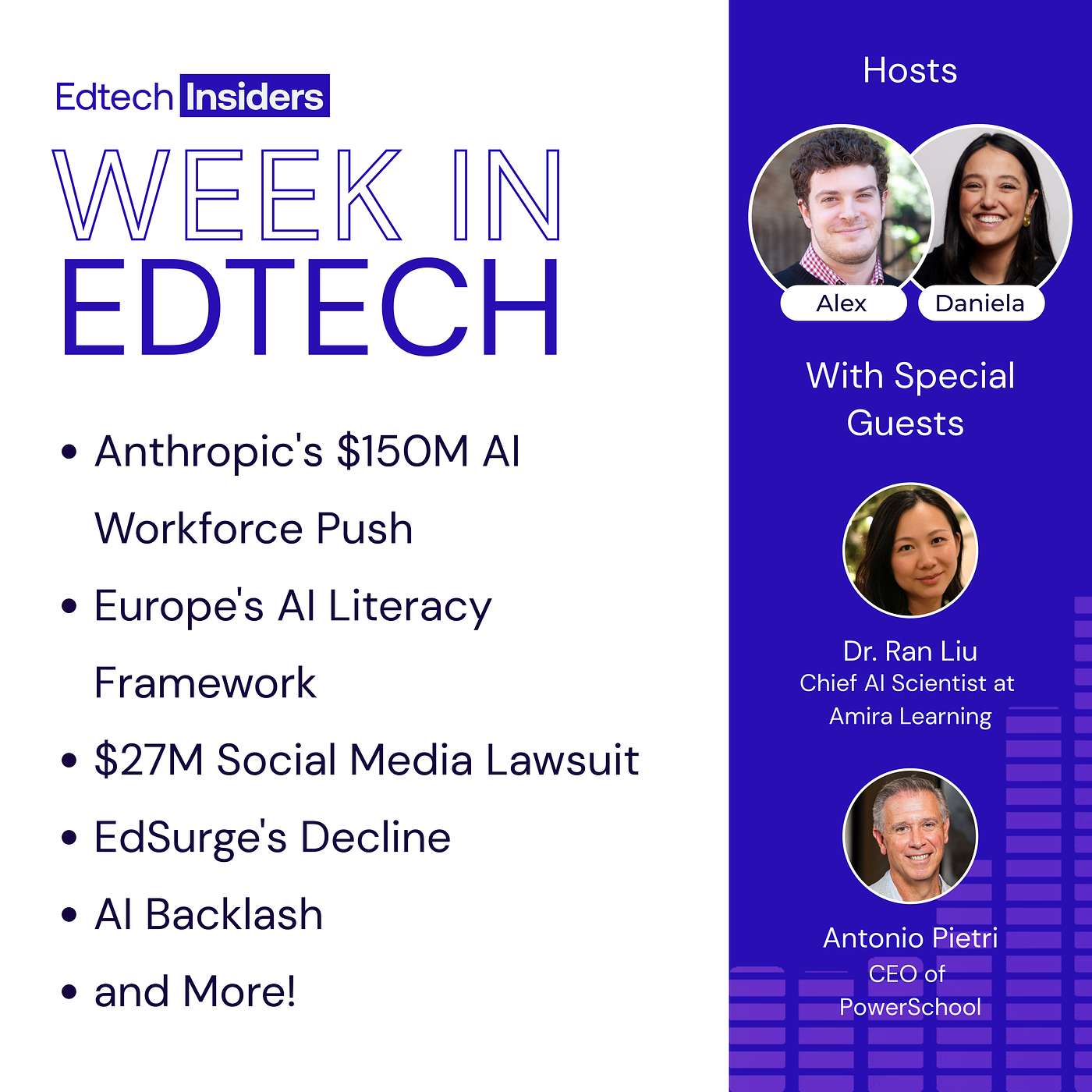
Edtech Insiders
Week in Edtech 6/24/26: Anthropic's $150M AI Workforce Push, Europe's AI Literacy Framework, $27M Social Media Lawsuit, EdSurge's Decline, AI Backlash, and More! Feat. Dr. Ran Liu of Amira Learning & Antonio Pietri of PowerSchool
01:39:48
Loading summary
Transcript140 lines
- [00:00]
Alex
This season of EdTech Insiders is brought to you by Starbridge. Every year, K12 districts and higher ed institutions spend over half a trillion dollars. But most sales teams miss the signals. Starbridge tracks early signs like board minutes, budget drafts, and strategic plans, and then helps you turn them into personalized outreach fast. Win the deal before it hits the RFP stage. That's how top ed tech teams stay ahead. It's an informal playbook, but there's a playbook for implementing new technologies within companies in useful ways. And it usually doesn't do what you just said of just like drop it on every division, every employee, every role separately. I mean, think about how companies evolve their IT departments, right? Just the idea of being like, okay, we don't want every single person to have to know how to go and fix their own computer and fix their Internet protocols and do that stuff that a centralized function.
- [00:58]
Dani Pico
I think the more of these decisions that get made, the more it feeds the AI backlash within the organizations because people, you need to meet them where they're at, they don't want to learn that way. And at the end of the day, you know, maybe you can lay off your entire workforce and hire a bunch of AI enthusiasts, but if you keep churning through them, at some point you're going to have to deal with the fact that AI is not being used effectively in your organization. And actually, nobody likes to work this way.
- [01:23]
Dr. Ran Liu
Foreign
- [01:27]
Host/Interviewer
welcome to EdTech Insiders, the top
- [01:29]
Alex
podcast covering the education technology industry.
- [01:32]
Host/Interviewer
From funding rounds to impact to AI
- [01:35]
Alex
developments across early childhood, K12, higher ed and work, you'll find it all here at EdTech Insiders. Remember to subscribe to the pod, check
- [01:46]
Antonio Pietri
out our newsletter and also our event calendar.
- [01:48]
Alex
And to go deeper, check out EdTech Insiders plus where you can get premium content, access to our WhatsApp channel, early access to events and back channel insights from Alex and Ben. Hope you enjoy today's POD. This week in EdTech from EdTech Insiders. We are so excited to have you here. We're talking the last week of June 2026 and we have an absolutely amazing special guest host today, somebody who I always have incredibly deep, amazing conversations with every time we talk and I'm so excited for every all our listeners here to get some of her wisdom, we have Dani Pico who is the head of platform at Forum Ventures. She's an ed tech veteran, she's a venture veteran. She understands spaces so well. Welcome Danny, to the podcast.
- [02:40]
Dani Pico
Thank you so much for having me, Alex.
- [02:42]
Alex
I'm so excited to get your Take on all of the things happening right now. We also talked to all sorts of amazing people recently. So if you haven't been checking out the podcast, we talked to Anthony Salcedo, the head of enterprise, new head of enterprise at Coursera. We talked to France Huang from Boodlebox is a great conversation. Had an amazing conversation with George Siemens from New Hampshire University, Southern New Hampshire University, of course. What other one is there? Who's the head of AI there? Check out everything on the podcast, but let's jump into some of the news today. So, Danny, one thing that I think we have to dig into because it's such an important move, and I think it's increasingly visible as an important move in workforce development is this Claude Core move. Anthropic investing $150 million to launch 1000 Claude Core Fellowships, basically training people for nonprofits. They're paying them $85,000 a year to train. Really interesting news. And you're in this space. Tell me what you make of it.
- [03:37]
Dani Pico
I mean, incredibly interesting move and definitely not the first tech company that we've seen make a play in this space. I think it says a lot in terms of them moving away from simply providing tools and into workforce development infrastructure. Important and interesting move. Not only the amount that they're investing and the impact they're hoping to have, but also the makeup of that partnership. So CodePath will deliver the programming act as employer record, and then social finance that has already built measurement and evaluation into it. Very anthropic move to be that thoughtful end to end. Always appreciate that from them. I think a couple of things to call out as super interesting in this move. One, the focus on nonprofits and early talent. The way that that is structured, I think leads to more stickiness, which is a very smart move from Anthropic. Those companies are typically the ones that would be adoption laggards because they lack both the budget and the talent to implement tools. I think that this program will really help see adoption in that space and probably see stickiness in that space more than they otherwise would have gotten to have. And the other thing that I think is fascinating is that they are taking workforce development into their own hands. They're not waiting for schools or K12 or governments or programs to figure out how to train the workforce of the future. They said we're going to train the workforce of the future. And I think that's a really important move for us to pay attention to a hundred percent.
- [05:05]
Alex
And you know, we've seen Google specifically, you know, think about all of these different types of internships and fellowships and partnerships with HBCUs over the years. And I feel like Claude is coming in and saying, you know, hold my beer. We can really jump into this space very thoughtfully, very quickly. And of course, Gemini is in direct competition with Claude, with ChatGPT, and I feel like it's really sort of ripping a page directly out of Google's playbook, but doing it in a really thoughtful way. And I agree with you. I think the focus on nonprofits stands out enormously. The payment is also great. I mean, these fellows are getting $85,000 for the training. That's not just getting paid to learn. That's like pretty good out of school salary to learn. That's pretty meaningful.
- [05:47]
Dani Pico
That's a good entry level job. Absolutely.
- [05:50]
Alex
Exactly. It's a good entry level job. And to your point about stickiness, and I know you have interesting thoughts about this, this is an area where stickiness really is very high likelihood. Right. If you have a fellow come into a nonprofit, especially if it's a relatively small nonprofit, they don't have an AI strategy, they don't have a lot of AI talent. That person builds all sorts of systems, builds all sorts of workflows, maybe agents, it's very likely that that nonprofit is now a cloud customer for many years. And that may not be as true in other situations.
- [06:19]
Host/Interviewer
Right.
- [06:19]
Alex
Where an investment bank is get all kinds of talent, grab everybody in, they're trying every different thing. They're trying to optimize their usage. It's less likely, I think, to be sticky. I know you have thoughts about this. I'd love to let you cook on it.
- [06:32]
Dani Pico
Yeah, absolutely. I think the likelihood that if you start off your AI journey as a anthropic customer and everything is built on that as your central system, the likelihood that you then switch to Gemini, copilot or an OpenAI is unlikely. Especially if the fellow within your organization. I mean, a lot of these companies, if they are able to prove the efficiencies with AI, will likely do better on the fundraising side, which will then allow them to keep these people on their staff and, you know, tbd, if that ends up being the case. I know that one of the big things right now is measuring efficiency in AI generally. And that's something that has been all over the news recently. As you know, people are adopting AI left, right and center, but where is the impact on the bottom line? And we can talk about that as a whole separate conversation, but I actually think that's something that probably a lot of the labs are focused on from a measuring standpoint because people, and I actually think this is more a deployment problem and an implementation problem than it is a problem with the tools themselves. But certainly if they can prove that they're driving efficiencies in the nonprofit sector, then that will drive their business case throughout all of the other sectors that they then sell into. And they'll have important case studies to show, hey, one person at an organization with a limited nonprofit budget did this with their bottom line. With a new graduate, imagine what you could be doing dear Investment bank, with 18 times the budget.
- [07:58]
Alex
Exactly. It's a great point. Right? So it's a way to sort of serve the anthropic mission of trying to be helpful to the world, trying to be the really beneficial AI company that's sort of their branding, but also a way to sort of create really meaningful case studies on limited budgets with very carefully monitored outcomes. And I think, you know, as you say, outcomes of AI, that sort of ROI for AI implementation has been really messy so far. People are spending huge dollars in budgets on tokens. But it's not necessarily some companies are being more thoughtful than others. I've seen some really interesting case studies, but I think across the board, there's no clear standard, no clear sort of framework for how to measure what you're getting out of those AI implementations. And of course, when you just throw AI into a company and say, everybod, everybody has it and you should use it. And you know, there's even been companies that are like, you have to use it as part of your performance, review all this interesting stuff. It's silly to just say, use this tool without having it tied to something that is actually meaningful for the company or for the person, at least for the person's development. But there isn't always the training in place, there isn't always the sort of system in place to say, this is what we're doing with AI. It's like we're just doing AI because everybody's doing AI.
- [09:09]
Dani Pico
There's so much to say on AI and workforce development. And I actually wrote about this recently. I've been working on this project called the Tiny AI Lab, which focuses on weekly experimentations for people trying to learn AI tools. It's like a fun side project for me. But a lot of people, what I've heard from their, their companies are basically like, you figure it out. That's our AI strategy, is you're going to figure out how to implement AI within your role. And that creates just like, first of All a Frankenstein of systems across their entire organization. Just reckless spending throughout because people depending on their own personal level of AI adoption and understanding, are using it for different reasons. You and I talked about how people are basically just using it as a supplement for Google, which is just a very expensive Google search. And I think that a big move in general, and this ties back to Cloud Court, is how are they leading on not just workforce development, but training. Like, do they then develop a program that organizations can use within their own companies to train and develop their staff? And I think that there's a huge need for that. Right now we're seeing big drops in spending on enablement, on learning and development. We're seeing a lot of teams in L and D get laid off. And these companies are claiming like, oh, I can do it, great, maybe I can do it. But how? Like, you're seeing, you know, training bots get built out and onboarding bots get built out. And I think that a lot of those things are worthy efforts, but we have yet to see the results of those things. And you've talked a lot about this on the podcast, but I think the more of these decisions that get made, the more it feeds the AI backlash within the organizations, because people, you need to meet them where they're at, they don't want to learn that way. And at the end of the day, maybe you can lay off your entire workforce and hire a bunch of AI enthusiasts, but if you keep turning through them, at some point you're going to have to deal with the fact that AI is not being used effectively in your organization. And actually, nobody likes to work this way. And I feel like the AI backlash momentum is a really interesting story overall, because there's so much in AI to be positive about. But you've got the AI labs out there just touting the fact that everyone's going to lose their jobs and, you know, there's going to be a permanent underclass and there's just, you know, the journalists around this have also just harped on the fact that, like, AI was bad and data centers are bad. As a AI optimist myself, I think that it's a huge marketing problem for everybody, not to mention the employees. Like, you can't. My opinion is that you cannot afford to sit on the back seats of this development, especially if you have strong opinions on and you care about it. It's going forward with or without you. And the more you know about the technology, the more you can be involved in actually shaping it.
- [11:58]
Alex
We'll be right back Tuck Advisors was founded by entrepreneurs who built and sold their own companies. Frustrated by other M and A firms, they created the one they wished they could have hired but couldn't. Find one who understands what matters to founders and whose North Star KPI is the percentage of deals closed. If you're thinking of selling your edtech company or buying one, contact Tuck Advisors now. I totally agree. And you know, it's funny because I feel like there is a playbook for implementing new technologies in. It's an informal playbook, but there's a playbook for implementing new technologies within companies in useful ways. And it usually doesn't do what you just said of just like drop it on every division, every employee, every role separately. I mean, think about how companies evolve their IT departments, right? Just the idea of being like, okay, we don't want every single person to have to know how to go and fix their own computer and fix their Internet protocols and do that stuff. That's a centralized function. And it's, it's helpful, it's necessary. It does security, it does so many things. Or data visualization. I always look at like the, the New York Times, like data visualization team. They have this amazing data team that literally goes around and, and podcasting team and all sorts of like technical expertise teams that go around and meet with journalists and connect with different departments and say, oh, we're going to do something really amazing with you. But it's not that they're saying, okay, we got to do data vis every reporter, learn how to do data visualizations, right? That would be ridiculous. And that's exactly what's happening in AI. They're like, use it for your role, it can enhance your role. And it's like, but I think a better model in workforce would be you have a, could be relatively small, but a dedicated AI team. That's whole job is creating AI workflows, creating AI tools, figuring out what to use, figuring out the licensing of the models, figuring out token, you know, optimization. But like that's their job. And training is part of that too. Right? But it should be enabling, right? It's not, it's not meant to be. Like, nobody has to think about AI, accept those people. Like, I don't think that's, I think that's too far. But just having no central org, no sort of strategic vision for it, which I, I'm seeing in a lot of places, I, I, I, I'm sure there's plenty of exceptions. I'm sure there are companies out there who are saying, okay, this is our Sort of central AI team. They're the ones who are going to do the strategy for this and do this sort of implementation. But for the most part, that's, I think I've seen much more of the model, you're saying, where it's like the strategy is buy licenses, give them to everybody and hope that they can figure out how to create efficiencies and then fire people around them and see if, see what happens then.
- [14:28]
Dani Pico
You know, I think a lot of it, Alex, too, is driven by two things. One, the lack of executives, knowledge of these tools that, like a lot of executives, don't actually hold the pencil on these decisions. And by that, I mean they are so far removed from the workflows that would be required to change in order for you to properly adopt AI. And from the other end, there's massive pressure from the markets to show that this is working, that you are gaining efficiencies. And so what I'm seeing a lot of companies do is they do the layoffs, but they don't have the AI to back it up. And so I think to your point, really smart organizations right now, what they're doing is they're bringing in fractional teams or consulting teams to go around and do what you said with the data visualization. Hey, Alex, what does your workflow look like? Let me help you. And then you're not asking employees to do their job and then on evenings and weekends be building AI agents that are going to get them replaced out of a job in silo from every other company. And I think, I do think that the fractional chief AI officer is going to become a lot more popular, especially in helping organizations through that transition. And I would be willing to bet that that job title is going to significantly grow within the next couple years.
- [15:47]
Alex
I totally agree. And I think similarly, the transition from outside consulting will be that over time, some companies of a certain size will also have internal orgs that, you know, the same way you and I say it, and we know exactly what, what kind of person that is and how they work and what the protocols are. There'll be an ait, basically, right. Like department that just. It works that way. I just think it's going to, it's. It's got to happen. So there's so many places we can go from here. I loved how you're talking about the backlash and I. We have to talk backlash. But before we do, I think one thing that's really interesting, and you really pointed this out this week, sort of called this out because I Think it's really important, and I think it has to do with the segue, is that it's about frameworks to actually make common understanding of something that is very complex in AI. The OECD and the European Commission are launching an AI literacy framework for primary and secondary education that's, you know, basically all of Europe. And it's trying to define exactly what AI literacy looks like, how it comes together, and what's really interesting, you should really explain this because I think you know more about it than I do. But it's really interesting because it's being done in collaboration with pisa, which is the big assessment organization. They're actually building assessments. They're actually building media and AI literacy assessments. So by creating assessments, as we know in edtech.
- [17:00]
Host/Interviewer
Right.
- [17:01]
Alex
Assessments create whole industries around them and create all sorts of compliance around them. So let's talk about it. Dig in.
- [17:09]
Dani Pico
Yeah, for sure. So we love assessment and education. I think in classic fashion, the OECD is leading with this. I love that they are not waiting to cement their training and assessment around specific tools, but rather creating a framework. So their whole framework for literacy is based around whether or not students were given the opportunity to engage effectively, ethically and responsible with digital content, media platforms and AI systems. That's the long tagline. So that just gives individual schools so much opportunity to flex within that, but also to evolve over time, which I think is really telling of where we are within AI literacy and media literacy right now. We slept on this for the social media companies, which is something that we can talk about, and now we're seeing huge backlash on that as well. But I think there's a big movement right now. I'll take this from the New York Times article that we were talking about earlier today that talked about an educator teaching students to be drivers of artificial intelligence as opposed to passengers of artificial intelligence. And I think the whole vibe right now in education around media and AI literacy is how do we create people with a good understanding of how they want this technology to play out in their lives? And that includes same with the PISA framework and what's included in what they're shortening mail. It's more about, do you properly understand how this works? How does the back end affect you? Do you recognize the role that humans should play in AI generated content? You understand the social and ethical consequences and can you communicate effectively with and about these tools? And I love that for two reasons. One, none of that requires you to actually use technology or any specific tool. We're not choosing a player which I think is so much of what schools are dug into right now is, are we going to use Copilot? Are we going to use ChatGPT at the end of the day, like, it doesn't actually matter what the tool is. There will be a new tool next year. I think that critical evaluation and the way that our students engage is way more important. But. Yeah, what do you think?
- [19:17]
Alex
No, I agree. And I mean, I think you need both. Right. I think what's really interesting about this kind of move, it's very European, right. It's regulatory, it's thoughtful. It feels like a committee approach. But I think it's really appropriate at this moment. And I agree with you that I love that it's not sponsored or tied to a specific AI Frontier lab. I love that it evolves, to use your word, right? This designed to evolve as the technology evolves. It's not like, okay, we know for sure that this is what AI literacy is, period. That's it. That's what it's going to be like. We're so early. Is still in the very early innings of this. So I think it's really designed to sort of be like, here's what we know now and we're going to be able to evolve the tests, evolve. They're talking about a 2029 media and AI literacy assessment. So we're three years out. They, I think, know that they're not writing the questions right now. They have to figure out what AI and media literacy actually looks like in practice. That said, I always, I mean, part of my stance on education in general is that I think it's not done a great job of actually teaching practical tooling. So I do think this needs to be paired in practice with access to and training on the tooling on the quads and copilots and Gemini Suites and all of that stuff. So. But the thing is, the companies are going to want to. The companies are going to provide that, right? I mean, you already have free courses from. From all of the companies I just named you all. You have a lot of attempts to move into certainly higher ed, but secondary education as well. Anthropic sort of aside, people are. They're trying to move into there. So I think the combination of having a really thoughtful, standardized sort of regulatory framework, and I won't say regulatory, it's a curricular framework for what AI literacy looks like, combined with practical usage and tooling and being like Estonia, for example, in Europe has this massive OpenAI relationship. They're using OpenAI all the time and it's being studied. But they also have this literacy framework that is separate from what OpenAI is telling them that AI literacy might look like. That feels like a really powerful combination, 100%.
- [21:15]
Dani Pico
And you know, I agree with that. I think it's so important that students are getting access to what real world scenarios and using of tools would look like. And I think if we don't do a good job of preparing them for that. I was actually reading this interesting article. Skipping Me was written by but it was talking about our schools over responding or under responding to AI. And the under response argument was listen, students are going to use these tools whether we equip them with knowledge of how to use them or not. And so if we bury our heads in the sand and say no phones, no tech, great. But that doesn't mean that our students are all of a sudden going to live tech free worlds and tech free lives. So are we actually just failing to give them exposure to what the world looks like and will look like for them in the future? And I think what's cool to me about this framework is that it creates the umbrella under which you can then decide how you teach it. And I think all good education should be theory matched with practice.
- [22:16]
Alex
Yes, yes, very well put. But it feels like we are behind in the US pretty significantly behind on having a theory of AI literacy. I mean there are plenty of people trying to come up them. There's lots of nonprofits, there's lots of orgs that have AI literacy. Teach AI is a big collaboration. I'm not sure where it stands even right now, but people have been trying, but we don't have as much practice having that sort of top down regulatory like okay, this is what the commissions that are the powers that be decided like we don't actually really have that here, which is totally.
- [22:47]
Dani Pico
And I think something I love about Europe is they're not afraid to put a framework in place first. I think in the US a lot of it right now is like, well, we can't possibly put a framework around this because look at how fast it's evolving. And I think the counter argument to that is how are you possibly going to measure anything if you don't have a goalpost set up of what you're trying to teach at the very least. And I think we're actually like, it's a smart move to go so far up layer in terms of what they're measuring because like I said at the beginning, the tools themselves don't really matter. And so the tools will evolve and the how is open to the individual markets, but the why and what it is is pretty fixed. And I think that that's cool. I feel like the US and Canada where I'm from, take a playbook from that and at least try to centralize like the biggest question of our age. Not to get too meta, but it's like what is the purpose of education? And I think that if we say the purpose of education is to create literate citizens and literacy can be defined in many different ways, AI literacy being a branch of that, then I would say that this is a pretty good overall North Star and where to point.
- [24:02]
Alex
I agree. And I think, you know, it's interesting because right at the beginning of the sort of AI, I don't know what you call it, the generative AI sort of wave, we talked a lot about Europe maybe being a little too regulated.
- [24:13]
Host/Interviewer
Right.
- [24:14]
Alex
The classic complaint about the European frameworks is that they can limit innovation or they can slow things down. And I feel like now we're sort of coming back around and seeing the negative effects of letting it be very free market, letting it be very open ended in the US and there's just like lots of people have thrown out frameworks. They are all in competition with each other. All the companies are throwing huge dollar amounts into things that are happening. It's very capitalist. It's a very sort of like, you know, laissez faire approach to this. And of course our government actively doesn't want to regulate things aside with like anthropic and mythos, like our federal government is like trying to get out of the way. And it's like if the federal government is trying to get out of the way and there's no sort of trusted entities, eventually you have the kind of backlash that we're, I think we're still actually in the early innings of the backlash too, which is like scary to say. But you know, we have still not. I mean there's been one or two really standout cases of self harm among students. There are sort of hints about biases. There's a really interesting article on Education Week this week about a study that AI will give different feedback based on the race and gender of students. And you know, this was done by doctoral students. It's not like, you know, some landmark study, but it's the kind of work that if we see a lot more of that, people are going to freak out even more. So I think maybe the approach to be a little, a little more thoughtful or at least have ideas and frameworks in Place is starting to pay off for Europe. And in the edtech sector, the European edtech sector has actually continued to see more investment, you know, pretty continually. A couple of big rounds this week in France and Spain. You mentioned social media and I think we can't really go further here or I think we shouldn't go further here until we talk about how much the echoes of social media are affecting this. I mean we talked about it a lot on the podcast. As you know, people are just so conflating all of these big ideas, you know, big tech screen time, social media, depression and anxiety, 16 year old cell phone bans. You're seeing UK and Australia create real. It's like people are saying, okay, technology hasn't done all the things it promised it would do. We've got to be smarter about this. And what they're doing is then lumping everything technology together, including education technology, which is like worked for many years to be the antithesis and try to counterbalance and be and not work the way social media works. But there was an interesting lawsuit this week in schools for social media that I think is also like a sign of the times that we have to and you know, we may see this in the future for AI. Tell us about the lawsuit.
- [26:44]
Dani Pico
Yeah, so love the story. Super interesting. It's a small rural district in Appalachia. I hope I'm saying it correctly. Breathed county school district just won a lawsuit for $27 million split between Meta, Snapchat, TikTok and YouTube. Their basic premise was that they had to spend more money servicing students because of the mental health and attention crisis caused by these social media companies. And some of what was talked about in the claim itself is the promotion of self harm among students. We know that Instagram in specific has had a lot of research done on that. But also distraction, which is a big one. In the lawsuit there was decisions called out from TikTok to not purposely turn off notifications within school hours, even though their policy teams had made those suggestions internally. Of course we are all familiar with the impact that Meta has had on education even though they have an education team and several education products. And so I think what's really interesting about this one is like the idea that there was a settlement on this lawsuit. So they're over 2400 additional cases involving individuals and municipalities are doing the same. So now we are seeing bottom line potential impact for these companies and I'm curious to see does that lead to more collaboration with schools and actual implementations of the types of guardrails that allow us to protect students. And a bigger question to that, is it maybe like a little too late for this? So I think this is a really interesting case, but more broadly to what you brought up, we are right now conflating everything under the technology umbrella. And so it's like tech equals bad. And there's such a huge backlash everywhere. And I mean, I see it, you know, this. I'm a new parent. I think about technology all the time. The way that my phone sucks up my 11 months old attention is truly terrifying. And as someone who works in technology, I think about the role that technology should play in classrooms all the time. But I think that we need to be cognizant as people in the education sector, that saying tech equals bad also removes years of progress, of technology that was meant to enable accessibility, technology that was made to meet learners where they're at, technology that was meant to personalize coaching education. Technology for languages. There's so many different types of tech tools. And there was a study that came out, I think, earlier this year that looked at ed tech in the classroom more broadly. And I think one of the things I hated about that study is that it looked at devices generally. And it's like, you cannot possibly study the impact of edtech if you are looking at it on a Chrome computer that also has access to the Internet. Because you know what those students are doing? Not just using, you know, blank program for math, but also Googling and they're on YouTube and they're accessing their social media and they're on their phone. And so I think what I would love to see in this new era at tech as we're seeing this backlash, is actually just more controlled device usage. Yes, I think that that is a really interesting premise. Is like, hey, not necessarily are we going back to the dumb phone era, but do we have a really limited scope of what these devices give you access to? And do we limit screen times? Do we? I think it requires us to be a lot more granular about what we actually do and tying back to this lawsuit. My hope, maybe naively, is that these companies say, holy crap, we can't afford to pay 30 million to every school district in the US let alone globally. Let's actually get serious about putting some guardrails in place to protect these students and work with schools to maybe give them, you know, devices that have access to only the quote unquote, positive tools that we offer for students.
- [30:27]
Alex
Totally. I totally agree with that. I would just add two things to it, which is one, I think that the idea of, you know, studying the impact of devices in schools or devices in kids hands too. I mean that's part of what the people leading this backlash are claiming. They're like, oh, when phones became ubiquitous, scores started going down for students. And you're like, okay, correlation versus causation aside, even if we do accept the premise that having phones being distracted, staying up late on your phone, all that stuff is going to have negative things, that's exactly not education technology. It's like specifically not education technology. Education technology has always seen it. Most ed tech companies that are pure ed tech companies see themselves as competition to YouTube, as competitive to regular Internet or gaming sites or things like that because they're like, that's where kids want to go and waste their time. How do we make their time useful and relevant and useful for learning? There's also, I think, a really interesting role. I mean I saw on LinkedIn recently that, you know, Jonathan Katzman, who is the head of the YouTube for education division, just, just sort of is moving on after many years he was at Minerva. Really, really smart guy. We have a great interview with him if you look in the EdTech Insiders archives. But like they've been thinking really hard. We've talked to Katie Kurtz several times about what does it look like to have a version of YouTube that would actually make like actually make sense on a school device and would not be distracting and would not actually work against the positive use of Chromebooks in schools. And Chromebooks themselves are also Google, of course. But like how do you create an ecosystem if you are an ed tech, if you're a sort of big tech company in education, like especially Google, how do you foster an environment where you actually really are helping, where you're not both trying to help and distract at the same time. And then those effects are conflated and, and people start to say, wait, get rid of the Chromebooks. Like it obviously is a big backlash to exactly that. So I think there's a really important role to play for the Googles. There aren't that many Googles, but Googles of the world, maybe the Microsoft of the world, Apple too. And I think that there is also a lot of work that we have to do as an edtech community to really make sure that people understand the difference between edtech and tech, ed tech and big tech and edtech and screen time. And we're working on it at EdTech Insiders but we need the bigger media outlets to understand and we need people to really make sense of it in a way It's a nuanced story and nuanced stories are hard to tell.
- [32:51]
Dani Pico
It really is. And I think that part of it has been, I wish I had a better term for it but like a short termism from tech in terms of especially big tech in schools, there was such a huge push to acquire young users as a way to grow their user base generally. And I mean you've seen massive backlash from Meta about this in their user age verification, which is, you know, anybody could work their way through that. Like there isn't a real intention to block those users out or work. And I think that that across, I'm calling on Meta a lot but like across all the big tech companies is proving to be what maybe it was. Short term looking good, long term looking extremely problematic from them. And I think to your point, there's wonderful people at all these companies who care deeply about education. And I think the real question will be can we convince the executives of these companies to look at the long term benefits of these more meaningful partnerships with education players that will still allow them to have brand recognition among the youth, but in a way that isn't negatively associated. You've seen, I'm sure, all of the reporting around Gen Z not wanting to have anything to do with technology. They hate it, all of it. Social media, artificial intelligence. And they're describing themselves as being addicted to this technology. And I think the likelihood that those people then grow up to be adults who themselves are cutting off these social media companies entirely is extremely likely. We're already seeing it. And so I think this, if I was an executive sitting at one of these companies, I would really be thinking about what is the long term impact of not having collaborated in that way and how do you seriously turn things around so that you can focus on user acquisition and retention?
- [34:37]
Alex
Totally. And parent backlash. I mean, you know. Yeah, yeah, There was an interesting just sort of passing article I noticed this week, sort of sociological study about how most two parent households, both parents are working full time, which is actually seems like that might have happened a long time ago, but that it not necessarily and it is truly true now. So you have parents who are overworked, who are worried about AI, you know, in their own jobs, who are worried about data centers because they're getting all this information about it from both sides and then they're like, okay, well when I look over the shoulder of my kid on his Google Chromebook and he's watching YouTube videos about video games, that's it. Like, I don't like Google anymore. Google like, look what happened there. Google has enabled an environment that allows my child to use a school device to do something that is clearly not educational and distracting and feeds exactly into my biggest fears about this.
- [35:26]
Host/Interviewer
Right.
- [35:27]
Alex
If you're a Roblox, you're, you're probably trying to worry about this. Microsoft owns Minecraft for education, that amazing acquisition, I think. But also maybe at this moment people are worried about this stuff. So it's a PR issue in the short term, but I think to your point, in the long term, I think most of these companies, they don't have that sort of evil intention that I think people ascribe to them who are really in this tech backlash world where they're like, they're just trying to get into kids minds as young as possible so that they can never leave their ecosystem. Like, I don't think that very many people in my experience in those companies think like that. But I mean, maybe there's an element of it, but that's not the main thing. They want to be a positive force. They want to build things that matter. They want to help society. They really do. I mean, Meta's gotten a lot of backlash because of all that internal whistleblowing and saying, hey, they actually did know about the age stuff. They did know about some of the negative effects of Instagram and they didn't seem to care. There was too much of a sort of corporate environment around it for them to care. And that's, that's a problem and that's legitimately the problem. I think it's hurt Meta enormously in many, many ways from their PR standpoint, from their hiring, from. It's just been a, it's been a mess. But like some of the other big tech companies could be starting to be placed in that bucket unless they're really careful. I know that Google's doubling down their investments on learning science, they're doubling down their investment on trying to figure out how to make these ecosystems safe and productive and useful. Lots of, lots of interesting strategizing there. I do want to talk about, I feel like we have two more things to cover and one's very small, but I think it's really telling and it's a meaningful one to me, which is that in the last couple of weeks the ISTE ascd, which had acquired Ed Surge, original, sort of one of a huge inspiration for everything we do at EdTech Insiders. Betsy Corcoran's an old friend and Tony won.
- [37:12]
Host/Interviewer
Amazing.
- [37:12]
Alex
They basically have now really basically turned Ed Surge into a little bit of a Shell. Over time they've gotten rid of a lot of their big reporter leads. And at this point there's really almost nobody left in the building doing ED Surge. And we've talked to them over the, over the years and whatnot. But there was a really interesting sort of tell all article by Steven Nunu, who's one of the big editors there, in a substack basically all about, you know, here's the title, how ISTE turned ED Surge into Slop. And it really focuses on not only the getting rid of the humans in favor of sort of AI generated reporting, that's the slop part, but also just the mishandling of this asset, that asset of this company that have worked so hard to build this really meaningful brand would build this really meaningful media channel. About EdTech and I remember talking to Betsy Corker and she's like, EdTech wasn't even a word. Like when we started, it wasn't even a phrase like, we, we like, we like helped invent this. Not she wasn't trying to take credit for it, but she's like, this whole field wasn't even involved. And this makes me sad. But also it's an interesting sign of the times that because this is a nonprofit, right? This isn't like a private equity firm drove it into the ground. And we like sdacd. We've had Richard Kolada on the podcast. I think they're really thoughtful about a lot of things, but it's just, they've just not found a way to make it sustainable and now it's sort of not working. We've complained a lot. I mean, since almost the first episode of EdTech Insiders, we've complained about how ED Search has had sort of lost some of its edge. But it's interesting to see it sort of being official, like officially sort of epitaphed here. What do you make of that, Danny?
- [38:46]
Dani Pico
I mean, it is also sad for me, but I think in general not to be like too meta about this, but I feel like this is a problem for content and journalism, for lack of a better specific generally is like we don't have a great way to have a business model around good, proper content and information and education. And I feel like with the incoming pressure of AI and innovation and efficiency and driving down costs, a lot of people are like, AI is great at content writing. We'll just replace that entirely. And it turns out, sure it is. But that content isn't very substantial. And so I think, sadly, this will probably not be the last of the Interesting small publications to die. I think a lot of players want to and have all the good intentions to integrate these things into their business and make them great. But it turns out, and you know this better than anyone, high quality content production is expensive and there isn't a great way to monetize it because going back to shitting on the social media companies, they've made it so that we have an equation where content equals free and if you have to pay for something then you just don't. And I think that this is a longer tail trend that hopefully will change for consumers where if you want to pay for the type of high quality content then that needs to come out of your pocket. But I think more broadly this is a business model problem and if these companies found a way to monetized, they probably wouldn't have sold in the first place.
- [40:25]
Alex
Yeah, it's also, you know, I mean ED Search came out pre substack, pre medium. There weren't these sort of auto publication platforms that you could use to try to monetize it. Not always successfully, but try to monetize on the side. So they're originally, you know, they took investment money early on. They were backed by foundations and all sorts of people and they, and they really were like, okay, we want this to be. And they had a great journalism background. I mean that's a. Corcoran is a really veteran journalist. So they're like we want this to feel extremely official and real and like it's a real media brand. And they built out a really beautiful website. They built out the, the ED Surge product index. Now it's called the EdTech Index. They did all sorts of events, they did all sorts of calendars. Like they worked really hard, really, really, really hard. Put a lot of love and effort and money into building out ED Surge. But it's been tricky. I think they've had a tricky go of it and I'm hoping we'll see if this comes to fruition listeners here. But I want to bring Betsy and Tony and maybe Stephen of this piece onto an episode of Ed Deck Insiders and do like a proper sort of eulogy or explanation and sort of, you know, after hours ED Surge. Because I think ED Search is a really interesting story but it is sad.
- [41:34]
Dani Pico
I would love to hear that because I think that it feeds into just a broader story around investment in the edtech ecosystem period. And I think these companies that are providing immense value to the ecosystem like ed surgically at EdTech insiders, they rely a lot because we don't have a business model from direct to consumer side on the partnership with companies that are in the space to sponsor this type of content. And I feel like as you know that landscape has been hard hit and therefore that is a downstream funnel into conferences, content providers, events, ecosystem players. And yeah, I would be really interested to hear what they have to say about how that downfall happened and what maybe could have been done differently to prevent that.
- [42:22]
Alex
Totally. And I mean I personally Tony Wan is now the head of platform at Reach Capital. He still publishes incredible stuff through that medium. They're great set of articles actually that if you have not checked them out. But he and Jennifer Carolyn have been working on basically responses to the ad tech backlash, a whole series of things about the backlash which had been really interesting to read. Like they're still making content out there, you know, in this diaspora way. Betsy Corporate is everywhere but like it is sad and I mean just slight inside baseball here. One of the things that's tricky about this space as well is that you have many more. So speaking of sponsors and advertisers, you have many more sponsors looking to reach schools or parents, right. And customers of edtech than people looking to reach edtech companies as customers. And so you know, we've gotten sponsorship from amazing people, but the universe of people for whom edtech companies are their customers is pretty small, right? I mean there's law firms, there's M and A firms, there's hiring firms, there's it there's places like Google Cloud and aws, like they do exist, but it's there's AI firms, there's Frontier Labs, but some of them are big, but they're not that many of them. And I think part of the ed search story and I mean I'm speaking for them, but I'd love to talk to them about it is that I think because a lot of their sponsors were places like, you know, McGraw Hill writing a big editorial about some aspect of science teaching, they needed to then sort of reach over the aisle to procurement people, to schools, to districts, to higher ed in some cases. And that actually diluted things a lot. I mean the issue I've had with ed surge over the last few years is you used to have Tony Juan on the ground doing these amazing exposes and various things about ed tech. And the last few years it's been all about schools, it's been all about teachers in the classroom. And you're like, we already have Education Week. We already have. But like it's just been much closer to the front lines of school than the actual sort of systems and ecosystem writ large of education technology, which is where it started. So there's a place for that and obviously does match iste's at East ASCDS membership, which is educators. Right. They're the huge professional development organization. But it just left a huge gap and I think that gap still exists. We've been doing our best on a very limited budget, but yeah, the business models aren't, aren't quite there anyway.
- [44:32]
Dani Pico
In general, Alex, this is a question about ecosystem building, period. Like, how does the edtech ecosystem enable all of these players to work together? And how do we support parts of the ecosystem that are important but maybe less profitable? And I think that edtech is small. I mean, it's an ecosystem. We are small. And I think that there is so much more room for coalitions of players than there currently is.
- [45:01]
Alex
You do see places like hackinger report or the 74, which are basically sponsored by foundations in different ways and doing amazing reporting. But yeah, but it is, it's small, it's limited and like, yeah, it's tricky. Rip ED surged a little bit and I feel very bad for all the reporters who, you know, we've talked to some of the. They're terrific. So we'll see what happens next in that space. We don't have a lot of time left, but let's just do a quick sort of around the world. Because we mentioned the AI backlash a lot, but they were like, this was sort of a little bit of a battery for it, especially when it comes to the New York Times, which I'm a New York Times devotee. It's like my number one website. I grew up with it on my family's dining room table every day. I love the time I work the Times. I worked my, one of my first jobs at the New York Times Learning Network out of the Times building in Times Square. Amazing organization. Like, they're incredible. But man, do I hate how they go for AI education. It is just so ridiculously slanted. I don't even know how to put it. I mean, they had an article this week about a high school teacher in Manhattan who just won an award for putting together this World War I simulation with AI. It's like so cool. Yeah, and here's the. And here's a headline. This teacher has doubts about AI but using it. I mean, screw you, he's still a skeptic. He's not sure, blah, blah, blah. And you're like, dude, you're finding an early adopter doing amazing work, really innovative and somehow you still just have to be the article a few weeks ago by. By Jessica Gross went into the school for AI and she's like, this is an amazing AI high school in Georgia, but it's not the AI. The AI isn't what makes it amazing. It's the people. You're like, okay. And then you know. Dana Goldstein, this week, how AI apps teach students how to cheat. Great, thank you. We all needed that. And Natasha, sorry, I'm just calling these people out by name, but
- [46:58]
Dani Pico
no, hate to the lovely journalists of the New York Times.
- [47:03]
Alex
They're all very smart people, but my God. And then I haven't listened to it yet. You've heard this one, but there's another daily, which is one of the top podcasts in the world, featuring our friend Natasha Singer, who is in the middle of promoting her book about how tech companies have taken over and ruined education. And yet again, I feel like she goes and finds interesting AI stories and then reports them, always through the exact same lens, which is your children are at risk because schools are being taken over by evil tech companies that are trying to force them to use AI. And it's just like the most. I don't know, it feels like. I don't know what the word even is. Yellow journalism. I despise it.
- [47:41]
Dani Pico
Anyway, I mean, you have to think about where we're coming from, though, and we talked about this a little bit, but I feel like in general, the AI Frontier labs are having a huge marketing problem because they keep promoting themselves as job replacers and guess the first people that they're coming for. Journalists and content creators. We just talked about this. So how can you possibly expect journalists to have a positive slant towards AI and technology when their internal life probably looks like cutthroat efficiencies expected of their time? Even though journalism, I actually think, is one of the careers that most requires in person time with sources, it's not something critical thinking. And you're also getting stuff that your AI alum can't tell you because they don't know yet. It's breaking news.
- [48:27]
Host/Interviewer
And so.
- [48:28]
Dani Pico
But I think, unfortunately, those professions are being threatened. And so I think that that impacts it a lot. I don't think that we will see more positive coverage on AI until the narrative shifts from we're going to take all your jobs and all of you are going to be completely underwater. And you also have to think about, you know, the techy and all of their investments and underground mansions in the Arizona desert so that they can hide from us when the rest of us underclass peasants, starve for food. Like it's dire, you know what I mean? And so I feel like there isn't really an incentive from them to seek out positive stories on technology. And I think that that is a huge downfall of the industry as a whole. But the AI labs have massive reach. I would love to see them doing more work to showcase positive stories in education. And not that they're not doing this, but I think that they could very much be using their platforms to showcase more positive technology.
- [49:29]
Alex
They're trying. I mean, Anthropic has a lot of case studies on its site about ed tech companies and education higher ed organizations that use it. OpenAI puts out press releases, like, every week about a new country that's adopted it for education. Like, they are trying, but it is messy. And then, of course, I know I'm sort of speaking out of both sides of my mouth now, but like, you know, an editorial in the Washington Post this week about AI backlash threatens to hold back kids. Okay, that sounds great. But then I put my skeptical hat on and I'm like, oh, Washington Post has a lot of reasons to be positive about AI. And I'm just like, this is the
- [50:03]
Dani Pico
problem generally, though, with our media ecosystem is like, everybody's got a different set of incentives. And I think that this is why critical thinking is so incredibly important for us, for our children, for everybody involved. And I am both a technology optimist and a technology skeptic. Like, do I think that we let big tech run wild with our school ecosystem because they gave us nice sponsorship dollars and pretty computers? Absolutely, I freaking do. Do I think that there is still a role for ed tech in the classroom that is really important, that drives better outcomes, better accessibility? Absolutely, I do. But I think that we need to be more discerning about what technology we let in front of our children. And I think it's probably going to be a while while we're hearing these negative tech stories. And I think parents have a huge role to play in this. But I also think school leaders have a huge role to play to say, hey, we know that this happened. We're measuring it. We're aware of it. Dear parents, thank you for your suggestion that we just remove technology entirely from the classrooms. But here is how technology has positively impacted your children. And I think that as an edtech ecosystem, we have a lot of investment to do in gaining the trust of educators. And more broadly, AI trust is one of the main barriers to adoption, and that is going to be be huge like huge in schools, but huge everywhere. We've got low, low, low, low levels of data trust. Right now in Canada where I am AI trust adoption is like in the 30%. Like most people don't trust AI enough to connect it to their calendar and email. How are you going to get widespread adoption among the population if most people don't even trust you to look at their email? It's not possible. And so we have to do a lot of work there I think just not just in education but, but beyond that.
- [51:55]
Alex
Yeah. And I think it goes back to your great point earlier about short term versus long term plays. As these tech companies have gone from Silicon Valley garages to as a stereotype to massive corporations. They are big companies. I think people have begun and very influential and sitting at the tables at the White House, I think people have started to get really skeptical about their intentions and then when they hear, oh wait, you know, so much of my kids time in school is connected to these companies in various ways.
- [52:23]
Dani Pico
But it's possible. Alex, remember an era where billionaires and millionaires were like beloved and they played a really important role in the development of core city infrastructure. That wasn't that long ago. And I think that like if I was sitting there with billions and billions of dollars, I would really be looking to do that. Like instead of, you know, not to call anybody out, but like instead of figuring out how to go to Mars, how about we figure out how to make the second half of San Francisco not what it currently is. And I feel like we have so many problems here that are super important for us to be fixing. And while not that I'm not a fan of space exploration, but I just think the tech ecosystem is not helping itself by continuing to focus on problems that are way too out there for the majority of the general population actually can.
- [53:16]
Alex
We'll be right back. Innovation in pre K to gray learning is powered by exceptional people. For over 15 years, EdTech companies of all sizes and stages have trusted higher education to find the talent that drives impact. When specific skills and experiences are mission critical, higher education is a partner that delivers offering permanent fractional and executive recruitment. Higher education knows the go to market talent you need. Learn more@higheredu.com that's H I R E edu.com yeah, I agree with that in theory. Unfortunately I think they've gotten burned a little bit. I mean you have Zuckerberg, they have hospitals in San Francisco named after them. Right, they do that. They've made Benioff like some of the attempts in the modern era to do that have not resulted in very positive PR or understanding of the companies. Especially Meta. Especially Meta. I mean they put unbelievable amounts. But you also think about the Gates foundation, right? All this backlash from the Gates foundation over the years, even though they've done unbelievable work with so much impact in so many ways, given away so much money, they also have been conflated with the sort of idea that tech rollog arcs, right? The Elon Musk's and the Bezos. And like they've just given this set, this very small set by the way of known CEOs. Right? There aren't that many CEOs that people know by name in America. Aren't. But like of the like 10 big tech ones that people know, a lot of them have gotten really bad reputations and it's really bled, you know, totally.
- [54:55]
Dani Pico
I think, I mean this is, I know we don't have a lot of time left and I'm about to drop like a giant philosophical bomb on us, but I feel like in general, I think social media and the over exposed environment that we live in has created a completely unrealistic standard of perfection for people that just so happen to be famous. And if we want to make progress in any area, we need to be more nuanced about the fact that both people will be good and bad. And this is why I personally am a believer in big governments. The idea that Jeff Bezos is going to favor public interests as opposed to shareholder interest is anti capitalistic and it is unrealistic. Therefore there needs to be strong regulation because we cannot expect individual members of society who are founders of companies to play the role of governments. That is never going to happen in Danny Pico's view. And so I think that we as individuals need to redirect some of our rage and willingness for accountability to people that are in elected positions and actually do serve the role of representing our voice, not Bezos and Musk and et cetera, et cetera. Zuckerberg. Like they are founders, they are business owners, they serve shareholder interests.
- [56:18]
Dr. Ran Liu
That is their job.
- [56:19]
Dani Pico
The fact that they're doing anything else in society is wonderful for my perspective that they're doing it to wash their reputations as questionable. But that's not their job. We should tax them poor. And that is all I'll say without getting overly political.
- [56:36]
Alex
I'm, I'm with you. I had a really interesting we talk forever. This is what, this is why I love. But like I had a really interesting sit down when I was working Silicon Valley and I was working in this world and I sat down with a bunch of other product people where I was working. And the conversation turned to Elon Musk. And I remember being like, my stance on it is similar to yours is like, we live in an era where, especially in the US of course, but where the government has really completely abandoned its role in regulating business in almost every meaningful way. And we just saw the housing bill go through that actually keeps private equity from buying a lot of properties, which is like one of the first things I've seen like that in a long time. But I'm like, basically like the private sector is one. Let me just put it that way. I think the private sector has like won in America over the last because
- [57:26]
Dani Pico
they scared the shit out of everybody with jobs. And it's time for government with big teeth to come back and look out for the rights of people. And we need that now more than ever because we have industries that are literally threatening to wipe out entire job categories.
- [57:43]
Alex
Yeah.
- [57:43]
Dani Pico
We cannot stand aside in the name of innovation. That is crazy.
- [57:48]
Alex
Totally. And I mean, there's been so few successful anti monopoly cases. You know, you talk about Bezos being like, he's a company owner, he owns an enormous massive global company and that's his job. But then when he goes and buys media outlets, there's nobody to stop him. Even though that's like a clear conflict of, of interest. Or when he goes like, I agree that that's where we should be focusing. And in some ways it's, I don't know, I go back and forth on this. Anybody who's listening to this podcast does like, I do think that especially in the education sector, almost everybody who works at these big companies who is doing education are like incredible people doing hugely amazing things at scale, that they are very well intentioned at least, and in some cases very, very, you know, have a great track record. But like I was an anti corporate person for many years. I was read ad busters in, in college. I read, you know, I read Naomi Klein and I get that this stuff is really, really problematic. And I do think the government has such an important role to play. And I, and I think it's actually such a sad state of affairs. I mean, I look at Jeff Bezos right now and I think like Lex Luther, literally, I'm like, this is the world. This is not the world we want to be in. Or Elon Musk, literally. I mean, these people act like super villains, like literally, totally.
- [59:03]
Dani Pico
But also to your point, they've been villainized. And I think A huge point. Part of it is that we have realistic expectations of the role that they serve in society of like you can't expect. Jeff Bezos is not the president. Elon Musk is not the president, even though he did involve himself in government. But you know what I mean, like, that's not their job. And so I'm not here to defend the super wealthy. Like, I think there are many issues with that sector, but I do think that people would do well to redirect some of their rage to action against people that are actually meant to. They're not elected officials.
- [59:37]
Alex
What I'd say is redirect their. I just don't know if there's benefit in being rageful at.
- [59:42]
Dani Pico
Redirect your Twitter anger at your elected local council.
- [59:47]
Dr. Ran Liu
Everybody.
- [59:48]
Alex
I know they're maybe more likely to fold than others, but like, yeah, it's okay. Anyway, as always, it's been such a fun conversation. I can't wait to have you back on the show. And we'll see you next week on EdTech Insiders. If it happens in EdTech, you'll hear about it here on EdTech Insiders.
- [60:05]
Host/Interviewer
Welcome to EdTech Insiders. We are talking to Dr. Ran Lu today. She's the Chief AI Scientist at Amira Learning. She has over 12 years of experience working in intelligent tutoring systems, and she holds a PhD in Cognitive and Learning sciences from Carnegie Mellon, one of the absolute best schools in the world for exactly this. She's also contributed research to Project Listen, the decades long CMU project that became the Amira Reading Tutorial. Dr.
- [60:35]
Alex
Ran Liu, welcome to EdTech Insiders.
- [60:38]
Dr. Ran Liu
Thank you so much for having me.
- [60:40]
Host/Interviewer
Oh, thank you for being here. I mean, you have such an incredible background and you're bringing such a depth of knowledge to Amira, and Amira has been having some really amazing evidence around it. So before we get into anything else, tell us about what Amira is and how this project, Listen Project morphed into Amira Learning to help students read with AI support.
- [61:02]
Dr. Ran Liu
Yeah, so Amira delivers a whole variety of experiences to help students and teachers to improve at reading. But the sort of core engine that Amira began with is really what we consider this intelligent Reading tutor. And that's the piece that, you know, kind of spun out of these, this decades long project that began at CMU and that I briefly worked on applying to classrooms as well. So what it is, is kids basically read with Amira out loud. They read texts that are engaging and they read texts that are leveled for their current, you know, ability to engage with text and to, you know, engage with foundational reading skills that might be required by the text. And as they read out loud, Amira listens to them, it can hear the different kinds of disfluencies. So if a student is kind of early in their journey of learning to read, we can detect all of the sound outs that they're doing, the kind of subword articulations that they're making, and also just the things that they're reading correctly and fluently. And we can make a lot of important judgments about where they're struggling, where their strengths are, where their reading skill gaps are, and then will give them small, just in time interventions to help support them as they read stories out loud, to help them not only to be able to get through the stories that they're reading, but also to work on the skills that in the moment, we're seeing evidence that they may need help on.
- [62:39]
Dani Pico
So, yeah.
- [62:40]
Host/Interviewer
Yes. And, you know, one of the things that I think is really unusual and exciting about Amira's take is that you have a very thoughtful approach to, you know, to how AI is used in an educational environment. Specifically, you know, one of the things you, you talk about frequently is the case for reducing students screen time and really using AI in very, you know, careful, specific ways to actually improve outcomes rather than, you know, falling into the trap of sort of using AI for everything or having students on screens all the time. You know, we're in the middle of this giant conversation about screen time. What is your take on how students should use screens and AI in a classroom so that it's positive and not a distraction?
- [63:22]
Dr. Ran Liu
Yeah, I think, you know, it's not so much the presence or absence of a screen. Right. That defines the quality of the experience being delivered. So I wouldn't say that my position is like we should just purely reduce time on it, but I do think we need to start being a lot more careful about how we're spending our time on screens or how kids are spending their time on screens. And so I really think that we need to be interrogating, like, what are the experiences we're giving kids through screens? How high quality are they, and what experiences are that screen time displacing? Right. This is really important because right now, you know, a lot of the common digital experiences that kids are getting are not really producing good results on either learning or on social and emotional development. So I think that the current pushback from parents and policymakers is warranted. But I also don't think that the answer is to Just ban screens as a blanket policy because there are cases where I believe technology can deliver experiences that really do accelerate learning beyond typical classroom instruction. And I think that's especially important for kids who don't have the privilege of accessing expert one on one tutoring, maybe like outside of school. So I just think we need to get more specific about what kinds of technology enabled experiences are actually positive for kids learning and development and which ones are not. And interestingly, the medical world has moved to this perspective recently as well. So the American Academy of Pediatrics actually just dropped for the first time in a really long time, its fixed time limits on screen time and replace them with questions about what the screen time is displacing as well as how high quality the interactions are that kids are having with screens. And I really think that's the right direction to be moving to with our thinking in edtech as well.
- [65:28]
Host/Interviewer
That makes a lot of sense. I hadn't heard that. I'm really happy to hear that. But it is really interesting how you're seeing screen time become this sort of hot button issue. People, as you mentioned, some districts are starting to do screen time limits, time limits, screen time bans, screen time bans for kids under a certain age. And they're considering screens, the sort of core element. But as with any medium of communication, as with paper, as with anything, you know what's on the screen, what's actually happening matters more than whether it's a screen or not. So that's powerful and I'm glad that the medical community is coming around to that as well. You mentioned evidence and outcomes. And I think one of the things that's really interesting about Amira, you've thought very hard. We interviewed Mark angel probably six months ago and Amira is really designed around evidence and outcomes. You've done some very serious research on it. I know you're working with Boston University. Wheelock School has a eval program. Tell us a little bit about how you approach outcomes and how you ensure that Amira is actually working to get to the outcomes that students and teachers and districts are looking for.
- [66:37]
Dr. Ran Liu
Yeah, so yeah, we are very serious about science research and evidence at all levels. And what I would say say about how we ensure that we achieve good outcomes is we start with prioritizing a pedagogical and learning experience that is already rooted in the best practices that we know from research and from, you know, reading science. Right. And fortunately, you know, areas like cognitive neuroscience and reading science offer us a lot of clear answers to like what makes for A good and effective learning experience. Experience. So starting kind of most broadly, I think, you know, cognitive neuroscience tells us that for really good learning to occur, the child really needs to do the hard cognitive work that is required to achieve that learning. And so we know that, you know, kids need to be actively retrieving what they know. They need to actively exercise the skills that they're learning and sort of engage in some degree the right amount of productive struggle and receive specific feedback that's just in time. The research supporting these principles is some of the most robust research that we have in learning science more generally. And so when you have a digital experience that asks a child to perform that target skill and is giving them feedback at the point of need, it's really engaging those important learning mechanisms.
- [68:08]
Dani Pico
Mechanisms.
- [68:09]
Dr. Ran Liu
So that's always, you know, something that we take very seriously. And you'll see in our product that that is the, you know, those form the core foundation of our tutoring experience. And then of course, beyond that, we draw most of our other design principles, you know, from what reading science tells us is specifically important for supporting children as they learn to read. So I think that, you know, basing your bets in the absence of having evidence that your product works in sort of like a gold standard RCT kind of way, it's like use the research that we have and use the pedagogy that we know works in the classroom or works with really great human teachers and tutors and try to bring that experience to life for kids.
- [69:02]
Host/Interviewer
But my understanding, and maybe correct me if I'm wrong, is that you've gone, you know, everything you're describing there is incredibly powerful and it aligns exactly with what the research is finding. Avoid cognitive offloading and outsourcing, productive struggle, feedback. Use AI in really intelligent ways that align to what we know about the science of reading. But I believe you're also getting closer to these higher tier research studies.
- [69:30]
Alex
Am I wrong about that?
- [69:31]
Dani Pico
Yes, yes, yes.
- [69:31]
Dr. Ran Liu
Yeah. Oh, we've done tons of research studies. Yeah, I think, you know, I'm just addressing like how we kind of in early days place our bets on the kinds of experiences that we believe are going to yield good results in the studies. But we have done tons of research studies. And you know, part of the advantage is that the technology and the design of the technology did kind of come out of decades long research at Carnegie Mellon. And so we have that research background as well, where they had done tons of experiments and studies and even rct. And so we had a really good basis. But then once we became Amira. We've also done a lot of third party independent studies of the efficacy of our product as well. And we do a lot of, we look at our own data, we look at efficacy each year, and we try to drive the product in directions that improve the efficacy. Right. So we're doing a lot of that behind the scenes. But yes, I mean, I think ultimately the gold standard is you have to have externally validated, externally conducted independent research that is rigorously done, you know, using kind of a good control condition and all of that.
- [70:41]
Host/Interviewer
Exactly. So, you know, you're deep in the learning science. How. What if you were a, you know, procurement person, if you were a district leader, if you're a principal right now and you, you're looking at this huge mess. I say mess. This huge. Here, let me start that again.
- [70:55]
Alex
Mess is not the right word there.
- [70:56]
Host/Interviewer
So, you know, you have this great deep learning experience, experience in learning science from Carnegie Mellon with intelligent tutoring systems. You know, Ken Koeniger, some of the Koetinger is. How do you pronounce his name?
- [71:08]
Dr. Ran Liu
Kadinger.
- [71:09]
Host/Interviewer
Kadinger. Right. Sorry, let me take this one more time. I'm butchering this. Okay. You know, hearing you talk about your learning science experience at cmu, Ken Kadinger and other amazing, you know, learning experts out of that school, you have such a deep understanding of the learning science and what the pedagogy and the science of literacy says. If you were a procurement expert, if you're, you're a principal, if you're a district lead, technology lead, and you're looking at all of the different AI learning tools out there, what would you recommend they do to sort of separate the wheat from the chaff in terms of what the evidence actually, actually says right now?
- [71:48]
Dr. Ran Liu
Yeah. So I would ask, you know, three key questions. The first one, I think is fairly simple to get at and I think really revealing and really important, especially when we're talking about screen time or digital tools, which is does the product engage active as opposed to passive learning? And the reason I think I'm singling this feature out is that passivity is probably our most common pitfall of screen based and digital experiences. It's just something that is a very common feature of those kinds of experiences. So, you know, another way to frame this question is, does the tool ask the student to actually perform the skill that it claims to build in the way that, you know, we would exercise that skill in the real world outside of a digital experience, or does it deliver, you know, kind of content passively does it engage a lot of kind of multiple choice or clicking? You know, those are the kinds of things to look out for, which I think are very common in a lot of screen based experiences and that sort of are known to promote passivity. So I think that's a good first cut. I think secondly, you know, although you may not be an expert in the science of learning, it's still helpful to ask the questions. Just ask the questions of like, was this designed based on the science of learning and the pedagogy around this subject that you're trying to teach, how was it designed based on that? Like, what are the research frameworks that your product, you know, was using? Right. In terms of designing experience, what if any scientists or researchers have you worked with who really understand how kids learn this particular domain in co designing the product? Right. So just I think asking those simple questions can tell you a lot. Right. Even if you can't evaluate every single detail of the response.
- [73:54]
Dani Pico
Yeah.
- [73:54]
Dr. Ran Liu
And then I think the last question I would ask, which I think should be decisive, is just what is your evidence that your product works?
- [74:04]
Alex
Yeah, yeah, it makes a lot of sense.
- [74:08]
Host/Interviewer
I like that tiered model and starting with active learning. I agree. And it's been in the field a long time and I totally understand that passivity has been, as you say, a very common element of ed tech that we are I think finally really able to move away from. It was sort of a limit in many ways for many years and I think, I think now we're able to move past passivity and we're trying to get there as a field as fast as we can. So my last question for you, I
- [74:32]
Alex
mean I think there's a really big
- [74:33]
Host/Interviewer
one is you know, people are having just like with screen time, AI has become this sort of blanket term for lots of different types of products and experiences and things like ChatGPT or Gemini or Claude and then a purpose built reading tutor like Amira that's actually having students read out loud and giving just in time feedback are both called, you know, AI tools and, but they're designed extremely differently. They have very different outcomes, they have very different users. What do educators need to know about the difference between sort of off the shelf general purpose AI and tailor purposed educational AI? And why does this distinction really matter for what you should actually do to use AI in a classroom?
- [75:13]
Dr. Ran Liu
Yeah, you're absolutely right that when Most people here AI because of the popularity of tools like ChatGPT and Claude, they really picture what we call generative AI or large language Models that's kind of become the public's mental image of what AI is. But not all AI is that. And the most foundational student facing AI in our product in Amira is really not that. It's not, you know, like that at all. And we actually use a large collection of a really specific and purpose built non commercial models that are all built in house and really designed to fit into a pedagogical experience that we wanted to create for kids to read out loud and to receive the just in time feedback and support they need. So this idea of AI being purpose built I think is a really critical feature for it to have a place in the classroom and maybe I can unpack a little bit. You know what I mean by that? Right. So we, you know, we want to start with the pedagogy first and the design of that student experience. We ask ourselves, like, what should great reading tutoring look like step by step, based on the science of how kids learn to read. We design that experience first and then we ask at each step like, where can a purpose built model help to deliver that step? And so then the AI is custom built to serve the goal of each of those steps in the desired learning experience. So like a really simple example is when kids learn to read, I mentioned this earlier. You know, they do a lot of sounding words out and saying a lot of partial words. And it turns out that commercial speech recognition systems are really bad at capturing that signal. And it's not surprising because those systems are not purpose built to listen to kids. To read. Sorry. To listen to kids read.
- [77:18]
Dani Pico
Right.
- [77:18]
Dr. Ran Liu
And help identify their struggles. They're built to capture, you know, what an adult is trying to say to your iPhone to get it to do something or to Alexa to act on it. Right. So of course letting a gloss over over details like individual letter or subword utterances. So that's not surprising given the goal of those systems. Right. But what it means is like we can't lean on commercial speech recognition systems to do these important steps of identifying kids, you know, reading gaps when they are reading out loud with a mira. And so our own system is built specifically to capture all of those sound outs and stumbles and you know, part words and all of that rich data that we think is so important to understand how to help that student just in time.
- [78:04]
Host/Interviewer
Yeah, I love that distinction. I love the phrase subword utterances too.
- [78:09]
Alex
I'm just that just like is a
- [78:10]
Host/Interviewer
fun one to say, but yeah, I totally agree. I mean there's been, it's been a Real challenge in the field is the speech recognition for young, for children and for young children who are learning to read, learning to speak in the first place. Because that, as you say, the commercial models aren't for that. And then to your broader point, commercial models are just not built for learning. Right. And they're working on it. Right. I mean, the Frontier Labs have versions that they're trying to be more pedagogically viable and feasible and meaningful and there's something to be said for that. But something like Amira, that's about, it's all about voice, it's all about reading, it's all about understanding phonemes and very specific parts and giving just in time feedback in a very specific way with sort of characters in it. I mean, it's just such a different experience and it's evidence based, which is really powerful as well for learning, which we don't have for a lot of other tools. So there's a lot to be said for a model that, you know, a tool that builds its own models that is really from the ground up. It's nothing like, you know, the wrapper quote unquote that people talk about in education and edtech AI, which really is, we've been moving away from. But I think Amira's never been a rapper in any way. It's really exciting to hear you talk about this and I love all the evidence that you are all building.
- [79:26]
Alex
I wish we had more time.
- [79:27]
Host/Interviewer
I hope we can talk more about this in the future. I think that reading tools are one of the most powerful uses of AI in the classroom and getting incredible results. But we're out of time today.
- [79:37]
Alex
Dr.
- [79:37]
Host/Interviewer
Ran Liu is the Chief AI Scientist at Amira Learning. She comes from Carnegie Mellon where she has over 12 years of experience working on intelligent tutoring systems. Again, one of the most evidence based edtech tools in history. Thank you so much for being here with us on EdTech Insiders.
- [79:52]
Dr. Ran Liu
Thanks so much for having me.
- [79:54]
Dani Pico
It was a pleasure.
- [79:55]
Alex
We have a truly Incredible guest on EdTech Insiders. Today. We are speaking to Antonio Pietri, the CEO of PowerSchool, leading strategy, growth and innovation with more than 30 years leading global software companies. Antonio brings deep operational experience and a strong belief in education as a driver of positive change. He previously served as President and CEO of enterprise software company Aspen Technology. Antonio Pietri, welcome to EdTech Insiders.
- [80:26]
Antonio Pietri
Thank you, Alex. Glad to be here.
- [80:29]
Host/Interviewer
I'm very happy to see you here.
- [80:31]
Alex
So you are in this amazing position. PowerSchool is one of the absolute premier learning management Systems, student information systems in the world. You've said that K12 education now requires enterprise level operations. So let's unpack that statement. What has changed in the last few years that make this shift to enterprise level necessary? And how should district leaders, how should edtech founders be thinking differently about running their organizations?
- [81:00]
Antonio Pietri
Yeah, no, thank you and I appreciate the question. I come from software industrial software. We're enterprise level software and applications rule the day. I think what's changed In K through 12, it's a number of things that are sort of converging. One, I do think educators in general are looking for more insight into what's happening with the students in order to drive student outcomes. And that requires an access to the overall data view around a student. Also, the issue of funding and how funding is changing, creating certainly pressure on efficiencies, on productivity. Teacher shortages is also driving educators, school systems to really think about how do they become more efficient to optimize the dollars they have to spend on applications, on technology and students. So there's a combination of factors and it's not uncommon for sort of external factors to sort of drive leaders in an industry to start thinking about how they leverage technology to drive credit productivity, more efficiency insights in order to at the end of the day, what they want to do is drive better student outcomes.
- [82:16]
Alex
Yeah, you're mentioning that combination of driving student outcomes, but understanding the complexity, the administrative complexity, the budget constraints that come with running companies in this era, the productivity needs. Schools are famously at this moment facing a combination of budget uncertainty. You know, the federal funding has changed, the state funding is changing, they're facing declining enrollment, they're facing chronic absenteeism, they're facing teacher shortages as you just mentioned. Tell us about how schools at this moment should be thinking about some of these challenges. Is one of them most pertinent. Are all of them sort of really threatening the core of school or do you think that they're is an aspect of hope even through all of these major challenges?
- [83:00]
Antonio Pietri
Well, let me look at what I've learned in my career is challenges bring the best in people. If people have a mission that they're passionate about, they'll find ways around challenges or find ways to solve those challenges. And I think that's what you at least that's what I'm seeing in K through 12. A group of individuals that are really dedicated to work through these, what hopefully are short term challenges, maybe a new normal as well is being established, but one where they recognize that now technology will play a much bigger role in how they run their districts, how they run their schools, how they run things at the state level as well. And ultimately it's about how they bring all this data together from different systems that they've been implementing over time the last 10 years. How do they start tapping into that investment to create better visibility into how they run their operations, how they can be more efficient, predictive enrollment, but really, what should be their outlook on enrollment, considering declining enrollment, schools for different factors? How do they think about their budget, the way it's presented to me, how do I create room in my budget so that I can hire more teachers or I can spend more on special programs? So how do I become more efficient to create that room in the budget and so on. So I think there's creativity and people tend to be very resolved about finding ways to solve challenges. And I think that's what we're doing. And from our standpoint, our installed base of solutions is really put us at the forefront of this opportunity and challenge, which is, okay, this breadth and depth of capabilities. How do we bring it together into an interconnected operating system where you have seamless data flows, seamless workflows. And it's something that I've been focused on since I came to PowerSchool. How do we bring all this together to deliver on that promise of better efficiencies, productivity, and better student outcomes?
- [85:09]
Alex
Yeah, I love that point about. Yes, there are a lot of challenges, but challenges can bring out the best of people and sort of force them to uplevel their thinking about efficiency, about where to put resources, about how to, you know, make the most of sometimes a smaller pool, but to actually really drive outcomes. And I think, you know, a lot of schools and districts are finding themselves in a very different position than they were in just a few years ago. But as you say, the challenges can foster creativity. One of the things that we talk about a lot on this show, because especially with the rise of AI, is that there's a lot of research about educators spending many, many, many of their weekly hours on administrative tasks, on manual workflows, on all sorts of non academic tasks, but that are behind the scenes. And PowerSchool, as you mentioned, the install base, it is massively used and it has hundreds and hundreds of tool sets and tens of thousands of data points to be able to sort of help these manual workflows become more streamlined. Where do you think the greatest opportunities for automation to give teachers and administrators their time back for learning?
- [86:14]
Antonio Pietri
Yeah, I think the important thing about AI is to think of it as an Enabler, as opposed to a threat, which in some cases some people do. I believe it is absolutely an enabler. I think AI has to be integrated into the existing capabilities of a product in order to enhance the productivity, the efficiency of the individual using that software, whether it is administrator in the back office managing the student information system, whether it's a CFO in a large school district looking at his or her budget, or whether it's a teacher trying to understand the overall behavior and performance of, of a student and how to intervene by providing early warnings or prescribing action. And this is something that has become more and more of a theme with the customers that I talk to, that they want their applications, the software, to actually not just tell them what's going on, but prescribe actions to guide them to take action. And these will then all lead to time being freed up for teachers to spend more time on those students that need that time through an improvement in their productivity and efficiency. So I think of AI not as a standalone tool, but something that is incorporated into the products that are being used regularly to enhance the performance of individuals using the application.
- [87:51]
Alex
Yeah, I mean, to your point about, you know, if schools are becoming in need of enterprise level data science basically to make sense of these enormous numbers of data points and prescribe actions, many school administrators, even though they're very well trained, are not data scientists. They're not used to running large, you know, businesses. So the idea of putting together all the data points and using AI to enable prescriptive, actionable insights, it feels like a sort of core capability of what AI can do in the modern era of schooling.
- [88:23]
Antonio Pietri
Yeah, no, we have customers that have implemented our financial planning software, our budgeting software, and through the greater visibility that these applications generate, they've been able to identify that they have funded headcount that they really don't need, but it wasn't visible to them because of the myriad of data points. But once you bring this data to life in an application, then you understand that there's an opportunity to, since you're not going to be hiring or you don't have a need for that headcount, to repurpose that funding into other activities. So ultimately this application, certainly it's about the productivity, but it's about greater visibility, greater insights that lead to more efficient decision making at the school, school district level. So it's about, you know, in a way, it's about doing more with the same, because ultimately that's what the budget, funding constraints are requiring.
- [89:22]
Alex
Yeah. And putting all that data to action. Right.
- [89:25]
Host/Interviewer
Doing.
- [89:25]
Alex
Using the data to identify opportunities to do more with the same, which is key.
- [89:30]
Antonio Pietri
I'm highlighting these opportunities for the user.
- [89:33]
Alex
Exactly. I want to ask about cybersecurity. It is a hot issue right now in many different parts of the edtech ecosystem.
- [89:40]
Host/Interviewer
Right.
- [89:40]
Alex
You have schools and districts who are needing to make sure increasingly they are safe from cybersecurity attacks. And then you have edtech companies facing sometimes some pretty serious cybersecurity attacks. As edtech companies get big, especially for a company like PowerSchool, it's a massive, massive number of users inside that system. How do you think about cybersecurity both for your users and for the company itself?
- [90:03]
Antonio Pietri
Yeah, look, cybersecurity, I believe, has to be job number one in today's environment. Certainly the company had an incident in December of 2024 and I think that was a hard lesson, but an important lesson. The company's taking steps to certainly address the shortcomings that existed at the time. And we've been working proactively internally to put in place the safeguards, the processes, the best practices, but also working with our customers because it's a very dynamic ecosystem. It's something that I found. I come from an industry where certainly safety was job number one, but cybersecurity was a requirement for safety. And I think cybersecurity has to be job number one here because of the concern around student data. So what we are now focusing on, the way we're focusing on in the company is what is that framework and go for governance around security that that continuously drives the company to become more and more secure. How do we work with organizations and partners to take on their standards? So, for example, around product security, what are those best in class standards that companies like Microsoft and AWS or Snowflake have for their own products and systems? How do we work with organizations like One, EdTech or for their best practices? So that is not only about product security, it's also enterprise security and even physical security as well. And how does that continue to evolve within that governance framework? Because this is, in a way, it's an arms race. When you think you've caught up to the bad actors, the bad actors continue to find ways to become more unpredictable. So I think if there's one area in an organization where you have to be diligent about it every day is security. And that's what I've tried to bring to Power school.
- [92:05]
Alex
Yeah, it makes a lot of sense. It's an arms race. And then there's AI on both Sides of the arms race, right, for both defensive AI and offensive AI. It's, it's a great point. We're at this really interesting moment, I think, in the edtech tech world where you mentioned governance, right, that governance within a company for security and safety is really key. I think schools and districts are really wrestling with this concept of what does governance look like and internal regulation in the AI era? They want to experiment with AI. They want to unleash the positive impacts of it on student learning, on efficiency, on optimization of teacher time. But they also want to make sure there's governance in place to make sure everything's done responsibly and they're not exposed to risk. What do you say to your many, many customers who are wrestling with AI adoption and AI governance and trying to figure out basically how to adapt to this new era where they know that AI is part of the story, but there aren't yet fully accepted best practices and how to use it in a niche setting?
- [93:03]
Antonio Pietri
Yeah, no, that's a great question. And frankly, it's about establishing clear guidelines for the use of AI, both internally in the company, in PowerSchool. How do we think about our teams using AI to develop software, how they use AI within the products as an enabler for the product, but also then what should our customers expect as far as the behavior of that AI? And starts with protocols or guidelines around this is expectation for the use of AI. This is what we would expect AI to behave inside a product. What are the guardrails that we want to put in place to protect our users when they're using our products? But also what should customers, what should their expectations be when they buy products from PowerSchool that incorporate AI? What is that transparency? What are the controls that are in there, the accessibility, even from a standpoint of design, how this product, products are designed to make sure that the AI is easy to use, but also again, provides those guardrails. So it's having that clarity. And I think it's also doing this in a transparent manner. We are very forthcoming with our products around what are those guidelines or those policies, best practices that we've put in place. And I think ultimately is getting everyone comfortable with how we leverage AI, how we use it, and also then the results that it provided. Because, you know, it's something that I used to question, used to have, which is, well, it's a black box. How do we know what is prescribing is the correct action? Then? This also calls for testing over time, getting comfortable that they prescribe actions if you take them, are the right ones. And I think ultimately it's about building confidence in the tool itself and the use of AI.
- [94:58]
Dani Pico
So.
- [94:59]
Antonio Pietri
But to your point, it is an evolving area and we just have to be very cognizant that it's not once and done, we have to stay with it to continue to evolve. Even those frameworks for governance and guidelines and best practices.
- [95:16]
Alex
Yeah, it is very dynamic and I think, you know, some best practices are starting to fall into place and people are starting to look, I think your point about looking at enterprise solutions, you know, how did the AWS's and snowflakes the world think of cyber security? People have lessons now to learn from large enterprises who have to think about AI in really complex ways. I'm curious. One of the things I find really interesting, this is my last question for you, but, but something that's really, really interesting about the education technology space is that it sort of combines some very different types of culture.
- [95:46]
Host/Interviewer
Right.
- [95:46]
Alex
So education culture is very humanistic. It's very hands on, it's sometimes very informal, informal about human relationships. And then of course you're talking about software and districts and places that have a lot of bureaucracy, a lot of systems and regulations and this sort of enterprise level thinking. And I'm curious, as you have moved into the edtech space, how you sort of reconcile those two cultures, that enterprise level, very formal thinking, as if you're, you know, an aws, you need to think about cybersecurity like aws, but also the humanistic aspect of education where at the end of the day it's about students and learning and changing the mind.
- [96:22]
Antonio Pietri
Yeah, it's a great question because to your point, it's one of the first things that I noticed when I came into the industry and power school. It is very humanistic, it's about individuals and students, which is what we want teachers to be focusing on. But ultimately we need to recognize that software is an enabler. And ultimately, when you listen to educators, administrators, the first thing they say is, I want to make sure that my teacher has the time to focus on that student that needs that attention from the teacher. So you have to flip the equation in some ways in that we're here to deliver the best possible software that will enable administrators, educators, teachers to focus then on their outcomes, which is students, personalized learning, career, life learning for these individuals that will be the future generation of this country. So it's something that I dealt with in PowerSchool, an incredibly humanistic mission and purpose. Part of the reason that attracted me to PowerSchool after my career in industrial software. But also ultimately you have to understand what is your mission as a company in software and it is deliver the best possible experience to users using your software so as to enable them to focus on what matters to them in industrial. In the industrial world was value. It was about creating all sorts of value. So we had to deliver great industrial grade software and cater to. We have to deliver K12 great software which has to incorporate that humanistic aspect around attendance, intervention as far as teachers performance matters and so on. But it is the best software that will enable them to focus on their outcome. So having that clarity of purpose, certainly the industry you're serving, but who as a company you are here to do and focus on that as well. So it's, it's a great question. I appreciate you asked.
- [98:35]
Alex
Yeah, that's a great answer as well, right? Having reliable enterprise level secure software enables education to educators and students to connect and, and build that type of relationship and build minds. I love it. Antonio Pietri is CEO of PowerSchool, an absolute giant in the EdTech space. Really one of the core companies driving the space and he leads strategy, growth and innovation. Thank you so much for being here with us on EdTech Insiders.
- [99:03]
Antonio Pietri
Thank you Alex. I appreciate it.
- [99:05]
Alex
Thanks for listening to this episode of EdTech Insiders. If you like the podcast, remember to rate it and share it with others in the EdTech community. For those who want even more EdTech Insider, subscribe to the free EdTech Insiders newsletter on substack. This season of EdTech Insiders is brought to you by Cooley LLP. Cooley is the go to law firm for education and ed tech innovators offering industry informed counsel across the pre k to gray spectrum. With a multidisciplinary approach and a powerful edtech ecosystem, Cooley helps shape the future of education.