← Elon Musk Thinking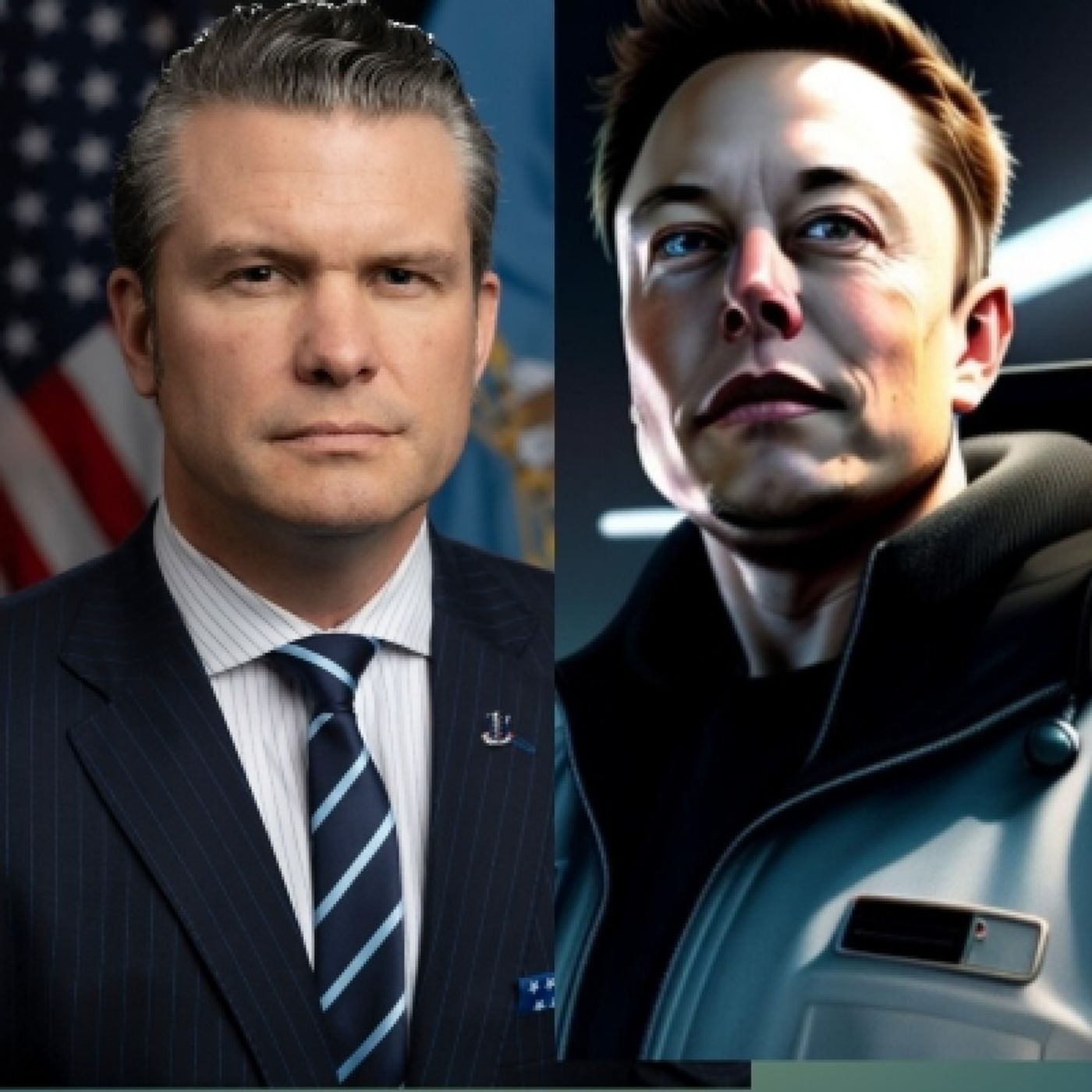
Elon Musk Thinking
Latest: Elon Musk And Pete Hegseth Speech At SpaceX Headquarters, Discuss Military Technology!
00:45:23
Latest: Elon Musk And Pete Hegseth Speech At SpaceX Headquarters, Discuss Military Technology! #ElonMusk #PeteHegseth Source: Forbes Breaking News Elon Musk is the CEO of the company X, Tesla, Neuralink, SpaceX and the Boring Company. Peter Brian...
Loading summary
Transcript14 lines
- [00:01]
Grainger Representative
If you're the purchasing manager at a manufacturing plant, you know having a trusted partner makes all the difference. That's why, hands down, you count on Grainger for auto reordering. With on time restocks, your team will have the cut resistant gloves they need at the start of their shift and you can end your day knowing they've got safety well in hand. Call 1-800-GRAINGER Click grainger.com or just stop by Grainger for the ones who get it done.
- [00:31]
Pluralsight Representative
Worried about your future in tech? Master new skills, accelerate your team's impact and redefine what's possible. With pluralsight, we're more than just another online learning platform. We're shattering the skills gap and shaping future generations of technologists. Transform your work, transform your team. Ready to tap in? Visit us@pluralsight.com to learn more.
- [01:00]
Pete Hegseth
Latest interview of Elon Musk if you like this episode, just like share and follow this podcast. Thank you. Back to the show.
- [01:09]
Elon Musk
All right, welcome to Starbase Texas. This is a city, it's actually legally a city that thanks to the hard work of the SpaceX team, we built out of nothing and is now a gigantic rocket manufacturing system. So, and for people out there who are curious to see it, we're actually on a public highway so you can come and visit and drive down the road and see the epic hardware. So I think this is the first time that a rocket development program has actually been on a public highway, so you can come and see the epic stuff. We're honored today to have the Secretary of War, Pete Hegseth, and much of the senior leadership of the Pentagon here. It's an honor to have them visit. We just did a tour of the factory and I think this, it really helps illustrate how manufacturing and manufacturing at scale is critical to the strength of America. So, and I'll tell you a little bit just about the purpose of SpaceX. It's like we want to make Star Trek real, okay? We want to make Starfleet Academy real so that it's not always science fiction. But one day the science fiction turns to science fact. And we have spaceships going through space, big spaceships with people going to other planets, going to the moon, and ultimately going beyond our star system to other star systems where we may meet aliens or discover long dead alien civilizations. I don't know, but we want to go and we want to see what's happening and we want to have epic futuristic spaceships with lots of people in them, traveling to places we've never been to before. Yeah, that's the goal. And that's what I think the public thinks of when they think of Space Force. So on that note, I'd like to introduce the Secretary of War, Pete Hegsett.
- [03:53]
Pete Hegseth
Thank you. Thank you very much. How about this? Star Trek. Real Star Trek original?
- [04:01]
Pluralsight Representative
Yes.
- [04:03]
Pete Hegseth
Appreciate. I love it. Well, what a tour. What an opportunity to be here at Starbase Texas with Elon and the SpaceX team. There's nothing like this in America. There's nothing like this in the world. And what you have built and what you will build here is a testament to the strength of American ingenuity and American invention. So I want to thank all of you, all the folks out here for having us today. Elon, thank you so much for hosting us, for what you built, for the vision you have for this company, the vision you have for our country, the vision you have for American innovation. I could not think of a more fitting venue to continue our Arsenal of Freedom tour and to outline today the future of technological innovation at the War Department. Those of you here at SpaceX will appreciate this, knowing that as World War II was ending, the Secretary of War and Secretary of the Navy wrote to the National Academy of Sciences and declared that scientific research was essential to our national security. To ensure continued preparedness, they wrote, the research scientists of the United States must be called upon to continue in peacetime some substantial portion, that of which they have made so effectively during the stress of the present war. The competitive time element in developing those weapons and tactics may be decisive in future conflicts. You see, those Secretaries of War and Navy many decades ago recognized the importance that innovation and readiness holds for our national security. They knew what was at stake, the very freedoms of the country we hold dear. All across the United States today, extraordinary innovation is unlocking new possibilities for freedom, prosperity and security. Now, the question before us is not whether or not the most powerful technologies of this century will reinforce free societies. Is it going to reinforce our free societies? Or will that technology be shaped and twisted by malign regimes that seek to use those technologies for control and coercion? You see, over the past several months, I've talked at length about the challenges we face in transforming the War Department to address current and future missions, all in service of meeting the needs of the 21st century war fighter. I'd like to think we've already made dramatic progress in the Pentagon's culture by reviving the warrior ethos and we're moving out quickly and transforming our acquisition ecosystem as well. But today is about how we supercharge innovation at the War Department for The era ahead Innovation is happening at a pace we can't even foresee. And we need the entire enterprise, our enterprise, to embrace the urgency required for this moment. Since the end of the Cold War, the defense industrial base in our country has consolidated. This makes it difficult, if not impossible, for new creators of technical innovations to win business at our department. The result is a risk averse culture that prevents us from providing our war fighters with the best resources that America has to offer. That ends today. Simply put, the United States must win the strategic competition for 21st century technological supremacy. Artificial intelligence, autonomous systems, quantum hypersonics and long range drones. If you talk to Elon Musk long enough, he will tell you how important hypersonics and long range drones are. And he's 100% correct. Space capabilities, directed energy and biotechnology are the new areas of global competition. The challenge is that our legacy approach to technological development assumes that technology moves in a predictable linear conveyor belt from lab to design, to development, to prototype, to test and qualify, to program of record, and can only be provided by a handful of companies that have consolidated dramatically. Now, while this system provided us with the weapons that won the Cold War, it is archaic and inconsistent with the novel threat environment that we face today. At its core, this old approach has the hubris to assume that you can easily predict the future. That you can foresee how an invention becomes a weapon in eight easy steps. Three decades from first discovery. Our system cannot keep treating innovation as a decades long one way march that dramatically reduces who and what is able to run the gauntlet at our department to get the capability to the war fighter. Until this administration, the Trump administration, the department's process for fielding new capabilities had become just one more post Cold War peace dividend relic that has not kept up with the times. Worse than that, we've done nothing but add layer upon layer of committees and councils that coordinated but never decided. We created endless projects with no accountable owners. We have high churn with little progress and few outputs. That sounds about like the exact opposite of SpaceX. We treated innovation as a box to check, not an outcome to deliver. In short, when it comes to our current threat environment, we are playing a dangerous game with potentially fatal consequences. We need innovation to come from anywhere and evolve with speed and purpose. You see, America's open scientific community is an advantage authoritarian regimes cannot replicate. They can read our scientific papers and copy our invention or distill our AI models, but they cannot replicate a culture like this, one of opened and distributed research. We need to be blunt here. We can no Longer afford to wait a decade for our legacy prime contractors to deliver the next perfect system, only to find that it's delivered years behind schedule and cost 10 times what it should. Winning requires a new playbook. Elon wrote it with his algorithm. Question every requirement, delete the dumb ones and accelerate like hell. That's why I want to make clear across the War Department and for our partners in the private sector, that our Under Secretary of War for Research and Engineering, Emil Michael, right here in the front row is the War Department's single chief technology officer, one CTO for the entire enterprise. Novel concept. As the sole cto, Emil will set the technical direction, lead the innovation ecosystem that will welcome progress from anywhere it resides. And he'll tell me face to face every day and frankly, whether we are gaining or losing the technology and innovation competition. He'll have the decision authority and will lead through rigorous evaluation with a focus on real, measurable outcomes. Now, Congress, and we have many members of Congress with us here today, will be our partner in this. By affirming the Undersecretary's role as the department cto. We're carrying out the core mission for R and E that Congress assigned. Signed in statute the last defense Bill expanded the CTO's authorities, including the power to direct military departments and other components to align around clear, innovative outcomes. We will use them to deliver those outcomes with speed and urgency. An empowered CTO will inject a disruptive mindset directly into our systems, directing the power of America's world leading scientists and and entrepreneurs, our cutting edge labs, the tech ecosystem and our capital markets to build what the warfighter needs, but to do so better, faster and cheaper. And Emil is the right man to do it. You see, this isn't about military structure. This is about building an innovation pipeline that cuts through the overgrown bureaucratic underbrush and clears away the debris Elon style, preferably with a chainsaw. And to do so at speed and urgency, that meets the moment. As I've said repeatedly to every audience, the President of the United States and I have the backs of our warfighters who have to make split second life and death decisions on the battlefield. I want this audience to know that we also have the backs of innovators who share that very same urgency. American taxpayers, especially those parents whose sons and daughters have answered the call to serve. I swore in 10 more today. Demand. And I demand. And we demand that we arm our war fighters with overwhelming and lethal technology. Right now, not a decade, but from now, in modern warfare, the fastest innovator and Iterator will be the winner and no one can out innovate. An American entrepreneur who has been liberated from the constraints of stifling bureaucracy. That old era ends today. We are done running a peacetime science fair while our potential adversaries are running a wartime arms race right now. From garage startups to factory floors to boardrooms across our nation.
- [14:25]
Grainger Representative
If you're the purchasing manager at a manufacturing plant, you know having a trusted partner makes all the difference. That's why hands down, you count on Grainger for auto reordering. With on time restocks, your team will have the cut resistant gloves they need at the start of their shift and you can end your day knowing they've got safety well in hand. Call 1-800-GRAINGER click granger.com or just stop by Grainger for the ones who get it done.
- [14:55]
Pluralsight Representative
My place in tech changes every day, but I don't fear the future because I'm with the leader, pluralsight. Their online learning platform has the hands on expert LED courses I need to master new tech skills and create bigger impact so I can learn quickly and stay ahead with pluralsight. I don't fear what's next. I embrace it. Tap in@pluralsight.com and see for yourself.
- [15:24]
Pete Hegseth
The question of how to harness innovation coming out of America's AI ecosystem is front and center, and rightfully so, because it has the potential to disrupt and transform every area of human endeavor. The same is true in the Department of War. President Trump's executive order spells out our approach succinctly. It is the policy of the United States to sustain and enhance America's global AI dominance in defense of human flourishing, economic competitiveness and national security. That, ladies and gentlemen, is the War Department's mission. We must ensure that America's military AI dominance so that no adversary can exploit that same technology to hold our national security interests or our citizens at risk. America first in every Domain Last month I took the first step toward changing how the department does business with Frontier AI Technologies when we announced the rollout of Gen AI with our partners from Google. And I want to thank the Google team for leaning forward and making the investment to get their Gemini app to about 3 million users in the War Department. But today we're excited to announce the next Frontier AI model company to join Gen AI Mil, and that is Grock from X AI, which will go live later this month. So I want to thank you, Elon and your incredible team for leaning forward with us on this as well. Very soon we will have the world's leading AI Models on every unclassified and classified network throughout our department. Long overdue. To further that, today, at my direction, we're executing an AI acceleration strategy that will extend our lead in military AI. Established during President Trump's first term, this strategy will unleash experimentation, eliminate bureaucratic barriers, focus on investments, and demonstrate the execution approach needed to ensure we lead in military AI and that it grows more dominant into the future. In short, we will win this race by becoming an AI first war fighting force across all domains, from the back offices of the Pentagon to the tactical edge on the front lines. The catalyst for this acceleration will be seven pacesetting projects focused on mission threads across war fighting, intelligence and enterprise missions, each with a single accountable leader. Aggressive timelines and measurable outcomes that answer a familiar question. Elon, what have you accomplished this weeks? This is the execution standard for AI first transformation. Each of the seven pace setting projects will use the following model. One owner who reports monthly on their progress. These projects will not be run in a vacuum, but will work directly with war fighters and transition partners. To ensure we incorporate real time operational feedback. We expect rapid iterations with failure accelerating the learning curve. These are not science projects. They are not governance boards. They are the execution standard for the entire department. We will not win the future by sprinkling AI onto old tactics like digital pixie dust. We will win by discovering entirely new ways of fighting. That's why we will run continuous experimentation campaigns, quarterly force on force combat labs with AI coordinated swarms, agent based cyber defense, and distributed command and control. Pushing the envelope, learning from failure at every stop. Which is exactly what this place does. You see, our department doesn't accept failure in the past, and so we never fail. Which teams, we never learn. We're flipping that dynamic. Before talking about the new rules of the game, let me talk about a little bit more about our new team. Because no game can be won without the right team. And we're proud to announce that Mr. Cameron Stanley has been appointed the new Chief Digital and Artificial Intelligence Officer, CEO of our war department. CAM will be leading a new team, many of whom have foregone thank you or left lucrative careers at pioneer companies such as aws, Databricks, Palantir and Meta to join the fight. This team will not only provide a catalyst for change in this department, but will also act, we believe, as a magnet for other talented members of the tech community who want to join us in doing the mission focused work to protect our great republic. So let's talk about the new rules first. Speed. Speed wins. Speed dominates. Our enterprise currently operates on staffing and committee cycles measured in months and years, and that's unacceptable. Military AI is going to be a race for the foreseeable future where the risks to US national security of moving too slowly outweigh the impacts of imperfect alignment. To do this, Cam and his team at TD at TDAO will define AI deployment velocity metrics for all the pacesetting projects in the next 30 days and report at least monthly after that. These will become the new benchmarks for programs across the department. Second, bureaucratic blockers. If you work with Elon, you know he finds the blockers and you remove them. We will take a wartime approach to people and policies that block this progress. You want to block, you can work somewhere else. Barriers to data sharing, authority to operate, or ATOs, test and evaluation and contracting are now treated as operational risks, not simply bureaucratic inconveniences. We are blowing up these barriers. That's why today, at my direction, I'm establishing a barrier removal SWAT team under R and E with the authority to waive non statutory requirements and escalate to our great Deputy Secretary Steve Feinberg, anything that slows down the acceleration of AI capabilities. Third compute resource. We will invest heavily in expanding our access to AI compute from data centers to the tactical edge and will tap into hundreds of billions of dollars in private capital flowing into American AI. President Trump's executive order has directed us to build data centers on military land and to work with the Department of Energy to ensure that we dramatically increase the number and breadth of resources needed to to power this computing infrastructure. We will work together with our partners at Google and AWS and Oracle and SpaceX, Microsoft and others on these initiatives. Fourth pillar, especially in this room, you'll understand it is talent. We will use every hiring and pay authority available to us to bring the best American technical talent and reward effect effective AI transformations by our workforce. We're going to heavily leverage President Trump's Tech Force initiative to bring in the best and brightest from industry and academia with people like Elon, David Sacks, Emil Mike and others from the entrepreneurial and business world. Already in government we have shown that we can and that we must enlist the world's leading talent in this cause. 5th Responsible AI Today I want to clarify what responsible AI means at the Department of War. Gone are the days of equitable AI and other DEI and social justice infusions that constrain and confuse our employment of this technology. Effective immediately, responsible AI at the War Department means objectively truthful AI capabilities employed securely and within the laws governing the activities of the Department. We will not employ AI models that won't allow you to fight wars. We will judge AI models on this standard alone. Factually accurate, mission relevant, without ideological constraints that limit lawful military applications. Department of War AI will not be woke. It will work for us. We're building war ready weapons and systems, not chatbots for an Ivy League faculty lounge. Sixth, and finally, data. AI is only as good as the data that feeds it. And the US Military has an asymmetric data advantage from two decades of military and intelligence operations that no other military in the world can replicate. But right now, we are underutilizing this advantage. Too much of our data is stranded. It's stuck in bespoke program databases locked behind Title 10 or Title 50 stovepipes invisible to operators, engineers and industry who can help us exploit it with winning speed and scale. And that's why today, at my direction, CDAO will exercise its full authority to enforce the Dow Data decrees and make all appropriate data available across federated IT systems for AI exploitation, including mission systems across every service and component. Each Service Secretary and component head will submit catalogs of their current data assets to the CDAO within 30 days. Denials of data access requests will be reported to the CTO within seven days and they better have a good justification today. I'm also directing the Under Secretary for Intelligence and Security, Brad Hansell to ensure appropriate data from across our intelligence enterprise receives the same treatment and can be fully leveraged to war fighting capability, development and an operational advantage. AI is only as good as the data that it receives and we're going to make sure that it's there. Persistent barriers to data access will be escalated to the Deputy Secretary of War for resolution with authority to reassign or terminate personnel or withhold funding from non compliant activities within the statutory limits. We'll be clear here. As I said, data hoarding is now a national security risk and we will treat it that way.
- [26:36]
Pluralsight Representative
At pluralsight, we don't just teach skills. We are building the tech workforce who deliver results fast, accelerated by top tier content. Lead with confidence. Lead with expertise. Visit us@pluralsight.com to tap in and learn more.
- [26:51]
Pete Hegseth
AI is an important part of the future. But here's another truth that we've ignored for too long. Beyond AI, we've treated every other kind of innovation as if they're the same as you know they're not. We need to break down unnecessary barriers to rapid technological development, adoption and transition. Some of you will remember this a generation ago. One of my predecessors, in a dinner speech to industry now infamously known as the Last Supper, advocated for the consolidation of our defense industrial base. This consolidation created a closed innovation ecosystem dominated by just a handful of prime contractors. The results have been characterized by soaring costs, sluggish delivery, and stagnant innovation. That's what President Trump's recent executive order on the defense industrial base and defense companies seeks to address. It makes crystal clear that the priority of the legacy prime contractors must be our nation's national security, not the next earnings call. That means less focus on stock buybacks and more investment on the men and women on the factory floor. It means less stockholder dividends, more investment in infrastructure, plant and equipment. Today, that old era comes to an end. The Department of War is reopening to the disruptive energy and agile creativity of our nation's tech startups, funded by our world's leading capital markets. I'm directing my chief Technology officer to lead this charge and his wingman, as always in this effort, Under Secretary for Acquisitions and Sustainment, Mike Duffy. For too long, we organized our ecosystem around stages and silos. Labs over here, so called rapid units over there, commercial outreach in a different building or on another coast altogether, and war fighters somewhere at the end, almost an afterthought. The result is duplication, drift and confusion. And like the acquisition process, we are already fixing the creation of organizations to work around the problems in the innovation ecosystem rather than taking the bold steps needed to transform it. We created an old ecosystem to get around the actual system. No more. Every dollar of innovation, whether it may be in a lab or a start startup or a classified shop, must exist to deliver one of three things. Game changing technology, scalable products, or new ways of fighting. If it's not doing one of those three things at speed, it will be realigned or it will go away. And that's why I'm entrusting Emil as the cto, to ensure that this directive across the department is rapidly carried out. Emil, you're going to be busy again. What we're talking about today is a transformation in the way we think about innovation. In requirements reform, led by Mike Duffy, we killed an old model, a sclerotic model, and rewired the department so that problems, money and experimentation live in one system. In acquisitions reform, we killed the defense acquisition system and created accountable portfolio acquisition executives, making speed to delivery, speed to delivery our organizing principle. We're going to do the same for technological innovation. That's why today, at my direction, we are ending the Alphabet soup of councils that Meet and brief and write memos and schedule meetings, but never decide and rarely, if ever, accelerate outcomes. Effective immediately, the Defense Innovation Steering Group, the Defense Innovation Working Group and the CTO Council are disestablished and abolished. In their place, the CTO will convene a CTO Action Group to assist him in making decisions, clearing bureaucratic blockers, holding leaders accountable, and most importantly, quickly, quickly delivering new technologies to our war fighters. Every organization in this ecosystem must earn its place by delivering war fighting advantages faster than our adversaries can adapt. No sacred cows, no exceptions to back up the cto. Today, at my direction, we are realigning two pillars of the War Department's innovation ecosystem. First, the Defense innovation unit, or DIU. Since its establishment 10 years ago, DIU has lived through shifting reporting structures and uneven administrative support. Doing great things, but at times, its portfolio overlapped with other parts of the department. Effective today, DIU is designated a Department of War Field Activity providing exceptional tech scouting, rapid contracting and other common services to the Department executed at commercial tempo. The CTO will provide support to DIU for administrative and resource matters and ensure that the Unit's efforts fit into the Department's innovation priorities. The Director of DIU will also continue to report directly to me as a Principal Staff Staff Assistant and carry out its statutory duties. And I'm appointing Mr. Owen west, executor of my Drone Dominance Initiative, as the director of Diu starting in March when the FY27 budget cycle firms up. As a Marine with lots of combat experience, Owen will bring a war fighters mentality to diu's core mission of transitioning technology to arm troops. Owen also has the private capital experience needed to ensure DIU remains working hand in glove with the venture and investor communities and continues to on ramp new entrants into the War Department. Owen led DOGE at dow, the most effective DOGE effort across the administration, saving tens of billions of dollars for our department and and now he will lead diu. Our world leading defense tech startups have attracted billions of dollars in capital. They're reshaping warfare through the proliferation of high tech low cost technologies. Diu's mission is to accelerate the adoption of this commercial technology to help convert entrepreneurial products into tangible combat power. Second, the Strategic Capabilities Officer Scoff is also being designated a Department of War Field Activity aligned under the cto. SCO will maintain focus on its core mission of identifying and prototyping disruptive applications of new systems, the unconventional uses of existing systems and near term technologies to create strategic effects. SCO will continue to maintain its statutory direct reporting relationship to the Deputy Secretary, but will be operationally realigned under the CTO to eliminate duplication and ensure the relentless daily focus on delivering near and medium term capabilities to our warfighters. Relentless urgency and focus is our focus. Today's defense innovation ecosystem is too fragmented, resulted in insufficient technology transition to the warfighter. We address some of this in the transformation we are making in the acquisitions ecosystem. But it also needs to enter the innovation ecosystem for too long and I know a lot of you have experienced this and others we met with in Los Angeles recently. The experience of founders and entrepreneurs has been running endless laps around the Pentagon looking for the right office, the right program and the right motivated sponsor. And too often new entrants are ultimately stymied by the bureaucracy. We hear it time and time again, they don't know where to go. And then when they go to that place, it's not the right place to go. Then they go somewhere else. It didn't want them in the first place. And the lap continues. For example, SpaceX and Palantir had to sue the Department of War just to get a shot at competing for department contracts. The bottom line is that new entrants need both a shot on goal, but also faster yeses and faster nos from the department. Rather than being strung along with a never ending stream of rudderless maybes at the Secretary of War level, we will replace the existing maze into two clear channels. The mission Engineering and Integration activity. MIA will tell industry what problems we're trying to solve. And DIU will help program offices adopt what industry has already built. This will help get the faster yeses or faster no clear guidance, clear guide rails, clear demand signal, which is what industry and capital expects. Now. This isn't just an office of the Secretary of Reform. The services need to transform their innovation ecosystems as well. The army, the Navy, the Space Force, the Marine Corps and the Air Force. That's why today, at my direction, our military services will take the following actions. Within 90 days, the secretaries of the military departments will brief the CTO on service innovation plans, how they will consolidate strategies, streamline and refocus their labs, research expertise, experimental units and rapid capability offices around three innovation outcomes.
- [37:14]
Pluralsight Representative
Our 60 at Pluralsight, we don't just teach skills, we are building the tech workforce who deliver results fast accelerated by top tier content. Lead with confidence, lead with expertise. Visit us@pluralsight.com to tap in and learn more.
- [37:30]
Pete Hegseth
Plus, Labs are a national asset, but it's past time they were organized to deliver and not just to discover and beginning with the fiscal year 2028 budget, every portfolio acquisition executive will fund an innovation insertion increment triple I dedicated money for the last mile integration test and rapid insertion of validation solutions into fielded systems. Innovation cannot be centralized and it should not be. In fact, hope it's okay I name them. But just this past weekend I received an email a proposal from an army captain named Drennan Green who I've known for a while. He had a detailed plan about how he and his unit wants to deploy AI. Innovation can and should come from anywhere and anyone, wherever those best ideas reside. We're going to bring that good captain in and hear from him. How can we apply those tools in his unit and other units bottom up, not just top down. The military services and program offices own the last mile and to that end, I'm directing the services to establish that triple I innovation insertion increment within the budgets of all program portfolios. This will ensure that they have funds set aside to quickly integrate innovations during weapon system development. This will be a tool to free new, innovative, cutting edge weapons and improvements from the constraints of yearly budget cycles. Here you iterate in terms of hours and days, maybe weeks. In Washington, we talk in terms of months, years and oftentimes multi years. It's too slow. The CTO ecosystem will give them the supply. Services are contributors to this ecosystem, not bystanders. They must deliver outcomes and they must deliver overmatch. And speaking of budgets and budget cycles, you may have seen President Trump's truth post of a few days ago. He's proposing a 1.5 trillion dollar budget for the War Department in fiscal year 27. This is by far the most ever in our history. A historic and generational investment in American security. We will not squander this once in a lifetime opportunity to rebuild our military. Think of what this means. As our efforts to transform the department come fully online, you add resources and you streamline process speed to deliver those capabilities to the warfighter. An invitation to new entrants into the defense industry which we need so badly, and an embrace of AI and other cutting edge defense tech. All of this will make our forces more agile, more lethal and more ready to deter and if necessary, win a future fight. This is what President Trump demands and this is what we will deliver. This feeds into a next area we need to fix. You see, reorganizing and a new attitude are not enough to truly unlock innovation for the war fighter. Our department needs to capitalize on a key advantage America has over her adversaries. The broadest and deepest capital markets and the best entrepreneurial talent in the world. You know, this capital is the lifeblood of American innovation. And therefore to be successful, we need to embrace the role in our Department of Private Capital, which we have not done for far too long. We need to be a better partner for private capital so we can help accelerate capital formation in key areas and lower the risk for the Department. Private capital is already helping to solve a major problem that President Trump has directed us to confront and solve across this administration, ending our reliance on competitors for access to rare earth and critical minerals. The Office of Strategic Capital, or osc, under the leadership of David Lorch, is spearheading those efforts and delivering as we speak. In the past five months alone, the OSC team has deployed over $4.5 billion in capital commitments as part of closing six critical mineral deals, all of which will help free the United States from market manipulation. Crucially, OSC's strategy relies on crowding in private sector investors, from this VC community to our country's largest financial institutions. The six OSC deals to date include nearly 5 billion from our private capital partners. OSC has closed most of those deals in less than 30 days, which is Trump time for complex transactions that may seem maybe slow. For Space X in Washington, that's as fast as it gets. I mean, that is warp speed in Washington. All of our investments serve one purpose, deliver faster for the war fighter. Now, some will want to cynically posit, is this just another innovation reorganization, Another set of strategies that brief well but don't actualize? No. This is the third leg of a single war plan. In fundamentally transforming our acquisition ecosystem, we killed J SIDS that focused only on process and turned the JROC into a body that ranks real world joint operational problems, not paper requirements. We created the MIA to run experimentation campaigns to solve these problems. We killed the old Defense Acquisition system and created the War Fighting Acquisition System to focus on speed, risk and accountability. With the AI strategy and innovation ecosystem transformation that we have just outlined, we are welding that third piece into place. The CTO, DiU, SCO, DARPA, CDAO and OSC are no longer a loose federation. They are the Office of the Secretary of War's Innovation Operating System. DARPA delivers game changing technology innovation and strategic surprise. DIU delivers scalable products. SCO delivers new ways of fighting and CDAO and OSC provide the data test and capital to move at wartime speed. As of today, they are an ecosystem, an arsenal of ideas and action for the arsenal of freedom wired directly into requirements, portfolios and Production, game changing technology, scalable products, new ways of fighting. All three moving at wartime speed. Problems drive experimentation. Experimentation flows to prototypes. Prototypes flow to our program executives. Program executives flow these to production. Production flows to the war fighter. And the cycle never stops. All always iterating. One system, one purpose speed to the fight. We are preparing to win the future. Because we know and you know, for the free world, for the west, the stakes could not be higher. Before this administration, our adversaries may have thought they finally broke American power. They're wrong. They do not have our entrepreneurs. They do not have our capital markets. They do not have our combat proven operational data from two decades of military and intelligence operations. They do not have our hard won classified technologies. They do not have the ingenuity and tenacity of American war fighters who refuse to lose. They don't have a military that can go 37 hours to downtown Tehran or downtown Caracas without being seen in the process. You see? But none of that matters, however, if we suffocate those advantages under a stifling bureaucracy. That's why we're unifying the innovation ecosystem. Making this an AI first department and holding every lab, every program accountable. All while pushing every officer to deliver war fighting advantages faster than others can adapt. We will not stop. We will not back down. We will forge the new arsenal of freedom with our partners in industry and the private sector. We believe the future will be shaped by those who lead in technology and innovation. We don't believe. We know. Those who fervently believe in freedom and the Western tradition like we do must be those leaders. If not us, if not America, if not the west, then who? And if not now, it will be too late to maintain that advantage. This is not reform for the sake of reform. It never has been. This is about whether our warriors fight with yesterday's tools or they fight overmatching our adversaries using tomorrow's technologies. We know the threat. We know the opportunity. We know what must be done. We share the urgency now. We will do it. And we must do it at wartime speed. Thank you. God bless you. God bless this company that you've built. And may God bless our great republic. Thank you very much. Appreciate it. Thank you. Thank you. Thank you, sir.