Loading summary
Transcript26 lines
- [00:00]
A
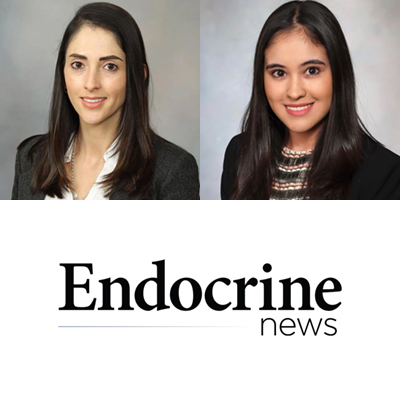
Hello, I'm Aaron Lohr and this is the Endocrine News Podcast. Today we're taking a closer look at tirzepatide, a type 2 diabetes medication also used to help with weight loss. Postmenopause weight gain can be a normal part of aging, and there are some questions about whether medications like Tirzepatide could be useful and safe for postmenopausal women. To help us answer those questions, we have two guests today, Dr. Daniela Hurtado Andrade and Dr. Regina Castaneda. Dr. Hurtado Andrade is Assistant professor of Medicine at the Mayo Clinic Alex School of medicine and Dr. Castaneda is a research fellow in the Division of Women's Health at Mayo Clinic. Our guest presented an abstract at end of 2025 entitled One Year Real World Weight Loss Outcomes with Tirzepatide in Postmenopausal Women with and Without Hormone Therapy. Thank you both for being here today.
- [01:09]
B
Thank you so much. We're very excited to be here.
- [01:12]
A
What is the connection between menopause and weight gain?
- [01:17]
B
We know that weight gain during midlife is a common concern among women, and we know that this is mostly related to aging. However, menopause itself also contributes. During menopause, women experience a decline in estrogen levels and this can lead to changes in body composition. We see a shift from subcutaneous fat to an increase in visceral fat. We also see changes in resting energy expenditure, a reduction in muscle mass coupled with an increase in fat mass. But also the menopause symptoms can contribute to sleep disturbances, changes in physical activity, and this contributes to the weight gain we observe during midlife.
- [02:01]
A
And what do we know about how many women receive menopause hormone therapy for their menopausal symptoms?
- [02:07]
B
Hormone therapy is indicated for the treatment of basement symptoms, and these are the cardinal symptoms of menopause. And this affects more than 80% of women. And despite being very effective under prescription remains widespread. Many women don't receive hormone therapy not only because they meet contraindications, but also due to personal preference, safety concerns, some misconceptions. Also, there is provider hesitancy. Also, it can be just personal preference, right? So real world data suggest that a minority of eligible patients actually are taking hormone therapy. And I don't know if Dr. Crucera wants to expand more in this idea.
- [02:50]
C
Just to highlight perhaps what you have said, that from the clinical practice perspective, the prevalence of menopause hormone therapy use have significantly declined over the past two decades. If we look at data from the 90s, the prevalence of hormone therapy was certainly greater than 20% in some countries. In Europe, greater than 30, 40%. So menopause hormone therapy was prescribed much more commonly than what it is now because of the data of large studies that showed a potential risk of hormone therapy. Again, the way these studies were developed and planned led to misunderstanding of what women should be on hormone therapy. And depending on the age and the duration of hormone therapy, the benefits still outweigh the risks. The prevalence of hormone therapy sharply started to decline in the 2000s and. And we never recovered. We are in 2025. We know that most women with vasomotor symptoms will have no contraindications to use hormone therapy, and we still don't use it. Currently, among the women who have an indication, less than 10% actually are using hormone therapy. So vasomotor symptoms are certainly undertreated. Again, Regina discussed about the concerns of hormone therapy. But let's keep in mind that there may be additional options for vasomotor symptoms, as seems like women feel that having these very bothersome symptoms that affect the quality of life, that affect your health, because we know these more symptoms are associated with increased cardiometabolic risk independently of menopausal status, Many women still are not treated for those.
- [04:33]
A
Before your research, what did we know about how menopause hormone therapy influences weight loss outcomes?
- [04:41]
B
Our previous study with semaglutide suggested that postmenopausal women using hormone therapy experience greater weight loss compared with those that were not using hormone therapy. However, no data existed on how hormone therapy might influence the outcomes with the newest medication, tirzepatide. And, you know, in observational studies like ours, evaluating the consistency of findings is essential because it helps strengthen the confidence in our association that we're seeing. So for us, it was very important to evaluate if we're seeing a similar finding or trend with a different medication of the same class, perhaps.
- [05:21]
C
Aaron, just to add on to what Regina had said, Regina was the junior researcher in this project. We worked on the semaglutide project with another research fellow, and the idea came from a couple of observations. My clinical practice is primarily perimenopausal women, breast cancer survivors, and we had noted a couple of things. So the one observation was that postmenopausal women were coming, and I was not seeing the expected outcomes or expected effectiveness of these medications in many of these women. So we started looking what may be explaining these differences. And then we thought, okay, we know about the role of estrogen, progesterone, and how hormone therapy could mitigate some of the body composition changes that women experience as they transition through these stage of life. That's why we started looking at our data. Then we also saw some data in breast cancer survivors, breast cancer survivors that were using aromatase inhibitors, which inhibit the production of estrogen from the adipose tissue. And we realized that these women on aromatase inhibitors, breast cancer survivors on aromatase inhibitors, were not losing weight as we would expect with weight loss medications. So we did two studies that were kind of parallel studies. One was looking at both weight loss outcomes in response to all obesity medications in breast cancer survivors using aromatase inhibitors. And we compared outcomes with women that have never had cancer. Therefore, they were not on aromatase inhibitors. And we found that those on aromatase inhibitors were losing a suboptimal amount of weight. Similarly, we did the study on semaglutide comparing postmenopausal women with and without hormone therapy. And we showed that those with hormone therapy did lose more weight. And we have been trying to find ways of validating our data, trying to understand why we're seeing these differences. And the first step was to look into the tirzepatide data. It had not been explored, and that's why we did this study.
- [07:27]
A
And it raises a question. So you already had done a study looking at semaglutide, and now you're looking at tirzepatide. Can you tell us a bit more about how those two medications differ from each other?
- [07:36]
B
We know that Semaglutide is the GLP1 receptor agonist, and then tirzepatide is a dual GLP GLP1 receptor agonist. So tirzepatide activates both pathways. Therefore, it improves glucose metabolism, reduces appetite, enhances weight loss more robustly. For us, it was very important to evaluate.
- [07:58]
A
All right, let's hear a little more about your study. What did we not know that you wanted to learn? Also, how is your study conducted?
- [08:05]
B
So, as Dr. Hutara was mentioning, we aim to evaluate the role of menopause hormone therapy on weight loss outcomes with tirzepatite in postmenopausal women with overweight or obesity. So we conducted a retrospective study. We started with more than 15,000 women with a prescription of tirzepatite. And then we identified 400 postmenopausal women, women who had been using tirasepatite for at least 12 months. We really wanted to see the long term outcome, so we included those that were using the medication for at least 12 months. Among these, 400, only 40 were using hormone therapy concurrently with Tirisepatide. Then we wanted to match to 80 women not using hormone therapy. So we performed a propensity score matching Based on age, BMI, history of type 2 diabetes, history of prior use of obesity medications, age at menopause, type of menopause, and we got 80 match controls and we compared them with the 40 that I mentioned before. And our primary endpoint was to evaluate total body weight loss at last follow up. And this was 18 months. We also wanted to see the categorical weight loss threshold. What was the percentage of participants that reached to that threshold at last follow up? So we were doing a very meticulous chart review to verify that they were using hormone therapy and we were ensuring that they were following up with tirzepatite hormone therapy during this year.
- [09:41]
A
And what did you find? And I love asking this question, was there anything in your findings that surprised you?
- [09:47]
B
We found that after 18 months of treatment, women using hormone therapy lost significantly more weight compared to those not using hormone therapy. 19% total body weight loss versus 14. In other words, the hormone therapy group experienced a 35% greater weight loss following 18 months of treatment. We also found that women taking hormone therapy were more likely to achieve categorical weight loss thresholds. For example, they were twice as likely to achieve more than 20% total body weight loss compared to those that have never been exposed to hormone therapy. This is an observation and this association suggests that there could be a potential synergistic effect between estrogen and tirzepatide. However, it's very important to emphasize that we know that these medications are effective across all reproductive stages. So its efficacy is not limited to women using hormone therapy.
- [10:46]
A
What do we still need to learn about the role of tirzepatide regarding weight loss outcomes?
- [10:53]
B
This is a very important question. Both of these studies that we're mentioning are retrospective. So we are demonstrating an association, but the nature of the design is not allowing us to establish causality. So we need prospective studies to confirm these findings. And then after we confirm these findings, we need to explore the underlying mechanisms behind this. We have some hypotheses that could explain the observed differences we are reporting. First, it's possible that we are seeing the effect of a healthy user bias, right? Whereby hormone therapy users are more likely to engage in healthier behaviors. There is also the possibility that the mitigation of basal motor symptoms in these women is improving the overall well being. So now it's easier for them to just adhere to lifestyle interventions in changes in diet, physical activity, and last but not least, GLP1 signaling may have a direct pharmacological effect influencing appetite, metabolism and weight regulation. There is some preclinical data from broad end models showing a potential synergistic interaction between estrogen and endogenous GLP1 signaling, where estrogen amplifies the appetite suppressing effects of GLP1 and reduces food motivated behavior. So I think we need to explore this and it will be very interesting to see what can be the underlying mechanism. Also, I think that for a future direction, we need to assess changes in body composition and just evaluate very careful cardiometabolic outcomes that could also show these differences.
- [12:34]
A
What should healthcare providers consider when determining therapeutic options for patients interested in menopause hormone therapy?
- [12:42]
B
First, I want to emphasize that hormone therapy is not recommended for weight loss. So despite we're showing this association and these findings suggest greater weight loss, we're not promoting the use of hormone therapy for weight loss. Prior to initiating hormone therapy, there should be a careful assessment of the patient's medical history, risk factors, potential contraindications to ensure the safety of this medication. Right. And the appropriate use and management should always be individualized. We have mentioned this in the past. So if a woman is experiencing significant beta marrow symptoms and is an appropriate candidate for hormone therapy, and in addition to this meets the criteria for obesity pharmacotherapy, that's a different conversation. And treatments are indicated and could be used concurrently. Right. So in such cases, I feel like there is no question, but the decision to start therapy should still follow a careful assessment. And that's very important. In general, when we want personalized, individualized therapy, we need to look at the whole picture. And I believe that when discussing weight loss interventions with a patient, we are recommending changes in physical activity, diet, lifestyle modifications, and this may be difficult to implement for someone that is constantly experiencing, experiencing the burden of basal motor symptoms. And I have no doubt that these interventions will be more feasible when a patient is feeling better, sleeping better, just enjoying a better quality of life. Right. So I feel like the mitigation of these symptoms can facilitate a greater engagement in the weight loss journey. And I think Dr. Hurtado can expand this idea because she sees this patient in clinical practice.
- [14:32]
C
Honestly, you did an amazing job. And what I want to summarize, because we have had patients trying to connect with me via email asking they should be prescribed hormone therapy. They are taking semaglutide or tirzepatide and they haven't seen the anticipated weight loss response and they are wondering if by adding hormone therapy they can achieve better weight Loss outcomes. And my answer is if there is an indication for hormone therapy, meaning the presence of asmotor symptoms, they should discuss this with their primary providers or their gynecologist or women's health provider. Because while it may affect weight loss outcomes, the benefits of treating vasomotor symptoms are beyond just improving. The weight loss responds to these medications. And if there is an indication, again, women are just living with vasomotor symptoms and they do not realize how their quality of life is affected by these very bothersome symptoms. So as long as an indication, irrespective of what they are doing from the weight loss perspective or not, this is something that should be treated. I tell them that while our study shows an association, it doesn't prove that the use of hormone therapy by itself will help them lose more weight. But they may be able to become more active, be more comfortable exercising without being afraid that they are going to have a hot flash.
- [16:00]
B
They may be able to sleep better.
- [16:02]
C
I also recommend that when people are using these medications there is a very comprehensive assessment of their health. Are they being evaluated for obstructive sleep apnea, which again is the higher prevalence among postmenopausal women. It presents differently in women than it presents in men. Are we evaluating for other comorbidities that could be affecting their weight loss outcomes? We know that individuals with type 2 diabetes will lose less weight in response to these medications compared to individuals who do not have diabetes. So it is not a yes or no answer. Is we need to provide an individualized approach for our patients. And if this means that we need to consider combination of therapy, menopause hormone therapy and these medications because women have a clinical indication, I think that should be explored. Another thing that I want to emphasize is that weight loss by itself is indicated as a non hormonal intervention for the improvement on vasomotor symptoms. And when women come to see me in clinical practice, if they are having vasomotor symptoms, I will put a consultation to visit with our women's health expert. Sometimes we are surprised by how the weight loss intervention helps with our vasomotor symptoms. So it's that two way connection. It needs to be explored further.
- [17:22]
A
This has been a fascinating conversation and I hate it when we run out of time. But unfortunately that's what's happened. So I want to say thank you to both of you for being on the podcast today. This was fantastic.
- [17:32]
B
Thank you so much Aaron. This was a great discussion.
- [17:36]
A
That's all for this episode. I hope you enjoyed hearing from Drs. Hurtado and Castaneda talk about menopausal hormone therapy, tirzepatide, and weight loss. Maybe you had some questions that I didn't ask. Wouldn't it be great if there was a place to talk about these issues more in depth with other professionals in the field? Well, good news. There is the Endocrine Society just refreshed their special interest groups and online forum. There are nearly a dozen special interest groups, including ones on obesity and women's health. If you'd like to be part of this vibrant community, we'll leave a link in today's episode description. We'll be back soon with another fascinating dive into the world of endocrinology. Until then, thanks for listening. Thing Endocrine News Podcasts are a free service of the Endocrine Society. To learn more or to become a member, visit the society's website at www.endocrine.org.