← English Learning for Curious Minds | A More Interesting Way To Learn English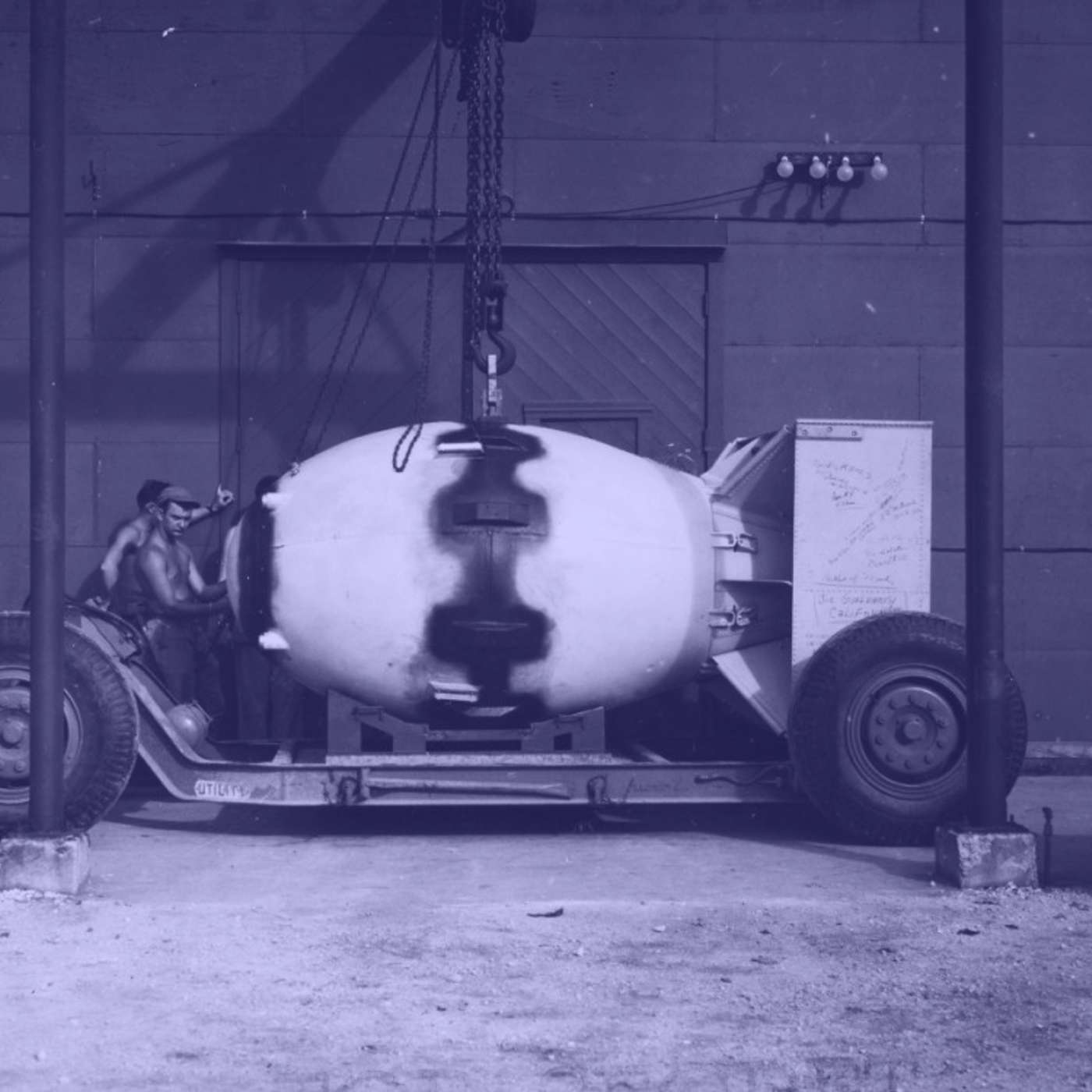
English Learning for Curious Minds | A More Interesting Way To Learn English
#284 | The Atomic Bomb Part 1: The Manhattan Project
Loading summary
Transcript14 lines
- [00:00]
Alastair Budge
Hi there, Alistair.
- [00:01]
Podcast Host
Here, let me tell you about something really exciting. Our first challenge of the year, the Great Speeches Challenge, is starting this Monday the 19th of January. We first ran this challenge last year and it was incredibly popular. So by popular demand we're doing it again. Over the next few weeks we'll study some of the most iconic and famous speeches in English from Winston Churchill to, to J.K. rowling, Queen Elizabeth I to Charlie Chaplin. You'll improve your listening, pick up memorable vocabulary and expressions and learn how great speakers actually use English to persuade, inspire and move people.
- [00:47]
Alastair Budge
I've put a link in the description.
- [00:49]
Podcast Host
For this episode where you can find out more. Okay then, now it's time to enjoy the show.
- [00:59]
Alastair Budge
Hello, hello, hello and welcome to English Learning for Curious Minds by Leonardo English. The show where you can listen to fascinating stories and learn weird and wonderful things about the world at the same time as improving your English. I'm Alastair Budge and today is the start of another three part miniseries, this time on the atomic bomb. There are few times in history where you can say that an event truly changed the course of world history. But at 8:15am on August 6th of 1945, when the first atomic bomb exploded over, Hiroshima was one of them. It didn't just kill tens of thousands of people instantly, it didn't just kill tens of thousands more in the following weeks, months and years. It changed the entire concept of what war was and ushered in a new nuclear age. And it's no surprise that when it comes to lists of what people believe are the most important events of the.
- [02:05]
20Th century, the creation and dropping of.
- [02:08]
The atomic bomb is always up there at the top. So this is what we're going to talk about in this mini series. In part one, today's episode, we are.
- [02:18]
Going to talk about the run up.
- [02:19]
To the dropping of the first bomb, how scientists discovered the potential for an.
- [02:25]
Atomic weapon, how the bomb actually worked.
- [02:28]
And the years that led up to it actually being dropped.
- [02:32]
Then in part two, which is going to be one of our member only ones, we will talk about the dropping of the atomic bombs on Hiroshima and Nagasaki and talk about the immediate aftermath of the events. Then in part three, our final part, we'll talk about the aftermath of the atomic bomb, some of the ethical questions that it raised, and ask ourselves whether such a huge loss of life could have been avoided. Before we get right into that though, I want to remind you that you can become a member of Leonardo English and follow along with the subtitles, the transcript and its key vocabulary. Over on the website, which is leonardoenglish.com membership of Leonardo English, gives you access to all of our learning materials, all of our bonus episodes. So that's almost 300 different episodes now, as well as two new ones every week, plus access to our awesome private community where we do live events, challenges and much, much more. So if you are ready to take the next step on your English learning journey, the place to go is leonardoenglish.com okay, let's get started. If you can think back to your science class at school, perhaps you remember something about atoms. An atom is the smallest unit of matter that exists. They are tiny, about 100 millionth of a centimeter across. You'd need to put a hundred million side by side, and even if you could, they would be no bigger than your little finger. And you might think that given they are so incredibly small, the discovery of the atom would be a relatively new thing. It isn't. The atom, or at least the idea of the atom, in fact, is nothing new. If you know your ancient Greek, you will know that the word atom comes from the ancient Greek atomum, meaning something that is impossible to be cut or divided. Ancient Greek philosophers, going back to the 5th century BC, theorized about what the smallest thing in the world was, imagining what would happen if every piece of matter was cut in half until it was impossible to cut any further. And although they, of course, lacked the technical ability to actually do this, they did believe that it existed. It wasn't just the ancient Greeks. There's evidence of Indian philosophers in the 8th century BC having similar discussions, imagining what the smallest unit of matter could be. And they reached a similar conclusion. For millennia. This idea, the concept of what was called atomism, was something that remained theoretical. Galileo explored it, as did Descartes and Sir Isaac Newton. Modern atomic theory was spearheaded by an Englishman named John Dalton back at the very start of the 19th century. In 1897, the English scientist J.J. thomson discovered the electron, the negatively charged particles that circle the atom. In 1911, a New Zealander called Ernest Rutherford discovered the proton, the positively charged particle, at the centre of the atom. But the crucial discovery for the purposes of the bomb would come 21 years later, in 1932, when an Englishman named James Chadwick discovered the neutron, which, as the name suggests, is neutral. It's neither positive or negative. This was important because scientists suddenly realized that there must be an incredibly powerful amount of energy holding the protons and the neutrons together at the core of the atom. Hidden in the center of an atom was the most incredible amount of Energy. If only that energy could be released, well, it would unleash a new world of possibilities. It was still to most leading scientists considered to be impossible. The nucleus was so small there was no way it could be split, no way that this energy could be released. Some, for example, the Hungarian physicist Leo Szilard foundation strongly believed it was possible, but lacked the ability to actually prove it. But six years later, in 1938, the German physicist Otto Hahn and the Austrian Swedish physicist Elise Meitner became the first people to actually conduct nuclear fission. A reaction in which the nucleus of an atom is split, broken into two or more pieces. What Hahn and Meitner observed was that during this process, large amounts of energy were released. News of this discovery spread fast. While scientists might have been interested in it from a scientific discovery point of view, politicians and also business people were interested in possibilities for its practical use. If there was a process that would release vast amounts of energy, just think of how it could be used to create energy to power transport, for construction or even for destruction. Shortly after the discovery of nuclear fission, war broke out in Europe. And By December of 1941 the United States had also entered the war. After the bombing of Pearl harbor on December 7, Hitler had become very interested in nuclear fission's potential. And there was a real fear in the United States and in Europe that Nazi Germany would develop a weapon that harnessed the immense power of nuclear fission. That Germany would get to the bomb.
- [08:45]
Before the Allies did.
- [08:47]
After all, nuclear fission had been discovered in Germany. And as early as 1939 Hitler had created the Uranwerheim, the Uranium Club in English, which was the German nuclear weapons program. Fortunately, it wasn't just the Nazis who had started their research. Early in 1939, two years before the US even entered the war, a a group of scientists sent a letter to President Franklin Roosevelt urging him to start a nuclear research program. The scientists weren't a random fringe group. The letter had been drafted by the well known Hungarian scientist Leo Szilard, who had been forced to flee Europe to the United States to avoid persecution as he was Jewish and the letter was signed by Albert Einstein, by this time, a well known physicist who had already won a Nobel Prize and who was himself in exile in the United States. On a related note, it is interesting to think that many of the scientists who made breakthroughs in atomic research and were instrumental in the discoveries that made the bomb possible were German and or Jewish and were pushed out of Europe precisely because of Hitler's anti Semitic policies. Now back to this letter written to President FDR. It's worth reading out parts of the letter as it gives you an idea of quite how right they were. The letter reads in the course of the last four months, it has been made probable, through the work of Joliot in France as well as Fermi and Szilard in America, that it may become possible to set up a nuclear chain reaction in a large mass of uranium by which vast amounts of power and large quantities of new radium like elements would be generated. Now it appears almost certain that this could be achieved in the immediate future. This new phenomenon would also lead to the construction of bombs. And it is conceivable, though much less certain, that extremely powerful bombs of a new type may thus be constructed. A single bomb of this type, carried by boat and exploded in a port might very well destroy the whole port together with with some of the surrounding territory. This letter had quite the impact on President Roosevelt. Funding was allocated for research and mining uranium, the element with atoms that are easiest to split apart. But it wasn't until two years later, in 1942, that a full blown large scale program to build an atomic bomb was created. The name of this program, as you may well know, was the Manhattan Project. It was a huge operation with 125,000 people employed at its peak and an estimated over half a million people employed on it over the five years it was active. When some people think of this kind of scientific discovery or ask who discovered the atomic bomb, people often think of a small group of scientists working in a laboratory and some name a man called Oppenheimer as the creator of the atomic bomb. But really it was a huge operation involving over 100,000 people. Oppenheimer, given we've mentioned him, was the head of a secretive laboratory which, where parts of the bomb were developed. But he was far from a mad scientist working alone on a dastardly bomb. It's even been said that the entire United States was turned into one big factory to develop this bomb. The correct type of uranium needed to be taken from the ground and then enriched to create uranium 235, the uranium isotope, the particular type of uranium that can sustain a nuclear chain reaction. Alongside this, there were huge factories working on producing plutonium, the element which would later be used in the bomb in Nagasaki. The technology that went into the two atomic bombs was actually very different. Uranium for the one that would later be dropped on Hiroshima and plutonium for the one dropped on Nagasaki. The Manhattan Project worked on both at the same time in order to increase the odds, increase the probability of discovering one type of bomb that would work. Now, you are probably thinking this sounds like an absolutely monumental project with hundreds of thousands of people involved. Was it really a secret project? Surely the news of it would get out. Well, there were over 100,000 people working on this project at its peak, but only a tiny proportion of them would have known what they were actually working on, that they were actually working on developing a bomb. The scientists would likely have known, or at least had some knowledge, but they were actually a small proportion of the total workforce and as little as 5%. The rest were working in construction of these very large plants, in mining the uranium, and would likely not have known that they were building an atomic bomb. 27 months later, on July 16th of 1945, the first bomb was ready. A test site was chosen in the desert in New Mexico, an isolated area far away from any other settlements. At 5.29am, with hundreds of scientists watching eagerly from a distance of 30 km, the weapon was detonated. The scientists believed it would work, but had no real idea of what would happen. Nobody had ever done anything like this before. And the director of the Manhattan Project, a man called Lt. Gen. Leslie Groves, had prepared three separate statements that could be provided to the governor of New Mexico, depending on what happened after the bomb exploded. The first statement read that everything had worked, that there was nothing major to report. The second read that there had been major damage. And the third included the obituaries, the articles written after a person dies for every scientist that had been watching 30 km away. This gives you an idea of quite how unsure they were about what might happen. Fortunately, only the first statement was required, and the test revealed to the scientists quite the destructive power of what they had created. There was a huge explosion, a massive flash of light and a mushroom cloud that rose 6km up in the sky. The desert sand melted and the shock was felt as far as 160km away. The scientists looked at each other in awe of what they had created. They had all known, in theory, what they were working towards, but seeing their creation in action must have been something very different. It was clear to all quite how powerful this weapon was, quite how much destruction it could cause if it were detonated in a city, not in a desert. Indeed, Oppenheimer, the lead scientist of the project, later recounted that at this moment, he. He thought of the words from the Hindu sacred text, the Bhagavad Gita. Now I am become death, the destroyer of worlds. From the point of view of the Manhattan Project, the test had worked. The United States had successfully built an atomic bomb. The only question remaining, and perhaps the hardest question that a US President would ever have to ask themselves was how would it be used? Okay then, that is it for part one of this mini series on the atomic bomb. We went from the early ideas about the structure of atoms through to the discovery that an atom could be split, right through to the consequences of this and the detonation of the world's first atomic bomb. Next up in part two of this mini series is going to be what Happened Next. I'm sure you know something of what happened next. Atomic bombs were dropped on Hiroshima and Nagasaki, but in the next episode we're going to discuss this in detail and pick up where we left off from the first test of the atomic bomb. That's going to be one of our member only ones, by the way, and will come out next Tuesday. Then in part three, we'll explore the aftermath of Hiroshima and Nagasaki, discuss some of the ethical questions that have been raised about the atomic bomb, and look at how the world has changed since then. As always, I would love to know what you thought about this episode. Was the Manhattan Project inevitable? How do you think the scientists working on the atomic bomb felt at the time and after they had seen its impact? What would you have done in their position if you knew what the atomic bomb would be used for? I would love to know. For the members among you, you can head right into our Community forum which is@community.leonardoenglish.com and get chatting away to other curious minds. And as a final reminder, if you enjoyed this episode and you are wondering where to get all of our bonus episodes plus the transcripts, subtitles and key vocabulary, then the place to go for that is leonardoenglish.com and if you aren't yet ready to become a member but you would like to do something to support the show, then I would love for you to think about leaving a review or a star rating on your favorite podcast app. It takes less than 30 seconds to do, but they are super helpful and each one brings a smile to my face. You've been listening to English Learning for Curious Minds by Leonardo English. I'm Alastair Budge. You stay safe and I'll catch you in the next episode.