← Enterprising Investor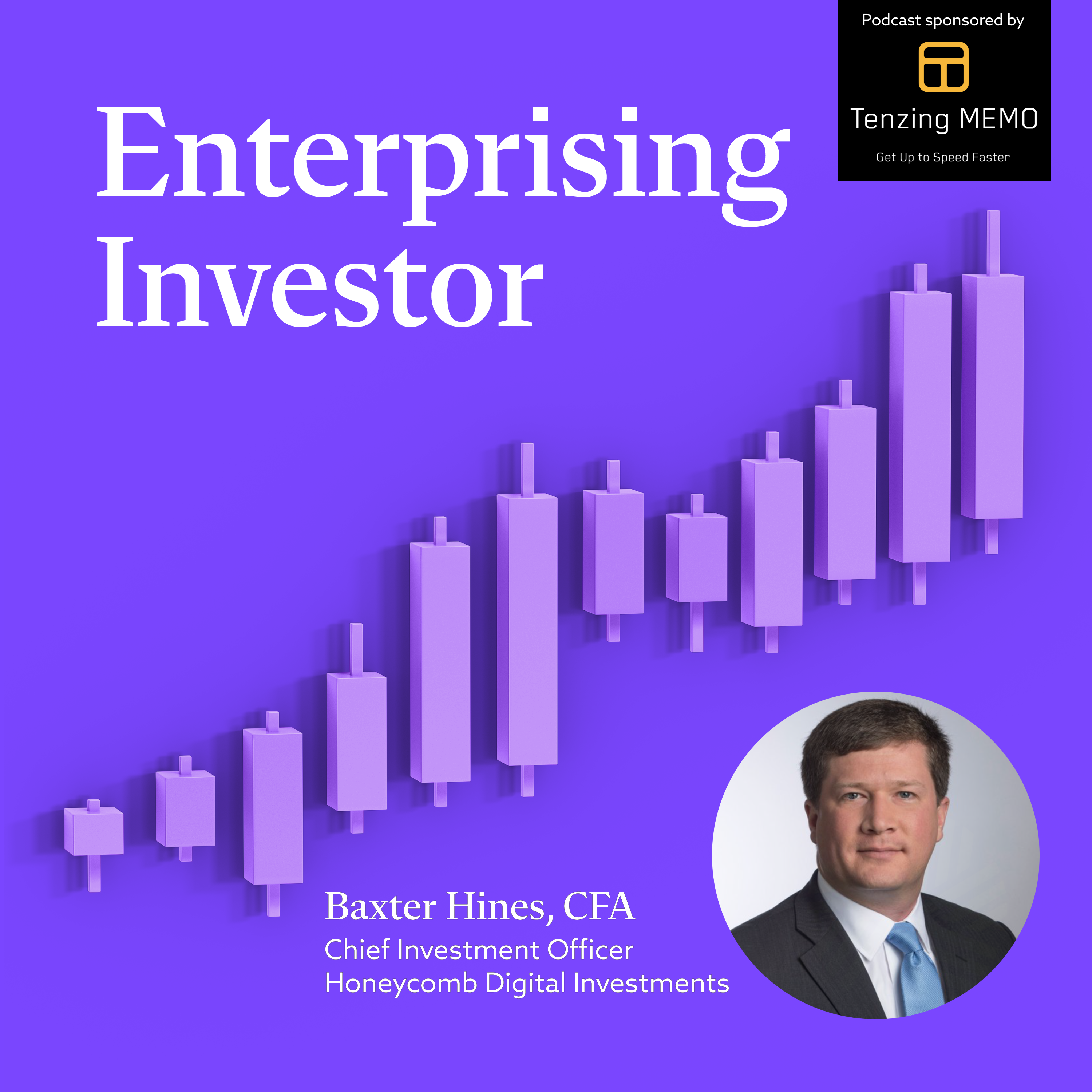
Enterprising Investor
Baxter Hines, CFA: Tokenization, Security Tokens, and the Future of Blockchain
00:27:07
Guest host Chris Wiese, CFA, Managing Director of Education at CFA Institute, speaks with Baxter Hines, CFA, Chief Investment Officer at Honeycomb Digital Investments and author of Digital Finance: Security Tokens and Unlocking the Real Potential of...
Loading summary
Transcript34 lines
- [00:03]
A
If you struggle to ramp up a refresh quickly on a long list of public companies. Listen to this Most research platforms make you dig through endless dashboards and raw data and charge a premium for it. Tenzing Memo is an AI powered market intelligence platform built for professional investors offering real time company research and insights without filters and dashboards. You just open it and get what you need in a tenth of the time at at a tenth of the cost. As one CIO put it. Tenzing Memo takes us from zero to one in understanding a candidate not in days, but in minutes. Get up to speed faster in nearly 6,000 public companies. Try memo free at Tenzing memo.com register with Code Enterprise to unlock an extended free trial.
- [00:56]
B
Hello and welcome to Enterprising Investor Podcast. I am your host Chris Wiese, CFA and Managing Director of the Education Division at CFA Institute. I'm filling in for Mike Wahlberg and today I'm speaking with Baxter Hines, cfa. Baxter is Chief Investment Officer at Honeycomb Digital Investments. He's an expert in the blockchain space and author of Digital Finance Security Tokens and Unlocking the Real Potential of Blockchain. Welcome Maxter.
- [01:27]
C
Thanks so much Chris. Really appreciate the opportunity to speak today.
- [01:30]
B
I'm glad to have you here. If you don't mind, we'll dive right in. You clearly from your books you see blockchain as maintaining a strong growth and adoption trajectory. And I wanted to ask you what use cases that you see really driving that growth for presently?
- [01:49]
C
Sure. I see blockchain being the biggest force for change in the financial industry since the Internet. It's going to revolutionize every aspect of finance. It's going to create a better, faster, cheaper way of doing things. And especially today with the advent of regulatory change and regulatory clarity coming out of Washington D.C. i think there's going to be enormous changes. Earlier this year, the House and the Senate up on Capitol Hill in D.C. they passed the Genius act, which allows for stable coins. If anyone in the audience is not familiar with the stablecoin, basically what that is is a digital version of the US dollar. So think if you have one stable coin or one stablecoin token, that's the equivalent of holding $1 in your your wallet. That is going to revolutionize what what we how we make payments in finance today. And so I think banks, any kind of financial intermediary, they are going to start to adopt this technology. And what that ultimately does is it creates a totally different cost structure for making payments. Today. A lot, a lot of transactions are done with ach. They're done with wire transfers, they're done on credit card rails and that's expensive. It's also from a settlement time perspective, it can take several days. With this new technology you can send money as easily as you send an email. And so that's going to be a game changer in such a big way. And I think that not only are we going to see peer to peer payments happening, but something that I wrote for the CFA Institute, it's an article that should be published fairly soon. It's about how foreign exchange is going to probably be the next step that people aren't thinking about. If you can tokenize a US dollar, you can tokenize a pound, a yen, a euro, whatever it might be.
- [03:46]
B
It's wonderful. What other early state use cases do you think we should be watching?
- [03:54]
C
Well, it's going to affect every part of the financial chain as I mentioned. I mean one of the interesting sort of early use cases that I was involved with was I bought a tokenized bond on the Ethereum blockchain. This was issued by an NBA basketball player. His name is Spencer Den Woody. He played for the Los Angeles Lakers, he played for the Dallas Mavericks, the Washington Wizards. He wanted to raise money for a technology company that he was starting a company called Calaxy that was a basically a social media company that was going to be blockchain based or still, it still is in existence. He wanted to raise money for that and he issued bonds on the Ethereum blockchain. Now what was interesting about this is, is that everything was done on chain, everything from the issuance to the payments that he would make. He had an interest rate of about 5% that paid monthly and all through Stablecoins, all through the Ethereum blockchain. And what was really interesting about this use case is, and this is what's so fabulous about blockchain is not only can you create what we are using today in the paper based securities field, but you can also embed compliance and other kinds of rules based coding into these new tokens and do things that you couldn't do in the paper based world. So for example, with Spencer being an NBA player, not only did he have to comply with securities laws just like anyone else, but he had the NBA worried about him. The, the NBA wanted to make sure that certain people did not hold these tokens. So you wouldn't want a referee in the NBA or another player in the NBA holding these tokens because it could give off the appearance that those other entities might have a reason to cheat or to violate some of the rules of the game. So let's say a referee owned these tokenized bonds that Spencer was issuing. That would cause a potential conflict of interest. You might have a newspaper reporter saying, hey, you know the referee, he made an easy call on Spencer last night. I think he fouled the guy. But Spencer got away with it. And the reason is because he had a financial interest in this contract. So what the NBA could do is create a blacklist of who could not own these tokens and they would issue it. And so if, let's say I was an investor in this bond, if I wanted to sell that bond and the person on the other side of the trade was an NBA referee, the blockchain just simply wouldn't allow me to do that. Also, from just a standard regulatory compliance with legal entities and regulators perspective, this bond was unique in that Reg. D securities require a one year seasoning from the time when the initial buyer acquires the bonds before he or she can sell to a new party. So let's say I own the bond and I wanted to sell to you, Chris, you said, hey, can I buy this bond? But I hadn't held it for a year. The blockchain wouldn't let me do it. So it forces regulatory compliance and cuts back on a lot of the workload for you, for me, for anybody that's overseeing these kinds of securities, it creates just a better, faster, cheaper way of doing things.
- [07:26]
B
When you say the blockchain wouldn't let me do it, what's the actual underlying mechanism that's preventing that or enforcing those different prohibitions?
- [07:37]
C
Sure. So there's code that's written into the chain itself and into the token that you have. And whenever I try to sell from me to you, the computers that are validating that transaction, meaning they'll write in the ledger, which blockchain really is. It's an accounting ledger. If they're going to write that I sold it to you, they have to go through a series of checks. And one of those checks is from a time perspective, has the bond been held for a year? If the answer's no, then it'll cut it out. Just like if you own a, an airline ticket from, you know, going from, let's say from Washington D.C. to Dallas and you've got in your phone, your American Airlines app, you try to go through the TSA line and, and you don't have TSA pre approval on your, your, your tokenized version of the airline ticket, you're not gonna be able to get through the, the TSA line because when you go up to the agent and you put your phone down, your QR code, there's going to be a series of checks that are run by the government. They're going to say, hey, you shouldn't be in this line. You're not, you're not eligible for tsa. Same kind of concept. You're digitizing these processes and ultimately you'll have lower error rates because you don't have the human factor. Get much quicker time to consummation because you don't have that human factor. The processes are automated and so there's less delay and as I was mentioning earlier, quicker settlement times.
- [09:07]
B
Well, as this gets more popular, I'm curious how you explain the benefits of tokenized securities like what you're describing. How do you explain those benefits to a skeptical investor?
- [09:22]
C
Yeah, I mean, I would just kind of say that, you know, people, people have been skeptical of blockchain for a long time, but it's now become a more seasoned technology and it's very easy to quantify a lot of, of these costs. There are tremendous costs to using paper based securities today. And you can say, look, if you want to say settle a stock or a bond and it takes three days to settle that in today's world, well, I can tell you that if you use a blockchain based, it'll be basically just a few seconds or a few minutes. I mean that's something you can quickly and easily point to and say that, that you know there's a benefit. So stuff like that is, is very easy. I think also you, you'll see that once these things are becoming much more prevalent in the marketplace that you'll see actual dollar costs going down in, in a big way. So let's, I'll just give you another example. So like in the remittance business that would be like if, if you wanted to send money from say the United States to Argentina today, you might go to something like a Western Union money. Let's say you want to send a thousand dollars to somebody, it might cost you 15, 20% as well as a lot of time to do that in terms of by the time you give the money to Western Union and the time that it would take to get it to Argentina. Plus, you know, if you send a thousand dollars, maybe the, the recipient only gets $850, there's $150 cost there. If you were to send stable coins from one wallet to another, it's going to be pennies. So very easy to quantify these benefits. And once I Think people start to see that those benefits emerge. The adoption is going to go through the roof.
- [11:17]
B
What does the correlation look like when you're investing in these tokenized securities as opposed to the more traditional corollary?
- [11:29]
C
It should be a one to one relationship because arbitrage should reduce any kind of frictions or any kind of imbalance in the prices. Actually the first way that I got interested in blockchain technology I was a portfolio manager for $40 billion investment manager based in Dallas. And we had an international strategy for equities. And a lot of our business was in the ADR space. If you're familiar with American depository receipts or ADRs, that's basically a way for US investors to get access to non US stocks. So we would buy let's say Royal Dutch Shell. We make investments in a company like that, that's a Dutch company. If we wanted to buy an investment in that, we could go to Amsterdam, we could set up a brokerage account there, we could get access to the Amsterdam Stock Exchange, we could take our dollars, we could convert them to euros. You know, we would receive our dividend payments in euros. A lot of steps there. The easier way to do it was to go and buy the, the adr, the American Depository Receipt which was basically just that. A receipt that a custody bank like a State street or a, or bank of New York, some, someone like that would give you saying that they held the Dutch shares in their vaults and they give you a receipt saying that you had them. That way you could trade the shares of Royal Dutch Shell on a US exchange and avoid a lot of those frictions. So tokenization is basically just that. It's a receipt that a digital receipt or a digital twin if you will of the underlying paper based shares. And there should be a mathematical relationship between the way that the ADRs trade versus the ordinary shares. And if that gets out of line people will arbitrage. It's going to be the same thing with these tokenized securities. And so if you look at, let's just go back to the dollar trading in the stablecoin form, very rarely do those prices deviate from a dollar. And if they do people, they will buy the stable coin if it's below a dollar and they'll, and they'll redeem them for a dollar and destroy them or vice versa. They, they would sell them if they, if the price went over a dollar and reiterate that process until the prices converged again.
- [14:02]
B
Well, maybe this might be a similar way of asking the question, but let Me ask something related which is what about volatility? Is there anything that's inherently more volatile when a security is tokenized as opposed to the underlying or is it truly the ADRs are not more volatile?
- [14:23]
C
Right, so similar tokenization is the same thing. It's like think about, I'll use the airline ticket again. Like if you have a paper based airline ticket that says hey, I'm flying from Washington D.C. to Dallas on September 1st on, on this flight number this time, that'll get you on the flight. And then the, the token that's in the, the QR code that's in your phone for that is actually is, is just the same. I mean this is exact same price that you pay for the, the airline ticket, all that. But what I would say is the, the ticket that's in your phone is actually better than the paper based ticket because let's say American Airlines decides, hey, we're going to have to change your flight time. Well, the paper based version doesn't update, whereas the phone version does. You know, and then you get all kinds of other features in the, in the, in the tokenized version. Like, you know, maybe you want to change the seat that you're in, maybe you want to change your meal preference. Same thing with a tokenized version of a security. If there's a stock split, if you've got a paper certificate for shares of the Walt Disney Corporation, it may say you have 500 shares. Well, there might be a corporate action that's happened since then where you actually have 2,000 shares. So all that information gets updated in the digital version. And so it's actually a superior way of holding the security.
- [15:44]
B
And you mentioned the regulatory structure. It sounds like it's beginning to really take shape. What work is there yet to be done in the regulatory structure?
- [15:54]
C
So great question. The regulations have made the banking laws a lot clearer. They've made it the risk of doing business on the blockchain. They've lowered them and again made the rules clear for people to operate in. Where you have some work to be done with these digital assets is around the. Probably the easiest way to put it is the taxonomy of some of these. They want to make whenever you buy a tokenized version of a security or any ownership of anything, you want to have clear legal titles. So right now what they're they're working on in, in D.C. is what they call the Clarity Act. That is to define again the market structure behind a lot of these digital assets. How do we classify if something is a security or Not a security. Who does and who does the jurisdiction fall under? Is it the, the cftc, Is it the sec if you're in Switzerland, finma, who, the regulator there, they've tried to do this. The US is going through that exercise right now. And so with the stable coins, there is some ambiguity right now around the interest payments. If I were to issue you a stable coin that bears interest now the question is, is that a security? Is that a bear instrument? What is the nature of that token that I'm selling to you? Is it a money market mutual fund? Depending on how the chips fall, based on the regulation that gets passed, it's going to determine a lot of different aspects. And so that's something that again, big banks, big financial services companies, they need to have clarity on that. Today you can issue a stable coin where it's equal to a dollar, but it's going to probably be equal to a dollar five years from now, ten years from now, whatever that period might be between when you have it today and where do you redeem it for? I think the getting the interest piece ironed out, that's going to be the next big thing that Congress needs to tackle.
- [18:18]
B
Do I understand correctly? I think there's some controversy over which entities can pay the interest as well. And what I'm alluding to is I think there's a provision that allows the actual exchange to pay interest and the banks are pretty worried about that. Are you familiar with that issue?
- [18:33]
C
Yes, there's a lot of issues around who pays that interest and then there are all kinds of reporting issues that have to be taken into place. So like if you buy a bond from a corporation or from the government, usually you'll get some sort of a statement, a W9 or not W9, some sort of an IRS tax form or whatever jurisdiction you're in so that you can pay taxes on that earnings. On the flip side, the entity that's paying you that interest, they want to get a tax credit for the interest that they've paid. So again, all of that has to be ironed out. And that's why at this point today, what we're seeing in the marketplace, the options that are dominating are the non interest bearing stable coins. And you might ask yourself, well, why would someone want to have a non interest bearing stable coin? And the answer is easy. And that is that the convenience of being able to pay someone in real time for whatever good or service that you're exchanging for that, for that actual dollar. So people are willing to forego the interest amounts to get that convenience yield, if you will.
- [19:44]
B
That makes sense. People all the time pay for that convenience when they pay for a credit card, right?
- [19:49]
C
Yeah. Or holding cash in your wallet. Why don't you put that in the bank? Well, because I want to go to the store and buy a stick of bubble gum.
- [19:57]
B
Yeah, that makes sense. Okay, so we've talked about tokenization, which is certainly improves the liquidity and the efficiency in the market. What about as an investment? So cryptocurrencies, for example, and adoption of cryptocurrencies. What are your thoughts there?
- [20:21]
C
So not financial advice, but I would encourage people to look at cryptocurrency as a viable investment option. I would say to look at it in the lens of, you know, what we were trained for when we took the CFA exam. Look at it, how it correlates to other assets, at least on historical basis. Crypto, if you're looking at any kind of long term correlations, is actually still very low correlation with other assets. And so if you can find those kinds of things, if you're a financial advisor, if you're an asset allocator, when you have investments that have a capital appreciation potential that are lowly correlated, there typically is room in a portfolio for that in small allocations. And so I think you're going to see more and more people, especially now that the laws are getting clarified so that people don't get into trouble for holding cryptocurrency, you're going to see more and more people at the margin getting off of zero allocations in crypto and, and putting money into the space. And Bitcoin, to me will serve as digital gold, as an alternative to gold and other precious metals, as well as other sort of stores of value, if you will. If it's the dollar, the yen, the euro, treasury bonds, I think it will at the margin take share from those asset classes. And then the other thing that I would say, which is to look down the road, is some of the other cryptocurrencies, and I'm the first to say most cryptocurrencies are total garbage. They have no value. But there are a select few cryptocurrencies that have a utility value, meaning you can use those cryptocurrencies to do something that solves a commercial or economic problem. Like you can use them to play a video game, you can use them to store a file online, you can use them to exchange goods or services. There are literally hundreds of different use cases that you can have with cryptocurrency. And I see that becoming Like a digital oil, if you will. I see companies like say Walmart, if they want to run their supply chain on the blockchain, they're going to have to go out and buy certain cryptocurrencies and use those cryptocurrencies to write transactions in the ledger. Same thing with something like Louis Vuitton. If they want to put any counterfeiting measures into their handbags and into their shoes to make, make people know that they're authentic and that they actually came from say, Louis Vuitton. Again, Louis Vuitton's gonna have to go out and procure cryptocurrencies just like they have to buy electricity or oil based products, whatever it might be. Crypto will become a commodity that is needed to conduct, to conduct business efficiently and sort of get with the times in the 21st century. So there's gonna be that type of value as well. And so I would encour, look at those investments again from a utility space and I think the allocations will go up into those cryptos as we go into the future.
- [23:27]
B
What do you look at when you're assessing the relative value or fair value of something like Bitcoin?
- [23:35]
C
Yeah, sure. So the first thing that people need to know is that the supply of Bitcoin is programmably fixed, meaning that you know at any point in time what the total amount of bitcoin in the world is and that supply caps out at 21 million bitcoins. So you know that there is a, a fixed supply of something and you know that there is a demand for it. If that demand is increasing over time, like we've discussed, you know, Economics 101 says prices should go higher, but there are different ways to think about what the actual price should be. But you look at it on a supply demand type of basis, that's the easiest way to think about it. I believe also that Bitcoin should trade somewhere around the total market cap of gold. That's another framework that I would encourage people to look at it on as well.
- [24:39]
B
I mean, it certainly is a substitute for holding gold or a substitute for holding dollars. Right. What's been the impact of the falling dollar, for example, on bitcoin, if any.
- [24:51]
C
Yeah, again, I'd go back to scarcity. You cannot create new bitcoins out of thin air. You can create new pounds, euros, dollars, yen, whatever it may be with a money printer or electronically. Just program them in. If you're the central bank of the countries that issue these, these, these fiat currencies, Bitcoin, you Can't do that. You have to have. You have a certain amount that's mined. Those bitcoins are in wallets, and the holders of those bitcoins, they have to be willing to release them at a given price through a sales process to make it happen. So that scarcity is really where it all begins and ends.
- [25:33]
B
With bitcoin, how do you tend to counsel people with respect to the volatility of some of the different bitcoins?
- [25:42]
C
Yeah, I say the first thing is, anybody who's got a CFA like me, you want to diversify. So keep your position, size small, rebalance periodically, and dollar cost average. I mean, those are the three things that I would say. If you do that and you're responsible with your allocations, you know, and where you can take the hit, but you can still be exposed to the asymmetric upside potential that bitcoin affords, then that's, That's a responsible way of, of, of looking at it.
- [26:17]
B
Well, we are, we're running low on time, but before we end, I wanted to ask you, is there anything I should have asked you, like, after we hang up here? Just like, man, I wish that guy would have gone this route or that.
- [26:29]
C
Yeah. I mean, I would say to, you know, keep abreast of what's, what's going on in, in Washington. You're, we are, are seeing now that these technologies are not just a. Something of imagination or what could be. They're. They're here knocking on our doorsteps. And, and I would encourage people to go out and find ways that you could incorporate blockchain and cryptocurrencies into your business, because it's here and it's not something that's down the road anymore.
- [27:06]
B
It's wonderful. Thank you. And to all our listeners, I'll say, these days, the CFA program has bitcoin within it, so if you feel you need to come up to speed, certainly check out our refresher ratings, and I hope you'll check out Baxter's books that we mentioned at the beginning of the podcast. So, Baxter, thank you so much for joining us. It's been quite interesting.
- [27:29]
C
Thank you so much, Chris. I really enjoyed being here today.
- [27:32]
B
Great. Thank you. And thank you all for tuning into the Enterprising Investor podcast.