← Enterprising Investor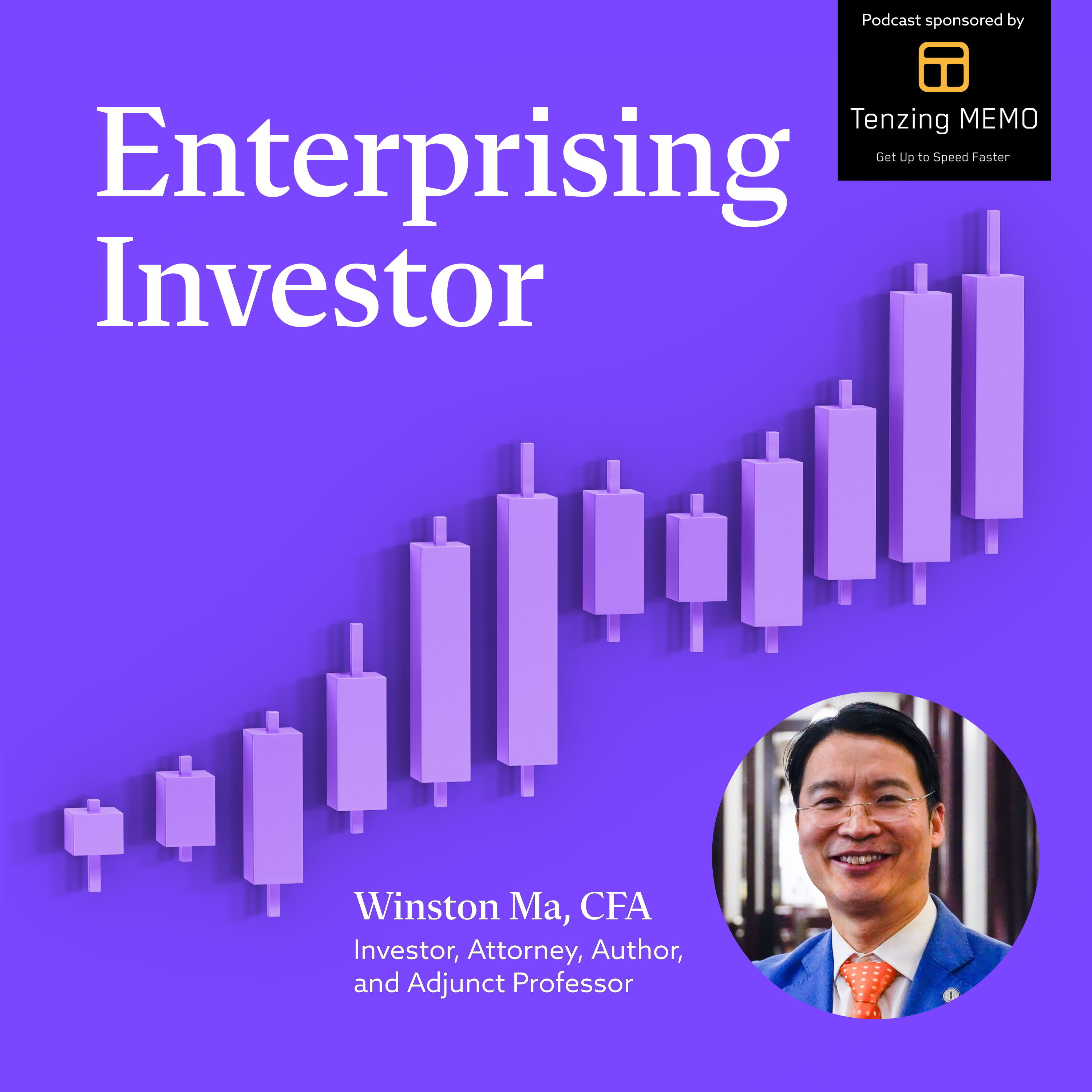
Enterprising Investor
Winston Ma, CFA: Sovereign Wealth, AI Strategy, and the Future of Global Capital
00:33:37
In this episode of Enterprising Investor, Winston Ma, CFA, investor, attorney, author, and partner at Dragon Capital, joins guest host and editor of the Enterprising Investor blog, Cathy Scott, to explore how sovereign wealth is reshaping markets in...
Loading summary
Transcript35 lines
- [00:03]
A
If you struggle to ramp up a refresh quickly on a long list of public companies. Listen to this Most research platforms make you dig through endless dashboards and raw data and charge a premium for it. Tenzing Memo is an AI powered market intelligence platform built for professional investors offering real time company research and insights without filters and dashboards. You just open it and get what you need in a tenth of the time at at a tenth of the cost. As one CIO put it. Tenzing Memo takes us from zero to one in understanding a candidate not in days, but in minutes. Get up to speed faster in nearly 6,000 public companies. Try memo free at Tenzing memo.com register with Code Enterprise to unlock an extended free trial.
- [00:56]
B
Hello and welcome to the Enterprising Investor, the flagship investment podcast for CFA Institute. I'm Kathy Scott, editor of the Enterprising Investor blog and today's guest is Winston Ma. He's an investor, attorney and author in the global AI digital economy. Winston is a partner of Dragon Capital, an AI focused family office, and the Executive Director of the Global Public Investment Funds Forum. And until recently, for 10 years, Winston was the head of the North America office for China Investment Corporation, China's sovereign wealth fund. Welcome Winston.
- [01:37]
C
Good morning.
- [01:37]
B
Kathy, Good morning. Thanks for joining. So you often say that modern investing lies at the intersection of law, finance, geopolitics and technology. And I suppose the creation of the US Sovereign wealth fund is a prime case study of that.
- [01:52]
C
Yes, very much so, Keith.
- [01:54]
B
So for those listeners who aren't following this initiative very closely, tell us how the US Fund differs from traditional sovereign wealth funds.
- [02:02]
C
Yes, you know, the US Sovereign wealth fund comes from a very different context when you compare that with global sovereign wealth funds. First, traditionally sovereign funds are created by countries that have a wealth or a surplus in cross border trade. And that's what the term sovereign wealth fund comes from. For the U.S. the Trump administration is creating a sovereign fund out of a deficit country. Secondly, for global sovereign funds, most of them are authorized by the their legislature and the Congress will allocate a portion of the national balance sheet to the sovereign wealth fund. But in the US it's the opposite. You know, the sovereign wealth fund is driven mostly by the executive power and the Trump administration is running it. Thirdly, and maybe the most interesting part is the unconventional source of capital. As we commented, the US Sovereign fund is based out of unconventional capital, unlike the Middle east, for example, which manages all your money for financial returns. Instead, the US Sovereign wealth fund has to find creative ways of capital, even including foreign capital, because During Trump administration's trade agreement with countries like Korea, Japan and the eu, the US Asked these countries to make investment commitments in the order of magnitude of several hundred billions of dollars for each. So altogether we may find a US Sovereign fund mostly financed by foreign capital.
- [04:06]
B
Right. When it first came out, there appeared to be like no asset allocation plan, right. For the US Fund. But a clear strategy appears to be emerging with its recent investment in Intel. So what is that strategy?
- [04:20]
C
Right. When you look at the evolution of this US Sovereign fund since February executive order by Trump, it started as an ad hoc collection of US assets, for example, Bitcoin reserve, golden share received from the Nippon Steel and US Steel merger, and also recent MP Materials investment. So if we look at the evolution of the US Sovereign wealth fund since the February executive order by Trump, the US Sovereign web fund initially started as a collection of ad hoc assets owned by the US Government, for example, the Bitcoin reserve or the golden share received from the Nippon Steel and U.S. steel merger, and even potentially a stake of TikTok if the deal can be approved by the China government. But now with intel investment, together with the recent MP Materials investment by the Pentagon, we can see a clear strategy of US Government using strategic capital to invest into strategic sectors, especially the chip and AI sectors, to compete with China for tech supremacy and supply chain independence. This is a very distinctive and clear strategy.
- [05:55]
B
So what ties all of these different industries together? Does the timing of the intel deal, just weeks after the White House's AI Action Plan, explicitly about winning the AI race? Does that suggest AI is at the center of the fund strategy?
- [06:11]
C
No, no, not at all. It's not a coincidence because the US Simon Wells Fund seems very closely connected with the White House AI Action plan. And you could even say most of the investments we have seen so far are related to the AI Action plan. So if we look at intel, intel is the only chip manufacturing company of the US that can manufacture physical chip on the US soil. So this is a very strategic company for the US Even though it has struggled since the smartphone and AI era. And when you look at the rare earth industry, that is also critical for chip manufacturing. So when you put all these together, essentially the Trump administration is developing a new supply chain for US chip, especially for chip manufacturing. So you could say that strategy is a made in USA strategy for the AI sector.
- [07:21]
B
Right, right. So I know you're dying to talk about it. The latest news out this morning as we're recording this on Intel.
- [07:31]
C
Sure, sure. Kasey, let's start with the first investment by Trump administration into intel last month, in August 2025. You know, in August, Trump administration converted $8.9 billion of chips act money into intel both in the form of grant and awards into equity. So essentially making US government close to 10% equity ownership in intel for this investment. There are three very important strategic angle coming from the US government. Number one is a strong market signal. As we know, intel has struggled in recent years because it has missed both waves of smartphone and AI. So Trump's investment into intel sends a signal to the market that intel will be here and the US Government will keep it there. Because intel is the only US company that can manufacture chips on the US soil. And the second part is a poison pure provision which highlights this strategic position in this term sheet. The US government will get the right to purchase additional 5% of intel if Intel's foundry business which manufactures chips will be sold to elsewhere. Now this is strategic because if you ask a Wall street banker or P fund, maybe their advice to intel is to get rid of the foundry business and to focus on chip design. But from a supply chain strategic point of view, it is important for the US to keep intel in the manufacturing business. Therefore, this poison pure provision indicates that the US Government is giving intel the incentive to keep the manufacturing unit and further develop it. Right. And the third aspect is the public private partnership. Because after Trump administration's 8.9 billion grant to Equity Conversion Softbank by Masayoshi San in Japan put additional $2 billion into intel, approximately 2% of the company. Which is a good indication that after the US investment, there will be more private capital being mobilized because they will have more confidence in the future of Intel.
- [10:30]
B
So take it to the next level from there. What was that news today and why is that significant?
- [10:37]
C
Right? So today, in September, now we have another layer of US Government's participation, subtly or not so subtly. Because if we put intel into the broad chip industry contest, we will find intel is in deep trouble. It does not only need money, it also needs customer. That's because for intel to build up its next generation AI chip facility and capabilities, intel needs to get customers first. So it's a little bit of like chicken and egg. In order for intel to be a main manufacturer of advanced AI chips, it needs to have those customers so that it can work on it and develop the chips together with its customers. And these customers are Nvidia, AMD and maybe Apple as well. So if you look at Nvidia, for example, Nvidia mostly manufactures its chips in tsmc. The Taiwan Semiconductor company. Now, for intel to be competitive, it needs to engage these customers so that it can work on the most advanced AI design as well as manufacturing. So what can the US Government help? The US Government essentially has put intel into a conversation with Nvidia. When you look at Nvidia's export license discussion with the US the the US essentially played as a sovereign wealth fund as well because in that case, US government has reached agreement with Nvidia to receive 15% 15% of sales kickback in connection with the chip sales of Nvidia into China. And that revenue could be viewed as part of the financing of the US Sovereign wealth fund. Furthermore, the US Government essentially is persuading Nvidia to become a customer of Intel. So today what we see in the press release is that intel will design and manufacture advanced AI chips with Nvidia. Plus Nvidia will invest $5 billion into Intel. So overall, intel is getting a lot more than pure financing. Right. First it gets the US government support. So it indicates the government is there to keep intel alive. So in some way it's like a Trump put. And secondly, it has de risked the intel situation so more private investment came in, including the SoftBank $2 billion investment. And furthermore, third, intel also gets strategic partnership with Nvidia got more financing plus strategic industrial partnership to design and manufacture advanced chips. So overall it becomes a lot more powerful package than a pure money lending or money grant investment project.
- [14:28]
B
Right. And the market agrees with you with instel surging 30% today on the news?
- [14:33]
C
Very much so, yes.
- [14:36]
B
But let's bring it down to the practitioner level. Longer term for asset managers, advisors or even retail investors. What are the real market implications and what are your suggestions for navigating this fast moving landscape that we have here?
- [14:52]
C
Yes, so let's talk about the positive side first. The positive side is the US Government using the US Sovereign wealth fund concept is getting to private sectors to de risk the investments that have strategic objectives. So for example, in the intel context, to build up a advanced AI chip manufacturing facility may take multiple years. Private capital may not want to be the first check because it's such a long term project. So the initial US Capital's participation is provide market confidence as well as a market signal to attract more private capital's participation. So in a sense that. So if we look at it differently, intel needs money and it needs a lot of money, but it may not get to the private market money without the initial US Government's commitment. So in that context, the long term capital of US Sovereign wealth fund is critical for intel to mobilize global private market capital. So for investors, they can look at situations like this to have US sovereign fund as a great co investor, especially for AI topics. These are long term projects, highly risky IND topics. Lots of capital may go to zero and lots of investments may need many years to receive their payback. So for those projects, the US government could be the anchor investor and market investors can find a good co investor in the U.S. sAM and wealth fund. This is a good scenario.
- [17:07]
B
It sounds like you're bullish. There are a lot of positives to these developments, but what about the complexities? What challenges might we see emerging?
- [17:15]
C
Yes, you know, as you know, I worked in a sovereign fund before, so I, I knew acutely that sovereign wealth bond investments always create complexities. But if we just start from the corporate governance side in terms of how private market investors could could work together with US sovereign wealth funds in US Investments. There are controversies of corporate governance rising already in the intel situation. Right. So let's just highlight three important corporate governance controversies here. Number one is very obvious conflicts of interest. Government plays a dual role as domestic investor and a regulator. So the role of the US Government itself has multiple facets and it is hard to tell which role it is play at any particular time. And the second part is about check and balance. Right. We just mentioned that in the intel investment, the US Government essentially is playing a dual role as investor and regulator. So, so the question is who will be the regulator of the US Government to provide some check and balance regarding the government's investments, transparency, reporting and accountability. And finally the third is fiduciary duty. And this is very, very complicated because if for a particular company, let's say intel, sometimes it's very difficult to tell if certain action is good for the company or is good for the country. So essentially it's a question of fiduciary duties in the context of the mixture of national strategy, corporate agenda and a shareholder value that's very. This fiduciary duty issue will come immediately when it comes to voting shares. Should the US sovereign fund vote on its ownership shares ever or always? And it's especially complicated when it becomes a golden share. Right. Should the US government have the veto power on strategic corporate decisions? These are all complicated corporate governance issues which we have to figure out with more deal cases like Intel.
- [20:11]
B
Yeah, indeed they are. So how does this shift or change the dynamics for others? Global sovereign wealth funds?
- [20:18]
C
Yes, so we talked about the US government can be a great co investor for the market players in the US market. And for this, the global sovereign funds, especially their New York office in the US will definitely take notice. Right. Because for those global sovereign wealth funds or Canadian pension funds, they have huge allocation in the U.S. they make lots of active investments in the U.S. as well. So they all try to be viewed as a great partner and a great investor in the US market. Now the US Simon Was fund of the Trump administration is the new big powerful kid on the block for US companies. Probably they will find the US sovereign fund a natural co investor to give the first call or they will look at the US sovereign fund as the leading indicator for investments in certain industries. Right. So because of this, the US sovereign fund could change the dynamics of the deal making in the US market, especially in the private equity market and the private debt market.
- [21:37]
B
Well, you've suggested already previously that deal flow might get crowded. Are there any indications of that happening yet?
- [21:44]
C
We'll see at this moment. Intel probably no, because intel needs so much capital. You know, for intel to build up its AI chip facility in the next five years, probably in average it will require $10 billion investment per year. So it's probably a very good case that the US Government's financing as well as strategic help will drive a lot of private capital investments into this, including global sovereign funds and foreign pension funds, such as Canadian pension funds. But for smaller deals it could be in the case of MP Materials, this is a rare earth, a company that DOD recently invested for $400 million. It's a much smaller check. So for the company. Right. If you can get the investment from the U.S. that's the best. In that case, the U.S. government not only invested in MP materials as a equity investor, but also emerged as a purchaser of of the future production of the new sites of the rare earth company. In smaller deals we will see sovereign funds competing for their investment allocation going forward. You know, in smaller deals going forward, we may see sovereign funds competing with the US hybrid fund for investment allocations in advanced companies. Right. Especially AI. In those cases, probably the US AI companies will see us, Alan, as a great leader investor. And for those smaller deals there probably will be competition. But you know, even without the US sovereign fund, the foreign sovereign funds and the foreign pension funds. Right. They compete with each other anyway. So it's just a new game with a new big player added into the mix.
- [23:54]
B
Yeah, an exciting time in the market. I just want to also distinguish between sovereign wealth funds and other big pools of capital because I believe you're not just talking about a traditional Sovereign wealth fund, but you're lumping in there public pension funds, central bank investment arms. And maybe we should be using an even broader term.
- [24:14]
C
Agree totally. The better term for probably is sovereign investment fund. For sovereign investment fund, where we use the term to describe a sovereign player that uses sovereign capital to make investments. And this can include both buckets. One is the traditional sovereign wealth fund which manages a country's wealth for future generations. Right. So for example, the real Middle east countries, they manage their oil money for financial gains and to build up the wealth for their future generations because oil is not infinite. And another bucket, we can say strategic development fund. And in some sense The Trump administration's U.S. sovereign fund is a strategic development fund because it uses strategic capital of the government for the development of critical sectors. And in the US the focus is on the AI chip and related manufacturing capabilities in connection with the White House AI action platform. And in emerging markets, for example, in Africa we have also seen strategic development funds to emerge in recent years to use government capital to facilitate strategic developments. For example, infrastructure investments in countries that are still lack of basic fundamental infrastructures.
- [25:59]
B
What's the global pot of money we're talking about here?
- [26:03]
C
It's humongous. According to the World Economic Forum Davos estimate, globally sovereign funds, pension funds and the investment arm of the central banks. And lots of smaller strategic development funds in emerging markets. Altogether they manage more than $30 trillion of assets. And the largest one is Norway sovereign fund. It's about $2 trillion assets under investment, partly thanks for thanks to their public market investments into companies like Nvidia. And if you look at the top 10 global sovereign wealth funds, their average SSI is about 1 trillion. Yeah, so when you put all these together, this is a very huge pool of long term capital.
- [26:59]
B
I wonder whether we're going to look back at some point at this time as sort of a market defining moment for this big pool of capital. As executive director of the Global Public Investment Funds Forum, what are you hearing on the ground? What are your members saying about these developments?
- [27:23]
C
Yes, they certainly look at this intensely because we talked about the market dynamics and its potential change with the addition of the US Sovereign wealth fund. The GPF program is part of my work at NYU Law School where I also teach a course on sovereign funds, their investments and regulations. And for the GPF program, I engage the peers right. In the sovereign wealth funds and the pension funds, central banks into a peer conversation. When the US sovereign fund emerged earlier this year, these players certainly take note, but it could be very positive because Last couple years a very big trend in the sovereign wealth fund space is more and more co investments among the sovereign funds. For example, for global sovereign funds to invest into India, right they team up with NIF National Investment and Infrastructure fund which has a focus on infrastructure investments in India. But for global sovereign funds and pension funds that are interested in long term infrastructure projects, they find India a very interesting market. And when they go there they find the Indian sovereign fund NIF a great co investment partner. And we can also say the same thing about Africa. For example, the Nigeria sovereign wealth fund which is also very active in attracting good global capital into the infrastructure investments strategic sectors in Nigeria and in the US maybe it's a slightly different angle because it's the center of innovation and it is the leading AI player. So for global sovereign investors who are looking to the US AI investing, they may also find the US sovereign was found a great partner to invest in the US and it is. And if we add into the legal and the regulatory aspect, it makes perfect sense because AI is a particularly sensitive topic, especially in the context of rising geopolitical tensions. So it is not easy for foreign capital to US in it is not easy for us. It is not easy for foreign capital to invest into the most advanced AI startups in the US but if the US government sovereign fund is actively investing and it offers opportunity for foreign sovereign investors to co invest, it could be a very good win win because all the regulatory hurdles will be cleared.
- [30:35]
B
So final thought, you've described this as a convergence of law, finance, technology and geopolitics. From an investor standpoint, what's the one thing an investor can do to prepare for these changing dynamics?
- [30:50]
C
Oh, they have to be more global. These days you cannot look at any investment in a local context. Every target company needs to be viewed in its global connections. So if you, for example, if you look at a AI company, you will have to look into what its supply chain, what's the AI company's target market and what will be the global synergies there or the global challenges there. So if you look at the US and the Middle east, this is a great example. Like these days, the US AI startups are receiving investments from Middle east to Southern west ones from uae, from Saudi, from Qatar, so on and so forth. And with these Middle east sovereign fund investments, the US AI companies also get the key to the Middle east market. So they will leverage the connection with the Middle east sovereign funds to set up the AI labs or AI applications in those countries that we have seen this many examples but the biggest one is the joint venture between Google Cloud and pif. The southern was found of Saudi Arabia. Right. As we know, the sovereign AI concept actually was not created by the sovereign fund executives. Instead it was created by the CEO of Nvidia, Jensen Huang. Jensen Huang famously said every country needs a sovereign AI. So essentially that means even for AI company looks this, it looks into, it looks at AI technology from a global angle. This global means global collaboration as well as data local sovereignty. So when we look at the joint venture between Google Cloud and the pf, the sovereign fund of Saudi, what they are going to do is both global and local. It's a global partnership. But what they will build will be sovereign digital infrastructure in Saudi Arabia. And they will also build up the computing power to train local large language models, especially using local language contents, so that it can build up Arabic language AI models in Saudi. So when we look at all this, right, the AI play is so complex, you really have to look at all these four angles. Law and regulation, tech, finance and geopolitics.
- [33:58]
B
Well, I look forward to following these developments with your series on Enterprising Investor blog. Thank you for joining us today, Winston.
- [34:07]
C
Thank you, Casey.