← Everything Belongs: Living the Teachings of Richard Rohr Forward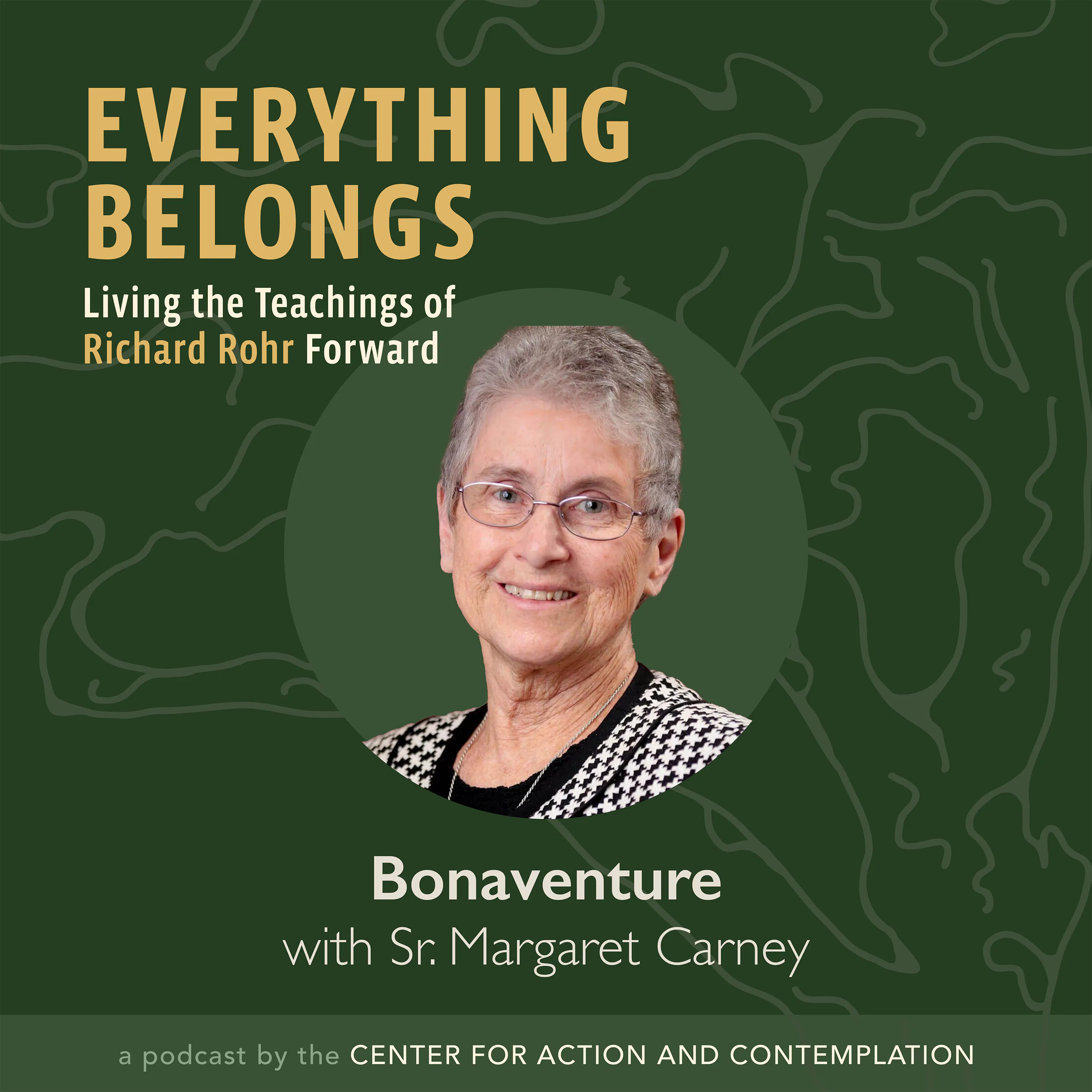
Everything Belongs: Living the Teachings of Richard Rohr Forward
Bonaventure with Sr. Margaret Carney
01:19:22
Loading summary
Transcript173 lines
- [00:00]
A
You're listening to a podcast by the center for Action and Contemplation. To learn more, visit cac.org hey, everyone.
- [00:08]
B
Welcome back to the Everything Belongs podcast. Today we're going to focus on Chapter 11 of Richard's book, Eager to Love Bonaventure. To yield to love is to return to the source. I'm joined here in conversation with one of our other hosts, Drew Jackson. Drew, great to have you here.
- [00:29]
C
So good to be here, Paul, and so always good to be in conversation with you.
- [00:33]
B
Yeah, ditto. And I'm excited that today we get to explore some of the themes of Richard's chapter on Bonaventure. And, you know, the first half of the conversation is Mike and I over at Richard's house, and then the second half of the conversation is you and I in conversation with Sister Margaret Carney, who we had so much fun talking to about Claire that we're like, let's get her back for Bonaventure.
- [00:55]
D
And.
- [00:55]
B
And I really feel like we dug into some really important roots around what Bonaventure was trying to do with Franciscan spirituality and trying to form it and share it in a way that could be life giving in times that, you know, Franciscanism was in a bit of a state. So curious for you, Drew. What were the themes that you were most excited to explore after reading this chapter and being in conversation with. With Sister Margaret Carney?
- [01:23]
C
Yeah, after reading the chapter, I was sitting a lot with those three great truths that Richard talks about in the chapter that come from the teaching of Bonaventure. These big theological, philosophical words of emanation, exemplarism, consummation. And really, I appreciate in both the conversation with Richard and Sister Margaret, really kind of unpacking those, bringing those down, and kind of putting the. In the simplest terms, helping us understand Bonaventure's heart of getting into what it means to be on this journey from love to love.
- [02:02]
B
Right.
- [02:03]
C
And how that really is the heart of this relationship with God and what it means to be human, to be a created being in this world? I think that really has been something that I've been sitting with and kind of coming back to. It was like, what does it mean to be on this journey from God to God, from love to love that seems to so consume Bonaventure's work and animate both Father Richard and Sister Margaret.
- [02:33]
B
Yeah, that's so well said. From love to love. And I think one of the themes that runs through that as well is like, how do we bring our whole self, our whole body, our whole being on this journey from love to love. And I think we steepen that in both these conversations and excited to share that with all those listening. And even for those who only think of Bonaventure as St. Bonaventure, as Sister Margaret pointed out, a university with a D1 basketball team. So if you only relate to Bonaventure as a place of hoops, know that you're welcome into this conversation to learn the depth of this Franciscan oracle of wisdom and action in this exploration here that we're going to go to with Father Richard and then we'll tip over into with Sister Margaret Carney. So thanks for joining this journey into the heart and mind of Bonaventure.
- [03:38]
E
From the center for Action and Contemplation, I'm Mike Petro.
- [03:41]
F
Paul.
- [03:42]
B
I'm Paul Swanson.
- [03:43]
C
And I'm Drew Jackson.
- [03:44]
E
And this is Everything Belongs.
- [03:55]
F
Paul.
- [03:56]
E
Richard, great to see you again.
- [03:58]
F
Happy New Year.
- [03:59]
E
Happy New Year. As always, very much. It's great to be together after a little bit of a winter break. Thrilled to be here with you today and talk about chapter 11 of the book. Eager to love Bonaventure. To yield to love is to return to the source. So right off the bat, Richard, I didn't know Bonaventure at all until I encountered Bonaventure in your teaching in the Living School. And it was so wonderful to experience how much love and appreciation you have. And it was so great to read My Teacher's Teacher. So I'd love to ask, just as we start, where did you first encounter Bonaventure and how soon did you know that he would be a huge guide in your life?
- [04:40]
F
It was in the early 60s when I was at Duns Scotus College, the other Franciscan intellectual. And I can't say that the professor had any great insight into Bonaventure because he has to be appreciated to be appreciated as a mystic. Yeah, and he presented him more as a philosopher. But I could still tell this guy was larger than life and really represented what was then called the Franciscan School of Philosophy. Theology in opposition. No, not opposition. In comparison to the thomistic Dominican school, St. Thomas Aquinas. We didn't emphasize Thomas Botavedra SCOTUS and the insights and really appreciating him only came later as I began to study theology and the mystics. Even, if I'd be honest, to visit the little town of Bagnoreggio where he was born, you come across a huge swinging bridge. It's often in pictures of Italian tourists that's super cool. It's a little town sitting on a precipice and there's a stone rock. This is the house of Bonaventure. But it's slowly falling into the surroundings. And he just became real after that. And I began to study him more seriously. And that was after I had already started here in the school in New Mexico.
- [06:34]
E
I appreciate that. You know, it's been interesting. I don't mind a well constructed intellectual argument here and there, but I feel like my whole life I've always been asked to choose between my head or my heart. Or if I have a. You know, too many times I've been in spiritual circles where I have a intellectual curiosity and someone says to me.
- [06:54]
F
Oh, you're, you're in your head right.
- [06:56]
E
Now, you need to get into your heart. But I've also been in academic circles where if you bring in the personal or the experiential, you're dismissed. What I love about the way you describe Bonaventure is that he is. He is a thinker, but also a mystic. It's encouraging, and I'm going to guess for some of our audience it's encouraging to recognize that the head and the heart can go together.
- [07:20]
F
Yeah, he's a great example of that. And for that reason was not taken as seriously as Thomas Aquinas was. His thinking is not as rigorous. And I mean rigorous in a good way because he was so heart centered. In fact, a quote that I was going to use. Hope I could fight it. Seek fire. Not understanding. That single word makes your point. And that's from Bonavetcher. I can't find it in the moment. He wrote a lot. He was in the great school of theology in the 13th century was Paris and he was a master there for 16 years.
- [08:11]
E
Seek fire. Not understanding is a pretty solid little mantra.
- [08:15]
F
Yeah.
- [08:15]
G
Rereading this chapter, you feel that in.
- [08:18]
B
Bonaventure that seeking fire and the way.
- [08:20]
G
That the synthesis of mystical theology that's.
- [08:25]
B
Grounded, intelligent, devotional and cosmic.
- [08:28]
F
Cosmic is important.
- [08:30]
G
Yeah. And that recognizes the trinitarian reality. It's such the central part of Bonaventure's work.
- [08:36]
B
The unity of everything in the Christ mystery and the crucified Christ reveals the.
- [08:40]
G
Pattern of loss and renewal of everything. And this reads very similar to me to the origin, intent and direction of the original living school.
- [08:51]
B
So what do you think of that connection?
- [08:53]
G
Might Bonaventure be one of the patron saints of the living school?
- [08:57]
F
You know, isn't there a group of students already who call themselves the Bonaventure group.
- [09:04]
G
Oh, I didn't know that.
- [09:04]
E
Bonaventure Circle is a group of our supporters.
- [09:07]
F
So that seems to be a recognition already that this is a name that needs to be highlighted. He's got way too much to offer. You know, if I present him in a general way, that will help you understand, maintain understanding. If the Carmelite school emphasizes the mystical journey as the finding of God through nada, the Franciscan school, in contradistinction, tells you you can find God through Xhosa. Things, things. And now let me read the quote that I was looking for a moment. From visible things, one rises to consider the power, wisdom and goodness of God. You can see him building on the canticle of creation. Francis is the intuitive. Bonaventure is the systematic theologian. This goodness of God is existing, living, intelligent, spiritual, incorruptible and unchangeable. This reflection can be extended according to the sevenfold properties of creatures, that all things can be known according to their power, their wisdom and goodness. If we consider the origin, magnitude, multitude, beauty, fullness, activity and order of. Of all things, that never developed, really. In the early 60s, when I was first exposed to Bonaventure in philosophy, a new name was on the scene that. Now you're familiar with. Teilhard de Chardin. Yeah, sure. And really, you could say Bonaventure was the 13th century. Teilhard de Chardin. Cosmology is already theology. Just hold on to that to see the shape of the universe, the origin of things, the magnitude of things, the multitude of things. I'm skipping descriptions of all of those. The beauty of things, the fullness of things, the activity of things, the order of things. This is all from his perhaps most famous book, which is called, interestingly enough, the Itinerarium. Sounds amazing. Like itinerary. Yeah, Itinerary Mantis. They use the words mind and soul interchangeably. The itinerary of the soul into God. Very fascinating verbiage. You know, that it's a journey, and that's the way it's usually translated, the soul's journey into God.
- [12:28]
E
I'm so taken with this. So for the nerds listening, this is a cataphatic mysticism, which is.
- [12:35]
F
That's right. That's right.
- [12:36]
E
The origin says, you know, I'm gonna bring some origin into it, that to love God and to love good things is one and the same.
- [12:43]
F
Did he.
- [12:44]
E
He did. But I. I think I. I've so often experienced mysticism, and not just in Christianity, in so many different religious tracks that I've studied where to Chase the divine is to run away from the.
- [12:56]
F
World, from things, and to leave all.
- [12:58]
E
These worldly distractions behind. And he's saying the opposite. He's saying we find the divine in the things right in front of us. That's really beautiful.
- [13:08]
F
Let me read one more short paragraph. Whoever, therefore, is not enlightened by the splendor of created things is blind. Whoever is not awakened by such outcries is death. Whoever does not praise God because of all these effects. So everything was a footprint, an effect of God. Whoever does not discover the first principle from such clear signs is a fool. This is the ending of chapter one. Therefore, open your eyes, alert the ears of your spirit, open your lips, apply your heart so that in all creatures, in all creatures you may see, hear, praise, love, love and worship, Glorify and honor your God, lest the whole world rise against you. Almost quoting Jesus. The stones will cry out. Bonaventure was desperately in love with St. Francis. And you can see that here. He's taken the canticle of creation, Brother Son, Sister Moon, and giving a universal application.
- [14:30]
E
Well, and it's beautiful because he's using intellectual language, but he's praising. He's celebrating the divine breaking through and emanating in everything around us.
- [14:41]
F
Yeah. Think of him as a spirituality of Xhosa.
- [14:45]
E
I love that.
- [14:46]
F
Of things.
- [14:47]
E
I like that.
- [14:48]
F
And nada.
- [14:50]
B
Those philosophical implications, the theological implications of.
- [14:53]
G
The things like are endless for how we think about how we live in relationship with one another. Every person, thing having value. How we think about climate crisis. Like, I feel like the ripple effect of this way of learning how to see the world, learning how to see the incarnation in all things.
- [15:13]
F
Very good.
- [15:14]
G
Changes the dynamics of everyday human life.
- [15:17]
F
It really does. It stops. Well, it takes the incarnation to his final conclusion, collusion. You know, Carl Jung, a friend of all of us too, here, in his analysis of the human personality, he says we're either sensates or intuitives. Bonaventure is giving the senzates a great big ticket that they were seldom given by the tradition because of the incarnation. We have to stop apologizing. The color, the shape, the texture. Yeah. All of this, to Bonaventure, is God.
- [16:01]
E
I mean, I appreciate that. That mantra that I quoted earlier, to love God and to love good things is one of the same. Changed my life.
- [16:08]
F
That's origin.
- [16:10]
E
Yeah. And I see it in Bonaventure and Francis. I'd been raised to believe that if I enjoyed something, it was holding me back from my spirituality.
- [16:18]
F
Less than good. Yeah.
- [16:20]
E
Ye. And then the notion of. No, like, experience God in your spiritual practice, but also in a good piece of chocolate, or the embrace of someone that you love, or a beautiful sunset, or your dog's sitting on your lap.
- [16:33]
F
Which he is right now. Here he is. Aren't you, Opie?
- [16:37]
E
This sounds to me like it must have been a huge part of your inspiration for writing the book, the Universal Christ. Is that correct?
- [16:44]
F
Oh, yeah. It was the first great permission. In fact, if I compare Bonaventure to Francis the way Paul is to Jesus, and it's specifically the Paul of Ephesians and Colossians, where you have this mystery that is cosmic, I think something else.
- [17:09]
E
That strikes me is how it's so cosmic, but it's also so personal.
- [17:15]
F
Very good.
- [17:16]
E
So in the living school, we read this book, the Soul's Journey into God. And what struck me is it reminded me of this ancient Christian notion. The Eastern Orthodox talk a lot about it. You talk about it, this idea of theosis, that we are becoming divine. And it shifted my understanding of religion.
- [17:34]
F
Well, we. We already are by our creation, the moment of conception. But we are coming to realize it, appreciate it, act out of it. Yeah, realize it, make it reality. Realize.
- [17:51]
E
You know, I grew up with this notion that the purpose of religion and even spiritual conversion was to, you know, escape hell or go to heaven. And this idea that it was actually a slow and steady transformation or becoming what you already are.
- [18:07]
F
There you go. That's good.
- [18:08]
E
And I think that's my question for Bonaventure. What are we becoming and how in the soul's journey into God? And you sort of already answered it, but I'd love to hear you say it again.
- [18:18]
F
We're becoming appreciators and appreciators of ourselves as a mirror of everything else. First, there's the loving of things, there's the loving of our humanity, and then we're ready for the love of God, in that order. He uses the metaphor of mirror a lot, as does Claire. So it's a Franciscan metaphor. All of creation is mirroring what it mirrors, which is the creator.
- [18:57]
G
Yeah, I like that.
- [18:59]
E
And I like not to get esoteric or too intellectual, but it is Bonaventure. I like the idea of a mirror over a mirror metaphor because I think it also been taught, you know, when something good in the world points to God, the idea is not to get hung up on the thing. And remember, that's just a metaphor. And it's supposed to point you to what really matters. And all that really matters is God. And then you discard the metaphor. But when it's a mirror, what is offering the reflection matters just as much. There's an equanimity there that's really, really beautiful.
- [19:31]
F
Good.
- [19:32]
E
It's helpful for me. And it gives permission to love and enjoy the things that are worth loving and enjoying.
- [19:39]
B
And it helps name the foundation of.
- [19:42]
G
The Trinity, of the relationality of us.
- [19:45]
B
And God and creation in this kind of boundless dance.
- [19:50]
G
Richard, you mentioned in this chapter the three great truths that hold together Bonaventure's theological framework. If you can define these terms to help put a little meat on the.
- [20:00]
B
Bones, can you help us name what.
- [20:02]
G
Is emanation, exemplarism and consummation as these terms that Bonaventure used holds up at.
- [20:08]
F
One point in his writing? At the moment, I can't recall it, but I'm sure we could find it. He says, all my teachings, so it must be toward the end of his life, can be summarized in three words. Everything emanates from God and things are known by their origin. You've got to get straight from the beginning. Where did you come from? Therefore, who are you? That's what secularism does not know, really. Exemplarism, in your uniqueness, what do you exemplify about the nature of God now we call it. You're adding a ground number, your Myers Briggs type, your occupation. All those things suddenly matter, that it isn't just a throwaway. Almost everything in life became a throwaway in the scenario you were describing, Michael. It was, oh, well, forget that. Forget that. We're just here to go to heaven. So emanation, exemplarism, and then third, consummation. And that made the full circle. The consummation is that we return where we started. Now, if you don't know where you started, frankly, you don't have any place to return to. That's modern secularism. There's no home base. This is really, I think, the root of a lot of modern mental illness and psychological disturbance. I don't know what I came from. I don't know what I exemplify. So I have to dress fancy, drive fancy, live fancy, have a title. I watched a few of the Golden Globe awards the other night, and, I mean, it is beautiful, but how hard could you try to dress up? It's just beyond belief. The outfits that the movie stars have to wear, so their 30 seconds on stage allows them not to be forgotten. I'm not putting them down, but that's all they have. You don't need that. I Don't need that.
- [22:51]
E
Did you have ever Franciscan awards where everyone would show up and the idea was to dress down as much as possible and celebrate.
- [22:58]
F
Patches on your robe.
- [22:59]
E
You look so terrible. You've accomplished so little this year. Great job. I love this idea. You know, the way that everything you're saying hits me experientially in the last few years is settling to this idea that we come from love. We're made by love, of love, to be love. And when it's all said and done, we go back to love.
- [23:21]
F
That's it. That's all I'm saying. Well, that's all Bonaventure is saying, not me. It's so simple. And, you know, it's like Einstein said, the truth has to be simple and beautiful. Yeah. And this is theology in its simplicity and in its beauty.
- [23:43]
D
Yeah.
- [23:43]
F
You don't have to be an intellectual. Even though he was.
- [23:47]
E
I love that. And even the recognition of, like our culture's impetus to go after accolades and titles and accomplishments or even the intellectual accomplishments of understanding. It reminds me what you reference of that story with the hat.
- [24:02]
B
Oh, yeah.
- [24:02]
G
I love this story about Bonaventure. When they brought him his cardinal's hat and he was washing dishes and he told him to hang it on a tree while he finished washing dishes.
- [24:13]
F
Hang that over there. I'll be done in a little bit.
- [24:16]
G
Can you tease that out for us? I mean, on this relational road of meaning, how is humility and this meaningful relationship with God primary before everything else that may drop in our heads? That. That seems like right. Relationship to other roles and things that get thrown our way. But the course of humility is kind of foundational to this process of emanation, exemplarism and consummation. The humility to see your place in that puzzle.
- [24:42]
F
Catholics remember things by a piece of art. I was struck by a number of sacristies in Europe, in Italy especially, where you go in to dress up to be a priest. And there's this painting of Bonaventure. Rather large sacristies are huge over there. With his cardinal's hat either laying on the ground or hanging on a tree. And I get the message why they put it there. I think it was in Florence. No, it was Venice.
- [25:21]
B
Well, Richard, this has been a wonderful.
- [25:23]
G
Kind of foray into Bonaventure. We know that we could go further in.
- [25:27]
F
Oh, my God, there's so much to take. Your course.
- [25:30]
G
We wanted to give everyone a taste of Bonaventure.
- [25:32]
F
Very good.
- [25:32]
B
This kind of unfolding wisdom.
- [25:34]
G
Keeper of the Franciscan lineage and, like you said, the Teilhard of his times.
- [25:39]
E
And I appreciate the invitation. One, that intellectual exploration is not off limits. But then also to stay humble and stay grounded in it and not take.
- [25:52]
F
Yourself too seriously as an intellectual who. Who understands this understanding is always relative and partial.
- [26:01]
E
Yeah. And don't lose the heart and the mystical reality in it.
- [26:05]
B
That seems like a big invitation is.
- [26:06]
G
The mind and heart that they're not in competition. But thank you, our wonderful companions as we journey.
- [26:13]
F
You two exemplify it. Thank you.
- [26:15]
B
Thank you, Richard.
- [26:16]
E
Thank you. Thank you for teaching us. Everything Belongs will continue in a moment.
- [26:48]
B
Margaret Carney is a member of The Sisters of St. Francis of the Newman Communities. Her education in theology and Franciscan studies took place at Duquesne University, the Franciscan Institute of Saint Bonaventure University, and the Pontifical University Antonium in Rome, to name but a few of Sister Margaret's accolades. She was the director of the Franciscan Institute, a founding member of the Commission on the Franciscan Intellectual Tradition, president of St. Bonaventure University, and continues to serve as a lecturer and leader for Catholic higher education and Franciscan organizations of the United States. Sister Margaret's most recent book is the Light of Assisi, the story of St. Clair. You know, it was such a joy to talk with you about Clare and to reap the rewards of all of your expertise in the way you've lived with Claire. And now, you know, as you mentioned, you were the president of St. Bonaventure University. And so thinking about that as a starting place to dive into a conversation on Bonaventure from your standpoint, knowing the political and cultural climate of his times, what was the significance of that role that Bonaventure was playing in the Franciscan tradition for that time? Was it like as a popularizer, an intellectual bridge, a mystic? How would you tee us off in the right direction here?
- [28:29]
D
Well, thank you very much. I would say, first of all, not a popularizer. He was a highly, highly trained academic. In fact, from the beginning to the end of his promotion to a full professorship in Paris, 18 years of study. So this guy is heavy duty, first string, you know, medieval theologian. However, where he needed to do something that you might call popularized, but for him, there was always the depth of philosophy and theology that needed to be included in his work was when he wrote for the friars to help them become formed in the Franciscan way of life. So that's where he stepped back a little from the podium of the classroom in Paris to the sitting room of a friary to say, okay, gentlemen, here's what we need to understand about Francis and why we love him and why we follow him. He was a mystic. No two ways about it. But we get to that mysticism through seeing what he wrote. You know, he doesn't write his own theology of prayer or methods of prayer. It's how he is teaching that we see. And then we realize from the way he describes what the full contemplative experience is, that he knew it personally. He wasn't talking about some abstract thing. His own experience flows at times right into the words on the page. Probably important to also say that that the environment in which he was working and living was very tough. At the university, the friars were not hailed as the greatest addition to the student body and faculty. There was a lot of tension because they were so different from other faculty in their teaching and their way of explaining major truths. As the general of the friars, he inherited one hot mess that he had to clean up. And we can talk about that a little bit later.
- [30:48]
B
Yeah, I was just thinking, as you were sharing that, about how Paris was the epicenter of these conversations. Right. And what I hear you saying is, Bonaventure, the way that he shared his mysticism was through his writing, was through an academic lens, with the mysticism being fully waiting behind that. But it was through the lens of academia that it was being accessed.
- [31:10]
D
And let me also add to that that there's always been a bias within the Franciscan family against academic study. It's dangerous, and it takes us away from the poor and what we should be doing. But several years ago, a monk from France, Jean Leclerc is his name, wrote a magnificent book called the Love of Learning and the Search for God. And he talks about how a person of faith, man or woman of faith, who is invested in this kind of study, knowledge, teaching, it's a pathway to God. If you're a person of faith, it's not, you know, some alter reality that you should apologize for. Bonaventure was an example of that, for sure.
- [31:56]
C
I mean, as you say that, Sister Margaret, it reminds me of the, you know, love the Lord your God with all your heart, your mind, soul, strength, the whole self. And so I hear that in the love of the mind, that becomes a bridge to God, to relationship.
- [32:13]
D
You know, Drew, what's so interesting about that is we really don't know much about his younger life, but he was still pretty young when he left Tuscany to go to Paris. But when you speak of a bridge, his home was on the top of a volcanic mountain. And the volcanic Substance of that mountain is literally falling away even to this day. So to get there, you go over a 300 foot high bridge.
- [32:41]
C
Wow.
- [32:42]
D
So Bonaventure and bridge really go together.
- [32:45]
C
I love that. I love that.
- [32:47]
D
Some people freak out. They say, I can't go. We say, well, here's a nice cafe. Have a glass of wine or a cup of tea. We'll find you when we come back.
- [32:57]
C
Well, I think that image of Bonaventure being a lover of God with his mind is such a perfect picture and way for us to enter deeper into this conversation. You know, as I was reading this chapter from Father Richard on Bonaventure, he talks about the Bonaventure's three great truths of emanation, exemplarism and consummation as holding everything together for him. And Father Richard for our listeners, summarizes these as emanation being that everything comes from God, exemplarism being that everything in creation is an example and illustration of the one God, mystery and consummation being that we return to the source from which we came. The Omega is the same as the Alpha. And so, Sister Margaret, can you say more about these three truths and why they are so foundational to Bonaventure's theological vision?
- [33:58]
D
Well, Drew, you just did a wonderful job of defining them in very good terminology because it's not easy. In every book you pick up and read on Bonaventure, there will be certain similarities in the way these are defined. There will be differences. So let me say a word about these. Bonaventure was studying the great theologians of the mystical life who came before him. So there are three important sources. One, a group, right in Paris. It was an abbey of monks who were like intellectual torchbearers in looking at what we would say today, mystical theology. The abbey was called St. Victoria, so they're referred to as the Victorines. And even before Bonaventure comes on the scene, they are looking at this way to think about how creation speaks of God, how our whole life progress is to return to the God from whom we came when we were created. The other is an ancient, possibly Syrian monk who had the tongue twister name Pseudo Dionysius. It sounds like a medicine that cures something, doesn't it? But they don't really know his name, but he was like the mystic Dionysius, so he's the Pseudo Dionysius. But he had very great influence on Bonaventure and others. And then finally, Bonaventure knew the Eastern fathers of the Church as Well as the Western fathers and in the Eastern fathers there is a path of enlightenment about the energy of God and how it's God's energies, which is, you know, we talk about energy today like we get energy drinks. Energies weren't necessarily a normal category back in those days, but the Eastern fathers used precisely that kind of terminology. So Bonaventure is weaving together ways of thinking about nature, human nature, the goal of human life, influenced by these people who are not, except for the Victorians, they're not next door neighbors. Their influences are coming from other cultures, other philosophies. So you are right, emanation, all creation comes forth from God. In fact, my friend Andre Serino, and I'll talk about his work a little later, loves to use the analogy of an overflowing fountain. You know, when you see one of these fountains where the water spills into basin after basin, he said that's a perfect image that Bonaventure uses for God is overflowing goodness. And that goodness comes to us, it's in us as humans, it's in creation, it's in the universe. The exemplarism, it's a little tough because the two are so close. But just think example. So for example, Jesus is the exemplar of the inner life of the Trinity. We wouldn't know that if we hadn't seen Jesus pray, suffer, love, but we've seen that now in Jesus. And so like this is what the Trinity makes present through the Son when he comes to earth. And then consummation, as you have pointed out, is why are we here? What are we doing here? And Bonaventure is absolutely insistent on, as we'll talk later, I'm sure about life is a journey, but the journey is to take us back sometimes. The language for this is very confusing to 21st century people. But we're going back to the origin. That's really our goal. That's why we exist. It's where we're headed. And he's writing in the hopes of helping people get there.
- [38:01]
C
Those big words, emanation and exemplarism, consummation, right? We can get lost in the headiness of them. But then you, you know, you read one of Bonaventure's most often quoted verses, right? Where he, he says, seek grace, not instruction, desire, not understanding, Seek the groaning of prayer over diligent reading. Seek the spouse more than the teacher. Seek God, not man, Darkness, not clarity, not light, but the fire itself, which is that last line. It just does something to me when I read it. What do you hear when you hear this, Sister Margaret? And what do you think Bonaventure is trying to tell us about God and what it means to be in relationship with this God?
- [38:49]
D
I hear a couple of things. First, I hear freshmen at Saint Bonaventure on the night they become official members of the student body in a candlelight ceremony, read that instruction out loud as part of their commitment as students. Now I hear them because I was standing before them for years as they read that, thinking to myself, this. These kids are probably wondering, what the heck did I just sign up for? But what they're going to learn as they move into the core curriculum is you signed up to enter into a world of learning and modeling your life on the learning and preparing for a career in a profession. But that learning is always to lead you back to God. The curriculum will impart that to the students in a variety of ways. When I hear it, I hear it as a beautiful, poetic statement about the meaning of caring about learning, about reading, about study. But what's also going on is Bonaventure is posting a warning label on the curriculum. And the warning label is, okay, you're a student. You've just arrived at the University of Paris. I'm the master faculty member. But this is the spirit in which I ask you to enter. Because he has already experienced, and anybody in academic work is bound to experience this, even in the best religious institutions, that too many academics get seduced by the lure of being the best in their field and making an A on that test and impressing the heck out of their professors. And so it's like, oh, I'm really loving this course. And I realize that we're supposed to not lose sight of. But I'm going to skip prayers tonight because I have two more chapters to read. So that's the constant play of, I have a life in which I'm supposed to demonstrate faith worship. But this thing can be like a siren call. And for many years, when I was studying in Rome, I would go back from time to time to the huge monastery outside of Rome where the Capuchin students lived. And when you walked into that monastery, there was an enormous mosaic that greeted you with an image of Christ. And in Italian, the saying, only one is your teacher. And after many times passing that mosaic, I realized the friars who built that monastery, knowing it would be filled with students, are saying, you just got off the bus. You're coming from class, you're getting ready for exams. You have one teacher here it is Jesus. And I've often thought it's subtle, but, boy, when I finally realized what the meaning of that mosaic was, it was like, you know, slapped me in the face every time I got off the bus and walked in there to use the library.
- [42:04]
B
That's so great. I had this image with that of kind of this warning towards striving, because, like, the more you strive and move away from the origins, you can lose that sense of. Your origin is love.
- [42:15]
D
Right.
- [42:16]
B
Certainly, as you said, it happens in academia, but I think in any field that one participates in, to be, you know, the best pastry chef in your town or whatever it is, if it doesn't start from that origin of love, you can lose the whole purpose of it.
- [42:31]
D
Right, right. It's a constant danger. Let me just point out. There's another word from this medieval vocabulary that you will find in places like the Journey to God that I think is a little easier for us to understand and translate. And the word is vestigia, which in English would be vestige. But the medieval meaning was footprint, or a print left by something. And that is the phrase that Francis uses. We must follow the footprints. He doesn't say steps, footprints. You see, footprints. And he says, we must follow the footprints of Jesus. And so I think Bonaventure was very struck by that and realize that Francis is trying to point out the emanation, the exemplar. It's a vestige, especially when it brings us closer to Christ.
- [43:28]
B
Yeah, well said. That brings up, too, like you mentioned, footprints and footsteps, but also the imagery of fingerprints, the imagery of mirrors, effigies, likeness. And this, of course, connects to Claire as well, that this seems to be just kind of part of the Franciscan teaching experience and embodiment is to have these dustings of following in a way, not trying to chart one's own personal path, but to live into a way that you've already been invited to, by the way of Francis, the way of Jesus.
- [43:59]
D
Yeah. And notice that I think in both cases, they're trying to use an image, a metaphor, an analogy that ordinary people can log on to and understand. So it's a way of helping balance this scholastic language that is not going to be everybody's vocabulary.
- [44:19]
B
Right. And, you know, one of the hard things of these conversations with a giant like Bonaventure is sometimes it feels like we're just playing the greatest hits. So to move on to the next one of Bonaventure's greatest hits, how do you see Bonaventure's theology of creation, the great chain of Being? Reflect the idea of evolving love.
- [44:39]
D
I was actually one of the moments when I felt really grateful that you had asked me and I agreed to do this was I was looking at some explanations of this aspect of his theology with a whole new insight. And the insight was this Bonaventure was breaking ground in the Middle Ages to point to the fact that creation is the first, first step in our learning who God is. And in fact, I heard a remarkable professor from Paris a couple of years ago who addressed a conference at St. Bonaventure University. And he said, shame on us that in this day of crisis in the environment, we are not constantly reminding people of Bonaventure's insistence this is. Is first in the development of our faith and love for God. So I believe that doesn't mean nobody else was saying it or understood it, but because he so perfectly places that within his writings in the journey of the soul, it's the very first thing you realize that it's kind of like a ship that's breaking ice. You know, if you've ever watched these movies of, you know, ice covers the water and you can't get anywhere, and then you get the break. And I think he's trying to do that, because don't forget that there are still great impacts of Manichaeism in the Christian community, which is the belief that matter is evil. You know, the world is evil. You shun the world, you shun the material, you punish your body. You know, you don't give yourself any pleasure. No cookies for dessert. He is asking us to rethink or not to be infected by that thinking. And here we are, Pope Francis Laudato. Si. You put Bonaventure and Pope Francis together. Now, Pope Francis, of course, is looking to Francis of Assisi, but Bonaventure brings that into the major work of theologians and of students of our theology. And so I think he helps make what is happening right now all the more urgent, but all the more at the heart of our theological plan program. Rather, I do think that sometimes we're missing out. Our students are way ahead of us in concern for the environment, climate, justice, et cetera. Not your generation, but my generation. I think unless we help our students realize what a powerful expression of faith and justice this is, we're leaving them to a secular concern which is valid and important and urgent. But our motivation should be coming from this.
- [47:38]
C
It's such a beautiful question and a necessary question, given the times we're living in, given the threats that we face collectively, the neglect of the powerful and the exploitation of the world, of the creation. And so what is ours to do in that? What does it mean? So, yeah, it's a beautiful invitation. Thank you. Thank you.
- [48:04]
D
A colleague, Father Keith Warner, who's taught at Santa Clara and many other colleges, says that when he introduces Laudato Si and some of the work that came before it on the environment from Vatican sources, he says the students are actually amazed to know that the highest authorities of the Catholic Church are writing and talking about this. They don't think there's any Catholic teaching about this, which is tragic. So I think that part of what you're doing and part of what I think we all need to do is people are happy to be sitting with Francis Sinclair and then Bonaventure. Oh, I don't know. He's too hard. Well, we can't deprive ourselves and the next generation of the richness of what this man brings to the task. And, yes, he's hard, but, you know, so are many other thinkers that we ask students to study and learn about. You know, Einstein Shine is no walk in the park.
- [49:14]
B
You know, something came to mind as you guys were just having that exchange. It made me think about. You said that students were surprised that someone like Pope Francis was talking about this. And of course, Pope Francis is not Franciscan, but definitely, you know, cherishes that heart and charism and tries to live it out.
- [49:32]
D
Pope Francis is not a Franciscan, but there are two things to bear in mind. He's Italian, and there are probably only five Italians in all history that didn't think of Francis as their hero. So there's a natural cultural alliance. That's one thing. The other, a lot of people don't realize, and I really find that we have to be very careful. We set up an opposition between Jesuit and Franciscan, which is wrong. What is the name of the Jesuit order? Company of Jesus. Ignatius had the same passion to be in the company of Jesus that Francis had, but he's a man of the Renaissance. He's a man of the breakdown of the Christian community through the Reformation. So the company of Jesus is going to have a very different task to do than the company of the little brothers of Assisi had two or 300 years earlier. And Francis has an uncanny. Our Pope, uncanny ability to bring them together. And my word to Franciscans is if we don't get behind this man and do everything we can to support his effort, it doesn't mean you have to agree with every sentence, but support and be part of bringing what he is doing to channel Francis to the world. Shame on us.
- [51:03]
B
That's brilliant. Thank you for taking us down that road and the needed mending. And again, to me, as we've been talking about that Franciscan spirit of being the bridge and not being afraid to be the bridge and doing the work that it takes to build a bridge, even if it is over an active volcano.
- [51:21]
D
Yeah, sure.
- [51:24]
C
You know, there's so much that we obviously can learn from Bonaventure, from his way of loving God with the mind through his expansive. And the heart.
- [51:37]
D
And the heart through.
- [51:38]
C
And the heart. Yes, absolutely. His expansive theological vision that includes all of creation.
- [51:47]
F
Right.
- [51:47]
C
This. We were just talking about that. But one of the things that I think is so important as we learn from all of the, you know, saints and mystics and teachers throughout time is we not only learn from their light, we learn from their shadow, and that there's wisdom for us in how we continue forward and learning from their shadow. And, you know, Father Richard, he talks about this a little bit, and he talks about Bonaventure shadows. He says that Bonaventure was largely responsible for the clericalism of the Friars Minor. And he talks about his censoring of other biographies of Francis and making his biography the official biography of Francis. He mentions the glossing over of Francis peacemaking efforts during the Crusades to make the order more acceptable and orthodox in Rome's view, and even hedging his bets with the radical poverty of Francis. And so I guess my first question to you is one, just, is there anything you want to say to that? But also, what would you say that we can learn from Bonaventure's shadow?
- [52:59]
D
Well, first of all, I really am pleased to get this question, because among the friars, there is this strain that has been very strong for a very long time of Bonaventure did damage. He moved the friar sort of away from the purity of the early years of the life of Francis. There's a great quote attributed to Brother Giles, a mystic, who said, paris, Paris, you have destroyed Assisi. Meaning the learned friars were changing the simplicity of the order. But let me say, first of all, I think we need to know a lot more about what was the context in which Bonaventure becomes the general. So the order was on the cusp of being suppressed, shut down by the papacy, because the general minister that he succeeded was found to be, in the Vatican's eyes, guilty of heresy. Now, Bonaventure did not believe he was guilty, but he knew that because this man had aligned himself with some very controversial teaching, it was like, you can't save the order if Rome thinks they're turning out a generation of heretics who are gonna go and preach this way. So this friar, whose name was John of Parma, is put aside, and the story is that Bonaventure imprisoned him in Gracio. Now, if you've been to Grecia, my theory is this. Bonaventure knew he would love it there because it was a beautiful hermitage beloved by Francis, and his prison was simply to live in Grecio. And I'm pretty sure that the friars were helping him out and saying, hey, John, we see the cavalry from the Vatican coming up. Get in your cell. You know, in other words, this guy made a mistake, but we're not going to crush him, and we're not going to make his life a horror. That's what Bonaventure's dealing with. Here's the Vatican. You better clean up this mess. So what does he have to do? He needs the friars to be formed very carefully. So he writes a biography of Francis, and it is a formation manual. It's, what are these events in Francis life? What are the virtues? What are. What do we learn from the virtues, my brothers? Now you go out and do likewise. And so that's why that became the official biography, because they needed a reset of all the order so that everybody's singing from the same hymnal about Francis and their tradition of spirituality and theology. I don't know enough about the idea of his lowering attention to the Crusades. I need to learn a little bit more about that. But I would simply say he's in the same dilemma that Francis and Claire were in, which is, if one of your founding principles is you will honor and reverence the Lord Pope, there are going to be a lot of times when you're walking a razor's edge because you may disagree violently with this idea of a Crusade, what do you do? Francis goes and visits the sultan. He doesn't denounce the Pope. Claire had to accept changes to her way of life that were drastic, but if she didn't accommodate at least halfway, her monastery could have been shut down. So we see this tension. All the great leaders had a shadow, if you will, of not doing what, in a perfect world, you would do. But it isn't a perfect world. And at times, they made decisions that we could look back and say that was wrong, but we're 21st century people. We're not walking in their shoes. And then I would finally also say that one of the readings, nobody does, but it's Very clear and very simple. And easy to figure out is the first letter he wrote to the friars when he became the general. So here's what he says. I've been made the general. This job is hard. I have a lot of business to attend to, and I'm counting on you, my brothers, to help me root out evil, strengthen the good. Now, what evils do I want to root out? This is literally what he says. First, too much money is being sought by the friars. So I don't think he's not worried about poverty. Later he will say, you get into a friary and you make expensive changes. That's terrible. I know friaries where the drapes get changed every five years, because that's just the thing we do. You know, it's convents too. Everybody likes a makeover. Beggars, the friars are so annoying to people by their begging. They would rather meet a robber than a friar. These are his literal words. You know, when they go through, they're building lavish buildings. There are suspicious relations with women. That has to stop. Offices in the order are being given to young men who are not mature and not educated enough. You're competing with the diocesan priests to get the stipends for funerals and weddings. And that's not good. We're not to get into a money war with them. And we really also need to get rid of these guys who are idle. They're just living off the product of other friars work. So this is what he's dealing with. So we may see him as bringing a shadow. He's trying to get rid of abuses that are really making the reputation of the order sink lower and lower. There's gotta be a reset.
- [59:00]
B
This story just reminds me about how anytime there's a charismatic leader, kind of like a revolutionary, it takes somebody with a sense of a systematizing, you know, to think about Bonaparte saying, like, okay, the fellows are all over the place. How do I craft a document that's official, that will be the thing that forms everyone? How do I create systems? And I think we experience that across, you know, even today, when we think about how do we organize the thoughts of brilliant thinkers or those who naturally have a charism that leads the revolution? But how do you sustain that? How do you make sure the dishes get done?
- [59:39]
D
Exactly. And I would say we can be very upset, and we are, that he ordered these other lives not to be preserved. And thank God the Benedictines preserve them. They had them in their libraries. But you have to consider that what he's probably dealing with is I can't have one more chapter where entire contingencies come and say, Francis said we shouldn't have books and now we've got to educate men to the priesthood. You can't do it without books. And this often happens to leaders. Okay, get rid of all those books and thank God. Through a lot of work in the last couple of hundred years, we've retrieved those manuscripts, including a proto life of Francis nobody knew about before six years ago. And there may be more that we'll discover in time.
- [60:32]
B
You know, so often with ancient texts or medieval teachers, we think, well, how does this apply to me today? So in that spirit, Sir Margaret, how can Bonaventure's teachings on love and spirituality be applied to the contemporary challenges of our time?
- [60:48]
D
Well, I've already spoken to what I think he brings to the climate crisis. I think that one of the other areas of his teaching, and you alluded to it early on, Drew, was beauty. He had a real appreciation of beauty and his own writings were really very poetic. In fact, Regis Armstrong, when he did that major, you know, started working with Ewart Cousins. They published the writings of Bonaventure and put certain segments into poetic sense lines to highlight that idea of he's creating an artistic image, you know, with language. So I think that the importance of the beautiful, the importance of understanding God as overflowing goodness, and Andres Serino, Joseph Reichel have designed a remarkable retreat that takes us through the journey of the soul to God in categories that we can understand. And the good news about that. So I'm not going to try to do more description, but I want to point the listeners to this. They have just given what they think will be the last retreat they do on the journey of the soul to God. But the entire thing was filmed and a film version of this combination teaching retreat on Bonaventure's number one hit. The journey of the soul to God is going to be available and something that is not an abstract of his teaching, but. But something we don't always understand is he was a man that people loved to be with. So he carried this sense of joy and beauty and the wonder of life in the universe. I used to tell the students we welcomed, you are here to help us increase the gross annual product of God's goodness in the world. That's what we're supposed to be doing. And that made him an attractive person. At his funeral, he was at a church council in Lyon, France. They said the total assembly wept openly at the loss of him because it was so sudden and he was trying to bring about peace between opposing factions. So there's something to be said about a man that had that kind of universal capacity for friendship. And the last I'll say because I can't resist it, he's got a Division 1 basketball team named after him. So if you don't understand any of the rest, get in there. I remember once when our team was on a tear and some big columnist wrote, who is this saint that's got more points in the paint than anybody else in heaven? We had a lot of fun with that.
- [63:44]
C
Oh, Sister Margaret, I love that. I love that you named even just that aspect of things, because I'm a big basketball lover right now. I get to coach my daughters.
- [63:56]
D
Oh, boy. Good luck.
- [63:58]
C
You know, it's been one of those places every week that is the most joy giving and, like, beautiful experiences of the week. And I think it just brings me to this kind of close of a question of, you know, you talk about Bonaventure and beauty being so at the core of his teaching and his invitation. I guess the question is simply, how has Bonaventure helped you in seeing and identifying and being present to the beauty of the world? And what is that doing for you now?
- [64:36]
D
Well, for me, it moved from abstraction to real life, sometimes extraordinarily difficult challenges. And becoming the president of the university that carried his name and his intellectual legacy. And what I came to realize is, from its founding to the time I inherited that privileged role, the Franciscan friars who founded and sustained this university were schooled in this Franciscan theology of goodness, beauty, fraternity, sisterhood, joy. And it permeates that campus. And we have people who come back 20, 30, 50 years later and say, and Thomas Merton said this. At Bonaventure, I learned what happiness is. Thomas Merton, who was there for a year and a half as a faculty member. And so what I realized is institutions carry these graces. And I used to say to my cabinet, it's ours to lose. We didn't create it, we received it. And you come in and there are bad days and good days, there are scandals to knock down, and there are triumphs to lift up. But you must constantly keep your eye on the mission of taking this intellectual, Catholic, Franciscan inheritance to the next generation. The next, the next. And it is hard. But I do think that I learned in being responsible for continuing this life of this institution, that it really shapes lives and impacts people. And it's no one thing. It's the darn good sciences that take people into nature and creation in the world. It's the darn good writers and literary figures and writers that we've turned out for the beauty of the language. It's the business professionals who have a moral standing that they do not abandon. And some of our most famous graduates have bone showing stories about having to take a stand in their companies against a corrupt way of dealing or a greedy way of dealing with. So it's transmuting that into real life. And the students may never hear emanation exemplarism, but they've learned it in a curriculum that is constantly trying to do that in the 21st century.
- [67:13]
C
Wow.
- [67:14]
B
Thank you, Sister Margaret. It's been such a delight. I do feel like I need to confess to you that even though I work at a Franciscan organization, I did go to a Jesuit school. So I'm going to try to do my part to hold the place.
- [67:25]
F
Welcome to.
- [67:27]
B
But, yeah, thank you for your time, Paul.
- [67:29]
D
Just let me point out, because this is something a lot of people don't realize. The turning point for St. Ignatius. He was wounded in battle. He's recuperating. He's reading meditations on the life of Christ written by a friar. He takes those meditations and translates them into a way of praying the Spiritual Exercises. So it's not this rupture, it's a waterfall. Here's the Franciscans trying to help people pray the Scriptures. Ignatius reads it, his heart is on fire. He creates another way. And of course, we have very different cultures as two orders, but I wouldn't want a world without the Jesuits, and the best Jesuits don't want a world without us.
- [68:16]
B
Hear, hear. Not a rupture, but a waterfall that's going to stick.
- [68:21]
D
Yeah. And Francis gives us that in spades. Right.
- [68:25]
B
Thank you so much, Sister Margaret. This has been a joy and a pleasure and a privilege. Again, so thanks for taking the time today.
- [68:45]
C
Paul. It was so good to be in conversation with Sister Margaret about the life, the teaching, the mysticism of Bonaventure. And, you know, there's a lot of people who, you know, are Bonaventure scholars and could have come on and spoken about Bonaventure's theology. But there's something about Sister Margaret that I appreciate so much, that not just that she knows a lot about Bonaventure, but that she has a passion for not just Bonaventure, the person, but this way of seeing and being in the world. This as she articulates, this loving God with the mind and the heart.
- [69:30]
E
Right.
- [69:30]
C
That comes together in Bonaventure. And so what were Some of the things that really are sticking with you from our conversation with Sister Margaret, you're.
- [69:40]
B
Naming it for me, I think it is that passionate presence of Sister Margaret. She doesn't want the tradition to be watered down. It's kind of one things that I take away from it in the peculiarity of the hits and misses of the Franciscan tradition. All of it needs to be welcomed and invited to for how it can impact us so we can learn from it and not be stuck into only certain corners of what Franciscan spirituality has to offer. And yeah, I think there's a few other highlight moments that I could circle around or muse about. But how about for you? Is there anything specific that came up, like an example that really shone a light on Bonaventure's brilliance or the way that Sister Margaret was able to live these teachings forward or invite us to do it?
- [70:30]
C
Yeah, I really keep going back to the story that she shared about being at St. Bonaventure University and the moment of new students coming in and reciting that verse from Bonaventure. And I'm going to read it for us again in a second because I think it's a beautiful way for us to reflect on all that was shared. But she talked about how, as students are reading this verse, she said, I imagine some of them are probably thinking to themselves, what did I get myself into? Like, what is this? What is this all about? But as we were talking about it, something like lit up in her. And I really think it is that this sort of, this is where the teaching of Bonaventure really kind of comes down to earth, right? The headiness of Bonaventure, it touches the. The fire in the heart, right? Which is where that. That verse ends. Not light, but the fire itself. And so I want to read this verse from Bonaventure again and really invite you, our listeners, to listen, to lean in, to hear it with fresh ears, and to consider what the invitation might be for you in these words from Bonaventure of what it might mean to sort of bring together the thoughts about God and the passion for loving God, to bring them into one space and to bring that out into a life lived in love in the midst of the world. Bonaventure says, seek grace, not instruction, desire, not understanding, understanding. Seek the groaning of prayer over diligent reading. Seek the spouse more than the teacher. Seek God, not man, darkness, not clarity, not light, but the fire itself.
- [72:49]
H
Thanks for listening to this podcast by the center for Action and Contemplation, an educational nonprofit that introduces seekers to the contemplative Christian path of transformation. To learn more about our work, Visit us@cac.org Everything belongs is made possible thanks to the generosity of our supporters and the shared work of Mike Petro, Paul.
- [73:10]
A
Swanson, Drew Jackson, Jenna Kuyper, Izzy Spitz.
- [73:14]
D
Megan Hare, Sarah Palmer, Dorothy Abrams, Brandon.
- [73:17]
H
Strange, Vanessa Yee and me, Corey Wayne. The music you hear is composed and provided by our friends Hammock and we'd also like to thank Sound on Studios for all of their work in post production production. From the high desert of New Mexico, we wish you peace and every good.
- [74:16]
A
Do you feel called to walk a more contemplative path? The center for Action and Contemplation is an educational nonprofit supporting the journey of inner transformation. Our programs and resources will help grow your consciousness, deepen your prayer practice, and strengthen your compassionate engagement with the world. Learn more about our resources such as publications, podcasts, email series and events@www.cac.org.