Loading summary
Transcript1 lines
- [00:01]
A
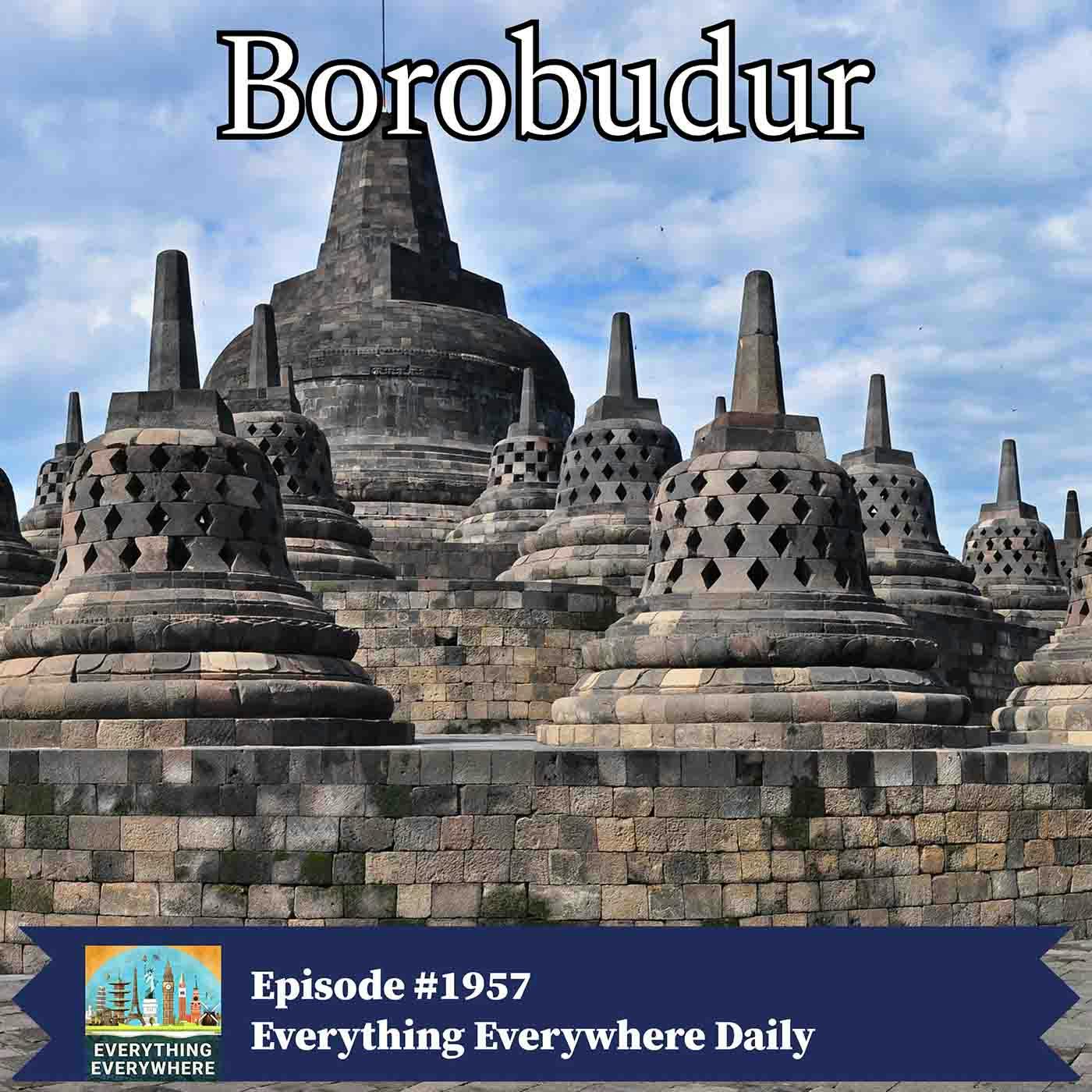
Located in central Java, just outside the modern city of Yogyakarta, lies the world's largest Buddhist temple, Borobudur. Borobudur doesn't get as much attention as other great monuments in the world, but it certainly should be included among them. And unlike the other great monuments, Borobudur has the distinction that no other monument has. It disappeared, quite literally, for several centuries. Learn more about Borobudur, its history, and its significance on this episode of Everything Everywhere Daily. This episode is sponsored by Quint's. The holiday season is upon us and that means buying gifts for friends and family. So why not get something that's top tier but affordable? That's where Quince comes in. Quince has great items like $50 Mongolian cashmere sweaters that feel like an everyday luxury and wool coats that are equal parts stylish and durable. And you'll pay a fraction of what you would from other retailers. And their prices are literally listed on the Quince website. I just got an Australian merino wool sweater that looks great and cost only half of what it would have if if I had bought it somewhere else. By partnering directly with ethical factories and top artisans, Quince cuts out the middleman to deliver premium quality at half the cost of similar brands and often even bigger discounts. Give and get timeless quality staples that last this season with Quince. Go to quints.com daily for free shipping on your order and 365 day returns. Now available in Canada too. That's Q U I-N-E.com daily free shipping and 365 day returns. Quince.com daily. This episode is sponsored by ExpressVPN. Did you know that Internet service providers, including mobile network providers, know every single website you visit? And in The United States, ISPs are legally allowed to sell that information to advertisers? That is just one of many reasons why you need to use a virtual private network, or VPN. ExpressVPN reroutes 100% of your traffic through secure encrypted servers, so your ISP can't see your browsing history. Moreover, unlike other VPN companies you might have heard about, ExpressVPN uses what they call Trusted Server architecture. Their server runs entirely in RAM with no hard drives, meaning that after a reboot, nothing persists and there are no logs. ExpressVPN's apps are available on phones, laptops, tablets and smart TVs. ExpressVPN now is a permanent home on my desktop and my Apple TV to allow me better and more secure access to more content. Secure your online data today by visiting expressvpn.comeed that's expresvpn.comeed to find out how you can get up to four extra months. Expressvpn.comed There's a good chance that many of you aren't familiar with Borobudor, but you should be. It's one of the largest and most significant religious monuments in the world, but it's often overlooked due to its location. The history of Borobudur dates back almost 1200 years. The temple was constructed during the height of the Shailinderid dynasty's power in Central Java, most likely between the years 780 and 840, although some scholars suggest construction may have begun as early as 750. The Shailindras were ardent Mahayana Buddhists who ruled over a prosperous maritime kingdom with strong cultural and trade connections to India and other Buddhist centers across Asia. At the time, Java was a mix of Hindu and Buddhist, depending on the region of the island. The monument was built without mortar, using an interlocking system of approximately 2 million cubic feet of stone quarried from nearby rivers. The builders demonstrated remarkable engineering skill, constructing the temple on a hill and creating an elaborate drainage system with 100 spouts to prevent water damage during Java's heavy monsoons. The entire structure was estimated to have taken 75 years to complete and involved thousands of workers, including stone carvers, laborers and artisans. The temple's design follows a mandala pattern representing the Buddhist cosmos. It consists of nine stacked platforms comprising six square bases and three circular terraces with a central dome or stupa at its summit. The monument measures approximately 123 meters, or 403ft on each side, and originally stood around 35 meters, or 115ft tall. Walking the entire circuit of all the levels covers nearly 5km. Borobudur functioned as a place of Buddhist pilgrimage and likely served as a center for religious education as well. The structure itself is a three dimensional representation of Buddhist cosmology and the path to enlightenment. Pilgrims would begin at the base and walk clockwise through each level, a process called pradoxina, experiencing a symbolic journey from the realm of desire at the base, through the realm of forms on the middle terraces, to the realm of formlessness at the top. The temple walls feature 2,672 relief panels, including 1,460 narrative panels that tell stories from Buddhist texts, particularly the life of Buddha, stories of Buddha's previous lives, and the pilgrimage of Sudhana, a disciple of The Buddha. These reliefs stretch for the approximately 5 kilometer spiral to the top and represent one of the most complete ensembles of Buddhist relief sculptures in the world. Additionally, the structure originally contained 504 Buddha statues, each positioned according to specific hand gestures corresponding to different directions and levels. Everything I've described so far is just a description of a very large and important religious monument. However, the story of Borobudur took an interesting turn. Sometime around the 10th century, Borobudur was mysteriously abandoned. There are several theories that attempt to explain why it was abandoned. The most accepted explanation involves the shift in political and religious power in Java. The center of Javanese civilization moved eastward and Hinduism began to supplant Buddhism as the dominant religion under the new ruling dynasties. A massive eruption of Mount Merapi around the year 1006 may have accelerated this process, covering the monument with volcanic ash and forcing the population to relocate. Another theory suggests that the conversion of the ruling class to Islam around the 15th and 16th centuries led to the temple's neglect. Whatever the reason, Borobudur became gradually covered by volcanic ash and jungle vegetation, eventually disappearing from collective memory. Local Javanese people knew of the site, but it became associated with folklore and was considered unlucky or haunted, which further discouraged visits. The temple remained buried and forgotten for centuries, while Islamic sultanates rose to prominence across Java. European travelers occasionally heard of a great monument hidden in the jungle, but these reports were vague and unverified. Borobudur's modern rediscovery is credited to Sir Thomas Stamford Raffles, the British lieutenant Governor General of Java during the brief period when the British ruled the island, from 1811 to 1816. In 1814, Raffles heard reports of a mountain of Buddhist sculptures in stone near the village of Busimi Goro. He dispatched Dutch engineer H.C. cornelius to investigate, who led a team of 200 men to clear the site. Over a period of two months, Cornelius documented his findings, though the monument remained partially buried. Over the following decades, various officials and scholars conducted further clearing work. In 1835, the site was fully uncovered for the first time in centuries, revealing its extraordinary scale and artistry. Unfortunately, this period also saw significant looting, with many statues and sculptural elements removed by colonial officials, collectors, and souvenir hunters. Some pieces ended up in museums abroad, including the National Museum of Ethnology in the Netherlands. The Dutch photographer Isador van Kinsberg documented borobudor in the 1870s, creating some of the first photographic records of the monument. These images sparked international interest and helped establish Borobudur's reputation as one of Asia's great archaeological treasures. By the late 19th century, having been excavated, Borobudur's condition had deteriorated significantly. The structure was unstable, with many stones out of place and vegetation continuing to damage the monument. In 1885, the Dutch government finally recognized the need for systematic conservation and appointed archaeologist YEAH Jan Igermann to conduct a thorough survey. The first major restoration was undertaken between 1907 and 1911 under the direction of Theodor van Erp, a Dutch army engineer with archaeological training. Van Erp's team dismantled and reconstructed the monument's three circular upper terraces in central stupa, addressing structural problems and improving drainage. They restored over 300,000 stones, cleaned the reliefs and documented the entire process photographically. This restoration was considered groundbreaking for its time and saved the monument from collapse. However, van Erp's work, though well intentioned, had limitations. The restoration focused primarily on the upper levels and fundamental structural issues in the foundation remained unaddressed. Additionally, some restoration techniques, viewed with modern knowledge, were not entirely appropriate for long term preservation. After Indonesia gained independence from the Netherlands in 1945, Borobudur took on new significance as a symbol of national identity and cultural heritage. The Indonesian government recognized the monument's importance not just as a Buddhist site, but as a symbol of Indonesia's ancient civilization and architectural prowess. During the 1950s and 60s, the government conducted maintenance work, but by the 1960s it became clear that comprehensive restoration was urgently needed. The structure continued to deteriorate due to water seepage, stone displacement and the effects of tropical weathering. The porous volcanic stone was particularly susceptible to moisture, which caused structural weakness and encouraged the growth of biological organisms. In 1973, the Indonesian government, with support from UNESCO, launched an ambitious international restoration project. This eight year undertaking, which cost approximately $25 million, represented one of the largest archaeological restoration project ever attempted in Asia. The project was funded by contributions from multiple countries and coordinated by UNESCO specialists working with Indonesian archaeologists and engineers. The restoration involved completely dismantling and cataloging over 1 million stones from the monument's base and lower levels, addressing the fundamental drainage and structural problems that earlier restorations had left unresolved. Engineers installed a modern drainage system with vertical and horizontal channels, placed stones on concrete foundations when necessary, and created a detailed photographic and written record of every stage. The team also addressed the problem of biological growth by treating stones with chemicals and improving water runoff. Throughout the process, restorers adhered to the principle of anastylosis, using only original materials and methods wherever possible. The restored monument was inaugurated in February of 1983 and Borobudur was designated a UNESCO World heritage site in 1991. Since its restoration, Borobudur has become one of Indonesia's most visited tourist attractions, drawing over 3 million visitors annually in recent years. The tourism brings economic benefits, but also creates conservation challenges. The constant foot traffic, touching of reliefs, and general wear have necessitated ongoing maintenance and monitoring. The monument has faced various threats in the modern era. In 1985, nine stupas on the upper terrace were damaged in a terrorist bombing attributed to Islamic extremists. Though the structures were successfully repaired, volcanic eruptions from nearby Mount Merapi, particularly the major eruption in 2010, have deposited ash on the monument, requiring extensive cleaning operations. While Borobudur was built as a Buddhist monument, Indonesia today is primarily Muslim, with Buddhists comprising only about 1% of the population. Nevertheless, the monument has experienced a religious revival. Since the 1980s, Indonesian Buddhists have been permitted to hold ceremonies at Borobudur, particularly during Vesak, the celebration of Buddha's birth, enlightenment, and death. This annual event, held during the full moon in May or June, attracts thousands of Buddhist pilgrims from Indonesia and abroad. The Indonesian government has worked to balance Borobudur's identity as both a religious site and a secular cultural monument. While religious ceremonies are permitted, restrictions are placed on overtly religious activities to maintain the site's character as a place for all visitors. Recent archaeological surveys of the surrounding area have revealed that Borobudur was part of a larger complex of religious structures, including the nearby Buddhist temples of Pawan and and Mendut, which appear to have been connected by a ceremonial pathway. Excavations have also uncovered evidence of the workshops, settlements, and infrastructure that supported the monument's construction and use. I had the pleasure of visiting Borobudur in 2008, and it was most certainly one of the highlights of my trip to Indonesia. Visiting was an easy day trip from Yogyakarta, and you can sufficiently experience a site in half a day. I'd recommend arriving as early as possible so you can experience the morning sun. And there's often a mist in the air in the mornings, which makes for great photography. You can also visit the nearby former Hindu religious site of Prambanan, which is also a UNESCO World Heritage Site. Borobudur's influence extends far beyond Java. The monument has inspired Buddhist architecture throughout Southeast Asia and represents a significant Buddhist pilgrimage site as well as a tangible link to the historical spread of Buddhism from India to Asia. For Indonesia, Borobudur serves as a secular symbol as well as a popular tourist attraction. Although Borobudur isn't as well known as other iconic landmarks such as the Taj Mahal or the Colosseum. Perhaps it should be, as it's one of the greatest and most important historical sites on earth. The executive producer of Everything Everywhere Daily is Charles Daniel. The associate producers are Austin Otkin and Cameron Kiefer. Today's review comes from listener Ricardo on Apple Podcasts in the United States. They write an intellectual oasis. I like to listen to a wide variety of podcasts to learn new things, from cycling to economics. Gary's podcast is by far my favorite. Everything Everywhere Daily has been a starting point to learn more on topics that were off my radar. It's also been great to remember things I learned before but had forgotten and at least partially the things I love the most about the show. It's clean, no foul language, and it's apolitical. The history episodes describe the facts without the bias of some of the history podcasts out there. The time allocated to each episode is perfect and it fits in my daily commute. I still have about 1600 episodes to go, and if some of these following topics may have been covered already? If they haven't, could they be added to the show? The invention of the derailleur, the St Patrick's Battalion, the Tordesillas Treaty, why viruses are not loving organisms, grease cotton air carriers in Lake Michigan during World War II, and the Polar Bears Expeditionary Force, just to name a few. Well, thanks Ricardo. You have quite a few recommendations. Some of those are already on my list of potential episodes to do in the future, and some of those I'll look into. And at least one has already been covered in a previous episode that you might not have gotten to yet. Remember, if you leave a review or send me a boostogram, you too can have it read on the show.