← Everything Everywhere Daily: History, Science, Geography & More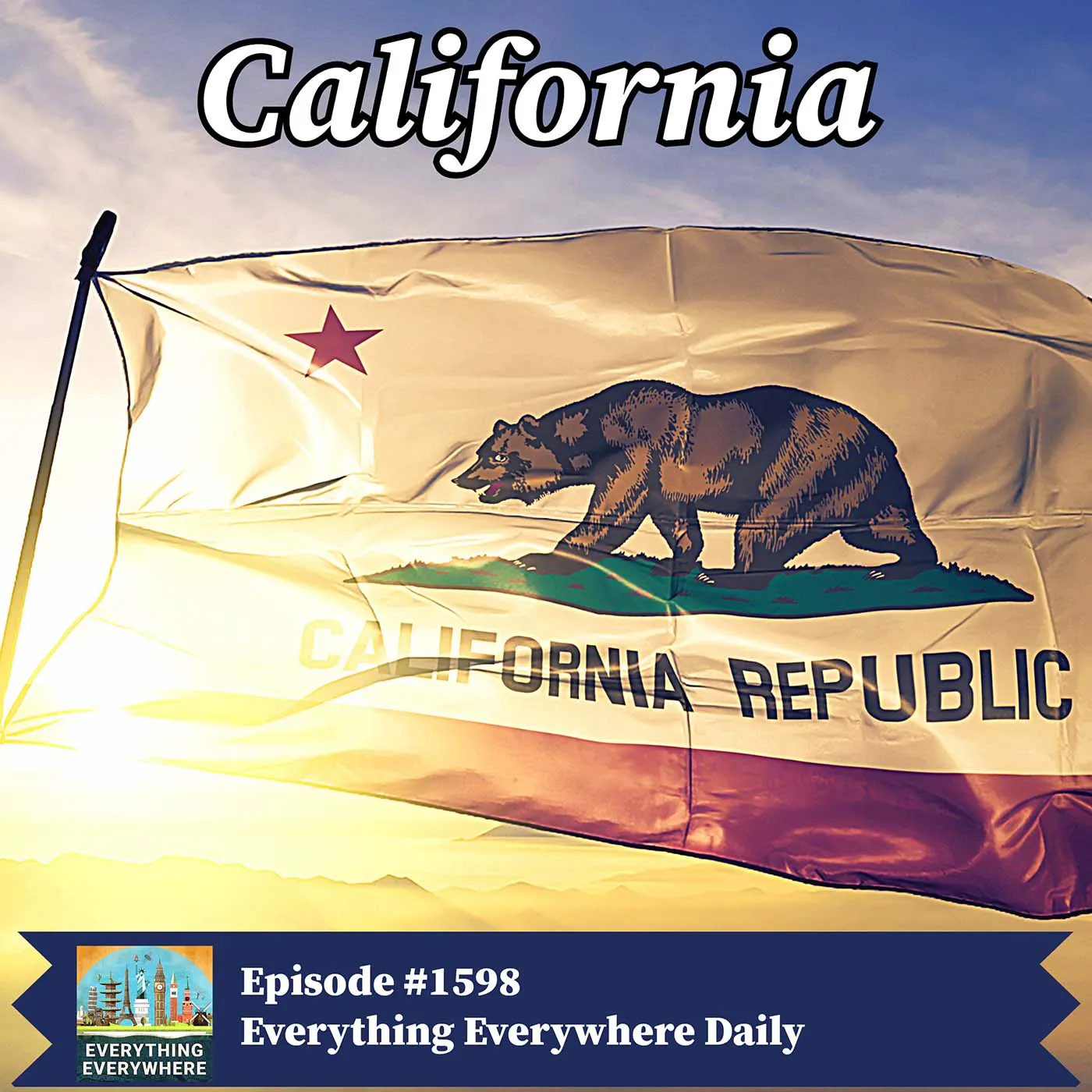
Everything Everywhere Daily: History, Science, Geography & More
California
00:16:07
Learn more about America's most populous state
Loading summary
Transcript3 lines
- [00:01]
Gary Arndt
California isn't just another US State. It's the most populous state in the Union, and it has an economy which, if it were an independent country, would be the fifth largest in the world. Yet this wasn't always the case. In the 19th century, California wasn't much at all. Hardly anybody lived there. It was far away from the American center of power and was technically part of Mexico. Yet despite their late start, it more than made up for lost time in the 20th century. Learn more about California, its history, and what makes it so special on this episode of Everything Everywhere. Daily. This episode is sponsored by Butcherbox. Thanksgiving is right around the corner and that means Thanksgiving dinner for friends and family. A Thanksgiving dinner can be a massive ordeal and a nerve wracking affair. You have to buy all the food and spend the better part of the day preparing everything before serving it. So why not take one thing off your plate by letting Butcherbox take care of the centerpiece of your Thanksgiving meal, the turkey. Not only will Butcherbox deliver the turkey directly to your door, but they will also offer some of the highest quality turkeys that you can find. Their turkeys are never given antibiotics or hormones, and they're all certified to be raised humanely. And in addition to turkey, they also have ham, beef and seafood, if that's what you prefer. New Butcherbox members that sign up using my link will receive their choice between a whole turkey turkey breast or a spiral ham plus $20 off when they visit butcherbox.com daily and enter code daily at checkout. Once again, that's butcherbox.com daily code daily at checkout.
- [01:52]
Carvana Representative
Decisions, decisions. Wait a minute. Are you still looking for cars on Carvana? Yeah. Decisions, decisions. When I use Carvana, I found the exact car I was looking for in minutes. Bought it on the spot, electric or full diesel. Decisions. Come on, you've been at it for weeks. Just buy it already.
- [02:13]
Gary Arndt
You're right. Crossover it is decisions decided. Whether you know exactly what you want or like to take your time, Buy your car the convenient way with Carvana When I was traveling around the world and I told people I was from the United States, one of the first questions I would often get would be, are you from California? Many people had no clue about anything in the country beyond California, Texas and New York City. In their minds, California was the United States. Two of the country's biggest cultural exports, Hollywood and Silicon Valley, are both from California. California has the largest population and economy of any state, and it's the third largest state by area. In order to understand what California is today, you have to understand both its geography and its history. The geography of California is remarkably varied. If you haven't traveled extensively in California, you might have some preconceived notions of what the climate and landscape is like. Whatever you think it is, if true, it's only true for a small part of the state. The most significant geographic detail about California is its coastline. It stretches 840 miles, or 1350 kilometers, along the Pacific Ocean from the Mexican border all the way up to Oregon. The coast consists of wide beaches in Southern California and rugged cliffs further north. In the middle of the coastline lies one of the largest and best natural harbors in the Pacific Ocean and indeed, one of the best in the world, San Francisco Bay. It's a standout harbor in what is otherwise a coast without good harbors. Approximately 77% of all Californians live along the coast. Moving inland, there is one major feature that dominates the entire the Central Valley. The Central Valley is a vast, flat, fertile, agricultural valley stretching 400 miles between the Sierra Nevada Mountains to the east and the Coast Ranges to the west. The northern part of the valley is known as the Sacramento Valley, and the southern part is known as the San Joaquin Valley. The valley's Mediterranean climate, rich alluvial soils, and extensive irrigation makes it one of the most productive agricultural regions in the world, supplying a significant portion of the United States fruits, vegetables, nuts and dairy. On the eastern side of the state lie the Sierra Nevada Mountains and the Cascade Mountains in the north. These contain some of the highest mountain peaks in the United States, including Mount Whitney, the highest point in the continental United States, and Mount Shasta in the north, a huge stratovolcano that's been inactive for the last 800 years. Along the mountainous border of Nevada, you can find the bristlecone pine, which is one of the oldest living life forms on Earth. The southern part of the state is mostly desert. It's dominated by the Mojave Desert and the Sonoran Desert near the Mexican border. This area includes Death Valley, one of the lowest and hottest places on Earth. The hottest temperature ever recorded on the planet was 56.7 degrees Celsius, or 134 degrees Fahrenheit, measured in Death Valley on July 10, 1913. The northern part of the state is very mountainous and is a high elevation. Here there are areas that have extreme amounts of Snowfall. Soda Springs, California, averages 411 inches, or 1,045 centimeters, of snow per year. That's over 34ft, or 10 meters. One of the more notable features in Northern California is the redwood forests which lie along the northern coast. Redwood trees have been known to reach heights of 116 meters, or 380ft. If you travel in California, one of the things you'll quickly notice is that once you get away from the San Francisco Bay area in Southern California, the population density of the state drops dramatically. There are enormous parts of the state that are almost desolate. This extreme, varied geography of California was instrumental in shaping its history. The history of California begins over 10,000 years ago, when the very first humans that we know of entered the region. Tribes such as the Chumash, Miwok, Yokuts, and Pomo developed complex societies. Each adapted to their specific environments. From coastal regions to inland valleys, they practiced hunting, gathering and fishing, with acorns being a staple food source. Rich in linguistic diversity, California was home to more than 100 different languages across dozens of distinct groups. In 1542, Spanish explorer Juan Rodriguez Cabrillo was the first European to explore the California coast, claiming it for Spain. What exactly he claimed is ambiguous, because he never ventured far beyond the coast and never saw the land he actually claimed for Spain. Despite sailing along the coast, he completely missed the San Francisco Bay, which is the most notable feature of the entire coastline. In fact, multiple Spanish expeditions up the coast failed to notice the bay for almost 200 years. Despite the claims by Cabrillo, Spain did nothing with the region for decades. Sixty years later, in 1602, Sebastian Vizcaino mapped the coastline, including Monterey Bay, further establishing Spanish claims. There was actually a belief that California was an island, which was a belief that persisted for decades. It wasn't until 1769 that the first Spanish mission was founded by Father Junipe Rosera in San Diego. The Spanish mission system in California, which existed between 1769 and 1823, was part of Spain's efforts to colonize and Christianize the region. It consisted of 21 missions stretching from San Diego to Sonoma, connected by El Camino Real, or the Royal Road. Led by Franciscan priests like Father Serra, the mission aimed to convert Native Americans to Christianity and integrate them into Spanish colonial society. San Francisco Bay was finally discovered by Europeans on November 4, 1769, during an expedition led by the Spanish explorer Gaspar de Portola. The discovery was actually accidental. Portola and his expedition were trying to find Monterey Bay, but overshot their destination. In 1821, Mexico gained independence from Spain and California became part of the Mexican Republic. Mexico dismantled the mission system, redistributing lands as large ranches to private individuals, mostly wealthy native Mexican landowners known as Californos, Mexico's claim to California wasn't to last long. In 1846, the United States declared war on Mexico. While Mexico was occupied fighting the Americans. In June 1846, a brief rebellion by a group of American settlers in Mexican controlled California took place which was known as the Bear Flag Revolt centered in Sonoma. The settlers, dissatisfied with Mexican governance, declared California an independent republic and raised a makeshift flag featuring a bear and a star which later inspired the modern California state flag. The Bear Flag Republic lasted less than a month before American forces assumed authority, marking a significant step towards the United States eventual annexation of California. In 1848, the Treaty of Guadalupe Hidalgo ended the war, formally ceding California to the United States. That same year, gold was discovered at Sutter's Mill, sparking the California Gold rush. The next year, thousands of prospectors known as 40 Niners migrated to California, transforming the social and economic landscape. The influx of settlers led to widespread displacement and violence against the Native Americans who lived there and forever changed California very quickly. In 1850, California was admitted to the Union as the 31st state. It was the first US state to border the Pacific Ocean. But California was isolated from the rest of the country. It didn't border any other state and getting to California required either a lengthy and dangerous journey over land or a lengthy journey around South America by sea. This problem was eventually solved in 1869 with the completion of the Transcontinental Railway which stretched from Cedar Bluffs, Iowa where it was connected to the Eastern railways to San Francisco. By the year 1900, California had a population of a little under 1.5 million people, with Los Angeles having a population of a little over 100,000 people. The 20th century saw the meteoric rise of California. The fertile Crescent Valley had made it an agricultural powerhouse. Ore and timber were large industries and its location made it the American gateway to the Pacific and Asia. Oil was discovered in Southern California in the early 20th century which spurred industrial growth in the state. The first modern industry to find a home in California was the motion picture industry. In 1910, many of the first film studios set up shop in Los Angeles Hollywood area. Southern California's consistent sunshine and mild weather allowed for year round outdoor filming, while its proximity to mountains, beaches, deserts and urban settings provided filmmakers with a variety of natural backdrops. Additionally, Hollywood's geographic isolation from Thomas Edison's base in New Jersey made it easier for filmmakers to evade his strict patent controls, fostering a more independent and creative environment. Good weather and economic opportunity caused California's population to rise dramatically in the first several decades of the 20th century. In 1910, it reached a population of 2.3 million people. In 1920, 3.4 million people and in 1930, 5.6 million people. An almost four fold increase in population in a mere 30 years. The great Depression, oddly enough, saw even more migration to California. California became a destination for Dust bowl migrants from places like Oklahoma. As depicted in John Steinbach's the Grapes of Wrath. Large scale infrastructure projects like the Hoover Dam provided jobs and water resources. Likewise, the Second World War didn't stop the growth of California either. California became a hub for defense manufacturing, particularly in shipbuilding and aviation. California was also the center of the large scale internment of Japanese Americans. Manzanar and Tule Lake were two of the largest internment camps in the United States. After the war, the area just south of San Francisco became a hotbed for the aerospace and defense industry. One company established in the 1950s was Fairchild Semiconductor. Fairchild became the seed of multiple technology companies in the area which were created by former employees. Intel, amd, National Semiconductor and Silicon Graphics were all microprocessor companies that were founded in the region. The entire area was dubbed Silicon Valley. California once again became the center of culture in the 1960s. It was the hub of the counterculture and the hippie movement. The Doors, the Grateful Dead, the Birds, the Mamas and the Papas, and even surf bands like the Beach Boys all came from California. In the 1970s, the young California wine industry came into its own when California beat French wines in a blind taste test. Wine growing regions such as Napa Valley and Sonoma became some of the most productive in the world. The 1980s saw a shift in Silicon Valley from microprocessors to personal computers and companies like Hewlett Packard and Apple. With the rise of the Internet in the 90s and the early 2000s, companies like Google and Facebook and many others were all founded in Silicon Valley. Today, California's economy is one of the largest in the world, driven by tech, entertainment, agriculture and tourism. As of the 2020 census, California has a population of 39 million people. It's home to nine national parks, the most of any state, including world class sites like Yosemite. California is of course, far from perfect. Today it suffers from homelessness, wildfires, drought, housing shortages, and a host of other issues, Much of it stemming from its success over the last century. For the first time since it joined the union, California has started to see net migration out of the state. Yet despite its problems, people worldwide still view California as the embodiment of America. And for the foreseeable future, it will probably remain the largest economy and population of any U.S. state. The executive producer of Everything Everywhere Daily is Charles Daniel. The associate producers are Benji Long and Cameron Keever. I want to give a big shout out to everyone who supports the show over on Patreon, including the show's producers. Your support helps me put out a show every single day, and also Patreon is currently the only place where Everything Everywhere Daily merchandise is available to the top tier of supporters. If you'd like to talk to other listeners of the show and members of the Completionist Club, you can join the Everything Everywhere Daily Facebook group or Discord server. Links to Everything are in the show. Notes.