Loading summary
Transcript3 lines
- [00:01]
Gary
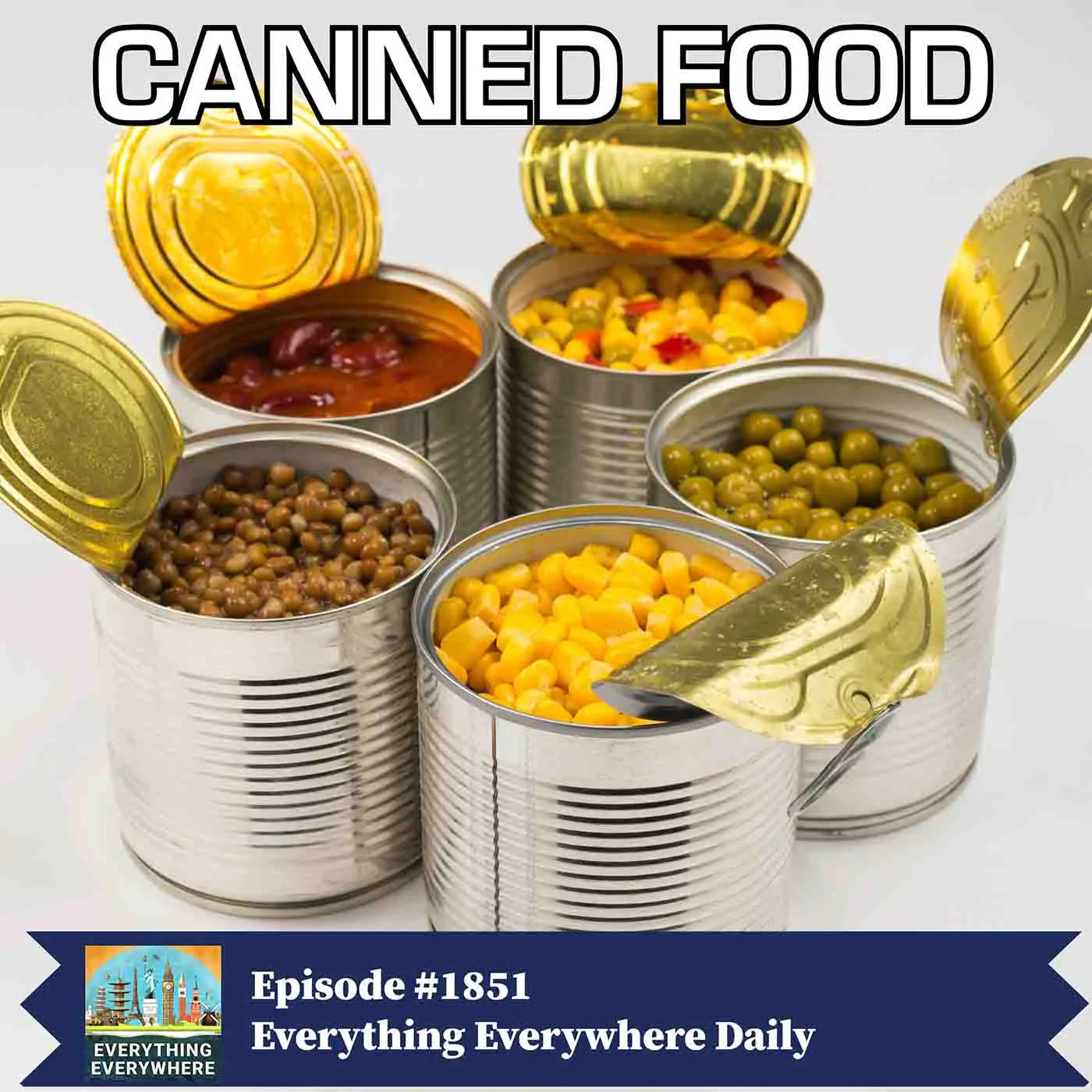
For thousands of years, food preservation was a significant challenge for humanity. Even if you were successful in hunting or gathering food, if you couldn't preserve it, it would be difficult to keep enough for survival. One of the most important advancements in the history of food preservation was the development of canning, which allowed for food to be preserved for significantly longer periods of time, sometimes very long periods of time. Learn more about the history of canning and its impact on the world on this episode of Everything Everywhere Daily. This episode is sponsored by Fiji Water. You've probably heard of Fiji Water and have seen it in stores. Well, Fiji Water really is from the islands of Fiji. Drop by drop, Fiji Water is filtered through volcanic rock 1,600 miles away from the nearest continent and all its pollution protected and preserved naturally from external elements. In this process, it collects a unique profile of electrolytes and minerals, resulting in more than double the electrolytes as the other top two premium bottled water brands, giving Fiji Water its smooth taste. Fiji water's electrolytes are 100% natural, and this water even has a perfectly balanced pH of 7.7. I've recently been trying to reduce my consumption of diet soda, and I've found Fiji Water to be a great alternative. Visit your local retailer to pick up some Fiji Water today for your next backyard party, beach day hike, or even your home office. Fiji Water is Earth's finest water.
- [01:45]
Carvana Representative
Buying a car in Carvana was so easy. I was able to finance it through them. I just. Whoa, wait, you mean finance? Yeah, finance. Got pre qualified for a Carvana auto loan, entered my terms and shot from thousands of great car options, all within my budget. That's cool. But financing through Carvana was so easy. Financed, done. And I get to pick up my car from their Carvana vending machine tomorrow. Financed, right? That's what they said. You can spend time trying to pronounce financing, or you can actually finance and buy your car today on Carvana financing, subject to credit approval, additional terms and conditions may apply.
- [02:18]
Gary
Food preservation has been a massive problem for centuries. Food starts to spoil the second it's collected. So to combat this, people had to develop methods to preserve food. Forms of preservation like drying, fermenting, pickling and salt curing were discovered, helping to keep food preserved for longer periods of time. I've previously done episodes on the use of salt for preservation as well as on frozen foods. However, perhaps the most revolutionary method of food preservation was the development of canning. So let's start out with how canning works. Canning is actually a pretty simple process. It involves placing foods into jars or cans and then heating them to a high temperature. The container is then closed while at a high temperature, which creates a vacuum seal, preventing outside microorganisms from contaminating the food within the jar or can and minimizing the amount of oxygen in the container. By doing this, food can be preserved significantly longer than other methods, Usually from one to five years, but potentially much longer. Much, much longer. But more on that in a bit. The origins of canning came from France during the Napoleonic Wars. The French needed an effective and cheap way to store vast amounts of food for the Grand Army. The French government offered 12,000 francs to any inventor who could solve this problem. The prize was considered to be worthwhile, as food availability prevented armies from campaigning during the winter. They could only fight during the summer and autumn, when fresh food was available. The prize was won by Nicolas Appert. Appert is considered to be the father of food science today. Appert was a convectioner and a brewer, and in 1804 he had begun to experiment with preserving food. He would do so by putting food into glass jars, sealing the jars and then boiling them. He had noticed that when he would seal food inside jars and boil it, the food would not spoil so long as the seal wasn't broken. Historians believe that this method of preservation may have originated in small households, But a pair is given credit for making canning an industrial method utilizing glass jars. He took his discovery to the French Minister of the Interior, Count Monteliver, and was awarded the prize in 1810. Though the French and a pair knew that the method worked, they didn't know the reason why why food didn't spoil. However, this method of canning was not super effective for the French army. Glass jars were fragile and heavy, making transportation across the French Empire very slow. Additionally, the canning process itself was also slow, making the development of the product logistically difficult for the French army. The Napoleonic wars ended before significant amounts of canned food could be shipped and the method could be perfected. The next known development in canning took place in the United Kingdom in 1810. Another Frenchman, Philippe de Garde, brought the canning process to London. That same year, Englishman Peter Durand patented a similar method using tin coated iron cans instead of glass. The idea was based on the glass seals a pair had developed the year prior, except that using metal cans was both cheaper and quicker to make and was also more durable. In 1812, he sold the patent for the tin can to fellow Englishmen Brian Donkin and John Hall. Donkin and hall used this to create the world's first commercial canning factory. Their initial Canning process had some serious flaws. The method they used to seal the can was lead soldering, which resulted in massive increases in lead poisoning. Addition this process was slow and labor intensive. Each can was handmade and the heating process could take up to six hours. During the early 19th century, Canning was typically done by smaller companies that were unregulated. They would be plagued with unsanitary conditions, and the unhygienic working conditions often led to contaminated cans being found on shelves. Nonetheless, there was a great deal of demand for canned food. The British army and Navy had a huge demand for canned food. Canned meat and fruit began to accompany sailors on their voyages across the ocean. This allowed for foods to be available on long trips that had never been possible before. By the mid 19th century, canned food had actually become a status symbol. It was considered by many to be an item that only the rich could afford. In the United States, the first canning factory was established by Thomas Kensett in 1825 in New York. Initially canning oysters, fruits and vegetables. During the U.S. civil War, canned food became essential for feeding union troops. This boosted industrial canning and familiarized American consumers with canned goods. Around this time, can making machines greatly increased output by not requiring each can to be sealed by hand. The work of Louis pasteur in the 1860s finally explained why canning worked. And the process was really simple. Microbes are primarily responsible for food spoilage. But in the early 19th century, this wasn't known, just as germs weren't known to cause disease. Yet all methods of food preservation involve preventing microbial growth in food. In the case of canning, it uses heat to kill microbes in the food. Cans are heated, usually under pressure, to reach temperatures higher than the boiling of water to ensure sterilization. The second step is simply to seal the container to prevent future contamination. Most of the innovation in food canning has been spent in this part of the process, in sealing and in canning material. After the Civil War ended, the remaining supply of canned food that was intended for the army was sold to the public, which is one of the reasons why canning became increasingly prevalent in households. For the average citizen. In 1890, the invention of the double seam can was developed. In this type of can, a crimped rather than soldered seal was used, improving safety and shelf life by eliminating lead soldering altogether. This was a huge innovation, and it's the same basic system that's still used today. This method involves interlocking the lid and the body of the can mechanically and then sealing by rolling or crimping the two layers of metal together. Today, there's often a thin rubber layer that is placed between the crimps to ensure a better seal. World War I saw the next development in Canning. As the First World War raged on, demand for canned food continued to skyrocket. Militaries across the world desired food rations for their soldiers and needed this food to be both cheap and provide necessary calories. Canned food was a proven safe method to transport food and would not spoil. In the trenches, however, much of the food was unpopular. Many soldiers felt that canned goods weren't of high quality and would complain to their superiors. To improve morale, militaries started to request higher quality food, and this sparked a series of innovations, including new food such as Spam stews, powdered milks, which offered better nutrition and more compact packaging. Canned food became a staple of the post World War II consumer society, especially in the United States and European. It symbolized modernity, hygiene, and efficiency. Products expanded to include everything from canned pasta and fruit cocktails to pet food and ready to eat meals. Nutritionally, canned food is usually just as nutrient rich as its fresh or frozen form, at least over reasonably short periods of time. Unlike curing or drying, it doesn't fundamentally change the food, and unlike freezing it, it doesn't require a constant source of energy. Additionally, canning food is relatively cheap. Canned foods are usually more affordable than frozen foods. This is why during times of crisis, canned foods sell quite well. During times of financial stress, people try to budget by not going out to eat and buying cheaper goods. This is why canned goods sold so well during the 2008 recession. Canned food is also popular with preppers or people who prepare for natural disasters. Canned food stores well, and you can often buy it in bulk. But the big question that many of you might have is just how long can food be stored in a can? Much of this depends on the quality of the can and how it was stored. Ideally, you want to store canned food in a cool, dry place. You probably don't want canned food to freeze, especially if it has water in it, as the expansion of the frozen water could break the seal on the can. Likewise, you don't want to store anywhere too hot, as it could accelerate any chemical reactions that are taking place inside. To maintain the best quality of food, it's best to eat canned food within the first year. Most of the best, if used by dates on cans, will usually be within a few years after canning. But that being said, canned food can be kept much longer than just a few years. In fact, as far as we know, canned food can preserve food almost indefinitely. One of the best examples were cans of food that were taken from the 1865 sinking of the steamboat Bertrand in the Missouri River. When excavated in 1968, archaeologists uncovered hundreds of intact cans containing oysters, peaches, tomatoes, and even brandied cherries. In 1974, some of the cans were opened and tested, and it was found that the food inside contained no bacterial growth and that the food was still perfectly edible. And the amazing thing wasn't the fact that the food was 109 years old. It was that the food was canned in the 1860s, not using modern techniques, and it was still able to be preserved that well. And this isn't an isolated example. In the process of researching this, I found not just many examples of canned food that were decades old being eaten, but there are entire YouTube channels that are dedicated to this. The oldest example I could find of something edible, and there might be even more extreme cases out there, was a man who in 2018 ate a can of British military rations from the Boer War, which were made between 1899 and 1902. It was edible, but not necessarily that tasty. And there are many such cases. A British couple, Les and Beryl Lally, were married in 1956. One of their wedding gifts was a basket of food which contained a can of Buxted chicken. The couple decided to keep the can in their cupboard and open it on their 50th wedding anniversary, which they did in 2006. It was perfectly edible. A German chemist named Hans Feldmeier received a can of Lard in 1948 as part of a post war shipment of food aid. He kept the can for 64 years and opened it in 2012 in the presence of chemists who tested it. They found the lard to be edible and even put some on bread and ate it. US Army Colonel Henry Mok served in Vietnam, where he received a ration in a can that had a pound cake. He kept the can and opened it 35 years later on the date of his retirement from the army, the pound cake was totally edible. While almost every case of old canned food that I could find was edible, after decades, not everyone was. The oldest unopened can of food that I found evidence of was canned in 1824. It was found in the pantry of a family in Fort Ross, California in 2010. It was a can of popcorn, which seems like an odd thing to can, but I guess that's what they did back then. When they opened the can, the popcorn was just a black mass and smelled of oil. This was not edible, but it was probably more of an issue of 1824 canning technology than it was how long it was in the can per se. I'm guessing that some of you might have some forgotten can of something in your house that's been sitting there for years. If you want to open it. The odds are, assuming the can is in good shape and has been stored properly, that the contents are edible. The takeaway is that if the zombie apocalypse comes, you will probably be safe in scrounging canned food for years after it happens. Canning has played a crucial role in the development of modern food preservation. By creating an affordable method to keep food for long periods of time, the quality of life for millions of people around the world has improved dramatically. The executive producer of Everything Everywhere Daily is Charles Daniel. The associate producers are Austin Ocken and Cameron Kiefer. Research and writing for this episode was provided by Olivia Ashe. Today's review comes from listener TimF1965 over on Apple Podcasts in the United States. They write Wowza. I'm hooked. Ran across this podcast a few months ago. I've always been a history buff, but Gary has introduced me to many topics that I was unaware of. I decided to start back at episode one, and I'm now on episode 800. I learned that it's not a good idea to eat a corned beef sandwich in space, along with other useful information. Well, thanks Tim. People might laugh at you now, but if you ever find yourself in space and someone's about to open up a package with a corned beef sandwich, you'll be the one getting the last laugh. Remember, if you leave a review or send me a boostogram, you too can have it read on the show.