Loading summary
Transcript1 lines
- [00:01]
Gary Arndt
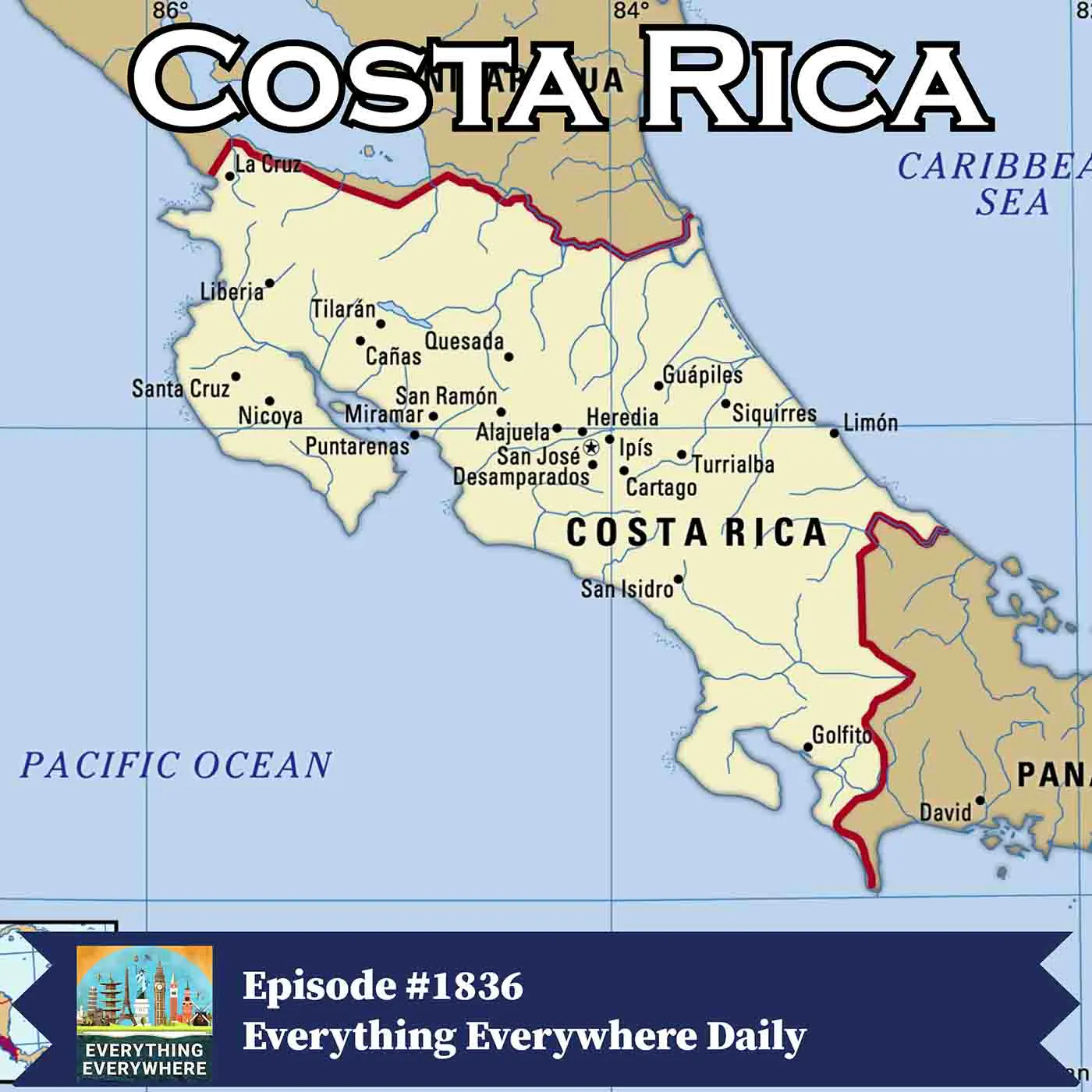
Located in the heart of Central America is the Republic of Costa Rica. Costa Rica is situated between Panama and Nicaragua and shares a similar colonial history with other countries in Central America. However, over the last hundred years, it has taken a radically different path, a path that has allowed the country to avoid most of the problems that have plagued the rest of the region, and as a result, it has become much more stable and much wealthier than many of its neighbors. Learn more about Costa Rica and what sets it apart from the rest of Central America on this episode of Everything Everywhere Daily. This episode is sponsored by Fiji Water. You've probably heard of Fiji Water and have seen it in stores. Well, Fiji Water really is from the islands of Fiji. Drop by drop, Fiji Water is filtered through volcanic rock 1,600 miles away from the nearest continent and all its pollution protected and preserved naturally from external elements. In this process, it collects a unique profile of electrolytes and minerals, resulting in more than double the electrolytes as the other top two premium bottled water brands, giving Fiji Water its smooth taste. Fiji Water's electrolytes are 100% natural and this water even has a perfectly balanced pH of 7.7. I've recently been trying to reduce my consumption of diet soda and I've found Fiji Water to be a great alternative. Visit your local retailer to pick up some Fiji Water today for your next backyard party, beach day hike, or even your home office. Fiji Water is Earth's finest water. This episode is sponsored by Quints. No one is ever going to confuse me with someone fashionable or trendy. That being said, if I'm going to buy something, I want it to look good, be of high quality and ideally be affordable. That is where Quint's comes in. Quint's is the kind of stuff you'll actually wear, like breathable flit Polos, crisp cotton shirts and comfortable lightweight pants. In addition to clothing, they also offer a range of great items for the home and travel. Everything with Quince is half the cost of similar brands. By working directly with top artisans and eliminating the middleman, Quince offers luxury pieces without the markup and I've told you all about the great items that I've purchased. From Quince. From towels to blankets to a duvet, Quince has become my go to source. Stick to the staples that last with elevated essentials from quince. Go to quince.com daily for free shipping on your order and 365 day returns. That's Q-U-I-N-C-E.com daily to get free shipping and 365 day returns quince.com daily before I dive into the history of Costa Rica, I need to cover the country's geography as its history and what sets it apart from the rest of Central America are in part shaped by its geography. Costa Rica is bordered by Nicaragua to the north and Panama to the southeast, with coastlines on both the Pacific Ocean to the west and the Caribbean Sea to the east. Despite its compact size, just under 52,000 square kilometers, it contains an extraordinarily diverse geography, shaped by volcanic mountain ranges, tropical coastlines, dense rainforests and fertile valleys. By area, it is slightly smaller than Croatia and slightly larger than Slovakia. The primary geographic feature of the country is the mountain range situated in the center of the nation, running from the border of Panama up through the country and not quite reaching Nicaragua. This range is divided into several smaller ranges, including the Cordillera de Guanacaste, the Cordillera de Tiliran, the Cordillera Central and the Cordillera de Talamanca, which are formed by tectonic and volcanic activities. Between these highlands lies the Central Valley, High home to the capital city of San Jose and the majority of the population, this elevated plateau offers a temperate climate and rich soils ideal for agriculture, especially coffee cultivation. Ecologically, Costa Rica is one of the most biodiverse places on Earth. Despite occupying only about 0.03% of the planet's landmass, it contains nearly 5% of all global biodiversity. This is due in part to its geographic position as a land bridge between north and South America, as well as the variety of habitats found within its borders, ranging from cloud forests and mangroves to dry savannas and coastal reefs. The total population of the country is a bit over 5 million people, and the population is highly distributed. San Jose is the capital and the primate city of the country, but has less than 10% of the population, with a population of around 330,000. There is no other city in the country with a population over 100,000. Le Mans, the second largest city located on the Caribbean side, has a population of only 55,000. The key takeaway about Costa Rica's geography and its impact on the country's development is that it's very mountainous, with most of the mountains running right through the center of the country. Before European contact, Costa Rica was home to several indigenous groups who laid the cultural groundwork for the region. The most significant of these were the Chorotegas in the northwest, who had migrated from Mexico and brought advanced agricultural techniques, and the Utares in the central valley who became skilled in gold working and created the famous golden figurines that would later attract Spanish attention. These early inhabitants were sophisticated societies rather than simple tribes. They developed complex trade networks that stretched from Mexico to South America, created elaborate burial sites featuring golden artifacts, and established agricultural systems that sustained substantial populations. The Dikas culture in the south left behind mysterious stone spheres that still puzzle archaeologists today, demonstrating advanced mathematical and engineering knowledge. When Christopher Columbus arrived in 1502, during his fourth voyage, he named the area Costa Rica, or Rich coast, after observing the gold ornaments worn by the indigenous people. However, this name would prove somewhat ironic, as Costa Rica would become one of Spain's poorest colonies. And here is the start of where Costa Rica's story diverges from other Latin American colonies in crucial ways. Unlike Mexico or Peru, for example, Costa Rica lacked a large indigenous population to exploit for labor and had no significant mineral wealth, such as silver or gold mines. Despite the fact that many of the native people wore gold and practiced advanced goldsmithing. This absence of wealth actually became a blessing in disguise, shaping Costa Rica's society later on. The colonial period was marked by isolation and poverty. The small population of Spanish settlers had to work their own land rather than relying on indigenous labor or enslaved people. This created a society of small farmers rather than large plantation owners, establishing a pattern of relative equality that would influence Costa Rica's development. For centuries. The Spanish crown ruled the region through the Captaincy General of Guatemala, which itself was under the viceroyalty of New Spain. The capital moved several times before settling in the city of Cartago, and the population remained concentrated in the central valley, where the climate and soil were most suitable for agriculture. Coffee, which was introduced in the early 19th century, would eventually transform the economy. Costa Rica gained independence from Spain in 1821 as part of the Central American Federation. However, news of independence actually didn't reach Costa Rica for over a month. Political instability in the region and civil war within the federation led Costa Rica to distance itself from the Union. In 1823, a conflict known as the Ocho Mogo War broke out between Cartago, which supported union with the Mexican empire, and San Jose, which favored republicanism. San Jose's victory set the tone for the country's eventual independence from all external authority. By 1838, they had effectively seceded from the federation, with head of state Braulio Carrillo consolidating power, laying the foundation for an independ independent Costa Rica. The coffee boom that began in the 1830s had a profound impact on Costa Rican society. Coffee cultivation was ideally suited to the country's geography and climate and demand from European markets created unprecedented wealth. However, this led to the formation of Costa Rica's coffee oligarchy, a small group of wealthy families that controlled coffee production, processing, and export. It was a fundamental societal shift from the small farmers who previously made up most of the country. Coffee was exported through the Pacific port of Punta Arenas and eventually via the Atlantic. Following the construction of the railroad in the 1870s and 1880s, which was partly financed by British capital, this investment also brought Jamaican laborers to the country. The railroad project brought another crucial element of Costa Rica's economic development. The introduction of banana cultivation and the arrival of Miner Cooper Keith, whose United Fruit Company would dominate the Caribbean lowlands for decades. The early 20th century saw growing social unrest and calls for reform. In the 1910s and 1920s, labor movements emerged and political tensions rose between liberal oligarchs and a rising middle class. The 1940s brought Costa Rica's greatest political crisis. The disputed 1948 election between Ottilio Ulate and Rafael Guardia led to a brief but significant civil war. Jose Figueres Ferrer led the victorious revolutionary forces, and this conflict would permanently reshape Costa Rica's political landscape. The civil war wasn't just about electoral fraud, but represented deeper tensions between traditional oligarchy and emerging middle classes, between conservative and social democratic visions of society, and between different models of economic development. Figueres and his supporters establish what historians refer to as the Second Republic. The new constitution of 1949 included several revolutionary provisions. Most importantly, it granted women the right to vote, established the framework for an expanded welfare state, and perhaps most notably, it abolished the military. This moment represents Costa Rica's definitive break with the traditional Central American pattern of military coups and authoritarian rule. Without a military, you can't have military coups or military juntas. It also eliminated the need for violent revolutions, focusing all energy for societal change into democratic processes. From the 1950s onward, Costa Rica became a stable, democratic nation with regular elections and peaceful transitions of power. While other Central American countries suffered coups, dictatorships, and civil wars, Costa Rica stood out as a model of democratic governance and human development. Its lack of a military allowed it to invest heavily in things like education and healthcare. The country also began to position itself as a leader in environmental conservation. In the 1980s and 90s, Costa Rica developed a system of national parks and pioneered ecotourism, making biodiversity a core part of its identity and economy. Presidents like Oscar Arias Sanchez, who won the Nobel peace Prize in 1987 for his role in Central American peace negotiations, associations helped raise The Country's International profile Costa Rica threaded the needle during the Cold War, balancing a market economy with social programs that eliminated the root cause of many of the left wing revolutionary groups that had spawned in other countries in the region. However, they were not completely immune to what was going on in the rest of the world. The 1980s brought Costa Rica's worst economic crisis since the 1930s. Massive foreign debt, inflation exceeding 100% and regional conflicts threatened to destabilize the country. The government was forced to accept structural adjustment programs from the International Monetary Fund, marking a shift towards neoliberal economic policies. From this, Costa Rica maintained its democratic institutions and social programs while opening its economy to international markets. The country diversified from coffee and bananas and into manufacturing and tourism. Costa Rica's tourism initiatives have been extremely successful. Beginning in the 1980s and accelerating in the 1990s, Costa Rica embraced ecotourism as a national strategy. Recognizing its unparalleled biodiversity, the country invested heavily in protecting its natural resources. Over 25% of Costa Rica's territory is now designated as protected land, including national parks, bio reserves and wildlife refuges. These protected areas attracted tourists interested in rainforests, cloud forests, volcanoes, beaches, bird watching and sustainable travel experiences. Unlike neighboring countries such as Honduras, Nicaragua or El Salvador, Costa Rica has remained politically stable and free of military conflict, which has made it a safe and attractive destination for international travelers. Its lack of an army and commitment to democracy and has helped build a global image of peace and safety, in stark contrast to the civil wars, coups and gang violence that have affected other Central American nations. And it's one of the reasons why Costa Rica has been called the Switzerland of Central America. While countries such as Guatemala and Nicaragua have rich cultural and ecological resources, their reputations for political instability or crime have hindered tourism growth. I visited Costa Rica in 2013 and spent time traveling around the country by bus. I visited Rincon Volcano national park and Tapanti national park, both of which are UNESCO World Heritage sites. Traveling around the country was easy and I didn't even get to either of the coasts, which is where most visitors tend to go. The path that Costa Rica has taken has worked well for them. Their GDP per capita is approximately $14,200, which is just behind that of Panama. However, it's more than double that of the next closest Central American country, Belize, and almost seven times greater than its neighbor Nicaragua. It isn't a wealthy country by Western standards, but it has become a solidly stable middle class nation, especially when compared to other countries in the region. Costa Rica has managed to achieve success by avoiding the problems that have plagued its neighbors. And this is due to choices it made in the 20th century, as well as its geography and the manner in which it was settled by the Spanish. It has resulted in the most politically stable country in all of Central America. The executive producer of Everything Everywhere Daily is Charles Daniel. The associate producers are Austin Oakton and Cameron Kiefer. I want to thank everyone who supports the show over on Patreon. Your support helps make this podcast possible. I'd also like to thank all the members of the Everything Everywhere community who are active on the Facebook group and the Discord server. If you'd like to join in the discussion, there are links to both in the show notes and as always, if you leave a review or send me a boostogram, you too can have it read on the show.