← Everything Everywhere Daily: History, Science, Geography & More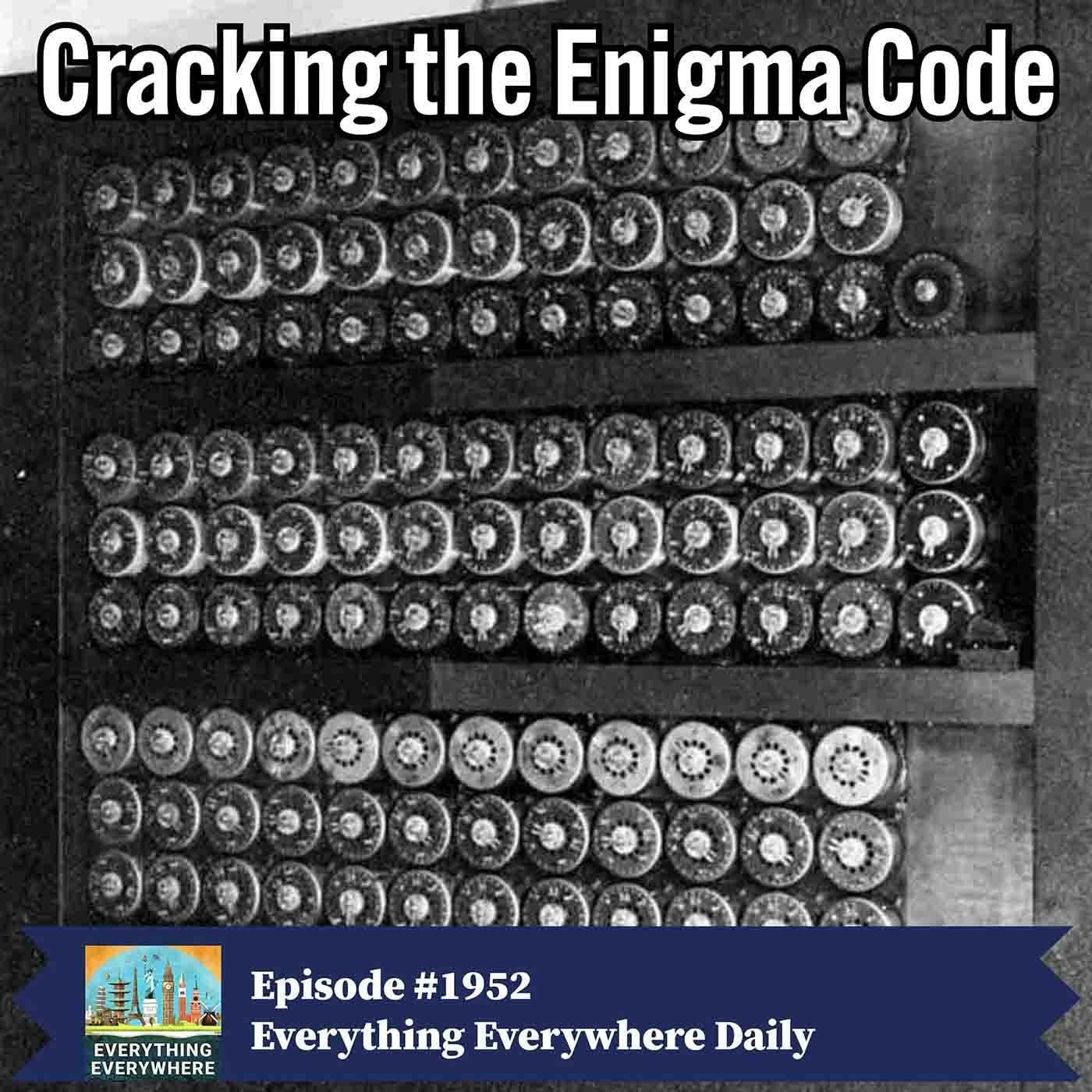
Everything Everywhere Daily: History, Science, Geography & More
Cracking the Enigma Code (Encore)
00:13:40
Loading summary
Transcript11 lines
- [00:00]
A
The following is an encore presentation of Everything Everywhere Daily. During the Second World War, the Germans used what they thought to be an uncrackable encryption system and it was a really good encryption system and for the longest time the Allies had a difficult time cracking the code. However, thanks to brilliant code breakers, a powerful computing machine and German mistakes, the Allies were finally able to break the code. Learn more about the Enigma code and how it was broken on this episode of Everything Everywhere Daily.
- [00:46]
B
This episode is sponsored by Quint's. The holiday season is upon us and that means buying gifts for friends and family. So why not get something that's top tier but affordable? That's where Quince comes in. Quint's has great items like $50 Mongolian cashmere sweaters that feel like an everyday.
- [01:03]
A
Luxury and wool coats that are equal.
- [01:05]
B
Part stylish and durable. And you'll pay a fraction of what you would from other retailers and their prices are literally listed on the Quint's website. I just got an Australian merino wool sweater that looks great and cost only half of what it would have if I had bought it somewhere else. By partnering directly with ethical factories and top artisans, Quince cuts out the middleman to deliver premium quality and at half the cost of similar brands and often even bigger discounts. Give and get timeless quality staples that last this season with quince. Go to quince.com daily for free shipping on your order and 365 day returns. Now available in Canada too. That's Q-U-I-N-E.com daily free shipping and 365 day returns. Quince.com daily this episode is sponsored by Mint Mobile. The reality is that smartphones and their associated mobile plans have become an indispensable.
- [02:03]
A
Part of the modern world.
- [02:05]
B
You almost can't get by without one. So if you have to have a monthly plan, why spend any more than you need to? That's why I recommend Mint Mobile. All their plans come with high speed data and unlimited talk and text delay delivered on the nation's largest 5G network. You can use your current phone, current phone number and keep all of your current contacts. Nothing has to change except the amount you pay. At Mint Mobile, their favorite word is no. No contracts, no monthly bills, no overages.
- [02:35]
A
No hidden fees and no bs.
- [02:38]
B
Ready to say yes to saying no? Make the switch@mintmobile.comeed that's mintmobile.comeed upfront payment of $45 required, equivalent to $15 a month limited time new customer offer for first three months only. Speeds may slow above 35 GB on unlimited plan. Taxes and fees extra.
- [02:58]
A
See Mint Mobile for details. Codes and ciphers have always been an important part of warfare. Commanders needed to give orders to units that couldn't fall into the hands of enemies. If you remember back to my episode on cryptography, cipher systems of some sort have been used since ancient history. There is evidence of some sort of encrypted writing in ancient Mesopotamia, India, Greece and Rome. For most of history, encryption was tied to a physical document. You could hide or conceal a document so the enemy wouldn't even know you had a document. However, with the advent of wireless radio communications, things changed. You could send communications quickly over long distances, but the communication could be picked up by anyone who was listening. When you know the enemy is going to have access to your encrypted communications, you need to have an extremely robust encryption system. There is a system that is extremely secure, known as a one time pad. A one time pad is a system of random characters that are shared between two parties. And the system is guaranteed 100% unbreakable. However, there's a catch. You can only use it once, and you really can't use it with multiple parties. If a central command wanted to communicate with multiple distributed units, you have to give everyone the same one time pads, and if one of them fell into the hands of the enemy, then it would be able to decrypt everything. What you wanted was a system that was difficult to crack. And if a message was cracked, it didn't mean that you could crack any previous or subsequent messages. Such a system was developed in 1918 by the German electrical engineer Arthur Scherbius. It was an electrical machine that could encrypt messages. He received a patent for his invention and sold it under the name Enigma. The Enigma machine was an extremely clever device. At its core was the oldest method of encryption in the world, letter substitution. Letter substitution systems are extremely simple. Just take a letter of the Alphabet and replace it with another letter and then write the code using the replace letters. The problem is these systems are also very easy to crack. They can be done almost instantly with a computer and they can be done rather easily by hand as well. They're easy enough to crack that they're often used as puzzles in newspapers. What was brilliant about the Enigma system, however, is that it changed the substitution after every letter. To have an understanding of how it worked, let me describe a basic Enigma machine. There were several different versions of the machine, but this basic description would apply to all of the versions. An Enigma machine was about the Size of a small cash register. At the bottom was a keyboard. Above the keyboard were rotors. Each rotor had 26 possible settings which had to be set before encrypting or decrypting a message. Depending on the version of the machine, there could be anywhere from three to eight rotors. The rotors could have been selected from a larger number of rotors, such as three out of a possible five in some machines. There was also an electrical plug board on the front just below the keyboard. For versions with the plug board, each plug corresponded to a letter of the Alphabet and multiple cables would connect multiple letters of the Alphabet together. At the top, there was a set of lights that also corresponded to each letter of the Alphabet. When a message was to be encoded, the rotors were set to whatever the predetermined settings were for that day. Likewise, if there was a plug board, those would have to be set to the preordained settings as well. The sender would type a key which would then light up one of the letters at the top. However, every time a key was pressed, it would turn the rotors, in effect creating a brand new letter substitution for every single character. The plug board added an extra layer of encryption by electronically switching letters before it was sent to the rotors. If you had a three rotor Enigma machine taken from a set of five rotors and ten letter prayers connected on the plug board, there would be almost 159,000,000,000, possible settings for the device. Decrypting the device would be doing the exact opposite. You would set the machine to that day's settings and then type in the encrypted letter which would light up the decrypted letter at the top. Every day the rotor settings would be changed according to a set schedule. So even if you could somehow decrypt a given message, it would be useless the next day because the routers would create a whole new system. If you wanted to decrypt a message, you needed an Enigma machine with the right rotors and you needed to know the settings for that message. The Germans were extremely confident in their Enigma machines. They were used at all levels of the German military and were used to transmit secrets with the highest classification. Needless to say, the protection of Enigma devices and the daily settings were a top priority in the German navy. The settings were actually printed on water soluble ink that would be erased if a ship were to sink. In the event that a ship were to be captured, the rotors were to be taken out and thrown overboard as the ship was abandoned. The first version of the Enigma machines were actually used by the German government as early as 1923, well before the Nazi party ever came to power. Over the years, various versions of the machine were rolled out to be used by various branches of the military. Attempts to break the Enigma code began well before the war started. It was truly a monumental task given the strength of the Enigma system. British cryptographers have gotten much of the attention and and more on that in a bit. But the Polish Cipher Bureau actually conducted the original work on the machines in the early 1930s. Poland had a greater and earlier incentive to crack the German code before any other European country did. Not surprisingly, the Poles had a great deal of difficulty in cracking the code. A Polish mathematician by the name of Marian Rieski made huge strides in understanding how it worked and weaknesses in the system. One of the things that he realized was that there were flaws in the German procedures. First, they used a single setting for all of the messages on a given day. And second, they put a six letter indicator with a message key at the top of every message. This was an encrypted command to tell the decrypting officer how to set their rotors. And this was done by the Germans up until 1938. This and other errors made by German operators made it possible for Rajsky to decrypt some of the messages without ever knowing the initial settings of the device. The Poles made many other advancements in cryptography in attempting to break the Enigma code and also developed one of the first machines that could work on decryption. It was called a cryptologic bomb or a bomba. The bomba was a brute force attempt at trying to solve the rotors. However, a general solution to the Enigma code eluded them. And things got worse when the Germans added two more rotors that could be used to make up the three rotors. This increased the number of rotor combinations from 6th to 60. In 1939, when it looked like war with Germany was inevitable, the Poles began to share what they had learned with Britain and France. When Germany did invade, the Polish Cipher Bureau destroyed their machines and documents and evacuated the team to the south into Romania. They wound up in France at a site called PC Bruno, where they continued their work. British cryptographers from the British Crypto Analysis Centre in Bletchley park visited P.C. bruno several times. In January 1940, one of the researchers by the name of Alan Turing came to PC Bruno to work with the Polish and French team. PC Bruno and Bletchley park worked closely together and had their own secure telegraph cable to communicate with each other. When the Germans invaded France in 1940, many of the PC Bruno team managed to flee to Britain, but some of them were actually captured. After the war, it was determined that none of the cryptographers had disclosed anything that they knew. I want to stress the work done by Polish cryptographers because much of the story of cracking the Enigma code focuses on Alan Turing and the team at Bletchley Park. While they do deserve a great deal of credit, as the team at Bletchley themselves recognized, their work wouldn't have been possible without the trail that the Poles had blazed in the years before the war. After the invasion of France, the job of cracking the Enigma code now fell to Bletchley park and the team led by Alan Turing. Turing created their own version of a cryptographic bomb. This, like the Polish version, would try to brute force all 17,576 possible settings of the wheel orders. The bomb wasn't a computer as we think of it today. It was electrical, but it was mostly mechanical. The problem was they had to do this every day with a fresh new set of intercepted codes, and they couldn't guarantee that they could break the code every day. What they needed was a shortcut, some phrase that they knew in advance that they could use to cut down on the number of possible combinations. The eureka moment came when they realized that almost every message sent by the Germans ended in the exact same two Heil Hitler. This seemingly innocuous phrase was the Achilles heel that allowed the Enigma code to be broken. Solving the known phrase Heil Hitler allowed them to decrypt the code for the day and read everything rather quickly. The Americans were eventually let in on the project when they joined the war, and the Americans built their own cryptographic bomb, which was much faster than the British version. Keeping the fact that they had cracked the Enigma code a secret was very difficult. They couldn't simply act on every bit of intelligence they had, or else it would give away the fact that they had cracked the code. They used just enough information to make the Germans think that they had gained the information from other sources, like radar or spying. Today, there are several original Enigma machines that can be found in museums around the world and in the hands of private collectors. Enigma devices have been sold at auction for as much as $547,000. And there are even replica Enigma machines that you can buy. If you're like me, you might be curious how quickly the Enigma code could be solved using modern computers. Well, in 2017, an artificial intelligence program managed to crack the Enigma code in 12 minutes and 50 seconds, and to do it that fast, it required the use of 2,000 cloud servers. Today, Alan Turing is celebrated on the 50 pound note in the UK, and the Turing Award given out by the association of Computing Machinery is considered to be the Nobel Prize in computer Science. Breaking the Enigma code was one of the most important strategic breakthroughs of the Second World War, and the public wasn't even made aware of it until the 1970s. But since it became public, the breaking of the Enigma code has become one of the most celebrated chapters in the history of the war, and the story has been told in books, movies and on television. Some historians believe cracking the Enigma code may have shortened the war by two years and saved over 14 million lives. The work done on breaking the code didn't just help win the war, but it helped lay the foundations for modern computing and cryptography. And it was all because a group of Polish and British code breakers managed to break a code that was considered to be unbreakable. The executive producer of Everything Everywhere Daily is Charles Daniel. The associate producers are Austin Otkin and Cameron Kiefer. My big thanks go to everyone who supports the show over on Patreon.
- [14:36]
B
Your support helps make this podcast possible.
- [14:39]
A
And I also want to remind everyone about the community groups on Facebook and Discord. That's where everything happens that's outside the podcast, and links to those are available in the show notes. As always, if you leave a review on any major podcast app or in the above community groups, you too can have it read on the show.