Loading summary
Transcript1 lines
- [00:00]
A
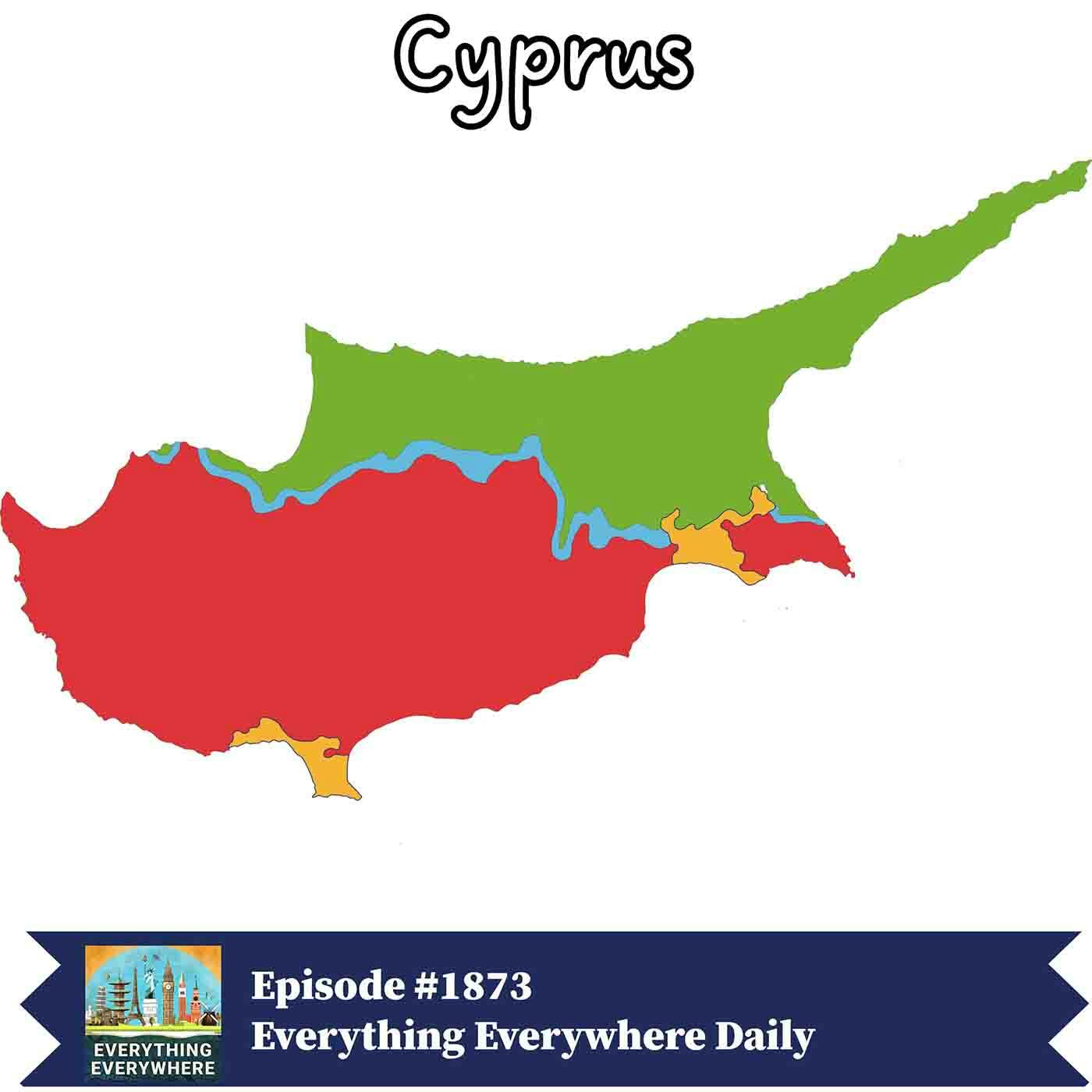
Strategically located in the eastern Mediterranean Sea, with access to Europe, Asia and Africa, is the island of Cyprus. Cyprus has a history that goes back as far as civilization itself, and it has had a history with almost every major civilization and empire around the Mediterranean. Its history isn't just a relic of the ancient world, it has remained strategically important and a source of conflict to the present day. Learn more about Cyprus and its deep history on this episode of Everything Everywhere Daily. This episode is sponsored by Fiji Water. You've probably heard of Fiji Water and have seen it in stores. Well, Fiji Water really is from the islands of Fiji. Drop by drop, Fiji Water is filtered through volcanic rock 1,600 miles away from the nearest continent and all its pollution protected and preserved naturally from external elements elements. In this process, it collects a unique profile of electrolytes and minerals, resulting in more than double the electrolytes as the other top two premium bottled water brands, giving Fiji Water its smooth taste. Fiji Water's electrolytes are 100% natural and this water even has a perfectly balanced pH of 7.7. I've recently been trying to reduce my consumption of diet soda and I found Fiji Water to be a great alternative. Visit your local retailer to pick up some Fiji Water today for your next backyard party, beach day hike, or even your home office. Fiji Water is Earth's finest water. This episode is sponsored by Mint Mobile. According to recent data, approximately 98% of all Americans own a mobile phone, and that means a monthly phone bill is something that almost all of us share. With all the bills you have to pay, why pay more than you have to for your phone bill? With Mint Mobile, you can start with plans as low as $15 per month, and with Mint Mobile, you can keep your phone, your number, and use the same towers and networks that you do now. All you do is save money, and that's why I recommend Mint Mobile this year. Skip breaking a sweat and breaking the bank. Get this new customer offer and your three month unlimited wireless plan for just $15 a month at mintmobile.comeed that's mintmobile.comeed upfront payment of $45 required, equivalent to $15 a month limited time new customer offer for first three months only. Speeds may slow above 35 gigabits on unlimited plan, taxes and fees extra. See Mint Mobile for details. Cyprus has historically been one of the most important islands in the world. It sits at the crossroads of Europe, Asia and Africa, and has played a significant role in every major civilization and empire from Mesopotamia to the Straits of Gibraltar. The earliest Human presence on Cyprus dates back to about 10,000 B.C. when hunter gatherers first arrived, likely from the nearby Anatolian coast in what is today Turkey. These Paleolithic people left behind important archaeological evidence at sites like Eitokremnos, where they appear to have driven the island's endemic pygmy hippopotamus and elephants to extinction through hunting. And this was one of the great tragedies of the world because we no longer have hippos and elephants that are the size of large dogs, which would have been really awesome to have as pets. The Neolithic period, beginning around 8200 BC marked Cyprus first major cultural transformation. The people of Chirolkidia developed a sophisticated society with distinctive roundhouses, advanced stone tools and elaborate burial practices. What makes this period particularly fascinating is that these Neolithic Cypriots lived for nearly 2,000 years without pottery, instead using carved stone vessels. This pottery free period, unique in the Mediterranean, ended around 5,500 B.C. when new settlers brought ceramic technology to the island. The introduction of copper working around 3000 BC fundamentally altered Cyprus destiny. The island's rich copper deposits, particularly in the Trodos Mountains, would give Cyprus its very name, derived from the Greek word kypros, meaning copper. The mineral wealth transformed Cyprus from a relatively isolated agricultural society into a major player in Bronze Age Mediterranean trade networks. The demand for Cypriot copper reached as far as Sardinia in the west and Mesopotamia in the east, establishing trade relationships that would persist for thousands of years. During the Late Bronze Age, roughly 1600-1050 BC Cyprus experienced what many historians consider its first Golden Age. The island developed a civilization that blended indigenous traditions with influences from neighboring cultures, particularly the Minoan and Mycenaean Greeks. The Bronze Age collapse, which took place around 1200 BC brought major changes to Cyprus. The arrival of new peoples, including groups we might identify as early Greeks, occurred during this period. Rather than destroying existing civilization, these newcomers seem to have gradually integrated with the existing population, creating the foundation for what would become classical Cypriot culture. From 1050 to 480 BC, Cyprus developed its distinctive city kingdom system. Ten major kingdoms emerged across the island, including Salamis, Paphos, Kitian, and Amathous, each controlling surrounding agricultural territory and maintaining its own royal dynasty. This political fragmentation actually proved remarkably resilient and would persist in various forms for centuries. What makes this period particularly interesting is how these Cypriot kingdoms navigated the rise of successive Near Eastern empires. When the Assyrian Empire expanded westward in the 8th century BC the Cypriot kings chose submission over destruction, agreeing to pay tribute while maintaining their internal autonomy. The kingdoms maintained this tributary relationship first with Assyria, then with Babylon, and finally with Persia after Cyrus the Great's conquest in the 6th century BC during the Persian period, Cyprus became increasingly influenced by Greek culture, even as it remained politically integrated into the Persian Empire. This created cultural tensions that can still be observed in the archaeological remains and the historical accounts from that period. The arrival of Alexander the Great in 333 BC marked another major turning point. Most Cypriot kings immediately switched allegiance from Persia to Macedonia, recognizing the shift in imperial power after Alexander's death, Cyprus became part of the Ptolemaic Kingdom of Egypt, which was Greek, beginning a period of Hellenistic rule that would last for over two centuries. Cities like Salamis and New Paphos became major Hellenistic centers, complete with theaters, gymnasiums, and elaborate religious complexes. The famous mosaics of Paphos, which today is a UNESCO World Heritage Site, date from this period and demonstrate the high level of artistic achievement reached under Ptolemaic Egypt. Rome's expansion into the eastern Mediterranean inevitably brought Cyprus into the Roman sphere. In 58 BC, Cyprus was annexed directly by Rome, initially as part of the province of Cilicia. This transition marked the end of the last Hellenistic kingdom and the beginning of what would prove to be the longest continuous period of external rule in Cypriot history. Roman Cyprus was reorganized as a senatorial province in 27 B.C. governed by a proconsul based in new Paphos. Christianity arrived early in Cyprus, brought by the apostles Paul and Barnabas around the year 45 during their first missionary journey. According to Acts of the Apostles, they converted the Roman proconsul Sergius Paulus, making Cyprus one of the first territories with a Christian governor. The transition from Roman to Byzantine rule occurred gradually during the 4th and 5th centuries as the Roman Empire's center of gravity shifted eastward to Constantinople. For Cyprus, this was relatively smooth as the island remained within the same imperial system as it transitioned into what we now call the Byzantine Empire. Byzantine Cyprus faced its first major external threat in the seventh century with the rise of the Islamic caliphate. The Arab raids, beginning in 649 under Muayya Ibn Abi Sufyan, destroyed many Cypriot cities and led to a unique political arrangement. Rather than complete conquest by either power, Cyprus became a condominium, jointly administered by Byzantium and the Umayyad caliphate. This arrangement, which lasted from 688 to 965, required Cyprus to pay tribute to both power while maintaining internal autonomy under a Byzantine governor. Byzantine control was restored in 965, beginning a period of renewed prosperity and cultural development. The 10th and 11th centuries saw extensive church building and artistic patronage producing some of Cyprus most remarkable Byzantine monuments. The Crusades brought another dramatic transformation to Cyprus. In 1191, during the Third Crusade, Richard the Lionheart of England conquered the island from the Byzantine usurper Isaac Komnenos. Initially, Richard just intended Cyprus to be a source of supplies and revenues for his crusading efforts in the Holy Land. However, recognizing the strategic importance of controlling Cyprus for maintaining Crusader states in Syria and Palestine, he sold the island to Guy de Lusignan, the former king of Jerusalem. The Lusignan dynasty ruled from 1192 to 1489 and created a uniquely French kingdom in the middle of the Eastern Mediterranean. The Lusignan dynasty established a Western European feudal system while governing a predominantly Greek Orthodox population. This created a complex social hierarchy with Catholic Frankish nobles at the top, a Greek Orthodox peasantry at the bottom, and various intermediate groups including Italian merchants, Armenian refugees, Jews and others. Lusignan Cyprus became one of the wealthiest kingdoms in medieval Europe, serving as the primary staging ground for crusading activities in the Middle East. The port of Famagusta in particular became one of the richest cities in the world, with merchants from Venice, Genoa, Pisa and other commercial centers maintaining permanent establishments there. However, the fall of acre in 1291 marked the end of the Crusader states in the Holy Land and began a gradual decline for Lusignan Cyprus. Without the lucrative trade generated by pilgrims and Crusaders, the kingdom's economy became increasingly dependent on the export of sugar, salt and other agricultural products. The final Lusignan rulers became increasingly dependent on Venice for financial and military support. By the time the widow of the last Lusignan king ceded Cyprus to Venice in 1489, she had been acting on behalf of Venetian interests that had essentially controlled the island for decades. Venetian rule, which lasted from 1489 to 1571, focused primarily on military defense and economic exploitation. Recognizing that Cyprus lay on the front lines of the expanding Ottoman Empire, Venice invested heavily in fortific, particularly around Nicosia and Famagusta. However, Venetian rule proved very unpopular with most Cypriots. The Venetians imposed heavy taxes, restricted trade that might benefit competitors, and showed little respect for local Orthodox traditions. Many Greek Orthodox Cypriots eventually began to see Ottoman rule as preferable to the Venetians. The Ottoman conquest of Cyprus in 1571 represented one of the most traumatic events in the island's history. The siege of nicosia lasted only 46 days, but the subsequent massacre of the city's inhabitants became legendary throughout Christian Europe. The Ottomans implemented their standard millet system, recognizing the Greek Orthodox Church as the sole representative of the Christian population. This gave the Orthodox clergy significant secular authority, including tax collection responsibilities which they never possessed under previous Catholic rulers. The early Ottoman period brought significant demographic and social changes. Many Venetians and Catholic Franks fled the island, while Muslim colonists, both Turkish and Turkish speaking Christians who converted to Islam, were settled in their abandoned properties. However, the majority of the population remained Greek Orthodox and the Ottoman administration generally respected existing local customs and land tenure systems. However, the Greek War of Independence, which began in 1821, brought disaster to Cyprus. Despite the island's distance from mainland Greece, the Ottoman authorities suspected the Orthodox clergy and community of supporting the Greek revolutionaries. In July of 1821, the Ottoman governor Kuchuk Mehmet ordered the execution of the Orthodox archbishop and hundreds of other prominent Greek Cypriots, dealing a devastating blow to the community's leadership and wealth. The 19th century brought gradual modernization but also increasing problems for the Ottomans. The empire's growing financial difficulties led to higher taxation, while the rise of Greek nationalism created new political tensions. Many Greek Cypriots began to identify with the newly independent Greek state, developing aspirations for a union with Greece that would dominate Cypriot politics for the next century and a half. British involvement in Cyprus began as a result of the Eastern Crisis of 1875-1878, which was a series of uprisings against Ottoman rule. As the Ottoman Empire struggled against Russian expansion on one hand and internal rebellion on the other, Britain sought to maintain the balance of power in the eastern Mediterranean. The Cyprus Convention of 1878 gave Britain administrative control over Cyprus in exchange for guaranteeing Ottoman territorial integrity against Russian expansion. Technically, Cyprus remained Ottoman territory, but effective control was given to the British Colonial Office. One of the reasons why the British wanted Cyprus was as a base to protect the Suez Canal. British rule brought significant modernization to Cyprus. However, British rule also intensified communal divisions on the island. The British implemented a constitutional system that formally recognized both Greek and Turkish Cypriot communities. But this institutional recognition of ethnic divisions arguably made them more rigid and politically significant than they had been under Ottoman rule. Britain outright annexed Cyprus in 1914 at the outbreak of World War I and later declared it a crown colony in 1925. An anti colonial insurgency led by a group known as AOKA erupted in 1955 and ended with the Zurich London agreements that created the Republic of Cyprus in 1960. The new nation's constitution divided offices and seats between Greek and Turkish Cypriots while three different countries, Greece, Turkey and Britain guaranteed the island's independence and constitutional order. Britain retained two sovereign base areas at Akrotiri and Dekelia under the Treaty of Establishment, which they still control today. Power sharing soon faltered. Intercommunal violence in 1963 led to the collapse of many constitutional arraignments and to the creation of Turkish Cypriot enclaves. In 1964, the United Nations Security Council established UNFASIP, a peacekeeping force that still patrols the buffer zone across the island. The crisis deepened dramatically in 1974. A coup in Nicosia by Greek officers seeking union with Greece triggered a Turkish military intervention on July 20, followed by a second offensive in August. The UN Security Council called for a ceasefire in respect for Cypriot sovereignty, but fighting left Turkish forces in control of about a third of the island and displaced roughly 200,000 Greek Cypriots and tens of thousands, thousands of Turkish Cypriots. The capital, Nicosia, became a divided city along the Green Line and remains so today. Since 1974, every comprehensive settlement effort has wrestled with security guarantees, territory, property and governance. The most ambitious proposal, the United Nations Annan Plan, went to parallel referendums on April 24th of 2004. Turkish Cypriot voters approved it by nearly 65%, while Greek Cypriot voters rejected it by about 76%. So the plan was never enacted. The division of Cyprus is a very complex story that will be the subject of a Future episode. In 2004 Cyprus joined the European Union and in 2008 they adopted the euro. Today, Cyprus is a highly divided island. The Republic of Cyprus controls the southern part of the island and is controlled by ethnic Greeks. The self proclaimed Turkish Republic of Northern Cyprus controls the northern third of the island but is only recognized by Turkey. Between the two is a thin buffer zone controlled by the United Nations. And then there are the two sovereign bases which the British still control. Visiting the various parts of the island actually isn't hard. I flew into Cyprus and was able to walk over to North Cyprus rather easily and it was also possible to drive through the British areas. The situation on Cyprus is basically a frozen conflict. Since 1974, little has changed on the ground and the US peacekeeping mission in Cyprus is one of the oldest in the world. Now, hopefully one day the situation will be resolved and it'll just be considered another part of Cyprus very long history. The executive producer of Everything Everywhere Daily is Charles Daniel. The associate producers are Austin Otkin and Cameron Kieffer. My big thanks go to everyone who supports the show over on Patreon. Your support helps make this podcast possible and I also want to remind everyone about the community groups on Facebook and Discord. That's where everything happens that's outside the podcast and links to those are available in the show Notes. As always, if you leave a review on any major podcast app or in the above community groups, you too can have it right on the show.