Loading summary
Transcript11 lines
- [00:01]
A
Disney is one of the most popular and well known brands in the world. They're a massive conglomerate of movie studios, television networks, a cruise line and theme parks. The massive company we know today, however, had much more humble beginnings. And it all began with a man and a cartoon mouse. Learn more about the history of Disney animation on this episode of Everything Everywhere Daily.
- [00:39]
B
Hey, Sal.
- [00:40]
C
Hank. What's going on? We haven't worked a case in years.
- [00:43]
B
I just bought my car at Carvana and it was so easy. Too easy.
- [00:46]
C
Think something's up?
- [00:48]
B
You tell me. They got thousands of options, found a great car at a great price, and it got delivered the next day.
- [00:55]
C
It sounds like Carvana just makes it easy to buy your car, Hank.
- [00:59]
B
Yeah, you're right. Case closed.
- [01:02]
A
Buy your car today on Carvana. Delivery fees may apply.
- [01:08]
D
Looking to create the bath you've always dreamed of without all the hassle? The Home Depot makes it easier. Shop fully styled rooms and curated collections to bring your vision to life. Use digital tools to preview flooring and finishes in your space. And get everything you need, from tubs to tile, delivered fast and priced right. The Home Depot Dream Baths built here.
- [01:41]
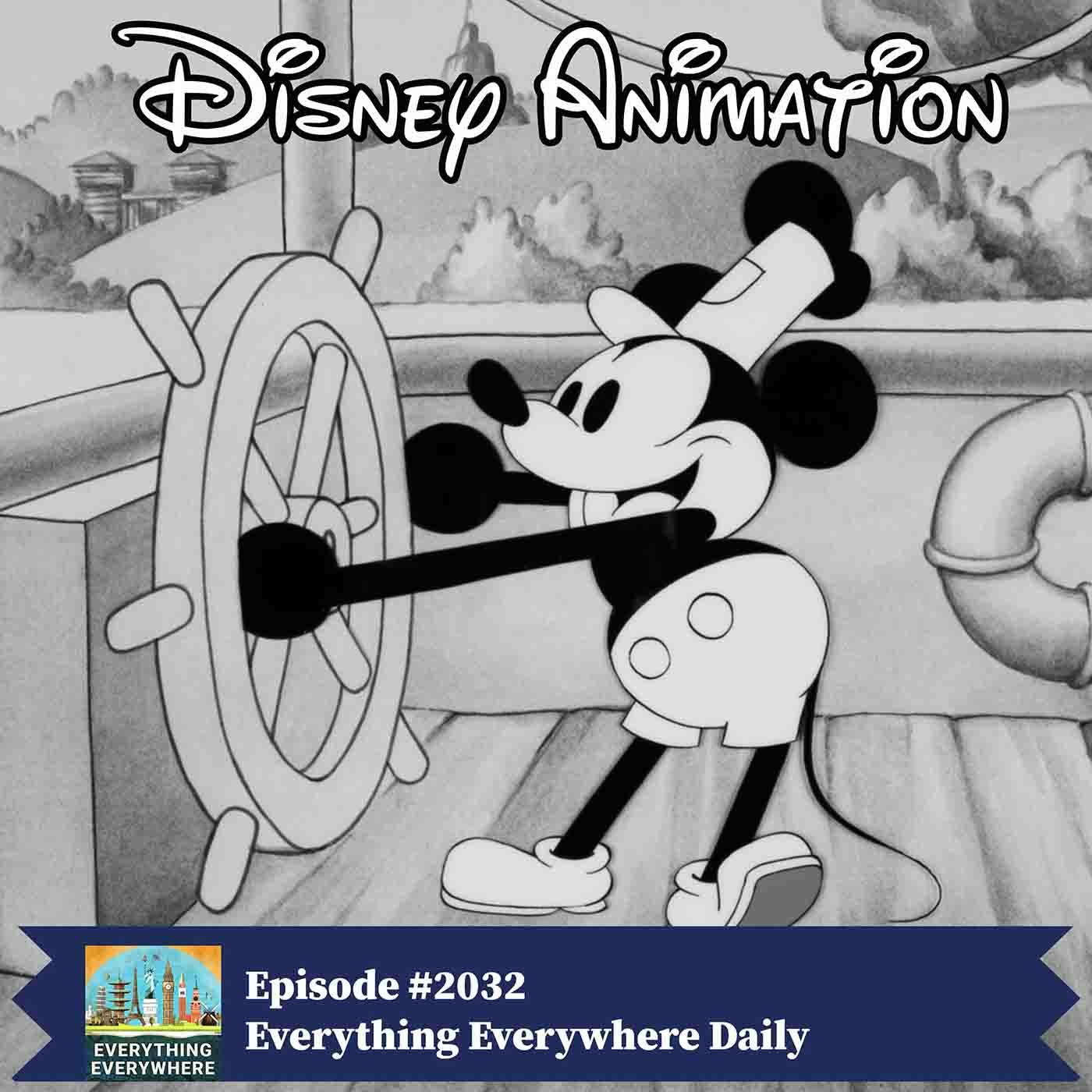
A
Walter Elias Disney was born on December 5, 1901 in Chicago, Illinois to Elias and Flora Disney. His family moved frequently during his childhood, eventually settling in Marceline, Missouri. Walt Disney had been an artist from a young age. He loved drawing animals inspired by his childhood on his Missouri farm. During World War I, Disney attempted to enlist in the US army, but was rejected for being underage. He instead joined the Red Cross Ambulance Corps and served in France after the Armistice, where he continued drawing cartoons for fellow soldiers. After returning to the United States, he worked briefly as a commercial artist in Kansas City and became fascinated by animation, then a young and experimental medium. In 1922, he founded Laugh O Graham Studio, producing short animated films inspired by fairy tales. The studio failed financially, leaving Disney bankrupt but determined to continue. In 1923, Walt moved to California to be closer to his older brother Roy, who was recovering from tuberculosis, and to pursue a career in the movie business. It was there that he and his brother formed the Disney Brothers Studio. The original studio operated out of their uncle's garage in Los Angeles. The brothers then relocated to a small office and from there they moved to larger office spaces. The company was renamed Walt Disney Studios in 1926 because Roy believed the company should reflect his brother's artistic vision. Roy provided financial and business direction, but wanted the company to showcase Walt's creativity. The production of Alice comedies marked their beginning. These were silent short films that Combined animation and live action elements. Alice Comedies was distributed by Winkler Pictures and was quite successful, leading to a second series distributed by Universal Pictures in 1927. The new series Oswald the Lucky Rabbit was completely animated. Oswald was the first true breakout cartoon star made by the studio. The character was considered to be charming, a bit troublesome and lovable. After the first year of producing Oswald, Disney went back to Winkler Studios in New York to renew his contract with the studio. However, the new owner of the studio wanted to cut his pay by a considerable amount and Disney refused to take the pay cut. Universal then acquired the rights to Oswald and set up a new studio to produce Oswald cartoons, taking most of Disney's staff. Meanwhile, in secret, Disney began working on a new project of his own. Wanting to maintain the rights to produce and distribute their own character, Disney brought together some of his most loyal staff members and animators to create cartoons featuring a new original character, Mickey Mouse. And if you go and search online, you'll see more than a striking resemblance between Oswald the Rabbit and Mickey mouse. The first two Mickey Mouse cartoons were produced in 1928 and had limited engagement. However, the third cartoon, Steamboat Willie, was the first Disney cartoon with synchronized sound and was a smash hit and became the most popular cartoon in the United States. Piggybacking on Mickey Mouse's success, Disney produced another round of sound cartoons known as silly symphonies in 1929. The most famous of these was Skeleton Dance. That same year, Walt Disney Studios had a financial dispute with its sound on film provider, leading to its reincorporation as Walt Disney Productions. After its renaming Walt Disney Productions signed a new distribution partnership with Columbia Pictures. Disney worked with Columbia Pictures for two years before signing with United Artists in 1932, and at the same time, Disney also signed a deal with Technicolor. Technicolor allowed Disney Studios to use its three strip color film process. This process allows cartoons to be produced in color by passing the film through a dye and light filters. As a result, Disney could now produce full color animated shorts. Around the same time in the early 1930s, Disney realized that to continue producing successful films, he needed to tell stories with emotionally compelling narratives. Realizing this need, Disney established a story department where Disney Studios is credited with inventing the technique of storyboarding. This technique involves drawing individual scenes on paper and then arranging them sequentially on a bulletin board. The first production to use storyboarding was the Silly Symphony cartoon the Three Little Pigs. This short became another massive hit for the studio, proving the technique's effectiveness. In 1934, Disney told key staff members of his Plan to produce an animated feature film. When news of the studio's plan to produce a film reached the rest of the industry, the studio faced mockery with the film being dubbed Disney's Folly. Despite the ridicule, Disney continued to produce the film. It was to be the first full length animated feature film produced in English and shot in Technicolor. To achieve this dream, Disney expanded its studio and hired new animators and artists. The company trained them in animation techniques. It used previous projects like Silly Symphonies to experiment with new animation methods, effects and cameras. Disney spent nearly $1.4 million, which was an enormous amount of money at that time, especially for an animated film. But the investment proved to be the right decision. The film, which was released in 1937, Snow White and the Seven Dwarves, became a box office hit. At that point in it was the highest grossing movie of all time, bringing in $8 million at the box office. If you include all of its theatrical re releases and media sales over the years, it has made over a billion dollars, not adjusted for inflation. This opened the door for the studio to produce more animated feature films. While Snow White was under production, work on Disney's other properties, Silly Symphonies and Mickey Mouse continued. Mickey Mouse received the technicolor treatment in 1935, and the cartoon added multiple supporting characters, including Donald Duck, Pluto and goofy. These three characters gained their own cartoons in 1940, with Donald Duck actually surpassing Mickey Mouse in popularity. With the success of these new cartoons, Silly Symphonies, which at this point had numerous awards including Academy Awards, ceased production in 1939. With the success of Snow White, Disney was able to build a new, larger studio. This new studio was completed in 1940 on Buena Vista street in Burbank, California, where it still stands today. That same year, Disney studios also went public, offering shares to investors on the stock market. Another big moment for the studio in 1940 was the release of their second animated film, Pinocchio. The film was not an initial success, bringing in less than Snow White and less than the studio expected. While not a box office success, it was a critical hit, earning praise from critics and winning Academy Awards for Best Original Song and Best Original Score. This made Pinocchio Disney's first film to win either of these Oscars. Also released in 1940 was an experimental film called Fantasia. This film was another financial failure for the studio due to its limited engagement and the high costs of installing the necessary sound equipment equipment for the film's orchestral score. Yet despite the financial failure, the film was another critical hit, winning two honorary Academy Awards in 1942 and just as an aside, Fantasia is a fantastic film, as is its follow up, Fantasia 2000. A significant setback hit the company in 1941 when a four month strike by animators, driven by anger over pay inequality, led to the departure of several key studio animators. To resolve the dispute, Disney agreed to several establishing an employee union, rehiring animators who had been fired during the strike, equalizing employee pay and implementing a clearer salary structure following the strike. The film in production at the time, Dumbo, was released in 1941. This film was a financial success. However, it was followed by Bambi in 1942, which was considered another financial failure. Following Bambi's disappointment, production on animated films was halted. This in tandem with World War II, which cut off international markets, led banks to give the studios money only for shorts. This meant that the films in production at the time, like Alice in Wonderland, lady and the Tramp and Peter Pan, were all placed on hold until the war's end. During World War II, Disney was hired to produce propaganda films for the war effort. During the war, about 95% of the studio's content was made for the US military. The studio also produced live action material that was used in other content. After World War II, the studio refocused on feature film projects. The first of these was Cinderella. Given Bambi's lack of success and the inability to release feature films for eight years, the studio's future was dependent upon the success of Cinderella. When Cinderella hit theaters in 1950, it was an instant box office sensation. The windfall from Cinderella empowered Disney to finally bring the long awaited productions like Alice in Wonderland, lady and the Tramp and Peter Pan to life. Each of these former limbo projects found success at the box office, ranging from solid performances to massive hits. The success of Cinderella also gave the studio the freedom to produce other riskier films, namely 1959's Sleeping Beauty, which was in production for 10 years. In the mid-1950s, Walt Disney began shifting his focus to other endeavors such as theme parks, live action movies and television, while the animation studios continued to produce films. However, with Walt focusing his attention elsewhere, projects like Sleeping Beauty were left in the hands of core animators and directors. This led to production taking longer and costing more. Despite its box office success, Sleeping Beauty's high development costs led to Disney Animation's first financial loss in 10 years, resulting in layoffs. The 1950s also saw other shifts at the studio, including the cessation of regular production of many short subjects such as Mickey Mouse. Between 1960 and 70, Disney released more successful animated films and continued to invest in projects outside of animation. The most important of these with respect to animation was the California Institute of the Arts. Disney had a history of training and educating animators at its studio, but with the founding of CalArts, Disney was able to offer its own developed animators program, which allowed animators to earn a degree and served as a way to funnel new talent into the studio. Walt Disney died of lung cancer in December 1966, and five years later, Roy died. And as a side note, Walt Disney's body was not frozen after he died. This rumor started because his death coincided with the first body being frozen and people put two and two together to create an urban legend. The studio maintained profitability following the death of its founders, achieving it through several reducing the evilness of its villains, prioritizing advertising to children and families, and implementing cost savings measures such as repurposing animation from earlier films. The animation studio struggled to make popular films in the 1980s. This difficulty arose from the declining market for animated family films, which prevented the studio from capturing a significant share of the teenage and adult audience. The challenge was compounded by changes in studio leadership. However, there was one notable animation technique that was used by Disney during this period that needs to be mentioned. In the Great Mouse Detective, released in 1986, Disney dabbled in computer animation for the very first time to help animate some of the film. This technique would go on to revolutionize animation in the decades that followed. The end of the 1980s began a transformative period for Disney animation known as the Disney Renaissance. The beginning of The Renaissance was 1989. The Little Mermaid, the studio's biggest success in decades, the Disney renaissance of the 90s was responsible for the release of several of the studio's most popular and cherished films, such as Aladdin, the Lion King and Mulan. Following the Renaissance and into the 2000s, Disney entered another difficult period. The success of animation at Disney and other studios led to a drastic rise in animator costs. Massive layoffs in the studio occurred, and the studio was forced to shift to cheaper computer animation. By 2004, the studio had fully transitioned to using computer generated imagery or CGI for all productions. This shift enabled the studio to downsize its staff and subsequently sell off a significant portion of its hand drawing equipment. In January 2006, Disney finalized a crucial deal with Pixar, its main animation rival. This agreement was mutually beneficial for both studios while largely maintaining separate animation operations. The deal significantly shifted Disney's approach, transitioning its product focus from executive control to filmmaker led development. Disney revolutionized the art of animation. It was not only at the forefront of technology such as sound and color, but also innovations in storytelling. The result has been films that have been enjoyed by billions of people for almost 100 years. The executive producer of Everything Everywhere Daily is Charles Daniel. The associate producers are Austin Otkin and Cameron Kiefer. Research and writing for this episode was provided by Olivia Ashe. My big thanks go to everyone who supports the show over on Patreon. Your support helps make this podcast possible, and I also want to remind everyone about the community groups on Facebook and Discord. This is where everything happens that's outside of the show. As always, if you leave a review on any major podcast app or in the above community groups, you too can have it read in the show.