Loading summary
Transcript1 lines
- [00:01]
A
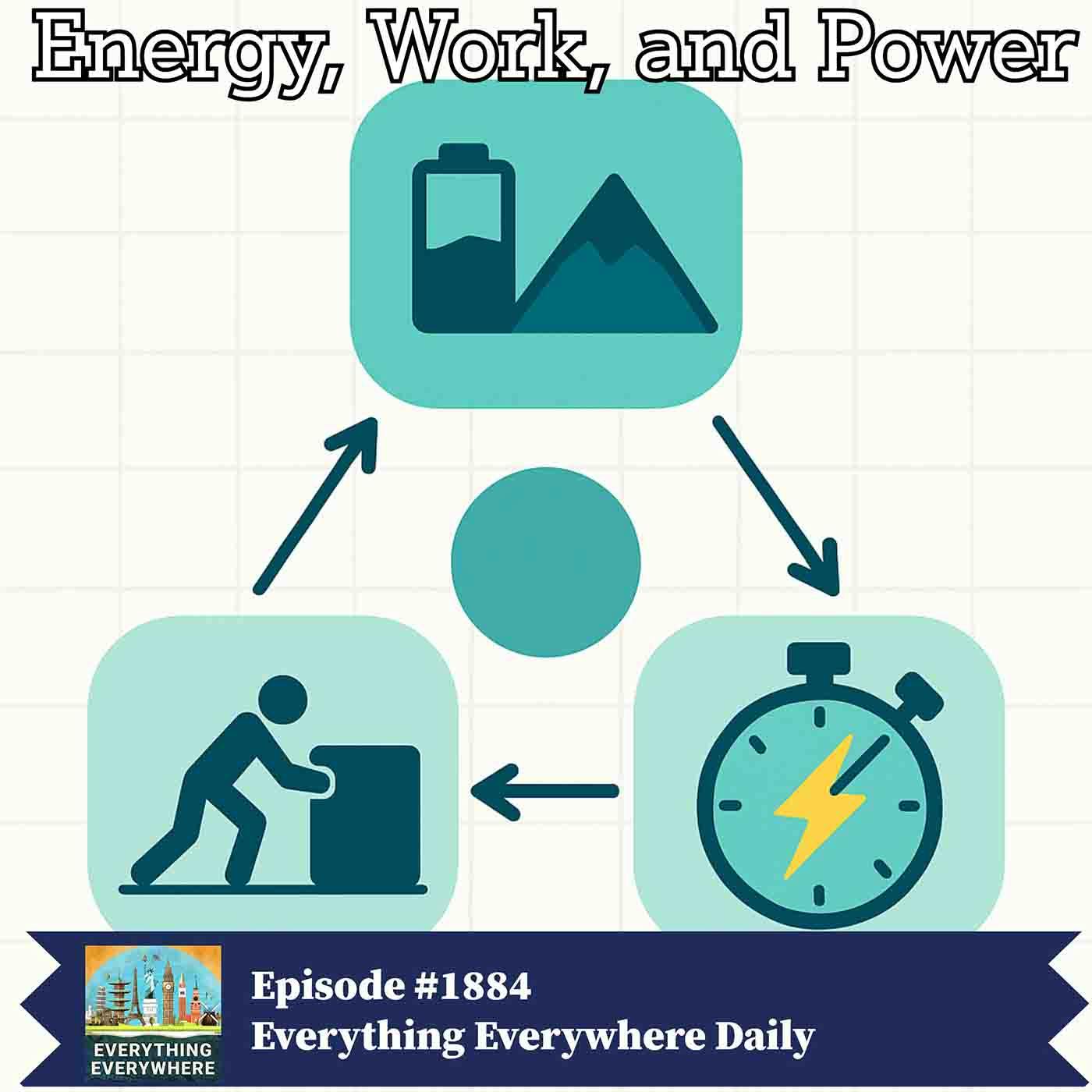
Everything we know in the world is ultimately dependent on energy. Energy fuels our bodies as well as our civilization. Energy is literally everywhere and it's all around us. Yet for the longest time we had no idea what energy really was. It wasn't until relatively recently that scientists had a grasp on energy as a concept, and once they did, they unlocked related concepts of work and power. Learn more about energy, work and power, what they are, and how they're different from each other on this episode of Everything Everywhere Daily. This episode is sponsored by Quints. I've been telling you about quints for quite a while now, but perhaps it still hasn't sunk in for some of you just how affordable quints can be. I went to their website and checked out several prices. A woman's Mongolian cashmere tee, which costs up to $175 from other retailers is available for just $44.90 on Quince. A men's comfort stretch trench coat that goes as high as $498 on other sites costs only $99.90 on Quince. A European linen chambray fitted sheet set that will run you $270 at competitors can be purchased for only $85.90 on Quinn's. These are serious discounts on high end luxury items and they can do this by working directly with top artisans and cutting out the middlemen. Quint's gives you luxury prices without the markup, passing the savings on to you. Keep it classic and cool this fall with long lasting staples from Quince. Go to quince.com daily for free shipping on your order and 365 day returns. That's Q U I-N-E.com daily and Quince free shipping and 365 day returns quints.com daily this episode is sponsored by Fiji Water. You've probably heard of Fiji Water and have seen it in stores. Well, Fiji Water really is from the islands of Fiji. Drop by drop. Fiji Water is filtered through volcanic rock 1600 miles away from the nearest continent and all its pollution protected and preserved naturally from external elements. In this process it collects a unique profile of electrolytes and minerals, resulting in more than double the electrolytes as the other top two premium bottled water brands, giving Fiji Water its smooth taste. Fiji Water's electrolytes are 100% natural and this water even has a perfectly balanced pH of 7.7. I've recently been trying to reduce my consumption of diet soda and I found Fiji Water to be a great alternative. Visit your local retailer to pick up some Fiji Water Today, for your next backyard party, beach, day hike, or even your home, Fiji. Water is earth's finest water. One of the first things that you learn in physics is the nature of energy. While the concept of energy seems obvious, for most of human history, we lacked a clear understanding of its nature. The concept of energy originated as a philosophical notion about what drives things to happen, and later evolved into a precise conserved quantity that connects every aspect of physics. In classical antiquity, Aristotle used terms like energia to discuss actuality or activity, rather than a measurable substance. So his notion of energy really had more to do with metaphysics than mechanics. In classical Chinese thought, chi is the vital breath or material force that animates and organizes the world. It's present in heaven, earth, and living beings. It condenses to form things and disperses to dissolve them. This was more of an anatomical and philosophical concept than a physical one. But it was an early idea of some force responsible for physical animation. The idea that motion, heat, and chemical energy could all be manifestations of the same thing wasn't really something that anybody had thought of in antiquity. Early modern mechanics replaced the ancient outlook with mathematical accounts of motion. Galileo demonstrated that a falling body trades height for speed in a systematic manner, suggesting an underlying principle behind changes in motion. 17th century thinkers then argued over what caused it. Rene Descartes proposed a conserved quantity of motion proportional to mass times speed. At the same time, Christiaan Huygens and Johann and Daniel Bernoulli discovered that the square of speed governed many problems in collisions and impacts, a quantity Gottfried Leibniz called vis via, which is the equivalent to the product of mass times the velocity squared. The debate over what magnitude was fundamental set the stage for the modern split between momentum and energy. The real change in our understanding of energy, as with so many things, began with Isaac Newton. Newton basically established our modern understanding of motion and mechanics, and that's why it's called Newtonian physics. For the purpose of this episode, the important thing that he did was to spell out the equation that defines force and define his three laws of motion. The definition of force is any action that tends to maintain or alter the motion of a body or or distort it. It could be a push or a pull. Newton's famous formula was that force equals mass times acceleration. The unit of force that we use today is called the Newton for obvious reasons. As we'll see in a bit, the concept of force is vital to understanding the concept of energy. One of the things that should be understood is what acceleration means in this context. Acceleration is A change in velocity. But velocity in physics doesn't just mean speed. Velocity is a vector, which means it consists of a speed and a direction. And this is important because you can change velocity by changing speed or by changing direction. If you've ever been in a car that's turned sharply, you will have experienced a force even if your speed didn't change. Throughout the 18th and 19th centuries, research was done on a wide variety of subjects, including heat, magnetism, and electricity. Eventually, it was realized that each of these could be converted into the other. Mechanical motion could be converted to electricity with a generator. Electricity could be used to create motion with a motor or heat with a resistance coil. The development of the steam engine also had an important role to play. Engineers had to figure out the efficiencies of steam engines in terms of getting the maximum amount of motion from a given unit of heat. It was in the 19th century that the term energy actually began to be used, in particular, the ability of energy to perform work. Thomas Young popularized the term Energy in 1807. Jean Victor Poncelet and Gaspard Gustave de Coriolis defined and quantified work as force through distance for machines. And William Reinke introduced potential energy to describe energy of position in 1853, complementing kinetic energy of motion. As early as the 18th century, the concept of energy conservation was proposed, although again, that name wasn't used to refer to it at the time. The French scientist Emile du Chatelet was one of the first to propose that energy was conserved. This was very similar to what Johann and Daniel Bernoulli proposed with the conservation of what was known as viz via. This idea was eventually codified into the first law of thermodynamics, which states that energy cannot be created or destroyed, only transformed from one form to another. Now, there's a lot that I've crammed in here so far, so I'll probably do a deeper dive on many of these concepts in future episodes. But for now, I want to shift gears a bit and discuss what energy is as it is understood in modern physics, and and how it relates to similar concepts. The contemporary definition of energy is that energy is the capacity to do work. Which then raises the question, what exactly is work? Work is the result of applying a force to an object, causing it to move. If you push a box across the floor, you've done work. In physics, work is defined as force multiplied by the distance moved in the direction of the force. Something I've never really touched on before in this podcast is the concept of units. Units are extremely important in science, and they separate one measurement from another. Back to the example of a moving box. Work is force times length, and force is mass times acceleration. Acceleration is the change in velocity, and velocity is length over time, such as in miles or kilometers per hour. So if velocity is length divided by time, then acceleration would be length over time squared. And you've probably heard this in the acceleration of gravity being 9.81 meters per second per second, or 32ft per second per second. Therefore, force would be mass times length divided by time squared. And therefore work would be mass times length squared divided by time squared. The metric unit of work is called the joule, named after English physicist James Prescott Joule, because energy is the potential to do work. Energy is measured in the exact same units as work. Energy is stored until it's used to do work. And there are various ways that energy can be stored. Kinetic energy is the energy of motion. For a mass m moving at speed V, kinetic energy equals 1/2 mass times velocity squared. Again, it's expressed in a slightly different way. But mass times velocity squared is still mass times length squared divided by time squared. Gravitational potential energy is based on the acceleration of gravity and the distance an object can fall. It's expressed as mass times the acceleration of gravity times height. Again, the expression is a bit different, but the units are all exactly the same. There are also many different types of energy, including magnetic, nuclear, sound, chemical, thermal elastic, mechanical, electric, and others. There are other units of energy that you might be familiar with. The calorie is also a unit of energy. It's simply a particular amount of energy that's measured in the form of heat. The calorie is actually a confusing term because there are two different types of calorie units. One is known as the small calorie and the other is known as the large calorie and also known as the kilocalorie. The small calorie is equivalent to 4.184 joules and the kilocalorie is 4184 joules. The kilocalorie or large calorie is usually what's used on food packaging to measure energy. There are other units of energy used for various purposes. The electron volt is a unit of microscopic energy used for atomic and particle physics. The elementary charge within the atom defines it. So 1 electron volt equals 1.602 times 10 to the negative 19th. So it's really, really tiny. Another popular non metric unit of energy is the British thermal unit, or BTU. A BTU is defined as the heat required to raise 1 pound of water 1 degree Fahrenheit. So a BTU is about 1,055 joules. Another rather antiquated unit of energy is the foot pound. And this will come into play in just a bit. Going back to our example of applying force to a box to do work, there is something that is time. Moving a box 1 meter over the course of a minute is very different than moving that same box over the course of one second. That difference in the speed of doing work is called power. Power is the rate at which work is done or energy is transferred. The unit of measure for power is the watt, which was named after James Watt. The watt is defined simply as joules per second. Or to put it in our basic units, it's mass times length squared divided by time cubed. If you're familiar with the Watt, it's probably because you have encountered the kilowatt, which is, of course, just 1000 watts. Power companies don't actually charge you for power per se, as it's defined in physics. What they charge you for is energy, and this is usually in the form of kilowatt hours. By multiplying power by time, the time cubed factor becomes time squared, which brings you right back to energy. A traditional unit of power is the horsepower, which is still often used in engines. Horsepower was coined by James Watt in the late 1700s to market his steam engines against those powered by real horses used to drive mine pumps and mine wheels. From observing ponies turning a mill, then scaling up, he defined 1 horsepower as the rate of doing 33,000 foot pounds of work per minute, which is 550 foot pounds per second, or about 745.7 watts. Historians note that Watt likely chose a generous figure so that an engine rated at 1 horsepower would outperform a typical draft horse in practice. Continental engineers later adopted a slightly different metric. Horsepower equal to 75 kilogram force meters per second, or about 735.5 watts. While the names of the units might sometimes be different depending on the application, force, work, energy, and power are all concepts that you're probably in some way already familiar with. So to summarize, force is an action that pushes or pulls something. Work is the distance that force is applied. Energy is the potential to do work which can be stored in any number of ways. And power is the amount of work performed in a given time. There are different units for measuring different amounts of energy and power, but they're all fundamentally measuring the exact same thing. And the way we know they're measuring the exact same thing is because all of the base units of mass, length and time are in the same proportions. Our understanding of energy, work and power is one of the fundamental concepts in physics which has helped contribute to the development of our modern world. The executive producer of Everything Everywhere Daily is Charles Daniel. The associate producers are Austin Otkin and Cameron Kiefer. My big thanks go to everyone who supports the show over on Patreon. Your support helps make this podcast possible, and I also want to remind everyone about the community groups on Facebook and Discord. That's where everything happens that's outside the podcast, and links to those are available in the show Notes. As always, if you leave a review on any major podcast app or in the above community groups, you can you too can have it read in the show.