Loading summary
Transcript1 lines
- [00:01]
A
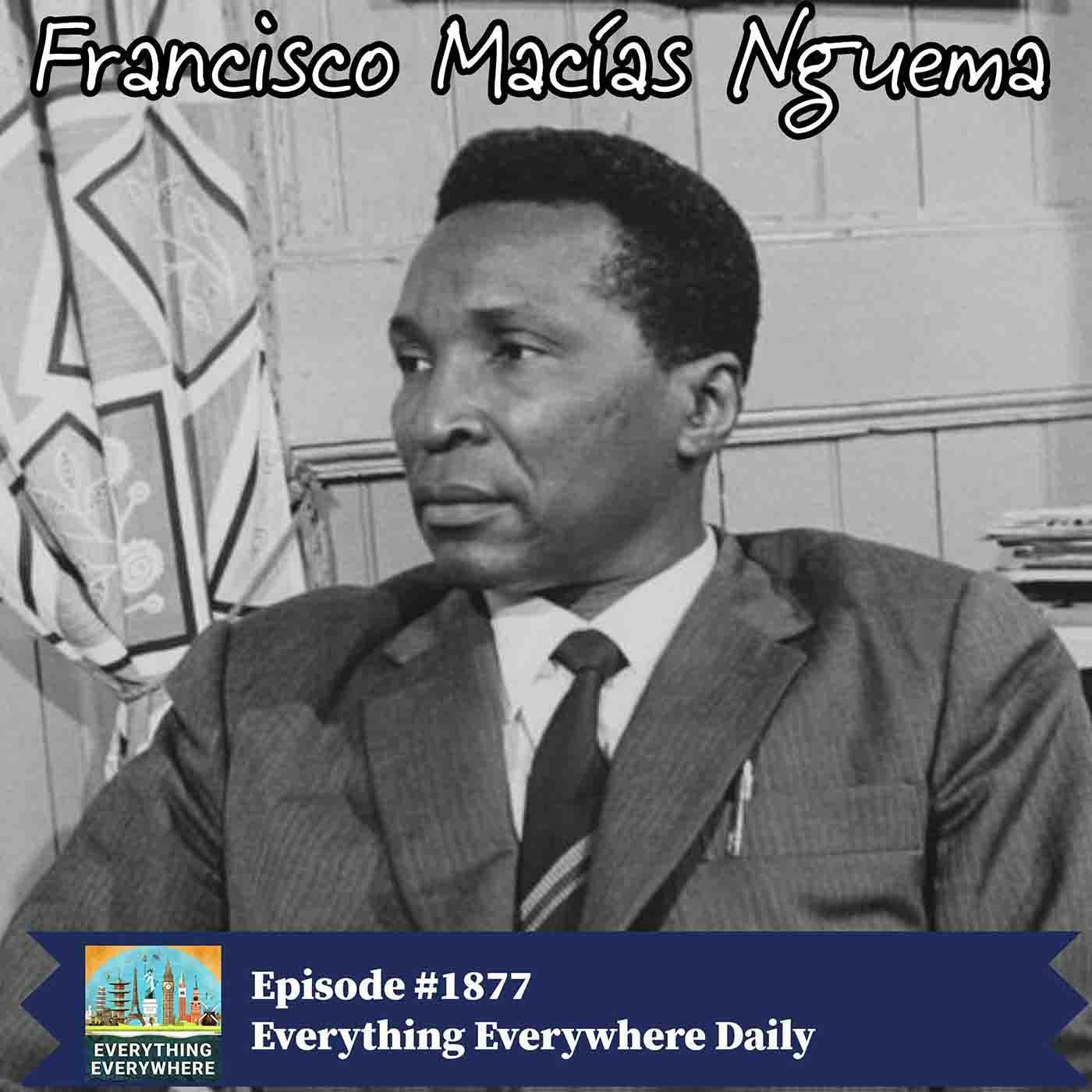
In 1968, the colony of Spanish guinea was granted independence and became the Republic of Equatorial Guinea. In its first open election, which turned out to be its last, it elected as president Francisco Macias Naguma. He very quickly turned out to be a dictator. However, he wasn't just a dictator, he became one of the worst dictators of the 20th century. Learn more about Francisco Macias Naguma, his reign of terror, and how he single handedly wrecked Equatorial guinea on this episode of Everything Everywhere Daily. This episode is sponsored by Fiji Water. You've probably heard of Fiji Water and have seen it in stores. Well, Fiji Water really is from the islands of Fiji. Drop by drop, Fiji Water is filtered through volcanic rock 1,600 miles away from the nearest continent and all its pollution protected and preserved naturally from external elements. In this process, it collects a unique profile of electrolytes and minerals, resulting in more than double the electrolytes as the other top two premium bottled water brands, giving Fiji Water its smooth taste. Fiji Water's electrolytes are 100% natural and this water even has a perfectly balanced pH of 7.7. I've recently been trying to reduce my consumption of diet soda and I found Fiji Water to be a great alternative. Visit your local retailer to pick up some Fiji Water today for your next backyard party, beach day hike, or even your home office. Fiji Water is Earth's finest water. This podcast is brought to you in part by Stash. Here's a secret. The best time to start building your financial future is always now. With Stash, you can grow with confidence no matter the market. Stash isn't just another investing app. It's a registered investment advisor that combines automated investing with expert guidance so you don't have to worry about figuring it out on your own. You can choose from personalized investments or let Stash's award winning smart portfolio do the work for you. With Stash, investing doesn't feel like gambling. It's simple, smart and stress free so your money can finally start working as hard as you do. Get access to world class financial advice with personalized guidance for just a $3 monthly subscription. Stash has already helped millions of Americans reach their financial goals. Don't let your money sit around put it to work with stash. Go to git.stash.com everything to see how you can receive $25 toward your first stock purchase and to view important disclosures. That's git.stash.com everything paid non client endorsement, not representative of all clients and not a guarantee. Investment advisory services offered by Stash Investments LLC and SEC Registered Investment Advisor. Investing involves risk or offers subject to T's and C's. What do you think of when I say the names Adolf Hitler, Joseph Stalin, Pol Pot, Mao Zedong, IDI Amin, Saddam Hussein or Kim Il Sung? You probably think of some of the world's worst dictators, horrible people who did horrible things. Yet there's someone else that you should think of when you think of the worst of the worst world leaders of the 20th century. Francisco Macias Naguma. There's a good chance that you've never heard of him before, but by the end of this episode, hopefully you'll see that he has earned a well deserved place amongst the worst leaders in history. The reason why you may not have heard of him before is that Equatorial guinea is a really small country that doesn't get much attention. Before I get into the man who called himself Macias, first a bit about Equatorial Guinea. Equatorial guinea was a former colony of Spain known as Spanish Guinea. The country is small and has two geographically separated parts, the mainland region known as Riomundi and several islands in the Gulf of Guinea, the largest of which is Bioko and is home to the capital Malabo. It is the only country in Africa that speaks Spanish. It's bordered by Cameroon to the north and by Gabon to the south and east. As with most African colonies, independence movements developed after World War II. Spain granted the colony autonomy in 1963 and it became independent on October 12, 1968. Francisco Macias Naguma was born in 1924 in Rio Mundi. He was a member of the Fang ethnic group, which was the dominant ethnic group on the mainland. His early life was marked by limited formal education, reaching only the elementary level before working various jobs, including as a court interpreter and later as a coffee plantation in administrator. He increasingly benefited from the colonial administration's advancement, rising from a court clerk and interpreter to mayor of mongomo and by 1964 Deputy Prime Minister of the autonomous government, positions that poised him to seize power at independence. Macias founded the Idea Popular de la Guinea Equatorial, or ipge, positioning himself as a champion of Fang interests and rural populations. His political strategy was shrewd, recognizing that the fong constituted about 85% of the population and had been somewhat marginalized by Spanish colonial policies that favored the more urbanized and educated populations on Bioco. The crucial moment came during the 1968 Constitutional Convention and subsequent elections. Spain had hoped that more moderate, educated leaders would emerge to lead the new nation. However, Mesilla Skillfully exploited ethnic tensions and rural urban divides. He campaigned as an authentic African leader who would restore traditional values and protect Fang culture from foreign influence. His opponents, including Bonifacio Ando Idu, were portrayed as tools of Spanish neocolonialism, despite their superior education and administrative experience. The 1968 presidential election was remarkably close, requiring a runoff between Macias and Ando Ido. Macias won by appealing to ethnic solidarity and promising to expel foreign influence and including Spanish settlers and businessmen. His victory speech ominously declared that he would build a nation for Africans by Africans, which many interpreted as a threat to the substantial Spanish population and other minorities. Independence came on October 12, 1968, with Macias as the first president. Initially, there were hopes that democratic institutions would take root. The new constitution included provisions for civil liberties, separation of powers and regular elections. The transformation from elected president to dictator accelerated rapidly between 1969 and 1972. Macias began concentrating power in his hands, dismissing competent civil servants and replacing them with loyal but unqualified supporters, primarily from his own ethnic group and region. He declared states of emergency to justify suspending constitutional rights and then extended these indefinitely. Opposition figures were arrested, tortured or executed. Ethnic booby leaders and intellectuals were disproportionately targeted, especially on Bioko Island. One of his first orders of business was creating the Juventud and Marcha Khanmancius or jmm. It was modeled loosely on fascist and revolutionary youth movements like the Hitler Youth or Mao's Red Guards, and it played a central role in consolidating his regime and enforcing loyalty through terror, indoctrination and violence. Ando Idou fled the country, but was extradited to Equatorial guinea by Spain. He was arrested, tortured, and either executed or committed suicide in March of 1969. 1969 also saw the expulsion of Spanish personnel and the closure of institutions. Spanish missionaries, educators and medical professionals were expelled. Western style education, media and religious institutions began to be dismantled. The Catholic Church lost its protection and and churches were increasingly harassed. On Christmas Eve, 150 of his opponents were brought to the National Stadium and executed on the grounds of allegedly plotting a coup. They were killed while the song those were the Days by Mary Hopkin were playing on the stadium sound system. And now that you know that you will never listen to that song the same way again. Macia started referring to himself in grandiose titles and demanded portraits of himself in public places. Some of the titles he gave himself included the unique miracle. Grand Master of Education, Science and Culture, Master of All the Powers of the Revolution, Father of the Nation, immortal and invincible. What little press and radio there was now became tools of state propaganda. In 1970, with most of his adversaries now gone, he established the Partido Unico Nacional de las Trabajadores, or punt, which was declared the only legal political party. All other parties were banned or forcibly merged into punt. Loyalty to the party became equated with loyalty to the President. In 1971, Decree 415 was issued. This decree gave the president complete control over all branches of government. It removed any pretense of institutional checks and concentrated all executive, legislative and judicial powers in Macias hands. Later that year, Law one was passed which criminalized dissent. Under this law, criticizing the president became punishable by decades in prison or death. Even private comments or jokes were ground for arrest. Later that year, he began to see education as a threat to his rule. He abolished private education, burned books, banned the use of the word intellectual, and closed libraries and schools. Wearing glasses or reading foreign books was viewed with suspicion, and members of the intelligentsia were purged or exiled. He famously declared that education was unnecessary and that Equatorial Guineans should return to traditional ways of life under his guidance. In 1972, he finally declared himself President for Life. A 1973 referendum officially approved the regime with a vote reportedly showing 99.9% approval, which was of course, a totally legit election. Economically, Equatorial guinea under Macias was a disaster. Spanish businesses and plantations, which had formed the backbone of the economy, were confiscated or abandoned as their owners fled the country. The coca industry, which had provided most export revenue, collapsed as skilled managers and workers left. Macias replaced technical expertise with political loyalty, leading to the breakdown of infrastructure, telecommunications and basic services. Under his regime, repression and terror became the norm. Entire villages vanished, mass arrests and executions were routine, and political, ethnic and intellectual opponents, especially amongst the booby minority, were mercilessly targeted. Estimates suggest that that between 20 and 80,000 people were either killed or forced into exile, representing up to one third of Equatorial Guinea's entire population. Initially, some African leaders viewed him sympathetically as an authentic African nationalist standing against neo colonial influence. However, as reports of atrocities mounted and refugees flooded neighboring countries, international opinion turned decisively against him. Spain, despite its colonial history, found itself hosting thousands of Equatorial Guinean refugees and became a center of opposition to the Macias regime. Not surprisingly, Macias aligned with eastern bloc nations, drawing support from the Soviet Union, Cuba and North Korea, while severing ties with Spain in the West. His paranoia began to extend to his own family. Everyone had to walk on eggshells around him, constantly showing their Support and never doing anything which could be considered a threat to or his regime. By the late 1970s, Equatorial guinea had become a failed state. The economy had collapsed entirely with no functioning currency, infrastructure or institutions. The population had declined dramatically through death and immigration. Even Macias own supporters began to recognize that his rule threatened the nation's very survival. The end came through a family coup in August of 1979. Teodoro Obiang Naguma Mombasago Macias nephew and head of the National Guard led a military uprising that quickly succeeded. The irony was thick. The man who had destroyed so many families through suspicion and paranoia was ultimately brought down by his own nephew who he had trusted with military command. The fall was swift and decisive. Macias attempted to flee, but was captured trying to escape with a large sum of money which he eventually ended up burning out of spite. His trial became a moment of reckoning for the nation as survivors testified about the horrors that they had endured. The proceedings revealed the full extent of his crimes against his own people. Documenting systematic torture, mass murder and the deliberate destruction of the nation's social fabric. Macias was executed by firing squad in September of 1979, ending 11 years of rule that had transformed a relatively prosperous small nation into into a devastated wasteland. His death marked not just the end of a dictatorship, but the conclusion of one of Africa's most destructive post independence governments. The new president of Equatorial guinea became Teodoro Obiang, Macias nephew. Initially, Obiang's takeover was welcome both domestically and internationally. After 11 years of Francisco Macias reign of terror, almost any change seemed positive. The early years of obiang's rule, from 1979 to the late 80s were marked with efforts to rebuild basic state institutions and restore some semblance of normal life. The new government reopened schools, attempted to restart the collapsed coca industry and encouraged some refugees to return. Spain and other international partners provided assistance, hoping to help stabilize the country after the devastation of the previous decade. However, it became clear relatively quickly that while Obiang represented a departure from his uncle's extreme brutality, he had no intention of establishing genuine democratic governance. The discovery of oil in the 1990s changed the economic fortunes of the country. The oil wealth had profound implications for Obiang's rule. On one hand, it provided resources to improve infrastructure and living standards for some segments of the population. The capital city of Malabo was rebuilt with modern buildings, roads and facilities. On the other hand, the concentration of oil revenues into government hands strengthened authoritarian tendencies by reducing dependence on taxation and popular consent. Obiang has amassed a fortune estimated at around $600 million, with money located in banks around the world. He's also adopted some of the megalomaniac habits of his uncle. He's developed his own cult of personality. In 2003, state radio claimed that he is like God in heaven who has all the power over men and things, and that he can decide to kill without anyone calling him into account and without going to hell, because it is God Himself with whom he is in permanent contract and who gives him this strength. A series of sham elections have been held over the years, with obiang receiving between 90 to 100% of the vote every time. 46 years after the downfall of Macias, Obiang is still the President of Equatorial guinea today and is the longest serving non monarch head of state in the world. Now 83 years old, his son is currently scheduled to succeed him. Many African countries have suffered from dictators or autocrats since achieving independence. However, few have suffered like Equatorial guinea, which has experienced literally nothing else. By selecting the wrong leader in their only fair election, they went down a path that almost destroyed the country and led to the deaths of tens of thousands of people. The executive producer of Everything Everywhere Daily is Charles Daniel. The associate producers are Austin Otkin and Cameron Kiefer. My big thanks go to everyone who supports the show over on Patreon. Your support helps make this podcast possible and I also want to remind everyone about the community groups on Facebook and Discord. That's where everything happens that's outside the podcast, and links to those are available in the show notes. As always, if you leave a review on any major podcast app or in the above community groups, you too can have it read on the show.