Loading summary
Transcript1 lines
- [00:00]
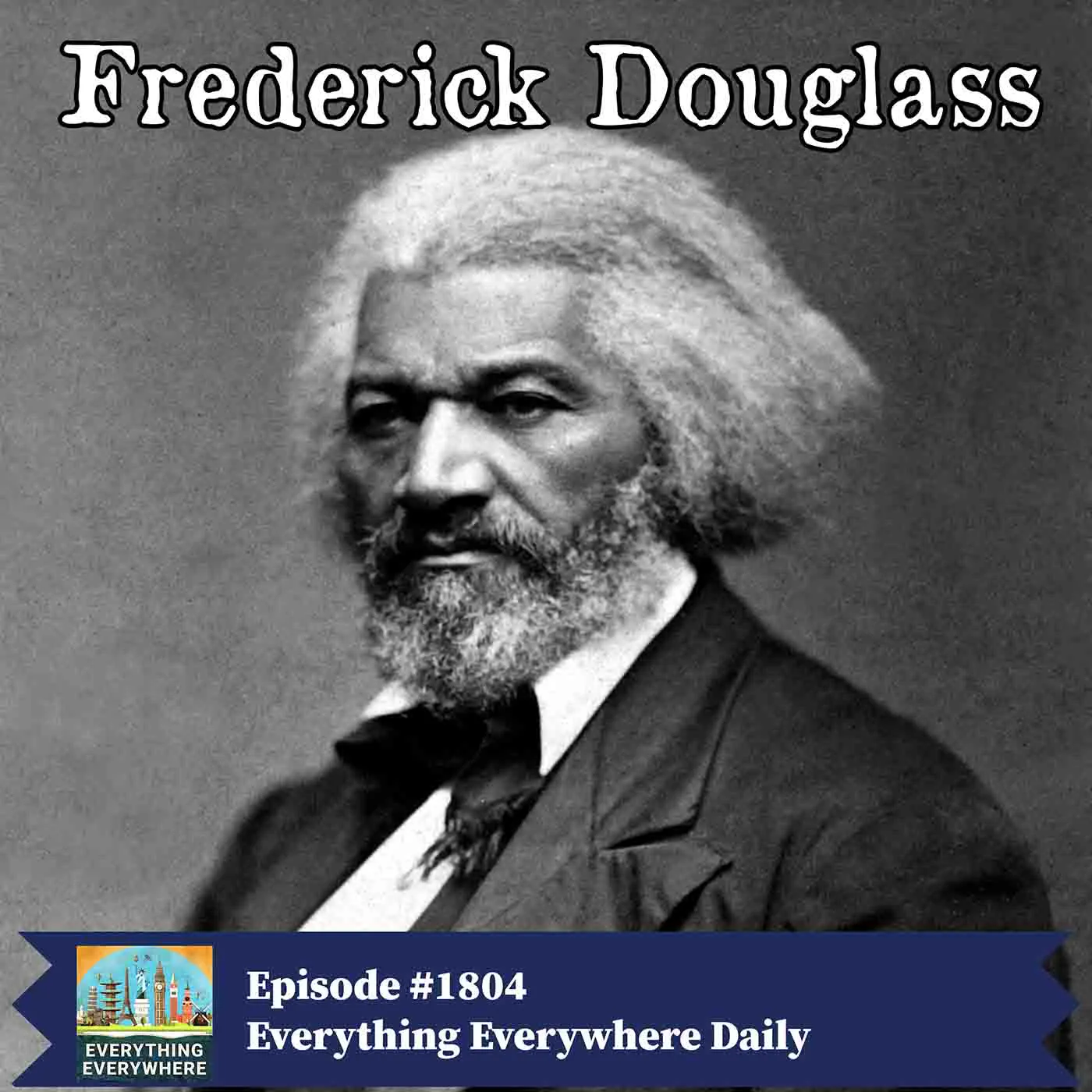
Host
In 1818. The man who would go on to become one of the greatest leaders in the cause against American slavery was himself born into slavery. At the age of 20, he escaped bondage and went on to lead one of the most remarkable careers of the 19th century. He led a multifaceted life, including becoming one of the era's most notable orators, a newspaper publisher, an author, a presidential advisor, and later an ambassador. In the end, he perhaps played one of the biggest roles in the end of American slavery. Learn more about the life of Frederick Douglass on this episode of Everything Everywhere Daily. This episode is sponsored by Quints. It's summertime, and that means it's time to bring out the summer clothes. If you're looking to update your wardrobe this summer, I suggest you check out quite a few Quints. Quints has all the things you actually want to wear this summer, like organic cotton silk polos, European linen beach shorts, and comfortable pants that work for everything from hanging out in the backyard to nice dinners. And the best part? Everything with Quint's is half the cost of similar brands. By working directly with top artisans and cutting out the middleman, Quint's gives you luxury pieces without the markups. I recently needed a new duvet and I went to Quint's and picked up a great one that looked much better than what I had before, and all at a fraction of the price I'd pay elsewhere. Stick to the staples that last with elevated essentials from quince. Go to quince.com daily for free shipping on your order and 365 day returns. That's quince.com daily to get free shipping and 365 day returns. Quince.com daily this episode is sponsored by Planet Money. Tariffs mean coins. Girl Scout cookies. What do they all have in common? Money. Economics is everywhere and everything, fueling our lives even when we least expect it. If you're a fan of Everything Everywhere Daily and are curious to learn something new and exciting about economics every week, I recommend you listen to the Planet Money podcast from npr. What I like about Planet Money is that I can get an update on the week's financial news in about 30 minutes. Stories like the adoption of stablecoins or the price of eggs. From the job market to the stock market to prices at the supermarket, Planet Money is here to help explain it all. The Planet Money hosts go to great lengths to help explain the economy. They've done things like shot a satellite into space, started a record label, made a comic book, and shorted the entire stock market all to Help you better understand the world around you. Tune in to Planet Money every week for entertaining stories and insights about how money shapes our world. Stories that can't be found anywhere else. Listen now to Planet Money from npr. The man we know as Frederick Douglass was born Frederick Augustus Washington Bailey on a plantation in Talbot County, Maryland. His mother, Harriet Bailey, was enslaved, and Frederick was born into this condition as well. His exact date of birth is unknown, but he later chose February 14 as his birthday simply because his mother had always called him his little Valentine. There's even been doubt as to the year he was born. It Most probably was 1818, but some biographers have placed his birth in 1817. And as an aside, the reason why Black History Month is in February is to honor the birth of Frederick Douglass. He didn't know who his father was. He only knew that he was a white man. However, it was widely speculated that his father's family also enslaved him. Douglass was separated from his mother as an infant and raised by his grandmother for a time. He only saw his mother a few times before her death when he was 7 years old. Around the age of 8, Douglass was sent to Baltimore to live with the Auld family. There, Sophia Auld began to teach him the Alphabet, an act her husband quickly forbade, insisting that literacy would ruin a slave. But the spark had been lit. Douglass secretly taught himself to read and write, using newspapers, religious texts and political pamphlets, including the Columbian Orator, which deeply influenced his views on freedom and human rights. As a teenager, Douglass was sent back to rural Maryland and hired out to Edward Covey, a cruel man and a notorious slave breaker. There, he endured brutal physical abuse, being whipped so frequently his wounds often couldn't heal. He eventually fought back, beating his captor in a fight, and after that, was never whipped again. In his autobiography, he declared this incident in to be transformational. He said, you have seen how a man was made a slave, and now you shall see how a slave was made a man. In September 1838, Douglass executed a daring escape from Baltimore using borrowed sailor's papers and a disguise. This wasn't just a physical journey from Maryland to New York. It was a psychological transformation from Frederick Bailey, his slave name, to Frederick Douglass, a name he chose to symbolize his new identity as a free man. He eventually settled in New Bedford, Massachusetts, with his new wife, Anna Murray, a freed black woman who helped finance his escape to freedom. He married his wife just days after his escape. Even in the North, Douglass faced intense discrimination. He couldn't work in skilled trade, such as being a ship caulker because white workers refused to work alongside a black man. Instead, he took whatever jobs he could findloading, ships, working in a brass foundry and sweeping chimneys. This experience taught Douglass a crucial lesson that would shape his entire philosophy. Legal freedom wasn't the same as true equality. The north might not have slavery, but it certainly had racism. The realization would fuel his lifelong commitment not just to ending slavery, but achieving full civil rights. In 1841, Douglass attended an anti slavery meeting of the American Anti Slavery Society in Nantucket, Massachusetts. Massachusetts. When he was unexpectedly called upon to speak, something magical happened. His natural eloquence, combined with his firsthand experience of slavery's horrors, electrified the audience. William Lloyd Garrison, the famous abolitionist, was so moved that he immediately hired Douglass as a lecturer for the Massachusetts Anti Slavery Society. Douglass understood that many northerners had never actually met someone who had been enslaved, let alone heard one speak articulately about their experiences. Douglass became a living contradiction to the racist stereotypes of his time. His very presence on the platform, eloquent, dignified and intelligent, changed the fundamental assumptions that justified slavery. In 1845, Douglass published his first autobiography, Narrative of the Life of Frederick Douglass, an American slave. This wasn't just another book. It was a revolutionary act. By naming names, places and dates, Douglass provided undeniable proof of slavery's reality while putting himself at enormous personal risk. The book became a best seller, but its success created a dangerous problem. Douglass was now famous and his former owner could easily track him down and reclaim him his property. This forced him to flee to Britain, where he spent nearly two years lecturing throughout England, Ireland and Scotland. For the first time in his life, Douglass experienced what it meant to be treated as a complete equal. He wrote to Garrison. I can truly say I have spent some of the happiest moments of my life since landing in this country. British supporters were so impressed with Douglass that they raised money to purchase his legal freedom, allowing him to return to America as a truly free man without the threat of capture looming over him. Returning to the United States, Douglass settled in Rochester, New York and launched the North Star, an anti slavery newspaper. His motto was right is of no sex, Truth is of no color. God is the father of us all, and we are all brethren. Through his newspaper, Douglass addressed not just slavery, but the full spectrum of human rights issues. He supported women's rights, as he was the only man to speak at the famous Seneca falls Convention in 1848, Irish Freedom and workers rights. He frequently clashed with other abolitionists, particularly William Lloyd Garrison, over strategy. While Garrison favored moral persuasion, Douglass came To support political action, including working within the U.S. constitution and political system to end slavery. He increasingly aligned himself first with the Liberty party and later the Republican Party. The 1850s brought increasingly harsh laws like the Fugitive Slave act, which required even free states to return escaped slaves to their owners. Douglass response revealed his evolving philosophy about how to achieve justice. He famously declared, where justice is denied, where poverty is enforced, neither persons nor property will be safe. He supported John Brown's raid on Harpers Ferry, though he wisely avoided direct participation when he realized it was likely to fail. By the time the Civil war began in 1861, he had spent over two decades methodically building what we might call political capital, the combination of credibility, connections, and a public platform that would make his wartime influence possible. Douglass was not just another abolitionist voice. He was the most famous former slave in America, with a weekly newspaper reaching thousands of readers, personal relationships with leading Republicans, and speaking engagements that drew massive crowds. And this wasn't accidental. It was the result of 20 years of strategic relationship building and reputation management. When Fort Sumter was fired upon in April of 1861, most Americans saw the beginning of a war to preserve the Union. Douglass saw something entirely different. The beginning of a war that would inevitably become about slavery. Whether politicians admitted it or not, the difference in perception shaped everything Douglass did during the war's first 18 months. While others debated whether slavery should become a war issue, Douglas worked systematically to make it impossible for the war to be about anything else. First, he argued that enslaved people were actively strengthening the Confederate war effort by growing food, building fortifications, and performing labor that freed white southerners from military service. This wasn't just a moral argument. It was a military one that practical minded politicians could understand. Second, he pointed out that Union generals returning escaped enslaved people to their owners or were literally returning military assets to the enemy. Imagine, he suggested, if Union forces captured Confederate horses and then return them because taking them might make it seem like theft. Third, he argued that enslaved people represented the Confederacy's greatest potential weakness. They had every reason to support the Union cause if given the opportunity. By refusing to accept their assistance, Union forces were rejecting valuable allies. General Benjamin Butler's decision to classify escaped enslaved people as contraband of war, AKA enemy property that could be seized, created a precedent that Douglass immediately recognized as a game changer. Here was a practical solution that advanced emancipation without requiring politicians to take an explicitly moral stance. Douglas response to Butler's decision revealed his strategic brilliance. Rather than celebrating it as a victory, he used it to push for more comprehensive action. If enslaved people were Contraband when they escaped to Union lines, He argued, why not make all enslaved people contraband by declaring emancipation a military necessity? When Lincoln finally issued the preliminary Emancipation Proclamation In September of 1862, Douglas faced a crucial strategic decision. The Proclamation had significant limitations. It only applied to areas in rebellion and exempted loyal border states and was justified as a military measure rather than a moral imperative. Douglass could have focused on these limitations, potentially undermining support for what was, despite its flaws, a revolutionary step. Instead, he chose a different approach that reveals his political maturity. He celebrated the Proclamation as the beginning of the end of slavery, while simultaneously using its limitations to argue for more comprehensive action. This wasn't just shrewd politics. It was an example of how effective advocates can use partial victories to build momentum. For complete victory. He threw himself into recruiting black soldiers, including his own sons, arguing that military service would prove black citizenship. By the end of the war, roughly 200,000 black men had served in Union forces, many of them recruited through Douglass efforts. Douglass relationship with Lincoln evolved from critic to advisor. Their meeting showed Lincoln's growing respect for Douglass insights. When Lincoln was assassinated, Douglass genuinely mourned him as a friend. Despite their earlier disagreements, the end of slavery was just the beginning for Douglass. He understood that without political rights, economic opportunities and access to education, freedom would remain incomplete. During Reconstruction, he advocated tirelessly for the 15th Amendment, which guaranteed black men the right to vote. Douglass also grappled with the complex questions about the relationship between racial justice and women's rights. When some women's rights activists opposed the 15th Amendment because it didn't include women, Douglass argued that it was the black man's hour. They faced immediate physical danger that required urgent political protection. And it was also another case of a partial victory going towards a total victory. In his final decades, Douglass served in various political appointments, including U.S. marshal for the District of Columbia and minister to Haiti. These positions made him one of the most prominent black Americans of his time, but they also sometimes put him in difficult positions. His tenure as minister to Haiti, for instance, came during a period when the US Was trying to establish a naval base there. Douglass had to balance American interests with his respect for Haitian independence. Even in his 70s, Douglass continued speaking out against lynching and the rollback of civil rights that followed the end of Reconstruction. His final speech, delivered the day he died in 1895, was to a women's rights meeting. If you consider the Civil War and the abolition of slavery the most important event in United States history in the 19th century, and I think most people would then Frederick Douglass has to be considered one of the most important Americans of that century. His personal story, his writing, his ceaseless advocacy, and his political acumen in knowing what to push that would be politically palatable, yet still advancing his cause made him perhaps the most important figure in the abolition of American slavery. The executive producer of Everything Everywhere Daily is Charles Daniel. The associate producers are Austin Oakton and Cameron Kiefer. I want to thank everyone who supports the show over on Patreon. Your support helps make this podcast possible. I'd also like to thank all the members of the Everything Everywhere community who are active on the Facebook group and the Discord server. If you'd like to join in the discussion, there are links to both in the show. Notes and as always, if you leave a review or send me a boostogram, you too can have it read on the show.