Loading summary
Transcript1 lines
- [00:01]
A
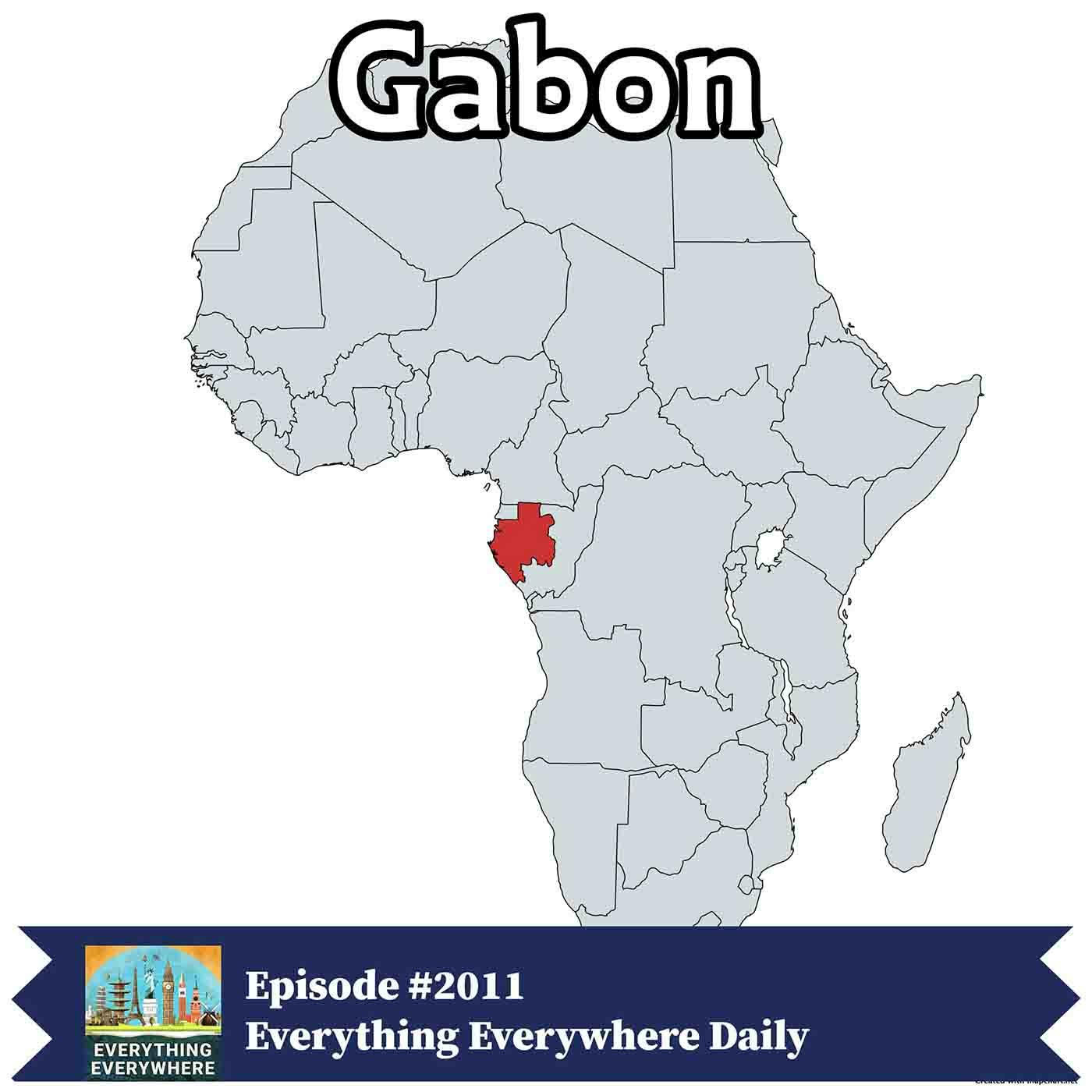
When you think of countries in Africa, it's unlikely that Gabon would be one of the first to cross your mind. It's entirely possible that some of you may have never even heard of Gabon. Consider Earth's last Eden. Gabon is one of the most biodiverse countries in the world, yet very little is known about it because not much has ever happened there to make it into the news. In fact, one of the biggest things to have ever happened there took place 1.7 billion years ago. Learn more about the history of Gabon on this episode of Everything Everywhere Daily. This episode is sponsored by Mint Mobile. Now that the holidays are over, you might be feeling like you got a big spending hangover. The drinks, the holiday food, the gifts, it all adds up. Luckily, Min Mobile is here to help you cut back on wireless spending this January, with 50% off Unlimited Premium Wireless, you can get 3, 6 or 12 months of Unlimited Premium Wireless for just $15 a month. All plans come with high speed data and unlimited talk and text delivered on the nation's largest 5G network. That's why I recommend Mint Mobile. You can get the same mobile experience you have now, but for less money. This January, quit overspending on Wireless with 50% off unlimited premium wireless plans start at $15 a month at mintmobile.comeed that's mintmobile.comeed limited time offer upfront payment of $45 for three month, $90 for six month or $180 for 12 month plan required $15 a month equivalent taxes and fees extra initial plan term Only greater than 50gb may slow when network is busy capable device required availability, speed and coverage varies. See mintmobile.com this episode is sponsored by Quints. A new year is upon us and that means new resolutions, new goals, and maybe a new wardrobe. If you're craving a winter reset, start with pieces truly made to last season after season. Quint's brings together premium materials, thoughtful design and enduring quality so you stay warm, look sharp and feel your best all season long. One of the sweaters I recently got from Quince is something that I have been wearing almost every single day and I love it. By partnering directly with ethical factories and top artisans, Quinn's cuts out the middleman to deliver premium quality at half the cost of similar brands and often even bigger discounts. Moreover, those competitor prices are often listed right on the Quince website. Refresh your winter wardrobe with quince. Go to quince.com daily for free shipping on your order and 365 day returns now available in Canada too that's Q-I-N-E.com daily free shipping and 365 day returns quince.com daily. When I do episodes on specific countries, I try to focus on small or lesser known nations, and I think Gabon definitely falls into the latter category. For those of you unfamiliar with Gabon, it's in Central Africa, bordered by the Atlantic Ocean to the west, Cameroon to the North, Equatorial guinea to the northwest, and the Democratic Republic of Congo to the south and east. Located directly on the equator, Gabon has an equatorial climate characterized by high temperatures, heavy humidity and nearly year round rainfall. It has a total area of 257,670 square kilometers, or 99,487 square miles, making it slightly smaller than New Zealand and slightly larger than the United Kingdom Kingdom and size this climate created ideal conditions for rainforests, which covers about 89% of Gabon's land area. The remaining roughly 11% comprises savannas mainly in the southeast and west, as well as developed areas and bodies of water. This makes Gabon one of the world's most heavily forested nations, especially in terms of rainforests. Gabon has three main a coastal lowlands, mountains and plateaus. The coastal lowlands extend inland from the Atlantic, featuring beaches, lagoons, mangroves, swamps and slow moving rivers. Plateaus in Gabon's interior consist mostly of rainforests. Another key part of Gabon's geography is the Ogoweh river basin. This river is one of the largest in Africa and almost every water source in the country drains into its watershed. This river is incredibly biodiverse, hosting hundreds of fish species and is crucial to local wildlife. It also provides a pivotal role in Gabon's development, powering much of its infrastructure via hydropower. Gabon's rainforests are considered exceptionally dense and biodiverse, with estimates of approximately 10,000 plant species, 604 bird species, up to 160 reptile species, 98amphibian species and 198 mammal species. Gabon's rich biodiversity has made it one of the most important wildlife reserves in all of Africa. The country is a stronghold for many endangered species, including an estimated half the world's African forest elephants, as well as significant populations of chimpanzees and gorillas. Gabon's mountains are not high, with the highest point in the country, Mont bengue, reaching only 1,070 meters or 3,510ft. Gabon savannahs are found along the edges of the rainforest. Often these savannas are called forest mosaics, but meaning that different species, vegetation and structures all live alongside one another. Gabon is also famous for its natural uranium deposits, as A result, Gabon is the only known place on Earth where a natural nuclear chain reaction took place. About 1.7 billion years ago, at the Okolo mine, there was a concentration of naturally occurring uranium235 sufficient to sustain a chain fission reaction. Because of the half life of Uranium235, such a phenomenon couldn't naturally occur on Earth today. The name Gabon comes from the Portuguese word gabao, which means hooded cloak. The Portuguese applied this term to the region in the 1470s after seeing the Como river estuary, which they thought resembled a cloak. This term caught on spreading to the surrounding region and eventually turning it into its modern name, Gabon. Very little is known about Gabon prior to colonization, though prehistoric remains indicate that early humans were present. The most notable evidence of human habitation are the remains of worked stone arrowheads and axes. The earliest known people in Gabon were the Bambenga, a group of pygmies. This group settled in the region around 5,000 BC and lived as hunter gatherers. Approximately 2,000 to 2,500 years ago, the Bantu people migrated and settled in modern day Gabon. The Bantu were people from different ethnic backgrounds, but they were all fleeing the area known as the Sahel. The Sahel is the transitional zone between the Sahara Desert and the tropical savannas. The Bantu were fleeing this area due to the expansion of the Sahara Desert. In their search for new land, the Bantus replaced the native pygmies who moved into the country's jungles. As time passed, more and more groups of people began to settle in Gabon, though the process was slow. One of the most notable periods of early Gabon was the kingdom of Orungu. This kingdom was established by members of the Bantu ethnic group in the 18th century. The Kingdom was best known as a slave trading hub. It consisted of an estimated 20 clans led by a single big chief or king, known as the Ngambwimboni. The kingdom facilitated trade between brokers. Besides slavery, the Kingdom of Orungu engaged in boat building and metalworking, which gave them dominance over the river trade. In addition, the kingdom also participated in the ivory, dyewood, ebony, and beeswax trade. Though the kingdom of Orungu was small, it generated considerable wealth, a portion of which was used to fund the slave trade. It played a significantly minor role in the transatlantic slave trade when compared to Western African countries. But early in the kingdom's history, they actually purchased slaves from traders rather than sold them, though this later changed. Around the 1760s, the Kingdom of Orungu exported slaves from the country, taking people from the center of Gabon. Unlike many other slave trading countries, the kingdom did not raid other states for slaves, but rather used slavery as a type of punishment. Selling adulterers, sorcerers, cheats, and debtors to the Portuguese. The slave trade technically ended in 1853. After the chief at the time Agreed to abolish it. However, this was a bit of a ruse, and the slave trade just moved upriver. And was done in secret until the 1870s. Outside of Gabon, the European powers had been competing. For control and power Within Africa. In the 19th century. One region that was affected by this. Was the Gulf of guinea. Britain, in particular, Held most of the control in the region, Prompting the French to make inroads to try to compete commercially. To do this, the French government established contacts. With local leaders in Gabon between 1839 and 1841. During this time, France signed treaties. With local chiefs Living on the coast. These leaders, often unknowingly Signed away their land, Leading them to ultimately sell their sovereignty to the French. With treaties in hand, the French established a protectorate. And later took moves inward. To establish control. Over the entire country's interior. One of the first cities founded by the French Was Libreville, Established by French admiral Edouard buuette Williamez in 1842. The city was established on territory Negotiated with local tribes. In exchange for trade rights and protection. Libreville didn't get its name, however, Until a few years later. France had been participating. In the British blockade of Africa since 1846. This was a proclamation by the United Kingdom. That made it illegal For British ships To transport slaves. And was designed to shut down the transatlantic slave trade. One of the ships that was captured during this time. Was called the Lalesia, which was a Brazilian slave ship. The French navy captured the ship. And freed the 52 slaves on board. They then settled these people in Libreville, or Freetown. The former slaves living in the city. Organized and began establishing procedures to elect leaders. The town continued to grow following this period, Ultimately becoming the administrative capital. Of the Congo Gabon Colony from 1888 to 1904. Another major city developed during this period. Was Franceville. In 1857, the city was founded. By the explorer Pierre Sauvignon de Brazze. He had chosen the village of Masuku. To resettle former slaves. And rename the area Francheville, or city of the freed. And later it was just renamed Franceville in the honor of France. France became a full administrator over the territory in 1885. And fully colonized Gabon in 1886. Though the power wasn't administered Directly in the country, Until a decade later. In 1910, Gabon became part of French Equatorial Africa, which included what is today Gabon, Chad, the French Congo and the Central African Republic. The federation existed until 1958 and was governed from Brazzaville, French Congo, with deputies placed in each major city. French Equatorial Africa was governed similarly to the Congo Free State, which was part of the Congo under King Leopold ii, which I covered in a previous episode. Unfortunately, like its counterpart, many of the same atrocities occurred in the territory, including burning children alive, mutilations, executions and much more. During World War II, Gabon was unique among French colonies. Unlike its counterparts, Gabon declared its loyalty to Vichy France rather than the Free French forces. Gabon stayed loyal to vichy France until November 1940 when the battle of Gabon took place in in which Free French forces forcibly retook the colony. Gaband remained a part of French equatorial Africa until November 1958 when it became an autonomous republic within the French community, which meant it had greater self governance over its own territory. Two years later, in August of 1960, Gabon became fully independent from France. Gabon and France reached an agreement under which Gabon gained independence, but remained connected to France through economic and military ties. As an independent country, Gabon had a rocky start. Its first president, Lian Omba, suppressed the media, banned political demonstrations, limited freedom of expression and excluded other political parties from power. His consolidation of power led to an attempted coup attempt against him in 1964, which failed. Mba died in 1967 and his vice president, Omar Bongo Ondimba, known as Bongo, became the president. He officially declared Gabon a one party state and attempted to form a national movement to support the government and ease tensions between tribes. This movement was called the Parti Democratique Gambonais or PDG. Bongo remained in power for the next 42 years. During his time in power, there were a few tumultuous periods. In the 1990s. The people of Gabon were frustrated with the economy and sought greater political freedoms and conducted protests and strikes to ease tensions. Bongo went sector by sector, negotiating with each frustrated group to offer fairer wages and greater political freedoms. This was done by organizing a national political conference. This conference approved political reforms, the most notable of which were the creation of a Senate, decentralizing the budget process and liberalizing freedoms of the press and assembly. Another interesting aspect of the meeting was the agreement to transform the political system into a multi party democracy. Bongo resigned as PDG chairman and appointed a transitional head of government led by the Prime Minister. The resulting government was known as the Gabonese Social Democratic Grouping. This new government was smaller than the former, and it guaranteed an independent judicial branch and a basic bill of rights, but it kept many of the president's authoritative powers. Despite these new freedoms, the political environment within Gabon remained tense with accusations of election fraud. This led to some outbreaks of political violence and attempted coups, but Bongo managed to maintain power. Bongo died in June of 2009. Following his death, the president of the Senate served as interim president until an election could be held. The election resulted in Bongo's son Ali Bongo winning. This election was also called fraudulent by many in Gabon, and political tensions and instabilities continued to rise. This ultimately culminated in a 2023 military coup and after he was elected to a third term. After the military seized power, they dissolved state institutions, including the state Constitutional assembly, the Parliament, and the judiciary. Following the coup, the new leadership went about establishing a new constitution and presidential elections, transforming the country's government. As of the recording of this podcast, the country appears to be stabilizing A presidential election in April of 2025 and parliamentary elections in September of 2025 went off peacefully and by all accounts, the elections were fair. Gabon currently has a population of approximately 2.4 million people and its per capita GDP of just under $25,000 per year is the highest of any country on the African mainland. Its economy has been growing at a rate between 2.5 and 3% per year. The economy of Gabon is dominated by oil production with major contributions from manganese mining, timber and forestry, as well as small sehgal agriculture and a growing services sector centered on government and urban commerce. Despite its many political problems, Gabon has never experienced a bloody civil war and has done much better than most African countries economically. And that alone makes it one of the success stories of post colonial Africa. The executive producer of Everything Everywhere Daily is Charles Daniel. The associate producers are Austin Otkin and Cameron Kiefer. Research and writing for this episode was provided by Olivia Ashe. My big thanks go to everyone who supports the show over on Patreon. Your support helps make this podcast possible and I also want to remind everyone about the community groups on Facebook and Discord. This is where everything happens that's outside of the show. As always, if you leave a review on any major podcast app or in the above community groups, you too can have it read on the show.