← Everything Everywhere Daily: History, Science, Geography & More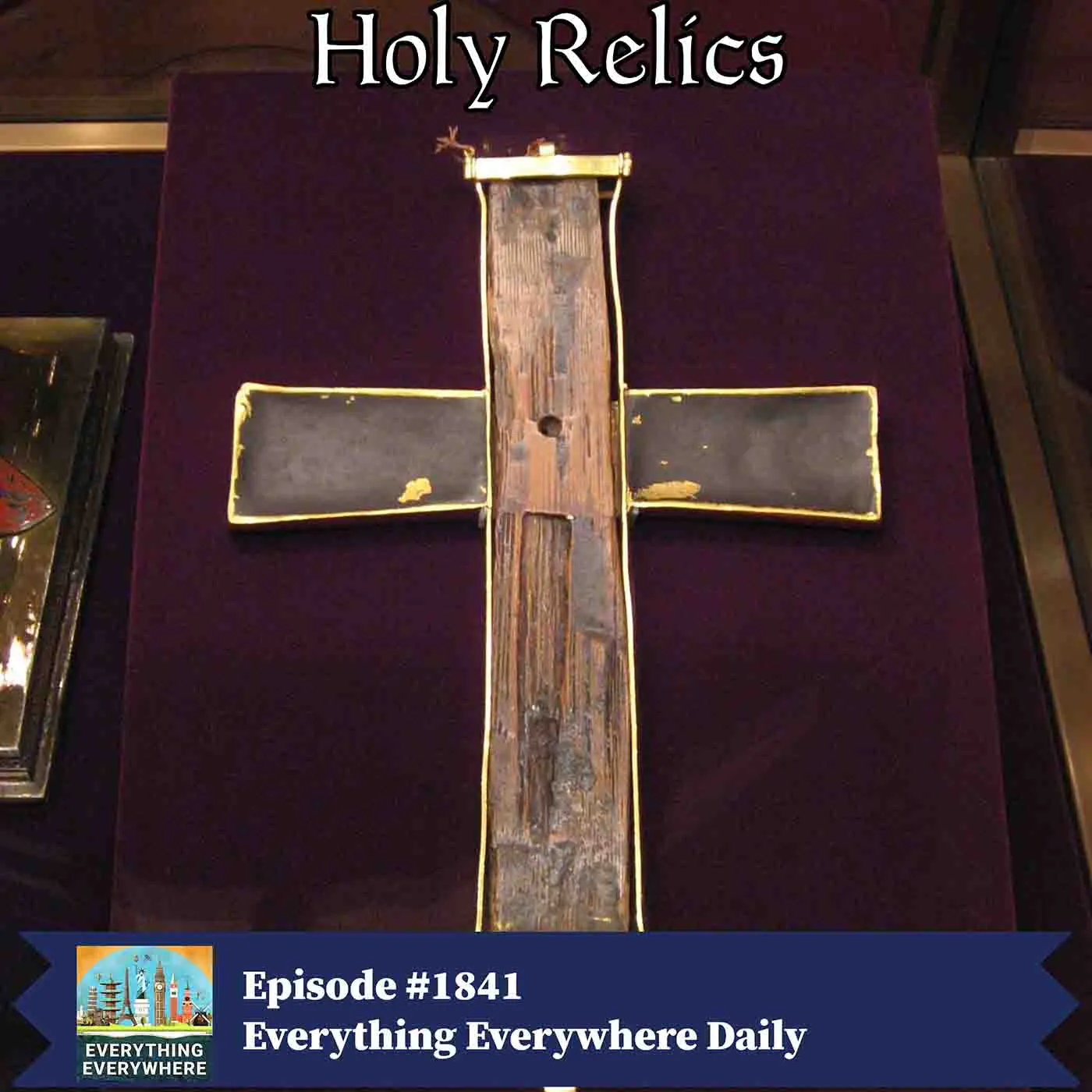
Everything Everywhere Daily: History, Science, Geography & More
Holy Relics
00:15:56
https://everything-everywhere.com/holy-relics/
Loading summary
Transcript1 lines
- [00:00]
Gary Arndt
Some of the most venerated objects in many different religions are holy relics. Relics offer a tangible connection to significant figures in various religious traditions, and they're often highly prized and sought after. In the Middle Ages, relics became a significant business, and possessing the right relics could substantially boost a local economy. It became such a good business that many people began to question their authenticity. Learn more about relics, the their authenticity, and the historical business surrounding them on this episode of Everything Everywhere Daily. This episode is sponsored by Fiji Water. You've probably heard of Fiji Water and have seen it in stores. Well, Fiji Water really is from the islands of Fiji. Drop by drop, Fiji Water is filtered through volcanic rock 1,600 miles away from the nearest continent and all its pollution protected and preserved naturally from external elements. In this process, it collects a unique profile of electrolytes and minerals, resulting in more than double the electrolytes as the other top two premium bottled water brands, giving Fiji Water its smooth taste. Fiji Water's electrolytes are 100% natural and this water even has a perfectly balanced pH of 7.7. I've recently been trying to reduce my consumption of diet soda and I've found Fiji Water to be a great alternative. Visit your local retailer to pick up some Fiji Water today for your next backyard party, beach day hike, or even your home office. Fiji Water is Earth's finest water. This episode is sponsored by Mint Mobile. There are numerous subscriptions that you pay for every month. If you want to reduce your monthly spending, your only option is usually to cancel and go without. But in case of your phone, you can significantly reduce your cost while still enjoying almost the exact same service by switching to Mint Mobile. With plans Starting at just $15 a month, Mint Mobile gives you premium wireless service on the nation's largest 5G network. With Mint Mobile, you can use your same phone, phone number, contact list, and even connect to the exact same towers and cellular network. The only difference is price and that's why I recommend Mint Mobile this year. Skip breaking a sweat and breaking the bank. Get your summer savings and shop premium wireless plans@mintmobile.comeed that's mintmobile.comeed upfront payment of $45 required equivalent to $15 a month limited time new customer offer for first three months only. Speeds may slow above 35 gigabytes on unlimited plan taxes and fees extra. See Mint Mobile for details. When most people think of religious relics, they probably think first of Christian relics and more specifically relics from the Middle Ages. While I'll get to the use of relics from that period. I should start by noting that relics are hardly a Christian phenomenon and have been used throughout history by most religions to one degree or another. In ancient Greece, the veneration of objects and remains was a widespread and culturally significant practice, which was deeply connected to religion, mythology and civic identity. The bones of Orestes were said to be crucial for Sparta's victory in the Peloponnesian War. According to Herodotus, they were exhumed and transferred to Sparta after the Oracle of Delphi revealed their significance. The remains of Theseus, the legendary Athenian hero, were recovered and ceremoniously reinterred in Athens by cimon in the 5th century BC affirming Theseus as a unifying national figure, these tombs often became shrines and cults formed around them. The tomb could be seen as a power center and people might seek blessings or protection from whatever hero was interred there. Buddhism also has several important relics. According to tradition, after the Buddha's cremation in 483 BC, his disciple Kama removed his left canine from the funeral pyre. The tooth was eventually taken to Kalinga in present day eastern India, where rulers worshipped it as a symbol of divine legitimacy. In the 4th century, the tooth was smuggled to Sri Lanka. It was gifted to the king of Anuradhapura, and from then on, possession of the tooth relic became intertwined with the right to rule Sri Lanka. Over the centuries, the tooth relic moved with shifting capitals of the island, surviving invasions, wars and colonial threats. And today it's housed in the Temple of the Tooth in the city of Kandy. From April 18 to April 27 of 2025, the tooth was put on public display where an estimated 1 million people saw it. However, the Buddha's tooth is just one example, as we'll see, of the problem of provenance in relics. Provenance is a term that's often used in the art world, referring to the ability to verify the origins and chain of ownership of an object. The problem is the temple in Sri Lanka is not the only one that claims to have a tooth from the Buddha. In fact, a paper published in 2023 found that 32 temples in the world claim to have at least one tooth, which is more teeth than is possible. The veneration of relics gained prominence in early Christianity, particularly during the Roman persecutions. Christians began to honor the tombs of martyrs as sacred sites. Very early Christians in Rome would often gather in catacombs near the remains of early martyrs. The bodies of martyrs were believed to carry spiritual power due to their sacrifice and proximity to God. Stories of Miracles at the tombs of martyrs reinforced this belief, and by the 4th century, the formal veneration of saints had developed. One of the earliest documented examples is the martyrdom of Polycarp, who was burned at the stake in the year155. Christians collected the ashes and bones of Polycarp as they were more precious than gold. By the time of Constantine the Great in the early 4th century, the veneration of relics had become mainstream amongst Christians. It was during the reign of Constantine that one of the greatest relics in the history of Christendom appeared, the True Cross. According to tradition, his mother, St. Helena, a devout Christian, is said to have traveled to the holy land around 326 to locate holy sites associated with the life and death of Jesus. In Jerusalem, Helena allegedly discovered three crosses during an excavation near what was believed to be Golgotha. According to legend, a dying woman, or in other versions, a dead man, was miraculously healed when touching one of the three crosses, confirming it as the True Cross. The site later became the Church of the Holy sepulchre, consecrated in 335 of which I've done a previous episode. A large portion of the cross was said to have remained in Jerusalem, while Helena sent other pieces to Constantinople and Rome. Over the following centuries, fragments of the cross were divided and sent to churches, monasteries, and even monarchs throughout Europe and the Byzantine Empire. By the time of the crusades, particularly the First Crusade in 1099, possession of a fragment of the True Cross was a mark of prestige and divine favor. The Latin Kingdom of Jerusalem housed what it claimed to be the main relic of the cross. It was even carried into battle, famously during the disastrous Battle of Hattin, where it was captured by Saladin's forces and then disappeared from history. Between the 9th and 16th centuries, the the number of relics claiming to be part of the True Cross increased significantly. Major cathedrals across Europe, including Notre Dame in Paris, Santa Croce in Rome, Cologne Cathedral and Westminster Abbey, all claim to house pieces of the True Cross. The possession of such relics boosted a church's status and made it a pilgrimage destination. This proliferation led to skepticism even in the Middle Ages. The 16th century Humorous Erasmus of Rotterdam famously joked that there were so many pieces of the True Cross that they could fill a ship. Later, the Protestant reformer John Calvin mocked the relic industry, stating that if all the fragments of the True Cross were gathered together, they could form a whole forest. Scholars and Catholic officials have acknowledged the problem of excess relics, especially since authentication methods in antiquity were based on tradition rather than forensic Science. In the 19th century French archaeologist Charles de Fleury tried to estimate the total volume of all known claimed fragments of the true cross. He concluded that even including hundreds of pieces, the total volume would still be less than a single cross of the type used by the Romans. He estimated that a full size cross would have required about 0.12 cubic meters of wood. His findings suggested that although the number of fragments was high, the total mass did not necessarily exceed that of a realistic cross. The largest section of the true cross, which is claimed today is located at the Orthodox monastic community at Mount Athos in Greece. Pieces of the true cross were not the only items that Helena supposedly found. She also supposedly found the holy nails that were used to crucify Jesus. In the case of the holy nails, there is most definitely a problem. There are no fewer than 30 holy nails that have been claimed, and at most there could have been only four that were actually used. These aren't the only relics that claim a direct association with Jesus. The Crown of Thorns is claimed to be located in Paris, and the holy lance that pierced the side of Jesus is claimed to be kept in Vienna's Hofburg Palace. But perhaps the most famous is the Shroud of Turin, which will be the subject of its own future episode. And I should note that all relics are not the same. There are in fact, different categories of relics. First class relics are the physical remains of saints, such as bones, blood, hair and teeth. Second class relics are items that the saintly person may have used, such as clothing or books. And third class relics are objects that touched a first or second class relic. Items like the true cross are second class relics. There has only been one alleged first class relic of Jesus, the foreskin of Jesus. It's based on a belief that Jesus, being Jewish, was circumcised according to the law of Moses on the eighth day after his birth. Since Catholic theology holds that Jesus ascended bodily into heaven, some theologians in the Middle Ages speculated that the foreskin was the only remaining physical part of Jesus left on earth, and therefore could be a uniquely sacred relic. And sure enough, soon after what began as a theoretical theological discussion, alleged foreskin started appearing in Europe. Places that have claimed to have had it include the Charo Abbey in France, Santiago de Compostela in Spain, as well as Antwerp, Bruges and Hildesheim in the Holy Roman Empire. The last known and most famous relic of the holy Foreskin was kept in the town of Calcatta, Italy, north of Rome. According to tradition, it was brought there in the 16th century and held In a reliquary in the local church. For centuries, it was paraded through the town during annual festivals on January 1, drawing pilgrims and curiosity seekers. However, in the 1980s, the relic mysteriously just disappeared. It was reportedly stolen under unclear circumstances. And if you're interested in learning more about the subject, my friend and travel writer David Farley has written a book on the topic titled An Irreverent Curiosity. Most relics in churches and cathedrals are actually first class relics. Some of them, such as the bones of St. James in Santiago de Compostela or the body of St. Mark in Venice, have dubious provenance. During the Middle Ages, relics were a big business. Some merchants specialized in selling relics, most of which were often fakes. However, at the time, there was no way to verify anything, and most churches that purchased relics had little incentive to verify anything. Having popular relics meant more pilgrims and visitors to their church where which meant having more money. However, most relics actually do have a very secure provenance because they are the remains of saints that were not ancient and not that famous. They are often associated with a saint who was buried in the place where the remains are interred. While Christian relics are the most common, they are not the only religion that has them. Relics do not have as great of an importance in Islam, but they do exist. In particular, the greatest collection of Islamic relics is held at the Topkapa palace in Istanbul. The Topkapa palace was the home to the rulers of the Ottoman Empire who controlled at the time the holy cities of Islam for centuries. The palace features a collection of over 600 items related to the Prophet Muhammad, early caliphs and Old Testament figures. The collection includes the Holy mantle, which is a cloak believed to have been worn by the Prophet Muhammad, the Prophet's beard, which is a collection of individual hairs believed to have been collected from Muhammad's beard, the Prophet's sword and bow, a stone with an impression believed to be Muhammad's footprint, and one of several diplomatic letters Muhammad is said to have written in his own hand. I'll close by noting that relics haven't gone away and have taken on a more secular, modern form. We often use the phrase celebrity worship, and it's not meant to be taken literally. But part of that celebrity worship involves relics. Today they're often just called collectibles. Just as pieces of cloth from the clothing of saints were once revered, today, game worn uniforms or even pieces of a uniform that's on a trading card can go for thousands and in some cases millions of dollars at auction. Autographs are a type of second class relic something that a famous person created and touched with their own hand. There are even some cases of first class relics from modern celebrities. In 2005, Neil Armstrong's barber was caught selling clippings of his hair for $3,000. Relics, whether holy or not, are a physical link to someone that people respect, worship or venerate. Relics in one form or another have been around for thousands of years and whether it's in the form of pieces of clothes, bone chips, locks of hair or game worn jerseys, they will likely be around for thousands more. The executive producer of Everything Everywhere Daily is Charles Daniel. The associate producers are Austin Otkin and Cameron Kiefer. I want to give a big thanks to everyone who came out for the show's fifth anniversary celebration this weekend. I was amazed and honored that so many people came from so far away. In addition to people from Wisconsin, there were also people from Michigan, Minnesota, Illinois, as well as a few who flew in from New Jersey and even California. Several Completionist Club members were in attendance, along with at least one double platinum member. The good folks at McFleshman Brewing Company made some of their specialty 5th anniversary hot sauce and of course were serving up their award winning beer. I want to thank Patricia Woodwind from the Tourist Office of Spain who came up from Chicago. As longtime listeners know, the Tourist Office of Spain was the first ever and is the longest running sponsor of this podcast. Special thanks to Alex Landa, the owner of Landa's Popcorn Factory in Mackinaw City, Michigan, who drove down with multiple boxes of his famous caramel corn with custom Everything Everywhere fifth Anniversary packaging. And if you're interested in trying some of his caramel corn out for yourself, you can purchase his many different flavors@caramelcorn.com he has the domain name. I might organize additional meetups in other cities around the country and around the world in the future and when plans are more firm, I'll let you know. Remember, if you leave a review or send me a boostogram, you too can have it read on the show.