← Everything Everywhere Daily: History, Science, Geography & More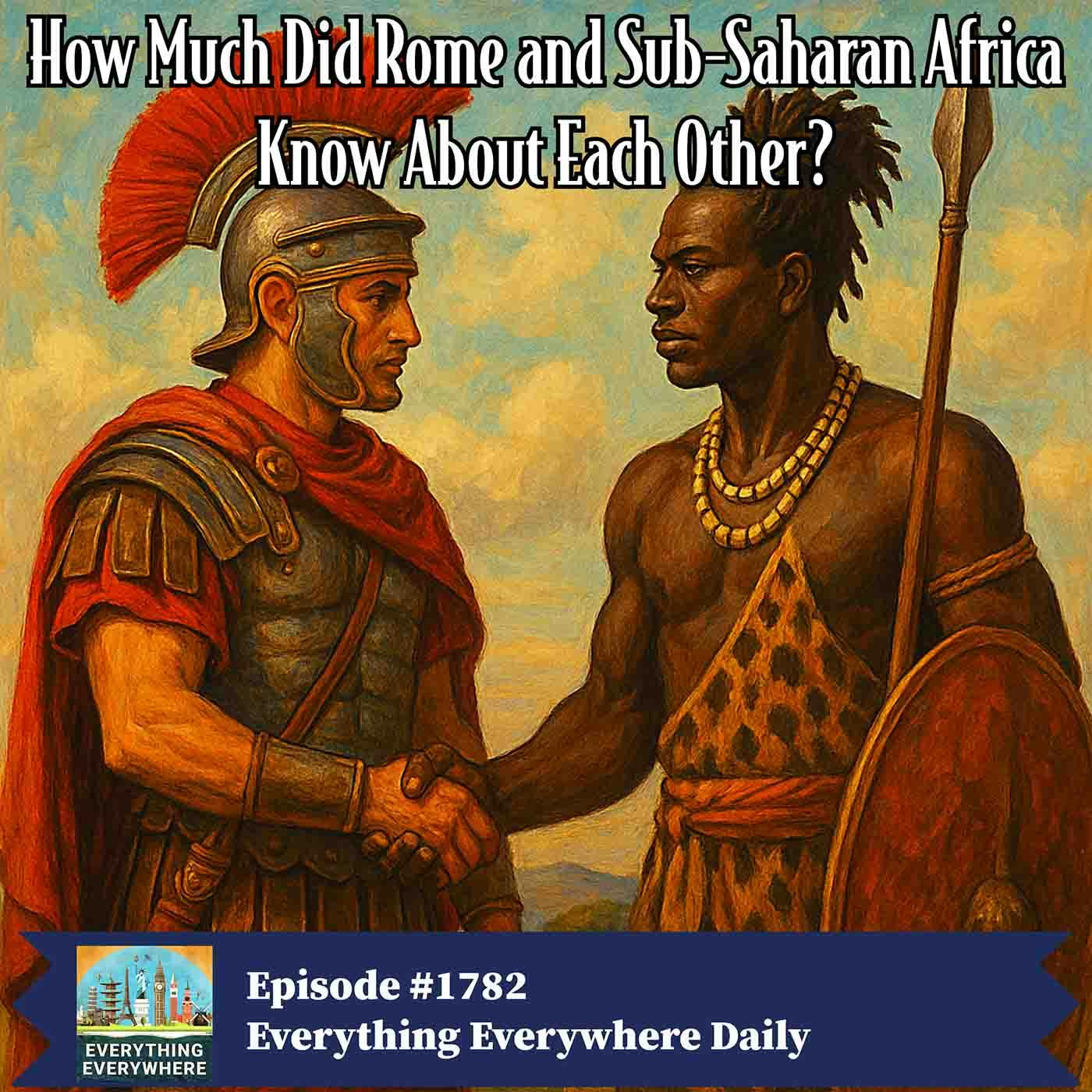
Everything Everywhere Daily: History, Science, Geography & More
How Much Did Rome and Sub-Saharan Africa Know About Each Other?
00:16:13
Learn about the contacts between Africa and Rome
Loading summary
Transcript1 lines
- [00:00]
Gary Arndt
The Romans were familiar with Africa, or at least part of it. At one point, they controlled everything on the north coast of Africa, from Morocco all the way to Egypt. However, below their African territories was the vast Sahara Desert, which was extremely difficult to cross. For all practical purposes, it served as a permeable barrier between the peoples above and below the desert. As such, historians have wondered just how much the people above and below the Sahara knew about each other. Learn more about Rome and Sub Saharan Africa and what contact they had with each other on this episode of Everything Everywhere Daily. This episode is sponsored by Quince. If you've been listening to the show for even a little while, you've heard me talk about Quince. The reason why I have such good things to say about them is because Quince has hit the trifecta by offering products that are low cost, high quality and easy to purchase and return online. They can do this because they work directly with top artisans and cut out the middleman. This is how Quince gives you luxury pieces without the crazy markups. I had someone over at my place the other day and they asked me, where's that Quince blanket you talk about? And I said it, it's right there. And they checked it out and said, wow, that's really a nice blanket. And I was like, yeah, it is. If you're looking for men's or women's clothing, home goods or travel accessories, you owe it to yourself to check out Quince. Go to quince.com daily for 365 day returns plus free shipping on your order. That's Q U I n c e.com daily to get free shipping and 365 day returns. Quince.com daily this episode is sponsored by Newspapers.com Break Down Genealogy Brick walls with a subscription to the largest online newspaper archive. Did you know that newspapers.com has over a billion pages of digitized newspapers going back to the year 1690? Their growing collection includes papers from the United States, United Kingdom, Canada, Australia and more. Discover birth and marriage announcements, obituaries and everyday stories about your ancestors. In seconds, Newspapers.com can help you fill in the gaps between vital records and reveal details about your ancestors lives that you can't find anywhere else. Their easy to use search feature will let you filter your results by date, location, specific paper and more. When you find something interesting, newspapers.com makes it a snap to share it with your family and friends and you can even save it directly to your ancestry Tree. Come explore one billion pages and make infinite discoveries. Today on Newspapers.com use promo code Everything Everywhere for a 20% discount on your subscription. In a very, very early episode of this podcast, I asked the question, how aware were China and Rome of each other? And the short answer was is that they were vaguely aware that there was some great nation far away from themselves, but there was no direct contact between China and Rome. What little they knew was a civilizational version of the telephone game. There were reports from China that they knew that this other nation had an elected body which was kind of like the Senate, but they had many of the facts wrong. Likewise, the Romans knew that there was some distant land where silk came from, but they didn't know much else. In this episode, I want to turn attention south to Sub Saharan Africa. And this is clearly different than China, if only because Sub Saharan Africa is much closer to the Roman base of power in the Mediterranean than China. The Romans had provinces on the continent of Africa. At various times, the provinces of Africa, Africanova, Mauritania, Numidia, and Egypt were all part of the Roman Republic or Empire. However, what they controlled was often just a very thin band along the Mediterranean coast. The Romans were clearly aware of Africa and knew that there were vast, uncharted lands to the south. The people in North Africa who became part of the empire were largely Berbers and Egyptians, and they eventually merged in part with Romans and other people from the empire who migrated to the region. There were a host of notable Roman the biographer Suetonius, the comic poet Terence, the Christian theologian Tertullian, and the philosopher and novelist Apuleius. But the most notable had to be the emperor Septimius Severus. Severus reigned for 18 years, a rather long time for an emperor, and is considered one of the better emperors in history. He was born in Leptis Magna in what is today Libya, and was of Carthaginian and possibly Berber ancestry. He spoke Punic as his first language before Latin. Likewise, Macrinus, who was briefly emperor, was born in the city of Caesarea in the province of Mauritania in what is today Algeria. Denzel Washington portrayed Macrinus in the movie Gladiator 2. Macrinus was most probably of Berber descent, and the Berbers will probably be the subject of a future episode. The big question that most modern people have is, were Macrinus and Septimius Severus black? And the truth is, we don't really know, and it depends on what you mean. The Romans didn't have a concept of race like we do today. If you looked different, it just meant that you or your ancestors were from A faraway place. It had no bearing on your position in the empire. What was notable about Macrinus wasn't that he was from Africa, but that he was the first emperor who wasn't of senatorial rank. We are pretty sure that Macrinus and Septimius Severus were not of sub Saharan African descent. And they did probably have darker skin than most people in Rome, but we don't really know what that means. So, yes, Rome was very intertwined with North Africa. But let's get to the big question of this. How much did they know about the rest of Africa? Due to its immense size, harsh climate, and geographic isolation, the Sahara desert served as a formidable natural barrier between the peoples of North Africa and those living in sub Saharan regions. That is why we even have a term for sub Saharan Africa. Spanning over 3.5 million square miles, the Sahara is the largest hot desert in the world, with extreme temperatures, scarce water resources, and vast stretches of sand dunes with rocky plateaus and arid plains that are extremely difficult to cross. These environmental challenges made sustained travel and communication across the desert extraordinarily difficult before the advent of camel caravans, which weren't developed until the first millennium. Without reliable means of transport or navigation, the Sahara severely limited cultural exchange, trade, and political interaction between the Mediterranean world and sub Saharan Africa, effectively dividing the continent into two largely separate spheres. For much of antiquity, the ancient Greeks had a word for all of the lands below the Sahara, and the Romans adopted the same term. They called it Ethiopia. People from Ethiopia were known as Ethiopians. And if the word sounds familiar, it's because it's the basis of the modern word Ethiopia. Ethiopia, however, referred not just to Ethiopia the country, but to everything else south of Egypt and the Sahara. Some writings indicated that the Ethiopians came from both the east and the west, which was really just another way of saying that the Mediterranean world's contact with sub Saharan Africa came primarily from East Africa along the Nile and the Red Sea, and to a lesser extent along the Atlantic coast. The best documented relationship was between Rome and the kingdom of Kush, centered in modern day Sudan. This was a sophisticated civilization that the Romans knew very well and respected. Roman sources describe military encounters, diplomatic exchanges, and trade relationships with their Nubian rulers. The Romans even built temples and settlements near the border regions, creating a zone of cultural exchange. If you remember back to the episode I did on Nubia and the kingdom of Kush, there was actually a battle fought between Rome and Kush. It wasn't a big battle. Nothing was really resolved, and they never fought Again, think of this relationship like neighboring countries today. There were tensions, negotiations, trade disputes, and periods of cooperation. Roman writers like Pliny the Elder and Strabo provided detailed accounts of Nubian society, architecture, and customs. The kingdom of Axum, located in modern day Ethiopia and Eritrea, was connected to Rome via the Red Sea. Roman merchants and diplomats visited Aksum in the first century, and Roman coins have been found in archaeological digs there. Over on the west coast of Africa, the Romans were generally terrified. Of sailing beyond the Strait of Gibraltar into the open sea. We know that they did on rare occasions, as they named the Canary Islands. But there were no regular trade routes there. Moreover, there weren't any harbors or ports for them to even visit. The contact with the people on the west coast would have been via traders who traveled over land routes along the coast. And I don't want to imply that there was zero contact between the Nile and the Atlantic. There was, but there just wasn't as much of it. Traders in the Sahara would often travel to markets in locations such as Carthage, Tripoli, or in Egypt. The Romans didn't deal directly with people in sub Saharan Africa. They dealt with intermediaries such as the Garamantes, an ethnic Berber people who lived in what is today southern Libya and Chad. They were one of the few cases of contact in the Sahara itself. They had a very complex relationship with Rome and connected Saharan trade routes to the Sahel. They traded with Romans and sometimes fought with them. More on that in a bit. The trade network wasn't one way. Sub Saharan Africans, particularly in modern day Ghana and Mali, knew about Roman goods and currency through these same networks. Roman coins have been found in archaeological sites deep in West Africa, showing that Roman economic influence reached far beyond their direct political control. One of the biggest imports from Africa was exotic animals. Giraffes and rhinoceroses were brought to Rome for public games. Through a vast and complex trade network stretching deep into Africa. These animals were typically captured in regions south of the Sahara, such as Nubia, Ethiopia, or even further inland, where local hunters and African intermediaries helped procure them. Once captured, they were transported northward across deserts and savanna by caravan, often through routes managed by desert peoples like the Garamantes. From there, animals were shipped down the Nile or across the Red Sea to Roman controlled ports such as Alexandria or Carthage. Specialized Roman ships then carried them across the Mediterranean to Italy, where they were housed in animal pens. And often displayed or fought in Roman arenas like the Colosseum. The immense cost and difficulty of these expeditions made the appearance of such exotic beasts. A Rare and spectacular event that that symbolized Rome's global reach and imperial power. Supposedly the first giraffe ever to appear in Rome was in a celebration held by Julius Caesar in the year 46 BC. So very clearly, unlike China, there was a fair amount of contact between Rome and Ethiopia, as the Romans understood it. Given how expansionistic the Romans were, it should come as no surprise that the Romans conducted several expeditions into Ethiopia beyond the Mediterranean coastal, motivated by strategic, commercial or exploratory goals. While the Romans formal control only extended as far south as the start of the Sahara Desert, they consistently showed interest in the lands beyond, especially regions rich in exotic animals, gold and other luxuries. Shortly after Egypt became a Roman province in the year 30 BC, Emperor Augustus commissioned exploratory missions to better understand the lands to the south. One of the earliest was led by Publius Petronius, the prefect of Egypt, who launched a military campaign into Nubia around the year 24 BC in response to raids into southern Egypt. He captured the city of Napata, capital of the kingdom of Kush. Augustus also sent an exploratory mission up the Nile river to locate its source. The mission is believed to have reached as far south as Meroe, a major city of the Nubian kingdom. In 19 BC, Lucius Cornelius Balbus, a Roman general and proconsul of Africa, led a significant military expedition deep into the Sahara Desert, becoming the first Roman commander to celebrate a triumph. For a campaign conducted entirely outside of the traditional Roman provinces. Bulbus targeted the Garamantes, who controlled the key trans Saharan trade routes. Bulbus may have traveled all the way down to the Niger river in what is today Mali. In the year 41, the Roman general Suetonius Paulinius led an expedition across the Atlas Mountains in modern day Morocco, becoming the first Roman commander known to have crossed that mountain range. As governor of Mauretania, he aimed to subdue resistant Berber tribes and expand Roman influence further inland. After defeating local forces near the coast, Polonius advanced with a well organized army through treacherous mountain terrain and into the desert beyond. He may have gone into modern day Mauritania and possibly even as far as Senegal. Around the year 50, the Roman commander Septimius Flaccus led an expedition southward from the Roman province of Africa, Proconsularis, into the central Sahara, Pushing beyond the limits of regular Roman control. With the support of the Garamantes, who were now allied with Rome, his forces advanced into the interior and reportedly reached a distant region known as Aegisimba, a land rich in wild animals like elephants and rhinoceroses. And it was possibly located near modern day Lake Chad or the Sahel. By the start of the second century, Rome lost interest in exploring southward. If you remember my episode on how the Sahara Desert used to be grasslands just 5,000 years ago, 2,000 years ago, it wasn't as big as it is today, and it was expanding. The Romans concluded, quite rightly, that expanding to the south just wasn't worth the effort. So to summarize, Rome and sub Saharan Africa knew a lot more about each other than Rome and China did. However, there were limits. There was much more contact in East Africa than there was in West Africa. In fact, there is no evidence that the Romans ever got as far as the modern countries we consider to be part of West Africa, other than possibly getting to Senegal. By the same token, we have no evidence of West African people making it to the north, to the areas controlled by Rome. There are no written records from Africa from this period. That allows us to see the other side of this exchange. So Rome and Africa were familiar with each other, but it depends on what part of Africa the further north and east, the more contact there was. The further south and west, the less contact there was. If you go far enough south in Africa, then there was no contact at all. And it just as well might have been like going to China. The executive producer of Everything Everywhere Daily is Charles Daniel. The associate producers are Austin Oakton and Cameron Kieffer. I want to thank everyone who supports the show over on Patreon. Your support helps make this podcast possible. I'd also like to thank all the members of the Everything Everywhere community who are active on the Facebook group and the Discord server. If you'd like to join in the discussion, there are links to both in the show notes and as always, if you leave a review or send me a boostogram, you too can have it right on the show.