Loading summary
Transcript1 lines
- [00:00]
A
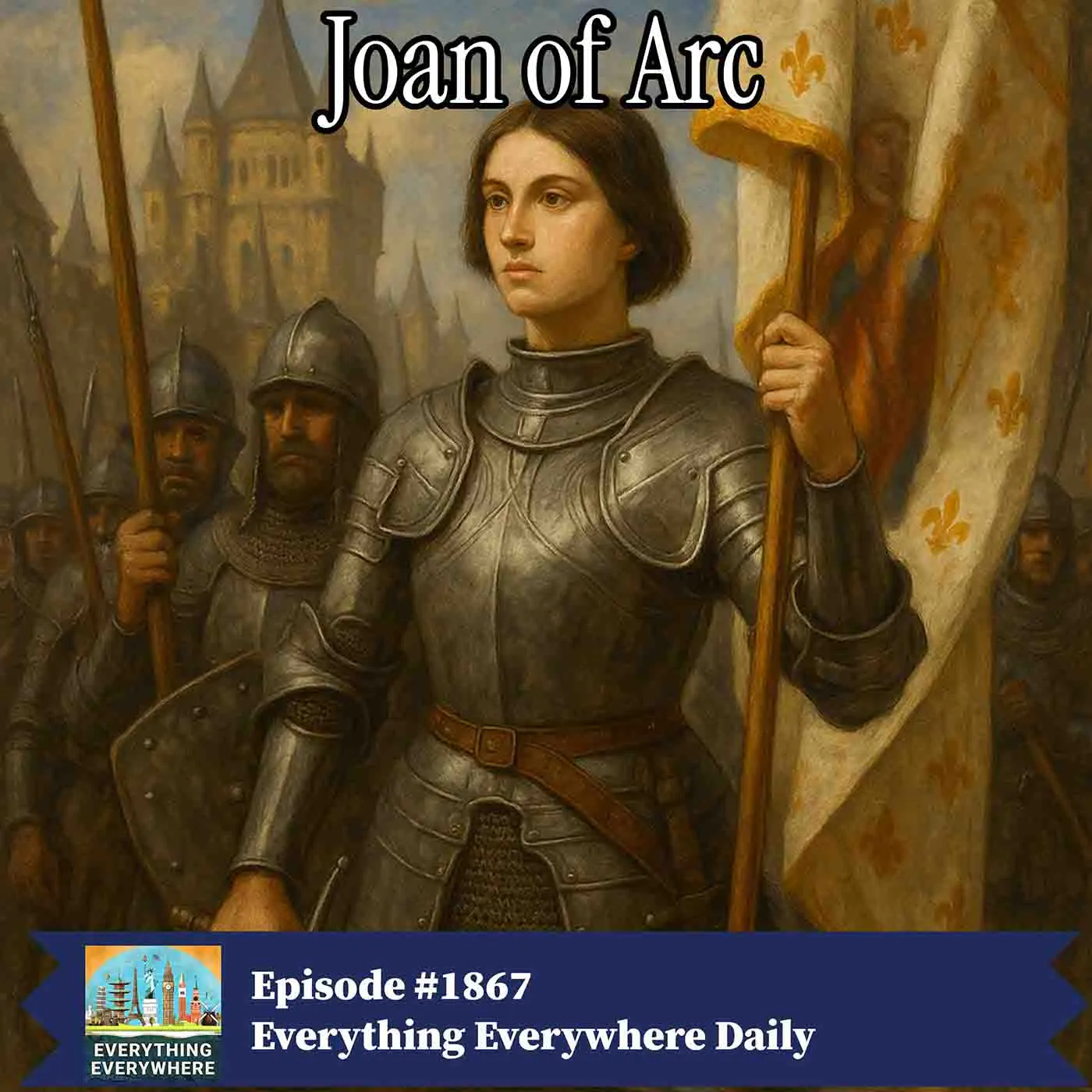
The following is an encore presentation of Everything Everywhere Daily In 1428, a young girl from the village of Domremy, France audaciously set out to meet the heir apparent to the French throne, the Dauphin, and told him what he had to do to defeat the English occupying her country. She claimed that she was told what to do, by God, against all odds, the Dauphin took her advice and it worked. After a series of military victories, the Dauphin was crowned king and the young girl went on to become one of the greatest heroes in French history. Learn more about Joan of Arc, her incredible story and how it changed French history on this episode of Everything Everywhere Daily. This episode is sponsored by Fiji Water. You've probably heard of Fiji Water and have seen it in stores. Well, Fiji Water really is from the islands of Fiji. Drop by drop, Fiji Water is filtered through volcanic rock 1600 miles away from the nearest continent and all its pollution protected and preserved naturally from external elements. In this process, it collects a unique profile of electrolytes and minerals, resulting in more than double the electrolytes as the other top two premium bottled water brands, giving Fiji Water its smooth taste. Fiji Water's electrolytes are 100% natural and this water even has a perfectly balanced pH of 7.7. I've recently been trying to reduce my consumption of diet soda and I found Fiji Water to be a great alternative. Visit your local retailer to pick up some Fiji Water today for your next backyard party, beach day hike, or even your home office. Fiji Water is Earth's finest water. This episode is sponsored by Quince. I recently purchased a new sweatshirt on Quint's. It was a black long sleeve cashmere sweatshirt and if that sounds fancy, it sort of is. But I only paid a fraction of what I would have paid if I purchased the same thing from a name brand designer. The Quince website literally showed me how much an equivalent sweatshirt of the same color and same material would have cost from other fashion designers and my savings were between 78 to 94%. I've been telling you for months now about how Quints brings you quality items at a fraction of the price and it's not just a marketing slogan. You can go to their website and see the savings for yourself by working directly with top artisans and cutting out the middleman. Quince gives you luxury pieces without the markup and they pass the savings onto you. Keep it classic and cool with long lasting staples from quince. Go to quince.com daily for free shipping on your order and 365 day returns. That's Q U I-n c e.com daily to get free shipping and 365 day returns. Quince.com daily if it hadn't actually happened, if you heard the story of Joan of Arc, you'd probably think that the story was fiction. It wasn't just an improbable story. It countered every single social norm of the era and every principle of military strategy. Imagine a teenage girl today walking up to a military base, saying she's a messenger from God, and offering the commander of the military base advice, and then having that advice work while this girl from out of nowhere was marching at the head of an army. Before I get into the details of who Joan of Arc was and what she did, I first need to explain what was happening in France at the beginning of the 15th century. Because the events surrounding Joan of Arc did not take place in a vacuum. They were the results of the specific events that took place at that time. The story really begins several hundred years earlier, in 1066, with the Norman Conquest of England. William the Conqueror, the Duke of Normandy and France, conquered England and established himself as king. In addition to claiming the English crown, he also had lands in France that he had claim to. All of William's successors to the English crown had claims to land in France, and through some strategic marriages, those claims eventually increased. This all came to a head in the year 1328 with the death of King Charles IV of France. Charles didn't have any sons or brothers. His closest male relative was Edward III of England, who was the grandson of Philip IV of France through his mother Isabell Isabella of France. The problem was, in England, the throne could pass through a female, in this case, Isabella. The French nobles rejected this because they claimed Isabella couldn't transmit something that she never possessed. The crown, in their mind, could only be passed through a direct male line. The nobles in France held an assembly and declared that Philip, the Count of Valois, should be king. This disagreement over the French throne was led to what we now know as the Hundred Years War. The Hundred Years War can be thought of as a string of multiple wars spanning decades and various rulers of both England and France. The conflict wasn't continuous. Rather, there were periods of war and periods of peace. Which side had the advantage changed over time, depending on who was in command of things and other events like the Black Death. Fast forward to the early 15th century when Henry V ascended to the throne of England. Henry did a masterful job on the battlefield fighting the French. His biggest victory was at the Battle of Agincourt in 1415. He controlled most of northern France, including Paris, and had a powerful alliance with the Duke of Burgundy. He married Catherine of Valois, the daughter of the French King Charles vi, which set him up perfectly. To take over the French throne, he forced Charles VI to sign the Treaty of Troyes in 1420. In the treaty of Troyes, Henry V or his heir, would be designated as the heir to the French throne. Perhaps more importantly, the treaty officially disinherited the king's son, the Dauphin, Charles vii, and they did this by declaring Charles to be illegitimate. There's actually no evidence that Charles VII was illegitimate, but it was a necessary fiction to pass the throne along to Henry. In 1422, however, both Charles VI and Henry V died within two months of each other. This left the one year old infant Henry VI as King of England and in theory, the King of France. However, Charles VII declared himself King of France. He controlled most of the south of France, but he didn't control the north, which included Paris and the city of Reims, where French kings were traditionally crowned. Charles had based himself in the city of Bourges and did almost nothing to try to expel the English from the north. He was mockingly called the King of Bourges. Now enter into the picture. Joan of Arc. Joan was born in 1412 in the village of Domremy in northeastern France, in the region known as Lorraine. The village was surrounded by Burgundian territory, which was controlled by the Duke of Burgundy. But the people of the region were still loyal to Charles vii. We don't know much about her childhood other than she was raised in a very strict religious environment and she was probably illiterate. Her father was Jacques d', Arc and it isn't known what the family surname is referring to, as there is no town called Arc. What is relevant to this story is that sometime in the year 1424, at the age of 12, Joan claimed that she began to hear messages from God. Eventually, in 1425, the voices in her head told her that she had to go to the Dauphin to help him expel the English and become crowned King of France. Not coincidentally, that very same year, the English also attacked the village of Domremy and stole many of the people's cattle. The voices she heard were supposedly from St. Michael, St. Catherine and St. Margaret. In March of 1428, at the age of 16, she asked her uncle to escort her to the nearby town of Vaucouleurs. There, she asked the garrison commander, Robert de Baudricourt, to provide her with an armed escort to the castle at Chinon where Charles VII was holding court. Needless to say, when some random girl shows up out of the blue asking for a military escort to go and see the potential king, it's probably not going to be taken seriously. And it wasn't. She returned to Domremy, and while back in her village, the English came again, burned everyone's crops, and forced the villagers to flee for their lives. In January 1429, she returned to Vaucouleur and made the same demand and got the same answer. However, this time something had changed. Word about her had started to spread. Several of the men in the Vaucouleur garrison believed in Joan's stories, and the Duke of Lorraine began to think that she could perform miracles. In February, the head of the Vaucouleur garrison met again with her for a third time and this time agreed to send six soldiers to escort Joan to Shinan. Before she left, she was given a set of men's clothing by the local villagers to wear. And she wore men's clothing for the rest of her life. She arrived in Chinon and met with the dauphin. She told him that she was there to help him break the siege of the city of Orleans and to help him get rightfully crowned king in Reims. Needless to say, he was skeptical. He ordered her to undergo a series of religious and physical tests to prove her religious devotion and her virginity. She passed the tests, although the priest said that they could not confirm if the voices in her head were actually divine. And around this time, she also started calling herself Joan the maiden. Charles, for his part, realized the potential in what Joan was offering. A legend had been floating around France for years, the that a maiden would come to deliver France from its enemies. Whether or not Charles actually believed Joan, he recognized that Joan could be useful as a symbol to rally around. If people believed her and the legend, it might tip the balance in their favor against the British. He commissioned a set of armor for Joan and a banner that she could carry with her. In April, she was sent with a contention to bring supplies to Orleans, which was under siege. The city wasn't totally cut off, so she was smuggled inside. In there, she consistently put herself on the front lines with the city's defenders. She had no official function, but she was very inspirational to the soldiers, giving them the impression that God was on their side. She was even injured when she was hit by an arrow in the shoulder. On May 8, the French broke the English siege of Orleans. Delivering the promise that Joan had made, the French began to believe that she was sent by God. And the English, of course, assumed that she was possessed by the devil. Joan began to be taken seriously. She didn't have any formal position in the army, but military commanders began to consult with her. She told the Dauphin that having relieved Orleans, now was the time to march north to Reims to be formally crowned. They set out and began liberating towns and villages in the Loire region. Joan was always in any such battle, holding up her banner for everyone to see. In one incident, she was personally climbing a ladder to get over a city wall when she was hit in the helmet by a projectile. Charles wanted to take the fight to Normandy, which was under English control. But she convinced Charles that he had to get to Reims to be crowned king first. The French army marched into Reims almost unopposed and Charles was crowned king in the the reims Cathedral on July 17, 1429, with Joan of Arc at his side. From Reims they went south and tried to take Paris from the English. This did not go as well as the previous military campaigns. Joan was once again injured in combat, this time by a crossbow bolt to the leg. Charles called off the attack on Paris, but Joan disagreed, arguing that they needed to press the attack. Charles called off the attack, agreed to a several month truce with the English. In May of 1430, Joan was sent with a force to Compiegne to defend the city. After a failed attack on a Burgundian camp outside of the city, Joan was thrown from her horse and captured. The Burgundians who captured her eventually sold her to the English. The English and the Burgundians were glad to have her off the battlefield. Likewise, Charles was probably glad to be done with her as well. There is no evidence that Charles ever tried to mount a rescue attempt to free Joan. The English decided to put Joan on trial for heresy. They claimed that she committed blasphemy by wearing men's clothing and that the voices she heard were actually demonic. The trial that Joan was subject to was a farce. The verdict was known before the trial even started. Joan was charged with a religious crime and was supposed to have been tried in an ecclesiastical court. However, the entire trial was irregular and none of the protections given to the accused in a normal ecclesiastic court were followed. Joan was found guilty of heresy and was sentenced to death. She was burned at the stake in rouen, France, on May 30, 1431 at the age of 19. The death of Joan of Arc did not solve the problems of the English. Joan became a bigger symbol in death than she was in life now that she was a martyr. Within four years, the Burgundians abandoned their alliance with the English, and in 1453, 22 years after Joan's death, the English were removed from all of France save for the Port of Calais. Eventually, Charles established an ecclesiastical tribunal because he didn't want it to look like a heretic got him crowned King of France. He commissioned two tribunals, both of which concluded that the English trial was a farce and that the rules were not properly Followed by In 1456, a posthumous retrial authorized by Pope Calixtus III overturned the original verdict and declared Joan innocent, recognizing her as a martyr. For centuries, Joan of Arc played a central role in the national mythology of France. Centuries later, this was eventually recognized by the Catholic Church. In 1901 she was beatified by Pope Pius X, and in 1920 she she was declared a saint by Pope Benedict XV. Joan of Arc is now one of the patron saints of France, and her life continues to inspire countless books, films and works of art. One of the greatest works is the 1928 film the Passion of Joan of Arc by Carl Theodore Dreier. While a silent film, the script was taken directly from the transcript of Joan's trial. In the film, Joan is played by Maria Falconetti in one of the most powerful performances in the history of cinema. What is even more remarkable is that it's the only movie she ever made in her life. If you've never seen it, and I'm guessing most of you haven't, given its age, I highly recommend it as it is one of my top 10 favorite films of all time. Joan of Arc, an obscure girl from a small village, managed to change the course of French history in a way that can still be felt today. Her legacy endures as a symbol of courage, faith, and the power of individual conviction in the face of adversity. The executive producer of Everything Everywhere Daily is Charles Daniel. The associate producers are Austin Otkin and Cameron Kiefer. My big thanks go to everyone who supports the show over on Patreon. Your support helps make this podcast possible and I also want to remind everyone about the community groups on Facebook and Discord. That's where everything happens that's outside the podcast, and links to those are available in the show notes. As always, if you leave a review on any major podcast app or in the above community groups, you too can have it read on the show.