Loading summary
Transcript7 lines
- [00:01]
Host
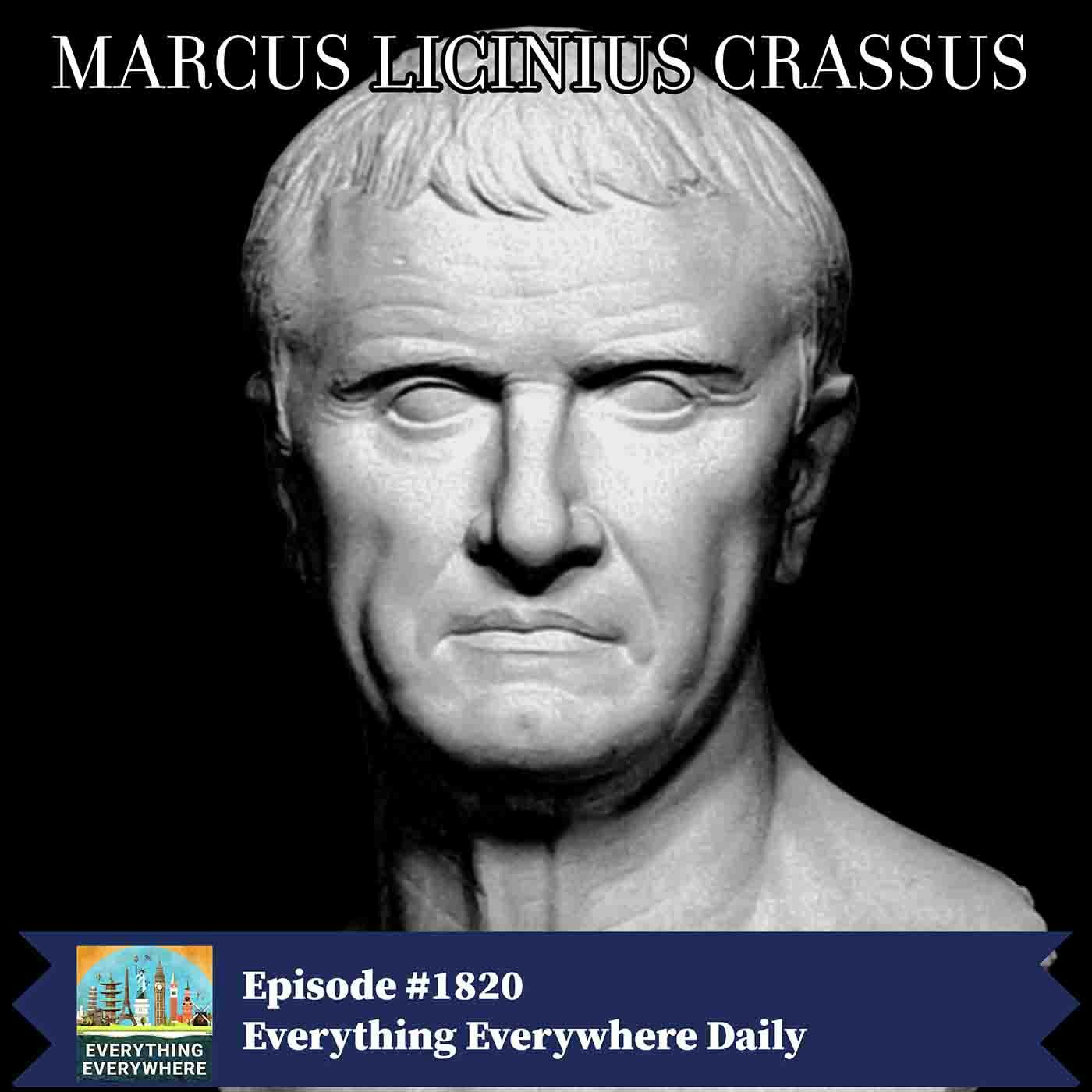
Marcus Licinius Crassus was the richest man in the Roman Republic. His wealth bought him power and influence, but it couldn't buy him everything. His massive wealth couldn't give him the respect and authority that came from victory on the battlefield. His desperate attempt to achieve this glory led to his spectacular demise and ultimately the fall of the Roman Republic. Learn more about Crassus and his stunning rise and fall on this episode of Everything Everywhere Daily.
- [00:41]
Carvana Representative
Buying a car in Carvana was so easy. I was able to finance it through them. I just. Whoa, wait, you mean finance? Yeah, finance got pre qualified for a Carvana auto loan, entered my terms and shot from thousands of great car options all within my budget. That's cool. But financing through Carvana was so easy. Financed, done, and I get to pick up my car from their Carvana vending machine tomorrow. Financed, right? That's what I said. You can spend time trying to pronounce financing, or you can actually finance and buy your car Today on car finance financing subject to credit approval. Additional terms and conditions may apply.
- [01:12]
Nordstrom Advertiser
Summer's here and Nordstrom has everything you need for your best dressed season ever. From beach days and weddings to weekend getaways in your everyday wardrobe, discover stylish options under $100 from tons of your favorite brands like Mango Skin, Skims, Princess Polly and Madewell. It's easy too, with free shipping and free returns in store order, pickup and more. Shop today in stores online@nordstrom.com or download the Nordstrom app.
- [01:44]
Host
The story of Crassus is one of the most fascinating in the late Republic period of Rome. Crassus isn't as well known as some of the other major players of this time, such as Julius Caesar, Pompey, Cicero, Cato the Younger, Mark Anthony, Brutus and Cleopatra. Nonetheless, Crassus is a pivotal player in the collapse of the Republic. Crassus has appeared in previous episodes, including the Servile War, also known as the War of Spartacus, and the First Triumvirate. While those were major points in his life, there was a lot more to his story. Marcus Licinius Crassus was born around 115 BC into a prominent Publian family. His father was Publius Licinius Crassus, who served as consul in 97 B.C. and also received the honor of a triumph. Marcus Licinius Crassus rose to prominence through a combination of military service, political ambition, and exceptional financial acumen. He came of age during the turbulent years of the Mari and Sullan civil wars, siding with Lucius Cornelius Sulla during his return to power in 83 BC. Crassus proved himself a capable military commander during this conflict, notably helping Sulla reclaim Rome. If you remember back to my episode on the proscription lists, Sulla and his team put together a list where anyone, including slaves, could legally kill anyone on the lists and their property was then seized. It was a quick way for Sulla to eliminate his enemies and raise a whole lot of money. And it was also how Sulla was able to reward his allies. Crassus was able to enrich himself massively through property confiscation, acquiring land at fire sale prices from the proscribed enemies of Sulla. And this marked the beginning of his legendary fortune. Unlike Sulla's other supporters, who made some money and were happy for the windfall, Crassus used his money as a seed investment to build an empire. Crassus became Rome's premier real estate speculator, money lender and slave trader. His assets included silver mines in Hispania and a private fire brigade in Rome, which he allegedly used to coerce owners of burning buildings into selling their properties at literal fire sale prices. He employed thousands of slaves, many of whom were educated Greeks who he trained to become scribes, architects and accountants. His immense wealth gave him considerable influence, although he was often resented and mocked by his contemporaries like Cicero and Plutarch for his greed. In the late Roman Republic, elite Roman society generally looked down on direct involvement in business and commerce, especially amongst members of the senatorial class. Roman aristocratic ideals elevated land ownership as the proper pursuit of a Roman noble. Making money through trade, lending or other commercial ventures was seen as somewhat disreputable, particularly for senators, because it was associated with the Equestrian order, who were wealthier but not part of the political aristocracy. So on one hand, many upper class Romans looked down on Crassus. On the other hand, money. Rome at this time operated on a client patron system. The client patron system in the late Roman Republic was a deeply entrenched social and political network based on reciprocal obligations between a more powerful patron and a less powerful client. Patrons, typically wealthy aristocrats or politicians, provided protection, literally legal aid, financial assistance and access to resources or influence. In return, clients offered loyalty, public support, votes in elections, and sometimes even personal service or military backing. Crassus, in this respect, became a mega patron. With Crassus money, he could make careers and buy elections, which is exactly what he did with one major client. More on that in a bit. Despite his wealth, he lacked several things that were highly respected amongst the Roman elite, in particular, military glory and great oratorical ability. His military success under Sulla wasn't really considered success because it happened against other Romans. So in the eyes of most people that didn't count. Pompey Magnus, his greatest rival, as you recall from a previous episode, was renowned for his military accomplishments and was highly respected. Likewise, Cicero, another of his contemporaries, was considered the greatest orator of his generation. Crassus, on the other hand, had money. That isn't to say Crassus didn't try. His most notable military Success came in 71 BC, when he was given command to suppress the massive slave revolt led by Spartacus. Although other Roman generals had mishandled the war, Crassus managed to crush the rebellion through brutal discipline, including the infamous decimation of his own troops to instill fear and obedience. After defeating Spartacus, Crassus crucified approximately 6,000 captured slaves along the Appian Way as a warning. However, even this victory was tainted. Though victory was undeniable. Pompey, who was returning from Spain, took credit by claiming that he had ended the rebellion by defeating the last fleeing remnants. Also, because the victory came against slaves, it was considered by most not to be a real victory. In 70 BC, Crassus and Pompey agreed to set aside their rivalry and were elected consuls together, a political partnership born more of necessity than mutual respect. Crassus supported legislation to restore the powers of the tribunes, undoing some of Sulla's constitutional reforms in a move designed to gain popular favor. But for the most part, the disagreements between Crassus and Pompey led to very little being accomplished during their year as consuls, as each one vetoed the other. By the late 60s BC, Crassus had found a new client in a rising politician, someone that you might have heard of before, Gaius Julius Caesar. Crassus paid off Caesar's debts and used his influence to promote Caesar's political career, seeing him as a useful counterweight to Pompey. Caesar won the election to the position of Pontifeus Maximus, the high priest in Rome, in 63 BC, with the help of Crassus. Caesar eventually realized that the rivalry between Crassus and Pompey was self defeating. He realized that what each of them wanted wasn't actually mutually exclusive with Crassus, wealth, Caesar's position as Pontifeus Maximus and Pompey's military authority. They could effectively control Roman politics if they just worked together. They finally came to an agreement in 60 BC, in what history has referred to as the first triumvirate, a topic I covered in a previous episode, the arrangement worked well for all the triumvirs. Crassus gained tax concessions for his clients in the equestrian order, while Pompey received land for his veterans and Caesar secured the consulship and a future provincial command. Caesar was consul in the year 59 and then left Rome to become the proconsul of Gaul for the next 10 years. In 55 BC, 15 years after his first tenure, Crassus was once again elected consul and and once again served alongside Pompey. Pompey and Crassus still weren't best friends, but they could do business. As was the tradition, after serving as consul for a year, a consul would get to serve as the governor of a province. Crassus arranged to become governor of Syria. Most provincial governors took the position with an eye towards making money, usually via graft and corruption. Crassus didn't really need the money. Instead, he was looking for something else, something that he had been wanting his whole life military glory. Crassus was going to conquer Rome's greatest adversary, Parthia. By doing this, he would achieve something greater than Pompey or Caesar's military accomplishments. In 53 BC, at the age of 62, an age at which most Romans would retire from public life, Crassus marched into Mesopotamia with a large army, expecting an easy victory and wealth to match Alexander the Great's legendary eastern campaigns. It turned out there was a good reason why Crassus was a great businessman and not a great general. Parthia presented unique military challenges that Crassus failed to fully appreciate. The Parthian army relied on cavalry, particularly mounted archers who could harass Roman infantry from a distance. Their tactics emphasized mobility and endurance rather than the direct confrontation that suited Roman legions. Additionally, Parthia's vast territories and harsh desert climate created logistical problems that Roman armies had rarely faced. The campaign began promisingly enough. Crassus crossed the Euphrates river with approximately 42,000 men, including seven legions of infantry and a substantial cavalry force. His initial advance encountered little resistance, and several Mesopotamian cities surrendered without a fight. However, these early successes may have contributed to Crassus overconfidence and his decision to continue advancing despite warnings from local allies. Crassus finally met the Parthian army at the Battle of Carrhae. The Battle of Carrhae stands as one of Rome's most devastating military disasters. Crassus encountered a Parthian army led by young Surena, a young nobleman who understood perfectly how to exploit Roman tactical weaknesses. The Parthians used their mounted archers to surround the Roman army, raining arrows down on the legions while staying out of reach of Roman weapons. The battle revealed both Crassus limitations as a commander and the broader challenges facing the Romans. Roman tactics had evolved to defeat other infantry based armies, but they struggled against enemies who refused to engage in close combat. When Crassus son Publius led a cavalry charge to break the Parthian circle, he was killed along with most of his men, devastating Roman morale. It's estimated that 20,000 Romans were killed, with 10,000 captured. Parthian losses, on the other hand, were minimal. The aftermath of Carrhae was perhaps even more damaging than the battle itself. Crassus attempted to negotiate with Surena under a flag of truce, but the meeting turned violent and somehow Crassus was killed. Ancient sources provide conflicting accounts of his death. Some claimed he was murdered during the negotiations, while others suggested that he died fighting. The symbolism of his end, however, was clear. The Parthians allegedly poured molten gold down his throat, representing the greed that had driven him to disaster. If you remember that scene from the first season of Game of Thrones with Khaleesi's brother, that was the inspiration for it. Worst of all in the eyes of the Romans was that Crassus had lost several legion standards. This, to the Romans was the ultimate humiliation. The standards wouldn't be returned to Rome until the rule of Augustus over 70 years later. Crassus death had profound consequences for Roman politics in the course of history. The previous year, Julia, the daughter of Caesar and the wife of Pompey, died, marking the first significant crack in the relationship. The death of Crassus marked the end of the triumvirate, as there was now nothing binding Caesar and Pompey together. The rivalry ultimately led to the civil war that destroyed the Roman Republic and paved the way for the reign of Augustus and the rise of the Roman Empire. The historical assessment of Crassus has often been harsh. Influenced by his catastrophic end and the political propaganda of his enemies. Ancient writers such as Plutarch portrayed him as a man consumed by greed and ambition, while modern historians have sometimes dismissed him as merely a wealthy businessman who lacked the military and political skills of his contemporaries. Crassus is in many ways a reflection of the state of the late Roman Republic. Power and wealth were pursued in a way that had never been seen before. The incredible fortune that Crassus amassed was achieved through means that could be described as sketchy at best. His use of buying entire armies and their loyalty was to be the hallmark of future Roman leaders. Ultimately, Crassus proved that, despite the upper class looking down on him because he got his hands dirty in business at the end of the day, nothing was more powerful in ancient Rome than money.
- [14:07]
Charles Daniel
The executive producer of Everything Everywhere Daily is Charles Daniel. The associate producers are Austin Oakton and Cameron Kiefer. I want to thank everyone who supports the show over on Patreon. Your support helps make this podcast possible. I'd also like to thank all the members of the Everything Everywhere community who are active on the Facebook group and the Discord server. If you'd like to join in the discussion, there are links to both in the show notes and as always, if.
- [14:31]
Host
You leave a review or send me.
- [14:32]
Charles Daniel
A boostagram, you too can have it read on the show.