Loading summary
Transcript1 lines
- [00:01]
A
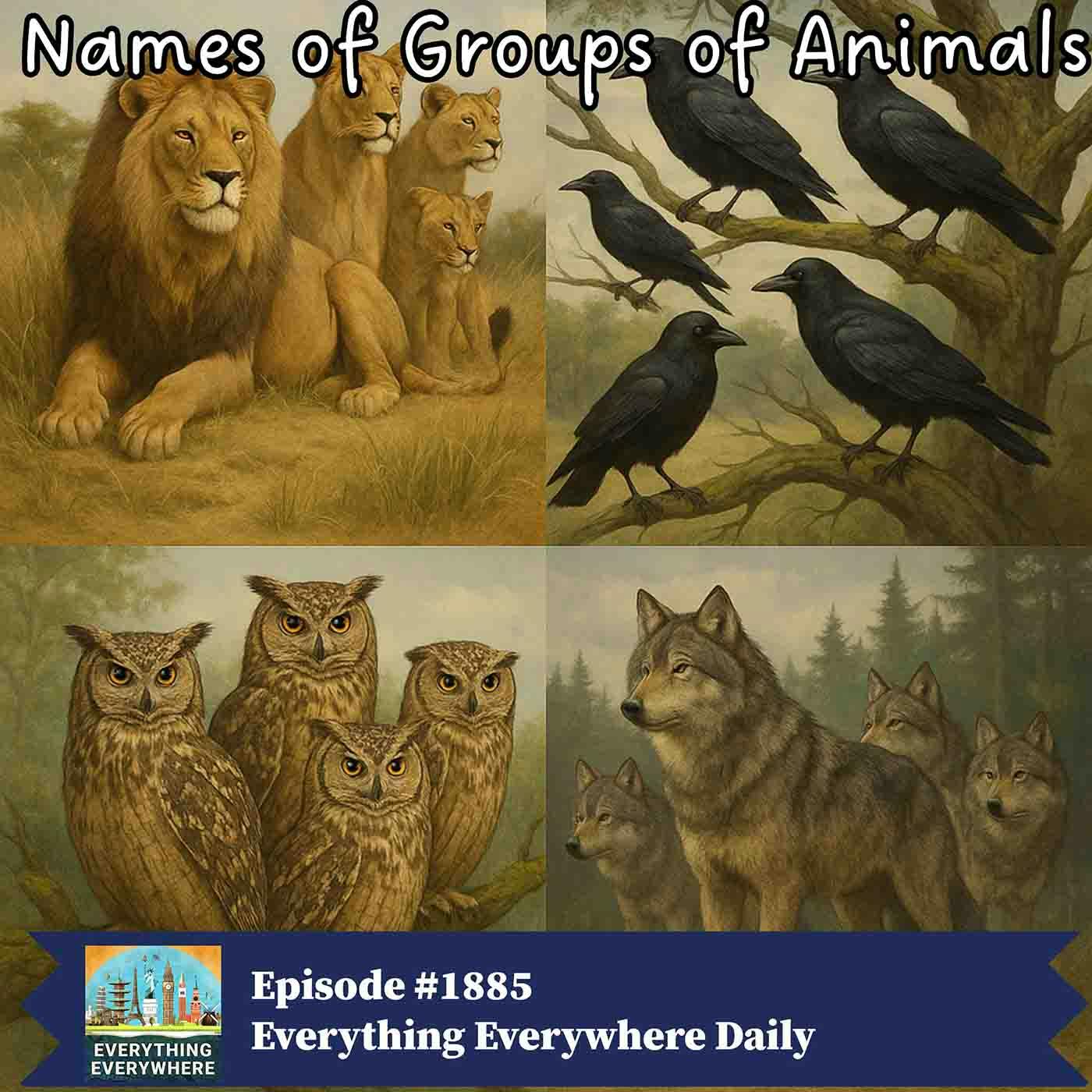
The English language is weird. We have words that are spelled the same but sound different and we have words that are spelled differently but sound the same. We have some words that sound nothing like how they're spelled, and a host of exceptions that you just kind of have to know and remember. And then for some reason we have totally different arbitrary words for different groups of animals. In fact, we have a lot of those words. Learn more about the words we have for groups of animals and why they exist on this episode of Everything Everywhere Daily this episode is sponsored by Quints. I've been telling you about quints for quite a while now, but perhaps it still hasn't sunk in for some of you just how affordable quints can be. I went to their website and checked out several prices. A woman's Mongolian cashmere tee, which costs up to $175 from other retailers is available for just $44.90 on Quince. A men's comfort stretch trench coat that goes as high as $498 on other sites costs only $99.90 on Quince. A European linen chambray fitted sheet set that will run you $270 at competitors can be purchased for only $85.90 on Quinn's. These are serious discounts on high end luxury items and they can do this by working directly with top artisans and cutting out the middlemen. Quince gives you luxury prices without the markup, passing the savings on to you. Keep it classic and cool this fall with long lasting staples from quince. Go to quince.com daily for free shipping on your order and 365 day returns. That's Q U I-N-E.com daily free shipping and 365 day returns. Quince.com daily this episode is sponsored by Fiji Water. You've probably heard of Fiji Water and have seen it in stores. Well, Fiji Water really is from the islands of Fiji. Drop by drop, Fiji Water is filtered through volcanic rock 1600 miles away from the nearest continent in all its pollution protected and preserved naturally from external elements. In this process, it collects a unique profile of electrolytes and minerals, resulting in more than double the electrolytes as the other top two premium bottled water brands, giving Fiji Water its smooth taste. Fiji Water's electrolytes are 100% natural and this water even has a perfectly balanced ph of 7.7. I've recently been trying to reduce my consumption of diet soda and I found Fiji Water to be a great alternative. Visit your local retailer to pick up some Fiji Water today for your next backyard party, beach day hike, or even your home. Fiji Water is earth's finest water. I'm sure that most of you have realized that the English language has a lot of different words for groups of animals. In fact, each animal seems to have its own word for a group of them. Some of those you might be familiar with, but there's a good chance you probably haven't heard even a fraction of the collective nouns that are associated with different species of animals. The ones you're probably familiar with include a pride of lions, a pack of wolves, a gaggle of geese, a pod of whales, a murder of crows, and a brood of chickens. And of course, the name that was very popular in the 1980s, a flock of seagulls. However, this is barely scratching the surface of the words that exist. Birds have an enormous number of words when you'd think that just the word flock would suffice for everything. Here is just a partial list of the collective nouns that are available for birds. And please stick with me to the end A convocation of eagles, a bellowing of bullfinches, a siege of bitterns, a sedge of cranes, a herd of curlews, a gaggle of geese only if they are on land, a skein of geese if they are in flight, a spring of teals, a paddling of ducks if they are on the water, and a bunch of ducks if they are in flight, a plump of wild fowl, a bevy of quail, an exaltation of larks, a watch of nightingales, a neigh of pheasants, a covey of partridge, a dole of doves, a pitying of turtledoves, a mermation of starlings, an ostentation of peacocks, a parliament of owls, a deceit of lapwings, a fall of woodcocks, a host of sparrows, a charm of goldfinches, a congregation of plovers, a flight of swallows, a building of rooks, a conspiracy of ravens, a cast of hawks, and a rafter of turkeys. Now, there are more, but this is a daily podcast and I have time limits. More importantly, I want to get to other types of animals. Mammals have a host of these collective nouns as well, and these A leap of leopards, a sleuth of bears, a sounder of swine, a crash of rhinoceroses, a singular of boars, a trip of hares, a drove of cattle, a mob of kangaroos, a shrewdness of apes, a labor of moles, a skulk of foxes, an embarrassment of pandas, a seat of badgers, a clowder of cats, a kindle of kittens, a destruction of wildcats, a pace of asses, a business of ferrets, a horde of gerbils, a tower of giraffes, a gaze of raccoons, a raft of otters and a barrel of monkeys. So there are tons of words for groups of birds and mammals, but what about other types of animals? Well, there aren't nearly as many for, say, reptiles or amphibians, a knot of toads, a nest of vipers, a pit of snakes, a chorus of frogs, a bale of turtles and a creep of tortoises. Fish also don't have as many collective nouns. In addition to the generic school of fish, there are a hover of trout, a shoal of bass, a shoal of herrings, a run of salmon, a swarm of eels and a draught of fish if they are caught in a net. And lest you think that this episode is going to be nothing more than a long list of words, let me do one last one with insects and arachnids, a bike of bees, a colony of ants, a cloud of grasshoppers, a plague of locusts, a scourge of mosquitoes, a flutter of butterflies, a rabble of gnats, a scourge of flies and a cluster of spiders. The list of words that I just provided is far from exhaustive. And to make things even worse, many of the words used for particular animals are not unique. There are often multiple words that are used to describe a group of the same animal. For example, in addition to a ostentation of peacocks, it is sometimes called a pride of peacocks or a muster of peacocks. And peacocks aren't the only animal horses can be in a herd, but they can also be called a stud, a team, a harris or a string. And there are many, many more examples, and perhaps you've heard of alternate words to describe some of the animals that I've just listed. So why do we do this? Why don't we just use a small number of words to describe animal groups more generally? Certainly herd, school, flock and swarm might cover most of the cases that we can think of. Other languages don't have this many words to describe groups of animals. Well, it turns out that there is a reason for the madness. It isn't necessarily a good reason, but it's a reason. It also explains why there are more words for groups of birds and mammals than there are for reptiles and fish. And it goes back to 15th century England. During this period, English aristocratic culture was heavily influenced by by hunting. This is why there are more words for mammals and birds than there are for reptiles and insects. It all had to do with hunting. Hunting was usually forbidden to lower class people. They were allowed to hunt small game like rabbits and hares. But it was legal for them to hunt larger, more desirable games such as deer. These animals were considered the property of the king and killing them would make you guilty of poaching. Hunting became a highly ritualized social activity amongst the nobility and educated classes. Going on a hunt would be an event that often involved dozens of people who came along in a support role. One of the things that elites do in every society is adopt language that separates them from the common rabble. Consider how in My Fair Lady Eliza Doolittle initially struggled to fit into upper class society due to her speech. The use of elite language and hunting as an aristocratic activity were jointly responsible for the development of so many words to to describe groups of animals. These collective terms served as a kind of verbal badge of sophistication. Knowing that a group of lions was called a pride or that crows gathered in a murder demonstrated your education and social standing. There was also a practical element. Different human activities such as farming, hunting and science created different needs for precision in animal terminology. Farmers needed to distinguish between different grouping behaviors of livestock. For practical management reasons, hunters required terminology that reflected the strategic challenges of pursuing different species. Our knowledge of most of these words has been passed down to us from a single 15th century. The book of St. Albans. Published in 1486. The book was actually one of the earliest books ever published on a printing press in England. The Book of St. Albans was a compendium on the pursuits expected of gentlemen, such as hawking, hunter, hunting and heraldry. It was produced at the St. Albans Press by the anonymous author called Schoolmaster Printer. It traditionally has been attributed to Dame Juliana Berners, a prioress linked with the Sopwell Nunnery. But it was most probably a compilation from earlier French and English works. It was written to instruct the aristocracy in the proper knowledge of noble pastimes, both as a practical manual and as a display of refinement. The hunting section included the long list of collective nouns for animals and people, partially serious and partially witty social wordplay. The original term used for the words was terms of venery, venery being an archaic word that referred to hunting. The book quickly became popular and was reprinted in 1496 with an added section on angling. Its fame endured because of the striking heraldic illustrations and and the entertaining lists of terms of venery, many of which entered the English language as curiosities. So most of the crazy words that we have for groups of animals can actually be traced back to this single book, published in 1486. But wait, there's more. Most of these words fell into disuse just a few decades after the book was published. For centuries, there was little to no mention of most of the collective animal nouns in literature. Then, in the 19th century, for reasons we're not totally sure, there was a resurgence in these collective animal nouns. Some of them, like a pride of lions or a murder of crows, stuck and remained part of the popular English vocabulary. The vast majority of them, however, remained obscure. There's something else I haven't mentioned, and maybe some of you have thought of it. It wasn't until after the 19th century resurgence that many words were developed for animals that people in medieval England were would never have been aware of. They had no clue what kangaroos, pandas, or raccoons were. All of the collective nouns for animals that are found in the New World were developed independently from the 19th century onward. And there's one type of animal I haven't yet mentioned, that the Book of St. Albans also has words. Humans. The book provides collective nouns for various types of people who were important to medieval society. These a state of princes, a draft of butlers, a drunkenness of cobblers, an eloquence of lawyers, a superfluity of nuns, a poverty of pipers, an untruth of summoners. These are the people who summon people to church courts, A disguising of tailors, an observance of friars, a sentence of judges, a lying of pardoners, a doctrine of doctors, an abominable sight of monks, a blast of hunters and a diligence of messengers. And at this point, I started thinking, if the medieval world had words to describe its society, perhaps we need similar terms to describe the 21st century. And if a single book, likely written by a single author, can create so many of these words that we use today, why can't someone just do that right now? And why can't that someone be me? So, ladies and gentlemen, I humbly present to you some of the new collective nouns for people in the 21st century. A lag of network administrators, a download of podcasters, a couch of gamers, an annoyance of influencers, a binge of Netflix viewers, an eye roll of smartphone users, a cringe of reality stars, a hustle of entrepreneurs, a lemon of car salespeople, a bug of programmers, a facepalm of flat earthers, an empty suit of politicians, a thread of commenters and a complaint of online reviewers. And finally, of course, a curiosity of Everything Everywhere Daily listeners feel free to use any of them and to spread them far and wide. The Executive producer of Everything Everywhere Daily is Charles Daniel. The associate producers are Austin Otkin and Cameron Kiefer. Today's one star review comes from former listener Stardust Babe on Apple podcasts in the United States. They AI is Destructive I am very disappointed to see the picture for this episode was generated by artificial unintelligence, which makes me worried that whoever writes it is also using slop to research and write. Honestly, if you, the person who makes this podcast and you the listeners are into learning and discovery, you should already know how extremely destructive and unethical a so called AI is. It is destroying the earth, it is exploiting humans, and it is destroying the process of human knowledge and learning because of the use of AI. I am now sadly unfollowing this podcast and will not recommend it to anyone. Well, Stardust Babe, assuming you're still listening, this is an audio podcast. The core of what I do is the creation of an audio program that people will listen to that will hopefully inform and entertain. The COVID art that I put on every episode is nothing more than a garnish. It's the podcasting equivalent of parsley. It is not the focus of what I do. I want to spend as little time, money and effort on creating show artwork, yet still have it be somewhat relevant to the topic at hand. Many times I'll use stock photography from Adobe as I have an account there, and if possible I'll sometimes use my own photography. AI images allow me to quickly, cheaply and legally obtain images for the episode, allowing me to focus on producing and recording the podcast. And I've talked about this several times on both the Facebook group and the Discord server. If you think that using an AI generated image on a podcast is going to lead to the destruction of the earth, you are free to do so. Personally, I use it as a tool to allow me to work more efficiently. As always, if you leave a review on any major podcast app, Facebook or Discord, you too can have it right on the show.