← Everything Everywhere Daily: History, Science, Geography & More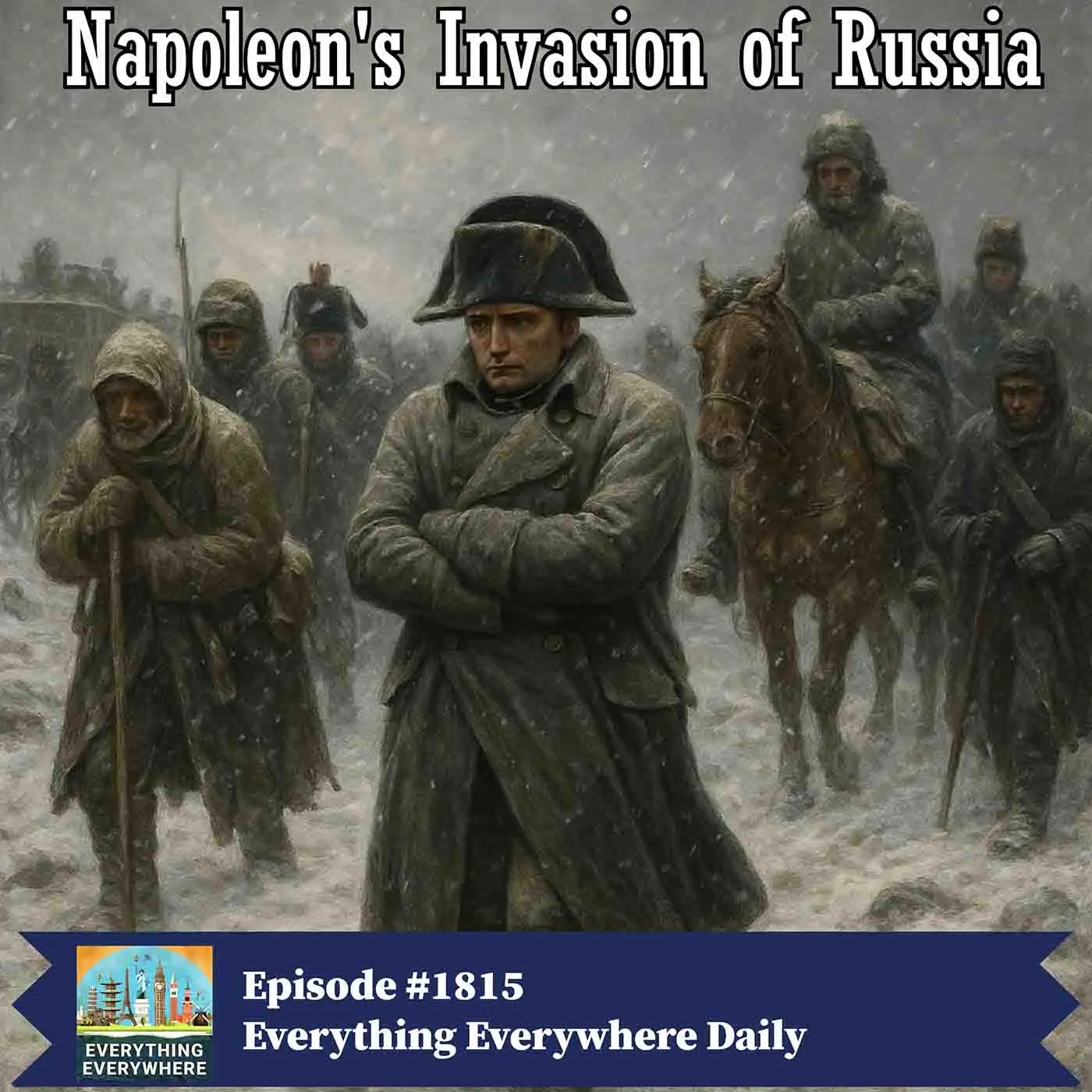
Everything Everywhere Daily: History, Science, Geography & More
Napoleon's Invasion of Russia
00:15:48
Loading summary
Transcript3 lines
- [00:00]
Gary
There are many lessons that we're supposed to know in life. Pick up after yourself. Never bet against a Sicilian when death is on the line. And perhaps most importantly, don't invade Russia in the winter. Known as one of the greatest military disasters in history, Napoleon's invasion of Russia is often cited as a key factor in the emperor's ultimate downfall. Although the campaign actually started in June, the brutal impact of General Winter led to the devastation of the French army and and ultimately contributed to the downfall of one of the greatest generals in history. Learn more about Napoleon's invasion of Russia and the devastation of the French army on this episode of Everything Everywhere Daily. This episode is sponsored by Quinn's. It's summertime, and that means it's time to bring out the summer clothes. If you're looking to update your wardrobe this summer, I suggest you check out Quint's. Quint's has all the things you actually want to wear this summer, like organic cotton silk polos, European linen beach shorts, and comfortable pants that work for everything from hanging out in the backyard to nice dinners. And the best part, everything with Quint's is half the cost of similar brands. By working directly with top artisans and cutting out the middleman, Quint's gives you luxury pieces without the markups. I recently needed a new duvet and I went to Quince and picked up a great one that looked much better than what I had before. And all at a fraction of the price I'd pay elsewhere. Stick to the staples that last with elevated essentials from quince. Go to quince.com daily for free shipping on your order and 365 day returns. That's Q-U I-C-E.com daily to get free shipping and 365 day returns. Quints.com daily.
- [01:57]
Quinton
Location the lab Quinton only has 24 hours to sell his car. Is that even possible? He goes to Carvana.com what is this, a movie trailer? He ignores the doubters, enters his license plate. Wow, that's a great offer. The car is sold, but will Carvana pick it up in time? They'll literally pick it up tomorrow morning. Done with the dramatics? Car selling in record time. Save your time. Go to Carvana.com and sell your car today. Pickup fees may apply.
- [02:29]
Gary
Napoleon Bonaparte came to power at the end of the French Revolution, becoming First Consul, a position he created in 1799 and later crowned himself Emperor of the French in 1804. Historically known as one of, if not the, greatest military generals of all time, Napoleon led the French army to decisive victories over multiple European powers during the Napoleon wars. Additionally, he radically reshaped the political landscape of France through the implementation of what became known as the Napoleonic Code. But for all his accomplishments, the beginning of the end for him was his decision to invade Russia. A few things to put the invasion of Russia into context. The French had been in a constant state of war against other European powers since the Revolution, with six different European coalitions being formed to defeat the French. Up to this point in Napoleon's reign, the first five coalition wars will be skipped over for the sake of brevity, but the ultimate result of each war was a French victory, with Napoleon gaining more and more influence and control over mainland Europe. However, there was one pesky enemy that was able to avoid direct military defeat by Napoleon in the French Great Britain. You might have heard the phrase Britannia rules the waves. And for Napoleon, this was especially true with the Emperor being unable to reach the island due to the superiority of the British Navy. The result of this was Napoleon's imposition of an embargo on the United Kingdom, known as the Continental System, which prohibited all trade between mainland Europe and Britain. The goal of the Continental System was to cripple the British economy and force the British to sue for peace. However, this system was difficult to enforce. The first notable example of enforcing the Continental System was in Spain. Napoleon invaded Spain in 1808 in a brutal military campaign lasting until Napoleon's fall in 1814. The Peninsular War, known as Napoleon's Vietnam, will be its own future episode, but for now, know that it was a massive drain on French resources and manpower. However, the big hole in the Continental System was Russia. The Russians also refused to follow the Continental System, with Czar Alexander I withdrawing from it in December of 1810 and openly trading with Britain while simultaneously imposing a heavy tax on French products. This was due to the Continental System destroying the Russian economy, tanking the value of the ruble. To retaliate, Napoleon began to prepare for an invasion of Russia. Despite popular perceptions, this campaign was planned over a long period, with preparations beginning as early as January 1811. On June 24, 1812, Napoleon and his army of about 600,000 men marched into Russia. The invasion was not one to conquer territory per se, but rather one for control. Napoleon's goal was to punish Russia and force it to rejoin the Continental system. Napoleon had hoped to defeat Russia in three weeks, but this didn't happen. Napoleon's military tactics typically relied on speed and outmaneuvering the enemy or using massive encircling movements. To demolish the army in one fell swoop. The strategy of the Russians was essentially don't fight Napoleon. The Russians retreated into their vast territory and scorched the earth behind them. Russia adopted a Fabian strategy. If you remember back to the previous episode on the subject, they knew they probably couldn't win, so they fought not to lose. Russia was able to enact this strategy due to the country's massive size and the leadership of General Barclay Datoli. Scorched earth is an effective military strategy because it destroys anything the enemy army could use from your land. In a country like Russia, this strategy is effective due to its vast size, which further forces the enemy supply lines to stretch across a large territory, leaving them vulnerable to sneak attacks and starvation. This was incredibly effective because if Napoleon couldn't live off the land, he couldn't use strategies that were dependent upon speed. And if he couldn't move as quickly, he couldn't encircle your army. And if he couldn't encircle your army, he couldn't land a decisive victory. And if he couldn't land a decisive victory, you weren't defeated. So you can see why this would be effective. The first battle of the invasion was in the city of Valina on June 27, and I say battle, but there was actually very little fighting as the Russians quickly retreated. The conditions after taking the city were immediately brutal, with the first night having a massive electrical storm with large amounts of rain, hail and sleet, resulting in some troops and horses dying. Napoleon did not take this foreshadowing seriously and continued through the Russian countryside, confident in his eventual victory. By late July, the Russians abandoned another city, Vitbisk, leaving the French nothing but its burned out remains. Along the way, peasants would burn their crops as they evacuated, refusing to let the crops fall into French hands. Though we often talk about the brutality of the Russian winter, the summer's not much better. The conditions were brutal. There was no food, oppressive heat and insects and waterborne diseases that were running rampant in the French army. The Russians did eventually fight Napoleon at the Battle of Smolensk In August of 1812, an important historical city. Napoleon had hoped for the Russians to defend it, and they did. Though it was a French victory, it was not the decisive victory that Napoleon was hoping for. Napoleon was unable to destroy the Russians, who managed to retreat from the city using bridges at nightfall and then burning the bridges after they escaped, preventing the French from following them. After the retreat at Smolensk, the Russians replaced their commander, installing General Mikhail Kutuzov as the new commander. Of the Russian army. His strategy was similar to that of General Barclay de Toli, who employed scorched earth and tactical retreats as his primary military tactic. However, General Kutuzov was forced to take a stand at Borodino, located just 120 kilometers, or 75 miles outside of Moscow. The Russians decided to fight here in an attempt to block the French advance to Moscow. The Russians hastily worked to reinforce the city before engaging in battle with the French. The Battle of Borodino was the decisive battle that Napoleon had wanted, but he paid a massive price. The battle was one of the bloodiest of the Napoleonic wars, involving approximately 300,000 men, lasting for 12 hours. The casualty numbers for both sides were massive, with 35,000 French and 45,000 Russians dead or injured. Although it was a significant win, it was not the decisive victory that Napoleon had sought, as the Russian army remained intact and managed to retreat once again, continuing its war of attrition. The most notorious part of Napoleon's invasion was his taking of Moscow. Napoleon entered Moscow on September 14, 1812, and found the city deserted and in flames. Reportedly, Napoleon was horrified by the fire, shocked that the Russians would burn their own city. But the fire was crucial in depriving the French of vital resources inside Moscow. Because the Russians had evacuated all the fire equipment with them, there was no way for the French to put the flames out, resulting in no food or shelter for the French army, which had to resort to pillaging. After reaching Moscow, Napoleon had expected Tsar Alexander to make peace, as Moscow was Russia's largest city and held a large cultural and historical significance. At this point, he also held a massive amount of Russian territory, though it was rendered useless by the scorched earth policy. Napoleon had sent a letter to Tsar Alexander asking for a surrender, but crucially, the Tsar never responded. After waiting for 36 days, Napoleon realized that a response was not coming. Not wanting to get stuck in Moscow in the winter, on October 18th, he ordered a retreat from Russia. But at this point, it was too late. At the time the retreat began, Napoleon and his army had only a portion of his original 600,000 men. The Russian autumn experienced heavy rainfall, turning dirt roads into thick patches of mud, which completely stalled the army and left them vulnerable to guerrilla attacks from the Cossacks. This allowed the main Russian army to begin pursuing the French, resulting in the Battle of Maloyaroslavets on October 24, 1812. Again, although this battle was technically a French victory, crucially, the Russians were able to prevent the French from retreating to the southern provinces, which still held important Resources like food, forcing the Russians to retreat along the same destroyed path that they had taken to invade. The retreat soon became a chaotic endeavor. Morale plummeted across the French army as they were forced to traverse previous battlefields, including the battlefield at Borodino, making the soldiers come face to face with their previous unburied, frozen dead comrades. In early November, the Russian winter finally hit, causing devastation of the French army. The weather dropped to minus 30 degrees Celsius or minus 22 degrees Fahrenheit. To put this into perspective, icicles would form from their breath and many soldiers became blind from the snow, while others simply dropped dead from the cold, freezing to death. These conditions led to the morale of the army quickly dropping, with fights breaking out due to a lack of food and water, and cannibalism even taking place amongst the French. By the time the French again reached Smolensk on November 9, Napoleon had already suffered 40,000 more casualties and had lost almost all of his horses and most of his artillery. This didn't stop the Russians from continuing their pursuit. The Battle of Krasnoy led to another 30,000 French killed, wounded or taken prisoner as they attempted to leave Smolensk. During these skirmishes, the French army was divided and the Russians were able to surround Napoleon at Borisov on the Berezina River. However, the French engineers were able to build bridges rapidly across the river before destroying it again before the Russians could arrive. After this, Napoleon appointed a new head of the army to oversee the rest of the retreat and himself returned to Paris ahead of the army to oversee problems in the city. Overall, of the roughly 600,000 men who invaded Russia, fewer than 100,000 returned to France. Those who did survive were crippled, suffering from frostbite range or were starving. The Russians also faced massive amounts of death between civilians and soldiers. While their numbers are unknown, they likely surpassed 1 million total people, making the invasion one of the deadliest operations in military history up to that point. The invasion of Russia is perceived as setting the stage for Napoleon's last defeat. The invasion was a massive strategic blunder, leaving the French vulnerable to the forces of the Sixth Coalition. Russia did not halt its advance after the invasion, continuing to march into Europe, and was quickly joined by Britain, Prussia, Sweden, Portugal, Spain and Austria. Just two years after his invasion began, Napoleon would fall to the Sixth Coalition. In 1814, Napoleon was forced to abdicate as Emperor of the French and was sent into exile on the Italian island of Elba. He did, of course, eventually escape and succeeded in retaking power in France. I have previously done an episode on the 100 Days War, which covers his return from Elba to his defeat at Waterloo. Overall, Napoleon's invasion of Russia was a military disaster, one of the worst in history. Despite his success in many individual battles during the campaign, the massive amounts of death and the horrific conditions his soldiers faced played a large part in the eventual defeat of one of the greatest military commanders of all time. It also provides proof of the old adage that you can win the battles but still lose the war. The executive producer of Everything Everywhere Daily is Charles Daniel. The associate producers are Austin Okun and Cameron Keefer. Research and writing for this episode was provided by Livia Ashe. A reminder that I'll be hosting the Everything Everywhere Daily 5th Anniversary event on July 19th in Appleton, Wisconsin. If you'd like to attend, information and an RSVP link are available in the show notes and if we get a decent turnout, maybe I'll consider coming to a town near you. Today's review comes from listener Mostly evilpenguin on Apple podcasts in the United States. They write just incredible. I love listening to your show and I know that everyone here appreciates all the effort you pour into it. Every morning I wake up and check Apple podcasts. It's a great learning experience and even with encore episodes, I learn even more. Thanks Gary. Always happy to hear from you. Hurricane by the way, very sad the packers didn't make it to the Super Bowl. Well, thanks Hurricane. I too am sad the packers didn't make it to the super bowl this year. However, I prefer to be realistic about it. There are 32 teams in the NFL on average. That means a team should win a Super bowl about once every 32 years. So far, during my lifetime, the packers are slightly ahead of the game, and if I'd been bored a bit sooner, they'd be well ahead of the game, certainly much better than every other team in the NFC North. Remember, if you leave a review or send me a boostogram, you too can have it read on the show.