← Everything Everywhere Daily: History, Science, Geography & More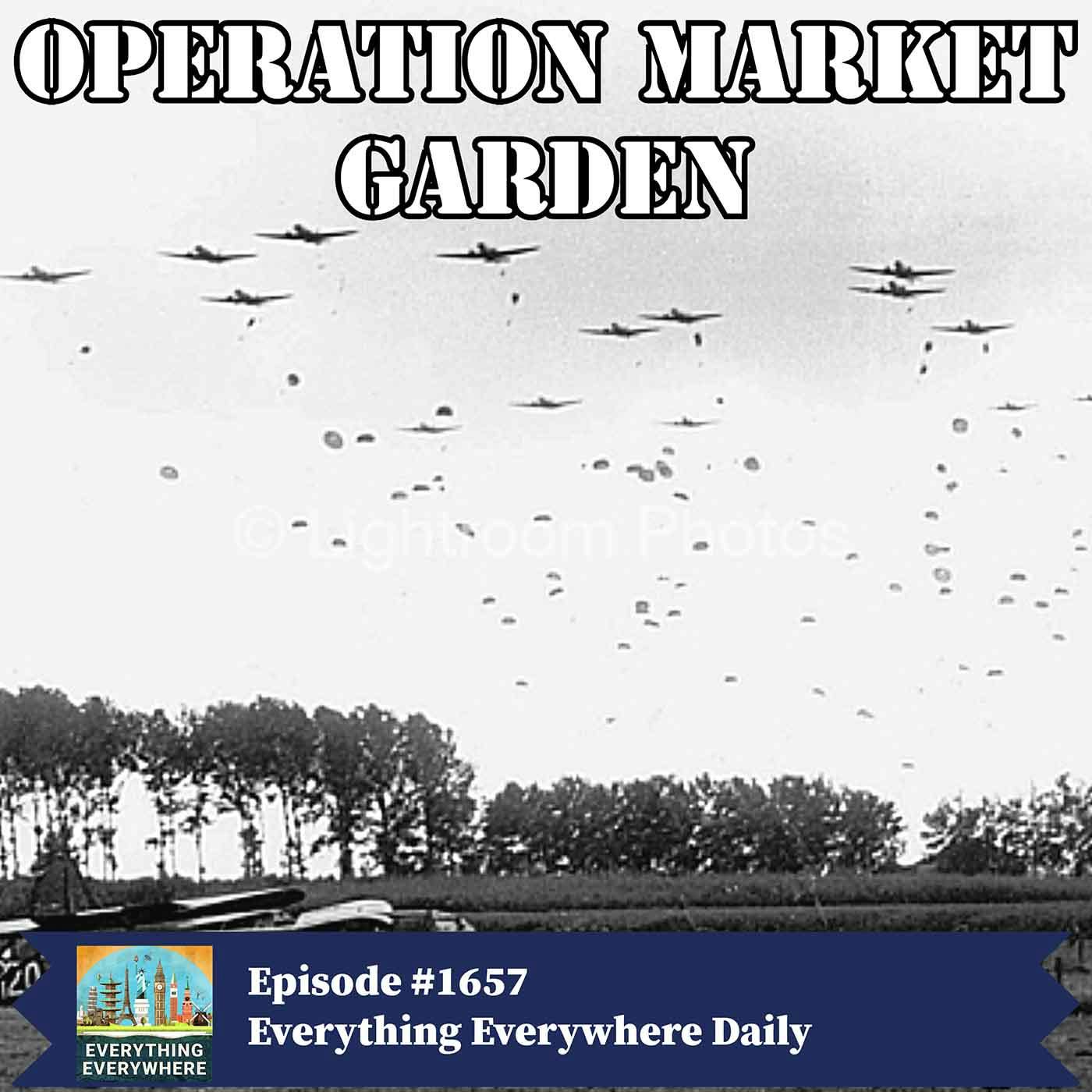
Everything Everywhere Daily: History, Science, Geography & More
Operation Market Garden (Encore)
00:14:39
Learn more about one of the most ambitious operations during WWII
Loading summary
Transcript1 lines
- [00:00]
Gary
Hey everyone, this is Gary. I'm going to be gone the next few days because I have the privilege of inducting my friend Chris Christensen into the Podcasting hall of Fame. Chris is the host of the Amateur Traveler Podcast on which I've appeared as a guest over 20 times. So until I come back, please enjoy these encore episodes. After the Allied landing in Normandy In World War II, the Allies made progress pushing back the Germans. However, By September of 1944, things had slowed down. One Allied commander devised a plan that he thought would end the war in one fell swoop. The plan was bold, audacious, and highly risky, and in the end, it was ultimately a failure. Learn more about Operation Market Garden and the attempt to quickly bring an end to the war on this episode of Everything Everywhere. D this episode is sponsored by Mint Mobile. One of the things I've noticed traveling around the world is how much more expensive American mobile phone plans are. In most countries I've visited, data and phone plans were very affordable. In the US they tend to be really expensive. Mint Mobile has solved that problem by offering some of the most affordable mobile plans that you can find. All Mint Mobile wireless plans are $15 a month when you purchase a three month plan. Mint Mobile's secret is that they sell wireless services online. They don't have retail stores or salespeople. Moving to Mint Mobile is super easy. They use the same cell towers and networks as major carriers and you can use your current phone and phone number. To get this new customer offer and your new three month unlimited wireless plan for just $15 a month, go to mintmobile.comeed that's mintmobile.comeed cut your wireless bill to 15 bucks a month at mintmobile.comeed $45 upfront payment required, equivalent to $15 a month new customers on first three month plan only speed slower above 40 gigabit on unlimited plan. Additional tax fees and restrictions apply. See Mint Mobile for details. This episode is sponsored by Quints. I speak from first hand experience when I tell you that dressing properly is the key to surviving winter. For the ultimate cold weather necessities made from premium materials, you've got to check out Quince. I literally write almost every episode of this podcast when I'm sitting on the couch covered in my Quince fisherman's blanket. It's incredibly warm, it's heavy and it looks great. It is the best blanket that I've ever owned and I love it. By partnering directly with top factories and cutting out the cost of the middleman, Quince passes the savings on to you. Quint only works with factories that use safe, ethical and responsible manufacturing practices. They use premium fabrics and finishes for that luxury feel in every piece. Luxuriate in coziness without the luxury price tag. Go to quints.com daily for 365 day returns plus free shipping on your order. That's Q-U-N-E.com daily to get free shipping and 365 day returns. Quince.com daily operation Market Garden was one of the biggest Allied operations of the Second World War. To understand the impetus behind it, and to understand why it ultimately failed, we have to understand the circumstances that the Allies found themselves in in September of 1944. The initial D Day landing on June 6th was a success. The Allies were able to establish a foothold on the European continent. However, immediately after the landing, their advancement into France was stalled due to the hedgerow landscape around the landing sites. I had always read about hedgerows and never really viscerally understood just how much of an obstacle they were until I actually traveled to Normandy and drove around the hedgerows myself. Not only were the shrubs and stone walls advantageous to defenders, but the narrow roads between hedgerows had become very deep over the centuries. The slow progress immediately after D Day was solved with Operation Cobra. COBRA, launched on July 25, was a breakout of the Allied forces, which allowed them to rapidly advance and capture the city of Caen. Once they broke through the German defenses, the Allies were able to advance rapidly, liberating much of France and eventually Paris on August 19th. By early September, they were already in Belgium. Soon after, however, the advance slowed down again. The front had expanded in size, diluting Allied forces along the front, making logistics difficult. Moreover, as they began to approach the German border, they were going to encounter the Siegfried Line. The Siegfried Line was a series of German defensive fortifications built along their western border from Switzerland to the Netherlands. It was created in the 1930s in response to the French Maginot Line, which was built by the French to stop a German invasion. The Maginot Line was a spectacular failure in that the Germans simply ran around it through Belgium to invade France in 1940. Once France fell, the Siegfried Line was abandoned. However, with the Allies now advancing through France, the Siegfried Line was reactivated. The Allies now faced a problem similar to what the Germans had faced four years earlier. Do you attack the Siegfried Line in what would probably be an extremely long and bloody fight, or do you try to do an end round around the entire line? General Eisenhower, the supreme commander of the Allied forces in Europe preferred a wide front where the Allies advanced at several different points. However, many of his top generals, particularly American General George S. Patton and British Field Marshal Bernard Montgomery, advocated a concentrated assault. Of course, each general wanted to be the one to lead the primary attack. Montgomery wanted to attack north into the Netherlands, and Patton wanted to attack further south, directly from France. Ultimately, Montgomery's proposal won out for several reasons. The first was that the Siegfried Line didn't go all the way to the sea. It stopped along the border with the Netherlands. If the Allies could advance quickly enough, they could just run around it and make an almost uncontested run to Berlin. Second was the fact that many of the German V2 bases that were launching rockets into London were located in the Netherlands. A thrust into the Netherlands could eliminate that threat. Finally, a turning to Germany would allow the Allies to capture the German industrial heartland, eliminating their ability to wage war. Oh, and Montgomery was also extremely stubborn. On September 10, he flew to Brussels directly, which had been liberated just a week earlier, and threw a tantrum in front of Eisenhower. Eisenhower felt that a single thrust and run to Berlin was going to be impossible, but he ultimately conceded to Montgomery's demands. If Montgomery could do it, the war could be over by Christmas of 1944. Monti's plan was called Operation Market Garden. The general plan was to advance up a single road in the Netherlands, connecting several major cities. The road crossed several bridges, particularly in the cities of Eindhoven, Nijmegen and Arnhem. The plan had two parts known as Market and Garden. The Market part would be the largest airborne operation in world history, delivering 34,600 paratroopers. The airborne soldiers would be dropped in ahead of the advancing ground forces to capture the key bridges. The American 101st Airborne Division would land near Eindhoven. The American 82nd Airborne Division would be dropped near Nijmegen. And the British 1st Airborne Division, along with the Polish 1st Independent Parachute Brigade, would be dropped near Arnhem. In total, there were nine bridges that had to be captured. The second part of the operation, nicknamed Garden, was the ground operation. It was to be conducted primarily by the 30th Corps of the British Second Army. Their objective was to meet up with the 101st Airborne on the first day, the 82nd Airborne on the second day, and the British Polish Airborne units no later than the fourth day. Even on paper, this was a risky operation. It wasn't a broad frontal attack that was trying to expel the enemy from a territory. It would just be holding a very narrow band of road in the cities it connected. It would be a salient vulnerable to attack from both sides everywhere along the road. Moreover, the success of the operation required the success of each phase of the operation. If they couldn't take one of the bridges, then all of the airborne troops beyond that bridge would would be stranded. Because the operation would take several days, the Germans could just blow up the bridges once they caught wind of what was happening. However, that didn't happen because Hitler had grandiose plans for a counterattack. Despite being an enormous operation, there was very little time to plan anything. This was unlike the Normandy invasion, which had an extreme amount of detailed planning to ensure its success. The operation began on September 17, 1944, just a week after after Montgomery proposed the idea to Eisenhower. And the first day of the operation actually went rather well. The first wave of airborne units landed close to their landing zones, which was quite an accomplishment given the level of technology at the time. However, not all of the airborne troops landed on the first day. There simply weren't enough planes to deliver everyone all at once. The 101st Airborne took four of the five bridges that they were assigned, and the 30th Corps advanced with little resistance. However, there were some obvious problems that were appearing. The radios used by the British were in many cases completely inoperable. They were either too weak to communicate with other units that were too far away, or they had been set to the wrong frequencies. There were also failures in the Allies intelligence. The Allies assumed that the German defenses had broken and that they were in full retreat. What they didn't know is that just days before, Hitler had moved the 2nd SS Panzer Corps into the Netherlands, under the command of Field Marshal Gerd von Rundstedt, who was brought out of retirement. And on top of all that, the second and third wave of paratroopers were delayed by inclement weather in England. When reports began coming into the Germans on the first day, they immediately figured out what was happening and took action accordingly. After the first day, the problems began to compound. The 30th Corps did manage to meet up with the 101st Airborne in Eindhoven on the second day. However, getting to Nijmegen was proving difficult. They didn't link up with the 82nd Airborne until the fourth day. And then there were still problems. The 82nd wasn't able to take the bridge on the Vaal river because everyone had landed only on one side of the river. So in order to take the bridge, they would have to cross the river. But they didn't have any boats. The Only boats that they were able to get were collapsible canvas boats, which, needless to say, are not bulletproof. They also had a limited number of paddles, so many soldiers had to use the butts of their rifles in order to paddle across. They did manage to take the bridge, but they did so at a great cost. If you remember way back, I did a previous episode on the city of Nijmegen. Every single day, veterans in the city conduct a walk over their new bridge at sunset to honor the men who gave their lives in helping to liberate the city of Nijmegen. The real problem, however, was with the group of British paratroopers who'd landed in Arnhem. Arnhem is only about 12 miles, or 20 kilometers away from Nijmegen. However, it might as well have been a world away. The units that landed near Arnhem ended up being split in two. One was caught near the town of Oosterbeek, and another group was holed up on one end of the Arnhem bridge. The Allies were completely surrounded, and the 30th Corps couldn't get to Arnhem. Despite the problem with the radios, the surrounded forces were eventually able to make contact using the telephone system, and they were quite aware that help was not on the way. By day four of the operation, the British, holding out on one end of the bridge, sent out a radio message that was never received by the Allies, but was intercepted by the Germans. The message was simply out of ammo. God save the King. The British fought valiantly as they waited for rescue. They had to revert to bayonet charges to defend their position, given how low they were on ammunition. On the evening of September 24 and 25 Polish airborne units managed to conduct a rescue of some of the stranded British 1st Airborne units in Arnhem. They managed to rescue 2,398 British paratroopers, having evacuated many of the last paratroopers. The final remaining 300, most of whom were injured, surrendered to the Germans in the morning. In the end, Operation Market Garden was considered to be a failure. The Allies did not make it to Berlin. By Christmas. Somewhere between 15 to 17,000 Allied soldiers were killed, wounded or captured, versus only 6 to 8,000 Germans. The failure to capture the bridge at Arnhem eventually foiled the entire operation, which depended on every part of the operation. Succeeding Eisenhower was right. Despite having approved the operation, it was ultimately a broad front, not a concentrated assault that worked. While the operation was generally considered a failure, it wasn't a total failure. The Allies did capture ground and it did hasten the liberation of the Netherlands at a time when many people were nearing starvation. Operation Market Garden was one of the largest operations of the Second World War and it's been depicted in books, movies and television shows. Probably the best movie on Operation Market garden was the 1977 film A Bridge Too Far. It had a truly star studded cast including Robert Redford, Gene Hackman, Anthony Hopkins, Sean Connery, James Caan, Michael Caine and Lawrence Olivier. In 2001, the HBO miniseries Band of Brothers documented the real exploits of Easy Company, a unit of American paratroopers who fought in Operation Market Garden and other actions in the war. Several years ago I made a trip following the route of the Allies from the beaches of Normandy all the way to Berlin. At the heart of the trip were the many sites associated with Operation Market Garden, including Eindhoven, Nijmegen and the Bridge in Arnhem. In fact, some of the best World War II museums in the world can be found in the Netherlands. Most military historians agree that Operation Market Garden was an ill conceived plan from the beginning. It suffered from a serious lack of planning which resulted in many of the problems that the troops encountered. Of course, in the end, the Allies did win the war, but if Operation Market Garden had been successful, the war would have had a radically different ending which would have changed the post war world and would have made the world a very different place. Today, the executive producer of Everything Everywhere Daily is Charles Daniel. The associate producers are Benji Long and Cameron Keever. I want to give a big shout out to everyone who supports the show over on Patreon, including the show's producers. Your support helps me put out a show every single day and also Patreon is currently the only place where Everything Everywhere Daily merchandise is available to the top tier of supporters. If you'd like to talk to other listeners of the show and members of the Completionist Club, you can join the Everything Everywhere Daily Facebook group or Discord server. Links to Everything are in the show notes.