← Everything Everywhere Daily: History, Science, Geography & More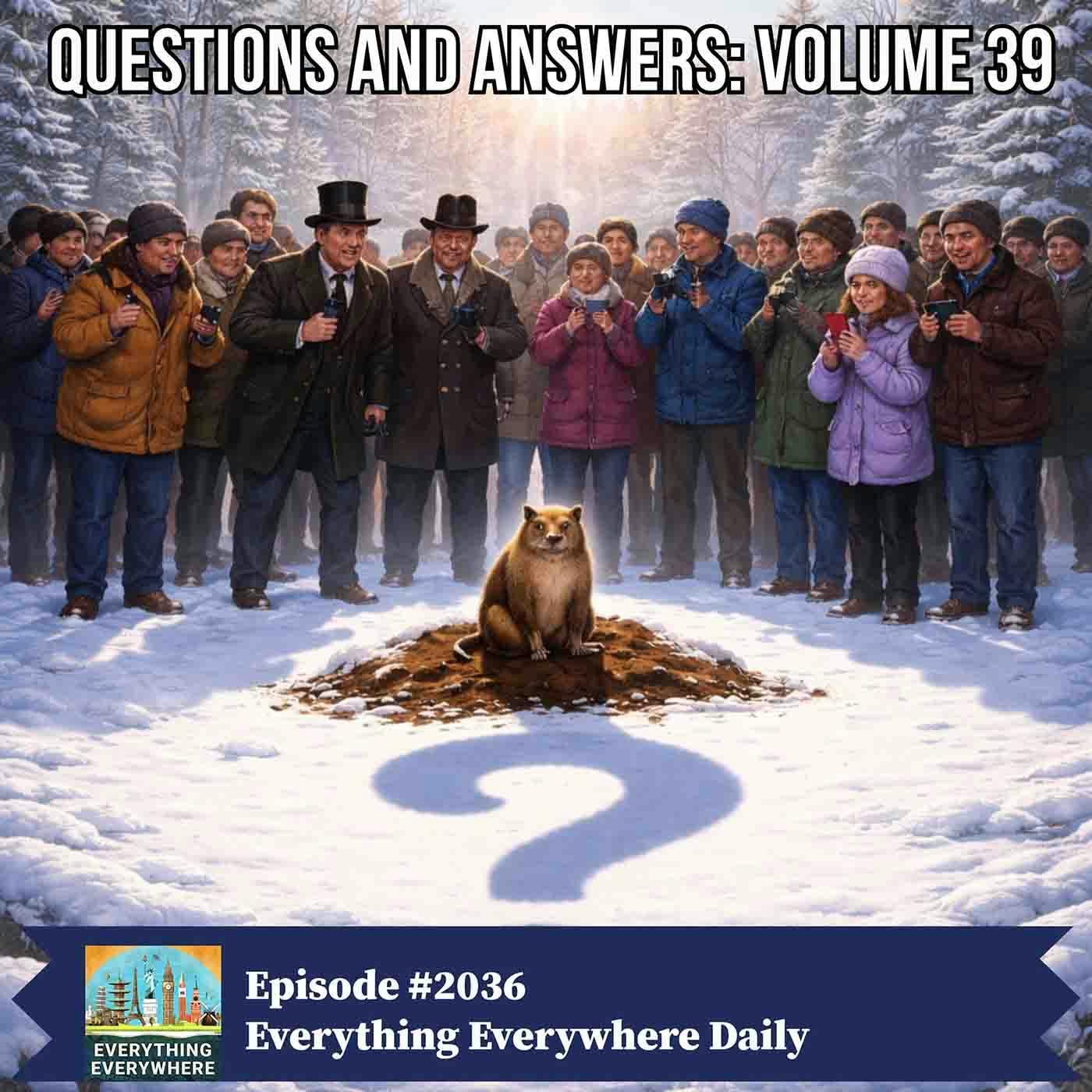
Everything Everywhere Daily: History, Science, Geography & More
Questions and Answers: Volume 39
00:15:07
Loading summary
Transcript1 lines
- [00:01]
A
February is upon us. It's a time when we in the United States predict the weather on the basis of a rodent seeing its shadow. And we celebrate American presidents by buying linen and mattresses. We also celebrate romance and sweetheart by honoring a third century Roman bishop who was beheaded. And if none of that makes sense, fear not. For there is one thing that does make Questions and answers. Stay tuned for questions and answers. Volume 39 on this episode of Everything Everywhere Daily. This episode is sponsored by Mint Mobile. Everybody knows someone who insists on doing things the hard way. There's a friend who keeps paying for a subscription they forgot they had, or the one refusing to update their phone just because it still works. Mint Mobile exists purely to fix that problem. You get the same coverage, same speed, just without the inflated price tag. That's why I recommend Mint Mobile. For a limited time, get 50% off 3, 6 or 12 month plans of unlimited Premium Wireless. Ready to stop paying more than you have to? New customers can make the switch today and for a limited time, get Unlimited Premium wireless for just $15 a month. Switch now@mintmobile.comeed that's mintmobile.comeed upfront payment of $45 for three months, $90 for six months or $180 for 12 month plan required $15 a month equivalent taxes and fees extra initial plan term only. Over 50gb may slow when network is busy. Capable device required. Availability, speed and coverage varies. Additional terms apply. See mintmobile.com this episode is sponsored by Quint's. For months I have been telling you about the high quality products at great prices at Quint's. But I want to share with you a recent experience I had with them. I recently purchased a new laptop bag from Quince. I ordered it online and waited for it to arrive but it never showed up. It turns out the Postal service lost it. Not Quince's fault, but I went to their website to report it. I was able to contact a live customer service agent via chat. They confirmed the issue and had a new bag sent to me immediately. The entire process took about a minute. No hoops to jump through and no waiting. Quint's works directly with top factories and cuts out the middleman. So you're not paying for brand markup, just quality clothing. And they also happen to have amazing customer service. Refresh your wardrobe with quince. Go to quints.com daily for free shipping on your order and 365 day returns. Now available in Canada too. That's Q U I-N-E.com daily free shipping and 365 day returns quints.com daily. Let's jump right into our first question with Deborah Wales from Patreon who asks what cuisine, of all the kinds you've tasted in your travels, is your favorite? Well, Deborah, that's an easy one as I've literally written an article on the subject for my website. My favorite would be Japanese food, followed by Spanish and Argentine. Almost everything in Japan is good, including random foods you find at food stands or even convenience stores. It's almost erroneous to say that Spain has a single cuisine as it has many regional cuisines, but Spaniards take food very seriously. And as for Argentina, I just love Argentina Sado, which is basically their version of barbecue Thomas Nicolaisen from Patreon asks Space travel seems to be on a trajectory towards becoming safer and more affordable. If you could take a 24 hour trip into low Earth orbit for the cost of a first class transatlantic flight, would you go? Well, Thomas, assuming the cost of spaceflight were the same as a transatlantic flight, I'm assuming that the level of safety would be about the same as well. And if that were the case, then yeah, I think I would do it. Why not? I think weightlessness would be a pretty interesting thing to experience and you get to have a pair of astronaut wings when you're done. That being said, I'm not sure we'll ever get to that point in our lifetime. The cost of reaching orbit has dropped dramatically over the last 20 years and it looks as if it will continue to drop for the foreseeable future. However, there will always be an issue with energy. Getting into orbit will always require more energy than a long haul flight. Likewise, entering the Earth's atmosphere from orbit is always going to be difficult, so I don't think we ever actually will get to the point where it will cost the same as a transatlantic flight. Green Nolan from Patreon asks, have you ever been caught in a natural disaster while traveling? The answer is not really. I was in Maui when the tsunami that hit the Fukushima nuclear plant in 2011 crossed the Pacific. There was a lot of concern at the time about the tsunami hitting Hawaii, but in the end nothing major ended up happening. I've never been in a hurricane. I've only experienced minor earthquakes enough to feel the earth move, but not enough to do damage. I've experienced some very bad thunderstorms and have been close to a tornado, but that wasn't while I was traveling. That was just something that happened at home. October sky on Discord asks a similar Question. What is the coolest temperature you have experienced and was it in Antarctica? The coldest temperatures I've ever experienced was not in Antarctica, and it's not even close. A few things to understand about Antarctica. While it is true that the coldest temperatures on Earth that have ever been recorded were in Antarctica, those temperatures were recorded far inland away from the coast and during the summer hemisphere winter. Moreover, those locations in inland Antarctica are at very high elevations. The vast majority of tourists who visit Antarctica visit the Antarctic Peninsula, which lies mostly north of the Antarctic Circle and near the sea. And moreover, they have to go during the summer. So the temperatures in Antarctica really aren't that bad. If you visit, for example, the temperatures around me the last two weeks have been much colder than they have been in the Antarctic Peninsula. As I am recording this episode, the temperature at Port Lockley, the British research base in the Antarctic Peninsula, is 33 degrees Fahrenheit, whereas where I'm recording right now, it is 8 degrees Fahrenheit. When I was in Antarctica, I would often go out on the deck of the ship just wearing a sweater, and the temperatures really weren't that bad, especially if you're used to winters. The coldest temperature I've personally experienced was in Whitehorse, Yukon in the middle of the winter when the temperatures dipped down to about minus 50 Fahrenheit or minus 45 Celsius. In 1996, it also dipped down to around minus 40 Fahrenheit. When I was in the Twin Cities, which I remember because I made the dumb decision to go walk several blocks to a target when it was that cold. When things get that cold, you really shouldn't even go outside as the air can actually damage your lungs. If you were teleported back in time to the year one in Rome and magically had the ability to speak the language and also not be killed immediately. As an outsider, what is something that you could invent for the people of that age from the modern era? After giving this some thought, the simplest thing you could do is bring back the germ theory of disease. This doesn't require building or inventing anything. If you can transmit the idea that germs exist, then you can dramatically improve life expectancies. Get people to wash their hands, to sterilize medical instruments, cook food properly, wash food preparation areas and utensils, and boil water. Disease and infection were one of the biggest health issues in the ancient world, and this knowledge would have made an enormous difference and you wouldn't have to build anything. Geronimo Richson on Facebook asks, will there ever be a point at which you might consider ending this podcast? Or would you have a designated successor take over the podcast? I don't mean to sound morbid, but this question has been burning in the back of my mind for over a month now. Keep up the good work. Well, all things do come to an end eventually. That being said, I have no plans to end the show. I have over 1000 show ideas which will keep me busy for years at a minimum, and I'll probably come up with hundreds or thousands more ideas in the meantime. That being said, there is no succession plan. While the show has done well, I don't think I'm at a point where I need to start worrying about that. Violet414 on Discord asks any predictions on third places that'll start to evaporate, like how movie theaters are getting beaten out by at home streaming? Well Violet, you are definitely right about movie theaters. TV sets are getting bigger, cheaper and better, and it's actually quite shocking how good and cheap they are getting. As I've mentioned before, I have a sizable film collection on disc and physical media has been growing in popularity even though it remains a pursuit still of a minority of people. Movie theaters are not the only type of establishments that have seen decrease. Business alcohol consumption has been decreasing and restaurant spending has also gone down. Yet spending on food delivery has gone up, participation in all sorts of organizations have been decreasing, and malls have been in decline for decades now. So as far as I've seen, there's been an across the board decrease in almost everything and this is due to a combination of economics, demographics and technology. Allzweckaffee on Discord asks, how does it feel now after 2000 episodes where you did all the writing for the episodes yourself now that you have a staff of co authors that take over some topics? Honestly, it has made the podcast much more sustainable. Doing the research, the writing and the recording of a podcast every single day for five years, even taking the occasional day off, wasn't easy. Getting help has allowed me to get a show out the door every day and work on other projects as well. As many of you may have noticed, the number of encore episodes has dropped dramatically over the last few months. Over the last two months I moved into a new place and have been taking things out of storage that I originally put there 19 years ago when I began traveling. So the extra help has made all of that possible. Brian Evans on Facebook asks, how did you come up with the name of the show? I know originally it was going to be a longer format, but were there any other names considered? Also, just asking for your blessing to start a competing podcast called Nothing Nowhere Never. So for the record, I came up with the name well before the movie came out. I also had the name well before I ever launched this podcast. When I decided to travel around the world, having a website for my travels was a natural next step. I thought about what to call the website and eventually settled on Everything Everywhere. And that was back in 2006. It was an incredibly broad and generic name, so when I pivoted to launch the podcast, I was able to keep the same name because it was generic enough to work for both a travel blog and a podcast. So 2026 will actually be the 20th year I have been using the everything-everywhere.com domain name Archibald Canfield on Facebook asks, how do you feel about Wikipedia? Do you make changes if you see something not accurate? Wikipedia is actually not bad for technical subjects. It is horrible for controversial subjects. That being said, it isn't hard to find discrepancies on Wikipedia in most articles. When I found these discrepancies, it is almost never worth editing Wikipedia. Despite the claim not everyone can edit anything, at least not make a permanent edit. There is a relatively small team of editors and regular writers at Wikipedia who basically control what gets published. Long story short, I don't find it worth the time to try to even make changes. Michel Jacques on Facebook asks, what is the piece of art that you have seen that has really stuck with you? My favorite sculpture is the Pieta by Michelangelo, which is in St. Peter's Basilica. In terms of more recent art, I am a big fan of the late sculptor Frederick Hart. He created the sculpture at the Vietnam Veterans memorial in Washington, D.C. the statue, not the wall, and he is also known for his work Ex Nilo at the Washington National Cathedral. He was also a pioneer in working with acrylic sculptures, and his acrylic work is gorgeous and it's actually relatively affordable for fine art. He was considered to be a member of the arrier garde movement, which was the opposite of the avant garde movement. Joshua Felty on Facebook asks hi Gary, We've now been introduced to the two writers who have done research and scripts for you, Olivia Ashe and now Joel Hermanson. Have either of them expressed interest in hosting an episode? If not, would you consider letting them or anyone else fill in for you? Well, they have never expressed any interest in hosting the show and that probably wouldn't happen. The main issue concerns recording and editing. I'm the one that has to edit and upload the final audio file. Given my current workflow, I can record and edit almost simultaneously, which makes it very easy to get an episode out the door. For a daily podcast, the ability to efficiently produce the show is vital. If someone else is recording, it would slow down the process. Editing would take much longer, the recording would sound different, and sending files back and forth would take a lot of time. That being said, I might consider a guest host on a one off basis in the future if the circumstances are right. However, it isn't something that I would do on a regular basis the last question comes from Brian Grant on Facebook, who asks, I've seen some of your photographs that you've done over the years in different countries which are outstanding, but have you ever done astrophotography? As anyone who does astrophotography would define it, I have not done any astrophotography. This has to do with the specialized nature of the equipment. You need a telescope, you need a motor to compensate for the earth's rotation, and a custom digital CCD camera that works with the telescope. I actually have a telescope that I purchased before I started traveling, but the motor doesn't work and I would need to get that fixed. That being said, I have taken many photos of the night sky. It is possible to capture the Milky Way without too much difficulty with a wide angle lens. You just can't leave the shutter open for longer than say 20, 30 seconds before the stars start to streak. I also took a photo of the full moon rising over the Rocky mountains with a 600 millimeter lens. I had an app that told me exactly when and where on the horizon the moon would appear, so I was ready at the right place and time. And I've also done photos of the northern lights and solar eclipses. While these are images of the sky, I don't consider it astrophotography. You can't take an image of a planet or a galaxy with normal camera equipment. That concludes this month's Q and A episode. If you want to leave a question for next month's show, you'll have to join the Facebook group or Discord or or support the show over on Patreon because those are the places where I will be soliciting questions. The executive producer of Everything Everywhere Daily is Charles Daniel. The associate producers are Austin Otkin and Cameron Kiefer. My big thanks go to everyone who supports the show over on Patreon. Your support helps make this podcast possible and I also want to remind everyone about the community groups on Facebook and Discord that's where everything happens that's outside the podcast, and links to those are available in the show Notes. As always, if you leave a review on any major podcast app or in the above community groups, you too can have it right on the show.