Loading summary
Transcript1 lines
- [00:01]
A
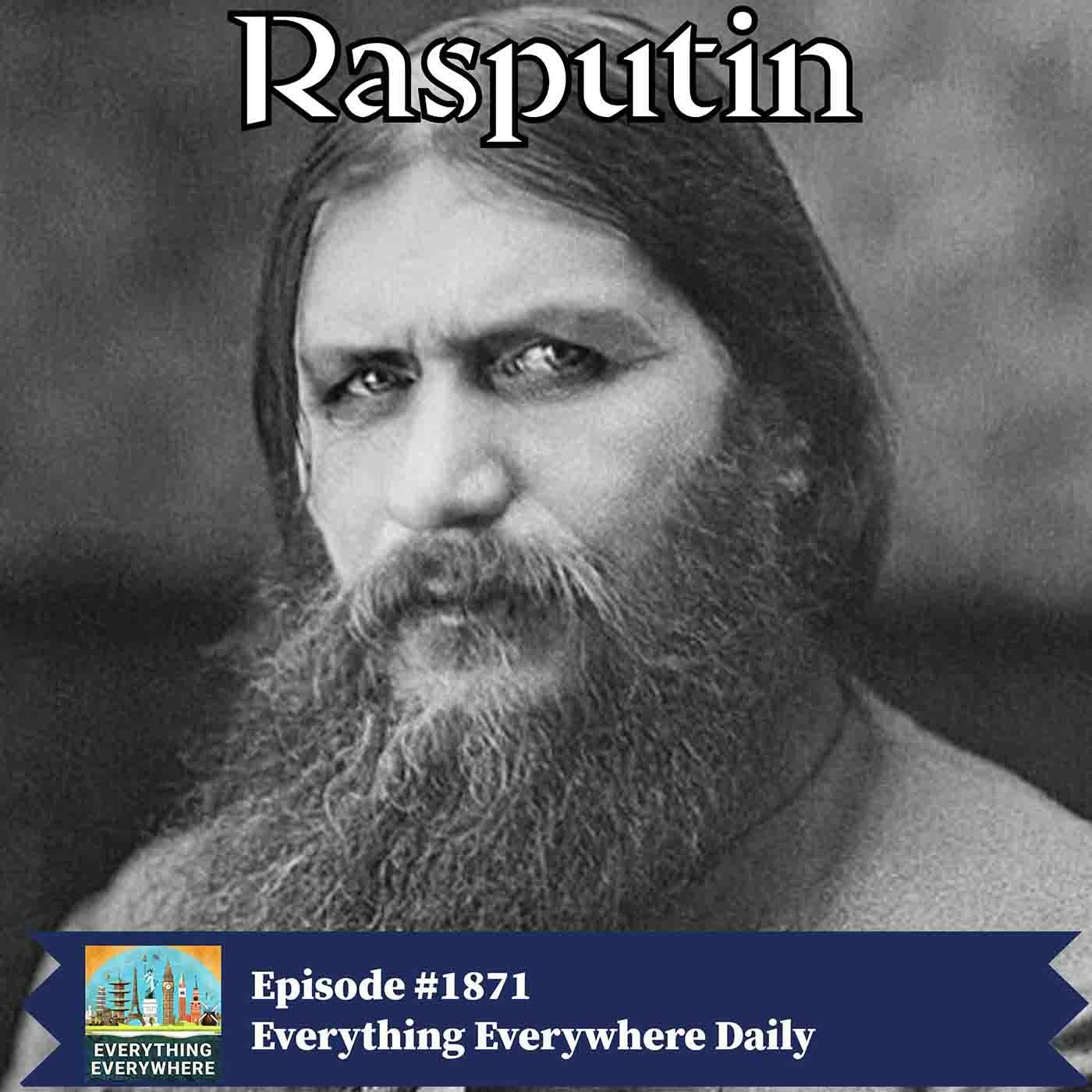
In the early 20th century, the Russian Tsar Nicholas II and his wife Tsarina Alexandra welcomed a homeless monk into their home. As this scruffy, unkempt looking man became closer to the royal family, he seemingly performed miracles, predicted the future and cured illnesses. He started to gain influence over the imperial family, a bit too much influence for some, so a group of nobles decided that he needed to be eliminated. However, that proved to be much easier said than done. Learn more about Rasputin, the magical man who Couldn't die on this episode of Everything Everywhere Daily. This episode is sponsored by Fiji Water. You've probably heard of Fiji Water and have seen it in stores. Well, Fiji Water really is from the islands of Fiji. Drop by drop, Fiji Water is filtered through volcanic rock 1,600 miles away from the nearest continent and all its pollution protected and preserved naturally from external elements. In this process, it collects a unique profile of electrolytes and minerals, resulting in more than double the electrolytes as the other top two premium bottled water brands, giving Fiji Water its smooth taste. Fiji Water's electrolytes are 100% natural and this water even has a perfectly balanced pH of 7.7. I've recently been trying to reduce my consumption of diet soda and I found Fiji Water to be a great alternative. Visit your local retailer to pick up some Fiji Water today for your next backyard party, beach day hike, or even your home office. Fiji Water is Earth's finest water. This episode is sponsored by Newspapers.com Break Down Genealogy brick walls with a subscription to the largest online newspaper archive. Did you know that newspapers.com has over a billion pages of digitized newspapers going back to the year 1690? Their growing collection includes papers from the United States, United Kingdom, Canada, Australia and more. Discover birth and marriage announcements, obituaries and everyday stories about your ancestors in seconds. Newspapers.com can help you fill in the gaps between vital records and reveal details about your ancestors lives that you can't find anywhere else. Their easy to use search feature will let you filter your results by date, location, specific paper and more. When you find something interesting, newspapers.com makes it a snap to share it with your family and friends and you can even save it directly to your ancestry Tree. Come explore one billion pages and make infinite discoveries. Today on Newspapers.com use promo code Everything Everywhere for a 20% discount on your subscription. Rasputin was one of the most infamous figures in all of Russian history. The fact that I can mention his last name and you've probably heard of him over a hundred years after his death is a Testament to his influence, Rasputin was born Grigory Yefimovich Rasputin in the Siberian village of Prokoi in January of 1869. His parents were poor peasants, so Rasputin never received a formal education and was illiterate until adulthood. Records suggest that Rasputin was troublesome in his youth, with local archives indicating that he was disrespectful to authority and was involved in drinking and petty theft. Other than this, very little is known about his early life. We do know that in February 1887, Rasputin married a woman named Praskovya Dubrovina and the couple had seven children together. His wife is often overlooked in the Rasputin story, but she was devoted to her husband both during and after his rise to notoriety. In 1897, Rasputin went on a pilgrimage to the St. Nicholas Monetary in the Russian town of Verkhotury. The visit supposedly transformed him. He spent multiple months at the monastery and when he went back home to his village, Rasputin was a changed man. He was now behaving differently, looking more disheveled. He would no longer eat meat or drink alcohol, and he started to pray and sing with more passion. Rasputin would now often leave his home and family for months or even years at a time, becoming a Stranak, which is Russian for a pilgrim. His travels led him to gain a cult like following. He would often hold secret prayer meetings with other peasants in his home village. These meetings were considered suspicious by their villagers and the village priest. This was because of rumors involving his relationship with the women of the group and potentially scandalous rituals. Rasputin's popularity grew throughout Siberia in the early 1900s and he gained a reputation for helping people solve their spiritual crises. However, this reputation was still tainted by rumors involving sexual conduct with the women in his sect. Nonetheless, despite the rumors surrounding him, local Siberian religious leaders recommended that Rasputin travel to St. Petersburg and join the Alexander Nevsky Monastery. Upon arrival in St. Petersburg, Rasputin quickly made connections with the local aristocracy. His natural charisma during religious discussions led many of the upper class Russians to become his early followers. At the time, many members of the nobility were curious about supernatural practices. Rasputin having connections to the occult and practicing spiritual beliefs was fascinating to these people. Tsar Nicholas II and Rasputin met for the first time in November of 1905. This meeting was clearly important to Nicholas as he took the time to log this interaction in his personal diary. Later, in July and October of 1906, the Tsar and Rasputin met again. During the July meeting, Rasputin met Nicholas wife Alexandra. And in the October meeting he was introduced to the couple's children. The reason the royal couple were interested in Rasputin was because of his reputation as a healer. They believed Rasputin could perform miracles. And as their son, Prince Alexei had hemophilia, they were desperate to find a cure. Hemophilia is a disorder where a person's blood doesn't clot correctly, which was common amongst royal families in Europe at that time. This was a particularly dangerous disease, as if someone received something as simple as a cut or a bruise, there was a potential that they could bleed to death. Tsarina Alexandra grew especially close to Rasputin. This likely first began in 1907 when Rasputin prayed over Alexei while he was suffering from an internal hemorrhage. It's said the next morning the prince had fully recovered. Then, in 1912, Alexei developed a hemorrhage in his thigh. The boy was close to death and Alexandra sent a telegram to Rasputin to pray to save her son. Rasputin assured her that her son would not die and his bleeding stopped. Doctors in St Petersburg were shocked by the boy's recovery, stating that there was no medical reason that the boy should have survived. They considered it a miracle. Historians are unsure of how or why Alexei recovered. There are a few theories, but regardless of what actually happened, it only increased the legend of Rasputin. Because of his supposed healing powers, Rasputin began to gain more status and power within Russia. Tsar Nicholas appointed Rasputin to the position of Lampagnik, or royal lamplighter. The position required him to keep the flames lit before the religious icons in the royal palace. The job doesn't sound that impressive on the surface, but the position gave Rasputin near constant access to the imperial family. His presence in the royal palace allowed him to expand his influence. He began to use his position to promote his personal followers in the Russian court. Additionally, Tsarina Alexandra grew even closer to Rasputin and sought his guidance on spiritual and political matters. This influence over the Tsar and his family was deemed dangerous, as less than qualified individuals would often be placed into positions over qualified candidates. And these decisions led to negative consequences for the royal family. His influence over the royal family, along with his other controversial activities with his followers, led to Rasputin earning enemies. Before I get into his enemies, I should list some of Rasputin's controversies and there were a lot to start. His political enemies accused him of religious heresy or defying the fundamental beliefs of the Russian Orthodox Church. The clergy back in his home village began to call him a heretic and claimed that he spread false doctrines. His most famous controversial exploits revolved around his sexual relationships and his participation in drunken revels. They accused him of rape both of his female followers and of the Tsar's daughters. Rasputin was also accused of having an affair with Czarina Alexandra. There's no evidence to support this, but this was the rumor at court. There's evidence that shows that Rasputin would frequently visit brothels. Rasputin would preach that physical contact with him would purify those who participated. Therefore, he would engage in many extramarital affairs with prostitutes and high society ladies. Another major controversy surrounding Rasputin occurred during World War I. The First World War, along with a few other confounding variables, caused the Russian economy to tank. Much of this blame fell on Tsarita Alexandra, whom Nicholas had left in charge of the country while he was off with the army and by association with Rasputin. Alexandra was a German princess before she married Nicholas and was placed in charge of Russia, who who was fighting Germany. This immediately made her look suspicious, but what made it worse was that a haggard, drunken wizard was now influencing her as well. Rasputin was painted as a puppet master, controlling the ministers in the imperial family. He was accused of working with the Germans, committing treason, and even starting a cholera outbreak. So it should come as no surprise, given all the rumors swirling around him and his proximity to the royal family, that many influential Russians wanted him gone. The first assassination attempt against Rasputin occurred in July of 1914. A peasant woman named Khayonia Gusava stabbed Rasputin in the stomach in his home village. Rasputin recovered from the wound after undergoing surgery. Gusava claimed that she had stabbed Rasputin after reading about him in the papers. She saw him as being the Antichrist and a false prophet. She was found not responsible for the crime due to insanity. But it's believed that an enemy of Rasputin, a priest named Illidor, ordered the hit. However, Ilidore fled the country before he could be questioned. The first failed assassination attempt didn't stop the forces in Russia who wanted Rasputin dead. A group of three nobles, a politician named Vladimir Porykevich, Grand Duke Dmitry Pavlovich, and Prince Felix Yusupov, next came up with an assassination plot. The trio planned on killing Rasputin on December 30, 1916. The murder was set to take place in the basement of the Moika palace, which was the home of Prince Yusupov. The hope was that by killing Rasputin, the Russian monarchy would restore its reputation by bringing the Tsar back to St. Petersburg, where he could govern the country directly. Rasputin was lured to the palace under the guise of meeting Yusupov's wife. Now, according to legend, this is what took place. When he arrived, Rasputin was served cakes. And these cakes were laced with potassium cyanide. And let me emphasize, these cakes were laced with enough of the poison to have killed an entire monastery of monks. So it should easily have killed Rasputin. He ate the cakes and yet he lived. Shocked, the prince then poured wine and mixed potassium cyanide into a glass. This should have made him unconscious almost instantly. Instead, Rasputin sipped the beverage, and then he drank a second glass and then a third. The assassins were shocked. He drank all of the cyanide and was still fine. So what were the assassins to do? Well, the next answer was to just shoot him. The prince used a revolver and shot Rasputin three times. One shot was said to have hit near his heart. Surely shooting him plus the poison would be enough to kill him. Well, no. Rasputin supposedly stood up and attacked Yusupov. It's said that Yusupov ran off and Rasputin still had the energy to chase him down. Eventually, the group entered a courtyard and Rasputin was shot four more times. Finally, he collapsed. The assassins wrapped his body in a piece of linen and threw it into a frozen river. According to the legend surrounding the story, Rasputin was killed not by poison or by gunshots, but rather by drowning. While the story did add to the legend of Rasputin, much of the narrative is probably fabricated when you look at the forensic evidence. Rasputin had a gunshot wound in his forehead. This likely means that he was dead before being dropped in the river, despite the claims that he died by drowning. The photograph also shows that Rasputin was shot at closer range, probably not in a courtyard. And his daughter also claimed that he dislikes sweet food, so he may never have even eaten a cake. That, coupled with no traces of poison being found in his system, leaves forensic experts to believe that the poisoning claims were false as well. It is far more likely that there's a much simpler story. Rasputin was invited to the palace for dinner and was simply shot on arrival. All the other events of that evening have likely been embellished. Though the details of his murder were likely fabricated, the news of his death spread quickly to the public. The Aristocrats who murdered Rasputin did not receive the praise that they expected. While the elites applauded the trio's actions, the the Tsar and the peasants were not pleased at all. Tsar Nicholas banished the trio from court. The peasants mourned Rasputin, with many seeing his murder as an example of the oppression by the nobility by murdering a member of the working class. Additionally, the assassins plans failed to reinstate the power and prestige of the monarchy. In fact, just three months after the murder, the Tsar abdicated in March of 1917. During the communist revolution, the Romanov rule ended and eventually the entire family was wiped out. So in many ways, Rasputin, through the weakening of the royal family, paved the way for the Russian Revolution. While much of what people know about Rasputin is likely myth, his influence on the royal family most certainly was not. By taking advantage of the Tsarina's concern for her son, Rasputin managed to worm his way into a position of influence which ultimately shaped the history of Russia. The executive producer of Everything Everywhere Daily is Charles Daniel. The associate producers are Austin Otkin and Cameron Kiefer. Research and writing for this episode was provided by Olivia Ash. My big thanks go to everyone who supports the show over on Patreon. Your support helps make this podcast possible, and I also want to remind everyone about the community groups on Facebook and Discord. This is where everything happens that's outside of the show. As always, if you leave a review on any major podcast app or in the above community groups, you too can have it read in the show.