Loading summary
Transcript1 lines
- [00:01]
Charles Daniel
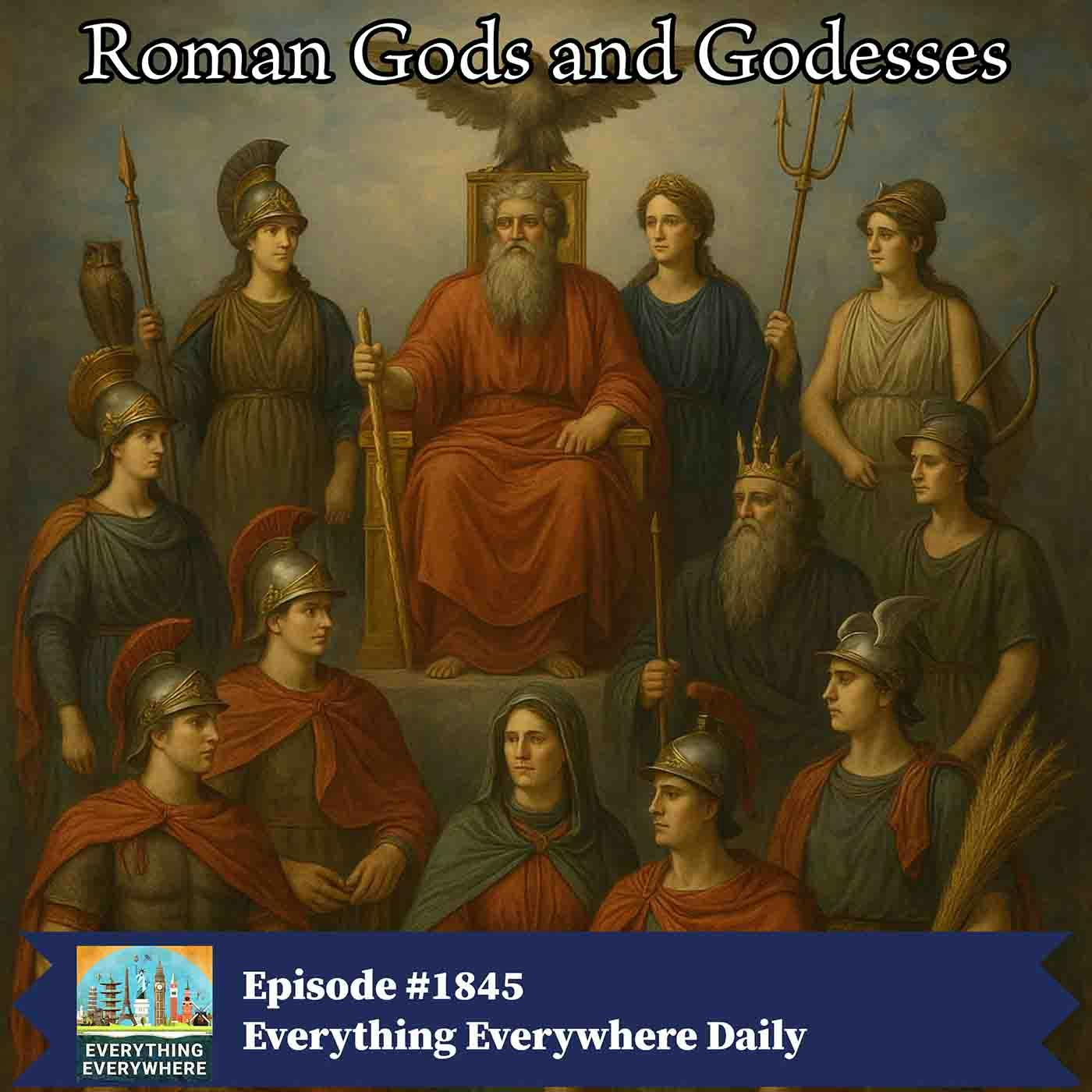
Like many ancient civilizations, the Romans had a vast pantheon of gods. But unlike other civilizations, the Romans were very flexible in where their gods came from. In particular, they adopted many of their gods from the Greek pantheon. It wasn't just a matter of copying them, they would often rename the gods and alter the mythology to align with Roman values. When it came to religion, the Romans weren't stealing so much as they were acting like the Borg. Learn more about the Roman pantheon of gods and how they borrowed their deities from other cultures on this episode of Everything Everywhere Daily. This episode is sponsored by Fiji Water. You've probably heard of Fiji Water and have seen it in stores. Well, Fiji Water really is from the islands of Fiji. Drop by drop, Fiji Water is filtered through volcanic rock 1,600 miles away from the nearest continent and all its pollution protected and preserved naturally from external elements. In this process, it collects a unique profile of electrolytes and minerals, resulting in more than double the electrolytes as the other top two premium bottled water brands, giving Fiji Water its smooth taste. Fiji Water's electrolytes are 100% natural and this water even has a perfectly balanced pH of 7.7. I've recently been trying to reduce my consumption of diet soda and I've found Fiji Water to be a great alternative. Visit your local retailer to pick up some Fiji Water today for your next backyard party, beach day hike, or even your home office. Fiji Water is Earth's finest water. This episode is sponsored by Mint Mobile. There are numerous subscriptions that you pay for every month. If you want to reduce your monthly spending, your only option is usually to cancel and go without. But in case of your phone, you can significantly reduce your costs while still enjoying almost the exact same service by switching to Mint Mobile. With plans Starting at just $15 a month, Mint Mobile gives you premium wireless service on the nation's largest 5G network. With Mint Mobile, you can use your same phone, phone number, contact list, and even connect to the exact same towers and cellular network. The only difference is price and that's why I recommend Mint Mobile this year. Skip breaking a sweat and breaking the bank. Get your summer savings and shop premium Wireless plans@mintmobile.com eed that's mintmobile.comeed.com Upfront payment of $45 required, equivalent to $15 a month Limited time new customer offer for first three months only. Speeds may slow above 35 gigabytes on unlimited plan taxes and fees extra. C Mint Mobile for details In a previous episode, I covered the major gods in the Greek pantheon And I mention this not because this is yet another episode on the religion of an ancient civilization, but rather because the Greek gods are vitally important to understanding the the Roman gods. The Roman adoption of Greek religion is a fascinating example of cultural syncretism. Syncretism, which is a word you probably don't come across that often is the blending of different religious traditions. The Roman adoption of Greek religious elements is probably the best well known example of this, but there are many others. Christianity uses Jewish holy books as one of its two testaments in the Bible. And Islam recognizes Jesus as a major prophet. To understand how and why the Romans borrowed so much of their religion from the Greeks, let's begin with the historical context and then examine how the transformation unfolded. Before the wholesale adoption of Greek deities, early Roman religion was characterized by animism and ritualism. The Romans believed in numerous numia or divine spirits that inhabited objects, places and processes. These included household gods like the Lares and Penates, agricultural deities such as Ceres and Terminus, and gods governing abstract concepts like fides for trust, pax for peace and fortuna for luck. Early Roman religion emphasized rituals, augury, which is observing birds to tell fortunes and ceremonies over myth and storytelling. Much of the early Roman religion was also borrowed from the Etruscans, who who were the major culture on the Italian peninsula before the Romans. Unlike Greek religion, which was highly mythological, early Roman religion was more functional and legalistic in nature. There was a strong emphasis on the pax deorum, or the peace with the gods, which was thought to be essential to Roman prosperity. The Romans encountered Greek culture primarily through Greek colonies in southern Italy, which they called magnia graecia starting around the 8th century B.C. the process of adoption happened gradually over centuries, driven by practical and political considerations. Roman religious practice was deeply intertwined with state power. Therefore, when the Romans encountered successful Greek cities with their elaborate religious systems, they viewed those gods as potential valuable allies. The Romans had a pretty pragmatic approach to religion. If a God seemed powerful and could help Rome succeed, why not honor that deity? The Roman approach to the Greek religion was not dissimilar to how the Borg from Star Trek assimilate other cultures. They would take those elements that were best to better themselves. However, the Romans didn't employ a simple copy paste strategy. They didn't go control c Ctrl V to their gods. Roman deities were equated with Greek counterparts. The Romans changed their names and forms of worship, but borrowed some myths, attributes, iconography and personalities of Greek go. The most straightforward adoption involved direct name changes while preserving the Gods essential characteristics. Zeus, the Greek king of the gods, became Jupiter or Jove. And if you've ever heard someone say by Jove, they are referring to Jupiter. The Roman God Mars provides an interesting example of how this wasn't simply a matter of copying. Greek Ares was a chaotic and often disliked God of war, representing the savage, destructive and irrational aspects of battle. He was portrayed as impulsive, cowardly and often humiliated. Roman Mars, by contrast, became the ideal Roman warrior. Disciplined, brave and honorable. He was not just a God of war, but also a guardian of agriculture and the father of the Roman people. Through his supposed paternity of Romulus and Remus, the mythical founders of Rome. This gave him a foundational role in Roman mythology that Ares never had in Greece. Greek Aphrodite was primarily a goddess of erotic love and beauty, often depicted as capricious and manipulative, influencing both gods and mortals to fall in love. Roman Venus, while also associated with love and beauty, took on a patriotic and maternal role. Through the myth of Aeneas, the Trojan hero and son of Venus, who fled Italy and founded the Roman line, she became the divine mother of the Roman people. This gave Venus a matron like dignity and political symbolism that was absent in Aphrodite's mythology. Julius Caesar utilized this story for political purposes as his family, the Julii, claimed descent from Aeneas, and thus he claimed to be descended from a goddess. Greek Heracles was a deeply flawed hero, known for his strength, but also his uncontrollable rage, excessive appetites and tragic mistakes, including the murder of his wife and children in a fit of madness. In Roman myth, Hercules becomes a symbol of strength, perseverance and virtuous, a Latin word encompassing courage, manliness and excellence. Roman emperors and generals frequently identified with Hercules as a heroic figure who conquered chaos and achieved immortality. His labors were framed less as penance and more as a demonstration of heroic greatness. Greek Cronus was a tyrant who castrated his father Uranus and devoured his own children to prevent being overthrown, only to be defeated by Zeus. Roman Saturn, while retaining some elements of Cronus, was reimagined as a benevolent agricultural deity associated with the mythical golden age of peace and prosperity. The Roman festival Saturnalia celebrated this lost age with feasting, role reversals and gift giving. This gave Saturn a far more positive and nostalgic connotation in Roman mythology. Greek Hestia was a modest domestic goddess of the hearth and rarely mentioned in myth and lacking a large public cult. Roman Vesta, by contrast, was the guardian of Rome's Sacred fire tended by the Vestal Virgins, a group of elite priestesses whose chastity and discipline symbolized the purity. The Romans stayed. The myths of Vesta were minimal, but her cult and rituals became central to Roman civic religion and far more prominent than Hestia's in Greece. There are, of course, many more examples. Poseidon, the God of the sea, became Neptune. Athena, goddess of wisdom, became Minerva. Diana, goddess of the hunt, became Artemis. Hephaestus, the God of fire and metalworking, became Vulcan. Hermes, the messenger of the gods, became Mercury. Dionysus, the God of wine, became Bacchus. And Hades, the God of the underworld, became Pluto. There is one God who should be mentioned because his name never changed. It's the same in both Greece and Apollo. The God Apollo is unique among the major deities in the Roman pantheon in that his name, attributes and mythology were adopted from the Greeks with relatively little changes. However, while the core identity of Apollo remained consistent between Greek and Roman religions, there were significant differences in emphasis, cultural significance and religious practice that distinguished the Roman Apollo from his Greek counterpart In Greek mythology. Apollo was a multifaceted Olympian God associated with prophecy, healing, music, poetry, archery and the sun. He was the epitome of human youthful beauty, reason and balance, serving as a conduit between mortals and the divine, particularly through the Oracle at Delphi. Greek Apollo embodied harmony, intellect and the artistic spirit, often juxtaposed with more chaotic Dionysus to represent order versus chaos in the Roman religion. Apollo retained his Greek attributes but became more politically important, especially under the rule of Augustus. Though not originally part of the early Roman Pantheon, Apollo was adopted as a God of healing and protection during times of plague, and later became a symbol of imperial ideology. Augustus claimed Apollo's patronage following his victory at the Battle of Actium, building a grand temple in his honor and casting him as the guardian of Roman order, morality and destiny. Here I should note that not every Roman God was just a temu version of a Greek God. While most major Roman gods were borrowed from the Greek Pantheon, some gods, like Janus, the God of beginnings, doorways and transitions, and the namesake of the month of January, had no Greek counterpart. Janus was a native Roman God that played a critical role, and likewise, many minor household gods were uniquely Roman and had no counterpart in Greek mythology. The Roman Pantheon was, or at least the interpretation of the Pantheon, wasn't permanent and evolved over time. Augustus fundamentally reshaped Roman religion as a tool of imperial legitimacy. He didn't abandon the traditional Pantheon, but rather reorganized it around imperial themes. The most significant Innovation was the imperial cult, the worship of deceased emperors as gods, and the veneration of living emperors as divinely appointed. Augustus had his adopted father, Julius Caesar, declared a God, which was a major change to the Roman pantheon and was previously unheard of. This was primarily done for political reasons. After his father was declared a God, Augustus was then able to call himself Divi Filius, which means son of a God. The deification of emperors then became a thing and served as sort of a referendum on their reign after their death. A total of approximately 40 Roman emperors and members of the imperial family were officially deified by the Roman Senate after their deaths. The imperial period also saw the continued absorption of foreign deities, but now they were often reframed in imperial terms. Egyptian Isis, Persian Mithras and other mystery gods gained following throughout the empire, but their worship was generally expected to complement the, not replace traditional civic religion. By the 2nd century, traditional Roman religion faced mounting challenges. The empire's vast size meant that local deities and practices increasingly competed with Roman gods. More fundamentally, Roman religion had always been transactional. You honored the gods and they provided prosperity and victory. But as the empire faced increasing difficulties, including plagues, invasions and economic troubles, many Romans began questioning whether the old gods were keeping their end of the bargain. This period witnessed the rise of what scholars today call theological anxiety. People sought more personal, emotionally satisfying religious experiences than traditional Roman religion typically provided. The mystery religions flourished because they offered individual salvation and direct personal relationships with deities. Mithraism became particularly popular among soldiers, while the cults of Isis and Cybele attracted urban populations. One of the biggest attempted changes to the Roman religion was done by the emperor Elagabalus, perhaps the worst emperor in Roman history. Born in Syria as a hereditary priest of the sun God Elagabal, Elagabalus became emperor at the age of 14 and immediately set about importing not just his God, but entire religious practices to Rome. He built a massive temple on the Palatine Hill and physically moved the sacred black stone representing Elagabal from Syria to the to Rome, positioning it as the supreme deity above Jupiter. The young emperor forced the Roman Senate and people to participate in elaborate foreign religious ceremonies, including ritual dancing, music, and what Romans considered unseemly displays of religious ecstasy that violated traditional Roman religious norms. The experiment lasted only four years before Elagabalus was assassinated by his own praetorian guard in the year 222. His successor, Alexander Severus, immediately restored traditional Roman religious practices and had Elagabal's sacred stone returned to Syria, demonstrating how thoroughly the religious revolution had failed to take root in Roman society. However, the Roman religion was starting to show cracks. As the Empire expanded, many local and regional religions chipped away at the Roman religion throughout the Empire, and this eventually paved the way for the rise of Christianity, which replaced the polytheistic religion and fundamentally changed the entire empire. The Roman religious system was odd. While most belief systems have elements which were borrowed from previous ones, nothing quite ever matched the wholesale adoption that the Romans exhibited. They took bits from other traditions and made it something that was uniquely their the Executive producer of Everything Everywhere Daily is Charles Daniel. The associate producers are Austin Oakton and Cameron Kiefer. I want to thank everyone who supports the show over on Patreon. Your support helps make this podcast possible. I'd also like to thank all the members of the Everything Everywhere community who are active on the Facebook group and the Discord server. If you'd like to join in the discussion, there are links to both in the show notes and as always, if you leave a review or send me a boostogram, you too can have it read on the show.