Loading summary
Transcript1 lines
- [00:00]
A
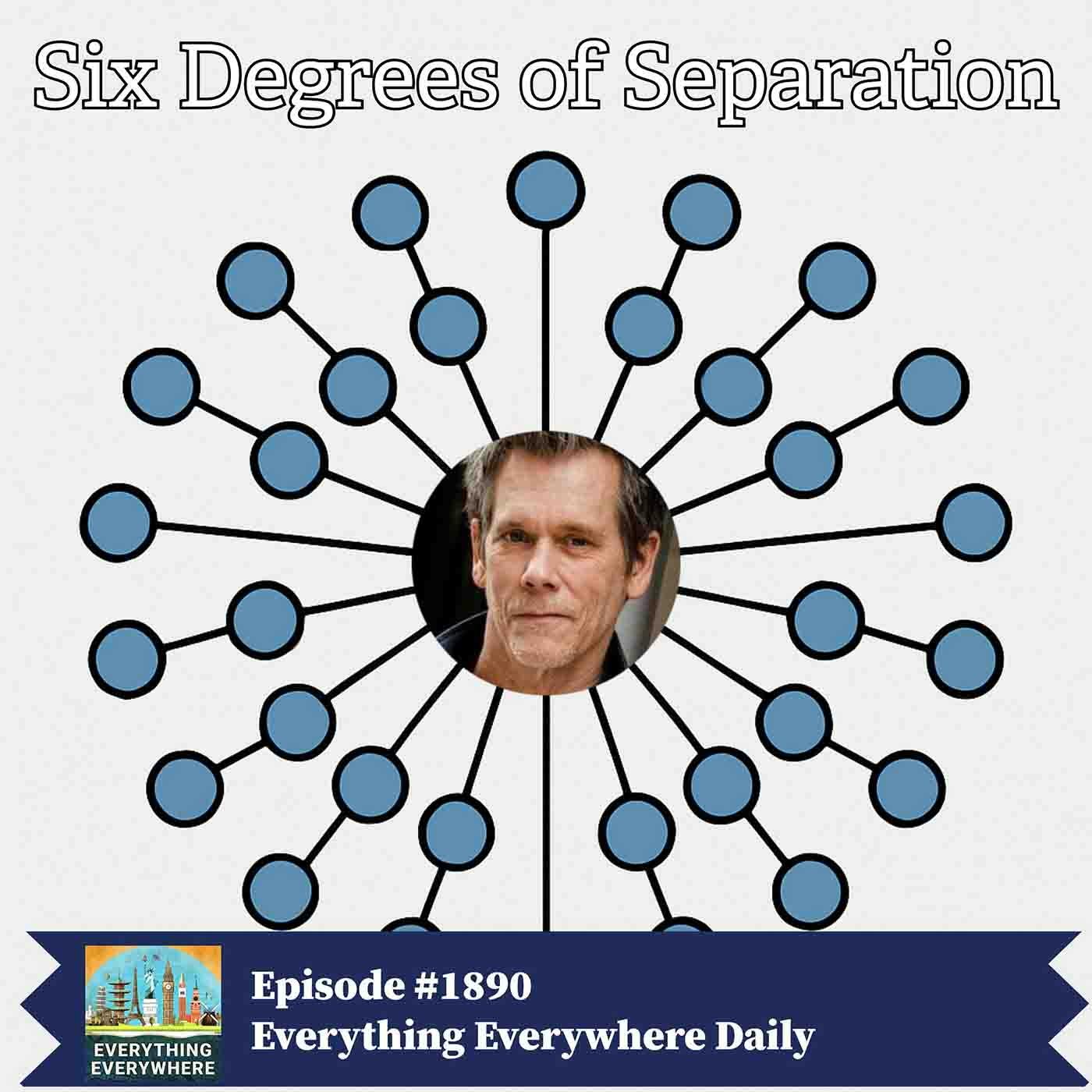
You may have noticed on occasion that friends you have from totally different parts of your life somehow know each other. It often comes as a surprise, but it actually shouldn't. It turns out that the world is highly connected via personal relationships. In fact, it's been suggested that any two people in the world are only six degrees apart from each other via friends of friends of a friend. In some special cases, this can actually be measured and even make for a fun game. Learn more about the six Degrees of Separation Theory and its connection to Kevin Bacon on this episode of Everything Everywhere Daily. This episode is sponsored by Jerry. Car insurance is something that most people have to do, not something they want to do as such, they usually put as little thought as possible into buying car insurance and end up paying a price for it. Well, there's a way to avoid wasting a lot of time shopping and still save a lot of money. Jerry Jerry isn't just another comparison site. It's the only car insurance app that takes care of everything for you from start to finish. And they'll even cancel your old policy for you. Making the switch Simple Stop needlessly overpaying for car insurance. Drivers who save with Jerry save over $1,300 a year on average. So before you renew your policy, do yourself a favor. Download the Jerry app or head to Jerry aidaily. In just a few minutes, you can compare quotes and coverages from up to 50 top insurers. Jerry Car Insurance made Simple, Smart and finally on your side. Based on drivers who switched and saved with Jerry over the past 12 months, over 20% of drivers who switched with Jerry found a monthly premium of $87 or less. Not all drivers find savings. This episode is sponsored by Quince. I've been telling you about Quince for quite a while now, but perhaps it still hasn't sunk in for some of you just how affordable Quince can be. I went to their website and checked out several prices. A woman's Mongolian cashmere tee, which cost up to $175 from other retailers, is available for just $44.90 on Quint's. A men's comfort stretch trench coat that goes as high as $498 on other sites costs only $99.90 on Quince. A European linen chambray fitted sheet set that will run you $270 at competitors can be purchased for only $85.90 on Quint's. These are serious discounts on high end luxury items, and they can do this by working directly with top artisans and cutting out the middlemen. Quince gives you luxury prices without the markup, passing the savings on to you. Keep it classic and cool this fall with long lasting staples from quince. Go to quince.com daily for free shipping on your order and 365 day returns. That's Q-U I-N-E.com daily free shipping and 365 day returns quince.com daily Most of you might be familiar with the Six Degrees of Kevin Bacon Game, also just known as the Kevin Bacon Game. The game is pretty simple. You need to find the shortest path between an actor and Kevin Bacon based on the movies they both appeared in. For example, Sir Laurence Olivier was in the 1979 movie Dracula with Frank Langella, who was in the 2008 movie Frost Nixon with Kevin Bacon. Shirley Temple was in the 1942 movie Miss Annie Rooney with June Lockhart, who was in the 1989 film the Big Picture with Kevin Bacon. I'll be coming back to the Kevin Bacon game in a bit, but this is just a well known version of a similar theory that was developed in the 20th century, the six degrees of separation theory. The six degrees of separation theory is the idea that any two people on Earth are connected by at most six social connections. Or to put it another way, you could reach anyone in the world through a chain of no more than six acquaintances where each link is a friend of a friend. The concept can be traced back to early 20th century thinking about networks and human connections. The Hungarian author Frigora Kerensky first popularized it in a 1929 short story collection called Everything Is Different. In his story titled Chains, he speculated that advances in communication and travel had shrunk the world such that everyone was linked through only a handful of connections. It was one of the few predictions from this period that was remarkably prescient. The theory gained academic attention in the 1960s with the small World Experiment conducted by social psychologist Stanley Milgram. You might remember Stanley Milgram from a previous episode on the Milgram Experiment. The Milgram Experiment, you might remember, was a test to see how far people would go when they thought they were shocking other people to follow instructions. The question that Milgram was trying to answer was if you pick two random people in the United States, how many intermediate acquaintances would it take to connect them? Milgram carried out the experiment in 1967. He recruited about 300 participants from Nebraska and Kansas and asked them to help forward a folder to a designated target person, a Boston stockbroker named Howard Milgram, who was no relation to stanley. The rules were 1 participants could not mail the folder directly to the target, 2 they had to send it only to someone they personally knew on a first name basis and three each recipient in turn would follow the same rule, forwarding it closer to the target. Each folder contained instructions, a roster sheet to track its path, and a postcard for recipients to return to Milgram so he could track progress even if the chain broke. The results were striking, although messy. Out of the roughly 300 starting chains, only about 64 successfully reached their target. For those who did arrive, the average length of the chain was about five to six intermediaries. This is where the phrase six degrees of separation originates, although Milgram himself never used that wording. He instead concluded that people live in a small world, meaning that social networks are much more tightly interconnected than intuition would suggest. The experiment, while groundbreaking, has been criticized. The study had a high attrition rate. Most chains never reached the target, raising questions about the robustness of the results. It also had a strong sample bias. Participants were mainly middle class Americans from limited geographic areas, which might not generalize to broader or more diverse populations. On the flip side, people may not have been strongly motivated to keep forwarding the letters, and thus the experiment may have underestimated social connectivity. Despite these issues, the concept held enormous intuitive appeal and sparked decades of research in sociology, mathematics and network science. One problem is that there wasn't a theoretical framework to explain the small world connections amongst people. The work by Australian researcher Duncan Watts and American Stephen Stogratz in the late 90s transformed Milgram's intuitive small world finding into a precise mathematical framework, opening up an entirely new field in Network Science. Their 1998 paper Collective Dynamics of Small World Networks, published in Nature, is one of the most influential studies in modern complexity science. Watts and Strogatz proposed a simple and elegant start with a regular lattice which each node connected to its immediate neighbor and two randomly rewire a small fraction of the edges, creating shortcuts across the network. The result was a small world network with two key high clustering, just like a regular lattice, and short average path length, similar to a random graph. This meant that you could preserve the local cliquishness of real social groups while still allowing long distance lengths that dramatically shorten the distance between any two nodes. One of the things that radically transformed this field of research was social media. Social media sites such as Facebook, Twitter and LinkedIn made it possible to measure the distances between people without having to resort to experiments. Studies have repeatedly shown that the average distance between Any two users is indeed surprisingly short, often just three or four steps, making Milgram's intuition prescient. In fact, if you look someone up on LinkedIn, it will show you the number of links that you are from them, including what people connect you. While this had been a field of academic study, what brought this into the popular consciousness was the Six Degrees of Kevin Bacon game. In 1994, three college students from Albright College in Pennsylvaniacraig, Fass, Brian Turtle and Mike Galiney were watching television when they noticed that Kevin Bacon seemed to appear in or be connected to a large number of movies. They joked that Kevin Bacon is the center of the universe and began challenging each other to link any actor to Kevin Bacon through co stars. They formalized it into a parlor game where participants tried to connect an actor to Kevin Bacon in six steps or fewer, each step being a film in which two actors appear together. The game was mentioned on the Jon Stewart show in 1994 and it rapidly spread as a pop culture phenomenon, and this was his short lived late night show on mtv, not his Comedy Central show. Kevin Bacon himself initially didn't like it, but eventually embraced the idea, even collaborating with the creators on a book and appearing on shows where the game was played. In later years he founded the charitable website SixDegrees.org, which uses the concept of interconnectedness to promote social good. The Kevin Bacon Game is a direct parody and application of the six Degrees of Separation theory. Just as Milgram's social experiment demonstrated that people are surprisingly close in a social network, the Bacon Game shows that actors in Hollywood form a tight knit network where at most only are a few degrees apart from each other. Because Kevin Bacon had a prolific and diverse career working across genres with many co stars, he became an ideal hub for the experiment. In the Kevin Bacon Game, everyone who can be linked to him is given a Bacon number. Kevin Bacon himself has the Bacon Number of 0, as he is the font through which all connections flow. If you appear in a movie with Kevin Bacon, then you have a Bacon number of one. For example, in the recent remake of the Toxic Avenger, Kevin Bacon is the villain and the Toxic Avenger is played by Peter Dinklage, giving Peter Dinklage a bacon Number of 1. If you didn't star in a film with Kevin Bacon, but you starred in a film with one of his co stars, then you have a Bacon number of two and so on, it's surprisingly difficult to find a regular working actor with a Bacon number greater than three. Now you might be Wondering who has the highest bacon number. This was actually difficult to research, but the best I could find was that it was General William Rufus Schaffner, an American general during the Spanish American War and recipient of the Medal of Honor. He has a bacon Number of 10. William Rufus Schaffner appeared in the Surrender of General Torrell in 1898 with Confederate General Joseph Wheeler. Joseph Wheeler appeared in General Wheeler and Secretary of War Alger at camp Wyckoff in 1898 with Union Army General Russell Alexander Alger. Russell Alexander Alger appeared in President McKinley's Inspection of Camp Witkoff in 1898 with President William McKinley. William McKinley was in President McKinley and escort going to the Capitol in 1901 with Nelson Miles, who was also a Union general. Nelson Miles was in the Indian wars in 1914 with Buffalo Bill Cody. Buffalo Bill Cody was in Buffalo Bill's Wild west and Pawnee Bill's far East in 1910 with showman Major Gordon W. Pawnee Bill Lilly. Pawnee Bill Lilly was in the Days of the thundering herd in 1914 with actor Wheeler Oakman. Wheeler Oakman appeared in Flash Gordon's Trip to Mars in 1938 with Gerry Gardner. Gerry Gardner was in Natural born killers in 1994 with Pruitt Taylor Vince and Prue Taylor. Vince appeared in 24 Hours in 2002 with Kevin Bacon. Many of those early films weren't films as we would consider them today, but they were shot on film and they were released to the public. And this got me wondering if I had a Kevin Bacon number. It turns out that I do. I have a Kevin Bacon Number of 5. In 2007, I appeared in a documentary as myself with my friend Hailey Chamberlain. The documentary was titled 50 States in 50 Days. In 2015, Haley was in a small film called the Telephone Game with Jesse Lavercombe. Jesse Lavercombe was in a 2019 film titled Chubby with Mark Ingram, who was in Sesame Street Sing Yourself Silly with John Candy, who was in She's Having a Baby with Kevin Bacon. Once the Internet Movie Database was created, researchers wanted to know if in fact Kevin Bacon was the center of the acting universe. They plowed through all the data to check every relationship with everyone to see had the lowest average score. When they first checked the center of the universe was not Kevin Bacon, it was actor Rod Steiger. The reason he had such a high score is that he appeared in a wide variety of movies, a lot of movies, and had a long career. However, this has changed over time as more movies have been released. The Oracle of Bacon website calculates this periodically and the new center of the acting Universe as of January 2025 is Eric Roberts. He is followed by Michael Madsen, Willem Dafoe, Samuel L. Jackson, Harvey Keitel, and Danny Trejo. The Chem and Bacon game isn't the only such linking game in town. The Erds number was created as a way to measure a mathematician's collaborative distance from the prolific Hungarian mathematician Paul Erds, who authored or co authored more than 1500 academic papers. The rules are the same as the Kevin Bacon game, but instead of appearing in a film, the links are made via co authoring academic papers from mathematics. You can then link to any number of fields, including physics, biology and economics. For example, Albert Einstein had an ERDs number of two and Milton Friedman has an ERDs number of three. Of course, someone has then taken this to the next step and developed the Bacon Erds number, which is the sum of your Bacon and Erds numbers. Very few people have them because not many academics are in movies and vice versa. The person with the lowest Bacon ERDS number is is mathematician Daniel Kleitman, who has a Bacon Erds number of three, as he co authored a paper with Erds himself and briefly appeared in Good Will Hunting with Minnie Driver, who is in sleepers with Kevin Bacon. Other people with a Bacon Erds number include Danica McKellar, Natalie Portman, Colin Firth, Christian Stewart, and of course, Carl Sagan. There's one other number I'll mention which is a bit different than the others. The Morphy number. Paul Morphy was arguably the greatest chess player of the 19th century. Your morphy number is based on the distance that you are from Morphy, based on who you've played a game of chess with. This is different from the Bacon or Erdsch numbers because it connects people through time. Every generation gets a higher number as time goes on. For example, Garry Kasparov has a 4 and Magnus Carlsen has a 5. And oddly enough, this is how early Christian Communities in the 1st and 2nd century established authority based on their connection to Jesus. In this system, the apostles would have a score of one, and the people whom the apostles trained and made bishops would have a score of 2, etc. The bishops, especially in key sees like Rome, Alexandria, and Antioch, were seen as custodians of the authentic teaching because of their short chain of succession going back to the apostles. This concept of apostolic succession still underpins Catholic, Orthodox and Anglican understandings of church authority today. You'd be surprised how fast you can link yourself to people around the world. In the course of my travels, I met people who had totally unexpected connections with people that I previously knew. So it turns out that Walt Disney had it right. It is a small world, after all. The executive producer of Everything Everywhere Daily is Charles Daniel. The associate producers are Austin Otkin and Cameron Kiefer. My big thanks go to everyone who supports the show over on Patreon. Your support helps make this podcast possible, and I also want to remind everyone about the community groups on Facebook and Discord. That's where everything happens that's outside the podcast, and links to those are available in the show Notes. As always, if you leave a review on any major podcast app or in the above community groups, you too can have it read on the show.