Loading summary
Transcript1 lines
- [00:00]
A
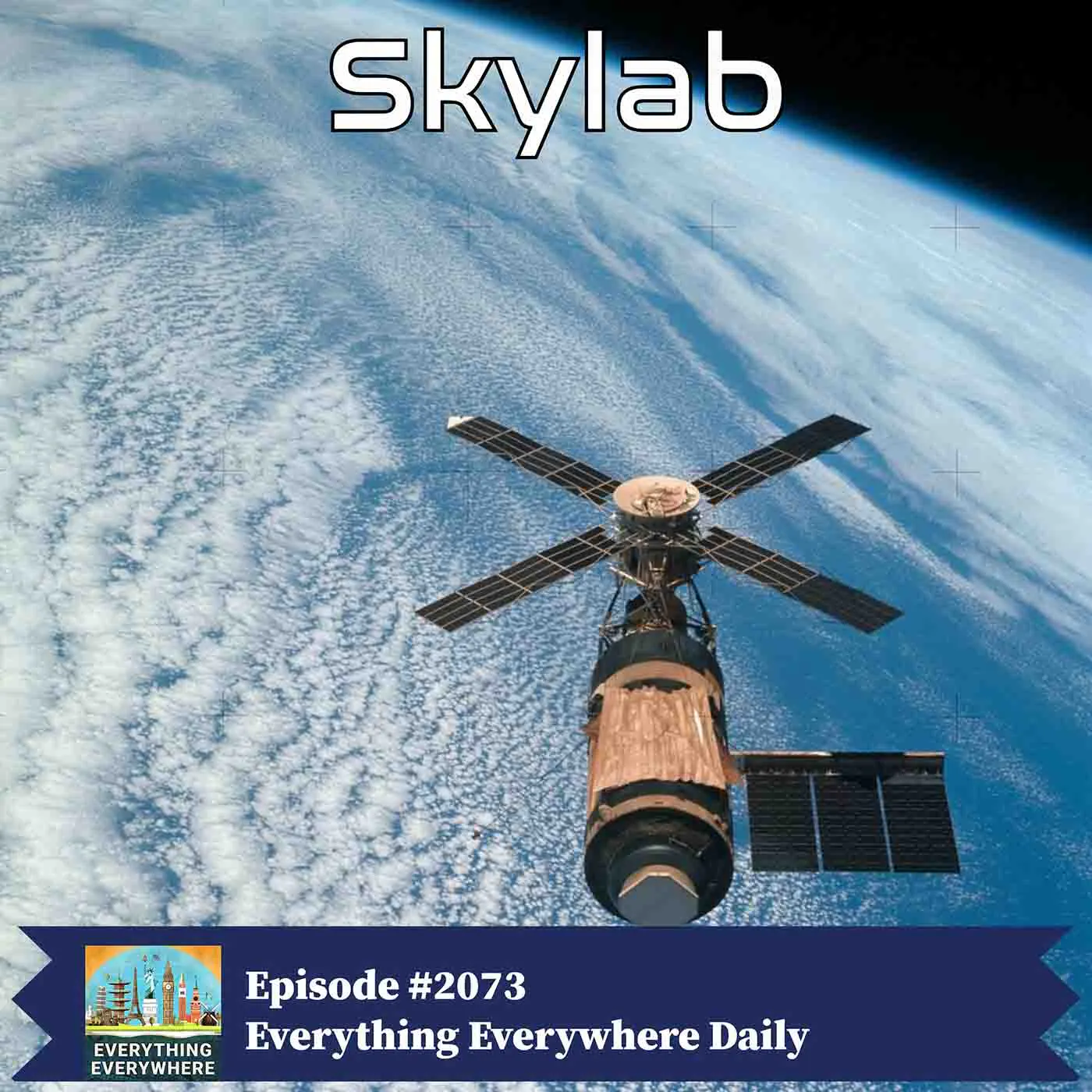
In the early 1970s, after the triumph of landing on the moon, NASA faced a what comes next? And the answer was Skylab, America's first space station. Built from leftover Apollo hardware and launched on the final Saturn V rocket, Skylab became humanity's first long term laboratory in space. Astronauts lived aboard for months, studying the sun, observing the Earth and learning how the human body adapts to weightlessness. Learn more about Skylab and its legacy on this episode of Everything Everywhere Daily. This episode is sponsored by Mint Mobile. Spring is finally around the corner, which means spring cleaning. And it's also a good time to get rid of your unnecessary subscriptions and expensive mobile contracts. Mint Mobile is here to rescue you with premium wireless plans starting at $15 a month. All plans include high speed data and unlimited talk and text on the nation's largest 5G network. Bring your own phone and number, activate with ESIM in minutes and start saving immediately. No long term contracts and no hassle. That's why I've been telling people to switch to Mint Mobile. If you like your money, Mint Mobile is for you. Shop plans@mintmobile.com eed that's mintmobile.com eed upfront payment of $45 for 3 month 5GB plan required equivalent to $15 a month new customer offer for first 3 months only, then full price plan options available, taxes and fees extra. See Mint Mobile for details. This episode is sponsored by Audible. It's Time to Believe in the Hail Mary. If you love big ideas, high stakes science and stories that keep you leaning forward, now is the perfect moment to experience Project Hail Mary, the beloved adventure by Andy Weir, now on the path to becoming a major motion picture in this gripping science based thriller, humanity's survival rests on one man. Ryland Grace wakes up alone, light years from Earth on a desperate last chance mission to save the planet from extinction. He has no memory, no backup and no margin for error. The audiobook is brought vividly to life by fan favorite narrator Ray Porter, whose performance delivers humor, heart and pulse pounding tension in every chapter. Part scientific mystery, part dazzling interstellar journey, Project Hail Mary is a story of discovery, speculation and survival that you won't forget. Listen to the audiobook now on Audible before the movie starring Ryan Gosling hits theaters on March 20th. Project Hail Mary Listen. Watch Save the World. Listen now@audible.com Hailmary. Skylab was the United States first space station and one of the most ambitious human spaceflight experiments of the early 1970s. The decision to create Skylab emerged in the mid-1960s as NASA began Considering what should follow. The Apollo Moon program. At the time, many engineers and planners inside NASA believed that space stations would be the next logical step in human spaceflight. One of the earliest advocates of space stations was Wernher von Braun, director of the Marshall Space Flight center in Huntsville, Alabama. Von Braun and his team had long envisioned large orbital stations assembled in space using Saturn rockets. However, by the mid-1960s, it was becoming clear that the political support and funding required for such large projects would likely disappear once the moon landing goal had been achieved. Within NASA, the idea began to shift towards using existing Apollo hardware to create something more affordable. This approach became known as the Apollo Applications Program, or aap. Instead of designing entirely new spacecraft, engineers proposed repurposing surplus Saturn rockets, Apollo command modules, and rocket stages for new missions. The concept included many possible ideas, including extended lunar missions, space telescopes, and orbital laboratories. The most practical of these was the idea of converting the upper stage of a Saturn rocket into a Space Station. By 1967 and 1968, NASA began refining these ideas into a concrete project. Several factors pushed the agency towards the space station concept. First, the Apollo program was nearing its peak, and NASA expected that several Saturn V rockets and Apollo spacecraft would remain unused after the moon landing goal was achieved. Second, Congress had begun cutting NASA's budget after 1966, making new large programs politically unrealistic. Reusing existing hardware became the only viable way to continue human spaceflight on a meaningful scale. In 1969, shortly after the Apollo 11 moon landing, NASA formally committed to building the space station, and the project was renamed Skylab. The decision was supported by NASA leadership, including Administrator Thomas Paine, and by members of Congress willing to fund a relatively inexpensive, expensive program that used existing Apollo infrastructure. The design was finalized so that the station would launch as a single large structure on a Saturn V rocket, with astronauts traveling to it using the Apollo command and service modules. Funding for Skylab was closely tied to the winding down of the Apollo program. Instead of developing an entirely new spacecraft system, NASA argued that converting existing rocket stages in spacecraft would provide a low cost way to continue human spaceflight research. Congress approved the program as part of NASA's post Apollo transition, seeing it as a bridge between the moon program and the proposed space shuttle. The resulting space station weighed nearly 170,000 pounds, making it the largest single object ever placed in orbit at that time. Skylab was launched by NASA on May 14, 1973, aboard the final functioning Saturn V rocket left over from the Apollo program. This mission was dubbed Skylab 1. The launch was dramatic and nearly disastrous Shortly after liftoff, the station's micrometeor shield, which also served as a thermal blanket, tore loose due to aerodynamic forces. The debris ripped off one of the solar panels and jammed another, leaving the station without adequate power and raising internal temperatures to dangerous levels. Engineers feared the station might be lost before any crew could even reach it. Ten days later, the first manned mission, Skylab 2, was launched. The three astronauts assigned to the mission were Commander Pete Conrad, science pilot Joseph Kirwin, and pilot Paul Weitz. When the crew arrived at Skylab, their first task was to inspect the damage. Weitz attempted to free the jammed solar panel during a spacewalk by pulling on it with a long pole from the Apollo command module, but the effort failed. The astronauts then docked with the station and entered an interior that had been baking in the sun for 10 days. Temperatures inside were extremely high, and many materials had degraded or had begun to smell funny from the heat. One of the crew's most urgent tasks was to cool the station. To accomplish this, they deployed a makeshift sunshade that had been rapidly designed by engineers on Earth. The device resembled a large parasol and was pushed through a small scientific airlock. Once opened, it shaded the station and allowed the temperatures inside to gradually drop to livable levels. A few days later, Conrad and Kirwan performed a second spacewalk in which they successfully freed the stuck solar panel. The panel suddenly snapped open with considerable force, restoring much of Skylab's electrical power. With both cooling and power largely restored, the station became fully operational. These repairs were among the earliest examples of complex in orbit maintenance and demonstrated that astronauts could fix major spacecraft problems while in space. After 28 days in space, the crew returned to Earth on June 22, 1973. Splashing down in the Pacific Ocean. The mission was widely considered a success, particularly given the severe problems that had threatened the station at launch. Skylab 2 not only saved the damaged space station, but but proved that astronauts could perform complex repairs and operate effectively during long duration missions. Skylab 3 was the second mission to visit Skylab. Lasting from July 28 to September 25, 1973. The crew consisted of Commander Alan Bean, science pilot Owen Garriott, and pilot Jack Lousima. Their mission lasted 59 days, more than doubling the duration of the first Skylab mission, and further demonstrated that astronauts could live and work productively in space for extended periods. By the time they arrived, the station had already been repaired by the previous crew, allowing Skylab 3 to focus primarily on scientific research. During their mission, the astronauts conducted a wide range of experiments in solar astronomy Earth observation and biomedical science. Using the Apollo telescope mount, they observed solar flares and other solar phenomena, collecting valuable data about the sun's activity. The crew also photographed the Earth's surface, studying geological formation, storms, and environmental changes. Medical experiments monitored how the human body adapted over nearly two months in microgravity, providing important information on muscle loss, bone density, and cardiovascular function. One of the highlights of the mission was Owen Garriott, who played a prank on Mission Control. He had a small tape recorder and had previously recorded messages from his wife to make it sound as if she were on the station with them. Owen Garriott also secretly brought a spider named Arabella as part of a student experiment to observe how spiders spin webs in microgravity. The spider successfully adapted to weightlessness and produced webs aboard Skylab, demonstrating that many instinctive behaviors could still function in space. The Skylab 4 mission was the third and final crewed expedition to the space station. Lasting from November 16, 1973 to February 8, 1974. The crew consisted of Commander Gerald Carr, science pilot Edward Gibson, and pilot William Pogue. Their mission lasted 84 days, which at the time was the longest human spaceflight ever conducted. Over the course of their mission, they carried out hundreds of experiments and observations. One of their primary responsibilities also involved operating the Apollo telescope mount. Using it, the astronauts observed solar flares, sunspots, and the complex structures of the sun's corona in ultraviolet and x ray wavelengths. These observations provided scientists with some of the most detailed information about solar activity ever collected at the time. Biomedical research remained an important aspect of the mission. Because Skylab 4 lasted nearly three months and was longer than any of the other missions, it provided the first opportunity for scientists to gather data on how the human body responds to weightlessness. For such an extended period, the astronauts participated in experiments that measured changes in muscle mass, bone density, heart function, and the body's fluid balance. They followed strict daily exercise routines, using equipment aboard the station to help maintain their health. The data gathered during Skylab 4 significantly advanced scientific understanding of how to keep astronauts healthy during long missions. The mission also included several spacewalks. During these extravehicular activities, the astronauts retrieve film from external solar observatories and perform maintenance tasks outside the station. Skylab 4 may be best remembered for the widely reported story of the so called Skylab mutiny. Mission Control had scheduled a very demanding workload for the crew, and the astronauts struggled to keep up with the constant stream of experiments and tasks. The crew once paused their activities to rest and adjust their schedule, briefly decreasing Contact with mission Control. The event, although later sensationalized as a space strike, demonstrated the significant psychological strain of extended space missions. Consequently, NASA was prompted to reevaluate its approach to planning astronaut workloads. Skylab 4 was the last crew to visit the space station, but that was not the original plan. When Skylab was designed in the late 1960s, NASA expected that the upcoming space shuttle, then scheduled to begin flying in the late 70s, would be able to reach the station. The plan was for the shuttle to periodically visit Skylab, deliver new crews, and use its engines to boost the station into a higher orbit to counteract atmospheric drag. However, delays in the shuttle program meant it would not be ready before Skylab's orbit began decaying. Skylab's final chapter became one of the most widely publicized events of the 1970s. As its orbit deteriorated, uncertainty about where it might land captured global attention. Engineers attempted to control its descent by firing onboard thrusters to guide debris towards the ocean. But the exact path couldn't be predicted. On July 11, 1979, Skylab Re entered the Earth's atmosphere and broke apart, scattering debris across the southeastern Indian Ocean and sparsely populated areas of Western Australia. Fortunately, no injuries were reported. The event became a cultural phenomenon, with worldwide news coverage of the Skylab watch and jokes about falling space debris. Skylab doesn't get much attention, but it was a brief, yet extremely important milestone in the history of spaceflight. The station's interior volume was enormous compared with earlier spacecraft, roughly comparable to a small house, giving astronauts far more room to move around than in Apollo capsules. Because it was built from a converted rocket stage, the workshop included features such as a ward room, sleeping quarters, exercise equipment, and even a shower, making it the most comfortable spacecraft humans had lived in up to that point. The program demonstrated that astronauts could remain healthy and productive during long missions, an essential step towards later stations. It pioneered techniques for repairing spacecraft in orbit, managing long duration crews, and designing space laboratories. Many procedures used on Skylab influenced later space stations, including the Soviet Mir and International Space Station. Skylab also helped refine the concept of space based solar observatories and earth observation platforms. In a broader sense, it served as a bridge between the era of the moon race and the space shuttle program that followed. American manned spaceflight in the 1970s began on a high note with the Apollo missions and then did absolutely nothing in the second half of the decade. Skylab was the transition between Apollo and the shuttle program that laid the foundation for the decades of spaceflight that followed. The executive producer of Everything Everywhere, Daily is Charles Daniel. The associate producers are Austin Otkin and Cameron Kiefer. My big thanks go to everyone who supports the show over on Patreon. Your support helps make this podcast possible, and I also want to remind everyone about the community groups on Facebook and Discord. That's where everything happens that's outside the podcast, and links to those are available in the show notes. As always, if you leave a review on any major podcast app or in the above community groups, you too can have it read on the show.