← Everything Everywhere Daily: History, Science, Geography & More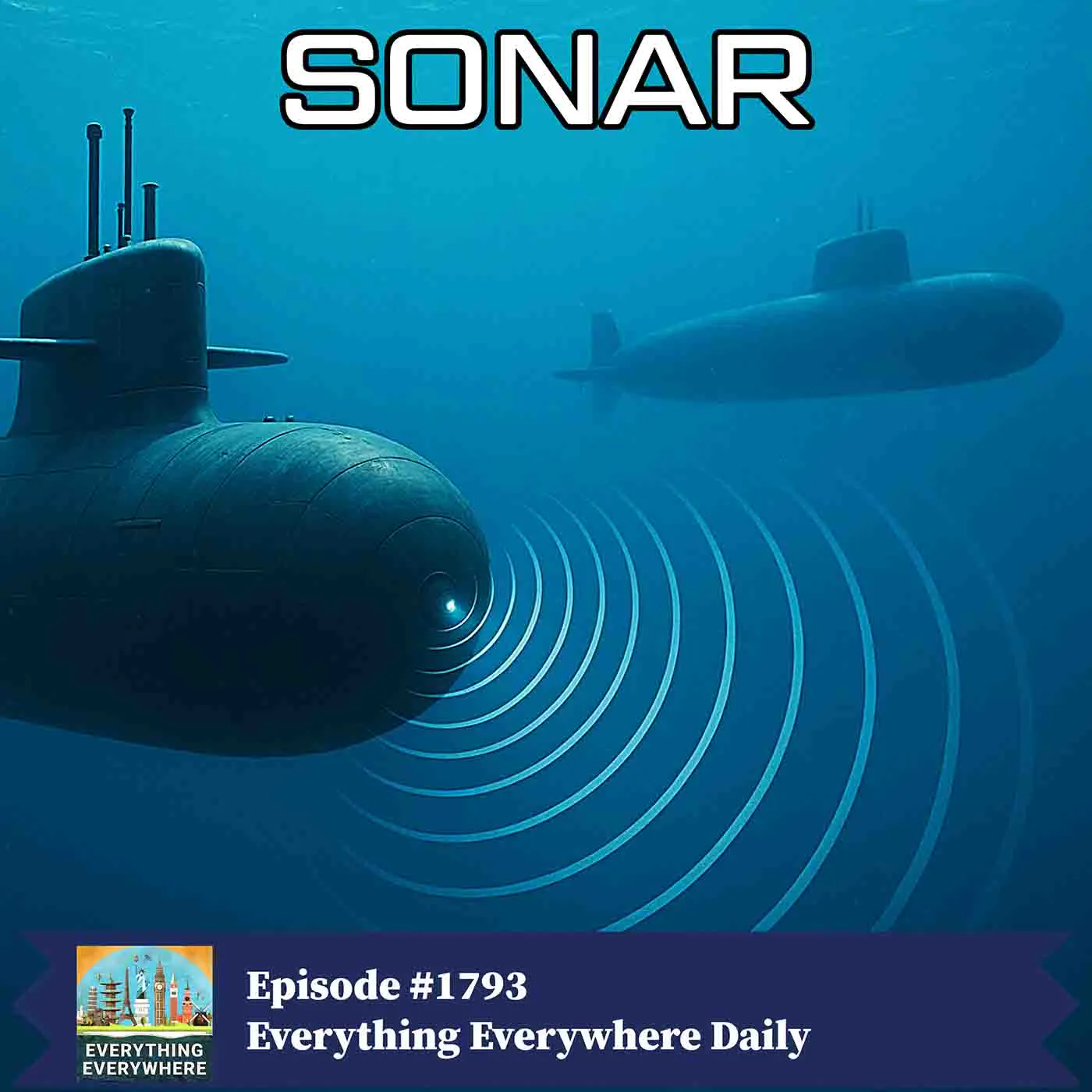
Everything Everywhere Daily: History, Science, Geography & More
SONAR
00:16:23
Learn about the technology that allows us to see through water
Loading summary
Transcript1 lines
- [00:01]
A
One of the most significant developments in the history of naval warfare was the submarine. The submarines offered a means of stealth and surprise that surface ships couldn't compete with. At first, navigating submarines was relatively simple. They just traveled below the surface and used a snorkel and a periscope to see their way. However, as submarines improved, they could dive deeper and they encountered a How could they see and navigate? The answer came from nature. Learn more about sonar, how it was developed, and how it works on this episode of Everything Everywhere Daily. This episode is sponsored by Quinn's it's summertime, and that means it's time to bring out the summer clothes. If you're looking to update your wardrobe this summer, I suggest you check out Quince. Quince has all the things you actually want to wear this summer, like organic cotton silk polos, European linen beach shorts, and comfortable pants that work for everything from hanging out in the backyard to nice dinners. And the best part? Everything with Quints is half the cost of similar brands. By working directly with top artisans and cutting out the middleman, Quint's gives you luxury pieces without the markups. I recently needed a new duvet and I went to Quince and picked up a great one that looked much better than what I had before, and all at a fraction of the price I'd pay elsewhere. Stick to the staples that last with elevated essentials from quince. Go to quince.com daily for free shipping on your order and 365 day returns. That's Q-U-N-E.com daily to get free shipping and 365 day returns. Quints.com daily. This episode is sponsored by Planet Money. Tariffs mean coins. Girl Scout cookies? What do they all have in common? Money. Economics is everywhere and everything, fueling our lives even when we least expect it. If you're a fan of Everything Everywhere Daily and are curious to learn something new and exciting about economics every week, I recommend you listen to the Planet Money podcast from npr. What I like about Planet Money is that I can get an update on the week's financial news in about 30 minutes. Stories like the adoption of stablecoins or the price of eggs from the job market to the stock market to prices at the supermarket. Planet Money is here to help explain it all. The Planet Money hosts go to great lengths to help explain the economy. They've done things like shot a satellite into space, started a record label, made a comic book, and shorted the entire stock market. All to help you better understand the world around you. Tune in to Planet Money every week for entertaining stories and insights about how money shapes our world, stories that can't be found anywhere else. Listen now to Planet Money from npr. Sonar, like radar, is actually an acronym. It stands for sound Navigation and ranging, essentially utilizes sound to navigate and detect objects underwater. While that's a brief summary of what sonar is, the operation is much more complex. It starts, of course, with sound. Humans recognize that sound had a finite speed for a very long time. The fact that sound wasn't instantaneous can be seen with an echo or via the difference in time between when you see a lightning bolt and hear the corresponding thunder. The speed of sound was first measured with reasonable accuracy in 1635 by Marin Marsen, a French scientist and mathematician. He estimated it to be about 1,380ft per second, which is remarkably close to the modern value. He measured the speed of sound by observing the time delay between seeing the flash and hearing the sound of gunshots or striking objects at a known distance. Despite the early measurement of the speed of sound, there was much that we still didn't know about it. In 1882, the French physicist Jean Daniel Colladan measured the speed of sound in Lake Geneva, demonstrating that sound could travel long distances through water and that sound, in fact, traveled faster through water than air. This experiment hinted at the potential for using sound waves for detection beneath the surface. In the early 20th century, research began on the nature of underwater acoustics. The tragic sinking of the RMS Titanic in 1912 sparked a significant interest in underwater detection technology, as the disaster underscored the urgent need for effective iceberg detection systems. Shortly after the disaster, British scientist Lewis Richardson filed a patent for an echo ranging device that could detect icebergs, though it remained largely theoretical. With the advent of the First World War, submarines took on a new importance. This new weapon required changes in naval tactics and strategy, and it also ushered in new technologies. During World War I, there was an urgent need to detect enemy submarines, which spurred rapid innovation. French physicist Paul Langevin, working with engineer Konstantin Cholowski, developed one of the first active sonar systems in 1915. This early sonar used a quartz transducer to emit sound pulses and detect echoes, a precursor to what we now call active sonar. It could detect an enemy submarine as far as 1500 meters, or 9/10 of a mile away. The British developed the ASDIC system. ASDIC stood for Anti Submarine Detection Investigation Committee. It became their primary submarine detection method, and this method used hydrophones for passive sound detection. The technology was crude by modern standards, but it represented a crucial step forward in underwater warfare capabilities. With the submarine CAT out of the bag, the interwar period became a period of rapid technological development. In the UK, they continued with their ASDIC system. ASDIC systems used a rotating transducer to send out pings in multiple directions and were increasingly installed on warships and submarines. The US Navy also worked on sonar, especially through the Naval Research Laboratory. And in partnership with companies like Western Electricity, they explored different frequencies, propagation models and methods of detecting and interpreting sonar returns. Despite the technical progress that was made, sonar in the interwar period was limited by weak signal processing technology, unreliable electronics, and a rudimentary understanding of sound propagation in different ocean conditions. Here I want a break from the story of sonar development for military use for a moment to mention a discovery made during the interwar period that had profound impact on sonar. For centuries, humans knew that bats could somehow fly in pitch darkness. However, they had no clue how they were able to do it. In 1793, the Italian scientist Lazzaro Spallanzani conducted experiments showing that bats could navigate when blinded, but not when their ears were plugged, suggesting that they used sound rather than sight. But it wasn't until 1938, just before the Second World War, that the true nature of echolocation was discovered by American physiologist and Donald Griffin. Working with physicist Robert Galambos. Using sound detection equipment, they demonstrated that bats emitted ultrasonic pulses and used their echoes to orient themselves. Griffin coined the term echolocation in 1944. Bats basically used a natural form of sonar. World War II was a watershed moment for the development of sonar. Both Axis and Allied powers invested heavily in submarine warfare and by extension, anti submarine technology. The Allies deployed ASDIC sets on most destroyers and escort ships. These systems were paired with depth charges and later hedgehog mortars to attack submerged submarines. Once detected, however, early sonar was limited in rough seas, and while the ship was moving quickly, it struggled with detecting submarines at depth or or while lying still. Germany, meanwhile, developed its own passive sonar systems known as GHG or Gruppenheuschkereit, which allowed U boats to detect enemy ships by their propeller noise. More ominously, the Germans developed acoustic torpedoes that could home in on the sound signatures of Allied ships. The Americans were working on their own system known as bearing Deviation indicator, or bdi. One of the researchers working on BDI was Frederick Hunt of Harvard University, and he suggested the word sonar to refer not just to bdi, but all underwater acoustical ranging systems. The term sonar was purposely coined to be an analog of radar, and the acronym was developed after the Fact in the Cold War, sonar became a crucial component of naval strategy, particularly in submarine detection and nuclear deterrence. The US Navy launched the Sound Surveillance System, or SOSUS, in the 1950s, a network of undersea hydrophone arrays laid on the ocean floor to passively detect Soviet submarines crossing the Atlantic. SOSUS played a vital role in tracking Soviet ballistic missile submarines throughout the Cold War. The Cold War also saw the development of improved electronics, transistors and later microprocessors. Improved acoustical signal processing as well as microphones. With the advent of nuclear submarines, which could stand or water almost indefinitely, and with submarines carrying intercontinental ballistic missiles, the need for improved sonar became even even more important. As with any military technology, any advancement always brings about some countermeasure. In the case of sonar, there are many antisonar countermeasures which have been adopted. Submarines began using anechoic tiles, which are rubber like materials applied to the hull to absorb sonar waves and reduce echoes. They were actually first deployed by Germany in World War II and later refined by the US and Soviet navies. Modern versions use layers that both absorb and scatter incoming sonar signals, making submarines harder to detect. Another counter sonar measure has been the development of quiet submarine engines. Modern submarines, especially nuclear powered ones like the US Navy's Virginia class or Russia's BOREI class, are extremely quiet, often said to be quieter than the ambient noise of the ocean, such as waves or marine life. Some are reported to be quieter than a whale's heartbeat or the sound of a commercial ship's propeller many miles away. This extreme stealth allows them to remain undetected, even by advanced sonar systems, making them among the most elusive military platforms in the entire world. Much of the noise level of a submarine is determined by its propeller, and this is why submarine propeller designs are often kept a secret. Submarines and ships can also deploy active antisonar measures, such as towed sonar decoys, which emit false acoustic signals to confuse active sonar or lure away torpedoes. Another active antisonar measure are bubble curtains. Bubble curtains work by releasing streams of air bubbles around a submarine or ship to disrupt and scatter incoming sonar waves, reducing the strength of the echoes and masking the vessel's acoustic signature. The bubbles create a layer of varying density that reflects and absorbs sound, making it harder for sonar to detect or locate the target accurately. After World War II, sonar technology wasn't only used for military purposes. A host of civilian uses also developed. Side scan sonar emerged during this period, providing detailed images of the seafloor and underwater objects. This technology proved invaluable for underwater archaeology, geographical surveys, and search and recovery missions. The famous discovery of the titanic wreck in 1985 by Robert Ballard utilized advanced side scan sonar technology. Multibeam sonar systems were also developed during this era, enabling comprehensive bathymetric mapping. These systems could survey large areas quickly and accurately, revolutionizing our understanding of ocean floor topography. Sonar became essential for underwater construction, cable laying, pipeline inspection, and environmental monitoring. Recreational markets also develop, with fish finders and depth sounders becoming standard issue on pleasure boats. Medical ultrasound technology derived from sonar principles revolutionized diagnostic medicine. The same acoustic imaging principles used to detect submarines now enables doctors to examine internal organs and monitor fetal development. Using sonar on a ship isn't a matter of just listening for sounds, AKA passive sonar, or making a sound and listening for an echo, AKA active sonar. It's highly dependent on local conditions. Sound travels through air at approximately 343 meters per second. In fresh water, it travels at approximately 1480 meters per second, and in salt water, it travels even faster at approximately 1500 meters per second. The reason why sound travels through saltwater faster than fresh water is that saltwater is denser it has water and salt as opposed to just water. Both salinity and temperature can change considerably in seawater depending on depth and location, both of which will affect sounds. Sound waves bend when they move through areas of differing temperature or salinity or pressure. So a sonar operator has to take all the all of these factors into consideration when monitoring. One question that some of you might be asking is why is sonar even necessary in the first place? Why can't you just use radar like they use above the water to detect objects? Radar works by emitting radio waves and detecting the reflections from objects. Water is a poor medium for electromagnetic wave propagation, especially at the frequencies used by radar. Water contains ions, especially seawater, which has salt. These ions interact with electromagnetic waves and convert the energy into heat, causing a rapid loss of signal strength. Water molecules are also polar, meaning that they have a positive and negative side, which means that they absorb and re radiate energy from electromagnetic fields, again converting wave energy into heat. Radar signals are thus absorbed within inches of water. In most cases, this makes radar useless for detecting submerged objects like submarines, fish, or the seafloor. Radar can detect objects on the surface of the water, such as ships and icebergs. But as soon as you try to detect below the surface, radar fails almost immediately due to the absorption issue. By the same token, you can't really use sonar above water. Bats and other animals are able to use it over very short distances, but over longer distances, sound waves simply wouldn't work. Sonar in the air would be limited by the speed of sound and by the fact that the atmosphere can absorb or scatter sound. Think of how difficult it is to yell at someone if they're far enough away, especially if it's a windy day. That's why ultrasound imaging, which is a type of sonar, is only used over very short distances and usually when you want to see inside something that is made of solid or liquid. From crude hydrophones to vast undersea surveillance networks, sonar has evolved into a cornerstone of maritime operations and ocean science. Its development has paralleled advances in material science, acoustics computing, and electronics, shaping everything from undersea warfare and global security to deep sea exploration and even fishing. The executive producer of Everything Everywhere Daily is Charles Daniel. The associate producers are Austin Oakton and Cameron Kiefer. I want to thank everyone who supports the show over on Patreon. Your support helps make this podcast possible. I'd also like to thank all the members of the Everything Everywhere community who are active on the Facebook group and the Discord server. If you'd like to join in the discussion, there are links to both in the show notes and as always, if you leave a review or send me a boostogram, you too can have it read on the show.